
Research notes / Laboratory documentation
Kovera Labs peptide reports: how to read and verify the evidence
A useful peptide certificate connects a named sample and batch to specific measurements. It does not turn a purity percentage into a guarantee about every vial. This guide explains the Kovera Labs documents published by Eternal Peptides Wholesale, using one BPC-157 report set to show how the checks work.
Start with the Kovera Labs report directory or the documents on the selected product page. Keep the laboratory report identifier, the batch number and the product SKU as separate fields: they identify a document, a lot and a catalogue item respectively.
Three checks before interpreting a result
- Identify the material. Compare the compound, nominal strength, blend composition where relevant, and printed batch identifier. Similar product names or different strengths are not interchangeable.
- Check the document. Open the certificate’s laboratory verification link and compare the returned record. Preserve the report date, sample identifier and version rather than relying on a cropped screenshot or a green tick.
- Establish the lot connection. Ask which displayed certificate relates to the material being offered or received. Each report is tied to the batch number printed on the certificate and on the product image.
A batch number shown on a product image is a reference. Match it with the written batch information in the product’s testing section, the certificate and the actual supplied stock. The product image shows the same batch reference as the certificate. The batch-verification checklist provides a receiving-record template.
Test overview: what each Kovera Labs document can show
| Document or result | Read these fields | Keep this limit in view |
|---|---|---|
| Purity and identity COA | Sample and batch; RP-HPLC purity; content in mg; the identity result and stated method | A percentage, a mass and an identity result are separate observations. Read only the methods actually stated on the selected COA. |
| Bacterial endotoxin | Exact result, EU unit, reporting limit, sample basis and acceptance criterion | Endotoxin is reported in EU/mL, the unit stated on the certificate. |
| Heavy metals | Each listed element, numerical result, unit, reporting limit and stated criterion | A result below a reporting limit is not zero. A four-element panel does not assess every contaminant. |
| Sterility testing | Organisms/findings, incubation period, temperature and report limitations | Read the findings with the stated test conditions and the identified sample and batch. |
Not every batch has every document. Some COAs contain qualitative screening rows; these do not supply all the methods, units and limits of a separate detailed certificate. An unavailable analysis should remain an unanswered question, rather than being inferred from another product’s report.
Why purity and content belong in different columns
Chromatographic purity describes the reported result under the analytical method. It should not be read as a complete inventory of everything in the vial. Peptide content concerns the amount of the analyte, and can differ from gross material mass. Bachem’s technical FAQ explains why water and counterions can make content and chromatographic purity different quantities. [5]
Identity is a third question. An LC-MS identity entry should be read with the sample description and the method’s scope; it is not a substitute for every structural or functional experiment a project might require.
Worked example: read the BPC-157 10mg report set without combining unlike results
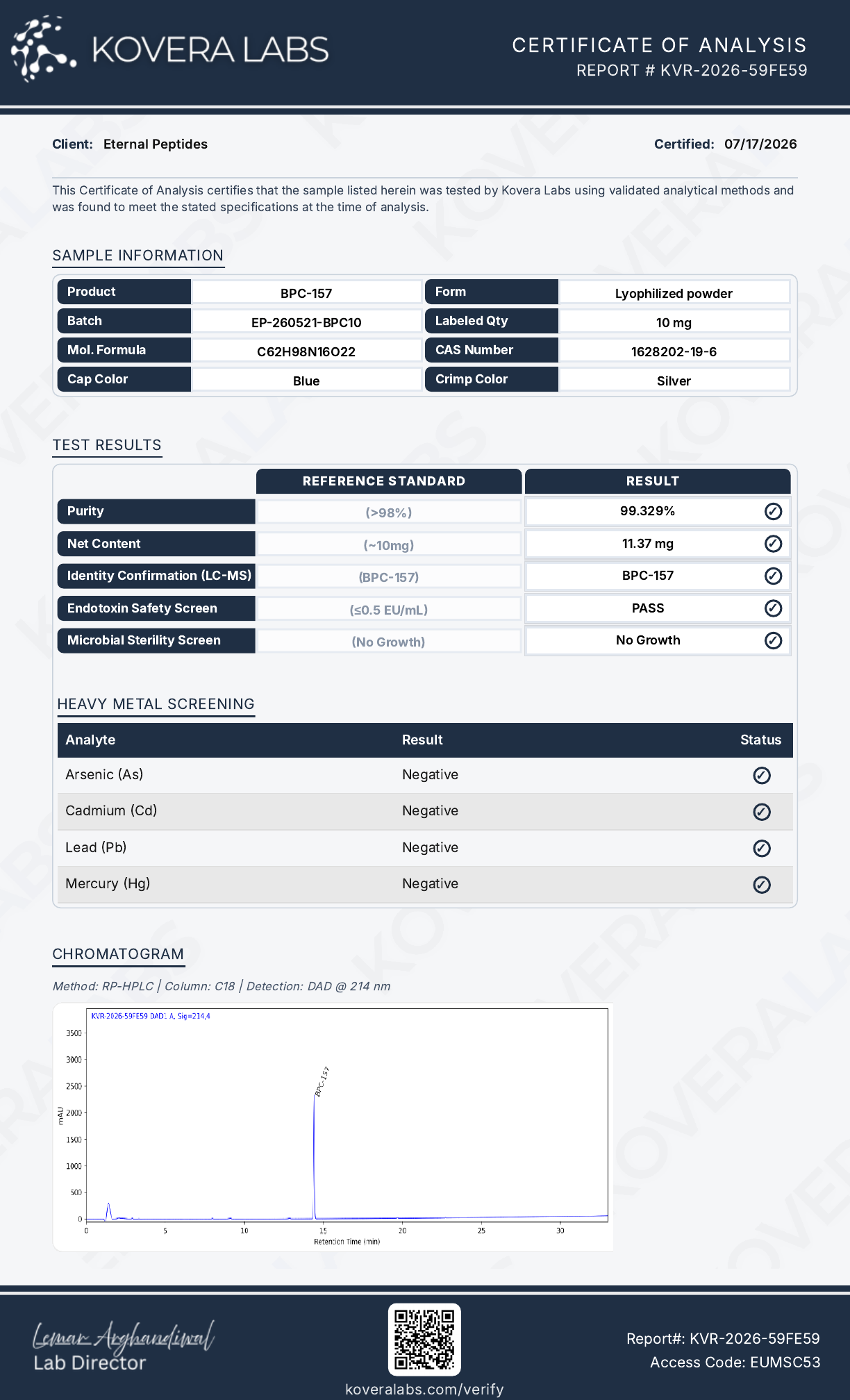
The supplied Kovera Labs COA KVR-2026-59FE59 identifies BPC-157, a nominal 10mg sample and batch EP-260521-BPC10. Its certification date is 17 July 2026. The companion endotoxin, metals and sterility testing documents are dated 10 July 2026. These are the dates on this report set, not a new test date or a guarantee about current inventory. [1–4]
| Printed result | What to record | What not to infer |
|---|---|---|
| Purity: 99.329% | Reported RP-HPLC purity for the identified sample | That the vial’s amount is 99.329% of its nominal label, or that all contaminants were excluded |
| Net content: 11.37mg | The measured content printed on this COA | That every vial or future batch contains 11.37mg |
| Identity: BPC-157, LC-MS | The identity statement and method shown | Biological effectiveness, medical suitability or a complete structural characterisation |
| Endotoxin: <0.03 EU/mL | Preserve “<”, the EU/mL basis and the printed ≤0.5 criterion | A zero result, an EU/vial value or a human-use safety threshold |
| Lead <0.5; arsenic <0.15; cadmium <0.05; mercury <0.3ppm | The four separate metal results; the report lists ICP-MS and internal acceptance criteria | That all metals are absent or that the criteria certify therapeutic suitability |
| Sterility testing: bacteria “No Growth”; fungi/yeast “Not Detected” | Two-day incubation at 30–35°C and the identified sample | Results for other containers or batches |
The endotoxin document uses different assay-type labels in its narrative and method table. If assay type is material to your project, request clarification from the issuing laboratory; do not silently choose one label or treat this guide as a method validation.
Companion records: verify the endotoxin certificate · verify the heavy-metal certificate · verify the sterility testing certificate. These links open the laboratory’s record for each certificate.
How to verify a Kovera Labs certificate
- Open the verification button beneath the individual certificate. Check that the destination uses koveralabs.com.
- Compare the sample/report identifier, product name, nominal strength and batch with the copy on our product page. A companion report may carry an ENDO-, HM- or RSTER- prefix; compare the underlying sample identifier as well as the test type.
- Compare the analysis/certification date, reported measurements, units and qualifiers exactly as printed.
- Save a dated record of the comparison. If the page does not load or the fields differ, retain the identifier and request clarification through the laboratory’s official site or EPW’s contact page.
- Confirm the connection to the lot being supplied. The verification record confirms the certificate’s report ID, product and batch.
Do not rewrite a sample identifier, substitute a certificate from another strength, or remove a qualification to make a report fit an order. Resolve the discrepancy first.
A concise record that another researcher can follow
Keep the product/SKU, nominal amount and pack quantity; offered and received batch identifiers; report IDs and dates; exact results with units; verification date and outcome; and unresolved questions with the supplier’s response. Record which acceptance requirement each analysis addresses. Keep your order details in your own secure purchasing file.
A report records the analyses, methods and results for the batch named on it. Eternal Peptides Wholesale supplies materials for laboratory research use only, not human consumption.
Continue with the testing standards and report directory, COA library and endotoxin reporting-unit guide.
Questions about Kovera Labs peptide reports
How do I verify a Kovera Labs peptide certificate?
Use the certificate’s Verify on Kovera Labs link, check the destination is koveralabs.com, and compare the laboratory record with the report identifier, product, strength, batch, dates and results. The record confirms the certificate’s report ID, product, batch and results.
What is the difference between purity and peptide content?
Chromatographic purity and measured peptide content are separate results. Each Kovera Labs certificate reports the purity percentage, the net content in milligrams and the LC-MS identity result.
What do the sterility testing reports show?
The reports record bacterial and fungal/yeast findings after two days at 30–35°C. Each certificate identifies the sample, report date and recorded results.
Which Kovera Labs reports does each product have?
Most batches have four reports: HPLC purity and LC-MS identity, endotoxin, heavy metals and sterility. Selank 5mg and PT-141 10mg have a purity and identity COA, and CBL-514 testing is pending. Each product page shows the reports for its batch.
Are products for human use?
No. Products are supplied for laboratory research use only, not for human consumption. A certificate records the analyses, methods and results for the batch named on it.
Sources and document basis
- Kovera Labs, BPC-157 10mg COA KVR-2026-59FE59, batch EP-260521-BPC10, certified 17 July 2026.
- Kovera Labs, ENDO-KVR-2026-59FE59, 10 July 2026. Numerical example and reporting units; assay-type wording requires clarification if relied on.
- Kovera Labs, HM-KVR-2026-59FE59, 10 July 2026. Listed analytes, reporting limits and internal criteria.
- Kovera Labs, RSTER-KVR-2026-59FE59, 10 July 2026. Sterility testing findings and test conditions.
- Bachem, FAQ: analysis of peptides, purity and net peptide content. General technical background on HPLC purity and peptide content.
Prepared from the supplied certificate set and technical source above, reviewed 1 November 2026. Certificate results are transcribed as examples, not replaced by this explanation.