
Posted on

Retatrutide: understanding triple-receptor research

This educational article discusses selected studies rather than providing a complete clinical review. It does not recommend personal use or provide treatment instructions.

The interesting question about retatrutide is not simply whether a study reports weight loss. It is what researchers can learn from a molecule designed to act on three hormone receptors—and how that knowledge translates into evidence about benefits and risks.

Retatrutide is an investigational agonist of the GIP, GLP-1 and glucagon receptors. An agonist activates a receptor; in this case, the research concerns three distinct signalling systems. That does not mean three times the benefit, or that the effects of three separate medicines can simply be added together. The combined action needs to be evaluated in its own studies. Jastreboff and colleagues, 2023 [1].

A useful starting point in the evidence

A randomised, placebo-controlled phase 2 trial published in 2023 enrolled 338 adults and evaluated weight change over 48 weeks. It reported substantial average weight reductions in retatrutide groups. Heart-rate increases were also observed, peaking during the study before declining. Serious adverse events occurred in both the retatrutide and placebo groups. These observations belong together: an efficacy result and its safety findings are parts of the same evidence, not competing stories. The original phase 2 trial [1].

This paper is a foundational example, not a claim that development stopped in 2023 or that it represents the entire current evidence base.

Why study design matters

Clinical trials specify who can participate, what outcomes will be measured and how participants will be monitored. Those details help explain what a result means. A trial average does not predict an individual’s outcome, and a result in one population does not automatically establish the same balance of benefits and risks in another.

The FDA describes phase 2 studies as a way to gather preliminary effectiveness and safety information, with larger phase 3 studies intended to provide more extensive evidence. More participants and longer observation can reveal issues that an earlier study was not equipped to detect. FDA guide to clinical research [2].

When reading a new retatrutide headline, ask: Was there a comparison group? How long did follow-up last? What happened to participants who stopped treatment? Were the results published in a paper or only announced? These questions are more informative than the largest percentage in a headline.

Research status in Australia

The TGA’s current safety information states that retatrutide has not been approved by the TGA or a comparable international regulator and should not be used outside a clinical trial setting. A study of an investigational medicine does not validate a separately supplied product bearing the same name. TGA retatrutide safety information [3].

The takeaway is to read retatrutide as an evolving research story: a specific molecule, tested under specific conditions, with outcomes and uncertainties that must be considered together.

A note on testing

Three questions should remain separate: What was in the sample? What happened in the experiment? What has been established about use in people?

Analytical tests address defined properties of a sample. For example, identity, strength and impurities are distinct categories in drug-quality testing. FDA testing overview [4]. A test report should therefore be read for its actual scope, not treated as an all-purpose quality or safety certificate.

Endotoxin testing is another separate question: it concerns bacterial components that can cause inflammatory reactions. It does not provide the same information as a test for living microorganisms. FDA endotoxin background [5].

No supplier reports were audited for these articles, and no claims are made about which tests a particular commercial product has passed. These articles explain research; they do not certify products or establish suitability for human use.

Later research context

The 2023 phase 2 paper remains an earlier part of the programme. In July 2026, Lilly reported additional phase 3 results for TRIUMPH-2 and TRIUMPH-3 while describing Retatrutide as investigational. This sponsor announcement should be distinguished from an independent analysis and regulatory approval. [6]

Related from Eternal Peptides Wholesale

Eternal Peptides Wholesale publishes batch-specific Kovera Labs reports in its certificate of analysis library, so the documentation for a listed batch can be read alongside the evidence discussed in this article.

References and bibliography

  1. Jastreboff AM, Kaplan LM, Frías JP, Wu Q, Du Y, Gurbuz S, Coskun T, Haupt A, Milicevic Z, Hartman ML, Retatrutide Phase 2 Obesity Trial Investigators. 2023. Triple-Hormone-Receptor Agonist Retatrutide for Obesity – A Phase 2 Trial. The New England journal of medicine. 389(6):514-526. doi:10.1056/nejmoa2301972.
  2. U.S. Food and Drug Administration. Step 3: Clinical Research. Accessed 27 September 2026.
  3. Therapeutic Goods Administration. 2026. TGA tests counterfeit retatrutide product following serious adverse event report. Accessed 27 September 2026.
  4. U.S. Food and Drug Administration. Drug Quality Sampling and Testing Programs. Accessed 27 September 2026.
  5. U.S. Food and Drug Administration. 1985. Bacterial Endotoxins/Pyrogens. Accessed 27 September 2026.
  6. Eli Lilly and Company. 2026. Retatrutide results from TRIUMPH-2 and TRIUMPH-3: sponsor announcement, 23 July 2026. Accessed 27 September 2026.

Testing references updated 1 November 2026 for the published Kovera Labs report set. Original research and catalogue snapshot dates remain as stated.

Posted on

How to Write a Peptide Procurement Proposal: A Practical Guide

How to Write a Peptide Procurement Proposal: A Practical Guide

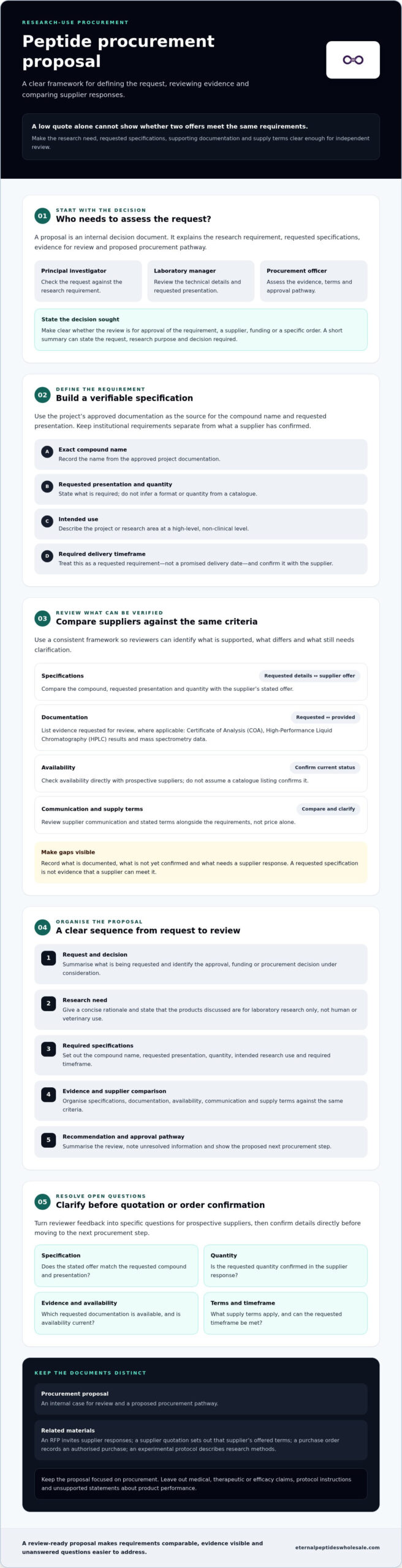
What if the lowest quote is the hardest to approve? A peptide procurement proposal can look complete yet leave reviewers unsure whether the specification, supporting evidence and supply terms are comparable. If you’re deciding how to write a peptide procurement proposal, the task is not simply to list a compound and quantity. It’s to make the research requirement, documentation and supplier commitments independently reviewable. A price alone can’t show whether two offers meet the same requirements.

That uncertainty is familiar to research teams balancing technical needs with internal procurement processes. A clear proposal gives decision-makers a consistent basis for assessment and helps identify what needs clarification before approval or ordering. This guide explains how to set out the research purpose, peptide specifications, quantity, required documentation and commercial terms, then compare supplier responses against the same criteria. It also covers practical next steps for seeking quotations and confirming details directly with prospective suppliers. For research-use procurement, keep intended laboratory use explicit and check that availability and relevant documentation are current. The result is a structured, evidence-led proposal that supports a fair review without overstating what a supplier can provide.

Key Takeaways

  • Learn how to write a peptide procurement proposal that sets out the research requirement, requested presentation, quantity and decision sought.
  • Identify the reviewers who may need to assess the proposal, then organise its information so each can evaluate the request.
  • Use a consistent comparison framework to assess supplier specifications, documentation, availability, communication and supply terms.
  • Structure the proposal from request through recommendation and approval, making gaps in evidence or information easier to spot.
  • Turn reviewer feedback into clear supplier questions before moving to a quotation or order confirmation.

What a peptide procurement proposal needs to help decision-makers assess

A peptide procurement proposal is an internal decision document. It explains the research requirement, the specifications being requested, the evidence reviewers need to assess and the proposed procurement pathway. Its purpose is to help an organisation determine whether a supply request is sufficiently defined and supported to move forward, not to serve as a supplier’s offer or an experimental guide.

Keep the document distinct from related procurement materials. A Request for Proposal (RFP) is generally used to invite supplier responses; a supplier quotation sets out that supplier’s offered terms. A purchase order records an authorised purchase, while an experimental protocol describes research methods. The proposal can inform these steps, but shouldn’t be used as a substitute for them.

Who reads the proposal and what must they decide?

Potential reviewers include the principal investigator, laboratory manager and procurement officer. Researchers need enough technical detail to check that the requested material aligns with the approved research requirement. Non-specialist reviewers need the rationale, evidence and approval pathway in clear language.

Be explicit about the decision sought. Is the review for approval of the requirement, a supplier, funding or a specific order? A short executive summary can state the request, its research purpose and the decision required, helping reviewers understand what action is expected before they examine supporting details.

What belongs in scope, and what does not?

Describe the application at a suitable, non-clinical level, then keep the rationale focused on procurement. State that the products discussed are for laboratory research only, not for human or veterinary use. This boundary should be clear in the proposal and in any supplier evaluation.

For a practical starting point, identify the information reviewers need to assess:

  • Research need: A concise explanation of why the material is being requested.
  • Decision required: The approval, funding or procurement step under consideration.
  • Evidence and pathway: The supporting supplier information and the proposed next step.

Leave out medical, therapeutic or efficacy claims, along with protocol instructions and unsupported statements about product performance. Those details don’t establish whether a supplier’s offer meets an organisation’s procurement requirements. Keeping the boundaries clear is central to how to write a peptide procurement proposal that researchers and procurement staff can review consistently, without confusing the request with claims or instructions outside its purpose.

Build the proposal around research needs and verifiable peptide specifications

Once the research requirement is approved, translate it into a concise specification that suppliers and internal reviewers can interpret consistently. Use the project’s approved documentation as the source for the compound name and requested presentation. Don’t infer a format, quantity or delivery date from a supplier’s catalogue or assume a supplier can meet a requested timeframe. Record these as requirements to be confirmed.

How to describe compound requirements precisely

For each requested item, record the exact compound name, requested presentation, quantity, intended laboratory research use and required delivery timeframe. Keep the research-use description high-level and non-clinical. For example, state the relevant project or research area without adding experimental steps or claims about expected outcomes.

Separate what the institution requires from what a supplier confirms it can provide. A timeframe in the proposal is a requested requirement, not a promised delivery date. Check product information and terms directly with prospective suppliers, and confirm applicable institutional procurement requirements before proceeding.

How to assess quality and documentation evidence

List the evidence requested for review, where applicable. This may include a Certificate of Analysis (COA), High-Performance Liquid Chromatography (HPLC) results and mass spectrometry data. These methods provide different analytical information: HPLC data can inform a purity assessment, while mass spectrometry can support identity assessment. Don’t treat one as a substitute for the other.

Record each item’s status so reviewers can distinguish evidence from supplier statements:

  • Received: Identify the document and the compound or batch it relates to.
  • Pending: Note what has been requested and when it will be reviewed.
  • Unverified: Flag claims that lack supporting documentation or confirmation.

Check that identifiers, such as the compound name and batch reference where supplied, align across the records. If information is missing or inconsistent, log the question rather than filling the gap with an assumption. This makes the evidence trail clearer and shows what remains unresolved before approval.

The US Research and Development (R&D) contracting framework offers context on structuring research procurement, but it isn’t Australian procurement guidance. Apply your organisation’s own review process and verify relevant Australian requirements. For a practical sourcing discussion, you can also review the research peptide wholesale range, intended for laboratory research only and subject to direct confirmation of current availability and documentation.

Compare peptide suppliers with a consistent procurement evaluation framework

A side-by-side comparison helps reviewers assess supplier responses against the same approved requirement, rather than relying on different claims or formats. Use one matrix for every supplier and ask the same questions. Include the response, its supporting evidence and any conditions or unanswered points beside each criterion. Missing information isn’t a pass; it’s an item to clarify before a decision.

Which criteria make supplier comparisons useful?

Focus on whether each supplier can address the requested specification and wholesale quantity, and whether the information is supported by relevant documentation. Evaluate the written response, not assumptions about a supplier’s capability or quality.

  • Specification fit: Does the supplier confirm the requested compound name and presentation?
  • Documentation: Are records available, identifiable and relevant to the material under consideration?
  • Availability: Has the supplier confirmed current availability and the requested quantity?
  • Communication: Are responses clear, complete and consistent with the questions asked?
  • Supply terms: What do the written terms state about fulfilment, shipping and how issues are handled?

Record the source and date of each response where practical. If a supplier hasn’t confirmed a point, mark it as pending rather than treating silence as agreement. This gives reviewers a clear view of what is known and what still needs verification.

How to present the comparison fairly

Distinguish evidence from claims. For example, label a point “document received”, “supplier statement” or “awaiting confirmation”, then note any condition attached to it. If a record doesn’t clearly relate to the requested material or batch, flag that gap for follow-up rather than assuming it applies.

Use the organisation’s approved evaluation method. If it assigns weight to criteria, describe how that weighting is applied so reviewers can understand the recommendation. If no formal scoring method is in place, don’t invent scores or present a subjective ranking as objective. A concise written explanation of trade-offs and unresolved questions can be more useful than an unexplained total.

For instance, one supplier might confirm the requested quantity but leave shipping terms unclear, while another provides terms but hasn’t supplied a relevant document. Record both conditions in the matrix. The comparison then supports a reasoned decision without implying that either supplier has passed a criterion that remains unverified.

This evidence-led approach is a practical part of how to write a peptide procurement proposal: it helps reviewers compare like with like and direct follow-up where it’s needed. Wholesale supply may be considered where it suits the organisation’s requirements, subject to institutional review and direct confirmation of documentation, availability and terms. Ensure any products under consideration are for laboratory research only, not human or veterinary use.

How to Write a Peptide Procurement Proposal: A Practical Guide

Write and review the peptide procurement proposal in a clear sequence

A consistent order makes the proposal easier to draft and review. Begin with the request, define its scope, set out the specifications, attach supplier evidence, compare responses, then present a recommendation and identify the approval required. This sequence helps reviewers trace the decision from the research need to the proposed procurement step.

What sections should the proposal contain?

Organise the document so readers can find the rationale and supporting information without searching through dense narrative. A practical structure is:

  • Purpose and executive summary: State why procurement is being considered and the specific decision sought.
  • Scope and requirements: Record the research-use context, requested specifications and any exclusions.
  • Supplier assessment: Present the comparison criteria, evidence and unresolved points.
  • Risks and assumptions: Identify dependencies, conditions and information that has not been verified.
  • Recommendation and approval: Explain the proposed next step and who needs to approve it.

Place supporting records in labelled appendices, then refer to them consistently in the proposal. Add a document register with each item’s source, date received, status and reviewer. This gives the team a practical way to locate evidence and see whether it has been checked. State assumptions and exclusions plainly rather than leaving them buried in paragraphs.

How to make the recommendation review-ready

Connect the recommendation to the criteria and evidence already presented. Avoid promotional language or unsupported claims. If the choice depends on a supplier confirming a document, availability or term, name that dependency and make clear that the point remains open.

Before circulation, summarise outstanding questions, approval dependencies and follow-up responsibilities. Assign each action to a role or named reviewer where appropriate, so requests don’t disappear between review and the next procurement step. A recommendation can be clear without suggesting every detail has been settled.

Use this final check before sending the proposal:

  • Does the executive summary identify the decision sought and reason for procurement?
  • Do specifications, supplier evidence and comparison criteria use consistent terminology?
  • Are evidence sources, dates, review status and open questions recorded?
  • Is research-only wording clear, with no human-use or veterinary-use implication?
  • Are assumptions, exclusions and required approvals explicit?

These steps make how to write a peptide procurement proposal a repeatable review process, not just a document-writing exercise. For an eligible laboratory procurement, you can review wholesale research peptide supply and confirm current availability, documentation and terms directly. Products are for research purposes only, not for human consumption or medical use.

Submit the proposal, resolve supplier questions and prepare the next procurement step

Once circulated, the proposal should produce a clear review outcome. Give reviewers a simple way to record approval, rejection or a request for additional evidence, with space for comments and any conditions. If the request isn’t approved, note the reason and whether the requirement needs revision or further review. If approval is conditional, record what must be resolved and who will follow it up.

Approval of an internal proposal doesn’t confirm that a supplier can fulfil the request. Treat it as authority to proceed to the next step in your organisation’s process, subject to any conditions. Keep the approved specification and decision record together so the enquiry that follows reflects what reviewers actually authorised.

What to confirm with a supplier before proceeding

Convert outstanding points into written questions. Ask the supplier to confirm current availability, the requested presentation and any applicable wholesale order requirements. Seek clarification on the documentation available for review, fulfilment arrangements, shipping and payment terms. Keep responses with the procurement record, and note any conditions or details that remain unconfirmed.

Don’t treat a proposal, catalogue entry or supplier statement as a guarantee of availability or acceptance. If the supplier’s response differs from the approved requirement, pause and return to the relevant internal reviewer before changing the scope. This keeps the procurement record aligned with the decision and prevents an informal adjustment from being mistaken for approval.

How to move from an approved proposal to an enquiry

Prepare the approved compound name, requested presentation, quantity and evidence requirements before contacting a supplier. Include the relevant timeframe as a request for confirmation, not as an assumed delivery commitment. Ask for a written response that addresses each point, and retain it for review before requesting an order confirmation.

Keep intended use explicit throughout the handover: products discussed are for laboratory research only, not for human consumption, medical use or veterinary use. This boundary should remain clear in the proposal, supplier correspondence and internal records.

Eternal Peptides Wholesale is an Australian-based wholesale supplier of research-grade peptides for laboratory use. Wholesale supply may be considered where it fits the organisation’s requirements and is subject to institutional review. Confirm current product availability, relevant documentation and supply terms directly before proceeding.

Review wholesale research peptide supply options

A disciplined handover completes the process of how to write a peptide procurement proposal: the approved need becomes a precise enquiry, open questions stay visible, and the next decision can be based on written information rather than assumptions.

Put your procurement decision on a clear footing

A strong proposal gives reviewers a consistent basis for deciding what is needed, what supplier evidence supports the request and what remains to be confirmed. Keep specifications tied to the approved research requirement, compare supplier responses using the same criteria, and document approval conditions and follow-up questions. These steps make how to write a peptide procurement proposal a practical process that supports clear decisions rather than assumptions.

For eligible laboratory procurement, Eternal Peptides Wholesale is an Australian-based national wholesale supplier of research-grade peptides for laboratory use. Assess any potential supply against your organisation’s requirements, and confirm current availability, documentation and terms directly. Products are for research purposes only, not for human consumption or medical use.

Review wholesale research peptide supply options as you prepare your next procurement step. With a well-documented request and a clear approval pathway, your team can move forward with confidence.

Frequently Asked Questions

What should a peptide procurement proposal include?

A peptide procurement proposal should set out the research need, requested compound and presentation, quantity, intended laboratory use, supplier evidence and approval sought. Include a consistent comparison of supplier responses, relevant supply terms, assumptions and unresolved questions. A concise executive summary helps reviewers see the decision required. Keep the proposal separate from a supplier quotation, purchase order and experimental protocol, as each serves a different purpose in the procurement process.

How do you compare peptide suppliers for laboratory research?

Compare suppliers against the same criteria and ask each the same questions. Assess whether they can confirm the requested specification and wholesale quantity, what relevant documentation they provide, and what they state about availability, fulfilment, shipping and issue resolution. Record whether each point is supported by evidence, based on a supplier statement or still awaiting confirmation. Treat missing information as a gap to clarify, not as evidence that a requirement has been met.

What documentation should a research peptide supplier provide?

Ask what documentation is available for the specific material or batch under consideration. Where applicable, review a Certificate of Analysis (COA), High-Performance Liquid Chromatography (HPLC) results and mass spectrometry data. HPLC data can inform a purity assessment, while mass spectrometry can support identity assessment; they aren’t interchangeable. Check that the compound and batch identifiers align across records, and mark documents as received, pending or unverified in the proposal.

Can a procurement proposal include more than one peptide supplier?

Yes. Including multiple suppliers can help reviewers compare responses against one approved requirement, provided each is assessed using the same criteria and evidence standards. Set out each supplier’s specification fit, documentation, availability and written terms in a side-by-side matrix. Note differences, missing information and conditions clearly. Follow your organisation’s procurement process, and avoid implying that a supplier has been selected or approved until the relevant decision-makers have recorded their decision.

How do you write a supplier recommendation for a research purchase?

Base the recommendation on the stated requirements and the evidence recorded in the proposal. Explain why the proposed option appears to fit, identify any gaps or conditions, and list follow-up questions and approval dependencies. Avoid unsupported quality claims or promotional language. A useful recommendation distinguishes confirmed information from supplier statements and matters awaiting verification, so reviewers can see both the rationale and what must be resolved before the next procurement step.

What is the difference between a procurement proposal and a purchase order?

A procurement proposal supports an internal decision by explaining the research requirement, assessing supplier information and stating the approval sought. A purchase order is a separate procurement document used to record an authorised purchase under an organisation’s process. The proposal may inform whether to proceed and with whom, but it doesn’t replace the supplier’s quotation, internal approval steps or purchase order. Confirm the required sequence with your institution’s procurement team.

Can research-grade peptides be proposed for human or veterinary use?

No. Research-grade peptides discussed in this procurement context are for laboratory research only, not for human consumption, medical use or veterinary use. State that limitation clearly in the proposal and related supplier correspondence. Keep the rationale focused on the laboratory research requirement, and don’t include therapeutic, clinical or efficacy claims. If your organisation has questions about applicable Australian requirements, check them with the appropriate institutional or regulatory contact rather than making assumptions.

Add an evidence appendix to a peptide procurement proposal

Give each acceptance criterion its own evidence field. A request for identity data, for example, should name the method or document that will answer it; a price quotation answers a commercial question. Keep unresolved items visible instead of allowing a favourable overall score to conceal a missing essential specification.

A useful appendix records the exact material, source, lot, analytical method, document version and reviewer decision. NIH resource-authentication guidance and OECD data-integrity guidance offer useful technical principles for traceability; neither document automatically imposes a purchasing rule on an Australian laboratory. [1][2]

For the next step, review the Australian research peptide buying guide and the batch-verification checklist. Contact Eternal Peptides Wholesale with the exact product and any unanswered documentation questions.

Related from Eternal Peptides Wholesale

Eternal Peptides Wholesale publishes batch-specific Kovera Labs reports in its certificate of analysis library, so the documentation for a listed batch can be read alongside the evidence discussed in this article.

References and bibliography

  1. National Institutes of Health. 2017. Reminder: Authentication of Key Biological and/or Chemical Resources (NOT-OD-17-068). Accessed 27 September 2026.
  2. Organisation for Economic Co-operation and Development. 2021. GLP Data Integrity. Accessed 27 September 2026.

Testing references updated 1 November 2026 for the published Kovera Labs report set. Original research and catalogue snapshot dates remain as stated.

Posted on

How to Vet a Research Peptide Company: An Australian Lab Checklist

How to Vet a Research Peptide Company: An Australian Lab Checklist

A supplier’s most persuasive claim may tell you less than a document linked to the batch on offer. Knowing how to vet a research peptide company means looking beyond product descriptions to assess whether its evidence is verifiable and its operations suit your laboratory’s procurement requirements.

It’s reasonable to expect documentation that matches the product and batch under consideration, along with clear answers about wholesale terms, ordering and communication. A research-use designation or confident quality claim isn’t independent evidence on its own. Check and record each detail before you commit.

This guide sets out a repeatable due diligence process: what to request, how to review batch-specific analytical documents, and which business and operational details to clarify. For example, Eternal Peptides Wholesale identifies itself as an Australian-based, wholesale-only supplier, with products designated for research purposes. Those statements describe its business scope, but they don’t independently establish the quality of a specific batch. Use the checklist to distinguish stated facts from evidence, assess supplier fit and document a decision against your laboratory’s requirements.

Key Takeaways

  • Use a five-stage process to assess company identity, evidence, product fit, operations and your procurement decision.
  • When learning how to vet a research peptide company, check whether documents identify the specific product and batch being offered.
  • Compare suppliers using verifiable criteria. Record unavailable evidence as unconfirmed rather than assuming it meets your requirements.
  • Check that supplier and order records align with your laboratory’s purchasing and receiving procedures. Request written details where needed.
  • Separate stated business scope from independently verified quality evidence when assessing whether a wholesale supplier fits your laboratory.

How to vet a research peptide company before your laboratory buys

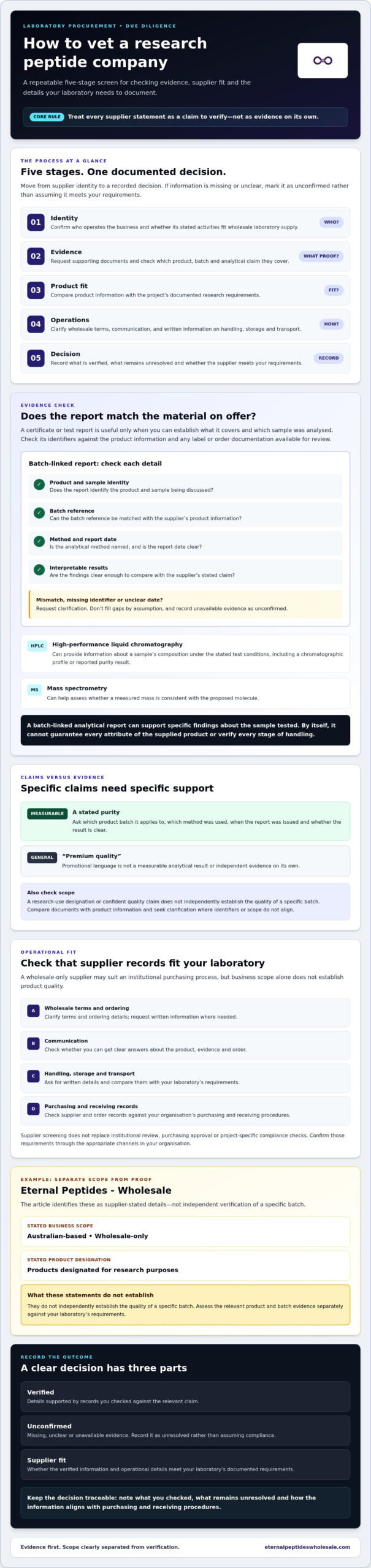
A defensible supplier decision relies on records you can check against your laboratory’s requirements, not confidence created by polished marketing. To understand how to vet a research peptide company, treat each statement as a claim to verify. Check it against documents, references where relevant, and your organisation’s purchasing and receiving criteria.

Use a consistent five-stage screen:

  • Identity: Confirm who operates the business and whether its stated activities fit wholesale laboratory supply.
  • Evidence: Request supporting documents and check which product, batch and analytical claim they cover.
  • Product fit: Compare the product information with the project’s documented research requirements.
  • Operations: Clarify wholesale terms, communication, and written information about handling, storage and transport.
  • Decision: Record what is verified, what remains unresolved and whether the supplier meets your requirements.

What should supplier vetting establish?

Start by confirming the supplier’s identity and stated business scope. A wholesale-only supplier may suit an institutional purchasing process, but that alone doesn’t establish product quality. Ask what evidence supports the specific product and any claims about quality or handling. Check that documents relate to the product under consideration, rather than relying on a generic example. Log missing or unclear information as unconfirmed and assign follow-up. Don’t treat silence as evidence of compliance.

Questions about product manufacture are another reason to be precise, not to make assumptions. A basic explanation of chemical peptide synthesis can provide context for why manufacturing or analytical statements need clear supporting records. The explanation itself doesn’t verify a supplier’s process or establish the quality of a particular batch.

Which claims deserve closer scrutiny?

Separate measurable statements from broad promotional language. A stated purity is a specific analytical claim; “premium quality” is not. For each measurable claim, ask which product batch it applies to, which method was used, when the report was issued and whether the result is clear. Compare those details with the product information and the supplier’s explanation. If identifiers or scope don’t align, seek clarification before relying on the claim.

Keep the review within laboratory procurement. Language that implies human use, treatment or performance outcomes isn’t evidence of suitability for a research project and falls outside this research-use guide. Supplier screening also doesn’t replace institutional review, purchasing approval or project-specific compliance checks. Confirm those requirements through the appropriate channels at your organisation before proceeding.

Check company identity and research peptide quality evidence

A certificate or test report is useful only if you can establish what it covers and which sample was analysed. A polished document without a clear product identifier, batch reference or testing scope may be impossible to connect to the material being offered. When working out how to vet a research peptide company, ask not just whether a report exists, but whether its details can be checked against the supplier’s claims.

A batch-linked analytical report can support specific findings about the sample tested. It cannot, by itself, guarantee every attribute of the supplied product or verify every stage of its handling. Treat the report as one piece of evidence and assess its scope against your laboratory’s requirements.

How to assess HPLC and mass spectrometry reports

Check that the report identifies the sample and relevant batch, names the analytical method, and provides a date and interpretable results. Compare its product name and batch reference with the supplier’s product information and any label or order documentation available for review. Differences, missing identifiers or unclear dates are reasons to request clarification, not details to fill in by assumption.

Methods answer different questions. High-performance liquid chromatography (HPLC) can provide information about a sample’s composition under the stated test conditions, including a chromatographic profile or reported purity result. Mass spectrometry (MS) can help assess whether a measured mass is consistent with the proposed molecular identity. Neither result proves every quality attribute. A chromatogram or mass spectrum is not, on its own, a complete quality guarantee or evidence about handling and storage.

Ask what the report’s conclusions actually support. If a supplier makes a claim about identity, purity or another attribute, request the relevant result and method rather than treating one test as evidence for everything.

How to confirm business and document consistency

Compare the company name on the report with the supplier’s stated business identity. If a separate laboratory performed the analysis, ask which laboratory it was and whether the supplier can clarify the relationship between that laboratory, the report and the sample. A third-party name alone doesn’t establish that the document relates to the batch under consideration.

Record the answers and any gaps. For more context on evaluating quality systems in procurement, consult this research peptide quality assurance guide. Eternal Peptides Wholesale identifies itself as an Australian-based, wholesale-only supplier of research-use products. Those stated business details are separate from batch-specific analytical evidence, which buyers should confirm for the product being considered.

Reviewing a supplier’s stated scope can help you assess wholesale fit alongside technical evidence. You can review Eternal Peptides Wholesale’s supplier information as part of that assessment, while requesting any product-specific documentation your procurement process requires.

Compare suppliers using evidence, transparency and procurement fit

A structured comparison makes supplier differences easier to assess and reduces the influence of persuasive but unsupported claims. To understand how to vet a research peptide company, compare like with like: the same product, comparable batch context and the same documentation requests. Laboratories apply these same verification principles to batch testing and purity documentation when evaluating any supplier, including overseas suppliers. Keep technical evidence separate from business reliability. A report may support a specific analytical claim, while communication, terms and wholesale fit determine whether the supplier suits your procurement process.

Use a comparison table and score only criteria you can verify. Mark missing or unclear information as unconfirmed, not as a low-risk assumption.

Criterion What to check Record
Evidence Does the documentation identify the product and explain its relationship to the sample or batch? Verified, unconfirmed or follow-up required
Communication Are answers accurate, complete and consistent with the documents? Examples and unresolved questions
Product fit Does the available product information align with the laboratory’s documented project requirements? Fit confirmed or not established
Terms Are wholesale conditions and purchasing details clear in writing? Terms reviewed or clarification needed
Open questions What information is still missing or needs institutional review? Owner and next step

What to ask before accepting a supplier’s claims

Request the documentation relevant to the product under consideration, then ask how it relates to the sample or batch being offered. Check whether product identifiers connect across the quotation, packaging information and supporting records. If names, references or descriptions differ, ask the supplier to explain the discrepancy in writing.

Record the quality of the response, not just whether a reply arrived. Does it address the question directly? Are limitations acknowledged? Can the supplier clarify what a document does and doesn’t establish? Score only observable answers and records. Don’t award points for claims you can’t independently assess.

How to compare wholesale suitability

Technical quality evidence and procurement suitability are separate assessments. Confirm whether the supplier’s wholesale model, written terms, product information and support channels align with your laboratory’s order and approval process. When assessing direct-supply arrangements, compare the terms and documentation each supplier provides. A supplier may be a potential operational fit while specific quality evidence remains unconfirmed, or the reverse. Keep both findings visible in your comparison rather than blending them into one overall impression.

For broader sourcing considerations, consult this Australian wholesale research peptide procurement guide. You can also review Eternal Peptides Wholesale’s stated supplier scope as one input to a comparison, while assessing product-specific evidence and procurement fit separately.

How to Vet a Research Peptide Company: An Australian Lab Checklist

Verify Australian operating, documentation and institutional requirements

An Australian operating presence can be relevant to procurement, but it doesn’t establish that a product is lawful for a particular purpose, that an import is permitted or that the product is suitable for your research. Check the supplier, product and proposed activity against the requirements that apply to your organisation. Keep those checks separate from technical quality assessment.

What Australian buyers should confirm

Requirements can depend on the compound, intended research activity and institutional setting. Don’t rely on a supplier’s location or a research-use-only statement as a substitute for checking. Consult current information from the relevant Australian regulator, such as the Therapeutic Goods Administration where applicable, and seek advice from your institution’s compliance staff or a qualified adviser if the position is unclear. Don’t apply a general statement to a specific compound or project without confirmation.

Before progressing an order, check the proposed purchase against your institution’s procedures. Confirm who can approve it, which records must be retained and what receiving checks are required. Make sure the order and product identifiers can be reconciled with the paperwork your team needs to file. These internal controls help turn supplier information into a reviewable procurement record.

How to assess fulfilment and communication

Ask the supplier for written details on handling, storage and transport, and confirm that the instructions are clear enough for your receiving process. Verify supplier-specific statements rather than assuming standard practices apply. You can also ask what order, dispatch and delivery information will be provided, and how the supplier would respond if a document or identifier didn’t match the order.

  • Can the supplier explain which records accompany the order?
  • Are product identifiers consistent across the order information and supporting documents?
  • Who should your procurement team contact about a discrepancy, and how will the issue be documented?

Record unanswered questions as unresolved. If instructions are vague, request clarification before approval rather than filling gaps with assumptions. This is a practical part of how to vet a research peptide company: assess what can be verified, then refer remaining questions to the relevant institutional or regulatory contact.

Eternal Peptides Wholesale describes itself as an Australian-based, wholesale-only supplier of research-use products. Those details can inform an initial business-fit review, but they don’t establish regulatory status, product suitability or specific handling and delivery arrangements. Confirm those points independently before relying on them.

For a supplier-scope review alongside your institutional checks, review Eternal Peptides Wholesale’s stated business information and verify any product or operational details your procurement process requires.

Make a documented supplier decision and assess Eternal Peptides Wholesale

Turn your checks into a decision record before seeking procurement approval. This gives reviewers a clear account of what the supplier has demonstrated, what remains uncertain and why the supplier is or isn’t suitable for the laboratory’s requirements. It also makes reassessment easier if product information, terms or institutional requirements change.

A practical supplier approval checklist

Record each finding under one of four statuses: verified, unverified, unsuitable or follow-up required. Check the supplier’s stated business scope, product identity, available product-specific documentation and written wholesale terms. Resolve discrepancies between claims, records and your laboratory’s specifications before approval.

  • Verified: A claim supported by records you’ve reviewed.
  • Unverified: Information that is missing or hasn’t been independently checked.
  • Unsuitable: A requirement the supplier or product doesn’t meet.
  • Follow-up required: A question awaiting clarification or institutional review.

Include who completed the review, which documents were considered, outstanding questions and the date or trigger for reassessment. Don’t treat an unanswered request as confirmation. If a key requirement remains unresolved, state that clearly in the record and follow your organisation’s approval process.

When to contact a wholesale supplier

Prepare a concise enquiry before contacting a supplier. Identify the product under consideration, the order volume your laboratory requires, and the documentation or written operational details needed for review. Ask whether product-specific evidence is available and how its identifiers relate to the product offered. Keep the discussion within research procurement. Supplier enquiries aren’t a substitute for medical advice or guidance on human use.

Assess Eternal Peptides Wholesale against confirmed scope only: it identifies itself as Australian-based and wholesale-only, and its products are designated for research purposes. Those facts may help establish whether its stated business model aligns with your purchasing needs. They don’t confirm that a particular product meets your specifications or that batch-specific reports, certifications, handling processes or other supporting records are available. Request and review the relevant information directly rather than assuming it exists.

A careful approach to how to vet a research peptide company ends with a measured decision, not automatic approval. Confirm business fit, documentation and outstanding requirements with the supplier, then complete your institution’s review before procurement approval. To check the stated wholesale range and raise product-specific questions, review Eternal Peptides Wholesale’s wholesale research range.

Make your next supplier decision evidence-led

A repeatable vetting process turns supplier claims into a decision your laboratory can explain and review. Match documents to the product and batch, assess wholesale and operational fit separately from technical evidence, and record what is verified, unresolved or unsuitable. Knowing how to vet a research peptide company also means checking project and institutional requirements rather than assuming a supplier’s stated location or scope settles them.

Eternal Peptides Wholesale describes itself as an Australian-based, wholesale-only supplier, with products designated for research purposes. Its listed wholesale offerings include Retatrutide 10mg. These are stated business details, not a substitute for requesting product-specific documentation or completing your laboratory’s own review.

For a practical next step, review Eternal Peptides Wholesale’s wholesale research range and confirm the product information and documentation relevant to your procurement requirements directly. A careful, recorded assessment gives your team a clearer basis for deciding whether to proceed.

Frequently Asked Questions

How do I vet a research peptide company?

Use a documented process to check the supplier’s identity, product-specific evidence, wholesale fit and operational information against your laboratory’s requirements. Compare product and batch identifiers across available records, clarify what analytical reports establish, and record gaps as unverified. Confirm institutional approvals and any applicable Australian requirements separately. A supplier’s location or research-use-only designation isn’t, by itself, proof of product quality, compliance or suitability for a particular project.

What documents should a research peptide supplier provide?

Ask what product-specific records are available for the item under consideration. Depending on your procurement requirements, these may include an analytical report with clear product and sample identifiers, order or quotation details, and written information about handling, storage and transport. Check whether the documents relate to the product or batch being offered, and ask who prepared any test report. Don’t assume a particular document, certification or quality system is available without confirmation.

Can I rely on a certificate of analysis for research peptides?

A certificate of analysis can support specific findings about the sample it identifies, but it shouldn’t be treated as a complete quality guarantee. Check the named product, sample or batch reference, date, analytical methods and reported results. Consider whether the report addresses the attribute being claimed, such as identity or purity. It won’t necessarily establish other product attributes, handling history or suitability for your laboratory’s research requirements.

How can I check whether a peptide test report matches the product batch?

Compare the report’s product name and batch or sample reference with the supplier’s product information and the records associated with the proposed order. Check that dates, identifiers and descriptions are consistent, and ask the supplier to explain any difference in writing. If the report doesn’t identify a relevant batch or sample, its connection to the product being offered remains unconfirmed. Record that gap and seek clarification before relying on the result.

Are research peptides from an Australian supplier automatically compliant for my laboratory?

No. An Australian-based supplier’s location doesn’t establish that a product or proposed research activity meets applicable requirements. The relevant considerations can depend on the compound, project and institution. Check current information with the appropriate Australian regulator or a qualified compliance adviser, and confirm your organisation’s purchasing, approval and receiving procedures. Treat supplier statements as information to verify, not as a substitute for institutional review or project-specific checks.

What should I do if a peptide supplier cannot answer technical questions?

Pause the assessment and record which questions remain unanswered. Request clarification on the specific product, report scope, sample or batch identifiers, and any stated analytical results. If the response remains incomplete or doesn’t match the available records, mark the point as unverified and follow your laboratory’s escalation or approval process. Don’t interpret a confident sales response, or the absence of an answer, as technical evidence.

Can research peptides be purchased for personal use?

This supplier’s products are designated for research purposes only, not for human consumption or medical use. A research-use label doesn’t establish that a product is appropriate or authorised for personal use. Rules may depend on the substance and circumstances, so don’t rely on supplier marketing to determine personal-use status. Check current Australian guidance with the relevant regulator and consult a qualified health professional for personal health questions. The supplier doesn’t provide medical consultations.

Trusted Australian peptide suppliers: separate three kinds of evidence

Company identity, analytical findings and suitability for your experiment require different evidence. Contact information helps establish who is making the offer. A laboratory report describes a tested sample. Your acceptance criteria determine whether those findings are sufficient for the intended work. None of these checks can stand in for the other two. [1][2]

Request the laboratory report identifier and confirm the exact product and lot relationship. Kovera Labs certificates link to the issuing laboratory’s verification site. Checking a report record does not establish that an untested consignment is identical to its submitted sample. [3]

For the next step, review the Australian research peptide buying guide and the batch-verification checklist. Contact Eternal Peptides Wholesale with the exact product and any unanswered documentation questions.

Related from Eternal Peptides Wholesale

Eternal Peptides Wholesale publishes batch-specific Kovera Labs reports in its certificate of analysis library, so the documentation for a listed batch can be read alongside the evidence discussed in this article.

Related reading: How to Write a Peptide Procurement Proposal: A Practical Guide; TGA Research Peptide Guidelines: 2026 Compliance Guide

References and bibliography

  1. Eternal Peptides Wholesale. Contact and Australian store locations. Accessed 27 September 2026.
  2. McCarthy D, Han Y, Carrick K, Schmidt D, Workman W, Matejtschuk P, Duru C, Atouf F. 2023. Reference Standards to Support Quality of Synthetic Peptide Therapeutics. Pharmaceutical research. 40(6):1317-1328. doi:10.1007/s11095-023-03493-1.
  3. Kovera Labs. Certificate verification links and sample/batch checks. Reports reviewed 1 November 2026; open the individual certificate and its laboratory verification link.

Testing references updated 1 November 2026 for the published Kovera Labs report set. Original research and catalogue snapshot dates remain as stated.
Posted on

Peptide Endotoxin Testing: How to Read EU/vial and EU/mg

A peptide endotoxin report needs more than a quick look at its headline number. The unit, sample identity, reporting limit and test conditions determine what that number means. Two small-looking results can describe different things, and a less-than result is not the same as zero.

This guide explains how to read and record endotoxin results for laboratory research materials. It is about understanding analytical documentation, not selecting a human-use dose or deciding that a product is safe to inject.

What does an endotoxin test measure?

Kovera Labs. Bacterial endotoxin certificates: sample, result, reporting units and limits. Reports reviewed 1 November 2026; open the individual certificate and its laboratory verification link.

An endotoxin result is separate from purity, peptide content and sterility testing. Kovera Labs sterility testing reports record bacterial and fungal/yeast findings after two days at 30–35°C. View the certificate for the tested sample and batch. [2]

EU/vial, EU/mg and EU/mL describe different bases

Unit What the result is expressed against What to check
EU/vial One vial, on the basis defined by the report Confirm the result represents the vial rather than an uncorrected prepared sample
EU/mg A stated mass of material Confirm what mass was used and whether it was nominal or measured
EU/mL A volume of solution Establish which solution, preparation and dilution the figure refers to

EU means endotoxin units. The denominator matters: a number per vial cannot be compared directly with a number per milligram or millilitre.

For results requiring a calculation, keep the supporting preparation and dilution information with the original value. Charles River’s technical guidance explains that dilution, product concentration and assay sensitivity are relevant to endotoxin calculations and validation. Endotoxin calculations and validation FAQ [3].

A worked example of converting the reporting basis

The following numbers are illustrative. They are not EPW test results, acceptance limits or safety thresholds.

Suppose a report gives 2 EU/vial, and the corresponding, documented mass basis for that same vial is 50mg:

2 EU/vial ÷ 50mg/vial = 0.04 EU/mg

If a different report gives 2 EU/vial on a corresponding 100mg mass basis:

2 EU/vial ÷ 100mg/vial = 0.02 EU/mg

The second number is lower per milligram, but both examples still state 2 EU per vial. The difference follows from the denominator; it is not evidence that the second vial has a lower total endotoxin result.

Before applying this arithmetic to a real document, confirm that the mass and endotoxin result refer to the same sample or a documented compatible basis. Do not combine the mass from one batch with the endotoxin result from another. Where the basis is unclear, ask the laboratory rather than presenting a calculated figure as its reported result.

The same caution applies to a purity percentage: it is not itself the mass denominator. Specialist peptide analysis distinguishes purity, gross weight and net peptide content. Bachem analytical guidance [4].

What does “less than” mean?

If a report states less than 1 EU/vial, retain that full expression. Do not rewrite it as “0 EU/vial” or “endotoxin-free.”

The reporting statement gives a bound under the conditions of that analysis. If the document uses “not detected,” check the laboratory’s stated detection or reporting capability. Detection limits and quantitation limits are not automatically the same; use the terminology provided by the laboratory.

Assay sensitivity and the dilution required for a particular sample can affect the level that can be reported. Charles River provides multiple sensitivity ranges and explains their relationship to interference and dilution requirements. Endotoxin testing sensitivity [5].

For an illustrative, justified conversion of <1 EU/vial on a 50mg basis, the result would remain <0.02 EU/mg. The qualifier stays attached to the calculation. It does not become an exact measurement of 0.02 EU/mg.

Why sample preparation and method information matter

A result expressed per millilitre may refer to a prepared or diluted solution. Multiplying it by a vial volume without knowing what the report already accounts for can produce an incorrect total.

Check whether the laboratory has already applied dilution and preparation factors. Request clarification where necessary; do not “correct” a final result twice. A valid interpretation depends on the documented method and the sample, not on choosing the most favourable number.

The FDA’s current endotoxin testing guidance addresses testing and acceptance criteria in regulated product contexts. It is a technical reference, not a certification of a research product or a universal limit for everything described as a peptide. FDA guidance on pyrogen and endotoxin testing [6].

Compare reports in this order

Before comparing results from two suppliers, strengths or batches, record:

  1. The product and sample description.
  2. The batch or lot identifier.
  3. The laboratory, report reference and analysis date.
  4. The assay or method identified.
  5. The complete result, including its qualifier and unit.
  6. The stated reporting capability and relevant preparation information.
  7. The basis of any conversion used in your comparison.

If an essential field is missing, the comparison is incomplete. Our COA library lists the published endotoxin results by batch where that test was run, with the units printed on each report. A lower displayed number alone does not establish that one product is cleaner, better tested or more suitable for your experiment.

Keep the source result and your calculation separate

For a laboratory record, use one field for the exact reported value and another for any derived value. Record the formula and inputs beside the calculation. This makes the work checkable and prevents your calculation being mistaken for a second result issued by the laboratory.

When saving a report, retain its sample and batch details along with the results section. Cropping an image down to a number removes the context needed to establish applicability.

For EPW’s published documents and report-field explanations, visit our peptide testing hub [7]. If a unit, batch relationship or report is unclear, ask our team for clarification [8] before relying on it.

An analytical result should be assessed against the requirements and procedures of the relevant laboratory. It does not establish approval or suitability for human use.

Related from Eternal Peptides Wholesale

Eternal Peptides Wholesale publishes batch-specific Kovera Labs reports in its certificate of analysis library, so the documentation for a listed batch can be read alongside the evidence discussed in this article.

References and bibliography

  1. Kovera Labs. Bacterial endotoxin certificates: sample, result, reporting units and limits. Reports reviewed 1 November 2026; open the individual certificate and its laboratory verification link.
  2. Kovera Labs. Sterility testing certificates: results and test conditions. Reports reviewed 1 November 2026; open the individual certificate and its laboratory verification link.
  3. Charles River Laboratories. Endotoxin Calculations and Validations: Frequently Asked Questions. Accessed 27 September 2026.
  4. Bachem. 2021. FAQ: Analysis and handling of peptides. Accessed 27 September 2026.
  5. Charles River Laboratories. Endotoxin Testing Sensitivity. Accessed 27 September 2026.
  6. U.S. Food and Drug Administration. 2026. Pyrogen and Endotoxins Testing: Questions and Answers. Accessed 27 September 2026.
  7. Eternal Peptides Wholesale. Peptide testing standards and report directory. Accessed 27 September 2026.
  8. Eternal Peptides Wholesale. Contact and Australian store locations. Accessed 27 September 2026.

Testing references updated 1 November 2026 for the published Kovera Labs report set. Original research and catalogue snapshot dates remain as stated.

Posted on

Peptide Batch Verification: A Receiving Checklist for Research Orders

A peptide certificate of analysis is most useful when it can be connected to the material your laboratory receives. The task is not simply to find a high purity number. It is to establish which sample was tested, which batch it represents and whether the document answers the question you are asking.

This practical checklist connects the product listing, order, package identifiers and laboratory report. Use it before ordering and again when the shipment arrives, alongside your laboratory’s own receiving procedures.

Start with the product, not the headline result

Record the compound name, product code, labelled amount per vial and pack quantity from the selected listing. For blends, record the stated components and individual amounts where specified, rather than relying on the total alone.

Keep the product code and batch number in separate fields. The product code identifies a catalogue item; a batch identifier distinguishes a particular lot of material. A catalogue item may be supplied from different batches over time.

This distinction matters when reordering. A report retained from a previous purchase is not automatically the relevant document for a new delivery, even when the product code has not changed.

What should match across the records?

Field Compare Why it matters
Compound or blend identity Listing, order and report sample description Similar names can refer to different materials
Labelled amount Selected variant, package and report sample description A report for another format needs clarification
Product code Order and supplied item Helps identify the exact catalogue selection
Batch or lot Supplied identifiers and laboratory report Connects the document to a particular batch
Laboratory document reference Source report and verification record Helps locate the correct analysis
Test requested Required analysis and report scope A purity report is not an endotoxin result
Result and unit Original document and your receiving record Prevents a percentage, mass or limit being copied incorrectly
Analysis date and document version Report and saved copy Makes the evidence traceable over time

Treat unexplained differences as questions to resolve, not fields to silently “correct.” If the laboratory and supplier use different sample identifiers, request a documented link between them.

Verify the laboratory record independently

Use the “Verify on Kovera Labs” link for the individual certificate, then compare the laboratory record with the displayed report: sample or report identifier, product, strength, batch, dates, tests and results. Each certificate links to its Kovera Labs verification record, so the report ID and batch can be matched to the supplied stock. Document authentication and matching the report to the material offered are separate checks. See our report-reading guide. [1] [2]

A QR code is a convenient route, not evidence by itself. Check the destination before entering information. When a verification record is available, compare the sample, batch, analysis and result with the document you were given.

Successful verification establishes a connection to a laboratory record. It does not, on its own, establish that the material delivered to you came from that sample or batch. That is why package and supplier traceability still matter.

If verification is unavailable, retain the document reference and request clarification from the issuing laboratory through its official contact route. Do not substitute a similar-looking public report.

Read each test as a separate piece of evidence

Our published Kovera Labs documents include a purity and identity COA for each tested listing, and most listings also carry endotoxin, heavy-metal and sterility reports. Each product page lists the reports for its batch, with the batch number and report ID. [1]

For your record, copy the result together with its unit and qualifier. For example, preserve a less-than sign rather than replacing the result with zero. Keep a reported pass attached to the stated test rather than expanding it into a broader certification. For purity and HPLC results, our peptide purity guide explains what the figures can and cannot show.

Do not use one batch’s report to fill an empty field for another batch. If the available report does not cover the material being supplied, the useful next step is to obtain the applicable evidence—not to assume equivalence.

A simple example of a mismatch

Consider an illustrative order for a 50mg research product, identified on receipt as Batch A. The supplied documentation describes a 100mg sample from Batch B.

The compound name may match, but both the amount and batch differ. This does not automatically establish that the shipment is defective. It does establish that the document, without further explanation, does not demonstrate the claimed relationship to the received item.

Record the discrepancy and ask for clarification. Do not alter the PDF, image or your receiving record to make the identifiers agree. This example is fictional and is not a laboratory result or a description of a particular Eternal Peptides Wholesale batch.

Keep a concise receiving record

The following blank record can be copied into an internal purchasing or quality system. It is a practical prompt, not a substitute for an approved laboratory procedure.

  • Order reference and receipt date:
  • Product name, code and labelled amount:
  • Box quantity and vial count received:
  • Batch or lot identifiers shown on the supplied packaging:
  • Supplier document or specification reference:
  • Laboratory report reference and analysis date:
  • Verification checked on:
  • Tests recorded, with exact results and units:
  • Packaging condition or discrepancies noted:
  • Applicable handling documentation received:
  • Clarification requested and response reference:
  • Reviewed by and internal disposition:

Keep identifiable order details in your own secure records. A public product review or shared screenshot should not expose addresses, contact details or private tracking information.

Check the shipment without relying on appearance alone

Compare the received quantity and identifiers with the order. Record visible packaging damage and retain relevant labels and documents. Follow the supplier’s documented conditions and your laboratory’s procedure for receiving, storage and any hold pending clarification.

Photographs can document packaging and label information. They cannot establish chemical identity, purity or suitability from appearance alone. If handling information is missing, request it rather than adopting an unsupported generic storage rule.

Ask a specific question when something does not match

A useful enquiry is short and factual:

Please confirm which laboratory reports apply to the supplied product and batch. The order identifies [product and amount], the package shows [batch], and the report identifies [sample and batch]. Please provide the applicable document or explain the traceability relationship.

Send sensitive order information privately. Include only the documents needed to resolve the question and retain the original files without modification.

When evaluating wholesale research peptide supply in Australia, make this document check part of the purchasing decision, not an afterthought. For questions about an Eternal Peptides Wholesale listing or supplied batch, contact our team [3] with the specific identifiers.

Laboratory reports describe the tested sample and reported analysis. They are not clinical approval, instructions for human use or proof that every vial was individually tested.

Related from Eternal Peptides Wholesale

Eternal Peptides Wholesale publishes batch-specific Kovera Labs reports in its certificate of analysis library, so the documentation for a listed batch can be read alongside the evidence discussed in this article.

Related reading: How to Write a Peptide Procurement Proposal: A Practical Guide

References and bibliography

  1. Kovera Labs. Published Kovera Labs reports and testing scope. Reports reviewed 1 November 2026; open the individual certificate and its laboratory verification link.
  2. Eternal Peptides Wholesale. Peptide testing standards and report directory. Accessed 27 September 2026.
  3. Eternal Peptides Wholesale. Contact and Australian store locations. Accessed 27 September 2026.

Testing references updated 1 November 2026 for the published Kovera Labs report set. Original research and catalogue snapshot dates remain as stated.

Posted on

Peptide Purity Guide for Australian Laboratories

Peptide Purity Guide for Australian Laboratories

Shipping and evidence maintenance — 29 September 2026: Shipping, stock-location and transport-service claims in this article have been corrected against the current Shipping Policy. These edits are not a new clinical or regulatory review.

Purity-threshold correction — 25 October 2026: Purity-threshold statements were corrected against EMA/CHMP/CVMP/QWP/367182/2025, European Pharmacopoeia general monograph 2034 and TGA impurity guidance.


In high-stakes laboratory environments, the difference between a breakthrough and a compromised dataset often rests on a fraction of a percentage point. For Australian researchers, inconsistent batch quality and the challenge of interpreting complex HPLC/MS reports aren’t just administrative hurdles; they’re direct threats to the integrity of scientific outcomes. It’s frustrating to invest months into a study only to find that trace impurities have skewed your results. This guide provides a definitive framework for peptide purity verification for research, ensuring you can navigate the technical nuances of Certificates of Analysis (COAs) with greater confidence.

You’ll learn to master the analytical techniques and reporting standards required to verify peptide integrity, moving beyond supplier claims to objective data. We will examine the critical role of High-Performance Liquid Chromatography and Mass Spectrometry, explain how impurity thresholds are described in pharmacopoeial and regulatory guidance (for example, the 0.1%, 0.5% and 1.0% reporting, identification and qualification thresholds the European Pharmacopoeia sets for synthetic peptides used in medicines), and outline a documented procurement process. The aim is to help you read batch documentation critically. No purity figure on its own guarantees reproducible results, and the standards discussed here are reference points written for medicines, not a specification for research materials. [11][12] [Evidence note 1]

Key Takeaways

  • Understand what an HPLC purity percentage does and does not measure, and why the acceptance criterion should be a method-specific specification set for your application, not a single “industry standard” figure. [Evidence note 1]
  • Master the technical distinctions between HPLC and Mass Spectrometry to establish a definitive framework for peptide purity verification for research.
  • Learn to critically evaluate Certificates of Analysis by cross-referencing batch numbers and verifying analytical conditions against physical inventory.
  • Implement a standardised procurement SOP that utilises objective analytical data to establish clear acceptance or rejection criteria for incoming compounds.
  • Optimise your laboratory’s supply chain by sourcing from Australian-based wholesale specialists who provide batch-specific documentation and maintain rigorous logistical integrity.

The Critical Role of Purity in Modern Peptide Research

In analytical reports, peptide “purity” usually means chromatographic purity. It is the proportion of the UV-absorbing material detected by HPLC that corresponds to the target peptide, expressed as a percentage of total peak area. It is not the same as the mass of peptide in the vial. Water, counter-ions (such as acetate or trifluoroacetate) and other non-UV-absorbing material are addressed by a separate measurement, net peptide content. No Australian or international standard sets a single minimum purity percentage for research materials. The appropriate specification depends on the peptide, the analytical method and the intended experiment, and should be agreed before purchase. [2] Using unverified compounds in long-term trials doesn’t just waste financial resources; it risks the scientific credibility of the institution. [Evidence note 1]

Distinguishing between grades is vital. Industrial-grade products are often “crude” and contain a high volume of synthesis byproducts. Research-grade compounds undergo rigorous purification to ensure that the biological activity observed in the lab is solely attributable to the target sequence. Without strict peptide purity verification for research, scientists cannot differentiate between the effects of the peptide and the interference of contaminants. High-purity compounds help laboratories produce reproducible data that stands up to peer review and scrutiny.

Common Impurities in Synthetic Peptides

Chemical synthesis is rarely perfect. Deletion sequences occur when an amino acid fails to couple during the synthesis cycle. This is particularly problematic in GLP-1 research where a single missing residue can radically alter receptor binding affinity. Truncated sequences happen when the peptide chain terminates prematurely, resulting in shorter fragments. Incomplete deprotection leaves residual chemical groups from the synthesis process attached to the peptide. These groups can obstruct active sites and lead to erroneous data. Identifying these specific impurities is the first step in maintaining a robust research environment.

Impact on Research Reproducibility

Trace contaminants are the primary cause of false-positive or false-negative results in cellular assays. In receptor-ligand interaction studies, byproducts may compete for the same binding sites as the target peptide, artificially depressing the observed potency. Maintaining the integrity of the research peptide quality assurance chain is essential for ensuring that every batch remains consistent across multi-year trials. When batch quality fluctuates, the reproducibility of the research is lost. Consistent procurement of high purity peptides wholesale is the only way to ensure that your findings are both accurate and repeatable.

Which purity standards apply in Australia?

For therapeutic goods, the Therapeutic Goods Act 1989 defines the “default standards” as the British Pharmacopoeia, the European Pharmacopoeia and the United States Pharmacopeia–National Formulary. Ministerial standards (Therapeutic Goods Orders) take precedence where they exist. The TGA’s guidance on impurities in prescription medicines notes that the qualification thresholds in ICH Q3A and Q3B do not apply to synthetic peptides, and points instead to the European Pharmacopoeia monograph Substances for pharmaceutical use. [13][14]

That monograph sets thresholds for peptide-related impurities in synthetic peptides: reporting above 0.1%, identification above 0.5% and qualification above 1.0%. The European Medicines Agency’s 2025 guideline on synthetic peptides restates the same thresholds. [11][12]

These frameworks apply to medicines. They do not define a “research grade”, and the TGA has stated that labelling a product “for research use only” does not by itself remove regulatory obligations. Products sold for laboratory research should not be described as meeting pharmacopoeial or GMP requirements unless that has been specifically demonstrated. [8]

Analytical Gold Standards: Understanding HPLC and Mass Spectrometry

Rigorous peptide purity verification for research relies on two distinct but complementary analytical techniques. While a supplier might claim a high purity percentage, professional laboratories require objective data to confirm both the concentration of the target molecule and its chemical identity. Relying on a single metric is a significant risk. HPLC (for chromatographic purity) and mass spectrometry (for molecular mass) are complementary and widely used together. Regulatory guidance for peptide medicines recommends at least two orthogonal identification methods. Mass agreement alone may not distinguish sequence isomers, so additional methods may be needed depending on the question being asked. [1][11] These tools allow researchers to look beyond the surface and identify the specific molecular profile of their compounds.

USP general chapter <1503> (Quality Attributes of Synthetic Peptide Drug Substances) and the European Pharmacopoeia describe how peptide purity, impurities and content are characterised for medicines. They are useful background for interpreting a report, although they are written for pharmaceutical substances, not research materials. [12][14] When interpreting a chromatogram, a high-purity sample should display one dominant, sharp peak. Any smaller peaks, or “shoulders” on the main peak, represent impurities or degradation products that could interfere with your experimental variables.

The HPLC Process: Separating the Analytes

HPLC functions by passing a liquid sample through a column packed with a stationary phase. As the mobile phase moves through the column, different molecules interact with the packing material at varying intensities. This causes the components to elute at different times, known as retention times. HPLC is the separation of components based on molecular interactions to determine relative purity percentages. Peptide bonds absorb strongly in the low-UV range, so detection is commonly performed at about 210–220 nm. The result is a relative peak-area percentage among UV-absorbing components, not a measure of peptide concentration or content. [2]

For institutions requiring consistent batch quality, sourcing from a dedicated wholesale peptide partner ensures that these HPLC profiles are provided for every compound. This allows procurement officers to check the reported result against the specification agreed for the order before the material enters the laboratory. [1] [Evidence note 1]

Mass Spectrometry and Molecular Weight Confirmation

While HPLC tells you how pure a sample is, Mass Spectrometry confirms exactly what is in the vial. MS works by ionising the peptide molecules and measuring their mass-to-charge (m/z) ratios. This process allows researchers to verify that the synthesized sequence matches the theoretical molecular weight of the target peptide. It can reveal peptide-related impurities, such as deletion or modified sequences, that co-elute with the target peptide in HPLC but have a different mass. It cannot distinguish impurities of identical mass, such as some isomers, and it does not measure water, salts or counter-ions. [1][11] [Evidence note 1]

Analytical reports must show a primary mass peak that corresponds precisely to the expected value of the peptide. If the m/z ratio deviates from the theoretical mass, it indicates an error in the synthesis or a contamination event. Used alongside HPLC, MS adds an independent identity check. It increases confidence but does not provide certainty on its own. It ensures that the biological responses you observe are triggered by the correct molecular structure, not a synthesis byproduct.

Deciphering the Certificate of Analysis (COA)

The Certificate of Analysis (COA) serves as the primary document for peptide purity verification for research. It isn’t merely a summary sheet; it’s a technical record that must include a unique batch number, the date of analysis, and the specific analytical conditions used during testing. Researchers should always cross-reference the batch number on the report with the label on the physical vial. Any discrepancy between these two points is an immediate indicator of logistical failure or compromised compound integrity. A valid report provides the transparency needed to trust the chemical identity of the sample.

Spotting fraudulent or “recycled” reports is a critical skill for procurement officers. Red flags include inconsistent formatting, missing analysis dates, or blurred text that suggests an image has been manipulated from a previous batch. A legitimate COA provides clear, high-resolution chromatograms that match the specific lot you’ve received. While manufacturer-provided reports offer a baseline, independent third-party analysis provides an additional layer of security for high-stakes studies. This independent oversight ensures that the data is objective and hasn’t been filtered to meet sales quotas.

Key Metrics to Audit in Every Report

Every audit should begin with the purity percentage. Compare the reported purity with the specification agreed for your order. The figure that is appropriate depends on the peptide, the method and the sensitivity of your experiment, and no single percentage is a regulatory requirement for research materials. Check that the appearance and solubility reported match the lot specification. Many peptides are supplied as white to off-white lyophilised powders, but this varies by compound and salt form. [1][2] Storage recommendations are also vital. The COA must clearly state temperature requirements to ensure the material was handled correctly before it reached your facility. [Evidence note 1]

Verifying Authenticity in the Australian Market

The Australian research landscape has shifted toward a model of independent verification. Many institutions now utilise online verification portals to authenticate batch reports directly from the testing facility. This level of transparency is essential because wholesale research peptides australia require traceable data to meet institutional compliance and safety standards. Verifying the source of the analytical data prevents the use of sub-standard compounds. It ensures that your peptide purity verification for research is grounded in verifiable facts rather than supplier assertions. Establishing this chain of custody is the only way to guarantee that the compounds in your lab meet the rigorous standards of modern science. [Evidence note 4]

Actionable Procurement Protocols for Australian Institutions

Establishing a standardised operating procedure (SOP) for peptide intake is the final safeguard in the procurement chain. It transforms the analytical data discussed in previous sections into a clear decision-making framework. For Australian institutions, this protocol ensures that every compound entering the laboratory environment meets the specific requirements of the study. A robust SOP dictates that no material is released for research use until the batch-specific documentation has been reviewed and archived. This systematic approach eliminates the risk of using sub-standard materials that could compromise longitudinal data.

A critical component of this SOP is the “Acceptance/Rejection” criteria. This framework should be based on objective analytical benchmarks. Define acceptance criteria in advance in your SOP: the purity specification, the mass tolerance and any other required tests. Treat a batch that falls outside them as non-conforming under your laboratory’s procedure. The thresholds should be set by your institution for the intended use. They are not a universal standard. [1] Maintaining a digital library of these reports is essential for troubleshooting future experimental variances. It allows researchers to trace results back to specific chemical profiles, ensuring the long-term integrity of the peptide purity verification for research process. [Evidence note 1]

The Procurement Checklist for Lab Managers

Lab managers should utilise a rigorous checklist before finalising bulk orders. This process begins with requesting batch-specific HPLC and MS data rather than relying on “typical” or “representative” reports. It’s also vital to assess the wholesaler’s track record for batch-to-batch consistency. Inconsistent quality between shipments can derail months of progress. Finally, verify the supplier’s commitment to research-only distribution. Ask each supplier what documentation they provide for every lot, and assess it against your institution’s own procurement and quality requirements. [4] For a comprehensive overview of the analytical standards and logistical frameworks that underpin large-scale procurement, the technical guidance on high purity peptides wholesale for Australian research laboratories provides an essential reference for institutional procurement officers.

To ensure your facility maintains these high standards, consider partnering with a specialised supplier. You can source research-grade compounds from providers who prioritise analytical transparency and logistical reliability. When evaluating potential partners, the 2026 laboratory procurement checklist for identifying reliable peptide wholesalers in Australia offers a structured framework for assessing supplier documentation, TGA compliance priorities, and domestic logistical capabilities. [Evidence note 4]

Storage and Handling Post-Verification

Transport conditions need to be confirmed for the specific product and shipment. National delivery does not by itself establish refrigerated transport, insulated packaging, temperature logging or a validated cold chain. If a study requires controlled transport, obtain written confirmation of the packaging, temperature range and monitoring before ordering. On receipt, assess available records and any excursion against the product-specific stability documentation and the laboratory’s procedures.

Reconstitution protocols must be followed with precision to maintain purity after the vial is opened. Use only high-quality, sterile solvents and avoid unnecessary agitation. It’s also critical to avoid repeated freeze-thaw cycles. These cycles introduce mechanical stress that can compromise the molecular structure of the peptide. Aliquoting the reconstituted solution into single-use volumes is the most effective way to preserve the integrity of your verified compounds. This level of care ensures that the high purity you’ve verified at the procurement stage remains intact throughout the duration of your study. [Evidence note 2]

Securing High-Purity Wholesale Peptides in Australia

Australian business ownership and Australian stockholding are different facts. Confirm the dispatch country and availability for the specific order rather than inferring them from a supplier’s address. EPW’s Shipping Policy allows offshore fulfilment, so a local business relationship does not guarantee domestic dispatch, freedom from customs delays or uninterrupted availability. Plan procurement around the confirmed route and current estimates.

Establishing a reliable system for peptide purity verification for research is particularly challenging when managing high-volume procurement. Many suppliers provide data for small retail batches but fail to maintain that same level of scrutiny at scale. Eternal Peptides Wholesale addresses this by specialising in bulk distribution for institutions, where consistency across hundreds of vials is a non-negotiable requirement. This focus on wholesale integrity ensures that long-term research projects aren’t derailed by sudden shifts in batch quality. It’s a professional partnership built on the understanding that your data is only as good as your source materials.

Commitment to Scientific Integrity

Transparency is the foundation of any long-term institutional partnership. By providing the logistical backbone for Australian innovative research, a dedicated wholesaler acts as a professional partner rather than just a vendor. This no-nonsense approach to business prioritises the success of the client’s larger-scale operations over transactional speed. Where a batch report has been published, it is linked from the product page so researchers can check the documentation before ordering. This commitment to peptide purity verification for research allows your team to focus on discovery without questioning the integrity of the base compounds. We invite you to review our wholesale standards for your next project to ensure your procurement process supports the highest levels of scientific integrity.

Advancing Scientific Outcomes through Analytical Certainty

Achieving precision in your laboratory requires more than just high-quality equipment; it demands a fundamental commitment to the integrity of your base compounds. By mastering the nuances of HPLC chromatograms and Mass Spectrometry data, your institution can establish a definitive framework for peptide purity verification for research. A documented approach helps confirm that each batch meets the specification your laboratory has set, and reduces the risk of unrecognised impurities affecting your results. Transitioning to a standardised procurement SOP provides the stability needed for longitudinal studies and ensures the reproducibility of your findings. [Evidence note 1]

Reliable results depend on a transparent supply chain. We specialise in bulk distribution for Australian institutions, providing rigorous HPLC/MS verification on wholesale batches within a strictly research-only compliant supply chain. Secure the compounds your project requires with confidence. Explore our wholesale research-grade peptide catalogue for your laboratory and check the batch documentation before your next laboratory study. Your commitment to these rigorous standards will drive the success of your larger-scale operations.

Frequently Asked Questions

What is the minimum purity required for peptide research?

There is no single regulatory or pharmacopoeial minimum purity for research peptides. Standards such as the European Pharmacopoeia set impurity thresholds for synthetic peptides used in medicines: impurities above 0.1% are reported, above 0.5% identified and above 1.0% qualified. Specifications are set for each product. For research materials, the appropriate purity figure depends on the peptide, the analytical method and the sensitivity of the experiment, and it should be agreed with the supplier before purchase. HPLC purity also does not measure net peptide content. [11][12][13] [Evidence note 1]

How do I read an HPLC chromatogram for a peptide sample?

You should look for a single, dominant, and sharp peak that represents the target peptide sequence. The x-axis indicates the retention time, while the y-axis shows the absorbance, typically measured at about 210–220 nm. Any smaller peaks or “shoulders” appearing on the main peak signify the presence of impurities or degradation products. For comparison, the European Pharmacopoeia’s thresholds for synthetic peptides used in medicines are 0.1% (report), 0.5% (identify) and 1.0% (qualify) for individual peptide-related impurities. These are pharmacopoeial thresholds for pharmaceutical substances, not a definition of “high purity” for research materials. [11][12]

Why is mass spectrometry necessary if I already have an HPLC report?

Mass spectrometry is essential because it confirms the molecular identity of the compound, whereas HPLC only measures its relative purity. HPLC can occasionally fail to distinguish between the target peptide and an impurity if both substances have identical retention times. MS measures the mass-to-charge ratio, allowing researchers to verify that the synthesized sequence matches the theoretical molecular weight. This dual-method approach is a critical component of peptide purity verification for research in professional laboratory settings.

Can I rely on the manufacturer’s COA for wholesale orders?

You can use a manufacturer’s Certificate of Analysis as a baseline, but independent third-party verification is the gold standard for wholesale procurement. Reliable B2B partners provide batch-specific reports that include both HPLC and MS data. It’s vital to cross-reference the batch number on the report with the physical vial label to ensure the data is current. For large-scale institutional orders, relying solely on a “typical” report rather than a batch-specific analysis introduces unnecessary risk to your dataset.

What are the most common contaminants found in research-grade peptides?

The most frequent contaminants are deletion sequences, where an amino acid fails to couple, and truncated sequences, which occur when the peptide chain terminates prematurely. Residual chemical groups from incomplete deprotection and trace amounts of salts or solvents from the synthesis process are also common. These impurities can obstruct active sites or trigger unintended biological responses. Identifying these specific analytes through rigorous testing is the only way to maintain the integrity of your research-grade biochemicals.

How does peptide degradation affect purity verification over time?

Peptide degradation, often caused by oxidation or hydrolysis, will gradually lower the purity percentage by increasing the concentration of breakdown products. This process is accelerated by improper storage conditions or repeated freeze-thaw cycles. Over time, a batch that originally met its specification may fall outside it. Regular re-verification is necessary for older inventory to ensure that the chemical profile remains consistent with the original data provided at the time of procurement. [Evidence note 1, 2]

What should I do if a batch fails to meet the verified purity on the COA?

If a batch fails to meet the purity levels stated on the COA, you should immediately quarantine the material and document the discrepancy. Contact your wholesale supplier and provide your independent analytical data as evidence. Reputable suppliers who prioritise scientific integrity will have a clear rejection protocol in place for sub-standard batches. It’s essential to resolve these issues before the compounds are integrated into your study to prevent the introduction of uncontrolled variables into your research.

Does third-party verification guarantee that a peptide is safe for human use?

No, third-party verification only confirms the chemical identity and purity of the compound for laboratory use. All products supplied by Eternal Peptides Wholesale are strictly for research purposes only and are not for human consumption or medical use. Verification does not imply safety for clinical applications or therapeutic use. Researchers must adhere to institutional safety protocols and regulatory guidelines, ensuring that these biochemicals are handled exclusively within controlled, non-clinical laboratory environments for scientific study. [Evidence note 4]

Reading peptide purity without conflating measurements

The report’s unit tells you what question it can answer. A percentage chromatographic result, an amount in milligrams and an endotoxin result in EU are not interchangeable. Read the stated method and the sample identity before interpreting the number. [1][9]

The oxytocin interlaboratory study by Li and colleagues illustrates method-dependent quantification using HPLC, quantitative NMR and amino-acid analysis. It is an analytical example, not a validation study of the Eternal Peptides Wholesale catalogue. [10]

For the next step, review the Australian research peptide buying guide and the batch-verification checklist. Contact Eternal Peptides Wholesale with the exact product and any unanswered documentation questions.

Related from Eternal Peptides Wholesale

Eternal Peptides Wholesale publishes batch-specific Kovera Labs reports in its certificate of analysis library, so the documentation for a listed batch can be read alongside the evidence discussed in this article.

References and bibliography

  1. McCarthy D, Han Y, Carrick K, Schmidt D, Workman W, Matejtschuk P, Duru C, Atouf F. 2023. Reference Standards to Support Quality of Synthetic Peptide Therapeutics. Pharmaceutical research. 40(6):1317-1328. doi:10.1007/s11095-023-03493-1.
  2. Bachem. 2021. FAQ: Analysis and handling of peptides. Accessed 27 September 2026.
  3. U.S. Food and Drug Administration / International Council for Harmonisation. Q6A Specifications: Test Procedures and Acceptance Criteria for New Drug Substances and New Drug Products: Chemical Substances. Accessed 27 September 2026.
  4. Eternal Peptides Wholesale. Peptide testing standards and report directory. Accessed 27 September 2026.
  5. Eternal Peptides Wholesale. Research product catalogue. Accessed 27 September 2026.
  6. Eternal Peptides Wholesale. Terms of service. Accessed 27 September 2026.
  7. Eternal Peptides Wholesale. Contact and Australian store locations. Accessed 27 September 2026.
  8. Therapeutic Goods Administration. 2026. How we regulate therapeutic peptide products. Accessed 27 September 2026.
  9. U.S. Food and Drug Administration. 2026. Pyrogen and Endotoxins Testing: Questions and Answers. Accessed 27 September 2026.
  10. Li C et al. 2019. Survey of peptide quantification methods and comparison of their reproducibility: A case study using oxytocin. Journal of pharmaceutical and biomedical analysis. 166:105-112. doi:10.1016/j.jpba.2018.12.028.
  11. European Medicines Agency. 2025. Guideline on the Development and Manufacture of Synthetic Peptides. EMA/CHMP/CVMP/QWP/367182/2025. Accessed 25 October 2026.
  12. European Pharmacopoeia. General monograph 2034, Substances for pharmaceutical use, Table 2034.-2. European Directorate for the Quality of Medicines & HealthCare (cited via reference 11).
  13. Therapeutic Goods Administration. 2024. Complying with requirements relating to impurities in prescription medicines. Last updated 15 November 2024. Accessed 25 October 2026.
  14. Therapeutic Goods Administration. Pharmacopoeias (default standards). Accessed 25 October 2026.

Testing references updated 1 November 2026 for the published Kovera Labs report set. Original research and catalogue snapshot dates remain as stated.

Posted on

TGA Research Peptide Guidelines: 2026 Compliance Guide

TGA Research Peptide Guidelines: 2026 Compliance Guide

Shipping and evidence maintenance — 29 September 2026: Shipping, stock-location and transport-service claims in this article have been corrected against the current Shipping Policy. These edits are not a new clinical or regulatory review.

In the Australian biotechnology sector, the distinction between a laboratory reagent and an unapproved therapeutic good is not merely a technicality; it’s a legal firewall that dictates the operational security of your facility. For procurement professionals and lead researchers, the increasing scrutiny from regulatory bodies means that “near enough” is no longer good enough. You likely recognise the frustration of managing a landscape where the definitions of research-only chemicals frequently overlap with restricted medicines, creating a climate of uncertainty during the acquisition process. [Evidence note 4]

Staying ahead of the TGA guidelines for research-only peptides Australia is essential to avoid the disruption of Australian Border Force seizures or the reputational risk of a compliance audit. This 2026 guide promises to clarify the complex regulatory framework, providing your institution with the confidence to manage high-purity peptide procurement legally. We will examine the essential documentation required for compliant sourcing, the technical standards for laboratory-grade vials, and the methods for maintaining a transparent audit trail for every compound in your inventory. [Evidence note 4]

Key Takeaways

  • Identify the critical legal distinction between unapproved therapeutic goods and laboratory reagents under the Therapeutic Goods Act 1989. [Evidence note 4]
  • Master the TGA guidelines for research-only peptides Australia to ensure your laboratory procurement remains fully compliant with 2026 standards. [Evidence note 4]
  • Evaluate the necessity of HPLC and Mass Spectrometry analysis to verify the purity and molecular weight of every peptide batch you acquire.
  • Mitigate the operational risks associated with grey-market international sourcing by establishing a transparent, Australian-based supply chain.
  • Develop a robust audit trail and documentation process that safeguards your institution against regulatory scrutiny and potential logistics disruptions. [Evidence note 4]

Navigating TGA Regulations for Peptides in Australia (2026)

The Therapeutic Goods Administration (TGA) operates under the Therapeutic Goods Act 1989 to oversee any substance that claims to have a therapeutic effect. While the TGA primarily focuses on medicines and medical devices, its reach extends to any compound that could be classified as a therapeutic good. For laboratory professionals, understanding the TGA guidelines for research-only peptides Australia is the first step in ensuring that procurement activities don’t inadvertently cross into the territory of “unapproved therapeutic goods”. These are substances that haven’t been evaluated for safety or efficacy by the TGA and are not listed on the Australian Register of Therapeutic Goods (ARTG). [Evidence note 4]

Specific compounds like BPC-157 and Retatrutide are currently under heightened scrutiny. This isn’t necessarily due to their chemical properties in a lab setting, but rather because of their widespread unlawful advertising and supply for human consumption. The TGA’s regulatory focus in 2026 remains firmly on preventing these research chemicals from entering the retail market as “lifestyle” or “performance-enhancing” drugs. When a compound is diverted from the lab to the consumer, it triggers enforcement actions that can impact the entire supply chain. [Evidence note 4]

The Role of the Australian Register of Therapeutic Goods (ARTG)

Research-grade chemicals are generally excluded from the ARTG because they are not intended for human administration. The regulatory classification of a peptide often hinges on its “intended use”. If a compound is marketed, sold, or packaged in a way that suggests human use, the TGA classifies it as a therapeutic good. To maintain compliance, laboratories must ensure their documentation clearly reflects the non-therapeutic, in-vitro nature of their work. The TGA monitors these boundaries through close collaboration with the Australian Border Force (ABF) and various state health authorities to intercept shipments that appear to bypass these definitions. It’s the responsibility of the procuring institution to prove the chemical is for scientific study rather than clinical application. [Evidence note 4]

TGA Compliance Priorities for 2026

The TGA has adopted a risk-based response to the emerging peptide market. Their 2026 priorities focus on compounds frequently diverted to the “image-enhancing” drug market. For legitimate research institutions, this means procurement processes must be demonstrably distinct from retail channels. Maintaining high standards of logistical integrity is vital. By sourcing through dedicated B2B channels that strictly adhere to the “research-only” mandate, facilities can avoid the complications associated with the grey market. This proactive approach ensures that institutional R&D remains unhindered by the enforcement actions targeting illicit retail supply chains. A clear distinction between chemical procurement and pharmaceutical acquisition is the best defence against regulatory delays. [Evidence note 4]

The Legal Distinction: Therapeutic Goods vs Research Chemicals

In the Australian regulatory context, the distinction between a medicine and a laboratory reagent rests primarily on the intent of the supplier and the end-user. Under the Therapeutic Goods Act 1989, a substance is classified as a therapeutic good if it is represented as having a therapeutic use. This includes claims regarding the prevention, diagnosis, or treatment of a physical or mental condition. For scientific facilities, the TGA guidelines for research-only peptides Australia provide a framework where compounds used exclusively for in-vitro or non-human research are treated as laboratory chemicals rather than pharmaceuticals. This legal boundary is fundamental to the operation of biotech firms and academic institutions. [Evidence note 4]

Maintaining this distinction requires more than just internal policy; it necessitates strict compliance in labelling and documentation. Every vial must be clearly marked as “Research Only” or “Not for Human Consumption”. These labels are not mere suggestions; they are legal declarations that define the compound’s status. If a peptide lacks these markings or is accompanied by marketing material suggesting clinical benefits, the TGA may reclassify it as an unapproved medicine. This reclassification can lead to immediate product seizures and significant legal liability for the procuring institution. The TGA views the wholesale distribution of bulk biochemicals to research institutions as a legitimate commercial activity, provided the clinical-to-chemical firewall remains absolute. [Evidence note 4]

Intended Use and the Therapeutic Goods Act

The TGA determines a product’s status by evaluating its “intended use” through advertising, packaging, and the context of the sale. Vague or suggestive marketing is the most common trigger for regulatory intervention. If a supplier hints at performance-enhancing or anti-ageing properties, they are effectively supplying a therapeutic good. To safeguard your laboratory, it’s essential to establish a comprehensive paper trail. Every procurement order should be linked to a specific, documented research project or protocol. This internal documentation serves as primary evidence that the chemicals are being used for scientific inquiry rather than clinical application, ensuring your facility remains on the right side of the law. [Evidence note 4]

Importing Peptides: Personal vs. Wholesale Frameworks

A domestic supplier is not a customs or regulatory exemption. Confirm where the goods will actually dispatch from and which import and supply obligations apply to the proposed order. Offshore fulfilment may involve border processing, and domestic sourcing does not guarantee that goods cannot be held or seized. Keep an allowance for delays rather than treating a supplier’s Australian address as proof of clearance. Related reading: Eternal Peptides Wholesale.

Compliance Risks in Wholesale Peptide Procurement

The most significant hurdle in laboratory procurement is verifying batch identity. If a facility cannot confirm the exact chemical composition of its inventory, it fails to meet the core tenets of TGA guidelines for research-only peptides Australia. Sourcing from international “grey market” retailers introduces substantial risk. These entities often bypass the rigorous quality controls required for legitimate scientific study, leading to the acquisition of mislabelled or contaminated compounds. For an institution, the discovery of such substances can trigger a formal TGA audit or lead to the permanent suspension of importation privileges. Regulatory bodies view the presence of substandard chemicals as a sign of a compromised supply chain. [Evidence note 4]

Batch-to-batch consistency is equally critical for the integrity of longitudinal research. In long-term studies, even a minor variance in purity or the presence of unexpected isomers can invalidate years of data. Secure procurement relies on a stable supply chain where every vial is accounted for through a transparent logistical framework. When a compound is sourced from a non-specialist retailer, the researcher loses the ability to verify the synthesis history. This lack of transparency is a primary concern for the TGA, as it mirrors the haphazard supply chains of the illicit performance-enhancing drug market. [Evidence note 4]

Avoiding the “Unapproved Medicine” Trap

To ensure your procurement process remains compliant, it must be demonstrably different from retail purchasing. A professional B2B transaction is defined by its documentation. Every shipment should be accompanied by a comprehensive Material Safety Data Sheet (MSDS). This document is essential for compliance because it categorises the substance as a chemical reagent rather than a finished pharmaceutical product. Vetting suppliers involves assessing their B2B infrastructure. A legitimate wholesale partner will require institutional credentials and will provide technical data sheets that align with Australian laboratory safety standards. If a procurement portal resembles a standard e-commerce shopfront, it’s a sign that the supplier may not be prioritising regulatory rigour. [Evidence note 4]

Counterfeit and Substandard Peptides

The TGA maintains a high level of concern regarding non-sterile vials that mimic injectable forms. While these products are intended for in-vitro use, their presentation can lead to regulatory red flags. Unmarked or poorly labelled vials are particularly problematic. They are often intercepted by the ABF because they lack the necessary identifiers for chemical reagents. High-purity standards, verified through independent testing, protect the integrity of your scientific data and serve as a secondary layer of regulatory protection. By insisting on vials that meet strict B2B labelling requirements, your institution demonstrates a commitment to the “research only” mandate. This clarity is the most effective way to avoid the complications of being associated with counterfeit or substandard peptide markets. [Evidence note 4]

Maintaining Rigour: Quality Standards for Laboratory Peptides

Technical verification is the bridge between a generic chemical and a compliant laboratory reagent. While the TGA does not evaluate the composition of unapproved goods, scientific institutions must maintain their own rigorous quality benchmarks to satisfy TGA guidelines for research-only peptides Australia. High-Performance Liquid Chromatography (HPLC) remains the gold standard for this verification. It allows researchers to quantify the purity of a sample by separating individual components based on their chemical properties. Coupled with Mass Spectrometry (MS) to confirm molecular weight and identity, these tests provide the empirical evidence required for an audit-ready inventory. A purity baseline of 99% or higher is the minimum standard for reliable study; anything less introduces variables that can compromise the validity of your results. [Evidence note 1, 4]

Storage and Stability Protocols

Stability is a secondary but equally critical compliance factor. The TGA often expresses concern regarding the degradation of unapproved goods, which can lead to unpredictable chemical profiles. Best practices for Australian laboratories involve storing lyophilised peptides in a temperature-controlled environment, typically between -20°C and -80°C, to prevent hydrolysis and oxidation. Logistical speed is a vital component of this chain. Rapid delivery from an Australian-based centre reduces the time compounds spend in transit, minimising exposure to fluctuating temperatures. Maintaining compound integrity from the point of synthesis to the point of use is essential for consistent data and remains a core part of complying with the TGA guidelines for research-only peptides Australia. If you are ready to secure high-purity compounds for your facility, you can view our wholesale laboratory inventory to find compliant solutions. [Evidence note 2, 3, 4]

Secure Sourcing with Eternal Peptides Wholesale

A domestic supplier is not a customs or regulatory exemption. Confirm where the goods will actually dispatch from and which import and supply obligations apply to the proposed order. Offshore fulfilment may involve border processing, and domestic sourcing does not guarantee that goods cannot be held or seized. Keep an allowance for delays rather than treating a supplier’s Australian address as proof of clearance.

Logistical integrity is at the core of our distribution model. Sourcing from within Australia allows for faster transit times and more reliable environmental controls, which are essential for maintaining the stability of lyophilised compounds. Our B2B focus means we speak the language of procurement professionals and lead researchers. We prioritise the delivery of high-purity vials that meet the exact specifications required for in-vitro study and pre-clinical trials. This disciplined approach supports the long-term success of Australian biotech hubs by providing a stable and predictable inventory of essential biochemicals.

Wholesale-Only: A Disciplined B2B Model

Our business model is intentionally restrictive to ensure absolute alignment with Australian law. We don’t engage in retail single-vial sales, nor do we provide medical consultations or advice regarding human administration. This professional boundary is vital for institutional compliance. By focusing exclusively on bulk wholesale, we provide the scale required for large-scale longitudinal research projects. This includes Retatrutide and various GLP-1 analogues, all sourced through a supply chain that prioritises chemical purity over commercial hype. Our clients benefit from a partner that understands the specific documentation requirements of the Therapeutic Goods Act. [Evidence note 4]

Partnering for Scientific Excellence

Streamlining procurement for Australian universities and private biotech hubs requires more than just high-quality products. It demands a partnership based on clinical-grade reliability and shared professional standards. We provide the necessary audit trails and technical reports to ensure that every acquisition is defensible under TGA guidelines for research-only peptides Australia. Our commitment to purity is reflected in our comprehensive batch testing and transparent reporting. If your facility requires a dependable Australian source for high-purity biochemicals, you can enquire about wholesale research supply for your institution to discuss your specific project requirements and volume needs. [Evidence note 4]

Securing Your Laboratory’s Regulatory Future

Maintaining operational stability in the Australian biotech sector requires a proactive approach to regulatory alignment. The boundary between a laboratory reagent and a restricted medicine is defined by your procurement documentation and the physical labelling of your inventory. By strictly adhering to the TGA guidelines for research-only peptides Australia, your facility ensures it remains insulated from the enforcement actions targeting the retail consumer market. Institutional security is built on this clear distinction between scientific chemicals and therapeutic goods. [Evidence note 4]

The transition to 2026 standards highlights the necessity of technical verification and domestic logistical security. Reliable research outcomes depend on 99%+ purity levels, verified through independent HPLC and Mass Spectrometry analysis. Partnering with a specialist B2B supplier provides the stable logistical backbone needed to avoid the risks of international acquisition. This methodical approach to sourcing protects your institution’s reputation and guarantees the integrity of your longitudinal data. We remain committed to providing the high-purity compounds required for the next generation of scientific discovery. [Evidence note 1]

Secure Compliant Wholesale Peptides for Your Lab and benefit from our 99%+ purity HPLC/MS verified, strictly research-grade B2B supply and Australian-based wholesale logistics. We look forward to supporting your facility with precision and professional reliability. [Evidence note 1, 3]

Frequently Asked Questions

Is it legal to buy peptides for research in Australia?

It’s legal to acquire peptides for legitimate laboratory research and in-vitro study within Australia. These substances are classified as laboratory reagents rather than therapeutic goods when there is no intention for human administration. Compliance depends on maintaining a clear distinction between chemical procurement and pharmaceutical supply. Following the TGA guidelines for research-only peptides Australia ensures that your facility operates within the legal framework established for scientific inquiry. [Evidence note 4]

What does “unapproved” mean in TGA guidelines?

In the TGA context, “unapproved” refers to a therapeutic good that has not been evaluated for safety or efficacy and is not listed on the Australian Register of Therapeutic Goods (ARTG). While research peptides are technically unapproved as medicines, they are permitted for use as laboratory chemicals. The term signifies that the substance cannot be legally marketed or supplied for therapeutic use in humans without specific exemptions. [Evidence note 4]

Can I use research peptides for clinical trials in Australia?

Research-grade peptides are not suitable for clinical trials involving human participants. Clinical trials require compounds manufactured under Good Manufacturing Practice (GMP) standards and must be conducted under the Clinical Trial Notification (CTN) or Clinical Trial Approval (CTA) schemes. Research-only peptides are strictly limited to in-vitro experiments or animal studies. Attempting to use laboratory-grade chemicals in a clinical setting violates the Therapeutic Goods Act and carries significant legal risks. [Evidence note 4]

What are the penalties for non-compliant peptide supply?

Penalties for the unlawful supply or advertising of unapproved therapeutic goods are severe under the Therapeutic Goods Act 1989. Civil and criminal penalties can include substantial fines reaching into millions of dollars for corporations and potential imprisonment for individuals. Additionally, the Australian Border Force may seize non-compliant shipments. Maintaining a robust audit trail and sourcing from professional B2B partners helps mitigate the risk of these regulatory enforcement actions. [Evidence note 4]

How does the TGA regulate GLP-1 analogues for laboratory use?

The TGA regulates GLP-1 analogues based on their classification in the Poisons Standard and their intended application. While many are Schedule 4 prescription-only medicines when sold for therapy, they are treated as research chemicals when supplied in bulk for laboratory use. Adhering to TGA guidelines for research-only peptides Australia is particularly important for GLP-1 analogues because of the high level of regulatory scrutiny regarding their diversion into the retail market. [Evidence note 4]

Do research-only peptides require ARTG registration?

Research-only peptides don’t require registration on the Australian Register of Therapeutic Goods because they are not therapeutic goods. The ARTG is a database of medicines and medical devices approved for human use in Australia. Since laboratory reagents are intended for scientific study rather than clinical application, they fall outside the scope of ARTG registration. However, they must still be clearly labelled and documented to maintain this exclusion from the register. [Evidence note 4]

What documentation is required for bulk peptide procurement in Australia?

Compliant bulk procurement requires several key documents to establish a transparent audit trail. These include a Material Safety Data Sheet (MSDS) that identifies the substance as a chemical reagent and a professional B2B invoice from an Australian supplier. Additionally, internal records should link the purchase to a specific research protocol or institutional project. This documentation proves the compound’s intended use and satisfies regulatory requirements during institutional audits or customs inspections. [Evidence note 4]

How can I verify the purity of wholesale peptides?

Purity verification is achieved through High-Performance Liquid Chromatography (HPLC) and Mass Spectrometry (MS). An HPLC report provides a quantitative analysis of the peptide’s purity level, which should ideally be 99% or higher for research consistency. Mass Spectrometry confirms the molecular weight and identity of the compound. Legitimate wholesale partners provide a Certificate of Analysis (COA) for every batch, allowing researchers to verify the technical specifications before beginning their study. [Evidence note 1]

Current Australian regulatory clarification

The TGA explains that research-only wording does not remove applicable regulatory obligations. Therapeutic peptide products generally require ARTG inclusion unless a valid exemption, approval or authority applies. This is not a blanket determination about every peptide or every laboratory activity. [8]

Separate the questions of product classification, proposed activity, customer eligibility and any specific authority. A purchasing checklist, institutional affiliation or analytical report cannot by itself resolve those questions. Use current official information and the institution’s compliance process for the actual proposed transaction.

For the next step, review the Australian research peptide buying guide and the batch-verification checklist. Contact Eternal Peptides Wholesale with the exact product and any unanswered documentation questions.

Related from Eternal Peptides Wholesale

Eternal Peptides Wholesale publishes batch-specific Kovera Labs reports in its certificate of analysis library, so the documentation for a listed batch can be read alongside the evidence discussed in this article.

References and bibliography

  1. McCarthy D, Han Y, Carrick K, Schmidt D, Workman W, Matejtschuk P, Duru C, Atouf F. 2023. Reference Standards to Support Quality of Synthetic Peptide Therapeutics. Pharmaceutical research. 40(6):1317-1328. doi:10.1007/s11095-023-03493-1.
  2. Bachem. 2021. FAQ: Analysis and handling of peptides. Accessed 27 September 2026.
  3. U.S. Food and Drug Administration / International Council for Harmonisation. Q6A Specifications: Test Procedures and Acceptance Criteria for New Drug Substances and New Drug Products: Chemical Substances. Accessed 27 September 2026.
  4. Eternal Peptides Wholesale. Peptide testing standards and report directory. Accessed 27 September 2026.
  5. Eternal Peptides Wholesale. Research product catalogue. Accessed 27 September 2026.
  6. Eternal Peptides Wholesale. Terms of service. Accessed 27 September 2026.
  7. Eternal Peptides Wholesale. Contact and Australian store locations. Accessed 27 September 2026.
  8. Therapeutic Goods Administration. 2026. How we regulate therapeutic peptide products. Accessed 27 September 2026.

Testing references updated 1 November 2026 for the published Kovera Labs report set. Original research and catalogue snapshot dates remain as stated.