Posted on

Buy Peptides Australia: An Evidence Review of Product Quality, Verification and Legal Risk

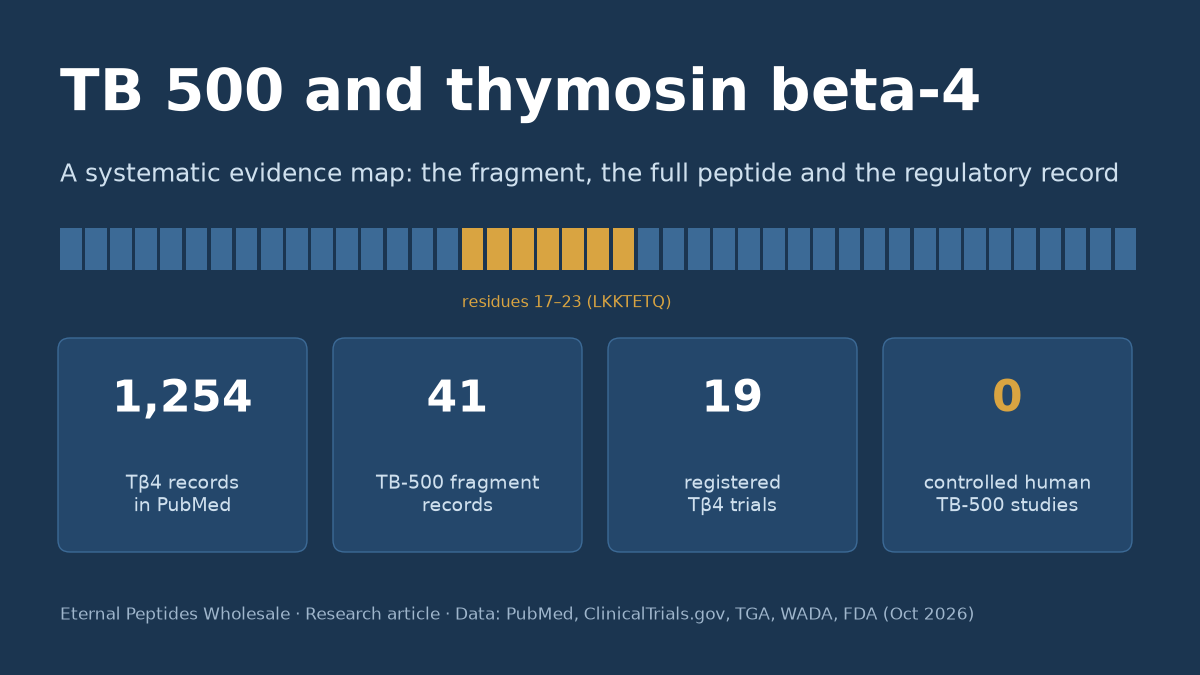
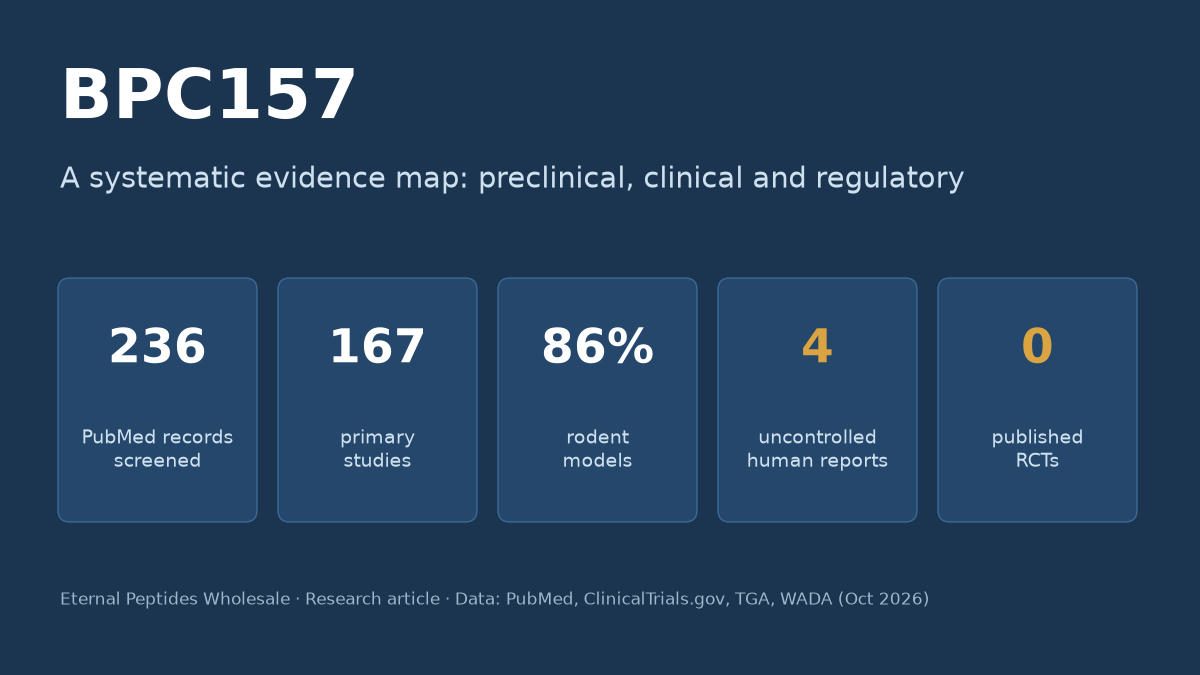
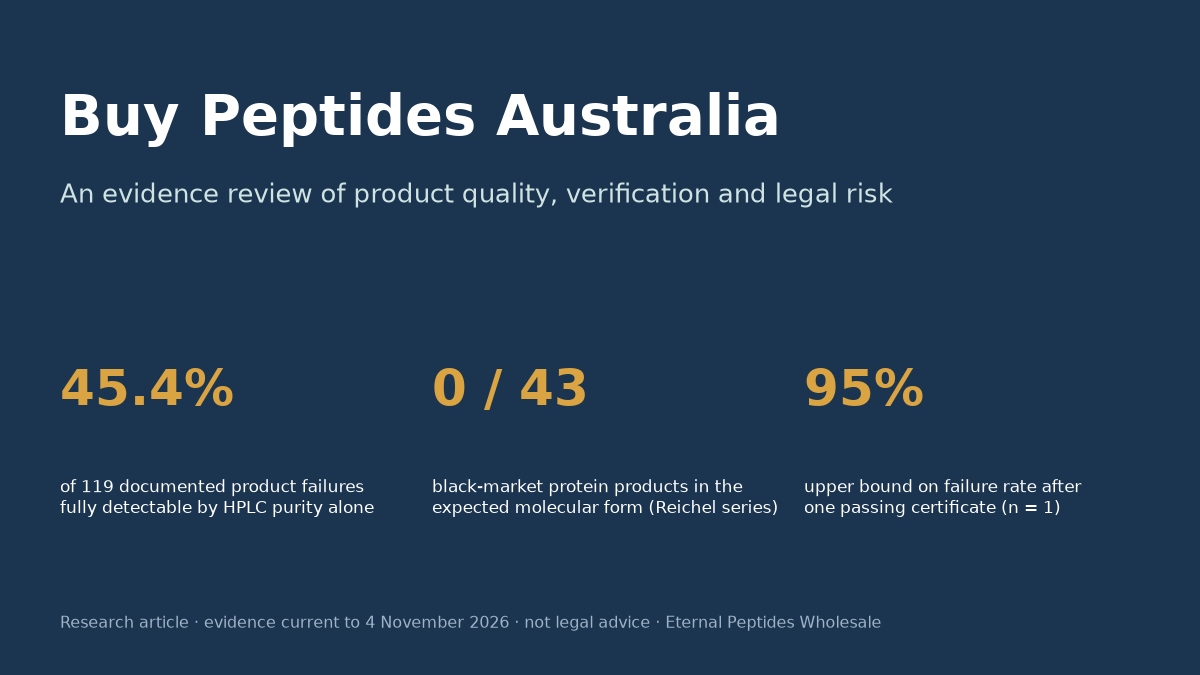
Buy peptides Australia evidence review title graphic with three summary figures from the article: 45.4% of 119 documented product failures fully detectable by HPLC purity alone, 0 of 43 black-market protein products in the expected form, and a 95% upper bound after one passing certificate

People who search buy peptides Australia are usually asking two questions together: what is actually inside the vial, and what the law says about bringing it into the country. This review answers both from primary sources. It re-analyses every published product-testing study we could find in which peptide or protein products from online, black-market or seized sources were measured in a laboratory. It then maps the documented failure modes against the tests that appear on a certificate of analysis and sets the Australian legal gates out at source.

Structured abstract

Background. Commercial pages for the phrase “buy peptides Australia” usually describe quality with a single number, such as a purity percentage printed on a certificate of analysis (COA), and describe legality with a “research use only” label. The Therapeutic Goods Administration (TGA) stated in 2026 that research-use disclaimers do not make supply lawful and do not change whether a product is a therapeutic good [1, 2]. Independent laboratory studies have reported products with no active ingredient, the wrong molecular form, or a content far from the label [3, 4, 5]. No published synthesis has asked how much of this documented failure a typical certificate would actually detect.

Objective. To build a reproducible, quantitative verification and risk framework for people researching the purchase of peptides in Australia. The framework has three parts: re-tabulated product-testing evidence, a failure-mode by test-coverage analysis of the COA, and the Australian legal gates cited at their primary source.

Methods. We ran ten documented PubMed searches through NCBI E-utilities on 4 November 2026, which returned 1,077 records before de-duplication, and used Europe PMC and citation chasing to find further studies [6, 7]. We included studies that reported a numerator and a denominator for product identity, form, content or purity. We re-calculated each proportion with a Wilson 95% confidence interval [8, 9, 10]. Each product-level failure was coded against nine laboratory tests. Zero-failure acceptance bounds were derived from the binomial model [11, 12, 13]. Legal gates were read from TGA, Australian Border Force (ABF), Office of Drug Control (ODC) and Federal Register of Legislation sources [14, 15, 16, 17].

Results. Across 17 extracted outcomes from 12 studies, black-market protein products contained the expected molecule in the expected molecular form in 0 of 43 cases (95% CI 0–8.2%) [3, 18, 19]. In a supplier-certified research set, 43 of 98 synthetic peptides (43.9%) met the purity printed on their certificates [20]. Products sold as retatrutide in Australia carried the correct molecule but contained 51% to 190% of the labelled amount [5]. Of 119 counted product-level failures, an HPLC purity figure alone would fully detect 54 (45.4%). Adding intact-mass spectrometry raises this to 108 (90.8%), and adding a quantitative content assay raises it to 117 (98.3%). Excluding the one purity-claim study, HPLC purity alone fully detects 0 of the 64 remaining failures. A single passing certificate, read as a sample of one, leaves a 95% upper bound of 95% on the batch failure rate. That bound falls below 10% only after 29 consecutive passing tests.

Conclusions. The published evidence shows that a purity percentage cannot verify identity, molecular form or quantity, and that one certificate is weak statistical evidence about a batch. Australian law turns on how a product is represented and imported, not on its label. A “research use only” statement is not legal clearance [1].

What is new here. As far as we could find, this is the first review to (1) re-tabulate published peptide product-testing results with per-study confidence intervals, keeping peptides separate from steroid comparators; (2) quantify, from 119 counted failures, how much documented product failure each COA test would detect; and (3) translate zero-failure binomial bounds into a plain reading of “one certificate”. These three analyses, together with the legal gates in Table 2, form an evidence-graded checklist. Every item in it traces to a cited standard or regulator statement.

Key findings

  • In three black-market protein studies, 0 of 43 products contained the expected molecule in the expected form; 30 carried an undeclared tag or the wrong form and 13 contained none of the expected protein [3, 18, 19].
  • A purity percentage measures chromatographic peak area. It cannot show that the main peak is the right molecule or that the vial holds the labelled amount [21, 22].
  • Of 119 counted failures, HPLC purity alone fully detects 45.4%. Mass spectrometry plus a quantitative content assay raises coverage to 98.3%.
  • One passing test leaves a 95% upper bound of 95% on a batch failure rate; 29 passes are needed to bring it below 10%, and 59 to bring it below 5% [12].
  • The TGA says research-use-only disclaimers do not make supply lawful, and that code-only or unlabelled vials will not be released under the Personal Importation Scheme [1, 23].
  • Importing prohibited goods without permission can lead to seizure and penalties of up to 2,500 penalty units or 10 years’ imprisonment [15].

Contents

  1. Introduction
  2. Methods
  3. Results 1: buy peptides Australia legal gates
  4. Results 2: what published product testing found
  5. Results 3: what a certificate of analysis can detect
  6. Results 4: how much one certificate proves
  7. Results 5: an evidence-graded verification checklist
  8. Discussion
  9. Limitations
  10. Relevance to Eternal Peptides Wholesale
  11. Conclusion
  12. Glossary
  13. Frequently asked questions
  14. References

Introduction

Australian searches for peptides grew sharply in 2026. So did regulator attention. Between April and October 2026 the TGA issued safety advisories on unapproved peptide products, announced a compliance focus, put promoters and suppliers on notice and reported enforcement outcomes [1, 23, 24, 25, 26]. The TGA and the Chief Medical Officer issued a joint statement on the public health risks [27]. NSW Health reported a rise in hospital presentations linked to peptide use [28]. Public health and consumer bodies, including healthdirect, the Alcohol and Drug Foundation and Healthy Male, published plain-language explainers [29, 30, 31].

The peer-reviewed literature has followed the same arc. Australian researchers have described illicit injectable peptides as a regulatory gap [32] and set out priorities for clinicians responding to injectable synthetic peptide use among young people [33]. They have also argued that harm-reduction thinking developed for steroids now needs to extend to peptides [34]. International reviews describe a grey market of products with uncertain identity, purity, potency and sterility, promoted through digital channels [35, 36, 37].

This article sits inside that context, but it asks a narrower and more technical question. When someone researches how to buy peptides in Australia, what can laboratory evidence and the law actually tell them before any purchase decision? The question has a quality half and a legal half, and the two are linked. The TGA’s own statements connect them: a product that is “not clearly labelled, including products identified only by codes” cannot be assessed for lawful importation, and the TGA lists “not knowing what’s in the vial” among the biggest risks [1, 23].

Why another review is needed

The companion paper on this site, Peptides Australia: An Evidence Map of the Regulatory Framework, classified 26 substances across the Poisons Standard, possession controls, import permits and the anti-doping list. It did not examine product quality. An earlier paper, Synthetic Peptides: Manufacture, Impurities and Analytical Verification, explained how peptides are made and tested. It did not ask how often products in the market fail, or which tests would catch those failures. This review fills the space between the two. It does not repeat their content. Readers who need the full scheduling history should go to the regulatory evidence map.

The existing pages that rank for buy peptides Australia have three gaps, which we describe in the Methods. First, they rarely cite primary product-testing studies, and none we found re-calculated those studies’ numbers. Second, they treat “HPLC purity” as if it answered the identity and quantity questions, which analytical guidelines say it does not [21, 22]. Third, they describe the law in general terms without quoting the regulator’s text on research-use labels, unlabelled vials or seizure [1, 23, 15].

Research questions

  1. What legal gates apply in Australia before a peptide product could be lawfully imported, supplied or possessed, as stated by the primary sources?
  2. In published studies that measured peptide and protein products from online, black-market or seized sources, how often did products contain the right molecule, in the right form and at the labelled amount?
  3. Which of those documented failures would each test commonly reported on a certificate of analysis detect?
  4. How much statistical assurance does a small number of passing certificates provide about a batch?
  5. What verification checklist follows from cited standards and regulator statements, rather than from marketing claims?

We do not address the effects of any peptide in the body. We make no claims about benefits or safety in use, and we give no information on dosing or administration. Several of the studies we cite concern products that people injected; we cite them only for what laboratories found in the products.

Methods

Design

This is a structured evidence review with three original secondary analyses. We did not buy, handle or test any product. Every number in the results is either taken directly from a cited source or calculated from such numbers, with the calculation shown. The review was planned and carried out between 3 and 4 November 2026 (Australia/Brisbane).

Review of existing search results

To define the gap, we read the leading results returned for “buy peptides australia” and three related phrases on 4 November 2026. Most were commercial storefront, “about” or certificate-library pages. The rest were regulator pages and legal commentary. The commercial pages typically showed a purity percentage and an “Australian” or “research use only” statement. None reported published product-testing numbers or explained which failures a purity figure cannot detect. The regulator and legal pages quoted the law accurately but did not address analytical verification. We do not name, rank or quote any vendor, and none of their text was reused. A generic description of these results is kept in the editorial file for this article.

Literature searches

We searched PubMed through the NCBI E-utilities interface [6] with the ten strings in Table 1, covering product quality from illicit, online or seized sources; mislabelling; internet sourcing; supplier certificates; research-chemical framing; Australian testing studies; counter-ion and net peptide content; endotoxin contamination; purity assignment methods; and binomial interval methods. The ten strings returned 1,077 records before de-duplication. We also searched Europe PMC [7], including its preprint index, and followed reference lists and citing articles of included studies. The Australian product-testing studies were found mainly in this way: search S6 returned 95 records, but none was an additional eligible product-testing study, because the term “composition” captured venom and food chemistry papers.

SearchConceptPubMed string (field tags as run)Records
S1Product quality of peptides from illicit, online or seized sources(peptide*[tiab] OR "peptide hormone*"[tiab] OR "growth hormone"[tiab] OR polypeptide*[tiab]) AND (counterfeit*[tiab] OR falsified[tiab] OR "black market"[tiab] OR confiscated[tiab] OR seized[tiab] OR illegal[tiab] OR illicit[tiab]) AND (identif*[tiab] OR purity[tiab] OR content[tiab] OR quantif*[tiab] OR impurit*[tiab])124
S2Mislabelling or adulteration of peptide products(peptide*[tiab] OR "growth hormone"[tiab]) AND (mislabel*[tiab] OR adulterat*[tiab] OR "label accuracy"[tiab] OR "labelling accuracy"[tiab] OR "labeling accuracy"[tiab] OR "undeclared"[tiab])186
S3Internet-sourced peptide products(peptide*[tiab] OR "growth hormone"[tiab]) AND (internet[tiab] OR online[tiab]) AND (purity[tiab] OR content[tiab] OR counterfeit*[tiab] OR quality[tiab]) AND (analys*[tiab] OR "mass spectrometry"[tiab] OR HPLC[tiab] OR chromatograph*[tiab])322
S4Supplier certificates for synthetic peptides("certificate of analysis"[tiab] OR "certificates of analysis"[tiab]) AND (peptide*[tiab] OR purity[tiab])16
S5Research-chemical framing("research peptide*"[tiab] OR "research chemical*"[tiab] OR "research use only"[tiab] OR "not for human consumption"[tiab]) AND (peptide*[tiab] OR purity[tiab] OR counterfeit*[tiab])23
S6Australian product-testing and drug-checking studies(steroid*[tiab] OR peptide*[tiab] OR "performance and image enhancing"[tiab] OR PIED*[tiab] OR IPED*[tiab]) AND ("drug checking"[tiab] OR "drug testing service"[tiab] OR "steroid testing"[tiab] OR "community testing"[tiab] OR composition[tiab] OR "labelling accuracy"[tiab] OR contaminant*[tiab]) AND (Australia[tiab] OR Australian[tiab] OR Australia[mh])95
S7Counter-ion and net peptide content(trifluoroacet*[tiab] OR TFA[tiab] OR counterion*[tiab] OR "counter-ion*"[tiab] OR "net peptide content"[tiab] OR "peptide content"[tiab]) AND (synthetic[tiab]) AND (peptide*[tiab]) AND (quantif*[tiab] OR determination[tiab] OR content[tiab])88
S8Endotoxin in synthetic or research peptide preparations(endotoxin*[tiab] OR lipopolysaccharide[tiab] OR LPS[tiab]) AND (contaminat*[tiab]) AND (peptide*[tiab]) AND (commercial[tiab] OR synthetic[tiab] OR reagent*[tiab])13
S9Purity assignment methods for synthetic peptides(peptide*[tiab]) AND ("mass balance"[tiab] OR "quantitative NMR"[tiab] OR qNMR[tiab] OR "amino acid analysis"[tiab] OR "isotope dilution"[tiab]) AND (purity[tiab] OR "reference standard*"[tiab])123
S10Zero-numerator and binomial interval methods("rule of three"[tiab] OR "zero numerator*"[tiab] OR "single proportion"[tiab]) AND (confidence[tiab])87
TotalBefore de-duplication—1,077
Table 1. PubMed searches for this buy peptides Australia evidence review, run through NCBI E-utilities on 4 November 2026 (Australia/Brisbane) with no date or language limits [6]. Counts are records, not studies, and they overlap. Titles from S1, S4, S5 and S8 (176 records) were screened in full; S2, S3, S6, S7, S9 and S10 were screened by title for primary studies and methods papers. Further studies came from Europe PMC [7] and from the reference lists and citing articles of included studies.

Eligibility for the re-tabulation

A study was eligible for Table 3 if it (a) analysed peptide or protein products obtained online, on the black market, by seizure, or with a supplier’s certificate; (b) used a stated analytical method; and (c) reported a numerator and denominator for at least one of identity, molecular form, content against label or purity against a stated specification. Single-product case reports were not tabulated as proportions but were used as qualitative evidence of failure modes. We added steroid and selective androgen receptor modulator (SARM) testing studies, including Australian community testing, as clearly labelled comparators. They are never pooled with the peptide results. One 2026 preprint was used only in the discussion and is flagged as not peer reviewed [38].

Extraction and statistics

For each outcome we extracted x (products meeting the criterion) and n (products tested) from the abstract or full text. We calculated the Wilson score interval, which performs well for small samples and proportions near 0 or 1 [8, 9, 10, 39]:

CI = [p + z²/2n ± z·√(p(1−p)/n + z²/4n²)] / (1 + z²/n), with p = x/n and z = 1.96.

For example, Verbeke and colleagues reported that 43 of 98 synthetic peptides met their ordered purity [20]. Here p = 0.4388, z²/n = 0.0392, the centre is (0.4388 + 0.0196)/1.0392 = 0.4411, and the half-width is 1.96 × √(0.002512 + 0.000100)/1.0392 = 0.0964. The interval is therefore 34.5% to 53.7%. We pooled only within a single research group’s method series (Reichel and colleagues) and reported a large community dataset separately [40]. Different designs, sources and outcomes make a pooled market-wide failure rate meaningless, so we did not calculate one.

Failure-mode by test-coverage analysis

We coded every counted product-level failure into one of eleven failure modes, for example “active ingredient absent” or “content outside ±10% of label”. We then rated nine laboratory tests against each mode as 2 (detects), 1 (partially or indirectly detects) or 0 (does not detect). The ratings are based on what each technique measures, as described in ICH Q2(R2), ICH Q6B, ICH Q3D(R2) and the European Medicines Agency (EMA) guideline on synthetic peptides [21, 41, 42, 22], and on the methods the source studies used. A failure was counted as “detected” by a test panel only when at least one test in the panel scored 2. The coding is our own, it is shown in full in Table 4, and readers can change it.

Acceptance-sampling bounds

If n independent samples all pass, the one-sided 95% upper confidence bound on the true failure proportion is 1 − 0.051/n, the Clopper-Pearson bound for a zero numerator [11]. The “rule of three”, 3/n, approximates this for large n [12, 13]. We compared both with lot acceptance-sampling principles from the NIST/SEMATECH handbook [43].

Legal sources

Legal statements were taken from the primary text of the Therapeutic Goods Act 1989, the Customs Act 1901, the Customs (Prohibited Imports) Regulations 1956, the Poisons Standard October 2026 (F2026L01327) and the Competition and Consumer Act 2010 on the Federal Register of Legislation [44, 45, 46, 17, 47], and from TGA, ABF, ODC, Sport Integrity Australia and WADA pages, each requested and read on 3 or 4 November 2026 [2, 15, 48, 49, 50]. Where a statement depends on interpretation, we flag it rather than resolve it.

Results 1: buy peptides Australia legal gates, cited at source

The legal half of the buy peptides Australia question is often answered with one word, “legal” or “illegal”. The primary sources show a series of gates instead. Each depends on what the product is, how it is represented and how it crosses the border. Table 2 sets out eleven gates. The detailed scheduling of individual substances is in the companion regulatory evidence map and is not repeated here.

Gate 1: is the product a therapeutic good?

Section 3 of the Therapeutic Goods Act 1989 defines therapeutic goods broadly. The definition includes goods represented or likely to be taken to be for use in humans in connection with “influencing, inhibiting or modifying a physiological process” [44, 51]. The TGA states that peptide products regulated as therapeutic goods “must be included in the ARTG before they can be imported, manufactured, supplied, exported or advertised”, unless an exemption, approval or authority applies [2, 52]. Products not in the Australian Register of Therapeutic Goods (ARTG) are “unapproved”, and the lawful routes to them are limited to defined access pathways [53].

The key point for anyone researching how to buy peptides is that classification turns on representation and likely use, not on the words on a label. The TGA says that disclaimers that a product is for “research use only” or “not for human use” “do not change whether a product is regulated as a therapeutic good” [2]. Its April 2026 advisory goes further. Such disclaimers “do not: change a product’s regulatory status, permit importation, or remove advertising or supply obligations” [1]. Sport Integrity Australia similarly notes that peptides are often sold labelled as research chemicals or “not for human consumption” [49]. Whether a particular product, sold in a particular way, is a therapeutic good is a question of fact and law that this review cannot answer for any reader. That is why we flag it rather than resolve it.

Gate 2: scheduling under the Poisons Standard

The Poisons Standard October 2026 (F2026L01327), registered on 30 September 2026, is the current instrument [17]. Many peptide substances, including growth-hormone-related peptides and melanotan II, sit in Schedule 4 (prescription only). Several growth-hormone-related substances are also listed in Appendix D, clause 5, which covers poisons that it is illegal to possess without authority [17]. The TGA notes that “many approved peptide-based medicines are prescription-only” [2]. States and territories give effect to scheduling through their own laws, and the TGA warns that “state and territory laws may impose additional controls” [1]. A substance-by-substance table is in the regulatory evidence map.

Gate 3: peptide import Australia rules and the Personal Importation Scheme

The Personal Importation Scheme (PIS) is the route most often discussed in relation to peptide import into Australia. Its conditions, quoted from the TGA page updated on 8 September 2026, are narrow [14]:

  • the goods are for the importer or an immediate family member and “cannot be sold, supplied or given away”;
  • for a prescription-only medicine, the importer must hold a valid Australian prescription, or written authority, at the time of importation, and eScripts are not accepted as that written authority;
  • each import is no more than a 3-month supply at the maximum prescribed dose, and no more than a 15-month supply is imported in 12 months;
  • the goods must not “contain a controlled substance” or be otherwise prohibited under customs or biosecurity law;
  • “counterfeit (fake) medicines… are prohibited from being imported under any circumstances”.

The same page states that products imported under the scheme “are not evaluated by us, meaning their safety, quality and efficacy cannot be guaranteed”, and that non-compliant imports “may be seized resulting in the loss of both the items and the money spent” [14]. The scheme is therefore not a quality assurance route. It is a narrow legal exemption that leaves quality unverified.

Gate 4: labelling at the border

The TGA’s May 2026 warning is the clearest statement linking product quality and legality. “Products referred to the TGA by the ABF are often poorly labelled,” it says, and “unmarked vials, code‑only labels, or missing ingredient and dosing information are major red flags” [23]. Products that are not clearly labelled “cannot be assessed for lawful importation under the Personal Importation Scheme, and will not be considered for release” [1]. For those products the TGA “will notify the ABF to seize and destroy” them [23]. In July 2026 the TGA reported increasing interception of unlabelled vials and noted that labelling a blank vial can itself be a manufacturing step [25].

Gate 5: controlled imports

Regulation 5G and Schedule 7A of the Customs (Prohibited Imports) Regulations 1956 prohibit importing listed substances without a permit [46]. The list includes anabolic or androgenic substances, erythropoietin, gonadotrophins, and natural and manufactured growth hormones, including somatomedins, insulin-like growth factors and growth-hormone-releasing hormones and their synthetic analogues [46, 16]. The Office of Drug Control (ODC) states that import is prohibited unless the importer holds an ODC permit [48]. The ABF warns that it “may seize your goods” and that “penalties of up to 2,500 penalty units or 10 years imprisonment, or both” can apply [15, 45]. Which penalty provision applies to a given import is a legal question that we flag for review.

Gates 6 to 8: advertising, enforcement and consumer law

Prescription-only medicines and unapproved therapeutic goods cannot be advertised to the public [54, 1]. In 2026 the TGA added unapproved peptide products to its compliance priorities [24, 55]. It put promoters and suppliers on notice that consequences range from warning letters to prosecution [25], and it reported warrants, seizures and penalties [26, 56, 57]. The August 2026 release cites civil penalties of up to $1.82 million per breach for individuals and $18.2 million for corporations, and criminal penalties of up to 7 years’ imprisonment [26]. Representations made in trade are also subject to the Australian Consumer Law in Schedule 2 of the Competition and Consumer Act 2010 [47].

Gate 9: sport

For athletes, legality and eligibility are separate. The WADA Prohibited List 2027, published on 26 August 2026 and in force from 1 January 2027, names many peptide classes. Section S0 covers non-approved substances, which are prohibited at all times [50, 58, 59]. Sport Integrity Australia warns that a therapeutic use exemption is unlikely to be granted for an unregistered medicine [49]. Global DRO is the public lookup tool [60].

GateWhat the primary source saysSourcePractical meaning
1. Therapeutic good?Represented or likely to be taken for use in humans, including modifying a physiological processTherapeutic Goods Act s3; TGA [44, 51, 2]A research-use label does not change the classification
2. ARTG entryMust be in the ARTG before import, manufacture, supply, export or advertising, unless an exemption appliesTGA [2, 52, 53]Unapproved products give no assurance on labelling, sterility or quality
3. Research-use disclaimerDoes not change regulatory status, permit importation or remove obligationsTGA advisory, 13 April 2026 [1]Never treat as legal clearance
4. SchedulingMany peptides are Schedule 4; some are in Appendix D, clause 5; states add controlsPoisons Standard Oct 2026 (F2026L01327) [17, 1]Substance-level detail in the regulatory evidence map
5. Personal Importation SchemePersonal or family use only; prescription for Sch 4; 3-month and 15-month limits; no controlled substances; counterfeits prohibitedTGA PIS page, 8 Sept 2026 [14]Quality and safety are not evaluated
6. Labelling at the borderCode-only or unlabelled vials will not be released and may be seized and destroyedTGA, 13 April and 7 May 2026 [1, 23, 25]Links legality directly to labelling quality
7. Controlled importsSchedule 7A substances need an ODC permitCustoms (Prohibited Imports) Regs r5G; ODC [46, 48, 16]Includes growth hormones, IGFs and GHRH analogues
8. Seizure and penaltiesGoods may be seized; up to 2,500 penalty units or 10 years’ imprisonmentABF; Customs Act [15, 45]Applicable provision needs legal review
9. AdvertisingNo public advertising of prescription-only or unapproved goodsTGA [54]Applies to promoters as well as suppliers
10. EnforcementInfringement notices, seizure, civil penalties, prosecutionTGA releases, June to Sept 2026 [24, 25, 26, 56, 57, 61]Active enforcement in 2026
11. SportMany peptide classes prohibited; S0 prohibited at all timesWADA 2027 List; SIA [50, 49, 60]Separate from legality
Table 2. Australian legal gates relevant to people researching how to buy peptides in Australia, each stated from the primary source read on 3 or 4 November 2026. This is a summary, not legal advice. Whether a gate applies to a specific product is a question of fact and law.

Two further points follow from Table 2. First, none of the gates is passed by a certificate of analysis. A COA is quality evidence, not legal authority, and the TGA’s own laboratories describe testing as no “replacement for other regulatory controls (such as GMP…)” [62, 63]. Second, several gates depend on facts only an expert can assess, such as whether a product is represented for human use, which schedule entry applies, and whether a state law adds controls. The editorial notes for this article list them as legal-review items.

Results 2: what published product testing found

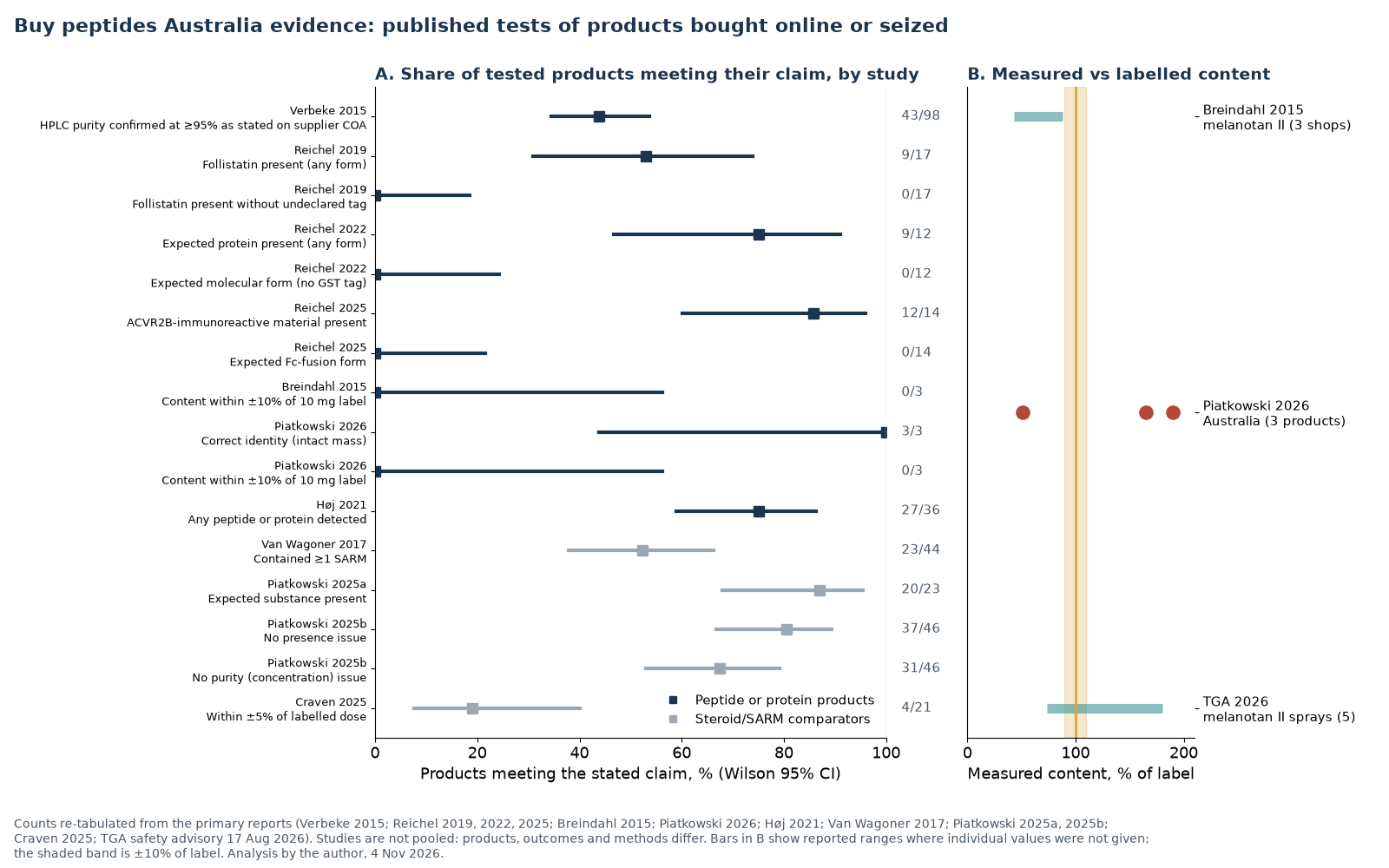
Twelve studies met the inclusion criteria and contributed 17 outcomes, which are shown with recalculated confidence intervals in Table 3 and Figure 1. A further group of studies documented failure modes in individual products without a usable denominator, and we use them qualitatively. The picture is consistent across countries, decades and laboratories. Products sold outside regulated supply chains often contain something, but less often the right thing in the right form at the right amount.

Study and product setOutcome (as defined by the source)x/nProportionWilson 95% CI
Verbeke 2015: research-grade synthetic peptides, ordered at ≥95% purity [20]HPLC purity confirmed at ≥95% as stated on supplier COA43/9843.9%34.5–53.7%
Reichel 2019: black-market follistatin 344 [3]Follistatin present (any form)9/1752.9%31.0–73.8%
Reichel 2019: black-market follistatin 344 [3]Follistatin present without undeclared tag0/170.0%0.0–18.4%
Reichel 2022: black-market myostatin propeptide [18]Expected protein present (any form)9/1275.0%46.8–91.1%
Reichel 2022: black-market myostatin propeptide [18]Expected molecular form (no GST tag)0/120.0%0.0–24.2%
Reichel 2025: black-market ACE-031 [19]ACVR2B-immunoreactive material present12/1485.7%60.1–96.0%
Reichel 2025: black-market ACE-031 [19]Expected Fc-fusion form0/140.0%0.0–21.5%
Breindahl 2015: melanotan II from 3 online shops [4]Content within ±10% of 10 mg label0/30.0%0.0–56.1%
Piatkowski 2026: products sold as retatrutide, Australia [5]Correct identity (intact mass)3/3100.0%43.9–100.0%
Piatkowski 2026: products sold as retatrutide, Australia [5]Content within ±10% of 10 mg label0/30.0%0.0–56.1%
Høj 2021: seized peptide/protein doping products, Denmark [64]Any peptide or protein detected27/3675.0%58.9–86.2%
Van Wagoner 2017: SARM products sold online (comparator) [65]Contained ≥1 SARM23/4452.3%37.9–66.2%
Piatkowski 2025a: CheQpoint AAS testing, Brisbane (comparator) [66]Expected substance present20/2387.0%67.9–95.5%
Piatkowski 2025b: AAS testing, Queensland (comparator) [67]No presence issue37/4680.4%66.8–89.3%
Piatkowski 2025b: AAS testing, Queensland (comparator) [67]No purity (concentration) issue31/4667.4%53.0–79.1%
Craven 2025: AAS samples, Australia (comparator) [68]Within ±5% of labelled dose4/2119.0%7.7–40.0%
Reichel series combined (same group and methods) [3, 18, 19]Expected protein present (any form)30/4369.8%54.9–81.4%
Reichel series combined [3, 18, 19]Expected molecule in expected form0/430.0%0.0–8.2%
Bonenti 2026: PEDTest community reagent reports, Australia, 2022 to 2024 (comparator) [40]Confirmed legitimate (reagent test)1,423/2,068*68.8%66.8–70.8%
Table 3. Published product-testing results re-tabulated with Wilson 95% confidence intervals calculated for this review [8, 10]. Peptide and protein rows come first. Steroid and SARM comparators are labelled and are never pooled with them. *Bonenti and colleagues report 68.8% of 2,068 reports; 1,423 is our back-calculation (0.688 × 2,068 = 1,422.8). Verbeke 2015: the abstract rounds to 44.0%; the full text states 43 of 98.
Buy peptides Australia forest plot of published product-testing studies with Wilson 95% confidence intervals, and measured peptide content as a percentage of the labelled amount
Figure 1. Buy peptides Australia evidence at a glance. Panel A: forest plot of the proportion of products meeting each source-defined criterion, with Wilson 95% confidence intervals; peptide and protein outcomes are shown above the steroid and SARM comparators. Panel B: measured content as a percentage of the labelled amount, where reported. Sources: Verbeke 2015; Reichel 2019, 2022, 2025; Breindahl 2015; Piatkowski 2026; Høj 2021; TGA melanotan II advisory 2026; Van Wagoner 2017; Piatkowski 2025a, 2025b; Craven 2025. Intervals calculated for this review. Data figure.

Identity and molecular form: the protein studies

The most striking results come from a series by Reichel and colleagues, who used SDS-PAGE, Western blotting and mass spectrometry on black-market protein products sold for “research purposes” [3, 18, 19]. Only 9 of 17 products labelled follistatin 344 contained follistatin. Growth-promoting peptides were found in some of the others, and all nine follistatin-containing products carried an undeclared His-tag and a high degree of oligomers [3]. Of 12 myostatin propeptide products, 9 contained the protein. In those nine the main compound had a mass of about 54 to 55 kDa rather than the expected 33 kDa, because a full-length glutathione S-transferase tag was still attached [18]. Of 14 products sold as ACE-031, an Fc-fusion protein, 12 contained activin receptor material, but it was the full-length receptor and not the fusion protein. A protease that cleaves Fc regions could not cleave the products [19].

Combining the three studies, which share a group and method, the expected protein was present in some form in 30 of 43 products (69.8%; 95% CI 54.9–81.4%). The expected molecule in the expected form was present in 0 of 43 (95% CI 0–8.2%). The upper limit uses the Wilson formula with x = 0, which reduces to z²/(n + z²) = 3.8415/46.8415 = 0.082. The same pattern of undeclared expression tags was reported earlier, when an unknown thioredoxin fusion protein with a His-tag was found in unlabelled black-market products from independent sources [69]. The Cologne laboratory has repeatedly reported vials labelled as growth hormone with no active content, unpurified growth-factor material, and analogue peptides with an extra N-terminal glycine [70, 71, 72]. Seized materials have also contained glycine-modified secretagogues and a previously undescribed analogue [73, 74].

These failures matter for verification because an HPLC purity figure cannot reveal them. A tagged protein or a glycine-extended peptide can give a clean main peak. Only a method that measures mass or sequence, or that separates by molecular size, shows that the main peak is the wrong molecule [41, 22].

Seized and confiscated products

Customs and forensic laboratories provide a second line of evidence. In Copenhagen in 2019, 36 seized samples were submitted for peptide or protein analysis using LC-UV, LC-TOF-MS, a colorimetric protein assay and an immunoassay. Fifteen contained a prohibited doping substance, 12 contained a non-prohibited substance and 9 contained no peptide or protein at all [64]. Peptide or protein material was therefore detected in 27 of 36 (75.0%; 95% CI 58.9–86.2%). In Norway, peptide and protein substances were identified in 28% of black-market products confiscated between 2011 and 2014 [75]. At the Swiss border, 146 (12%) of 1,190 seized products were peptide hormones or growth factors, and fewer than 20% of all products contained the claimed substance in the claimed amount [76]. Belgian control laboratories have repeatedly identified research peptides, including some with no completed clinical trials, in seized unknown preparations. They developed screening methods specifically because labels could not be trusted [77, 78, 79, 80, 81]. A Belgian study of samples containing molecules that have no international nonproprietary name or therapeutic code, a group that includes many research peptides, found that 83% came from the illegal market and 3% from the legal market [82]. Single-case analyses have characterised unlabelled vials by NMR and mass spectrometry [83] and confiscated research peptides by LC-MS [84].

Content against label

Identity alone is not enough. Content is a separate measurement, and in the studies that reported it, it was usually wrong. Breindahl and colleagues bought melanotan II from three online shops, each claiming 10 mg per vial. They measured 4.32 to 8.84 mg, which is 43.2% to 88.4% of the label, so none was within ±10% [4]. In 2026 the TGA reported that five melanotan II nasal sprays labelled 30 mg per 20 mL contained 22 to 54 mg, or 73% to 180% of the label (22/30 = 0.733; 54/30 = 1.80) [57]. An Australian study of products sold as retatrutide confirmed the correct molecule by intact mass in all three, but measured 5.13, 19.0 and 16.5 mg against a 10 mg label, or 51% to 190% [5]. Vida and colleagues found that somatropin products bought from websites contained significantly less active substance than labelled [85]. Janvier and colleagues reported large variation in the amount of active ingredient per unit, together with low purity, across the ten most common falsified peptide drugs bought from suspected illegal internet pharmacies in Belgium [86].

The direction of error was not consistent: some products were underfilled and some overfilled by almost double. This means that a purchaser cannot correct for mislabelling by assuming a typical shortfall. Only a quantitative content assay, reported against the label, answers the question [22, 21].

Purity claims on certificates

The most direct test of a supplier’s certificate comes from Verbeke and colleagues. They ordered 98 synthetic research peptides at a stated minimum purity of 95.0%, and “all the 98 peptides were accompanied by a certificate of analysis stating at least 95.0% purity”. Independent analysis confirmed that only 43 met this specification (43.9%; 95% CI 34.5–53.7%). One product (ID25) was a different, related sequence [20]. Choules and colleagues used quantitative NMR to show that two custom synthetic peptides contained 20% and 43% w/w of undeclared mannitol, which is transparent to UV detection and so invisible to standard HPLC. They concluded that “experimental verification supersedes trust” [87]. Esposito and colleagues identified a growth-hormone-releasing hormone analogue with incomplete C-terminal amidation [88]. Recombinant research proteins have also been shown to carry bacterial lipopolysaccharide [89, 90].

Microbial and elemental contamination

A Belgian case report found haemolytic Bacillus cereus in two illegal injectable peptide products [91]. Graham and colleagues cultured skin commensal organisms from underground-market vials [92]. Janvier and colleagues screened falsified peptides for elemental impurities and residual solvents [86, 93]. Craven and colleagues detected twelve heavy metals in Australian steroid products, and only 4 of 21 samples with a defined labelled dose were within ±5% of it [68]. A 2026 preprint that has not been peer reviewed analysed 6,441 test results for 14 consumer-marketed research peptides from a public independent-testing dataset. It reported measurable endotoxin in 15% of samples and failure rates of 41.6% to 71.1%, depending on the acceptance framework [38]. Because it is a preprint, we report it separately and do not count it in Table 4.

Australian comparators

Australia has one of the world’s most developed community testing programmes for performance and image-enhancing drugs. Most of its data concern steroids, not peptides, but they show what routine testing finds. In the CheQpoint pilot in Brisbane, 20 of 23 products contained the expected substance (87.0%) [66]. In a Queensland mixed-methods study, 37 of 46 had no presence issue and 31 of 46 had no concentration issue [67]. Across 2,068 PEDTest reagent reports from 2022 to 2024, 68.8% were confirmed legitimate, 12.9% were swapped, 7.0% contained no active ingredient and 11.4% were inconclusive [40]. Researchers have described how consumers respond to testing results and community notices [94, 95, 96], women’s particular difficulty obtaining genuine products [97], health care engagement among people who use these drugs [98], and international lessons for testing programmes [99]. In the United States, only 23 of 44 products marketed as SARMs (52.3%) contained one [65]. In a 2026 proof-of-concept study, a rapid mass-spectrometry screen detected at least one prohibited substance in each of 16 black-market products without false positives in certified supplements. Manual spectral review, however, identified only 68% of individual substances correctly [100].

The comparators are not evidence about peptides. They are included because they show that even well-established Australian testing services find a large minority of products to be mislabelled. They also show that the measurement chosen, whether a reagent colour test or quantitative chromatography, determines what can be found.

Results 3: what a peptide certificate of analysis can detect

A peptide certificate of analysis is a report of specific measurements on a specific sample. Its value depends on which measurements it contains, whether those measurements suit the failures that actually occur, and whether the sample represents the batch. This section deals with the first two questions. The third is in the next section.

What each test measures

Analytical guidelines are explicit that one test does not establish identity, purity and quantity together. ICH Q2(R2) sets different validation requirements for identification, impurity and assay procedures. It notes that a lack of specificity in one procedure can be compensated by “one or more other supporting analytical procedures” [21, 101]. ICH Q6B, which covers biotechnological products, states that a single test is often not enough to establish identity or purity [41]. The EMA guideline on synthetic peptides, adopted in December 2025, asks for identification by at least two orthogonal methods. It also asks for an assay on a “counter-ion free, anhydrous” basis, a stated counter ion, and the reporting, identification and qualification of peptide-related impurities “above 0.1%”, “above 0.5%” and “above 1.0%” respectively [22, 102]. In practice the tests divide as follows.

  • HPLC-UV purity reports the main peak’s share of the UV-absorbing peak area. It does not identify the main peak. It cannot see compounds that do not absorb UV, such as mannitol [87], and its result can depend on chromatographic conditions, especially for basic peptides [103].
  • Mass spectrometry of the intact molecule confirms that a component of the expected mass is present. It detects tags, wrong forms and most wrong substances, but it is not quantitative unless calibrated [22, 104].
  • MS/MS or peptide mapping confirms the sequence and can locate modifications such as deamidation or incomplete amidation [104, 88, 4].
  • Quantitative content, also called net peptide content or assay, measures how much peptide is actually present. It can be done by calibrated HPLC against a reference standard, by amino acid analysis or by quantitative NMR [22, 105, 106, 107, 108, 109].
  • SDS-PAGE or size-exclusion chromatography separates proteins by size and reveals fusion tags, oligomers and aggregates [3, 18, 41].
  • ICP-MS measures elemental impurities against the ICH Q3D permitted daily exposures [42].
  • Bacterial endotoxin and sterility tests are separate microbiological measurements [90, 89, 91].
  • Counter-ion analysis, usually ion chromatography for trifluoroacetate (TFA) or acetate, accounts for non-peptide mass [110, 111, 112].

Why purity is not content

Purity and content are often confused, and the difference can be large. Melanson and colleagues assigned a certified purity to an angiotensin II reference material by combining three orthogonal methods. TFA counter-ion made up nearly 25% of the mass, and the final assigned purity was 691 ± 9 mg/g, or 69.1% peptide by mass [106]. A peptide like this could show a single, clean HPLC peak and still contain less than 70% peptide by weight. Wang and colleagues used a mass balance approach for synthetic glucagon and oxytocin. They subtracted related impurities, water, counter-ions and residual solvents, which are measured separately, to reach an SI-traceable purity [107, 108]. Consensus work on TFA analysis recommends validated methods under ICH principles [112]. This is why the EMA asks for assay limits expressed on a counter-ion-free, anhydrous basis [22], and why pharmacopoeial reference standards underpin peptide quality control [105].

For a purchaser reading a peptide certificate of analysis, the practical point is this. A line saying “purity 99%” and a line saying “content 10 mg” are different claims, made with different tests. A certificate with only the first does not support the second.

Coverage of documented failures

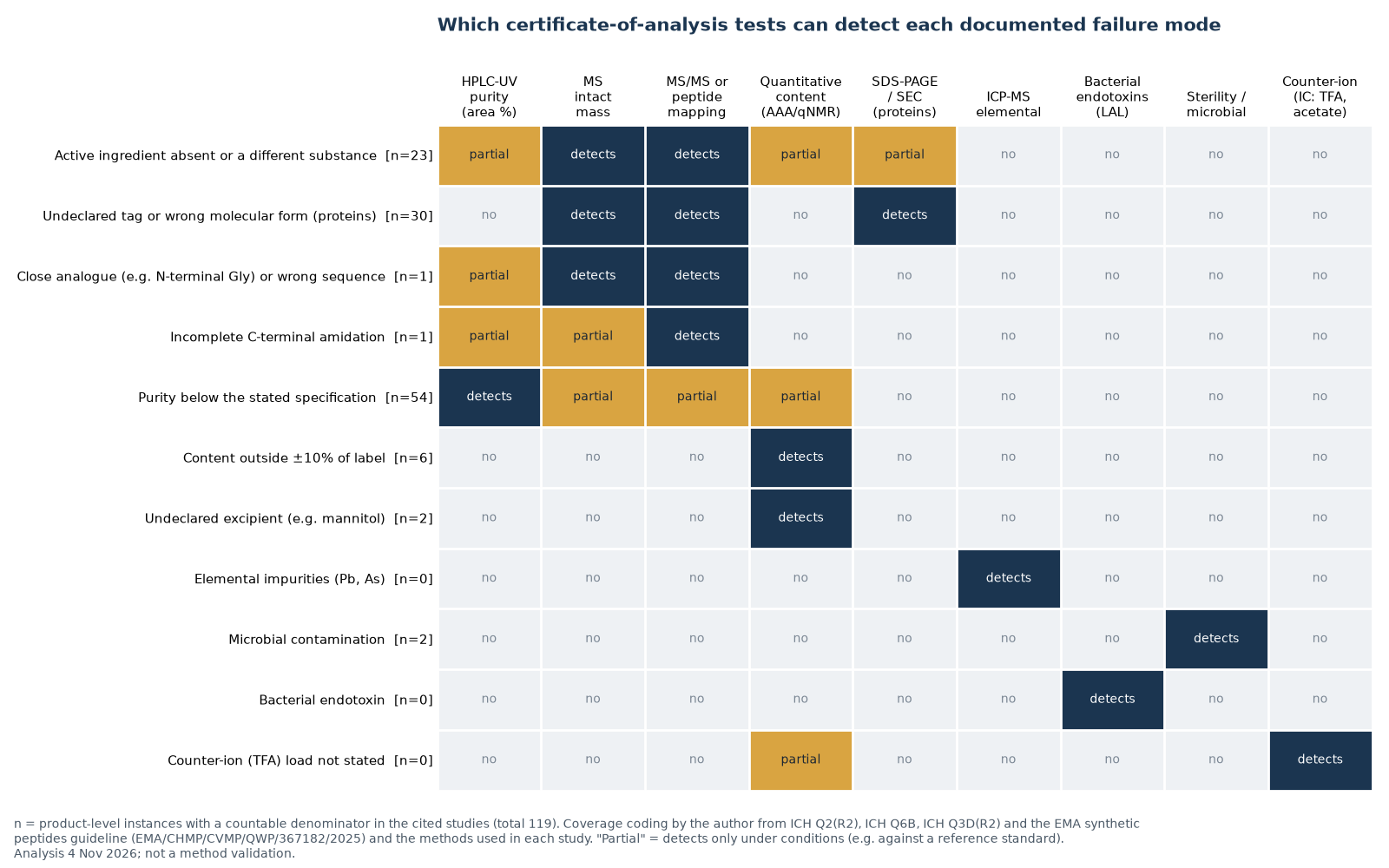
Table 4 and Figure 2 cross the eleven documented failure modes against nine tests. Seven modes had countable product-level instances, giving 119 in total. Verbeke contributed 55 (54 purity failures plus one wrong sequence), the Reichel series 43 (30 tag or wrong-form products plus 13 with none of the expected protein), Høj 9, Breindahl 3, Piatkowski 3, Choules 2, Janvier 2, Esposito 1 and the TGA retatrutide alert 1. The sum is 55 + 43 + 9 + 3 + 3 + 2 + 2 + 1 + 1 = 119.

Failure modeCounted instancesSourcesHPLC-UVMS massMS/MSContentSDS-PAGE/SECICP-MSEndotoxinSterilityCounter-ion
Active ingredient absent or a different substance23Reichel 2019/2022/2025 (8+3+2 = 13); Høj 2021 (9 with no peptide or protein); TGA 2026 retatrutide alert (1)◐●●◐◐————
Undeclared tag or wrong molecular form (proteins)30Reichel 2019 (9), 2022 (9), 2025 (12)—●●—●————
Close analogue (e.g. N-terminal Gly) or wrong sequence1Verbeke 2015 ID25 (1); Krug 2018, Gajda 2019, Popławska 2019 (uncounted)◐●●——————
Incomplete C-terminal amidation1Esposito 2014 (1)◐◐●——————
Purity below the stated specification54Verbeke 2015 (55 claims unconfirmed, less ID25 counted above)●◐◐◐—————
Content outside ±10% of label6Breindahl 2015 (3); Piatkowski 2026 (3)———●—————
Undeclared excipient (e.g. mannitol)2Choules 2020 (2)———●—————
Elemental impurities (Pb, As)0Janvier 2018 (uncounted); Piatkowski 2026 (Pb below concern)—————●———
Microbial contamination2Janvier 2018, Bacillus cereus case series (2)———————●—
Bacterial endotoxin0Preprint dataset: 15% of samples (not counted here)——————●——
Counter-ion (TFA) load not stated0Analytical literature; no counted product series———◐————●
Total119
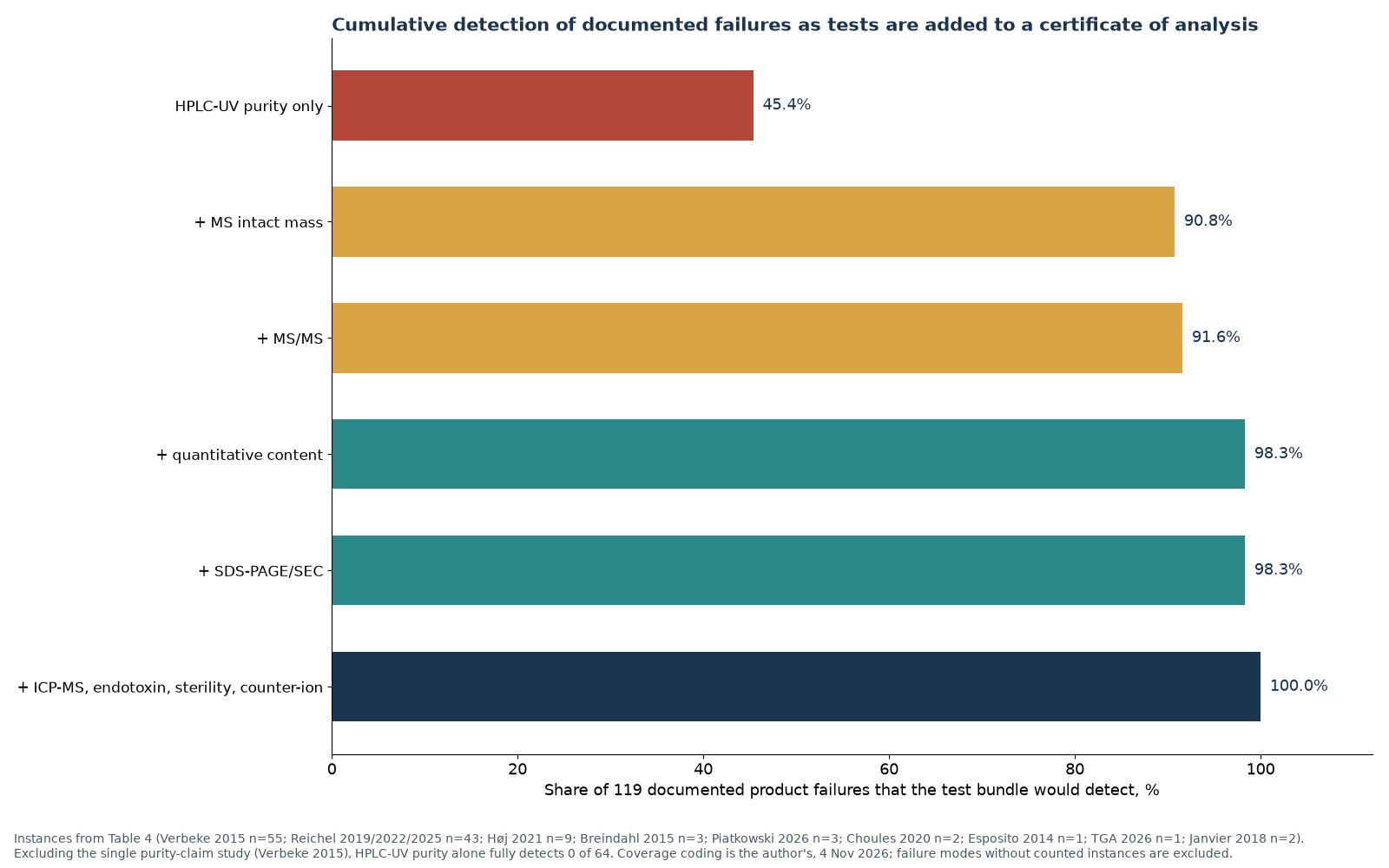
Table 4. Documented peptide and protein product failure modes against the tests that can appear on a peptide certificate of analysis. ● detects; ◐ partial or conditional; — does not detect. Coverage ratings follow what each technique measures [21, 41, 42, 22]; the coding is the author’s (4 November 2026). Instances are product-level failures with a countable denominator in the sources [20, 3, 18, 19, 64, 4, 5, 87, 88, 91, 61]. Cumulative full detection: HPLC-UV purity only: 54/119 (45.4%); + MS intact mass: 108/119 (90.8%); + MS/MS: 109/119 (91.6%); + quantitative content: 117/119 (98.3%); + SDS-PAGE/SEC: 117/119 (98.3%); + ICP-MS, endotoxin, sterility, counter-ion: 119/119 (100.0%).
Heatmap of eleven peptide product failure modes against nine laboratory tests, showing which certificate of analysis tests detect each failure
Figure 2. Peptide certificate of analysis test-coverage matrix: documented product failure modes (rows) against laboratory tests (columns), with the number of counted instances for each mode. Sources: as for Table 4; coverage coding by the author from ICH Q2(R2), ICH Q6B, ICH Q3D(R2) and the EMA synthetic peptides guideline. Data figure.

Figure 3 shows the cumulative result. HPLC-UV purity alone fully detects 54 of 119 documented failures (45.4%). All 54 are purity shortfalls from the single study in which the failure was defined as a purity shortfall [20]. Excluding that study, HPLC purity alone fully detects none of the remaining 64 failures. Adding intact-mass MS raises full detection to 108 of 119 (90.8%), because it catches the absent, substituted, tagged and wrong-form products. MS/MS adds the amidation defect, for 109 (91.6%). A quantitative content assay adds the six out-of-range contents and two undeclared-excipient cases, for 117 (98.3%). Microbial testing accounts for the last two. Elemental impurities and endotoxin had no counted instances in the peer-reviewed series, so the final step in Figure 3 reflects microbial testing only. Their absence from the count reflects how little they have been studied, not evidence that they are rare [86, 68, 38].
Bar chart of the cumulative share of 119 documented peptide product failures detected as tests are added to a certificate of analysis, from HPLC purity alone to a full panel
Figure 3. Cumulative share of 119 documented product failures fully detected as tests are added to a certificate of analysis, from HPLC purity alone to a full panel. Sources: Table 4; calculation for this review. Data figure.

What “third-party tested” does and does not mean

“Third-party tested” describes who did the test, not what was tested or how well. A certificate from an independent laboratory is more informative than one from the seller, but only for the measurements it reports and only for the sample analysed. Accreditation is the recognised way to show that a laboratory is competent for a specific test. NATA describes accreditation as assurance of technical competence in accredited activities [113], and the ILAC Mutual Recognition Arrangement lets accreditation be recognised across borders, with directories showing which tests a laboratory is accredited for [114]. The TGA’s own laboratories are NATA-accredited to ISO/IEC 17025 and test about 1,500 samples a year. Their default standards are the British Pharmacopoeia, European Pharmacopoeia and United States Pharmacopeia [62]. A certificate’s claim of accreditation can be checked against the accreditation body’s public scope. The scope, not the laboratory’s name, shows whether a given method is covered.

Results 4: how much one certificate proves

Even a complete certificate describes one sample. The TGA notes that a sample is assumed to represent a batch only when there is assurance about how it was stored and handled [62]. Acceptance-sampling theory makes the limits precise [43].

The zero-failure bound

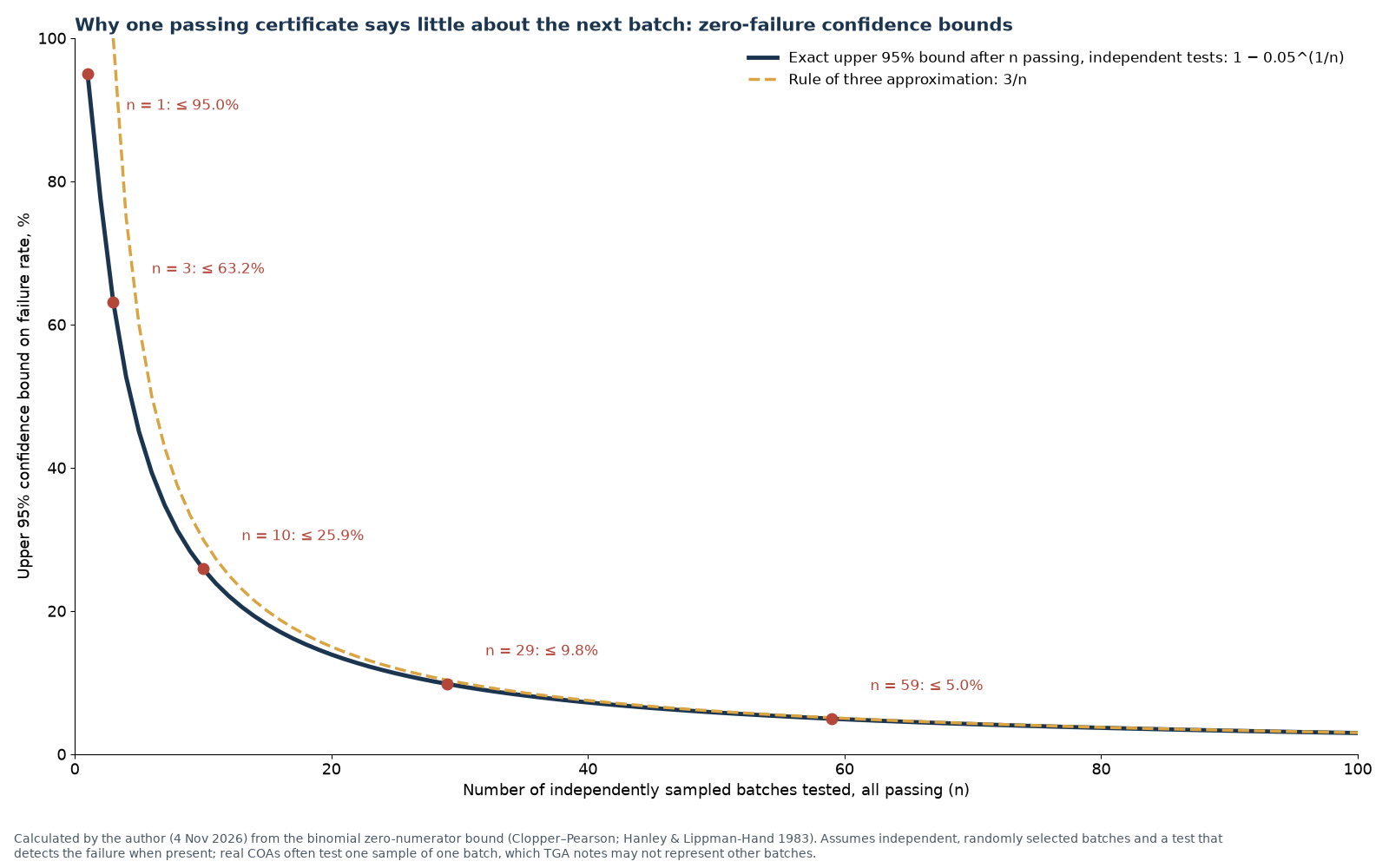
Suppose a purchaser sees n certificates for n independently sampled batches, and every one passes. What is the highest batch failure rate still consistent with that record? If the true failure proportion is p, the chance that n independent batches all pass is (1 − p)n. The one-sided 95% upper bound is the value of p at which that chance falls to 5%: (1 − p)n = 0.05, so p = 1 − 0.051/n [11, 12]. For example:

  • n = 1: p = 1 − 0.05 = 0.95, or 95%;
  • n = 3: 0.051/3 = 0.368, so p = 63.2%;
  • n = 10: 0.050.1 = 0.741, so p = 25.9%;
  • n = 29: 0.051/29 = exp(−2.9957/29) = exp(−0.1033) = 0.9019, so p = 9.8%;
  • n = 59: p = 5.0%.

To push the bound below 10% requires the smallest n with 0.9n ≤ 0.05, which is n ≥ ln 0.05 / ln 0.9 = 28.4, so n = 29. Below 5% requires n ≥ ln 0.05 / ln 0.95 = 58.4, so n = 59. Below 1% requires n = 299. The familiar “rule of three” (3/n) gives 30% at n = 10, against an exact 25.9%. The two converge as n grows [12], but Ludbrook warns that the rule can “grossly” underestimate risk in small samples [13]. Figure 4 plots both.
Line chart of the 95% upper confidence bound on a batch failure rate after 1 to 300 passing tests with zero failures, compared with the rule of three
Figure 4. Upper 95% confidence bound on a batch failure rate after n independent passing tests, with the rule-of-three approximation, showing why one peptide certificate of analysis is weak statistical evidence. Sources: Clopper and Pearson 1934; Hanley and Lippman-Hand 1983; Ludbrook 2009. Calculated for this review. Data figure.

Interpreting a single certificate

One passing certificate is fully consistent with a process in which most batches fail. This is not a criticism of any laboratory. It is a property of sample size. A certificate is strong evidence about the vial or aliquot that was tested, and weak evidence about anything else. Three conditions are needed before a certificate says something about the product in hand:

  1. Traceability: the batch or lot number on the certificate matches the label on the product, and the laboratory’s report can be checked independently, for example through a verification link or report identifier.
  2. Representativeness: the tested sample was drawn from that batch and stored appropriately. The TGA assumes representativeness only with such assurance [62].
  3. Repetition: results for successive batches are published, including failures, so that a run of results can be judged, not one report.

The model assumes independent, randomly selected batches and a test that detects the failure when it is present. Real batches are not independent, and certificates are not randomly selected. A seller can choose which reports to publish. The bounds above are therefore the best case. They show how much a record of passes could justify, not how much it does.

Why Wilson intervals

Many of the studies in Table 3 have small denominators of 3, 12, 14 or 17. The simple Wald interval, p ± 1.96√(p(1−p)/n), collapses to zero width when x = 0 or x = n and has poor coverage at small n [10, 39]. Newcombe compared seven methods and recommended score-based intervals [9], which is the Wilson method [8]. For Breindahl’s 0 of 3, the Wald interval would be 0% to 0%, a meaningless result. The Wilson interval is 0% to 56.1% (z²/(n + z²) = 3.8415/6.8415 = 0.561). It correctly shows that three products cannot establish a market-wide failure rate, even though all three failed.

Results 5: an evidence-graded buy peptides Australia verification checklist

Table 5 turns the four analyses into sixteen questions. Each question is linked to the evidence behind it and graded by the type of source. The checklist is designed to be read in order. The legal questions come first because, under the TGA’s statements, no analytical result can make an otherwise unlawful import or supply lawful [1, 2]. The checklist is not a guide to buying anything. It is a way of judging how much a set of claims is worth.

#DomainQuestionWhy it matters (evidence)GradeSource
1LegalIs the product in the ARTG, or is there a lawful access pathway that applies?Unapproved goods need an exemption, approval or authorityA[2, 52, 53]
2LegalDoes the label or listing rely on “research use only” or “not for human use”?These disclaimers do not change regulatory status or permit importationA[1, 2]
3LegalIs the substance scheduled, in Appendix D, or listed in Customs Schedule 7A?Prescription, possession and permit requirements may applyA[17, 46, 48]
4LegalWould a personal import meet every Personal Importation Scheme condition?Prescription, quantity, no controlled substances, no counterfeitsA[14]
5LegalIs the vial clearly labelled with name and amount, not a code?Code-only or unlabelled vials will not be released and may be destroyedA[23, 1]
6LegalFor athletes: is the substance on the WADA List?S0 and peptide classes are prohibited; TUEs unlikely for unregistered goodsA[50, 49, 60]
7DocumentDoes the certificate show a batch number that matches the product label?A certificate describes only the sample testedA[62]
8DocumentCan the report be verified with the issuing laboratory?Independent verification is the basis of trust in a reportC[87, 20]
9DocumentIs the laboratory accredited for these specific methods?Accreditation applies to the accredited scopeA[113, 114, 62]
10AnalyticalIs identity shown by mass spectrometry, ideally with a second orthogonal method?HPLC purity alone fully detected 0 of 64 non-purity failuresB[22, 21, 41]
11AnalyticalIs quantitative content (assay or net peptide) reported against the label?Content ranged from 43% to 190% of labelB[22, 4, 5, 57]
12AnalyticalIs HPLC purity reported with the chromatogram and method conditions?Purity depends on method; UV-transparent impurities are missedB[103, 87, 22]
13AnalyticalFor proteins: is molecular size shown (SDS-PAGE or SEC)?Tags and wrong forms were found in all 30 protein products that contained the expected proteinC[3, 18, 19, 41]
14AnalyticalAre counter-ion and water content stated?TFA can make up about a quarter of the massB[106, 22, 110]
15AnalyticalAre endotoxin, sterility and elemental impurities reported, each as a separate test?These are separate measurements with separate limitsB[42, 90, 91]
16SamplingHow many batches have published results, including any failures?One pass leaves a 95% upper bound of 95%; 29 passes are needed for under 10%D[12, 11, 43]
Table 5. Evidence-graded verification checklist for people researching how to buy peptides in Australia. Grades: A, statute or Australian regulator statement; B, international regulatory guideline (ICH or EMA); C, peer-reviewed product-testing evidence; D, statistical derivation. A “yes” to every analytical item is quality evidence only. It is not legal clearance and does not make any product approved for human use.

Reading the checklist

Three features of the checklist follow directly from the results. First, legal and analytical questions are separate. A certificate answers none of items 1 to 6. Second, items 10 and 11 carry the most weight among the analytical questions. In the documented failures, identity by mass spectrometry and quantitative content together account for most of the gain in detection (Figure 3). Third, item 16 limits all the others. Without repeated, traceable results, any single answer is a statement about one sample.

The checklist also explains why marketing language is uninformative. Terms such as “lab-grade”, “pharmaceutical grade”, “99% pure” or “third-party tested” do not answer any item on their own. “Pharmaceutical grade” in particular implies conformity to a pharmacopoeial monograph or a manufacturing standard. Such a claim would need evidence of good manufacturing practice, which the TGA regulates separately [63]. The World Health Organization’s definitions are useful here. A substandard product is an authorised product that fails its specification, and a falsified product deliberately misrepresents its identity, composition or source [115]. Most of the failures in Table 4 would meet one definition or the other if the products had been represented as medicines.

Buy research peptides Australia: what the label “research” changes

People searching to buy research peptides in Australia often assume that the word “research” places a product in a different legal category. The primary sources do not support that assumption. The TGA states that “research use only” and “not for human use” disclaimers do not change whether a product is a therapeutic good [2]. Sport Integrity Australia and the Alcohol and Drug Foundation both describe how such labels are used in the consumer market [49, 30]. Scientifically, “research grade” has no fixed meaning. It does not correspond to any pharmacopoeial or ICH specification, and the Verbeke study shows that a research-grade certificate stating at least 95.0% purity was confirmed for fewer than half of the products [20]. Genuine laboratory research uses the same analytical principles described here: reference standards, orthogonal identity tests and quantitative assay [105, 22].

Discussion

Principal findings on the buy peptides Australia question

This review set out to answer the buy peptides Australia question with evidence rather than assertion. Four findings stand out. First, the Australian legal position turns on representation, scheduling, import rules and labelling, and it is not changed by research-use disclaimers [2, 1, 14]. Second, published laboratory studies show that products sold outside regulated supply often fail on identity, molecular form and content. These failures are not limited to purity [3, 18, 19, 4, 5, 64]. Third, the most widely advertised quality metric, HPLC purity, fully detects fewer than half of the documented failures. Its share depends entirely on one study in which the failure was defined as a purity shortfall. Fourth, one certificate is weak statistical evidence about a batch, however well the test was done.

Comparison with other work

Our findings agree with recent reviews that describe the consumer peptide market as one of “uncertain identity, purity, potency, sterility, and safety” [35]. They also agree with Australian analyses that frame illicit injectable peptides as a regulatory gap [32, 33]. Commentators in the harm-reduction literature have argued that testing infrastructure built for steroids should extend to peptides [34, 37, 99]. Our coverage analysis adds a specific technical point to that argument: a peptide testing service built on purity measurement alone would miss most of the failure modes documented so far. Reviews of the scientific literature on growth-hormone-axis peptides make a related point from the clinical side, noting the gap between marketing claims and evidence [36]. We do not assess that evidence here.

Australian consumer and health sources reach the same practical conclusion in plainer language. NSW Health notes that the contents and strength of unapproved peptide products may vary between batches with the same label, and that approved medicines carry AUST R or AUST L numbers [116]. healthdirect and Healthy Male both note inaccurate labelling and the absence of TGA assessment [29, 31]. The joint statement by the TGA and the Chief Medical Officer says the TGA has no oversight of the composition or manufacturing standards of unapproved products [27]. Reported hospital presentations in NSW rose through 2026 [28]. That trend shows why regulators are concerned, although this review makes no claim about cause.

The 2026 preprint by Mendias and Awan is the largest dataset to date, covering 6,441 samples of 14 consumer-marketed research peptides from a public independent-testing dataset [38]. Its failure range of 41.6% to 71.1% overlaps the peer-reviewed estimates in Table 3, and its endotoxin finding addresses a gap in the peer-reviewed series. Until it has been peer reviewed, it should be treated as supporting, not decisive, evidence.

Implications for reading a peptide certificate of analysis

For anyone reading a peptide certificate of analysis, the analysis suggests a simple order of questions. Is the document traceable to this batch? Does it show identity by mass? Does it report quantity against the label? Does it show purity with the chromatogram and method? Are the microbiological and elemental tests reported separately? Then, how many batches have been reported? This order follows the coverage results (Figure 3) and the guideline hierarchy [22, 21, 41]. It also reflects the TGA laboratories’ approach of testing unregistered products mainly for undeclared ingredients [62], which in effect is identity testing first.

For regulators and researchers, the results support two practical recommendations. Product-testing studies should report identity, form, content and purity as separate outcomes, with numerators and denominators, so that results can be pooled within outcome. Community and laboratory testing services that publish certificates should also publish failures and the number of batches tested. Without that, purchasers cannot apply the sampling logic in Figure 4.

Are peptides legal in Australia? What the evidence allows us to say

The question “are peptides legal in Australia” has no single answer because “peptides” is not a legal category. Approved peptide medicines in the ARTG are lawful when supplied through the proper channels, many of them on prescription [2, 52]. Unapproved products are subject to the gates in Table 2, and the TGA has stated what research-use labels do not do [1]. Many peptide classes are prohibited in sport regardless of their legal status [50]. Beyond that, legality depends on the specific substance, how it is represented, the route of import and state law. These are matters for legal advice, and the regulatory evidence map on this site sets out the scheduling detail.

Limitations

This review has several limitations. First, the product-testing literature is small and heterogeneous. The denominators range from 3 to 2,068, and the products, sources, years and methods differ. We have therefore not estimated a market-wide failure rate, and none should be inferred from Table 3. Second, the studies are not a random sample of products. Seized products may be worse than average, and supplier-certified research peptides may be better. Third, the failure-mode coding in Table 4 is our own. Another analyst could reasonably rate some cells differently, for example giving HPLC partial credit for detecting gross substitution. We publish the coding so that it can be changed. Fourth, the coverage analysis counts only product-level failures with a denominator. Failure modes that have not been studied systematically, notably endotoxin and elemental impurities in peptides, score zero instances, and this understates their importance. Fifth, we searched PubMed and Europe PMC only. Our title screening of the larger search sets used keyword filtering, so some eligible studies may have been missed. Sixth, the comparator studies concern steroids and SARMs, not peptides. Seventh, legal statements reflect sources read on 3 and 4 November 2026. Law and regulator guidance can change, and the interpretation of several gates needs expert legal review. Finally, we did not test any product, and this review cannot say anything about the quality of any specific product or supplier.

Relevance to Eternal Peptides Wholesale

This article is published by Eternal Peptides Wholesale, a distributor of research peptides for laboratory research. We publish it because the questions it examines are the ones any reader should ask of any supplier’s documentation, including ours. The framework is not an endorsement of any product, and nothing in it states or implies that any product or activity is lawful, approved or suitable for human use.

Eternal Peptides Wholesale publishes a certificate of analysis library organised by batch. Its reports carry report identifiers and verification links to the issuing laboratory. Readers can apply Table 5 to those documents in the same way as to any others: check the batch match, the identity method, whether content is reported separately from purity, whether microbiological and elemental results appear as separate reports, and how many batches are covered. The testing standards page explains, consistent with the evidence above, that purity percentage, compound identity and measured vial content are different measurements. More about the business is on the About page. Laboratory accreditation scope should always be checked directly with the accreditation body, as described in the section on third-party testing [113, 114].

Readers who want more depth on particular points can turn to earlier research on this site. The supplier qualification review covers how organisations assess suppliers. The synthetic peptides analytical review explains impurity formation in detail. The stability and storage evidence map explains why sample handling affects whether a result represents a batch.

Conclusion

For people researching how to buy peptides in Australia, the evidence supports three conclusions. Legally, a “research use only” label is not legal clearance. The TGA has said so, and unlabelled or code-only vials will not be released at the border [1, 23]. Analytically, the published product-testing record shows frequent failures of identity, molecular form and content, which a purity percentage cannot detect. Mass spectrometry and quantitative content assays catch most of them [22, 21]. Statistically, one passing certificate supports a claim about one sample, and only a long, traceable record of results, including failures, supports a claim about a supply. The checklist in Table 5 brings these conclusions together into questions that can be checked against primary sources. They apply to every supplier equally.

Glossary

ARTG
Australian Register of Therapeutic Goods: the public register of therapeutic goods that can be lawfully supplied in Australia [52].
Certificate of analysis (COA)
A laboratory report of specific test results on a specific sample, usually identified by a batch or lot number.
Counter ion
A non-peptide ion, such as trifluoroacetate or acetate, that is present in a peptide salt and adds to its mass without being peptide [110, 112].
HPLC-UV purity
The main peak’s share of total UV-absorbing peak area in a chromatogram. It is not a measure of identity or content.
Intact mass (MS)
Mass spectrometric measurement of the whole molecule’s mass, used to confirm identity.
Net peptide content (assay)
The amount of peptide actually present, measured against a reference standard or by amino acid analysis or quantitative NMR.
Orthogonal methods
Analytical methods based on different principles, used together so that one method’s blind spots are covered by another [21, 22].
Personal Importation Scheme
A narrow TGA exemption allowing some unapproved goods to be imported for personal use under strict conditions [14].
Schedule 7A
The schedule to the Customs (Prohibited Imports) Regulations 1956 listing substances that need a permit to import [46].
Substandard and falsified
WHO terms for authorised products that fail specification, and products that deliberately misrepresent identity, composition or source [115].
Wilson interval
A confidence interval for a proportion that performs well at small sample sizes [8].
Zero-failure bound
The highest failure rate consistent, at a chosen confidence level, with observing no failures in n tests: 1 − 0.051/n at 95% [11].

Frequently asked questions

Are peptides legal in Australia?

It depends on the product. Approved peptide medicines in the ARTG are lawful when supplied through proper channels, often on prescription. Unapproved peptide products regulated as therapeutic goods generally cannot be imported, supplied or advertised without an exemption or authority, and research-use labels do not change that [2, 1].

What does the evidence say for people searching buy peptides Australia?

For anyone researching how to buy peptides in Australia, published testing shows that products from unregulated sources often had the wrong identity, the wrong molecular form or the wrong content. The TGA states that research-use disclaimers do not make supply lawful. This review sets out the legal gates and verification questions; it does not recommend buying any product.

Can I import peptides into Australia for personal use?

Only within the Personal Importation Scheme’s conditions: personal or family use, a valid Australian prescription for prescription-only medicines, quantity limits, no controlled substances and no counterfeits. Clearly labelled products are also required, and non-compliant imports may be seized [14, 23].

Does a “research use only” label make peptides legal?

No. The TGA states that such disclaimers do not change a product’s regulatory status, permit importation, or remove advertising or supply obligations [1].

How do you verify a peptide certificate of analysis?

Check that the batch number matches the product, that the report can be verified with the issuing laboratory, and that the laboratory is accredited for the methods used. Then check whether identity by mass spectrometry and quantitative content are reported as well as purity, and how many batches have results [22, 113, 62].

Is HPLC purity enough to confirm a peptide?

No. In this review, HPLC purity alone fully detected 54 of 119 documented product failures (45.4%), and none of the 64 that were not purity shortfalls. Identity needs mass spectrometry, and quantity needs a separate content assay [21, 22].

What does “third-party tested” mean?

It means a laboratory other than the seller tested a sample. It says nothing on its own about which tests were run, whether the laboratory is accredited for them, or whether the sample represents the batch [113, 62].

Can Australian customs seize peptides?

Yes. The ABF may seize prohibited or restricted goods imported without a required permit, and the TGA has said poorly labelled peptide imports will not be released and may be seized and destroyed [15, 23].

References

  1. Therapeutic Goods Administration. Understanding your responsibilities when importing, compounding and supplying unapproved peptide products. Safety advisory, 13 April 2026. Available at: https://www.tga.gov.au/safety/safety-monitoring-and-information/safety-alerts/understanding-your-responsibilities-when-importing-compounding-and-supplying-unapproved-peptide-products. Accessed 4 November 2026.
  2. Therapeutic Goods Administration. How we regulate therapeutic peptide products. Page updated 2026. Available at: https://www.tga.gov.au/products/medicines/monitoring-and-compliance/how-we-regulate-therapeutic-peptide-products. Accessed 4 November 2026.
  3. Reichel C, Gmeiner G, Thevis M. Detection of black market follistatin 344. Drug Test Anal. 2019;11(11-12):1675-1697. doi:10.1002/dta.2741 PMID: 31758732. Available at: https://doi.org/10.1002/dta.2741. Accessed 4 November 2026.
  4. Breindahl T, Evans-Brown M, Hindersson P, et al. Identification and characterization by LC-UV-MS/MS of melanotan II skin-tanning products sold illegally on the Internet. Drug Test Anal. 2015;7(2):164-72. doi:10.1002/dta.1655 PMID: 24771717. Available at: https://doi.org/10.1002/dta.1655. Accessed 4 November 2026.
  5. Piatkowski T, Craven A, Cornell S, et al. Composition and Labelling Accuracy of Products Sold as Retatrutide in Australia. Drug Alcohol Rev. 2026;45(6):e70231. doi:10.1111/dar.70231 PMID: 42559975. Available at: https://doi.org/10.1111/dar.70231. Accessed 4 November 2026.
  6. National Center for Biotechnology Information. Entrez Programming Utilities (E-utilities) Help. Bethesda (MD): National Library of Medicine. Available at: https://www.ncbi.nlm.nih.gov/books/NBK25501/. Accessed 4 November 2026.
  7. Europe PMC. Europe PMC RESTful Web Service (Articles API). EMBL-EBI. Available at: https://www.ebi.ac.uk/europepmc/webservices/rest/search?query=peptide&format=json. Accessed 4 November 2026.
  8. Wilson EB. Probable inference, the law of succession, and statistical inference. J Am Stat Assoc. 1927;22(158):209-212. doi:10.1080/01621459.1927.10502953 Available at: https://doi.org/10.1080/01621459.1927.10502953. Accessed 4 November 2026.
  9. Newcombe RG. Two-sided confidence intervals for the single proportion: comparison of seven methods. Stat Med. 1998;17(8):857-72. doi:10.1002/(sici)1097-0258(19980430)17:8<857::aid-sim777>3.0.co;2-e PMID: 9595616. Available at: https://doi.org/10.1002/(sici)1097-0258(19980430)17:8<857::aid-sim777>3.0.co;2-e. Accessed 4 November 2026.
  10. Brown LD, Cai TT, DasGupta A. Interval estimation for a binomial proportion. Stat Sci. 2001;16(2):101-133. doi:10.1214/ss/1009213286 Available at: https://doi.org/10.1214/ss/1009213286. Accessed 4 November 2026.
  11. Clopper CJ, Pearson ES. The use of confidence or fiducial limits illustrated in the case of the binomial. Biometrika. 1934;26(4):404-413. doi:10.1093/biomet/26.4.404 Available at: https://doi.org/10.1093/biomet/26.4.404. Accessed 4 November 2026.
  12. Hanley JA, Lippman-Hand A. If nothing goes wrong, is everything all right? Interpreting zero numerators. JAMA. 1983;249(13):1743-5. PMID: 6827763. Available at: https://pubmed.ncbi.nlm.nih.gov/6827763/. Accessed 4 November 2026.
  13. Ludbrook J, Lew MJ. Estimating the risk of rare complications: is the 'rule of three' good enough?. ANZ J Surg. 2009;79(7-8):565-70. doi:10.1111/j.1445-2197.2009.04994.x PMID: 19694672. Available at: https://doi.org/10.1111/j.1445-2197.2009.04994.x. Accessed 4 November 2026.
  14. Therapeutic Goods Administration. Personal Importation Scheme. Page updated 8 September 2026. Available at: https://www.tga.gov.au/products/unapproved-therapeutic-goods/access-pathways/personal-importation-scheme. Accessed 4 November 2026.
  15. Australian Border Force. Prohibited goods (importing and exporting). Available at: https://www.abf.gov.au/importing-exporting-and-manufacturing/prohibited-goods. Accessed 4 November 2026.
  16. Office of Drug Control. Growth hormones (natural and manufactured): list of controlled substances. Available at: https://www.odc.gov.au/controlled-substances/list/growth-hormones-natural-and-manufactured. Accessed 4 November 2026.
  17. Therapeutic Goods (Poisons Standard—October 2026) Instrument 2026 (F2026L01327). Federal Register of Legislation; registered 30 September 2026. Available at: https://www.legislation.gov.au/F2026L01327/asmade/text. Accessed 4 November 2026.
  18. Reichel C, Gmeiner G, Thevis M. Electrophoretic detection of black market myostatin propeptide. Drug Test Anal. 2022;14(11-12):1812-1824. doi:10.1002/dta.3398 PMID: 36336354. Available at: https://doi.org/10.1002/dta.3398. Accessed 4 November 2026.
  19. Reichel C, Filip T, Gmeiner G, et al. Gel Electrophoretic Detection of Black Market ACE-031. Drug Test Anal. 2025;17(10):1934-1946. doi:10.1002/dta.3898 PMID: 40312924. Available at: https://doi.org/10.1002/dta.3898. Accessed 4 November 2026.
  20. Verbeke F, Wynendaele E, Braet S, et al. Quality evaluation of synthetic quorum sensing peptides used in R&D. J Pharm Anal. 2015;5(3):169-181. doi:10.1016/j.jpha.2014.12.002 PMID: 29403929. Available at: https://doi.org/10.1016/j.jpha.2014.12.002. Accessed 4 November 2026.
  21. International Council for Harmonisation. ICH Q2(R2): Validation of analytical procedures. Step 4, 1 November 2023. Available at: https://database.ich.org/sites/default/files/ICH_Q2%28R2%29_Guideline_2023_1130.pdf. Accessed 4 November 2026.
  22. European Medicines Agency. Guideline on the development and manufacture of synthetic peptides (EMA/CHMP/CVMP/QWP/367182/2025). Adopted by CHMP 1 December 2025 and CVMP 4 December 2025; effective 1 June 2026. Available at: https://www.ema.europa.eu/en/documents/scientific-guideline/guideline-development-manufacture-synthetic-peptides_en.pdf. Accessed 4 November 2026.
  23. Therapeutic Goods Administration. TGA warning on the risks of importing unapproved peptide products. Safety advisory, 7 May 2026. Available at: https://www.tga.gov.au/safety/safety-monitoring-and-information/safety-alerts/tga-warning-risks-importing-unapproved-peptide-products. Accessed 4 November 2026.
  24. Therapeutic Goods Administration. TGA strengthens compliance focus on unapproved peptide products as part of evolving risk response. Media release, 10 June 2026. Available at: https://www.tga.gov.au/news/media-releases/tga-strengthens-compliance-focus-unapproved-peptide-products-part-evolving-risk-response. Accessed 4 November 2026.
  25. Therapeutic Goods Administration. Unapproved peptide product promoters and suppliers are put on notice. Media release, 20 July 2026. Available at: https://www.tga.gov.au/news/media-releases/unapproved-peptide-product-promoters-and-suppliers-are-put-notice. Accessed 4 November 2026.
  26. Therapeutic Goods Administration. TGA flexes its muscle against illegal peptides and steroids. Media release, 17 August 2026. Available at: https://www.tga.gov.au/news/media-releases/tga-flexes-its-muscle-against-illegal-peptides-and-steroids. Accessed 4 November 2026.
  27. Therapeutic Goods Administration; Chief Medical Officer. Concerns regarding the public health risks associated with unapproved peptide products. Joint statement, 19 June 2026. Available at: https://www.tga.gov.au/news/media-releases/concerns-regarding-public-health-risks-associated-unapproved-peptide-products. Accessed 4 November 2026.
  28. NSW Government. NSW Health warns of surge in hospital presentations linked to peptide use. Ministerial release, 19 October 2026. Available at: https://www.nsw.gov.au/ministerial-releases/nsw-health-warns-of-surge-hospital-presentations-linked-to-peptide-use. Accessed 4 November 2026.
  29. healthdirect Australia. Peptides and your health in Australia: facts versus hype. Blog, 20 October 2026. Available at: https://www.healthdirect.gov.au/blog/peptides-and-your-health-in-australia-facts-versus-hype. Accessed 4 November 2026.
  30. Alcohol and Drug Foundation. Peptides (Insights). Available at: https://adf.org.au/insights/peptides/. Accessed 4 November 2026.
  31. Healthy Male (Andrology Australia). Peptides in Australia: what you need to know. Available at: https://healthymale.org.au/health-article/peptides-australia-what-you-need-know. Accessed 4 November 2026.
  32. Piatkowski T, Ganson KT, Nagata JM. Illicit Injectable Peptides and Regulatory Gaps. JAMA. 2026;336(3):189-190. doi:10.1001/jama.2026.10690 PMID: 42295803. Available at: https://doi.org/10.1001/jama.2026.10690. Accessed 4 November 2026.
  33. Piatkowski T, Ganson KT, Nagata JM. Responding to injectable synthetic peptide use among young people: priorities for clinicians and public health. Lancet Child Adolesc Health. 2026;10(8):547-549. doi:10.1016/S2352-4642(26)00099-4 PMID: 42114544. Available at: https://doi.org/10.1016/S2352-4642(26)00099-4. Accessed 4 November 2026.
  34. Piatkowski T, Nagata JM, Nielsen S. Where next for human enhancement and harm reduction? From steroids to peptides. Addiction. 2026;121(11):2878-2879. doi:10.1111/add.70625 PMID: 42802609. Available at: https://doi.org/10.1111/add.70625. Accessed 4 November 2026.
  35. Hailu KT, Abriha FN, Duguma YM, et al. Unregulated Peptide Use in the Age of Biohacking: Digital Promotion, Gray-Market Access, and Emerging Public Health Risks. Cureus. 2026;18(6):e110657. doi:10.7759/cureus.110657 PMID: 42437212. Available at: https://doi.org/10.7759/cureus.110657. Accessed 4 November 2026.
  36. Dominikowski A, Rękoś Z, Olejarz M, et al. The emerging landscape of performance-enhancing peptides modulating GH-IGF1 axis: bridging the gap between clinical evidence and patient self-administration. Front Endocrinol (Lausanne). 2026;17:1822475. doi:10.3389/fendo.2026.1822475 PMID: 42395176. Available at: https://doi.org/10.3389/fendo.2026.1822475. Accessed 4 November 2026.
  37. Turnock LA, Lazuras L. Experimental peptides, GLP-1s and polypharmacy: Future directions for image- and performance-enhancing drug harm reduction. Addiction. 2026;121(11):2872-2873. doi:10.1111/add.70545 PMID: 42427135. Available at: https://doi.org/10.1111/add.70545. Accessed 4 November 2026.
  38. Mendias CL, Awan TM. Evaluation of research grade peptides marketed directly to consumers reveals extensive variability in purity and measured abundance. Preprints.org, posted 24 April 2026 (preprint, not peer reviewed). doi:10.20944/preprints202604.1748.v1 Available at: https://doi.org/10.20944/preprints202604.1748.v1. Accessed 4 November 2026.
  39. Agresti A, Coull BA. Approximate is better than "exact" for interval estimation of binomial proportions. Am Stat. 1998;52(2):119-126. doi:10.1080/00031305.1998.10480550 Available at: https://doi.org/10.1080/00031305.1998.10480550. Accessed 4 November 2026.
  40. Bonenti B, Craven A, Ferris J, et al. Investigating the Legitimacy of Anabolic-Androgenic Steroids in Australia's Unregulated Market Using Community Testing Data. Subst Use Addctn J. 2026;47(3):884-889. doi:10.1177/29767342261426103 PMID: 41923329. Available at: https://doi.org/10.1177/29767342261426103. Accessed 4 November 2026.
  41. International Council for Harmonisation. ICH Q6B: Specifications: test procedures and acceptance criteria for biotechnological/biological products. Step 4, 10 March 1999. Available at: https://database.ich.org/sites/default/files/Q6B%20Guideline.pdf. Accessed 4 November 2026.
  42. International Council for Harmonisation. ICH Q3D(R2): Guideline for elemental impurities. Step 4, 26 April 2022. Available at: https://database.ich.org/sites/default/files/Q3D-R2_Guideline_Step4_2022_0308.pdf. Accessed 4 November 2026.
  43. NIST/SEMATECH. e-Handbook of Statistical Methods, section 6.2: Test product for acceptability: lot acceptance sampling. Available at: https://www.itl.nist.gov/div898/handbook/pmc/section2/pmc2.htm. Accessed 4 November 2026.
  44. Therapeutic Goods Act 1989 (Cth). Federal Register of Legislation, C2004A03952, latest compilation. Available at: https://www.legislation.gov.au/C2004A03952/latest/text. Accessed 4 November 2026.
  45. Customs Act 1901 (Cth). Federal Register of Legislation, C1901A00006, latest compilation. Available at: https://www.legislation.gov.au/C1901A00006/latest/text. Accessed 4 November 2026.
  46. Customs (Prohibited Imports) Regulations 1956 (Cth). Federal Register of Legislation, F1996B03651; Compilation No. 147 (F2026C00751, compilation date 13 July 2026). Available at: https://www.legislation.gov.au/F1996B03651/latest/text. Accessed 4 November 2026.
  47. Competition and Consumer Act 2010 (Cth). Federal Register of Legislation, C2004A00109, latest compilation. Available at: https://www.legislation.gov.au/C2004A00109/latest/text. Accessed 4 November 2026.
  48. Office of Drug Control. Anabolic, androgenic, hormones and other controlled substances. Available at: https://www.odc.gov.au/anabolic-androgenic-hormones-and-other-controlled-substances. Accessed 4 November 2026.
  49. Sport Integrity Australia. Peptides (substance education). Available at: https://www.sportintegrity.gov.au/what-we-do/anti-doping/substance-education/peptides. Accessed 4 November 2026.
  50. World Anti-Doping Agency. World Anti-Doping Code International Standard: Prohibited List 2027 (final, 26 August 2026). Available at: https://www.wada-ama.org/sites/default/files/2026-09/2027list_en_final_clean_26_august_2026_2.pdf. Accessed 4 November 2026.
  51. Therapeutic Goods Administration. What are therapeutic goods? Available at: https://www.tga.gov.au/products/regulations-all-products/regulation-essentials/what-are-therapeutic-goods. Accessed 4 November 2026.
  52. Therapeutic Goods Administration. About the Australian Register of Therapeutic Goods (ARTG). Available at: https://www.tga.gov.au/products/regulations-all-products/about-australian-register-therapeutic-goods-artg. Accessed 4 November 2026.
  53. Therapeutic Goods Administration. Access pathways for unapproved therapeutic goods. Available at: https://www.tga.gov.au/products/unapproved-therapeutic-goods/access-pathways. Accessed 4 November 2026.
  54. Therapeutic Goods Administration. What can and cannot be advertised to the general public. Available at: https://www.tga.gov.au/products/regulations-all-products/advertising/advertising-basics/what-can-and-cannot-be-advertised-general-public. Accessed 4 November 2026.
  55. Therapeutic Goods Administration. Compliance Principles 2026 and 2027. Last updated 10 June 2026. Available at: https://www.tga.gov.au/safety/compliance-and-enforcement/compliance-management-enforcement/compliance-principles-2026-and-2027. Accessed 4 November 2026.
  56. Therapeutic Goods Administration. Three Victorians arrested following seizure of over $2 million worth of steroids and peptides by the ABF and TGA. Media release, 17 April 2026. Available at: https://www.tga.gov.au/news/media-releases/three-victorians-arrested-following-seizure-over-2-million-worth-steroids-and-peptides-abf-and-tga. Accessed 4 November 2026.
  57. Therapeutic Goods Administration. Melanotan II tanning peptide products found to be inconsistently dosed. Safety advisory, 17 August 2026. Available at: https://www.tga.gov.au/safety/safety-monitoring-and-information/safety-alerts/melanotan-ii-tanning-peptide-products-found-be-inconsistently-dosed. Accessed 4 November 2026.
  58. World Anti-Doping Agency. WADA publishes 2027 Prohibited List. News, September 2026. Available at: https://www.wada-ama.org/en/news/wada-publishes-2027-prohibited-list. Accessed 4 November 2026.
  59. Sport Integrity Australia. The Prohibited List explained. Available at: https://www.sportintegrity.gov.au/what-we-do/anti-doping/substance-education/prohibited-list-explained. Accessed 4 November 2026.
  60. Global DRO. Australia search portal. Available at: https://www.globaldro.com/AU/search. Accessed 4 November 2026.
  61. Therapeutic Goods Administration. TGA tests counterfeit retatrutide product following serious adverse event report. Safety alert, 14 September 2026. Available at: https://www.tga.gov.au/safety/safety-monitoring-and-information/safety-alerts/tga-tests-counterfeit-retatrutide-product-following-serious-adverse-event-report. Accessed 4 November 2026.
  62. Therapeutic Goods Administration. TGA Laboratories: what we test, how we test and what we do with our results. Available at: https://www.tga.gov.au/safety/safety-monitoring-and-information/product-testing-and-investigations/tga-laboratories/tga-laboratories-what-we-test-how-we-test-and-what-we-do-our-results. Accessed 4 November 2026.
  63. Therapeutic Goods Administration. Good manufacturing practice (GMP). Available at: https://www.tga.gov.au/how-we-regulate/manufacturing/manufacture-medicine/good-manufacturing-practice-gmp. Accessed 4 November 2026.
  64. Høj LJ, Rasmussen BS, Dalsgaard PW, et al. Analysis of seized peptide and protein-based doping agents using four complimentary methods: Liquid chromatography coupled with time of flight mass spectrometry, liquid chromatography-ultraviolet, Bradford, and immunoassays. Drug Test Anal. 2021;13(7):1457-1463. doi:10.1002/dta.3026 PMID: 33686802. Available at: https://doi.org/10.1002/dta.3026. Accessed 4 November 2026.
  65. Van Wagoner RM, Eichner A, Bhasin S, et al. Chemical Composition and Labeling of Substances Marketed as Selective Androgen Receptor Modulators and Sold via the Internet. JAMA. 2017;318(20):2004-2010. doi:10.1001/jama.2017.17069 PMID: 29183075. Available at: https://doi.org/10.1001/jama.2017.17069. Accessed 4 November 2026.
  66. Piatkowski T, Coomber R, Francis C, et al. The world's first anabolic-androgenic steroid testing trial: A two-phase pilot combining chemical analysis, results dissemination and community feedback. Addiction. 2025;120(7):1366-1377. doi:10.1111/add.70009 PMID: 39911049. Available at: https://doi.org/10.1111/add.70009. Accessed 4 November 2026.
  67. Piatkowski T, Coomber R, Francis C, et al. Anabolic-androgenic steroid testing as a tool for consumer engagement and harm reduction: a sequential explanatory mixed-method study. Harm Reduct J. 2025;22(1):114. doi:10.1186/s12954-025-01270-4 PMID: 40616139. Available at: https://doi.org/10.1186/s12954-025-01270-4. Accessed 4 November 2026.
  68. Craven A, Ferris J, Nielsen S, et al. Lead Astray? The Hidden Contaminants in Australian Anabolic-Androgenic Steroid Market and Their Potential Health Impact. Drug Alcohol Rev. 2025;44(6):1641-1647. doi:10.1111/dar.70007 PMID: 40898878. Available at: https://doi.org/10.1111/dar.70007. Accessed 4 November 2026.
  69. Walpurgis K, Krug O, Thomas A, et al. Detection of an unknown fusion protein in confiscated black market products. Drug Test Anal. 2014;6(11-12):1117-24. doi:10.1002/dta.1713 PMID: 25219942. Available at: https://doi.org/10.1002/dta.1713. Accessed 4 November 2026.
  70. Kohler M, Thomas A, Geyer H, et al. Confiscated black market products and nutritional supplements with non-approved ingredients analyzed in the Cologne Doping Control Laboratory 2009. Drug Test Anal. 2010;2(11-12):533-7. doi:10.1002/dta.186 PMID: 21204286. Available at: https://doi.org/10.1002/dta.186. Accessed 4 November 2026.
  71. Krug O, Thomas A, Malerød-Fjeld H, et al. Analysis of new growth promoting black market products. Growth Horm IGF Res. 2018;41:1-6. doi:10.1016/j.ghir.2018.05.001 PMID: 29864719. Available at: https://doi.org/10.1016/j.ghir.2018.05.001. Accessed 4 November 2026.
  72. Krug O, Thomas A, Walpurgis K, et al. Identification of black market products and potential doping agents in Germany 2010-2013. Eur J Clin Pharmacol. 2014;70(11):1303-11. doi:10.1007/s00228-014-1743-5 PMID: 25168622. Available at: https://doi.org/10.1007/s00228-014-1743-5. Accessed 4 November 2026.
  73. Gajda PM, Holm NB, Hoej LJ, et al. Glycine-modified growth hormone secretagogues identified in seized doping material. Drug Test Anal. 2019;11(2):350-354. doi:10.1002/dta.2489 PMID: 30136411. Available at: https://doi.org/10.1002/dta.2489. Accessed 4 November 2026.
  74. Popławska M, Błażewicz A. Identification of a novel growth hormone releasing peptide (a glycine analogue of GHRP-2) in a seized injection vial. Drug Test Anal. 2019;11(1):162-167. doi:10.1002/dta.2467 PMID: 30051972. Available at: https://doi.org/10.1002/dta.2467. Accessed 4 November 2026.
  75. Hullstein IR, Malerod-Fjeld H, Dehnes Y, et al. Black market products confiscated in Norway 2011-2014 compared to analytical findings in urine samples. Drug Test Anal. 2015;7(11-12):1025-9. doi:10.1002/dta.1900 PMID: 26607218. Available at: https://doi.org/10.1002/dta.1900. Accessed 4 November 2026.
  76. Weber C, Krug O, Kamber M, et al. Qualitative and Semiquantitative Analysis of Doping Products Seized at the Swiss Border. Subst Use Misuse. 2017;52(6):742-753. doi:10.1080/10826084.2016.1263665 PMID: 28156209. Available at: https://doi.org/10.1080/10826084.2016.1263665. Accessed 4 November 2026.
  77. Vanhee C, Moens G, Deconinck E, et al. Identification and characterization of peptide drugs in unknown pharmaceutical preparations seized by the Belgian authorities: case report on AOD9604. Drug Test Anal. 2014;6(9):964-8. doi:10.1002/dta.1687 PMID: 24976118. Available at: https://doi.org/10.1002/dta.1687. Accessed 4 November 2026.
  78. Vanhee C, Moens G, Van Hoeck E, et al. Identification of the small research tetra peptide Epitalon, assumed to be a potential treatment for cancer, old age and Retinitis Pigmentosa in two illegal pharmaceutical preparations. Drug Test Anal. 2015;7(3):259-64. doi:10.1002/dta.1771 PMID: 25535022. Available at: https://doi.org/10.1002/dta.1771. Accessed 4 November 2026.
  79. Vanhee C, Francotte A, Janvier S, et al. The occurrence of putative cognitive enhancing research peptides in seized pharmaceutical preparations: An incentive for controlling agencies to prepare for future encounters of the kind. Drug Test Anal. 2020;12(3):371-381. doi:10.1002/dta.2717 PMID: 31667971. Available at: https://doi.org/10.1002/dta.2717. Accessed 4 November 2026.
  80. Vanhee C, Janvier S, Desmedt B, et al. Analysis of illegal peptide biopharmaceuticals frequently encountered by controlling agencies. Talanta. 2015;142:1-10. doi:10.1016/j.talanta.2015.04.022 PMID: 26003685. Available at: https://doi.org/10.1016/j.talanta.2015.04.022. Accessed 4 November 2026.
  81. Janvier S, De Sutter E, Wynendaele E, et al. Analysis of illegal peptide drugs via HILIC-DAD-MS. Talanta. 2017;174:562-571. doi:10.1016/j.talanta.2017.06.034 PMID: 28738623. Available at: https://doi.org/10.1016/j.talanta.2017.06.034. Accessed 4 November 2026.
  82. Deconinck E, Vanhee C, Keizers P, et al. The occurrence of non-anatomical therapeutic chemical-international nonproprietary name molecules in suspected illegal or illegally traded health products in Europe: A retrospective and prospective study. Drug Test Anal. 2021;13(4):833-840. doi:10.1002/dta.3001 PMID: 33453144. Available at: https://doi.org/10.1002/dta.3001. Accessed 4 November 2026.
  83. Gaudiano MC, Valvo L, Borioni A. Identification and quantification of the doping agent GHRP-2 in seized unlabelled vials by NMR and MS: a case-report. Drug Test Anal. 2014;6(3):295-300. doi:10.1002/dta.1603 PMID: 24446112. Available at: https://doi.org/10.1002/dta.1603. Accessed 4 November 2026.
  84. Cox HD, Miller GD, Eichner D. Detection and in vitro metabolism of the confiscated peptides BPC 157 and MGF R23H. Drug Test Anal. 2017;9(10):1490-1498. doi:10.1002/dta.2152 PMID: 28035768. Available at: https://doi.org/10.1002/dta.2152. Accessed 4 November 2026.
  85. Vida RG, Fittler A, Mikulka I, et al. Availability and quality of illegitimate somatropin products obtained from the Internet. Int J Clin Pharm. 2017;39(1):78-87. doi:10.1007/s11096-016-0398-y PMID: 27888454. Available at: https://doi.org/10.1007/s11096-016-0398-y. Accessed 4 November 2026.
  86. Janvier S, Cheyns K, Canfyn M, et al. Impurity profiling of the most frequently encountered falsified polypeptide drugs on the Belgian market. Talanta. 2018;188:795-807. doi:10.1016/j.talanta.2018.06.023 PMID: 30029448. Available at: https://doi.org/10.1016/j.talanta.2018.06.023. Accessed 4 November 2026.
  87. Choules MP, Bisson J, Simmler C, et al. NMR reveals an undeclared constituent in custom synthetic peptides. J Pharm Biomed Anal. 2020;178:112915. doi:10.1016/j.jpba.2019.112915 PMID: 31671336. Available at: https://doi.org/10.1016/j.jpba.2019.112915. Accessed 4 November 2026.
  88. Esposito S, Deventer K, Van Eenoo P. Identification of the growth hormone-releasing hormone analogue [Pro1, Val14]-hGHRH with an incomplete C-term amidation in a confiscated product. Drug Test Anal. 2014;6(11-12):1155-9. doi:10.1002/dta.1730 PMID: 25283153. Available at: https://doi.org/10.1002/dta.1730. Accessed 4 November 2026.
  89. Abouelasrar Salama S, De Bondt M, Berghmans N, et al. Biological Characterization of Commercial Recombinantly Expressed Immunomodulating Proteins Contaminated with Bacterial Products in the Year 2020: The SAA3 Case. Mediators Inflamm. 2020;2020:6087109. doi:10.1155/2020/6087109 PMID: 32694927. Available at: https://doi.org/10.1155/2020/6087109. Accessed 4 November 2026.
  90. Weinstein JR, Swarts S, Bishop C, et al. Lipopolysaccharide is a frequent and significant contaminant in microglia-activating factors. Glia. 2008;56(1):16-26. doi:10.1002/glia.20585 PMID: 17910052. Available at: https://doi.org/10.1002/glia.20585. Accessed 4 November 2026.
  91. Janvier S, Wattijn E, Botteldoorn N, et al. Are injectable illegal polypeptide drugs safe? Case report demonstrating the presence of haemolytic Bacillus cereus in 2 illegal peptide drugs. Drug Test Anal. 2018;10(4):791-795. doi:10.1002/dta.2304 PMID: 28941153. Available at: https://doi.org/10.1002/dta.2304. Accessed 4 November 2026.
  92. Graham MR, Ryan P, Baker JS, et al. Counterfeiting in performance- and image-enhancing drugs. Drug Test Anal. 2009;1(3):135-42. doi:10.1002/dta.30 PMID: 20355187. Available at: https://doi.org/10.1002/dta.30. Accessed 4 November 2026.
  93. Janvier S, De Spiegeleer B, Vanhee C, et al. Falsification of biotechnology drugs: current dangers and/or future disasters?. J Pharm Biomed Anal. 2018;161:175-191. doi:10.1016/j.jpba.2018.08.037 PMID: 30165334. Available at: https://doi.org/10.1016/j.jpba.2018.08.037. Accessed 4 November 2026.
  94. Piatkowski T, Puljevic C, Francis C, et al. "They sent it away for testing and it was all bunk": Exploring perspectives on drug checking among steroid consumers in Queensland, Australia. Int J Drug Policy. 2023;119:104139. doi:10.1016/j.drugpo.2023.104139 PMID: 37481876. Available at: https://doi.org/10.1016/j.drugpo.2023.104139. Accessed 4 November 2026.
  95. Piatkowski T, Volpe I, Brien R, et al. Development, dissemination and community response towards the first community notice regarding misrepresented illicit anabolic-androgenic steroids in circulation in Australia. Drug Alcohol Rev. 2025;44(3):735-741. doi:10.1111/dar.14015 PMID: 39930659. Available at: https://doi.org/10.1111/dar.14015. Accessed 4 November 2026.
  96. Piatkowski T, Coomber R, Francis C, et al. Behavioural Intentions Associated with Exposure to Anabolic-Androgenic Steroid Testing Results: A Two-Phase, Multi-Wave Intervention Trial. Subst Use Addctn J. 2026;47(3):826-833. doi:10.1177/29767342261427145 PMID: 41923393. Available at: https://doi.org/10.1177/29767342261427145. Accessed 4 November 2026.
  97. Piatkowski T, Havnes IA, Kill E, et al. "The compounds for females are really commonly faked!": Women's challenges in anabolic steroid acquisition and the place of drug checking interventions. Drug Alcohol Rev. 2024;43(7):1962-1966. doi:10.1111/dar.13931 PMID: 39187954. Available at: https://doi.org/10.1111/dar.13931. Accessed 4 November 2026.
  98. Jacka B, Larance B, Copeland J, et al. Health care engagement behaviors of men who use performance- and image-enhancing drugs in Australia. Subst Abus. 2020;41(1):139-145. doi:10.1080/08897077.2019.1635954 PMID: 31545138. Available at: https://doi.org/10.1080/08897077.2019.1635954. Accessed 4 November 2026.
  99. Piatkowski T, Magnolini R. Toward a Coordinated Global Response to Anabolic-Androgenic Steroid Consumption: Lessons From the World's Current Steroid Checking Initiatives. Drug Alcohol Rev. 2026;45(1):e70075. doi:10.1111/dar.70075 PMID: 41309059. Available at: https://doi.org/10.1111/dar.70075. Accessed 4 November 2026.
  100. Henderson A, Krug O, Sage A, et al. Rapid Analysis of Sports Prohibited Substances in Black Market Pharmaceutical Products Using Atmospheric Solids Analysis Probe-Mass Spectrometry. Anal Sci Adv. 2026;7(1):e70088. doi:10.1002/ansa.70088 PMID: 42058445. Available at: https://doi.org/10.1002/ansa.70088. Accessed 4 November 2026.
  101. International Council for Harmonisation. Quality guidelines (web page). Available at: https://www.ich.org/page/quality-guidelines. Accessed 4 November 2026.
  102. European Medicines Agency. Development and manufacture of synthetic peptides: scientific guideline (web page). Available at: https://www.ema.europa.eu/en/development-manufacture-synthetic-peptides-scientific-guideline. Accessed 4 November 2026.
  103. Stalmans S, Gevaert B, Verbeke F, et al. Quality control of cationic cell-penetrating peptides. J Pharm Biomed Anal. 2016;117:289-97. doi:10.1016/j.jpba.2015.09.011 PMID: 26397208. Available at: https://doi.org/10.1016/j.jpba.2015.09.011. Accessed 4 November 2026.
  104. Jiang H, Wu SL, Karger BL, et al. Mass spectrometric analysis of innovator, counterfeit, and follow-on recombinant human growth hormone. Biotechnol Prog. 2009;25(1):207-18. doi:10.1002/btpr.72 PMID: 19224592. Available at: https://doi.org/10.1002/btpr.72. Accessed 4 November 2026.
  105. McCarthy D, Han Y, Carrick K, et al. Reference Standards to Support Quality of Synthetic Peptide Therapeutics. Pharm Res. 2023;40(6):1317-1328. doi:10.1007/s11095-023-03493-1 PMID: 36949371. Available at: https://doi.org/10.1007/s11095-023-03493-1. Accessed 4 November 2026.
  106. Melanson JE, Thibeault MP, Stocks BB, et al. Purity assignment for peptide certified reference materials by combining qNMR and LC-MS/MS amino acid analysis results: application to angiotensin II. Anal Bioanal Chem. 2018;410(26):6719-6731. doi:10.1007/s00216-018-1272-7 PMID: 30143839. Available at: https://doi.org/10.1007/s00216-018-1272-7. Accessed 4 November 2026.
  107. Wang X, Zhang F, Li H, et al. Purity determination of synthetic glucagon using a mass balance approach. Sci Rep. 2020;10(1):4423. doi:10.1038/s41598-020-61109-9 PMID: 32157163. Available at: https://doi.org/10.1038/s41598-020-61109-9. Accessed 4 November 2026.
  108. Wang S, Wu P, Li M, et al. Mass balance method for SI-traceable purity assignment of synthetic oxytocin. J Pharm Biomed Anal. 2022;207:114401. doi:10.1016/j.jpba.2021.114401 PMID: 34656934. Available at: https://doi.org/10.1016/j.jpba.2021.114401. Accessed 4 November 2026.
  109. Cueto Díaz S, Ruiz Encinar J, García Alonso JI. Evaluation of online carbon isotope dilution mass spectrometry for the purity assessment of synthetic peptide standards. Anal Chim Acta. 2014;844:48-53. doi:10.1016/j.aca.2014.07.041 PMID: 25172815. Available at: https://doi.org/10.1016/j.aca.2014.07.041. Accessed 4 November 2026.
  110. Mrozik W, Markowska A, Guzik L, et al. Determination of counter-ions in synthetic peptides by ion chromatography, capillary isotachophoresis and capillary electrophoresis. J Pept Sci. 2012;18(3):192-8. doi:10.1002/psc.1436 PMID: 22252914. Available at: https://doi.org/10.1002/psc.1436. Accessed 4 November 2026.
  111. Streuli A, Coxon CR, Steuer C. Simultaneous Quantification of Commonly Used Counter Ions in Peptides and Active Pharmaceutical Ingredients by Mixed Mode Chromatography and Evaporative Light Scattering Detection. J Pharm Sci. 2021;110(8):2997-3003. doi:10.1016/j.xphs.2021.04.008 PMID: 33864781. Available at: https://doi.org/10.1016/j.xphs.2021.04.008. Accessed 4 November 2026.
  112. Erckes V, Streuli A, Chamera Rendueles L, et al. Towards a Consensus for the Analysis and Exchange of TFA as a Counterion in Synthetic Peptides and Its Influence on Membrane Permeation. Pharmaceuticals (Basel). 2025;18(8). doi:10.3390/ph18081163 PMID: 40872554. Available at: https://doi.org/10.3390/ph18081163. Accessed 4 November 2026.
  113. National Association of Testing Authorities, Australia (NATA). Accreditation. Available at: https://nata.com.au/accreditation/. Accessed 4 November 2026.
  114. International Laboratory Accreditation Cooperation. ILAC MRA and signatories. Available at: https://ilac.org/ilac-mra-and-signatories/. Accessed 4 November 2026.
  115. World Health Organization. Substandard and falsified medical products. Fact sheet, 3 December 2024. Available at: https://www.who.int/news-room/fact-sheets/detail/substandard-and-falsified-medical-products. Accessed 4 November 2026.
  116. NSW Health. Peptides (consumer information). Available at: https://www.health.nsw.gov.au/pharmaceutical/patients/Pages/peptides.aspx. Accessed 4 November 2026.

Related research from Eternal Peptides Wholesale

About this article

This is a research article in the Eternal Peptides Wholesale research blog. It reviews published evidence and primary regulatory sources current to 4 November 2026. It is not legal or medical advice. It makes no claim that any product is safe, effective or lawful, and it contains no information about use in humans or animals. Readers should seek independent legal advice about their own circumstances.

Related reading

About the author

Dr. Sarah Chen, PhD Pharmacology. Author and reviewer attribution for this article is as confirmed by Eternal Peptides Wholesale.
Posted on

Peptides Australia: An Evidence Map of the Regulatory Framework (TGA, Poisons Standard and Importation), 2010–2026

Peptides Australia regulatory framework evidence map title graphic, listing TGA, Poisons Standard, Appendix D, Customs and WADA with summary counts: 26 substances across 5 regimes, 52 Poisons Standard instruments and 13,328 versus 16 PubMed records

Structured abstract

Background. Searches for peptides Australia mostly lead to regulator advisories, consumer journalism and commercial directories. Each of these explains one part of the law. None of them shows, substance by substance, how the Therapeutic Goods Act 1989, the Poisons Standard, the Appendix D possession controls, the Customs import-permit schedule and the anti-doping Prohibited List overlap, or how that overlap built up over time. In 2026 the Therapeutic Goods Administration (TGA) made unapproved peptide products a compliance priority, issued a run of safety advisories and enforcement releases, and the October 2026 Poisons Standard extended possession controls again [1, 2, 3].

Objective. To build a reproducible, source-traced evidence map of the Australian regulatory framework for peptides, to measure how it changed from 2010 to 2026, and to measure how much peer-reviewed research has examined it.

Methods. We read the authorised text of 52 Poisons Standard instruments registered on the Federal Register of Legislation between August 2010 and September 2026, together with the primary Acts and Regulations. We extracted every peptide, protein and growth-hormone-axis entry in Appendix D clause 5 (previously Item 5). Twenty-six substances were classified across five regimes using a three-level code (named, captured only by a group or interpretive entry, not named). TGA, state, Sport Integrity Australia and World Anti-Doping Agency (WADA) publications from 2026 were compiled into a dated timeline. PubMed was searched through NCBI E-utilities on 3 November 2026 with 8 theme filters and 20 substance-level queries, each run globally and with an Australia filter [4].

Results. Appendix D possession-controlled peptide and protein entries rose from 4 in 2010 to 21 in October 2026, in five steps (2012, 2015, 2016, 2024, 2026). Of the 26 substances, 16 are named in Schedule 4 and 11 are named in Appendix D clause 5. Only somatropin is named outright in the Customs import-permit schedule, although six more may be captured by its class wording. Seven substances promoted online are not named in any Australian scheduling or import instrument. This does not make them unregulated: products that meet the statutory definition of a therapeutic good still need inclusion in the Australian Register of Therapeutic Goods (ARTG), or an exemption, before supply [5, 6, 7]. Of 13,328 PubMed records on the named peptides, 16 carried an Australia term and about 4 were relevant on audit. Not one Australian record addressed importation, product quality, compounding or harms.

Conclusions. In Australia, peptide regulation is layered and has expanded in steps. It does not depend on whether a substance appears on any single list. “Unscheduled” does not mean “unregulated”, and the TGA states that “research use only” disclaimers do not change a product’s regulatory status [1]. The research base needed to evaluate these controls is almost absent.

What is new here. This is, to our knowledge, the first substance-by-regime crosswalk of 26 peptides across Australian scheduling, possession, import, advertising-relevant and anti-doping instruments. Each group-entry or interpretive classification is flagged rather than assumed. It is also the first count of Appendix D possession entries across all 52 Poisons Standard instruments from 2010 to 2026, including an undocumented 2015 misprint (“AOD-9694”). The third contribution is a measured gap: an audit of what Australian research exists, ending in a prioritised research agenda (Table 5).

Key findings

  • Several laws at once. A peptide product in Australia can be caught at the same time by therapeutic goods law, the Poisons Standard (as adopted by each state and territory), Appendix D possession controls, Customs import permits, advertising law and the WADA Code [5, 3, 8, 9, 10].
  • Possession controls grew in five steps. Peptide and protein entries in Appendix D clause 5 went from 4 (2010) to 5 (2012), 14 (2015), 17 (2016), 18 (2024) and 21 (October 2026) (Figure 2).
  • Not named is not the same as unregulated. Seven promoted substances, including retatrutide, MOTS-c, selank and semax, are not named in any Australian scheduling or import instrument. The ARTG requirement still applies to them when they are therapeutic goods [11, 7].
  • Labels do not change legal status. The TGA states that “research use only” disclaimers do not change a product’s regulatory status, permit importation or remove advertising and supply obligations [1].
  • 2026 was an enforcement year. The year saw a compliance-priority designation, a joint CMO statement, 27 paid infringement notices (melanotan II), multi-agency seizures, and NSW data showing 1,180 emergency department presentations linked to peptides [2, 12, 13, 14, 15].
  • Australian research is almost absent. Only 16 of 13,328 PubMed records on these peptides mention Australia, and none studies Australian importation, product quality or compounding (Figure 4).

Contents

  1. Introduction: why “peptides Australia” needs an evidence map
  2. Methods: instruments, classification and searches
  3. Results 1: the layers of the Australian regulatory framework for peptides
  4. Results 2: a substance-by-regime classification of 26 peptides
  5. Results 3: Appendix D possession controls, 2010–2026
  6. Results 4: TGA peptides regulation in 2026
  7. Results 5: what Australian research exists
  8. Discussion
  9. Limitations
  10. Relevance to Eternal Peptides Wholesale
  11. Conclusion
  12. Glossary
  13. Frequently asked questions
  14. References

Introduction: why “peptides Australia” needs an evidence map

Peptides are short chains of amino acids. As a chemical class they sit between small-molecule drugs and full-sized proteins. Medicine has used them for a century. Insulin, oxytocin and the gonadotrophin-releasing hormone analogues are familiar examples, and analyses of the pharmaceutical pipeline count more than 80 peptide drugs on the global market, with many more in clinical development [16, 17]. Cyclic peptides alone accounted for 18 new approvals between 2001 and 2021 [18]. “Peptide” is therefore a chemical description, not a legal category. There is no Australian Act called a peptide law, and no regulator keeps a single list of permitted and prohibited peptides. In Australia the legal position of a peptide product comes from several separate instruments, each written for its own purpose. Taken together, they decide whether the product may be imported, manufactured, supplied, advertised, possessed or used in sport.

The question has become urgent. In 2026 Australian regulators treated unapproved peptide products as a public-health problem. On 13 April 2026 the TGA published a safety advisory on importing, compounding and supplying unapproved peptide products. It stated that these products are regulated as therapeutic goods and that adverse events, including severe allergic reactions, had been reported [1]. A warning about poorly labelled imports followed in May [19]. In June the TGA added unapproved peptide products to its priority compliance areas [2, 20]. Later that month the Chief Medical Officer co-signed a statement on the public-health risks of these products [12]. By October, NSW Health was reporting a steep rise in emergency department presentations linked to peptide use [15]. Sport Integrity Australia (SIA) issued its own warning to athletes [21]. At the same time, several peer-reviewed reviews described a growing market for injectable peptides sold outside medical supervision. They noted that it is promoted through social media and “health optimisation” settings and supported by little or no human evidence [22, 23, 24, 25]. A 2026 review titled “Dangers of Injectable Peptides and Other Unregulated ‘Biohacking’ Drugs” is another example of the same trend [26].

Online information about peptides Australia does not match the complexity of the law. Regulator pages are authoritative, but each one covers a single regime: the TGA pages explain therapeutic goods obligations, SIA pages explain the Prohibited List, and state health pages give consumer advice [7, 27, 28]. Journalism reports particular events. Commercial directories and supplier pages often reduce the subject to a yes-or-no answer about whether a named peptide is “legal”. From the instruments themselves, we found no publicly available source that does three things at once: (i) classifies a defined set of peptides against every relevant Australian instrument; (ii) shows how those instruments changed over time; and (iii) measures how much independent research has examined the Australian framework. This article sets out to do those three things. Related searches such as “research peptides Australia” and “buy peptides Australia” lead to the same mix of sources. This article answers them only in informational, regulatory terms and does not advise on purchasing.

Research questions for the peptides Australia evidence map

The study asked four questions.

  1. What legal regimes apply to peptide products in Australia, and what does each one control?
  2. How are 26 peptides and comparator substances, including those named most often in 2026 Australian government warnings, classified across those regimes? Where does classification depend on group or interpretive entries rather than on names?
  3. How have Appendix D possession controls on peptides changed across every Poisons Standard instrument from 2010 to 2026?
  4. How much peer-reviewed research addresses peptide regulation, importation, product quality and harms in Australia, and where are the gaps?

This article is a regulatory and bibliometric analysis. It does not assess whether any peptide is safe or effective. It contains no information on use, quantities or administration, and it does not advise any person on whether a particular activity is lawful. Earlier Eternal Peptides Wholesale research papers examined the scientific literature on individual molecules, for example the BPC-157 evidence map and the thymosin beta-4 and TB-500 evidence map. This paper looks instead at the legal framework that surrounds all of them.

Why “unscheduled” and “unregulated” are different questions

A common mistake in public discussion of peptides legal Australia questions is to treat the Poisons Standard as the whole of the law. The Poisons Standard decides the level of access control for a substance, such as prescription-only (Schedule 4). Most of its effect comes through state and territory adoption [3]. A separate and earlier question is whether a product is a therapeutic good. Under section 3 of the Therapeutic Goods Act 1989, therapeutic goods are defined broadly. The definition includes products represented for, or likely to be taken to be for, use in humans in connection with preventing, diagnosing, curing or alleviating a disease or injury, or influencing, inhibiting or modifying a physiological process [5, 6]. Unless an exemption, approval or authority applies, a therapeutic good must be entered on the Australian Register of Therapeutic Goods (ARTG) before it is imported, manufactured, supplied or exported [11, 7]. A substance that appears in no schedule can therefore still be unlawful to supply, if the product is a therapeutic good that is not on the ARTG. The reverse also holds: naming a substance in a schedule does not on its own make every product containing it unlawful. This distinction runs through the rest of the article.

Methods: instruments, classification and searches

The study had four components: a regime inventory, a substance-level classification, a longitudinal analysis of the Poisons Standard and a bibliometric evidence map. Every statement of law or regulator position in this article was checked against the primary source on 3 November 2026 (Australia/Brisbane). Every reference was requested from its URL or identifier and confirmed to resolve; the references section records how each was checked. We did not rely on secondary summaries of the law.

Regime inventory: primary legislation and regulator publications

We read the current compilations of the Therapeutic Goods Act 1989 [5] and Therapeutic Goods Regulations 1990 [29], the Customs Act 1901 [30], the Customs (Prohibited Imports) Regulations 1956 [8] and the Competition and Consumer Act 2010, which contains the Australian Consumer Law [31]. All were obtained from the Federal Register of Legislation. For the Customs regulations we used Compilation No. 147 (F2026C00751, compiled 13 July 2026), the latest compilation available on the search date [8]. Regulator publications were taken from the TGA, the Office of Drug Control (ODC), NSW Health, SIA and the World Anti-Doping Agency (WADA), restricted to pages and statements that deal with peptides, unapproved therapeutic goods, importation, advertising or anti-doping [7, 32, 33, 9, 34, 35, 36, 28, 37, 38]. A regime counted as relevant if it either (a) controls a step in a peptide product’s life cycle (import, manufacture, supply, advertising, possession) or (b) applies a separate legal consequence to use, as the WADA Code does for athletes.

Poisons Standard instruments, 2010–2026

We identified every principal Poisons Standard instrument registered on the Federal Register of Legislation from the Poisons Standard 2010 (F2010L02386) to the Therapeutic Goods (Poisons Standard—October 2026) Instrument 2026 (F2026L01327, registered 30 September 2026), 52 instruments in all [39, 3]. Each authorised PDF was downloaded and converted to text with poppler-utils. A script located the Appendix D section headed “Poisons for which possession without authority is illegal”. This was Item 5 in older instruments and clause 5 after the 2021 restructure of the Standard. The script then searched that section for a predefined list of 24 peptide, protein and growth-hormone-axis terms. Any count that changed between consecutive instruments was checked by reading the instrument text directly [40, 41, 42, 43, 44, 45, 46, 47, 48]. That manual check found a misprint. In the June 2015 and July 2015 instruments the Item 5 list prints “AOD-9694” next to CAS number 221231-10-3, which is the CAS number of AOD-9604, while Schedule 4 and the index print AOD-9604. The October 2015 instrument corrects the spelling [42, 43, 44]. Because the CAS number identifies the substance, we counted these entries as AOD-9604 and report the uncorrected series alongside. The scheduling decisions behind each change were traced to published delegate reasons where they were available [49, 50, 51].

Substance selection and classification rules

Twenty-six substances were chosen in advance. They comprise (a) every peptide named in the 2026 TGA, NSW Health and SIA publications [1, 15, 21, 27]; (b) peptides commonly promoted online in Australia and named in the peer-reviewed literature on unregulated peptide markets [22, 23, 52]; and (c) three comparators: somatropin (an approved protein with long-standing controls), gonadorelin (an approved peptide), and ibutamoren (a non-peptide growth-hormone secretagogue listed beside the peptides). Each substance was classified against five regimes: Poisons Standard Schedule 4, Appendix D clause 5, Customs Schedule 7A, the WADA 2027 Prohibited List (approved 10 September 2026, in force 1 January 2027) and the 2026 Australian government warnings [3, 8, 10, 53]. We used three codes. Named means the substance or an unambiguous synonym appears in the instrument. Group or interpretive means the substance is not named but may fall within a group entry (for example “growth hormone releasing hormones”), a class entry in Schedule 7A, or a chemical-family entry (for example “copper compounds”). Not named covers everything else. The middle code is deliberately conservative. It marks where a lawyer would have to interpret the instrument, and it is not a finding that the substance is or is not captured. The WADA column relies on WADA’s own naming, and on the S0 non-approved-substances class only where WADA or SIA names the substance [54, 55, 56].

2026 regulatory timeline

We collected every TGA safety advisory, media release and joint statement on peptides published between 1 January and 3 November 2026, along with the NSW Government release of 19 October 2026 and the SIA media statement of 13 May 2026 [1, 19, 2, 12, 57, 58, 13, 14, 15, 21]. For each item we recorded the date, issuing body, type of action and any numbers it reported. Only numbers stated in the source were recorded. None were estimated.

Bibliometric evidence map: PubMed searches and screening

PubMed was searched through NCBI E-utilities (esearch for counts, esummary and efetch for metadata and abstracts) on 3 November 2026 [4]. A peptide block (P) combined title/abstract terms for the peptides most associated with non-medical markets with generic terms such as “peptide hormone”, “research peptide” and “unapproved peptide”. An Australia filter (A) combined title/abstract terms with the MeSH heading Australia. Eight theme filters were each crossed with P, and with P AND A: regulation and law, import and border, doping and anti-doping, performance- and image-enhancing drug (PIED) use, online markets, product quality and counterfeiting, compounding and pharmacy, and adverse events. Twenty substance-specific queries were each run globally, with A, with doping terms and with regulation terms. Three supplementary searches captured Australian regulatory and PIED literature that does not use peptide terms. Table 2 gives the exact strings and counts so that the searches can be re-run. All 16 records retrieved by P AND A were screened at title and abstract level for relevance to Australian peptide regulation, markets or harms. The supplementary Australian PIED, personal-importation and regulatory records, and the international product-quality and detection records, were screened and synthesised narratively. We did not formally appraise study quality, because the aim was to map what evidence exists rather than to pool effect estimates.

SearchPubMed string (field tags as run)Global recordsWith Australia filter (A)
P (peptide block)("BPC-157"[tiab] OR "BPC 157"[tiab] OR "TB-500"[tiab] OR "thymosin beta-4"[tiab] OR "thymosin beta 4"[tiab] OR "CJC-1295"[tiab] OR ipamorelin[tiab] OR hexarelin[tiab] OR pralmorelin[tiab] OR GHRP*[tiab] OR "growth hormone releasing peptide"[tiab] OR "growth hormone-releasing peptide"[tiab] OR "growth hormone secretagogue*"[tiab] OR "AOD-9604"[tiab] OR "AOD9604"[tiab] OR melanotan[tiab] OR "peptide hormone"[tiab] OR "peptide hormones"[tiab] OR "research peptide*"[tiab] OR "unapproved peptide*"[tiab] OR "mechano growth factor"[tiab] OR "MOTS-c"[tiab] OR "GHK-Cu"[tiab])13,328—
A (Australia filter)(Australia[tiab] OR Australian[tiab] OR Australia[mh])—16
P AND Regulation / law(legislation[tiab] OR legislative[tiab] OR "legal status"[tiab] OR illegal[tiab] OR illicit[tiab] OR unapproved[tiab] OR "regulatory status"[tiab] OR "regulatory agency"[tiab] OR "regulatory authorities"[tiab] OR "drug and narcotic control"[mh] OR "prescription-only"[tiab] OR "controlled substance*"[tiab] OR "Therapeutic Goods"[tiab] OR FDA[tiab])891
P AND Import / border(importation[tiab] OR imported[tiab] OR importing[tiab] OR "personal import*"[tiab] OR border[tiab] OR customs[tiab] OR seized[tiab] OR confiscated[tiab])540
P AND Doping / anti-doping(doping[tiab] OR "anti-doping"[tiab] OR antidoping[tiab] OR WADA[tiab] OR "doping in sports"[mh] OR athlete*[tiab])1921
P AND PIEDs / non-medical use("performance and image enhancing"[tiab] OR "image and performance enhancing"[tiab] OR PIED[tiab] OR PIEDs[tiab] OR IPED[tiab] OR IPEDs[tiab] OR "non-medical use"[tiab] OR "nonmedical use"[tiab] OR misuse[tiab] OR abuse[tiab])970
P AND Online market / internet(internet[tiab] OR online[tiab] OR website*[tiab] OR "social media"[tiab] OR "black market"[tiab] OR "illicit market"[tiab])1031
P AND Product quality / counterfeit(counterfeit*[tiab] OR falsified[tiab] OR adulterat*[tiab] OR substandard[tiab] OR mislabel*[tiab] OR "product quality"[tiab] OR contaminat*[tiab] OR purity[tiab])890
P AND Compounding / pharmacy(compounded[tiab] OR compounding[tiab] OR pharmacist*[tiab] OR pharmacy[tiab])80
P AND Adverse events / harms("adverse event*"[tiab] OR "adverse effect*"[tiab] OR "adverse reaction*"[tiab] OR toxicity[tiab] OR "case report"[pt] OR poisoning[tiab])2700
Generic: (peptide*[tiab] OR "Peptides"[mh]) AND A AND regulation filtersee regulation filter above—52
Australian regulatory terms R AND A("Therapeutic Goods Administration"[tiab] OR TGA[tiab] OR "Poisons Standard"[tiab] OR "performance and image enhancing"[tiab] OR "image and performance enhancing"[tiab] OR PIEDs[tiab] OR IPEDs[tiab])—478
R AND A AND generic peptide termsas above—9
PIED/IPED terms AND A("performance and image enhancing"[tiab] OR "image and performance enhancing"[tiab] OR PIEDs[tiab] OR IPEDs[tiab])—33
Table 2. PubMed search strings and record counts for the peptides Australia evidence map. Searches were run through NCBI E-utilities on 3 November 2026 (Australia/Brisbane) with no date limits. Theme rows combine the peptide block P with each theme filter; the right-hand column adds the Australia filter A. Counts are records, not studies, and they overlap across themes.

Results 1: the layers of the Australian regulatory framework for peptides

The inventory found nine regimes that can apply to a peptide product in Australia (Table 1). They differ in who administers them, what step in a product’s life cycle they control and what triggers them. Several can apply to the same product at once, and none of them gives a complete answer by itself.

RegimeInstrument and administering bodyWhat it controlsWhat triggers itPeptide relevance in 2026
Therapeutic goods and the ARTGTherapeutic Goods Act 1989 and Regulations; TGAImport, export, manufacture and supply of therapeutic goodsProduct meets the s 3 definition of a therapeutic good (including by presentation or likely use)TGA states peptide products are regulated as therapeutic goods and names commonly promoted peptides as unapproved products [5, 1, 7]
Manufacturing licensingTG Act Part 3-3; Schedule 8 of the Regulations; TGA GMPManufacture, including steps such as labelling, packaging and storageAny manufacturing step for supply, unless an exemption appliesTGA states that labelling a blank vial can be a step in manufacture [29, 34, 57]
Unapproved-goods access pathwaysSpecial Access, Authorised Prescriber, clinical trial and Personal Importation schemes; TGALawful access to goods not in the ARTGPrescriber, trial sponsor or individual importer meeting scheme conditionsThe Personal Importation Scheme is limited to personal use and does not permit commercial supply or advertising [32, 33, 7]
Poisons Standard schedulingPoisons Standard (legislative instrument under the TG Act); adopted by state and territory lawLevel of access control (for example Schedule 4, prescription-only)Substance named in a schedule, or captured by a group entry16 of the 26 study substances are named in Schedule 4 [3]
Appendix D possession controlsPoisons Standard Appendix D clause 5 and section 64; state and territory lawPossession without authoritySubstance listed in clause 521 peptide or protein entries in October 2026 [3]
Border control (import permits)Customs Act 1901; Customs (Prohibited Imports) Regulations 1956, reg 5G and Schedule 7A; ODC permits; ABFImportation of listed hormones and growth factors without a permitGoods fall within a Schedule 7A itemGrowth hormones, IGFs and GHRH analogues require a permit; other goods can be seized if imported unlawfully [30, 8, 35, 36]
Therapeutic goods advertisingTG Act Chapter 5 and the Advertising Code; TGAAdvertising to the publicPromotion of therapeutic goods, including through social media and affiliatesPrescription-only and unapproved goods cannot be advertised to the public [9, 57]
Consumer lawAustralian Consumer Law (Schedule 2, Competition and Consumer Act 2010); ACCC and state regulatorsMisleading conduct and representations in tradeConduct in trade or commerceApplies alongside therapeutic goods law [31]
Anti-dopingWorld Anti-Doping Code and Prohibited List; SIAUse and possession by athletes under the CodeAthlete bound by the CodeMost growth-hormone-axis peptides, BPC-157 and TB-500 are prohibited [10, 37, 27]
Table 1. Regimes that apply to peptide products in Australia, as of 3 November 2026. This summarises the instruments as read for this study. It is not legal advice, and state and territory law may add further controls [1].

TGA peptides regulation starts with the therapeutic goods definition

Therapeutic goods law is the foundation. The TGA explains that therapeutic goods are defined broadly by reference to use in humans in connection with disease, injury or modification of a physiological process, and that how a product is represented can matter as much as what it contains [6, 5]. Unless an exemption, approval or authority applies, a therapeutic good must be in the ARTG before it is imported, manufactured, supplied, exported or advertised. The ARTG is the public database of goods that can be lawfully supplied [11, 7]. In its April 2026 advisory the TGA stated directly that peptide products are regulated as therapeutic goods under the Act, named several commonly promoted unapproved peptides and described the exemptions that do and do not apply [1]. Two exemptions matter most. Pharmacists may dispense or compound extemporaneously for a particular person, within limits. Schedule 8 of the Regulations sets out the persons exempt from manufacturing-licence requirements [1, 29]. The TGA has also said that the Pharmacy Board and Ahpra have a role where registered health practitioners are involved [1].

The TGA’s position on product labels is just as clear. Its April advisory states that disclaimers describing a product as for “research use only” do not change the product’s regulatory status, do not permit importation and do not remove advertising or supply obligations [1]. Its page on how it regulates therapeutic peptide products makes the same point about “not for human use” style disclaimers [7]. NSW Health tells consumers that unapproved peptide products have not been assessed by the TGA and that contents and strength can vary between batches carrying the same label. It adds that approved medicines carry an AUST R or AUST L number [28].

Lawful access pathways and the Personal Importation Scheme

Australia allows several controlled routes to goods that are not in the ARTG: the Special Access Scheme, the Authorised Prescriber Scheme, the clinical trial schemes and the Personal Importation Scheme [32]. The Personal Importation Scheme is often misunderstood in discussions of peptide importation Australia rules. According to the TGA, it covers goods for the importer’s own use or that of their immediate family and not for sale or supply. A prescription-only medicine requires a valid Australian prescription or written authority at the time of import (eScripts are not accepted). Each import is limited to three months’ supply, and no more than 15 months’ supply may be imported in 12 months. Goods must be in original or identifying packaging. The scheme does not cover controlled substances or goods prohibited under Customs or quarantine rules [33]. In May 2026 the TGA added that personal importation is permitted only if goods are clearly and accurately labelled. Unmarked vials, or vials labelled only with a code, will not be released, and the TGA will ask the Australian Border Force (ABF) to seize and destroy them [19]. The TGA also states that the scheme does not permit commercial supply or advertising [7]. Legal scholarship has examined personal importation as an access pathway for patients facing cost barriers, and the 2022 changes to advertising rules about promoting personal importation [59, 60, 61, 62, 63]. That work concerns access to medicines, not peptides specifically.

Import permits under Customs Schedule 7A

The Customs regime runs alongside therapeutic goods law and works in a different way. Regulation 5G of the Customs (Prohibited Imports) Regulations 1956 prohibits importing the goods in Schedule 7A without permission. The listed goods are anabolic or androgenic substances, erythropoietin, gonadotrophins, natural and manufactured growth hormones, and darbepoetin alfa. The growth hormone item expressly includes somatropin, somatrem, somatomedins, insulin-like growth factors (other than insulins) and growth hormone releasing hormones (somatorelin and synthetic analogues) [8]. The ODC administers these permits and lists growth hormones and IGFs among the controlled substances that need one [35, 36]. Among the 26 study substances, only somatropin is named in Schedule 7A. Six others are coded as possibly captured by its class wording (Table 3). The Customs Act 1901 is the head Act under which these regulations are made and under which prohibited imports can be seized [30].

Advertising rules and the Australian Consumer Law

Therapeutic goods advertising law applies whether or not a product is lawfully supplied. The TGA states that prescription-only medicines and substances, and unapproved therapeutic goods, cannot be advertised to the general public [9]. Its page on peptide products says the same about advertising unapproved goods or prescription-only medicines [7]. In July 2026 the TGA said that its head had written to social media and e-commerce platforms, and that influencers and affiliates who promote unapproved peptide products could be held accountable [57]. The Australian Consumer Law, in Schedule 2 of the Competition and Consumer Act 2010, applies to conduct in trade alongside the therapeutic goods regime [31].

The anti-doping layer: WADA Prohibited List and Sport Integrity Australia

Anti-doping rules are not part of the general law of supply, but for athletes they have a separate and serious legal effect. The 2027 Prohibited List was approved on 10 September 2026 and takes effect on 1 January 2027 [53, 38]. It names BPC-157 under S0 (non-approved substances). Under S2 it names growth hormone fragments including AOD-9604, GHRH analogues such as CJC-1295, sermorelin and tesamorelin, growth hormone secretagogues and GHRPs such as ipamorelin, GHRP-2, GHRP-6 and hexarelin, kisspeptin, and IGF-1 analogues, mechano growth factors, FGFs and thymosin β4 derivatives such as TB-500. MOTS-c is listed under S4 [10]. SIA explains that S0 covers substances with no approval from any government health regulator for human therapeutic use, prohibited at all times [37]. It confirms that BPC-157 sits under S0 and thymosin β4 under S2 [54, 55]. The US Anti-Doping Agency gives the same S0 explanation for BPC-157 [56]. SIA warns that peptides are sold labelled as research chemicals or “not for human consumption” and that a therapeutic use exemption is unlikely to be granted for an unregistered medicine [27]. The 2026 List remains in force until 31 December 2026 [64]. Athletes can check substance status in Australia with Global DRO [65].

Results 2: a substance-by-regime classification of 26 peptides

Figure 1 and Table 3 show how the 26 study substances are classified across the five regimes. The matrix shows several patterns that do not appear in any single regulator page or list.

Peptides Australia classification matrix of 26 substances across Poisons Standard Schedule 4, Appendix D possession controls, Customs import permits, the WADA 2027 list and 2026 Australian government warnings
Figure 1. Peptides Australia classification matrix: 26 substances across Poisons Standard Schedule 4, Appendix D clause 5 possession controls, Customs Schedule 7A import permits, the WADA 2027 Prohibited List and 2026 Australian government warnings. Dark blue cells: named in the instrument. Amber cells: captured only by a group, class or chemical-family entry (legal-review flag). Light grey cells: not named. Sources: Poisons Standard October 2026; Customs (Prohibited Imports) Regulations 1956; WADA 2027 Prohibited List; TGA, NSW Health and Sport Integrity Australia publications, 2026. Data figure.

Schedule 4: TGA peptides scheduling covers most, but not all, promoted peptides

Sixteen of the 26 substances are named in Schedule 4 of the October 2026 Poisons Standard. Three more (tesamorelin, mechano growth factor and GHK-Cu) are captured only by group or chemical-family entries, and seven are not named [3]. The named set includes the growth-hormone-axis peptides added in 2015: AOD-9604, CJC-1295, GHRP-2 (pralmorelin), GHRP-6, hexarelin and ipamorelin. It also includes BPC-157, added in 2024, and the older therapeutic proteins and peptides such as somatropin and follistatin [49, 51, 47]. Melanotan II and afamelanotide are both named in Schedule 4 [3]. Tesamorelin is a GHRH analogue. It is not named. The 2015 decision introduced group entries for growth hormone releasing hormones, growth hormone releasing peptides and growth hormone secretagogues alongside the individually named substances [49], and the Appendix D clause 5 group entries state that they include substances separately specified in Schedule 4 [3]. Whether a particular unnamed analogue falls within a group entry is a question of interpretation, so we have flagged it rather than decided it. GHK-Cu is not named. The Schedule 4 entry for copper compounds for human use, with its concentration-based exceptions, may be relevant to some copper-peptide products [3]. Whether that entry reaches a particular GHK-Cu product depends on the product’s formulation and use, which is also a legal-review question.

Appendix D clause 5: possession offences

Appendix D clause 5 is headed “Poisons for which possession without authority is illegal”. Section 64 of the October 2026 Poisons Standard provides that a poison included in the clause 5 table must not be possessed by a person without authority under the law of the jurisdiction where the possession occurs. The instrument gives possession other than in accordance with a lawful prescription as an example [3]. The table has 41 items in October 2026. Many are not peptides: anabolic steroids, selective androgen receptor modulators and several other drug classes are also listed. Of the 41, 21 are peptide or protein entries, and two more are non-peptide growth hormone secretagogues (capromorelin and ibutamoren) [3]. Eleven of the study substances are named in clause 5, four are captured only by group entries (sermorelin and tesamorelin through the GHRH group, mecasermin through the IGF entry and mechano growth factor as an IGF-1 splice variant) and eleven are not named. Melanotan II and afamelanotide are in Schedule 4 but not in clause 5. Schedule 4 status and Appendix D status are therefore separate questions [3].

Customs Schedule 7A: one named substance, six interpretive

Schedule 7A is drafted by class. Somatropin is the only study substance named in it. CJC-1295, sermorelin and tesamorelin are synthetic GHRH analogues, and the growth hormone item includes “growth hormone releasing hormones (somatorelin and synthetic analogues)” [8]. Mecasermin and mechano growth factor relate to the “insulin-like growth factors” wording, and AOD-9604, a growth hormone fragment, relates to the “manufactured growth hormones” wording. We coded all six as interpretive [8, 36]. The growth hormone secretagogues (ipamorelin, GHRP-2, GHRP-6, hexarelin) and BPC-157 and TB-500 are not named in Schedule 7A. That does not make importing them lawful. Any import of a therapeutic good not in the ARTG still needs an exemption, approval or authority, and the TGA states that the ABF may seize and destroy unlawful imports [7, 19].

The WADA Prohibited List names more peptides than Australian law

Eighteen of the 26 substances are named on the WADA 2027 Prohibited List, more than in any Australian instrument [10]. Kisspeptin and MOTS-c are named by WADA but appear in no Australian scheduling instrument. The difference reflects the List’s purpose. WADA prohibits substances that may enhance performance or that have no regulatory approval for human therapeutic use [37, 38]. The Poisons Standard grades access according to public-health risk.

Seven peptides not named in any Australian scheduling or import instrument

Seven substances are not named in Schedule 4, Appendix D or Schedule 7A: bremelanotide, kisspeptin, MOTS-c, retatrutide, selank, semax and epitalon [3, 8]. Retatrutide and MOTS-c are among the peptides named in the 2026 Australian government warnings [1, 15, 21]. This is the clearest example of the gap between “unscheduled” and “unregulated”. The TGA’s position is that a peptide product that is a therapeutic good must be in the ARTG, or covered by an exemption, approval or authority, before it is imported, manufactured or supplied, whatever its scheduling status [7, 11]. The NSW Government stated in October 2026 that none of the peptides it named (BPC-157, GHK-Cu, TB-500, retatrutide and CJC-1295) is currently approved in Australia for any purpose [15]. Two of those five (retatrutide and GHK-Cu) are not named in Schedule 4 at all. A “not scheduled” result from a list lookup therefore says nothing about whether supply is lawful.

Which peptides the 2026 warnings named

Nine of the 26 substances were named in at least one 2026 TGA, NSW Health or SIA publication [1, 15, 21, 13]. These include the five peptides the TGA and NSW named repeatedly (BPC-157, TB-500, GHK-Cu, CJC-1295 and retatrutide), as well as melanotan II, which was the subject of a separate TGA laboratory-testing advisory. Seven of the nine are named in Schedule 4 or captured by a group entry. The warnings therefore cover both scheduled and unscheduled substances. Regulators appear to have chosen which peptides to warn about by market prominence and reported harms, not by scheduling status.

SubstanceTypePoisons Standard Schedule 4Appendix D clause 5 (possession)Customs Schedule 7A (import permit)WADA 2027 Prohibited ListNamed in 2026 Australian government warnings
BPC-157peptideNamedNamed—NamedNamed
Thymosin β4 / TB-500peptideNamedNamed—NamedNamed
CJC-1295peptideNamedNamedGroup / interpretive †NamedNamed
SermorelinpeptideNamedGroup / interpretive †Group / interpretive †Named—
TesamorelinpeptideGroup / interpretive †Group / interpretive †Group / interpretive †Named—
IpamorelinpeptideNamedNamed—NamedNamed
GHRP-2 (pralmorelin)peptideNamedNamed—Named—
GHRP-6peptideNamedNamed—Named—
HexarelinpeptideNamedNamed—Named—
AOD-9604peptideNamedNamedGroup / interpretive †Named—
Mecasermin (IGF-1)proteinNamedGroup / interpretive †Group / interpretive †Named—
Mechano growth factorpeptideGroup / interpretive †Group / interpretive †Group / interpretive †Named—
FollistatinproteinNamedNamed—Named—
Melanotan IIpeptideNamed———Named
AfamelanotidepeptideNamed————
Bremelanotidepeptide—————
Kisspeptinpeptide———Named—
GHK-CupeptideGroup / interpretive †———Named
MOTS-cpeptide———NamedNamed
Retatrutidepeptide————Named
Selankpeptide—————
Semaxpeptide—————
Epitalonpeptide—————
Somatropin (comparator)proteinNamedNamedNamedNamed—
Gonadorelin (comparator)peptideNamed——Named—
Ibutamoren (non-peptide comparator)small moleculeNamedNamed—NamedNamed
Table 3. Classification of 26 substances across five regimes (status at 3 November 2026). “Named” means the substance appears by name in the instrument. “Group / interpretive †” means it is not named but may fall within a group, class or chemical-family entry; these cells are legal-review flags, not findings of law. “—” means not named. Sources: Poisons Standard October 2026 [3]; Customs (Prohibited Imports) Regulations 1956, Schedule 7A [8]; WADA 2027 Prohibited List [10]; TGA, NSW Health and Sport Integrity Australia 2026 publications [1, 15, 21]. The 2027 List takes effect on 1 January 2027 [53].

Results 3: Appendix D possession controls on peptides, 2010–2026

Figure 2 follows the number of peptide and protein entries in Appendix D clause 5 (previously Item 5) across all 52 Poisons Standard instruments. The series does not rise gradually. It is flat for long stretches and then jumps when a scheduling decision is made, in five steps.

Step chart of peptide entries in Poisons Standard Appendix D possession controls across 52 instruments, rising from 4 in 2010 to 21 in October 2026
Figure 2. Peptide and protein entries in Poisons Standard Appendix D clause 5 (possession without authority illegal) across 52 instruments, August 2010 to October 2026. The dark line counts peptide and protein entries. The grey line counts all growth-hormone-axis entries, including the non-peptide secretagogues ibutamoren and capromorelin. June and July 2015 values are corrected for the “AOD-9694” misprint. Sources: Poisons Standard instruments F2010L02386 to F2026L01327, Federal Register of Legislation. Data figure.

2010–2012: a short list of therapeutic proteins

The Poisons Standard 2010 lists four peptide or protein entries in Appendix D Item 5: darbepoetin, the epoetins, insulin-like growth factors and somatropin [39]. All of these are therapeutic proteins with medical uses and a known history of misuse in sport. Follistatin was added by June 2012, bringing the total to five [40], and the list then stayed the same until early 2015 [41].

2015: the growth hormone secretagogue decision

The largest single step came on 1 June 2015. In its March 2015 decision the scheduling delegate created Schedule 4 and Appendix D Item 5 entries for AOD-9604, CJC-1295, pralmorelin (GHRP-2), GHRP-6, hexarelin and ipamorelin, and group entries for growth hormone releasing hormones, growth hormone releasing peptides and growth hormone secretagogues [49]. The published reasons refer to misuse in sport and bodybuilding, supply over the internet, organised crime involvement and unproven claims by suppliers. They also record that one public submission opposed the Appendix D entry for AOD-9604 [49]. The decision followed the investigation into the Australian Football League, which had made peptide misuse a matter of national attention. A forensic case study of that investigation has been published [66], and the Court of Arbitration for Sport later upheld WADA’s appeal concerning 34 players and thymosin β4 [67]. With the misprint corrected, Item 5 went from 5 to 14 peptide or protein entries [42, 44].

An undocumented 2015 misprint: “AOD-9694”

Reading the instruments directly revealed something not reported elsewhere. In the June 2015 Poisons Standard (F2015L00749), the Appendix D Item 5 list prints “AOD-9694” next to CAS number 221231-10-3. That is the CAS number of AOD-9604. Schedule 4 and the index of the same instrument print “AOD-9604”. The misprint carries into the July 2015 instrument (F2015L00844) and is corrected in October 2015 (F2015L01534) [42, 43, 44]. Because the CAS number identifies the intended substance, we treated the entry as AOD-9604. Our script’s uncorrected count shows 13 entries for those two instruments, and the corrected count shows 14. We did not find this misprint discussed in any regulator publication or in the literature. Whether it had any legal effect during that window is a question for legal review, not for this study. It also shows a wider point: a lookup that matches names exactly can give wrong answers about a peptide’s status.

2016–2018: growth factors and thymosin β4

The June 2016 instrument added fibroblast growth factors, TB-500 and thymosin β4, raising the peptide and protein count to 17 [45]. It came five months after the Court of Arbitration for Sport decision in the AFL matter [67]. In June 2018 the non-peptide growth hormone secretagogue ibutamoren was added [46]. The peptide and protein count did not change, but the all-entries line in Figure 2 rises. After that the peptide and protein count stayed at 17 for six years, across 33 consecutive instruments.

2024: BPC-157, after 48 import referrals

In 2023 the scheduling delegate proposed new Schedule 4 and Appendix D entries for BPC-157. The interim decision notice states that the proposal responded to 48 referrals for importation received since 1 July 2022. Its stated aims were to align BPC-157 with other performance- and image-enhancing substances and to address the lack of clinical data and the inadequately characterised toxicity [50]. The final decision added BPC-157, and capromorelin, to Schedule 4 and Appendix D clause 5 from 1 June 2024 [51, 47]. This was the first new peptide possession control in eight years. Unlike the 2015 decision, it was driven by evidence from border referrals rather than by a sporting scandal. The peer-reviewed literature on BPC-157 is still almost entirely preclinical. A 2025 systematic review found no human clinical safety data and noted risks arising from unregulated production [68].

October 2026: long-acting growth hormones

The June 2026 instrument kept the 2024 set of 18 [48]. The October 2026 instrument added three long-acting growth hormone products to clause 5: lonapegsomatropin, somapacitan and somatrogon. That brought the count to 21 peptide or protein entries, or 23 including the non-peptide secretagogues [3]. All three are modified forms of growth hormone. Their addition brings possession controls into line with the way somatropin was already treated, rather than responding to a newly promoted research peptide.

What the step pattern shows

Three things follow from the series. First, possession controls react to events. They change after a specific trigger (a sporting investigation, a build-up of border referrals, new medicines entering the market) and do not track the overall size of the market. Second, the lag can be long. Retatrutide, MOTS-c and the other substances named in 2026 warnings had no possession control when this study was done, even though regulators had already warned about them [1, 15]. Third, this pattern tells us nothing about the many substances outside Appendix D. Those remain subject to therapeutic goods law, and the 2026 enforcement actions show that the TGA uses that law directly [2, 57, 58].

Results 4: TGA peptides regulation in 2026

2026 brought more regulatory activity on peptides in Australia than any previous year. We found 12 dated events between 13 April and 19 October 2026 (Figure 3, Table 4). Taken in order, they show the regulators’ response moving from education, to formal priority-setting, to enforcement, and then to monitoring of harms.

Timeline of 2026 TGA peptides advisories, enforcement actions, sport-integrity warnings and the October 2026 Poisons Standard in Australia
Figure 3. Timeline of 2026 Australian regulatory events concerning peptides, 13 April to 19 October 2026, coloured by type: TGA guidance and statements, enforcement outcomes, sport anti-doping, Poisons Standard and state health data. Sources: TGA safety advisories and media releases; Sport Integrity Australia; WADA; Federal Register of Legislation (F2026L01327); NSW Government. Data figure.
Date (2026)BodyEventFigures reported in the source
13 AprilTGASafety advisory on responsibilities when importing, compounding and supplying unapproved peptide productsAdverse events reported, including severe allergic reactions requiring adrenaline or hospitalisation [1]
17 AprilABF, TGA, Victoria PoliceThree arrests after a joint investigation640 vials intercepted (Aug 2025); more than 10,000 vials and 600 tablets seized; estimated value over $2 million [14]
7 MayTGAWarning on the risks of importing unapproved peptide productsUnmarked or code-only vials will not be released under the Personal Importation Scheme [19]
13 MaySIAWarning to athletes on anti-doping and health risksMany peptides prohibited under the Code [21]
10 JuneTGAUnapproved peptide products added to priority compliance focus areasResponses may include infringement notices, seizures, import interventions and civil or criminal penalties [2, 20]
19 JuneTGA and Chief Medical OfficerJoint statement on public health risksLiver damage, severe allergic reactions and inflammation identified in reports and hospital data [12]
20 JulyTGAPromoters and suppliers put on noticeLetters to social media and e-commerce platforms; influencer and affiliate accountability [57]
4 August (announced 17 August)TGAWarrants executed at two NSW premisesMore than $120,000 of peptide and steroid products seized [58]
17 AugustTGAMelanotan II laboratory-testing safety advisory5 nasal sprays labelled 30 mg/20 mL measured 22–54 mg; 27 infringement notices totalling $101,412 paid in May 2026 [13]
10 SeptemberWADA2027 Prohibited List approvedIn force from 1 January 2027 [53, 10]
30 SeptemberTGA (scheduling)October 2026 Poisons Standard registered21 peptide/protein entries in Appendix D clause 5 [3]
19 OctoberNSW GovernmentWarning on surge in hospital presentations1,180 emergency department presentations, 1 July 2025 to 30 September 2026 [15]
Table 4. Dated 2026 regulatory events concerning peptides in Australia. Only figures stated in each source are reported.

April–May: clarifying the law and border practice

The April advisory set out the TGA’s interpretation in plain terms. Peptide products are regulated as therapeutic goods, the compounding exemptions are narrow, labels do not alter legal status, and state and territory laws may add further controls [1]. The 17 April release described a joint investigation by the ABF, the TGA and Victoria Police. It had begun with 640 vials intercepted in August 2025 and ended with warrants executed on 26 March 2026 [14]. The 7 May warning described the poor labelling of imports referred by the ABF, including unmarked vials, code-only labels and missing names and concentrations. It stated that such vials would not be released under the Personal Importation Scheme [19]. SIA’s 13 May statement took the same message to athletes. Its chief executive said peptides were often falsely marketed to athletes as safe or low-risk [21].

June: compliance priority and the Chief Medical Officer statement

On 10 June the TGA added unapproved peptide products to the priority focus areas under its Compliance Principles for 2026 and 2027. Those principles set the priorities for 1 January 2026 to 31 December 2027 and are reviewed each quarter [2, 20]. Nine days later the TGA and the Chief Medical Officer issued a joint statement. It reported liver damage, severe allergic reactions requiring hospitalisation, and inflammation and other complications, drawn from TGA reports and state and territory hospital data. It also stated that the TGA has no oversight of the composition or manufacturing standards of unapproved products [12].

July–August: putting promoters on notice and enforcement

The 20 July release described the possible consequences for promoters and suppliers, ranging from warning letters and infringement notices to seizure, civil penalties and prosecution. It said the TGA head had written to social media and e-commerce platforms. It also noted that more unlabelled vials were being intercepted and that manufacturing includes steps such as labelling a blank vial, packaging and storage [57]. On 17 August the TGA reported warrants executed on 4 August 2026 at two NSW premises and more than $120,000 of peptide and steroid products seized. It noted that civil penalties can reach $1.82 million per breach for individuals and $18.2 million for corporations, and that criminal penalties can include up to seven years’ imprisonment [58]. On the same day the TGA published laboratory results for melanotan II nasal sprays. Five products labelled 30 mg/20 mL contained between 22 and 54 mg, no melanotan II product is in the ARTG, and 27 infringement notices totalling $101,412 had been paid in May 2026 [13].

September–October: scheduling and harm surveillance

The October 2026 Poisons Standard was registered on 30 September and extended Appendix D possession controls to three long-acting growth hormones [3]. On 19 October the NSW Government reported 1,180 emergency department presentations linked to peptide use between 1 July 2025 and 30 September 2026. Monthly presentations rose from about 5 in July 2025 to more than 217 in September 2026. The release named five peptides and said none is currently approved in Australia for any purpose [15]. These are the first population-level Australian harm figures for peptides that we found. They come from a government release and have not been peer reviewed. Case definitions, coding practice and changes in clinician awareness over the period could all affect the trend (see Limitations).

Results 5: what Australian research exists on peptides regulation

The bibliometric searches show a large gap. The peptide block (P) returned 13,328 PubMed records. Adding the Australia filter left 16, about 0.12% of the total (Table 2) [4]. Crossing P with the theme filters gave 270 records on adverse events worldwide, 192 on doping, 103 on online markets, 97 on non-medical use, 89 each on regulation and on product quality, 54 on import and border topics, and 8 on compounding. With the Australia filter added, every theme returned either one record or none. Regulation, doping and online markets had one each. Import and border, non-medical use, product quality, compounding and adverse events had none (Figure 4A).

Bar charts comparing global and Australian PubMed records for peptides by regulatory theme and by substance, showing near-zero Australian research
Figure 4. PubMed evidence map for peptides: global records compared with records carrying an Australia term. Panel A: peptide block crossed with eight theme filters. Panel B: twenty substance-level queries (logarithmic scale). Sources: PubMed via NCBI E-utilities, searched 3 November 2026 (Australia/Brisbane); search strings in Table 2. Data figure.

Substance-level counts: research peptides in Australia are barely studied

At the substance level (Figure 4B), Australian records clustered around two molecules with long-established basic-science literatures: follistatin (10 Australian records of 2,983) and kisspeptin (6 of 3,455). Afamelanotide had 2, and melanotan II, GHRP-2/GHRP-6 and retatrutide had one each. BPC-157 (224 global records), thymosin β4/TB-500 (1,157), CJC-1295 (35), ipamorelin (51), AOD-9604 (22), MOTS-c (264), GHK-Cu (103), selank (68) and semax (210) had no Australian records at all [4]. Several of these global literatures are small in absolute terms. Searches combining AOD-9604 with regulation terms returned 4 records, and CJC-1295 with regulation terms returned 8. The substances most visible in Australian warnings are among the least studied in the peer-reviewed literature.

The Australian records: sport, dermatology and anti-doping knowledge

About four of the 16 P AND A records were directly relevant on screening, and they fall into two groups. The first is sport. A forensic case study of the AFL peptide investigation describes how the anti-doping investigation was carried out [66]. A survey of Australian athletes found limited knowledge of the WADA Prohibited List [69]. An earlier analysis of 900 urine tests in senior Australian rules football between 1990 and 1995 reported no positive results for peptide hormones [70]. The second group is dermatology. Australian dermatologists have described melanotan II use as a matter of public health interest [71] and reported a case of melanoma in situ in a person who had used melanotan, noting that the product was available online despite being unlicensed [72]. A historical study of tanning technologies places melanotan injections within a longer history of products promoted as “safe” tanning [73]. None of the Australian records examined the scheduling, importation or supply framework itself.

Australian performance- and image-enhancing drug research

A broader search for Australian PIED literature found 33 records [4], and these give more context. Australian studies have described PIED trafficking cases. One found 31 cases in which 19 of 37 individuals were health professionals and 7 cases involved importation [74]. Others have examined insulin use in image- and performance-enhancing communities [75], health risks and service use among people who inject PIEDs [76, 77, 78], trends among needle and syringe program clients in Queensland from 2007 to 2015 [79], whether people who inject PIEDs are a growing group of needle and syringe program attendees [80], the effect of COVID-19 on use [81] and the value of monitoring “enhanced” bodybuilders as a sentinel population [82]. A systematic review of injecting IPED use in the general population sets these Australian studies in an international context [83]. Two recent Australian studies tested anabolic steroids from the community market. One found that oral products were more prone to quality problems [84]. The other found that 13% of 23 samples contained something other than what the person expected [85]. These studies are about steroids, not peptides, but they show that community drug-checking methods could be applied to peptides. On personal importation, a survey of 1,180 Australians aged 45 and over found that 1.8% had personally imported a prescription medicine. A doctor raising the option was the strongest predictor, and 44.4% said they would consider importing [86]. Two older papers examined overseas online pharmacies as a supply source and the regulation of online pharmacy in Australia [87, 88].

International evidence on product quality and identity

Almost all analytical evidence on the quality of peptide products sold outside regulated channels comes from overseas laboratories, mostly anti-doping and customs laboratories in Europe. That research consistently finds problems with identity, content and labelling. Analyses of black-market products confiscated in Germany found growth hormone vials with no active content and supplements containing non-approved ingredients [89], and a separate analysis identified GHRP-2 in a nutritional supplement [90]. A 2010–2013 German series found that 12.8% of products examined were peptide hormones or growth factors [91]. Laboratories have identified BPC-157 and an MGF analogue in confiscated vials [92], glycine-modified GHRP analogues in seized material [93, 94, 95], a GHRH analogue with incomplete C-terminal amidation [96], and His-tagged follistatin 344 in all nine black-market follistatin products examined [97]. Melanotan II products sold online contained 4.32–8.84 mg per vial against a claimed 10 mg, with impurities of 4.1–5.9% [98]. A report on the underground melanotan market describes how such products are sold [99]. A nuclear magnetic resonance study found an undeclared constituent in custom synthetic peptides and concluded that experimental verification should take precedence over trust [100]. Reviews of falsified biotechnology medicines and of injectables seized in Europe describe a general lack of labelling and traceability [101, 102]. These findings match the 2026 TGA observations on unlabelled vials and inconsistent content [19, 13, 12]. We found no Australian peer-reviewed analytical study of peptide products.

Detection science and published harm reports

Anti-doping science has developed methods to detect peptides and their metabolites. Examples include methods for synthetic GHRH analogues and for the metabolism of growth hormone releasing peptides, and characterisation of the thymosin β4 fragment found in TB-500 products [103, 104, 105]. Reviews summarise how peptidic drug candidates and non-approved substances are detected in doping control [106, 107]. Studies of internet forums have used open-source information to describe doping markets [108], and a netnography of women’s forum discussions of CJC-1295 examined how users talk about the product [109]. Published harm reports are mostly case reports and reviews. They include systemic toxicity after melanotan II injection [110], reviews of the risks of unregulated use of alpha-melanocyte-stimulating hormone analogues [52, 111], social-media promotion of melanotan [112], and a 2026 case of refractory nausea in a person using peptide injections in a health-optimisation setting [25]. Recent reviews describe the evidence for growth-hormone-axis peptides as ranging from randomised data for approved medicines to no human studies at all for many promoted products [22]. They also note that good prevalence data are lacking [23], and editorial commentary has questioned the evidence base for injectable peptides in sports medicine [24]. These sources are cited to describe the state of the evidence. This article makes no claim about the effects of any substance.

Discussion: what the evidence map means for peptides Australia

This study gives three main findings. The Australian regulatory framework for peptides has several layers, and no single list decides legal status. Possession controls have grown in five distinct steps over sixteen years. And the peer-reviewed research needed to evaluate the framework hardly exists. Each finding is discussed below, with the points that most need further work.

Layered regulation: why list lookups mislead

Most public answers to the question “are peptides legal in Australia?” check a list, usually the Poisons Standard or the WADA Prohibited List, and report whether a name appears on it. Our matrix shows why that approach is unreliable. First, schedules and lists differ. Melanotan II is in Schedule 4 but not in Appendix D. Kisspeptin is prohibited by WADA but not scheduled. Somatropin is named in every regime [3, 10, 8]. Second, group and class entries capture substances that are not named. Of the 78 cells for the three Australian scheduling and import instruments (26 substances across Schedule 4, Appendix D and Schedule 7A), 13 depended on interpretation rather than on a name. Third, and most important, the therapeutic goods definition works independently of all the lists. The TGA’s 2026 publications are framed almost entirely in terms of the ARTG, exemptions, manufacturing and advertising. Scheduling plays a secondary role [1, 7, 57]. For a product presented or likely to be taken as being for human therapeutic use, the starting question is whether it is in the ARTG or covered by an exemption, approval or authority. Whether it is scheduled comes later [6, 11].

The same reasoning applies to labelling. Research use only labels are widely used, and SIA has noted that peptides are sold as research chemicals or as “not for human consumption” [27]. The TGA has said directly that such disclaimers do not change regulatory status, permit importation or remove obligations [1, 7]. In the TGA’s view, how a product is actually represented and likely to be used counts for more than the label. Whether any particular product is a therapeutic good depends on its facts. That question should go to a qualified legal adviser and cannot be answered from a label or a list.

Step changes in the Poisons Standard and their triggers

Appendix D possession controls changed in response to specific events. The 2015 decision followed the AFL investigation and cited misuse in sport, online supply and organised crime [49, 66]. The 2016 additions came after the Court of Arbitration for Sport decision on thymosin β4 [45, 67]. The 2024 BPC-157 decision was based on 48 border referrals [50]. The 2026 additions brought new long-acting growth hormone medicines into line with somatropin [3]. This pattern has costs and benefits. Scheduling by event lets the system respond to evidence, but substances can circulate widely before any possession control applies. Retatrutide, MOTS-c and GHK-Cu were all named in 2026 warnings without being named in Appendix D [1, 15, 21]. The 2026 response relied instead on therapeutic goods enforcement, border action, advertising controls and public warnings [2, 58, 13]. Whether scheduling should change further is a policy question for the scheduling process and is beyond the scope of this study. The point here is that a gap in the possession controls does not leave a gap in the overall framework.

Importation: the busiest point of control

The 2026 record shows that the border is where enforcement happens most. The Victorian investigation began with vials intercepted at the border [14]. The BPC-157 scheduling decision rested on import referrals [50]. The TGA’s May warning and July notice describe the ABF referring poorly labelled vials and the TGA directing their seizure [19, 57]. The Personal Importation Scheme has strict limits. It covers personal or family use only, requires a prescription for prescription-only medicines, caps quantities, requires original packaging and excludes controlled substances [33]. Australian legal research has looked at personal importation as a route for patients with legitimate needs [59, 62, 61], and at the advertising changes affecting promotion of personal importation [60]. No Australian study has measured the volume or content of peptide imports, despite the regulator’s repeated references to them. The ABF and TGA referral data that informed the 2024 scheduling decision show that such data exist [50]. Publishing them in aggregate would help research.

Product quality: international evidence, Australian silence

The international analytical literature consistently reports substitution, under-dosing, unexpected modifications and poor labelling [89, 91, 97, 98, 94, 102]. The TGA’s own testing of melanotan II sprays fits that pattern [13], and NSW Health warns that contents and strength can vary between batches with the same label [28]. Even so, we found no Australian peer-reviewed analytical study of peptide products. Australian community testing of anabolic steroids shows that such studies can be done [84, 85]. The NMR finding of an undeclared constituent in custom synthetic peptides also shows the limits of documents compared with direct measurement [100]. Product quality and legal status are separate questions. A well-characterised product is not lawful to supply because of its quality, and the TGA has noted that it has no oversight of the composition of unapproved products [12].

Harm surveillance and the NSW signal

The NSW figure of 1,180 emergency department presentations is the most significant new dataset of 2026 [15]. The rise from about 5 a month to more than 217 a month over fifteen months is steep. There is no published case definition, and coding and awareness may have changed over the period, so the trend should be read with caution. The TGA–CMO statement and the April advisory describe the kinds of harm reported, including allergic reactions, liver injury and inflammation [12, 1]. The published case literature is consistent with those concerns but small [110, 25, 72]. A peer-reviewed analysis of the NSW data, with case definitions and substances identified, would be a high-value next step.

Research agenda: priorities for Australian peptide regulation research

Table 5 sets the gaps from this map against the data sources that already exist and the study designs that could fill them.

Gap identifiedEvidence from this mapExisting data that could be usedSuggested study design
Volume and content of peptide imports0 Australian import/border records; regulator cites 48 referrals and repeated interceptionsABF and TGA referral and seizure data [50, 19]Descriptive analysis of de-identified aggregate referral data
Product identity and content in the Australian market0 Australian product-quality records; international studies show substitution and under-dosingTGA laboratory testing; community drug-checking models [13, 84]Cross-sectional analytical survey with published methods
Population harms0 Australian adverse-event records; NSW reports 1,180 presentationsNSW emergency department data; Poisons Information Centre calls [15]Peer-reviewed surveillance analysis with case definitions
Prevalence and motives of useAustralian PIED research exists but does not separate out peptidesNeedle and syringe program surveys; PIED cohort studies [79, 77]Adding peptide-specific items to existing surveys
Compounding practice0 Australian compounding records; TGA highlights compounding exemptionsPharmacy Board and TGA compliance data [1]Regulatory document analysis; practitioner survey
Legal interpretation of group entries13 interpretive cells in the matrixPoisons Standard text; delegate reasons [3, 49]Doctrinal legal analysis
Online promotion1 Australian online-market record; TGA letters to platformsPlatform takedown data; advertising complaints [57]Content analysis of promotional material
Table 5. Evidence gaps and a research agenda for peptide regulation in Australia. Counts refer to PubMed records with the Australia filter (Table 2). Suggested designs are research proposals, not regulatory recommendations.

Limitations

The study has several limitations. First, it is a reading of public instruments and regulator publications, not legal advice. The classification codes describe what the instruments say. The “group or interpretive” code marks where interpretation is needed, and the cells flagged as legal-review items have not been resolved. Second, the Poisons Standard takes effect largely through state and territory law, and those laws were not analysed. Adoption, exemptions and possession offences may differ between jurisdictions [3, 1]. Third, the Appendix D series was built by automated extraction checked by hand at every change point. A substance listed under a name not in our term list could have been missed, although the manual review of each changed instrument reduces that risk. Fourth, the bibliometric searches used PubMed only and title/abstract fields. Grey literature, legal databases, government reports and non-indexed journals were not searched, so the Australian evidence base is probably larger than PubMed suggests, though unlikely to be different in kind. The Australia filter needs an Australian term in the title, abstract or MeSH headings, so Australian authors writing on general topics will not be captured [4]. Fifth, the NSW emergency department figures come from a government release without a published method [15], and the TGA’s harm descriptions are summaries, not datasets [12]. Sixth, the 2026 timeline covers events up to 3 November 2026. Regulatory positions are changing, and readers should check current instruments and TGA guidance before relying on any statement here [7]. Finally, substances were selected for their relevance to 2026 Australian warnings and online markets. They are not a random sample of all peptides.

Relevance to Eternal Peptides Wholesale

This article is published by Eternal Peptides Wholesale. The About page describes the business as a distributor of wholesale research peptides for laboratory research. That makes the Australian regulatory framework directly relevant to it and to its readers. Eternal Peptides Wholesale publishes batch-specific Kovera Labs certificates for its listed products on its COA library. It explains how purity, identity, endotoxin, heavy-metal and sterility reports should be read on its Kovera Labs testing standards page. Those documents describe the analytical results for a tested batch. As this article shows, analytical quality and legal status are separate questions. A certificate of analysis is not a regulatory approval, and the TGA has stated that “research use only” wording does not change a product’s regulatory status [1, 7]. Readers who need to know whether a particular activity is lawful should get independent legal advice and consult the TGA directly.

Conclusion

Peptide regulation in Australia does not depend on a single list. It is a set of overlapping regimes: therapeutic goods law and the ARTG, manufacturing licensing, access pathways for unapproved goods, Poisons Standard scheduling, Appendix D possession controls, Customs import permits, advertising and consumer law, and, for athletes, the WADA Code. Our classification of 26 substances shows that their status differs from one regime to the next, that a considerable share of cells depends on group or interpretive entries, and that seven substances promoted online are not named in any Australian scheduling or import instrument. As the TGA has made clear, that does not take them outside therapeutic goods law. The Appendix D series shows possession controls growing from 4 peptide or protein entries in 2010 to 21 in October 2026, in steps that followed sporting investigations, border referrals and new medicines. 2026 was the most active year for peptide regulation on record, and over the same period the first population-level harm signal appeared. The research base has not kept up. Of 13,328 PubMed records on these peptides, 16 mention Australia and none examines Australian importation, product quality or compounding. The research agenda in Table 5 identifies where existing data could close those gaps. For anyone reading about peptides Australia, the most important conclusion is this: “unscheduled” does not mean “unregulated”, and a “research use only” label is not legal clearance [1, 7].

Glossary

Appendix D clause 5
The part of the Poisons Standard that lists poisons for which possession without authority is illegal. It was called Item 5 in instruments before the 2021 restructure.
ARTG
Australian Register of Therapeutic Goods. The public register of therapeutic goods that can lawfully be supplied in Australia.
AUST R / AUST L
Numbers shown on the labels of registered (R) and listed (L) medicines included in the ARTG.
ABF
Australian Border Force. The agency that intercepts and seizes prohibited or unlawfully imported goods at the border.
Group entry
A Poisons Standard entry that covers a class of substances (for example, growth hormone releasing peptides) rather than a single named substance.
ODC
Office of Drug Control. Issues import permits for substances in Customs Schedule 7A.
Personal Importation Scheme
A TGA scheme that lets individuals import limited quantities of some unapproved therapeutic goods for their own use, subject to conditions.
PIEDs / IPEDs
Performance- and image-enhancing drugs, a term used in Australian public health research.
Poisons Standard
A legislative instrument under the Therapeutic Goods Act 1989 that classifies substances into schedules. It is given effect mainly through state and territory law.
Schedule 4
Prescription-only medicines in the Poisons Standard.
Schedule 7A (Customs)
The schedule to the Customs (Prohibited Imports) Regulations 1956 listing hormones and growth factors that need a permit to import.
S0 (WADA)
The Prohibited List class for non-approved substances, meaning those with no government regulatory approval for human therapeutic use. They are prohibited at all times.
Therapeutic good
A product defined in section 3 of the Therapeutic Goods Act 1989 by reference to use in humans in connection with disease, injury or modifying a physiological process, including how it is represented.
Unapproved therapeutic good
A therapeutic good not included in the ARTG.

Frequently asked questions about peptides in Australia

Are peptides legal in Australia?

There is no single answer, because “peptide” is not a legal category. In Australia the legal position of a peptide product depends on whether it is a therapeutic good, whether it is in the ARTG or covered by an exemption, how it is scheduled in the Poisons Standard, whether it is listed in Appendix D, whether it needs an import permit and, for athletes, the WADA Prohibited List. The TGA states that peptide products are regulated as therapeutic goods and has named several commonly promoted peptides as unapproved.

Does the TGA regulate peptides?

Yes. The TGA states that peptide products are regulated as therapeutic goods under the Therapeutic Goods Act 1989. Unless an exemption, approval or authority applies, they must be in the ARTG before they are imported, manufactured, supplied, exported or advertised. In June 2026 the TGA made unapproved peptide products a compliance priority.

Can you buy peptides in Australia legally?

This article does not advise on purchasing. In regulatory terms, approved peptide medicines are supplied through the ARTG and, where they are prescription-only, on prescription. The TGA states that unapproved peptide products cannot lawfully be supplied or advertised without an exemption, approval or authority, and NSW Health states that the peptides it named are not approved in Australia for any purpose. Individuals with questions about their own circumstances should talk to a doctor or pharmacist, or to a legal adviser.

Can I import peptides into Australia for personal use?

The Personal Importation Scheme has strict conditions. It covers personal or immediate-family use only, requires a valid Australian prescription for prescription-only medicines, limits each import to three months’ supply and 15 months’ supply in any 12 months, and requires original or identifying packaging. It excludes controlled substances and goods prohibited under Customs rules. The TGA has said that unlabelled or code-only vials will not be released and may be seized.

Is BPC-157 a Schedule 4 substance in Australia?

Yes. BPC-157 has been in Schedule 4 and in Appendix D clause 5 of the Poisons Standard since 1 June 2024, after a scheduling decision that cited 48 import referrals. It is also listed under S0 of the WADA Prohibited List, and the NSW Government has stated that it is not approved in Australia for any purpose.

Does a “research use only” label make a peptide legal in Australia?

No. The TGA states that “research use only” and similar disclaimers do not change a product’s regulatory status, do not permit importation and do not remove advertising or supply obligations. Whether a product is a therapeutic good depends on how it is presented and likely to be used, not on its label alone.

Are peptides banned in sport in Australia?

Many are. Sport Integrity Australia applies the WADA Prohibited List, which names BPC-157 under S0 and many growth-hormone-axis peptides, thymosin β4 derivatives and growth factors under S2. Athletes can check a substance’s status through Global DRO. SIA says a therapeutic use exemption is unlikely to be granted for an unregistered medicine.

What is Appendix D of the Poisons Standard?

Appendix D sets extra controls on some poisons. Clause 5 lists poisons for which possession without authority is illegal. In the October 2026 Poisons Standard, clause 5 contains 41 items, 21 of them peptide or protein entries, up from 4 in 2010. Possession offences are given effect through state and territory law.

References

  1. Therapeutic Goods Administration. Understanding your responsibilities when importing, compounding and supplying unapproved peptide products. Safety advisory, 13 April 2026. Available at: https://www.tga.gov.au/safety/safety-monitoring-and-information/safety-alerts/understanding-your-responsibilities-when-importing-compounding-and-supplying-unapproved-peptide-products. Accessed 3 November 2026.
  2. Therapeutic Goods Administration. TGA strengthens compliance focus on unapproved peptide products as part of evolving risk response. Media release, 10 June 2026. Available at: https://www.tga.gov.au/news/media-releases/tga-strengthens-compliance-focus-unapproved-peptide-products-part-evolving-risk-response. Accessed 3 November 2026.
  3. Therapeutic Goods (Poisons Standard—October 2026) Instrument 2026 (F2026L01327). Federal Register of Legislation; registered 30 September 2026. Available at: https://www.legislation.gov.au/F2026L01327/asmade/text. Accessed 3 November 2026.
  4. National Center for Biotechnology Information. Entrez Programming Utilities (E-utilities) Help. Bethesda (MD): National Library of Medicine. Available at: https://www.ncbi.nlm.nih.gov/books/NBK25501/. Accessed 3 November 2026.
  5. Therapeutic Goods Act 1989 (Cth). Federal Register of Legislation, C2004A03952, latest compilation. Available at: https://www.legislation.gov.au/C2004A03952/latest/text. Accessed 3 November 2026.
  6. Therapeutic Goods Administration. What are therapeutic goods? Available at: https://www.tga.gov.au/products/regulations-all-products/regulation-essentials/what-are-therapeutic-goods. Accessed 3 November 2026.
  7. Therapeutic Goods Administration. How we regulate therapeutic peptide products. Page updated 2026. Available at: https://www.tga.gov.au/products/medicines/monitoring-and-compliance/how-we-regulate-therapeutic-peptide-products. Accessed 3 November 2026.
  8. Customs (Prohibited Imports) Regulations 1956 (Cth). Federal Register of Legislation, F1996B03651; Compilation No. 147 (F2026C00751, compilation date 13 July 2026). Available at: https://www.legislation.gov.au/F1996B03651/latest/text. Accessed 3 November 2026.
  9. Therapeutic Goods Administration. What can and cannot be advertised to the general public. Available at: https://www.tga.gov.au/products/regulations-all-products/advertising/advertising-basics/what-can-and-cannot-be-advertised-general-public. Accessed 3 November 2026.
  10. World Anti-Doping Agency. World Anti-Doping Code International Standard: Prohibited List 2027 (final, 26 August 2026). Available at: https://www.wada-ama.org/sites/default/files/2026-09/2027list_en_final_clean_26_august_2026_2.pdf. Accessed 3 November 2026.
  11. Therapeutic Goods Administration. About the Australian Register of Therapeutic Goods (ARTG). Available at: https://www.tga.gov.au/products/regulations-all-products/about-australian-register-therapeutic-goods-artg. Accessed 3 November 2026.
  12. Therapeutic Goods Administration; Chief Medical Officer. Concerns regarding the public health risks associated with unapproved peptide products. Joint statement, 19 June 2026. Available at: https://www.tga.gov.au/news/media-releases/concerns-regarding-public-health-risks-associated-unapproved-peptide-products. Accessed 3 November 2026.
  13. Therapeutic Goods Administration. Melanotan II tanning peptide products found to be inconsistently dosed. Safety advisory, 17 August 2026. Available at: https://www.tga.gov.au/safety/safety-monitoring-and-information/safety-alerts/melanotan-ii-tanning-peptide-products-found-be-inconsistently-dosed. Accessed 3 November 2026.
  14. Therapeutic Goods Administration. Three Victorians arrested following seizure of over $2 million worth of steroids and peptides by the ABF and TGA. Media release, 17 April 2026. Available at: https://www.tga.gov.au/news/media-releases/three-victorians-arrested-following-seizure-over-2-million-worth-steroids-and-peptides-abf-and-tga. Accessed 3 November 2026.
  15. NSW Government. NSW Health warns of surge in hospital presentations linked to peptide use. Ministerial release, 19 October 2026. Available at: https://www.nsw.gov.au/ministerial-releases/nsw-health-warns-of-surge-hospital-presentations-linked-to-peptide-use. Accessed 3 November 2026.
  16. Muttenthaler M, King GF, Adams DJ, et al. Trends in peptide drug discovery. Nat Rev Drug Discov. 2021;20(4):309-325. doi:10.1038/s41573-020-00135-8 PMID: 33536635. Available at: https://doi.org/10.1038/s41573-020-00135-8. Accessed 3 November 2026.
  17. Wang L, Wang N, Zhang W, et al. Therapeutic peptides: current applications and future directions. Signal Transduct Target Ther. 2022;7(1):48. doi:10.1038/s41392-022-00904-4 PMID: 35165272. Available at: https://doi.org/10.1038/s41392-022-00904-4. Accessed 3 November 2026.
  18. Zhang H, Chen S. Cyclic peptide drugs approved in the last two decades (2001-2021). RSC Chem Biol. 2022;3(1):18-31. doi:10.1039/d1cb00154j PMID: 35128405. Available at: https://doi.org/10.1039/d1cb00154j. Accessed 3 November 2026.
  19. Therapeutic Goods Administration. TGA warning on the risks of importing unapproved peptide products. Safety advisory, 7 May 2026. Available at: https://www.tga.gov.au/safety/safety-monitoring-and-information/safety-alerts/tga-warning-risks-importing-unapproved-peptide-products. Accessed 3 November 2026.
  20. Therapeutic Goods Administration. Compliance Principles 2026 and 2027. Last updated 10 June 2026. Available at: https://www.tga.gov.au/safety/compliance-and-enforcement/compliance-management-enforcement/compliance-principles-2026-and-2027. Accessed 3 November 2026.
  21. Sport Integrity Australia. Sport Integrity Australia warns athletes peptides pose serious anti-doping and health risks. Media statement, 13 May 2026. Available at: https://www.sportintegrity.gov.au/news/media-statements/2026-05/sport-integrity-australia-warns-athletes-peptides-pose-serious-anti-doping-and-health-risks. Accessed 3 November 2026.
  22. Dominikowski A, Rękoś Z, Olejarz M, et al. The emerging landscape of performance-enhancing peptides modulating GH-IGF1 axis: bridging the gap between clinical evidence and patient self-administration. Front Endocrinol (Lausanne). 2026;17:1822475. doi:10.3389/fendo.2026.1822475 PMID: 42395176. Available at: https://doi.org/10.3389/fendo.2026.1822475. Accessed 3 November 2026.
  23. Coutinho LFD, DE Oliveira Neves LF, Camilo RP. A new era of doping? Use of peptide and peptide-analog drugs in recreational and professional sport and bodybuilding: a critical review. J Sports Med Phys Fitness. 2026;66(7):880-885. doi:10.23736/S0022-4707.26.17773-1 PMID: 41880199. Available at: https://doi.org/10.23736/S0022-4707.26.17773-1. Accessed 3 November 2026.
  24. DeFoor MT, Dekker TJ. Injectable Therapeutic Peptides-An Adjunct to Regenerative Medicine and Sports Performance?. Arthroscopy. 2025;41(2):150-152. doi:10.1016/j.arthro.2024.09.005 PMID: 39265666. Available at: https://doi.org/10.1016/j.arthro.2024.09.005. Accessed 3 November 2026.
  25. Buzzi RM, Huber LC. Emerging risks of health optimisation: refractory nausea associated with peptide injections reported to contain retatrutide. BMJ Case Rep. 2026;19(10). doi:10.1136/bcr-2026-276106 PMID: 42843917. Available at: https://doi.org/10.1136/bcr-2026-276106. Accessed 3 November 2026.
  26. Moiz A, O’Keefe EL, O’Keefe JH. Dangers of Injectable Peptides and Other Unregulated "Biohacking" Drugs. Mo Med. 2026;123(4):337-343. PMID: 42757290. Available at: https://pubmed.ncbi.nlm.nih.gov/42757290/. Accessed 3 November 2026.
  27. Sport Integrity Australia. Peptides (substance education). Available at: https://www.sportintegrity.gov.au/what-we-do/anti-doping/substance-education/peptides. Accessed 3 November 2026.
  28. NSW Health. Peptides (consumer information). Available at: https://www.health.nsw.gov.au/pharmaceutical/patients/Pages/peptides.aspx. Accessed 3 November 2026.
  29. Therapeutic Goods Regulations 1990 (Cth). Federal Register of Legislation, F1996B00406, latest compilation. Available at: https://www.legislation.gov.au/F1996B00406/latest/text. Accessed 3 November 2026.
  30. Customs Act 1901 (Cth). Federal Register of Legislation, C1901A00006, latest compilation. Available at: https://www.legislation.gov.au/C1901A00006/latest/text. Accessed 3 November 2026.
  31. Competition and Consumer Act 2010 (Cth). Federal Register of Legislation, C2004A00109, latest compilation. Available at: https://www.legislation.gov.au/C2004A00109/latest/text. Accessed 3 November 2026.
  32. Therapeutic Goods Administration. Access pathways for unapproved therapeutic goods. Available at: https://www.tga.gov.au/products/unapproved-therapeutic-goods/access-pathways. Accessed 3 November 2026.
  33. Therapeutic Goods Administration. Personal Importation Scheme. Page updated 8 September 2026. Available at: https://www.tga.gov.au/products/unapproved-therapeutic-goods/access-pathways/personal-importation-scheme. Accessed 3 November 2026.
  34. Therapeutic Goods Administration. Good manufacturing practice (GMP). Available at: https://www.tga.gov.au/how-we-regulate/manufacturing/manufacture-medicine/good-manufacturing-practice-gmp. Accessed 3 November 2026.
  35. Office of Drug Control. Anabolic, androgenic, hormones and other controlled substances. Available at: https://www.odc.gov.au/anabolic-androgenic-hormones-and-other-controlled-substances. Accessed 3 November 2026.
  36. Office of Drug Control. Growth hormones (natural and manufactured): list of controlled substances. Available at: https://www.odc.gov.au/controlled-substances/list/growth-hormones-natural-and-manufactured. Accessed 3 November 2026.
  37. Sport Integrity Australia. The Prohibited List explained. Available at: https://www.sportintegrity.gov.au/what-we-do/anti-doping/substance-education/prohibited-list-explained. Accessed 3 November 2026.
  38. World Anti-Doping Agency. Prohibited List (web page). Available at: https://www.wada-ama.org/en/prohibited-list. Accessed 3 November 2026.
  39. Poisons Standard 2010 (F2010L02386). Federal Register of Legislation; registered 27 August 2010. Available at: https://www.legislation.gov.au/F2010L02386/asmade/text. Accessed 3 November 2026.
  40. Poisons Standard 2012 (F2012L01200). Federal Register of Legislation; registered 14 June 2012. Available at: https://www.legislation.gov.au/F2012L01200/asmade/text. Accessed 3 November 2026.
  41. Poisons Standard 2015 (F2015L00128). Federal Register of Legislation; registered 10 February 2015. Available at: https://www.legislation.gov.au/F2015L00128/asmade/text. Accessed 3 November 2026.
  42. Poisons Standard June 2015 (F2015L00749). Federal Register of Legislation; registered 28 May 2015. Available at: https://www.legislation.gov.au/F2015L00749/asmade/text. Accessed 3 November 2026.
  43. Poisons Standard July 2015 (F2015L00844). Federal Register of Legislation; registered 18 June 2015. Available at: https://www.legislation.gov.au/F2015L00844/asmade/text. Accessed 3 November 2026.
  44. Poisons Standard October 2015 (F2015L01534). Federal Register of Legislation; registered 30 September 2015. Available at: https://www.legislation.gov.au/F2015L01534/asmade/text. Accessed 3 November 2026.
  45. Poisons Standard June 2016 (F2016L00849). Federal Register of Legislation; registered 30 May 2016. Available at: https://www.legislation.gov.au/F2016L00849/asmade/text. Accessed 3 November 2026.
  46. Poisons Standard June 2018 (F2018L00625). Federal Register of Legislation; registered 17 May 2018. Available at: https://www.legislation.gov.au/F2018L00625/asmade/text. Accessed 3 November 2026.
  47. Therapeutic Goods (Poisons Standard—June 2024) Instrument 2024 (F2024L00589). Federal Register of Legislation; registered 30 May 2024. Available at: https://www.legislation.gov.au/F2024L00589/asmade/text. Accessed 3 November 2026.
  48. Therapeutic Goods (Poisons Standard—June 2026) Instrument 2026 (F2026L00633). Federal Register of Legislation; registered 28 May 2026. Available at: https://www.legislation.gov.au/F2026L00633/asmade/text. Accessed 3 November 2026.
  49. Therapeutic Goods Administration. Delegates final decisions and reasons for decisions (medicines scheduling). 19 March 2015. Available at: https://www.tga.gov.au/sites/default/files/reasons-medicines-scheduling-delegates-final-decisions-march-2015.pdf. Accessed 3 November 2026.
  50. Therapeutic Goods Administration. Notice of interim decisions to amend (or not amend) the current Poisons Standard: ACMS #43, ACCS #37, joint ACMS-ACCS #35 (November 2023). Published 3 April 2024. Available at: https://www.tga.gov.au/sites/default/files/2024-04/public-notice-of-interim-decisions-acms-43-accs-37-joint-acms-accs-35.pdf. Accessed 3 November 2026.
  51. Therapeutic Goods Administration. Notice of final decisions to amend (or not amend) the current Poisons Standard (November 2023). Published May 2024. Available at: https://www.tga.gov.au/sites/default/files/2024-05/notice-final-decisions-amend-not-amend-current-poisons-standard-november-2023.pdf. Accessed 3 November 2026.
  52. Habbema L, Halk AB, Neumann M, et al. Risks of unregulated use of alpha-melanocyte-stimulating hormone analogues: a review. Int J Dermatol. 2017;56(10):975-980. doi:10.1111/ijd.13585 PMID: 28266027. Available at: https://doi.org/10.1111/ijd.13585. Accessed 3 November 2026.
  53. World Anti-Doping Agency. WADA publishes 2027 Prohibited List. News, September 2026. Available at: https://www.wada-ama.org/en/news/wada-publishes-2027-prohibited-list. Accessed 3 November 2026.
  54. Sport Integrity Australia. BPC-157 (substance education). Available at: https://www.sportintegrity.gov.au/what-we-do/anti-doping/substance-education/bpc-157. Accessed 3 November 2026.
  55. Sport Integrity Australia. Thymosin beta-4 (substance education). Available at: https://www.sportintegrity.gov.au/what-we-do/anti-doping/substance-education/thymosin-beta-4. Accessed 3 November 2026.
  56. US Anti-Doping Agency. BPC-157: experimental peptide creates risk for athletes. Available at: https://www.usada.org/spirit-of-sport/bpc-157-peptide-prohibited/. Accessed 3 November 2026.
  57. Therapeutic Goods Administration. Unapproved peptide product promoters and suppliers are put on notice. Media release, 20 July 2026. Available at: https://www.tga.gov.au/news/media-releases/unapproved-peptide-product-promoters-and-suppliers-are-put-notice. Accessed 3 November 2026.
  58. Therapeutic Goods Administration. TGA flexes its muscle against illegal peptides and steroids. Media release, 17 August 2026. Available at: https://www.tga.gov.au/news/media-releases/tga-flexes-its-muscle-against-illegal-peptides-and-steroids. Accessed 3 November 2026.
  59. Ghinea N. Personal Importation and the Law: Protecting Patients Who Import Medicines for Legitimate Health Care Needs. J Law Med. 2022;29(3):829-846. PMID: 36056668. Available at: https://pubmed.ncbi.nlm.nih.gov/36056668/. Accessed 3 November 2026.
  60. Rudge C, Ghinea N. Promoting the personal importation of therapeutic goods: recent legislative amendments to advertising regulations may impact consumer access and understanding. Aust Health Rev. 2023;47(2):182-191. doi:10.1071/AH22209 PMID: 36774826. Available at: https://doi.org/10.1071/AH22209. Accessed 3 November 2026.
  61. Ghinea N. An Analysis of Australia's Legal Framework for Access to More Affordable but Unapproved Medicines and Biologics. J Bioeth Inq. 2025;22(3):639-649. doi:10.1007/s11673-024-10392-6 PMID: 39602029. Available at: https://doi.org/10.1007/s11673-024-10392-6. Accessed 3 November 2026.
  62. Ghinea N, Heal H, Danta M. Patient-driven personal importation in the face of cost barriers to care: can we do better?. Intern Med J. 2025;55(1):130-133. doi:10.1111/imj.16569 PMID: 39815690. Available at: https://doi.org/10.1111/imj.16569. Accessed 3 November 2026.
  63. Donovan P. Access to unregistered drugs in Australia. Aust Prescr. 2017;40(5):194-196. doi:10.18773/austprescr.2017.062 PMID: 29109604. Available at: https://doi.org/10.18773/austprescr.2017.062. Accessed 3 November 2026.
  64. World Anti-Doping Agency. Prohibited List 2026 (final, September 2025). Available at: https://www.wada-ama.org/sites/default/files/2025-09/2026list_en_final_clean_september_2025.pdf. Accessed 3 November 2026.
  65. Global DRO. Australia search portal. Available at: https://www.globaldro.com/AU/search. Accessed 3 November 2026.
  66. Harcourt PR, Marclay F, Clothier B. A forensic perspective of the AFL investigation into peptides: an antidoping investigation case study. Br J Sports Med. 2014;48(10):810-3. doi:10.1136/bjsports-2014-093531 PMID: 24642697. Available at: https://doi.org/10.1136/bjsports-2014-093531. Accessed 3 November 2026.
  67. World Anti-Doping Agency. WADA commends CAS decision to uphold Agency's appeal in AFL case. News, 11 January 2016. Available at: https://www.wada-ama.org/en/news/wada-commends-cas-decision-uphold-agencys-appeal-afl-case. Accessed 3 November 2026.
  68. Vasireddi N, Hahamyan H, Salata MJ, et al. Emerging Use of BPC-157 in Orthopaedic Sports Medicine: A Systematic Review. HSS J. 2025;21(4):485-495. doi:10.1177/15563316251355551 PMID: 40756949. Available at: https://doi.org/10.1177/15563316251355551. Accessed 3 November 2026.
  69. Orr R, Grassmayr M, Macniven R, et al. Australian athletes' knowledge of the WADA Prohibited Substances List and performance enhancing substances. Int J Drug Policy. 2018;56:40-45. doi:10.1016/j.drugpo.2018.02.025 PMID: 29550541. Available at: https://doi.org/10.1016/j.drugpo.2018.02.025. Accessed 3 November 2026.
  70. Hardy KJ, McNeil JJ, Capes AG. Drug doping in senior Australian rules football: a survey for frequency. Br J Sports Med. 1997;31(2):126-8. doi:10.1136/bjsm.31.2.126 PMID: 9192125. Available at: https://doi.org/10.1136/bjsm.31.2.126. Accessed 3 November 2026.
  71. Adler NR, Dowling JP, Pan Y. The unregulated use of melanotan-II is of public health interest to Australian dermatologists. Australas J Dermatol. 2017;58(4):327-329. doi:10.1111/ajd.12711 PMID: 28905366. Available at: https://doi.org/10.1111/ajd.12711. Accessed 3 November 2026.
  72. Ong S, Bowling J. Melanotan-associated melanoma in situ. Australas J Dermatol. 2012;53(4):301-2. doi:10.1111/j.1440-0960.2012.00915.x PMID: 22724573. Available at: https://doi.org/10.1111/j.1440-0960.2012.00915.x. Accessed 3 November 2026.
  73. Creed F. Sunbeds, dihydroxyacetone (DHA) fake tan, and MelanoTan injections: A history of ‘safe’ tanning technologies. In: Elder R, Schlich T, editors. Technology, Health, and the Patient Consumer in the Twentieth Century. Manchester (UK): Manchester University Press; Chapter 6. 2025. PMID: 40300020. Available at: https://pubmed.ncbi.nlm.nih.gov/40300020/. Accessed 3 November 2026.
  74. Dunn M, Bright D, Fletcher P. Investigating the methods and characteristics of the trafficking of performance and image enhancing drugs in Australia. Drug Alcohol Rev. 2024;43(1):278-282. doi:10.1111/dar.13751 PMID: 37718272. Available at: https://doi.org/10.1111/dar.13751. Accessed 3 November 2026.
  75. Piatkowski T, Cox LTJ. 'Insulin is super dangerous if you don't know what you're doing': Situating the risks of insulin within the image and performance enhancing drug community. Drug Alcohol Rev. 2024;43(7):1976-1984. doi:10.1111/dar.13857 PMID: 38665042. Available at: https://doi.org/10.1111/dar.13857. Accessed 3 November 2026.
  76. Van de Ven K, Maher L, Wand H, et al. Health risk and health seeking behaviours among people who inject performance and image enhancing drugs who access needle syringe programs in Australia. Drug Alcohol Rev. 2018;37(7):837-846. doi:10.1111/dar.12831 PMID: 29968372. Available at: https://doi.org/10.1111/dar.12831. Accessed 3 November 2026.
  77. Jacka B, Larance B, Copeland J, et al. Health care engagement behaviors of men who use performance- and image-enhancing drugs in Australia. Subst Abus. 2020;41(1):139-145. doi:10.1080/08897077.2019.1635954 PMID: 31545138. Available at: https://doi.org/10.1080/08897077.2019.1635954. Accessed 3 November 2026.
  78. Dunn M, Henshaw R, McKay FH. Do performance and image enhancing drug users in regional Queensland experience difficulty accessing health services?. Drug Alcohol Rev. 2016;35(4):377-82. doi:10.1111/dar.12363 PMID: 26644363. Available at: https://doi.org/10.1111/dar.12363. Accessed 3 November 2026.
  79. Jacka B, Peacock A, Degenhardt L, et al. Trends in PIEDs use among male clients of needle-syringe programs in Queensland, Australia; 2007-2015. Int J Drug Policy. 2017;46:74-78. doi:10.1016/j.drugpo.2017.05.048 PMID: 28651113. Available at: https://doi.org/10.1016/j.drugpo.2017.05.048. Accessed 3 November 2026.
  80. Iversen J, Topp L, Wand H, et al. Are people who inject performance and image-enhancing drugs an increasing population of Needle and Syringe Program attendees?. Drug Alcohol Rev. 2013;32(2):205-7. doi:10.1111/j.1465-3362.2012.00499.x PMID: 22931298. Available at: https://doi.org/10.1111/j.1465-3362.2012.00499.x. Accessed 3 November 2026.
  81. Dunn M, Piatkowski T. Investigating the impact of COVID-19 on performance and image enhancing drug use. Harm Reduct J. 2021;18(1):124. doi:10.1186/s12954-021-00571-8 PMID: 34863199. Available at: https://doi.org/10.1186/s12954-021-00571-8. Accessed 3 November 2026.
  82. McVeigh J, Salinas M, Ralphs R. A sentinel population: The public health benefits of monitoring enhanced body builders. Int J Drug Policy. 2021;95:102890. doi:10.1016/j.drugpo.2020.102890 PMID: 32912824. Available at: https://doi.org/10.1016/j.drugpo.2020.102890. Accessed 3 November 2026.
  83. Brennan R, Wells JSG, Van Hout MC. The injecting use of image and performance-enhancing drugs (IPED) in the general population: a systematic review. Health Soc Care Community. 2017;25(5):1459-1531. doi:10.1111/hsc.12326 PMID: 26806443. Available at: https://doi.org/10.1111/hsc.12326. Accessed 3 November 2026.
  84. Bonenti B, Craven A, Ferris J, et al. Investigating the Legitimacy of Anabolic-Androgenic Steroids in Australia's Unregulated Market Using Community Testing Data. Subst Use Addctn J. 2026;47(3):884-889. doi:10.1177/29767342261426103 PMID: 41923329. Available at: https://doi.org/10.1177/29767342261426103. Accessed 3 November 2026.
  85. Piatkowski T, Coomber R, Francis C, et al. The world's first anabolic-androgenic steroid testing trial: A two-phase pilot combining chemical analysis, results dissemination and community feedback. Addiction. 2025;120(7):1366-1377. doi:10.1111/add.70009 PMID: 39911049. Available at: https://doi.org/10.1111/add.70009. Accessed 3 November 2026.
  86. Ghinea N, Roberts A, Prvan T, et al. The incidence of personal importation of prescription medicines among Australians 45 and older: a cross-sectional survey. Aust Health Rev. 2023;47(6):694-699. doi:10.1071/AH23143 PMID: 37980715. Available at: https://doi.org/10.1071/AH23143. Accessed 3 November 2026.
  87. St George BN, Emmanuel JR, Middleton KL. Overseas-based online pharmacies: a source of supply for illicit drug users?. Med J Aust. 2004;180(3):118-9. doi:10.5694/j.1326-5377.2004.tb05832.x PMID: 14748673. Available at: https://doi.org/10.5694/j.1326-5377.2004.tb05832.x. Accessed 3 November 2026.
  88. Bernath P. Regulation of online pharmacy: an Australian perspective. J Law Med. 2003;10(3):339-63. PMID: 12650004. Available at: https://pubmed.ncbi.nlm.nih.gov/12650004/. Accessed 3 November 2026.
  89. Kohler M, Thomas A, Geyer H, et al. Confiscated black market products and nutritional supplements with non-approved ingredients analyzed in the Cologne Doping Control Laboratory 2009. Drug Test Anal. 2010;2(11-12):533-7. doi:10.1002/dta.186 PMID: 21204286. Available at: https://doi.org/10.1002/dta.186. Accessed 3 November 2026.
  90. Thomas A, Kohler M, Mester J, et al. Identification of the growth-hormone-releasing peptide-2 (GHRP-2) in a nutritional supplement. Drug Test Anal. 2010;2(3):144-8. doi:10.1002/dta.120 PMID: 20878896. Available at: https://doi.org/10.1002/dta.120. Accessed 3 November 2026.
  91. Krug O, Thomas A, Walpurgis K, et al. Identification of black market products and potential doping agents in Germany 2010-2013. Eur J Clin Pharmacol. 2014;70(11):1303-11. doi:10.1007/s00228-014-1743-5 PMID: 25168622. Available at: https://doi.org/10.1007/s00228-014-1743-5. Accessed 3 November 2026.
  92. Cox HD, Miller GD, Eichner D. Detection and in vitro metabolism of the confiscated peptides BPC 157 and MGF R23H. Drug Test Anal. 2017;9(10):1490-1498. doi:10.1002/dta.2152 PMID: 28035768. Available at: https://doi.org/10.1002/dta.2152. Accessed 3 November 2026.
  93. Krug O, Thomas A, Malerød-Fjeld H, et al. Analysis of new growth promoting black market products. Growth Horm IGF Res. 2018;41:1-6. doi:10.1016/j.ghir.2018.05.001 PMID: 29864719. Available at: https://doi.org/10.1016/j.ghir.2018.05.001. Accessed 3 November 2026.
  94. Popławska M, Błażewicz A. Identification of a novel growth hormone releasing peptide (a glycine analogue of GHRP-2) in a seized injection vial. Drug Test Anal. 2019;11(1):162-167. doi:10.1002/dta.2467 PMID: 30051972. Available at: https://doi.org/10.1002/dta.2467. Accessed 3 November 2026.
  95. Gajda PM, Holm NB, Hoej LJ, et al. Glycine-modified growth hormone secretagogues identified in seized doping material. Drug Test Anal. 2019;11(2):350-354. doi:10.1002/dta.2489 PMID: 30136411. Available at: https://doi.org/10.1002/dta.2489. Accessed 3 November 2026.
  96. Esposito S, Deventer K, Van Eenoo P. Identification of the growth hormone-releasing hormone analogue [Pro1, Val14]-hGHRH with an incomplete C-term amidation in a confiscated product. Drug Test Anal. 2014;6(11-12):1155-9. doi:10.1002/dta.1730 PMID: 25283153. Available at: https://doi.org/10.1002/dta.1730. Accessed 3 November 2026.
  97. Reichel C, Gmeiner G, Thevis M. Detection of black market follistatin 344. Drug Test Anal. 2019;11(11-12):1675-1697. doi:10.1002/dta.2741 PMID: 31758732. Available at: https://doi.org/10.1002/dta.2741. Accessed 3 November 2026.
  98. Breindahl T, Evans-Brown M, Hindersson P, et al. Identification and characterization by LC-UV-MS/MS of melanotan II skin-tanning products sold illegally on the Internet. Drug Test Anal. 2015;7(2):164-72. doi:10.1002/dta.1655 PMID: 24771717. Available at: https://doi.org/10.1002/dta.1655. Accessed 3 November 2026.
  99. Callaghan Iii DJ. A glimpse into the underground market of melanotan. Dermatol Online J. 2018;24(5). PMID: 30142729. Available at: https://pubmed.ncbi.nlm.nih.gov/30142729/. Accessed 3 November 2026.
  100. Choules MP, Bisson J, Simmler C, et al. NMR reveals an undeclared constituent in custom synthetic peptides. J Pharm Biomed Anal. 2020;178:112915. doi:10.1016/j.jpba.2019.112915 PMID: 31671336. Available at: https://doi.org/10.1016/j.jpba.2019.112915. Accessed 3 November 2026.
  101. Janvier S, De Spiegeleer B, Vanhee C, et al. Falsification of biotechnology drugs: current dangers and/or future disasters?. J Pharm Biomed Anal. 2018;161:175-191. doi:10.1016/j.jpba.2018.08.037 PMID: 30165334. Available at: https://doi.org/10.1016/j.jpba.2018.08.037. Accessed 3 November 2026.
  102. Venhuis BJ, Keizers PH, Klausmann R, et al. Operation resistance: A snapshot of falsified antibiotics and biopharmaceutical injectables in Europe. Drug Test Anal. 2016;8(3-4):398-401. doi:10.1002/dta.1888 PMID: 26456392. Available at: https://doi.org/10.1002/dta.1888. Accessed 3 November 2026.
  103. Memdouh S, Gavrilović I, Ng K, et al. Advances in the detection of growth hormone releasing hormone synthetic analogs. Drug Test Anal. 2021;13(11-12):1871-1887. doi:10.1002/dta.3183 PMID: 34665524. Available at: https://doi.org/10.1002/dta.3183. Accessed 3 November 2026.
  104. Thomas A, Delahaut P, Krug O, et al. Metabolism of growth hormone releasing peptides. Anal Chem. 2012;84(23):10252-9. doi:10.1021/ac302034w PMID: 23101768. Available at: https://doi.org/10.1021/ac302034w. Accessed 3 November 2026.
  105. Esposito S, Deventer K, Goeman J, et al. Synthesis and characterization of the N-terminal acetylated 17-23 fragment of thymosin beta 4 identified in TB-500, a product suspected to possess doping potential. Drug Test Anal. 2012;4(9):733-8. doi:10.1002/dta.1402 PMID: 22962027. Available at: https://doi.org/10.1002/dta.1402. Accessed 3 November 2026.
  106. Thevis M, Thomas A, Schänzer W. Detecting peptidic drugs, drug candidates and analogs in sports doping: current status and future directions. Expert Rev Proteomics. 2014;11(6):663-73. doi:10.1586/14789450.2014.965159 PMID: 25382550. Available at: https://doi.org/10.1586/14789450.2014.965159. Accessed 3 November 2026.
  107. Thevis M, Schänzer W. Analytical approaches for the detection of emerging therapeutics and non-approved drugs in human doping controls. J Pharm Biomed Anal. 2014;101:66-83. doi:10.1016/j.jpba.2014.05.020 PMID: 24906629. Available at: https://doi.org/10.1016/j.jpba.2014.05.020. Accessed 3 November 2026.
  108. Pineau T, Schopfer A, Grossrieder L, et al. The study of doping market: How to produce intelligence from Internet forums. Forensic Sci Int. 2016;268:103-115. doi:10.1016/j.forsciint.2016.09.017 PMID: 27710891. Available at: https://doi.org/10.1016/j.forsciint.2016.09.017. Accessed 3 November 2026.
  109. Van Hout MC, Hearne E. Netnography of Female Use of the Synthetic Growth Hormone CJC-1295: Pulses and Potions. Subst Use Misuse. 2016;51(1):73-84. doi:10.3109/10826084.2015.1082595 PMID: 26771670. Available at: https://doi.org/10.3109/10826084.2015.1082595. Accessed 3 November 2026.
  110. Nelson ME, Bryant SM, Aks SE. Melanotan II injection resulting in systemic toxicity and rhabdomyolysis. Clin Toxicol (Phila). 2012;50(10):1169-73. doi:10.3109/15563650.2012.740637 PMID: 23121206. Available at: https://doi.org/10.3109/15563650.2012.740637. Accessed 3 November 2026.
  111. Evans-Brown M, Dawson RT, Chandler M, et al. Use of melanotan I and II in the general population. BMJ. 2009;338:b566. doi:10.1136/bmj.b566 PMID: 19224885. Available at: https://doi.org/10.1136/bmj.b566. Accessed 3 November 2026.
  112. Sidhu AS, Konig DJ, Yu-Corpuz BX, et al. Unregulated Melanotan Use Promoted via Social Media: Emerging Dermatologic and Public Health Risks. Int J Dermatol. 2026;65(6):1343-1344. doi:10.1111/ijd.70286 PMID: 41559011. Available at: https://doi.org/10.1111/ijd.70286. Accessed 3 November 2026.

Related research from Eternal Peptides Wholesale

About this article

This is a research article published on the Eternal Peptides Wholesale blog. It maps laws, regulator publications and peer-reviewed literature as they stood on 3 November 2026. It is not legal or medical advice, does not state that any product or activity is lawful, and makes no claims about the effects of any substance. Every statistic is taken from the cited source or from searches and extractions described in the Methods.

Related reading

For quality documentation, see the Kovera Labs testing standards page. For earlier analyses of individual molecules, see the CJC-1295 evidence map and the supplier qualification paper.

About the author

Dr. Sarah Chen, PhD Pharmacology. Author and reviewer attribution for this article is as confirmed by Eternal Peptides Wholesale.
Posted on

Peptides for weight loss: how to read retatrutide results without losing the context

“Peptides for weight loss” covers very different substances and evidence. Retatrutide has clinical-trial results, but a trial result is not approval for an online product. Anyone searching “buy retatrutide” needs to distinguish the investigational medicine studied in trials from a vial marketed under the same name.

What is retatrutide?

Retatrutide is an investigational agonist of GIP, GLP-1 and glucagon receptors. Its research programme includes obesity and type 2 diabetes. The evidence should be read study by study, with the population, follow-up and statistical analysis kept visible. (Bellido et al., 2026)

Why do different articles quote different percentages?

The figures can come from different populations, durations and analysis methods. A percentage without those details can mislead even when the number itself was copied correctly.

Selected results, not a head-to-head comparison
Source Population and duration Selected reported result Interpretation limit
2023 phase 2 paper (Jastreboff et al., 2023) 338 adults with obesity or qualifying overweight; 48 weeks 24.2% mean reduction in the highest-dose group versus 2.1% with placebo. A result from a particular trial and analysis, not an individual prediction.
2026 TRIUMPH-2 paper (Bellido et al., 2026) 1,152 adults with obesity and type 2 diabetes; 80 weeks 18.8% mean reduction in the highest-dose group versus 5.1% with placebo, using the treatment-regimen estimand. A different population and analysis from the phase 2 result.
September 2026 sponsor announcement (Eli Lilly and Company, 2026) TRIUMPH-2; 80 weeks Headline efficacy figure of 20.8% in the highest-dose group. Do not mix this with the paper’s treatment-regimen figure as though they are the same estimate.

What is an estimand?

An estimand specifies the treatment effect a study aims to estimate, including how events such as stopping treatment are handled. Two analyses of the same trial may answer different questions. Read the methods before deciding that two percentages contradict each other or that the larger number is the “correct” one.

For a useful comparison, record the trial name, participant group, time point, treatment arm, comparator and analysis definition. Do not rank unrelated medicines by the largest percentage available in separate studies.

What about side effects and discontinuation?

TRIUMPH-2 reported gastrointestinal events more often with retatrutide than placebo. Hypotension and altered skin sensations were also more frequent, and discontinuations due to adverse events or death differed across groups. Investigators judged the reported deaths unrelated to the study intervention. A balanced account includes tolerability alongside weight change. (Bellido et al., 2026)

Can I buy retatrutide as an approved medicine in Australia?

The TGA’s 14 September 2026 advisory stated that retatrutide remained in clinical trials and had not been approved by the TGA or a comparable international regulator. It also reported testing a product sold as retatrutide that contained an undeclared active ingredient and no retatrutide. That investigation concerned a particular product; it is not a survey of all sellers. (TGA, 2026c)

A named ingredient on a retail label does not establish that the contents match a trial medicine. A study citation also does not establish the legal status of the product being sold. For personal care, discuss authorised treatment options and any relevant access pathway with a qualified practitioner.

What does a trustworthy comparison look like?

It reports meaningful outcomes and harms, labels sponsor announcements as such, separates historical and current findings, and makes the study population visible. It also says when the evidence cannot answer a question.

This is a selected evidence comparison checked on 20 October 2026, not a systematic review or a treatment recommendation. Its purpose is to make the numbers interpretable—not to turn trial averages into promises about personal results.

References

Linked author–year citations identify the source for the nearby statement. Publication years refer to the journal issue where available; earlier online dates are noted below. “n.d.” means no publication date is displayed; letter suffixes distinguish sources by the same organisation. Tables labelled as editorial interpretation are our reading of the cited evidence.

Posted on

Peptides Stability, Storage and Degradation: An Evidence Map of 51,380 Records, Published Kinetics and the Regulatory Conditions

Title graphic for the peptides stability, storage and degradation evidence map, showing an abstract peptide chain with highlighted reactive residues above summary counts from the evidence map

Abstract

Background. Peptides are short chains of amino acids, and their chemical and physical stability limits how long they can be stored and how far a stored sample still matches its label [1, 2, 3]. The published science of peptide degradation is large but scattered across pharmaceutics, protein chemistry, food science and clinical laboratory medicine. Online guidance on peptide storage rarely cites it, and almost never shows the numbers behind a stated storage condition.

Objective. To map the peptide stability literature by degradation pathway and storage condition, to find where the evidence is thin, and to bring the published kinetic values together in one place with their conditions and the arithmetic shown. A further aim was to set those values against the stability conditions defined by the International Council for Harmonisation (ICH) and adopted in Australia by the Therapeutic Goods Administration (TGA) [4, 5].

Methods. A reproducible evidence map, with reporting informed by PRISMA 2020 and its scoping-review extension [6, 7]. PubMed was searched through NCBI E-utilities on 2 November 2026 (Australia/Brisbane) [8]. A base query for peptide stability or degradation was crossed with 12 degradation-pathway term sets and 9 storage-condition term sets, giving a 108-cell matrix, and was then split into five publication periods. Four cells were hand-audited for precision. Kinetic values (half-lives, fold-differences and activation energies) were taken only from primary studies whose abstracts or records report them. Derived values were calculated from the published numbers, and every step is shown. Regulatory conditions were read from the ICH, TGA, World Health Organization (WHO), European Medicines Agency (EMA) and United States Pharmacopeia (USP) documents themselves.

Results. The base query returned 51,380 records. Enzymatic and proteolytic degradation was the largest pathway set (9,346 records; 18.2%). Biological matrices (plasma, serum or blood) were the largest condition set (9,332). Only 476 records (0.93%) concerned the solid or lyophilised state, 210 concerned moisture and 209 concerned freeze-thaw or freezing. Four pathway-condition cells were empty: freeze-thaw crossed with deamidation, isomerization, diketopiperazine formation and pyroglutamate formation. Hand-audit precision was 37 of 56 records (66%). Published half-lives ran from about 4 minutes in diluted serum to model deamidation half-times of up to 50 years, almost seven orders of magnitude. Within a single set of asparagine and aspartate model peptides, sequence alone changed rates 232-fold. Published activation energies of 33.5 to 116.3 kJ/mol imply that cooling from 25 °C to 5 °C slows a reaction 2.6-fold to 29-fold.

Conclusions. Most published peptide “stability” work concerns breakdown by enzymes in biological fluids, not the chemistry of stored material. The storage-relevant evidence is concentrated in a few model hexapeptides and a few proteins. Freeze-thaw chemistry of the peptide bond and side chains is almost unstudied. Temperature effects can be estimated only when an activation energy for the specific reaction is known. Regulatory stability requirements exist because general rules cannot replace product-specific data, and in Australia those requirements assume Zone IV climatic conditions [5].

What is new here. This is, to our knowledge, the first public pathway-by-condition count matrix of the peptide stability literature, with search strings, counts, a precision audit and trend data that anyone can rerun. It brings published degradation half-lives and activation energies into one table with their conditions, derives further values with the arithmetic shown, and uses them to quantify how much a storage temperature changes a degradation rate. It also identifies specific, empty evidence cells where new research is needed.

Key findings

  • Of 51,380 PubMed records on peptide stability or degradation, 18.2% concern enzymatic or proteolytic breakdown. Fewer than 1% (476) concern the solid or lyophilised state [8].
  • No indexed record combines freeze-thaw with deamidation, isomerization, diketopiperazine or pyroglutamate formation. These are the main non-oxidative chemical routes for stored peptides [8, 9].
  • In the classic model hexapeptide, asparagine deamidation has a half-life of 1.4 days at 37 °C and pH 7.4. Replacing the asparagine with aspartate slows the reaction 34-fold [10].
  • Neighbouring residues matter as much as the reactive residue itself: one dataset shows a 232-fold range from sequence alone, and pentapeptide models extend deamidation half-times to 2–50 years [11, 12].
  • Published activation energies for peptide and lyophile degradation range from about 33.5 to 116.3 kJ/mol. Moving from 25 °C to 5 °C therefore slows degradation 2.6-fold to 29-fold, and a single “rule of thumb” cannot capture that range [13, 14, 15].
  • Australia is treated as a Zone IV (hot and humid) region for registration stability studies. A label that says “research use only” does not change whether a peptide product is regulated as a therapeutic good [5, 16].

Contents

  1. Introduction: why peptides degrade and why the evidence needs mapping
  2. Peptides degradation chemistry: the pathways
  3. Methods: searches, counts, audit and kinetic extraction
  4. Results: the peptide stability evidence map
  5. Results: how the field has changed since 1966
  6. Results: published peptide degradation kinetics, with the arithmetic
  7. Results: what temperature does to peptides degradation rates
  8. Results: lyophilised peptides, moisture and the solid state
  9. Results: freezing, freeze-thaw and surface loss
  10. Results: peptides stability testing rules in Australia and internationally
  11. Discussion
  12. Gap analysis: research questions for peptides stability science
  13. Limitations
  14. Conclusion
  15. Relevance to Eternal Peptides Wholesale
  16. Glossary
  17. Frequently asked questions about peptides stability and storage
  18. References
  19. Related research
  20. About this article

Introduction: why peptides degrade and why the evidence needs mapping

Peptides are chains of amino acids joined by amide (peptide) bonds. They are usually defined as shorter than proteins, although the boundary is a convention rather than a chemical fact. The TGA’s 2026 safety communication describes them simply as “short chains of amino acids, which are the building blocks of proteins” [1]. More than 80 peptide medicines have reached the market since insulin, and the class sits chemically between small-molecule drugs and biologics [17, 18, 19]. That middle position is the source of most of their stability problems. Like proteins, peptides carry reactive side chains (amides, thiols, thioethers, carboxylic acids and aromatic rings) along a backbone that can be hydrolysed. Unlike most folded proteins, short peptides often have little stable structure to shield those groups, so a reactive residue in a flexible chain is exposed to water, oxygen, light, surfaces and buffer ions [2, 3, 20].

Degradation matters in research for a simple reason. A peptide sample is only useful as an experimental reagent if what is in the tube still matches what the label and the certificate of analysis say. Deamidation adds about one dalton and an extra negative charge. Isomerization to isoaspartate changes neither mass nor composition but alters the backbone. Oxidation of methionine adds 16 daltons. Aggregation and adsorption can remove peptide from solution without creating any new chemical species at all [21, 22, 23]. Each of these changes can alter how a peptide behaves in an assay, and several are invisible to a simple purity measurement unless the analytical method has been shown to separate them. Regulatory guidelines for synthetic peptide medicines now list these pathways explicitly. The EMA guideline on synthetic peptides, adopted in December 2025 and in effect from 1 June 2026, names oxidation, hydrolysis, isomerization, deamidation, cyclic imide (aspartimide) formation, diketopiperazine and pyroglutamic acid formation, beta-elimination, condensation, disulfide cleavage or exchange and acetylation as routes to degradation products, and asks for aggregation to be investigated [9].

The scientific literature on these reactions is old, large and dispersed. Mechanistic work on asparagine and aspartate degradation began with model peptides in the late 1980s [10, 11, 24], formulation science has produced periodic reviews of protein and peptide stability since 1989 [2, 3, 25], and clinical laboratory medicine has its own literature on whether peptide hormones survive sample handling [26, 27]. Most public guidance on peptide storage, by contrast, consists of unreferenced rules about temperatures and months. A reader therefore cannot tell which statements rest on measured kinetics, which are extrapolations, and which are habits.

This article sets out to make that evidence base visible and countable. It does not offer storage instructions, and it makes no claim about the stability of any particular product. Instead it asks four questions. Where in the literature does peptide stability evidence actually sit, by pathway and by condition? Which combinations have barely been studied? What do the published kinetic numbers say when they are placed side by side with their conditions? And how do those numbers relate to the conditions written into the ICH guidelines that the TGA adopts for medicines registered in Australia [4, 28, 5]?

Peptides degradation chemistry: the pathways

Degradation is conventionally divided into chemical instability, in which covalent bonds are made or broken, and physical instability, in which the covalent structure is unchanged but conformation, association state or location changes [2, 21, 22]. The distinction is useful for analysis but not absolute. Covalent changes can promote aggregation, and aggregation can bring reactive groups together. Table 1 summarises the pathways used in this evidence map, with the sequence features and conditions that the primary literature associates with each.

Deamidation and isomerization at asparagine and aspartate

Deamidation of asparagine is the most studied non-enzymatic reaction of peptides. At neutral and alkaline pH, the backbone nitrogen of the following residue attacks the side-chain carbonyl of asparagine to form a five-membered succinimide ring. The ring then hydrolyses to a mixture of aspartate and isoaspartate, and it can also racemize, producing D-residues [10, 29]. In the hexapeptide Val-Tyr-Pro-Asn-Gly-Ala (VYPNGA), a fragment of adrenocorticotropic hormone used as a model in many later studies, Geiger and Clarke measured a deamidation half-life of 1.4 days at 37 °C and pH 7.4. The succinimide intermediate itself hydrolysed with a half-life of 2.3 hours and racemized with a half-life of 19.5 hours [10]. Tyler-Cross and Schirch found that isoaspartate and aspartate products formed in about a 3:1 ratio at neutral and alkaline pH [30]. In acid, the mechanism changes. Asparagine is then hydrolysed directly, without a succinimide, and only the aspartate product forms [31, 32, 30].

Aspartate residues undergo the same ring closure, but more slowly, producing isoaspartate and D-aspartate without any change in mass [10, 11]. Below pH 3, aspartate also promotes hydrolysis of its own peptide bonds. In the Asp-hexapeptide VYPDGA, Oliyai and Borchardt found specific acid-catalysed hydrolysis of the Asp-Gly bond at pH 0.3 to 3, and at pH 4 and 5 isomerization through the cyclic imide to the isoaspartate peptide alongside continued Asp-X hydrolysis [33]. The Asp-Pro bond is a well-known acid-labile site; its unusual cleavage was reported during protein sequencing in 1970 and has since been studied in synthetic epitope peptides [34, 35]. Formulation reviews treat the asparagine and aspartate reactions together because both run through the same cyclic imide intermediate, whose formation is rate-limiting at physiological pH [29].

Oxidation and photodegradation

Methionine, cysteine, histidine, tryptophan and tyrosine are the residues most susceptible to oxidation [36]. Methionine is oxidized to methionine sulfoxide by hydrogen peroxide, hydroxyl radicals, hypochlorite and other oxidants [37]. Oxidation can be driven by trace peroxides in excipients, catalysed by transition metal ions or initiated by light, and its rate depends on pH, temperature and buffer composition [36, 38]. The oxidant matters as well as the residue. In parathyroid hormone (1-34), hydrogen peroxide and t-butyl hydroperoxide oxidized mainly the two methionines, whereas a radical initiator and peroxide plus iron also oxidized tryptophan, and copper led to histidine oxidation [39]. In relaxin, the two surface methionines oxidized independently, at different rates, in line with their solvent exposure [40]. Photodegradation has its own chemistry. Tryptophan, tyrosine, phenylalanine and cystine are the primary photo-oxidation targets [41], and in lyophilised bovine somatotropin near-ultraviolet light attacked disulfide bonds specifically [42].

Diketopiperazine, pyroglutamate and backbone cleavage

A free N-terminal amine can attack the second peptide bond and cut off the first two residues as a cyclic dipeptide, a diketopiperazine. The reaction is fastest when proline is the second residue [43]. In the model compound Phe-Pro-p-nitroanilide, Goolcharran and Borchardt found that the reaction depended on ionization of the N-terminal amine, with a kinetic pKa of 6.1, and on the residue before proline [43]. For substance P, an 11-residue neuropeptide with proline at positions 2 and 4, spontaneous degradation in the solid phase and in solution released the diketopiperazines cyclo(Arg-Pro) and cyclo(Lys-Pro). The acetate salt was less stable than the hydrochloride and trifluoroacetate salts [44]. Later ion-mobility work showed that this sequential cleavage begins with a trans-to-cis change at the penultimate proline [45], and a 2022 mass spectrometry study estimated activation enthalpies of 93 to 109 kJ/mol for diketopiperazine-driven cleavage [46].

N-terminal glutamine, and more slowly glutamate, can cyclize to pyroglutamate, losing ammonia or water. In recombinant antibodies, the half-life of N-terminal glutamate was about 9 months in a pH 4.1 buffer at 45 °C, with minimal conversion at pH 6.2 [47]. The same conversion proceeds in vivo after injection, which shows that it is not only a storage artefact [48]. Ordinary backbone hydrolysis, meanwhile, is slow at neutral pH but is accelerated by acid, by neighbouring aspartate and by specific sequences such as Asn-Ser, where Tyler-Cross and Schirch measured peptide cleavage at about 10% of the rate of deamidation [30].

Aggregation, adsorption and disulfide exchange

Physical instability covers self-association into amorphous aggregates or structured fibrils, adsorption to surfaces, and precipitation [49, 22]. Peptide aggregation depends on intrinsic properties such as sequence, charge and hydrophobicity, and on external factors such as concentration, pH, ionic strength, temperature, interfaces and agitation [49]. Glucagon, a 29-residue peptide hormone, is the standard example. Its fibrils differ in kinetics, morphology and stability depending on salt, peptide concentration and temperature, and pre-formed fibrils pass their properties on when used as seeds [50]. Free thiols and disulfide bonds add another set of reactions, including oxidation, beta-elimination and disulfide exchange, which can drive covalent aggregation [51]. Adsorption is often overlooked because it changes the amount of peptide in solution rather than its structure. It can nevertheless be large: in one systematic study, glass and plastic surfaces removed 90% or more of some cationic peptides from dilute solution [52].

Enzymatic degradation in biological matrices

In plasma, serum, tissue homogenates and cell culture, peptides are cut by proteases and peptidases far faster than by any of the chemical routes above. Powell and colleagues reported half-lives from about 4 minutes to more than 10,000 minutes in diluted human serum, with most peptides at about 10 to 100 minutes [53]. Exopeptidase cleavage at the termini dominated, and placing D-amino acids at both ends stabilized the peptides [54]. Böttger and colleagues found that the same peptides degraded faster in serum than in plasma and were more stable in fresh whole blood, so the choice of matrix itself changes the measured result [55]. Shortening somatostatin and introducing a D-amino acid produced octreotide, whose plasma half-life of about 1.5 hours compares with a few minutes for the parent hormone [56]. This enzymatic literature is important for biology, but it answers a different question from storage stability: it describes what happens to a peptide inside a biological system, not in a sealed vial.

PathwayMain sequence or structural featuresConditions that accelerate it in the cited studiesTypical product or changeKey sources
Asn deamidationAsn followed by Gly (fastest), then Ser; bulky or branched residue after Asn slows it up to 70-foldNeutral to alkaline pH, higher temperature, buffer catalysis; direct hydrolysis in acidAsp and isoAsp (about 1:3 at neutral pH); +0.98 Da; new negative charge[10, 30, 31]
Asp isomerizationAsp-Gly, Asp-Ser; His next to Asp speeds succinimide formation 8- to 11-foldpH 4–5 in the model hexapeptide; neighbouring HisisoAsp, D-Asp; no mass change[33, 57, 58]
Acid-catalysed backbone hydrolysisAsp-X and especially Asp-Pro bondspH below about 3Fragments[33, 34, 35]
OxidationMet, Cys, His, Trp, TyrPeroxides, metal ions, light, oxygenMet sulfoxide (+16 Da), Trp and His oxidation products[36, 37, 39]
PhotodegradationTrp, Tyr, Phe, cystineUV and visible light; ICH Q1B exposurePhoto-oxidation products, disulfide cleavage[41, 42, 59]
Diketopiperazine formationFree N-terminus with Pro (or Gly) at position 2Unprotonated N-terminal amine (kinetic pKa 6.1 in one model); counter-ionCyclic dipeptide plus truncated peptide[43, 44, 46]
Pyroglutamate formationN-terminal Gln or GlupH 4 and pH 8 faster than pH 6.2 for Glu; heatpyroGlu; −17 Da (Gln) or −18 Da (Glu)[47, 48]
Disulfide exchange and beta-eliminationFree Cys, disulfide bondsNeutral to alkaline pH, heatScrambled disulfides, covalent aggregates[51]
Aggregation and fibrillationHydrophobic and amyloidogenic sequencesHigh concentration, interfaces, agitation, freezing, temperature, saltOligomers, fibrils, particles[49, 50]
AdsorptionCationic and hydrophobic peptidesLow concentration, glass and some plasticsLoss from solution with no new species[52, 60]
Maillard reaction and excipient adductsLys, Arg and N-terminal aminesReducing sugars such as glucose in lyophilised solidsSugar adducts[61, 62]
Enzymatic degradationExposed termini and protease sitesSerum, plasma, tissue homogenates, cell cultureFragments; half-lives of minutes to hours[53, 54, 55]
Table 1. Peptide degradation pathways used in the evidence map, with the features and conditions associated with each in the cited primary studies. Mass changes are monoisotopic approximations. The table describes laboratory chemistry and is not a stability prediction for any specific peptide.

Methods: searches, counts, audit and kinetic extraction

Search strategy and evidence matrix

The review followed the logic of a scoping review and evidence map: it set out to chart the extent and distribution of a literature rather than to pool effect sizes. Reporting was informed by PRISMA 2020 and the PRISMA extension for scoping reviews [6, 7]. All searches were run against PubMed through the NCBI E-utilities interface (esearch for counts and identifiers, esummary and efetch for records and abstracts) on 2 November 2026 between 04:06 and 04:12 Australia/Brisbane time (AEST, UTC+10) [8].

A base query captured records whose title or abstract mentions peptides together with stability or degradation, or which are indexed under the MeSH heading Drug Stability: (peptide[tiab] OR peptides[tiab]) AND (stability[tiab] OR degradation[tiab] OR "drug stability"[mh]). This base set was crossed with 12 pathway term sets (Table 1) and 9 storage-condition term sets. Each of the 108 pathway-by-condition intersections was counted separately. The full term strings and the total count for each set are given in Table 2. The base set and three condition sets (solid or lyophilised, freeze-thaw and moisture), together with all 12 pathway sets, were then split into five publication-date periods (1966–1985, 1986–1995, 1996–2005, 2006–2015 and 2016–2025) using the PubMed [dp] field. Further counts were made for storage or shelf-life wording, Arrhenius and activation-energy wording, ICH and forced-degradation wording, and publication types (reviews and clinical trials).

Precision audit

Text-word counts measure where words occur, not what papers study. To estimate how far the counts can be trusted, the most recent records in four cells were retrieved and read at title and abstract level: deamidation × solid state (15 records), aggregation × freeze-thaw (15), diketopiperazine × aqueous solution (11, the whole cell) and oxidation × light (15). A record was coded as on-topic if it reported degradation or stability of a peptide or protein product, or a model peptide, under the named condition. The audit was done by a single reviewer, and its result is reported as a simple proportion.

Kinetic data extraction and derived values

Kinetic values were extracted from primary studies identified through the searches and through the reference lists of the main reviews [2, 3, 62, 29]. A value was included only if the PubMed record or abstract states it with its conditions (temperature, pH, matrix or physical state). The included values are half-lives, shelf-life times (T90, the time to 10% loss), fold-differences between sequences or states, and activation energies. Values reported in kcal/mol were converted with 1 kcal = 4.184 kJ. Where a study reported a percentage loss over a time, a first-order rate constant was derived as k = −ln(fraction remaining)/t, and the half-life as ln 2/k. Where a study reported a fold-difference relative to a measured half-life, the derived half-life was obtained by multiplication. Every derived value is labelled as derived, and the arithmetic is shown in Table 4.

Temperature arithmetic

Temperature effects were calculated with the Arrhenius relationship in ratio form, k(T)/k(Tref) = exp[(Ea/R)(1/Tref − 1/T)], with R = 8.314 J/mol/K and temperatures in kelvin. Five activation energies were used: the lower and upper bounds of the range reported for most degradation pathways in lyophiles (8 and 25 kcal/mol, or 33.5 and 104.6 kJ/mol) [13]; the value for VYPNGA deamidation at pH 9 (13.3 kcal/mol, or 55.6 kJ/mol) [15]; the highest value reported for oxytocin, at pH 4.5 (116.3 kJ/mol) [14]; and the default heat of activation of 83.144 kJ/mol used by USP for mean kinetic temperature unless better data are available [63]. Mean kinetic temperatures were calculated with the USP formula [63, 64]. These calculations illustrate how sensitive rates are to temperature. They are not stability predictions.

Regulatory sources

Regulatory statements were taken from the primary documents: ICH Q1A(R2), Q1B and Q5C [4, 59, 28]; the draft consolidated ICH Q1 guideline and the ICH Q1 work plan [65, 66]; WHO Technical Report Series 1010, Annex 10 [67]; USP general chapter 1079.2 [63]; the EMA guideline on synthetic peptides [9]; the TGA’s stability guidance for prescription medicines [5]; the TGA’s 2026 peptide pages [16, 1]; the Therapeutic Goods Act 1989 [68]; and the current Poisons Standard [69]. TGA web pages time out for automated requests from the research host, so they were read in full through a fetching tool, as recorded in the reference ledger.

SetTerm string (all terms in [tiab] unless stated)Records in base setShare of base
Base(peptide OR peptides) AND (stability OR degradation OR “drug stability”[mh])51,380100%
Degradation pathways
Deamidationdeamidation OR deamidated OR succinimide3590.70%
Oxidationoxidation OR oxidized OR oxidised OR “methionine sulfoxide”1,5172.95%
Hydrolysis or backbone cleavagehydrolysis OR “peptide bond cleavage” OR “backbone cleavage”2,5554.97%
Isomerization or racemizationisoaspartate OR isoaspartyl OR isomerization OR isomerisation OR racemization OR racemisation3910.76%
Diketopiperazinediketopiperazine OR diketopiperazines560.11%
Pyroglutamatepyroglutamate OR pyroglutamic OR pyroglutamyl2000.39%
Disulfide exchange“disulfide scrambling” OR “disulfide exchange” OR “disulfide shuffling” OR “thiol-disulfide”660.13%
Aggregation or fibrillationaggregation OR fibrillation OR fibril OR fibrils2,6085.08%
Adsorptionadsorption OR “surface adsorption” OR “nonspecific binding”5791.13%
Maillard or excipient adductsmaillard OR glycation OR “excipient reactivity”2070.40%
Photodegradationphotodegradation OR photooxidation OR “photo-oxidation” OR photostability1260.25%
Enzymatic or proteolyticprotease OR proteolysis OR proteolytic OR peptidase9,34618.19%
Storage and test conditions
Solid or lyophilisedlyophilized OR lyophilised OR lyophilization OR lyophilisation OR “freeze-dried” OR “solid state” OR “solid-state”4760.93%
Aqueous solution“aqueous solution” OR “aqueous solutions” OR “in solution”1,5272.97%
Temperature or Arrheniustemperature OR thermal OR arrhenius4,8489.44%
pHpH4,8719.48%
Freeze-thaw or freezing“freeze-thaw” OR “freeze thaw” OR freezing2090.41%
Moisture or humiditymoisture OR humidity OR “water content”2100.41%
Lightlight OR photostability OR UV2,7425.34%
Excipients or formulationexcipient OR excipients OR formulation OR formulations2,0974.08%
Biological matrixplasma OR serum OR blood9,33218.16%
Supplementary counts (each ANDed with the base)
Storage or shelf lifestorage OR “shelf life” OR “shelf-life”1,6643.24%
Storage AND solid or lyophilisedStorage set AND solid set940.18%
Arrheniusarrhenius330.06%
Activation energy or Arrhenius“activation energy” OR arrhenius890.17%
ICH or stress testingICH OR “accelerated stability” OR “forced degradation” OR “stress testing”1290.25%
Reviewsreview[pt]6,44212.54%
Clinical trialsclinical trial[pt]2330.45%
Table 2. Search strings and record counts for the peptides stability evidence map. PubMed via NCBI E-utilities, searched 2 November 2026, 04:06–04:12 Australia/Brisbane (AEST) [8]. Shares are of the 51,380-record base set. Sets overlap, so shares do not sum to 100%.

Results: the peptide stability evidence map

Search yield

The base query returned 51,380 PubMed records [8]. Of these, 6,442 (12.5%) were indexed as reviews and 233 (0.45%) as clinical trials. The 12 pathway sets together captured 18,010 record-hits. Because one record can mention several pathways, this sum exceeds the number of distinct records. Enzymatic and proteolytic wording was by far the most common: 9,346 records, or 18.2% of the base set. It was followed by aggregation or fibrillation (2,608; 5.1%), hydrolysis or backbone cleavage (2,555; 5.0%) and oxidation (1,517; 3.0%). The non-oxidative chemical routes that the EMA lists as characteristic of synthetic peptides were each small. Isomerization or racemization had 391 records, deamidation 359, pyroglutamate 200, disulfide exchange 66 and diketopiperazine formation 56 [9]. Diketopiperazine formation, a recognised route to truncated impurities in proline-containing peptides, therefore accounts for about one record in every 900 (51,380 ÷ 56 = 917).

Among the condition sets, biological matrices (plasma, serum or blood; 9,332 records) and pH (4,871) and temperature (4,848) dominated. Formulation or excipient wording appeared in 2,097 records and aqueous-solution wording in 1,527. The three conditions most directly connected with how material is stored before use were the smallest: solid or lyophilised state (476 records; 0.93%), moisture or humidity (210; 0.41%) and freeze-thaw or freezing (209; 0.41%). Storage or shelf-life wording occurred in 1,664 records, but only 94 of these also mentioned the solid or lyophilised state. Only 89 records mentioned an activation energy or Arrhenius analysis, and 129 mentioned ICH, accelerated stability, forced degradation or stress testing.

The pathway-by-condition matrix

Figure 1 and Table 3 show the 108-cell matrix. Three patterns stand out. First, the matrix is dominated by one row and one column. Enzymatic degradation crossed with biological matrix is the largest cell (1,761 records), followed by enzymatic degradation crossed with pH (898) and temperature (678). Second, the solid-state column is thin everywhere. Its largest cell, aggregation, holds 79 records, and the deamidation cell holds 22, even though deamidation in lyophilised solids is one of the most mechanistically studied topics in pharmaceutics [62, 70, 71]. Third, there are holes. Four cells are empty: freeze-thaw crossed with deamidation, isomerization, diketopiperazine formation and pyroglutamate formation. Three more cells are empty in the moisture column (diketopiperazine, pyroglutamate and disulfide exchange), and photodegradation crossed with freeze-thaw is also zero. In all, 8 of 108 cells (7.4%) contain no records, and a further 16 contain 1 to 5 records.

Heatmap of PubMed record counts for peptides stability crossing 12 degradation pathways with 9 storage conditions, showing enzymatic and biological-matrix work dominate and freeze-thaw cells are empty for deamidation, isomerization, diketopiperazine and pyroglutamate
Figure 1. Evidence map of the peptides stability literature: PubMed records in each degradation pathway × storage or test condition cell, on a logarithmic colour scale, with counts printed. Red zeros mark empty cells. The light column is inflated by “light chain” and ultraviolet-detection wording, and the hydrolysis row includes enzymatic hydrolysis. Sources: PubMed via NCBI E-utilities, searched 2 November 2026 (Australia/Brisbane); strings in Table 2 [8]. Data figure.
PathwaySolid / lyophilisedAqueous solutionTemperaturepHFreeze-thawMoistureLight*ExcipientsPlasma / serum / blood
Deamidation223260117018386130
Oxidation2669204244212617985197
Hydrolysis / backbone cleavage†37903945691127129112368
Isomerization / racemization833627504342824
Diketopiperazine31181200144
Pyroglutamate4613170015338
Disulfide exchange148810889
Aggregation / fibrillation791533422892421288164379
Adsorption102476107453942136
Maillard / excipient adducts675132310151345
Photodegradation341918011101910
Enzymatic / proteolytic4916967889820243392001,761
Precision audit (most recent records, title and abstract): deamidation × solid 15/15 on-topic; aggregation × freeze-thaw 5/15; diketopiperazine × aqueous solution 9/11 (whole cell); oxidation × light 8/15. Total 37/56 (66%).
Table 3. Pathway × condition count matrix for the peptides stability literature, with the precision audit. Empty cells are in bold. *The light column includes records that mention antibody “light chains” or ultraviolet detection. †Includes enzymatic hydrolysis. Source: PubMed, 2 November 2026 [8].

How far the counts can be trusted

The precision audit gives a sense of how far each cell reflects the topic its label suggests. All 15 of the most recent deamidation × solid-state records were on-topic. They included solid-state insulin kinetics under controlled temperature and humidity [72], a kinetic model of water and deamidation in amorphous solids [70], two mechanism-based studies of succinimide-mediated adducts in lyophiles [73, 74] and three model-peptide studies of sugars, acidic neighbouring residues and beta-turn structure in the solid state [71, 75, 76]. Precision was much lower for aggregation × freeze-thaw (5 of 15). Most off-topic records in that cell came from food science, where freezing of fish, dough or muscle protein is studied for texture and quality rather than for the stability of a peptide. Oxidation × light was 8 of 15 on-topic. The off-topic records used light as a tool (photosensitisers, photoelectrochemical sensors or light-driven bioconjugation) rather than studying it as a stress, and the term “light” can also match “light chain” wording in antibody papers. Diketopiperazine × aqueous solution was 9 of 11. The overall precision of 66% (37 ÷ 56) means the counts should be read as upper bounds on the volume of relevant work, especially for the light and freezing columns. Low precision cannot fill an empty cell, however. A zero is a zero whatever the precision, and the empty cells can only become less empty if relevant work exists that does not use the indexed terms. That possibility is discussed under Limitations.

Results: how the field has changed since 1966

Peptide stability publishing has grown steadily. The base set rose from 2,176 records in 1966–1985 to 20,834 in 2016–2025, a 9.6-fold increase (20,834 ÷ 2,176 = 9.57). Together the five periods hold 48,237 records. The remaining 3,143 base records carry 2026 or other publication dates. Because the whole literature grew, Figure 2 expresses each subset per 1,000 base records in the same period, which separates a change in emphasis from general growth.

Two-panel chart of peptides stability publications by period from 1966 to 2025, showing 9.6-fold growth overall and solid-state work remaining about 1% of records
Figure 2. Peptides stability publications by period. Panel A: all base-set records. Panel B: records for selected storage conditions and pathways per 1,000 base-set records in each period. Sources: PubMed via NCBI E-utilities, 2 November 2026 (Australia/Brisbane), publication-date [dp] filters [8]. Data figure.

Solid-state work grew 23.8-fold, from 9 to 214 records, faster than the field as a whole. Its share rose from 4.1 to 11.0 per 1,000 base records by 2006–2015 and then eased to 10.3. Even at its peak it was about 1% of the literature. Freeze-thaw work rose from 1.8 to 4.9 per 1,000 and moisture work from zero to 5.2 per 1,000. Aggregation saw the largest change in emphasis, rising from 18.8 to 60.4 per 1,000 (41 to 1,258 records), in line with the attention biopharmaceutical development has given to particles and immunogenicity [49, 25]. Photodegradation rose from 0.9 to 3.3 per 1,000, and Maillard and excipient-adduct wording from zero to 5.1. Enzymatic degradation remained the largest single theme but fell in relative terms, from 246.8 to 150.2 per 1,000.

The classical chemical pathways tell a different story. Deamidation rose from 5.1 per 1,000 in 1966–1985 to 9.5 in 1986–1995, when the model-peptide studies of Clarke, Borchardt and colleagues appeared [10, 11, 31, 77], and has since fallen back to 6.0. Isomerization followed the same arc (3.2, then 10.5, then 6.1). Pyroglutamate fell from 10.6 to 1.6 per 1,000, and diketopiperazine formation stayed at about one record per 1,000 throughout (0.9 to 1.8). In absolute terms, 125 deamidation records and 18 diketopiperazine records appeared in 2016–2025, against 1,258 for aggregation and 3,129 for enzymatic degradation. The mechanistic chemistry of stored peptides is therefore a mature but slow-moving literature, still largely built on studies from the 1980s to 2000s.

Results: published peptide degradation kinetics, with the arithmetic

The evidence map shows where the literature is. The kinetic data show what it says. Table 4 brings together half-lives, shelf-life times and fold-differences that are stated with their conditions in primary studies. Figure 3 plots the half-lives on one logarithmic axis. Values in the table fall into three groups: those reported directly, those derived here from reported numbers by the arithmetic shown, and ranges reported as ranges.

System and pathwayConditionsReported valueDerived value and arithmeticSource
VYPNGA hexapeptide, Asn deamidation37 °C, pH 7.4t½ 1.4 daysReported[10]
VYPNGA succinimide intermediate, hydrolysis37 °C, pH 7.4t½ 2.3 hours2.3 ÷ 24 = 0.096 days[10]
VYPNGA succinimide intermediate, racemization37 °C, pH 7.4t½ 19.5 hours19.5 ÷ 24 = 0.81 days[10]
VYPDGA (Asp analogue), succinimide formation37 °C, pH 7.434-fold slower than the Asn peptide1.4 × 34 = 47.6 days (approximate; assumes the same first-order framework)[10]
Val-Tyr-Pro-X-Y-Ala series, succinimide formationpH 7.4Asn 13.1–35.6× faster than Asp; Gly 6.5–17.6× and Ser 1.6–4.5× faster than Ala at Y; 232-fold overall rangeReported[11]
VSNXV / VXNSV pentapeptides, deamidationNeutral and alkaline pHUp to 70-fold slower with bulky or branched residue after Asn, compared with Gly; isoAsp:Asp about 3:1Reported[30]
Gly-Xxx-Asn/Gln-Yyy-Gly pentapeptides (648 sequences)37 °C, pH 7.4, Tris-HClSlowest deamidation half-times 2–50 years2 × 365.25 = 730 days; 50 × 365.25 = 18,262 days[12]
His-Asp sequences in ACTH-derived hexapeptidesPhysiological conditionsPreceding His increased succinimide formation 8–11-foldReported[58]
Histrelin (9-residue analogue), aqueous87 °C, pH 5.447% degraded in 18 daysk = −ln(0.53) ÷ 18 = 0.0353 per day; t½ = 0.693 ÷ 0.0353 = 19.7 days (first-order assumption)[78]
Spantide II, aqueous buffer60 °C, pH 3 (maximum stability)t½ 95 daysReported[79]
Spantide II, 50% aqueous ethanol25 °CT90 (10% loss) 230 daysk = −ln(0.90) ÷ 230 = 4.58 × 10⁻⁴ per day; t½ = 0.693 ÷ k = 1,513 days (first-order assumption)[79]
N-terminal Glu → pyroGlu (antibody chains)45 °C, pH 4.1t½ about 9 months9 × 30.44 = 274 days[47]
MHC-binding model peptides, enzymatic degradation25% human serum or 25% synovial fluid in culture mediumt½ about 4 to more than 10,000 minutes; most 10–100 minutes4 ÷ 1,440 = 0.0028 days; 10,000 ÷ 1,440 = 6.9 days[53]
VYPNGA and GQNGG, solid versus solution50 °C, pH 7, 5% sucrose or mannitol; solids at 30% RH2- to 80-fold slower in solids than in 5% carbohydrate solutionReported[71]
AcGQNGG and AcGQNQG, solid versus solution70 °C; solids at 50% RH with PVPUp to 60× slower in the solid; acidic N+1 residues showed no solid-state advantageReported[75]
Cyclic versus linear beta-turn peptides, solid37 °C, PVP lyophilesCyclic 1.2–8× slower; rate constants fell by four orders of magnitude in glassy solidsReported[76]
Table 4. Published peptide degradation kinetics with conditions, and values derived from them. Derived half-lives assume first-order loss, which the cited studies report as pseudo-first-order where stated. Model peptides are research tools, not products, and none of these values is a shelf life for any material.
Log-scale chart of published half-lives for peptides degradation reactions in buffer, solids and serum, spanning minutes to decades
Figure 3. Published peptide half-lives on a logarithmic scale of days, each labelled with its conditions. Filled circles are values reported in the source; open circles are derived here from reported numbers (arithmetic in Table 4); bars are reported ranges. Sources: as listed in Table 4 [10, 78, 79, 47, 12, 53]. Data figure.

Peptide shelf life: sequence matters as much as the reactive residue

The values span almost seven orders of magnitude, from 0.0028 days (about 4 minutes) for the most labile peptides in diluted human serum to 18,262 days (50 years) for the slowest asparagine and glutamine pentapeptides in buffer. Log10(18,262 ÷ 0.0028) = 6.8. Part of that range reflects the difference between enzymatic and chemical degradation, but a large part comes from sequence alone. In the Val-Tyr-Pro-X-Y-Ala series, changing only the residue at X and the residue after it changed the rate of succinimide formation 232-fold [11]. In the Gly-Xxx-Asn-Yyy-Gly set, the slowest sequences were thousands of times slower than the fastest: the VYPNGA half-life of 1.4 days compares with model half-times of up to 50 years, a ratio of about 13,000 (18,262 ÷ 1.4 = 13,044) [10, 12]. The Robinsons used these rates to build a model that predicts deamidation from primary and three-dimensional structure across 23 proteins [80], and showed by mass spectrometry that synthetic pentapeptides are useful structural models for peptide and protein deamidation [81].

Structure modifies sequence effects further. In folded proteins, native conformation restricts the backbone flexibility that succinimide formation needs, which is why many Asn-Gly sites in proteins are far slower than in the equivalent short peptide [24, 11]. Cyclic beta-turn peptides deamidated 1.2 to 8 times more slowly than their linear analogues in the same solids [76]. Even concentration can matter. In VYPNGA, raising the peptide concentration slowed deamidation, and 5% sucrose reduced the rate by up to 40% at 35 °C, an effect attributed to a greater preference for a beta-turn conformation [15]. Model peptide data can still transfer reasonably well. In one comparison, deamidation and oxidation rates in fragments of a growth factor were comparable to rates in the full protein, although diketopiperazine formation was slower in the protein [82].

pH changes the mechanism, not only the rate

The pH dependence of peptide degradation is not a single curve. Asparagine deamidates through the succinimide at neutral and alkaline pH but by direct side-chain hydrolysis in acid [31, 30]. The size of the residue after asparagine strongly affects the neutral-pH route but not the acid route [32]. Aspartate-containing peptides undergo backbone hydrolysis in strong acid and isomerization at pH 4 to 5 [33], and the size of the residue after aspartate changes how fast the cyclic imide forms [57]. Corticotropin (ACTH) deamidated by pseudo-first-order kinetics that depended on pH and buffer [77]. For whole molecules, the result is a pH of maximum stability that is specific to each peptide. Spantide II was most stable at pH 3 to 5 [79], oxytocin degraded fastest at pH 9.0 and slowest at pH 4.5 [14], and N-terminal glutamate cyclized least at pH 6.2 [47]. Buffer species matter as well. Phosphate and glycine buffers catalysed diketopiperazine formation in a model dipeptide derivative [43], and buffer catalysis of deamidation was seen between pH 7 and 11 [31]. No single “safe” pH exists for peptides as a class.

Results: what temperature does to peptides degradation rates

Temperature is the storage variable that public guidance most often addresses, and the one for which the arithmetic is most often skipped. The Arrhenius equation links rate to temperature through the activation energy (Ea) of the reaction. A review of lyophile stability found that most reported activation energies for degradation pathways in freeze-dried solids fall between 8 and 25 kcal/mol (33.5 to 104.6 kJ/mol). It concluded that the Arrhenius equation is a reasonable empirical tool for these solids “provided that specific conditions are met”, while noting breaks in Arrhenius plots around the glass transition temperature [13]. Deamidation of VYPNGA at pH 9 followed Arrhenius behaviour from 5 to 65 °C with Ea = 13.3 kcal/mol (55.6 kJ/mol) [15]. Oxytocin degradation followed the Arrhenius equation at four pH values, with the highest activation energy, 116.3 kJ/mol, at pH 4.5 [14]. For diketopiperazine-driven cleavage of model Xaa-Pro peptides, activation enthalpies were about 93 to 109 kJ/mol [46].

Line chart of Arrhenius rate multipliers for peptides degradation between 5 and 40 degrees Celsius at five published activation energies, showing cooling from 25 to 5 degrees slows reactions 2.6-fold to 29-fold
Figure 4. Arrhenius rate multipliers for peptides degradation relative to 25 °C, for five published or standard activation energies. The dashed guides mark the ICH refrigerated (5 °C), long-term (25 °C), Zone IV (30 °C) and accelerated (40 °C) conditions. Sources: activation energies from [13, 15, 14, 63]; conditions from [4, 67]. Calculated figure; illustrative arithmetic, not stability data.

Figure 4 and Table 5 show what these activation energies imply. Using the ratio form of the Arrhenius equation, cooling from 25 °C to 5 °C slows a reaction 2.6-fold at 33.5 kJ/mol, 5.0-fold at 55.6 kJ/mol, 11.2-fold at the USP default of 83.144 kJ/mol, 20.8-fold at 104.6 kJ/mol and 29.2-fold at 116.3 kJ/mol. The worked example for 83.144 kJ/mol is exp[(83,144 ÷ 8.314) × (1/278.15 − 1/298.15)] = exp(10,001 × 0.000241) = exp(2.41) = 11.2. Warming from 25 °C to the ICH accelerated condition of 40 °C speeds a reaction 1.9-fold to 9.5-fold across the same range. The often-quoted rule that a 10 °C rise doubles a reaction rate corresponds, between 20 °C and 30 °C, to an activation energy of about 51 kJ/mol. The five activation energies used here give Q10 values of 1.57 to 4.83, so the rule is right only for some reactions.

The same arithmetic shows why short-term data cannot simply be scaled. As an illustration only, the activation energy measured for VYPNGA at pH 9 can be applied to the half-life at pH 7.4 and 37 °C. That predicts a half-life of 1.4 × 2.38 = 3.3 days at 25 °C and 16.7 days at 5 °C. Extending the same equation to −20 °C gives 180 days, but that number is not valid. Freezing changes phase, concentrates solutes, can shift buffer pH by more than a unit and can create ice-liquid interfaces, so one Arrhenius line cannot describe a reaction across the freezing point [83, 84]. The Arrhenius equation also fails to describe some lyophile reactions across the glass transition [13, 85, 86], and mixed mechanisms, as at different pH values, can give apparently non-Arrhenius behaviour [14]. The ICH guidelines reflect this. Q5C requires that storage periods for biotechnological products be based on “long-term, real-time, real-condition stability studies” [28], and Q1A requires freezer storage periods to be based on real-time data at the long-term condition, with only a single-batch study at an elevated temperature to address excursions [4].

Quantity33.5 kJ/mol55.6 kJ/mol83.144 kJ/mol104.6 kJ/mol116.3 kJ/mol
Source of EaLower bound, most lyophile pathways (8 kcal/mol)VYPNGA deamidation, pH 9 (13.3 kcal/mol)USP default for mean kinetic temperatureUpper bound, most lyophile pathways (25 kcal/mol)Oxytocin, pH 4.5
Rate at 5 °C relative to 25 °C0.3780.1990.08970.04810.0343
Slow-down from 25 °C to 5 °C2.6×5.0×11.2×20.8×29.2×
Rate at 30 °C (Zone IV long-term)1.25×1.45×1.74×2.01×2.17×
Rate at 40 °C (ICH accelerated)1.91×2.93×4.99×7.55×9.46×
Q10 between 20 and 30 °C1.572.123.084.124.83
Naive slow-down from 25 °C to −20 °C11×54×389×1,810×4,188×
ICH and WHO stability conditions: long-term 25 °C ± 2 °C / 60% RH ± 5% RH or 30 °C ± 2 °C / 65% RH ± 5% RH; intermediate 30 °C / 65% RH; accelerated 40 °C ± 2 °C / 75% RH ± 5% RH; refrigerated long-term 5 °C ± 3 °C with 25 °C / 60% RH accelerated; freezer −20 °C ± 5 °C; Zone IVb long-term 30 °C / 75% RH [4, 67].
Mean kinetic temperature examples (USP formula, ΔH 83.144 kJ/mol): 23 hours at 5 °C and 1 hour at 25 °C give an MKT of 7.8 °C against an arithmetic mean of 5.8 °C; 22 hours at 5 °C and 2 hours at 25 °C give 9.8 °C; 29 days at 25 °C and 1 day at 40 °C give 26.1 °C [63].
Table 5. Arrhenius rate multipliers for five activation energies, the ICH and WHO stability conditions, and worked mean kinetic temperature examples. The −20 °C row is shown to illustrate the error of extrapolating across freezing and is not a valid estimate. Calculated with R = 8.314 J/mol/K.

Mean kinetic temperature (MKT) puts the same point in regulatory form. USP chapter 1079.2 defines MKT as “the single calculated temperature at which the total amount of degradation over a particular period is equal to the sum of the individual degradations”, using a default ΔH of 83.144 kJ/mol “unless more accurate information is available from experimental studies” [63]. Because the calculation is exponential, brief warm periods weigh more than their duration. In the worked examples, one hour at 25 °C in a day otherwise spent at 5 °C raises the MKT to 7.8 °C, although the arithmetic mean is only 5.8 °C. Two hours raise it to 9.8 °C, above the USP limit of 8 °C for controlled cold temperature. USP also states that degradation caused by higher temperatures is not reversible and that MKT must not be used to justify a system that is out of control [63]. The idea of a single “virtual temperature” that integrates a fluctuating temperature history goes back to work by Haynes in 1971 [64].

Results: lyophilised peptides, moisture and the solid state

Lyophilisation (freeze-drying) is the usual way to give peptides and proteins an acceptable shelf life when they are unstable in solution [87, 88]. The evidence map shows that solid-state work is less than 1% of the peptide stability literature, but the work that exists is unusually quantitative. Its central finding is that a dry solid is not a frozen moment. Chemical reactions continue in amorphous solids at rates governed by molecular mobility, residual water and the excipient matrix [62, 89].

The solid state usually slows reactions, by widely varying amounts. VYPNGA and GQNGG deamidated 2 to 80 times more slowly in lyophilised sucrose or mannitol than in 5% solutions of the same carbohydrates, and the relative rates of the two peptides depended on the matrix [71]. AcGQNGG and AcGQNQG were up to 60 times slower in polyvinylpyrrolidone solids than in solution. When glutamate or aspartate followed the asparagine, however, solid-state rates were similar to solution rates, possibly because the acidic residue increases local hydration [75]. Rate constants for model beta-turn peptides fell by four orders of magnitude in glassy solids compared with more mobile matrices [76]. For an aspartate hexapeptide in lyophilised formulations, the type of bulking agent (amorphous or crystalline), residual moisture and temperature were significant variables, while the pH of the starting solution was not [90].

Water affects solid-state reactions in more than one way. Review of the literature shows two patterns for deamidation in amorphous solids: a steady increase in rate with water content, and a “hockey stick” pattern in which deamidation is almost independent of water until a threshold is crossed [70]. In lyophilised insulin, degradation increased as the apparent pH fell, giving solid-state pH-rate profiles parallel to the solution profile, and the reaction plateaued in a way best described by reversible first-order kinetics [91]. Water also changed how the reactive intermediate partitioned between products [92]. In a 2025 study of solid human insulin stored at 25, 40 and 60 °C and 1%, 33% and 75% relative humidity for 6 months, temperature had a major effect on deamidation and covalent aggregation, while humidity mattered little at 25 °C and 40 °C but was important at 60 °C [72]. For a lyophilised antibody, high moisture increased aggregation only when the cake was stored above its glass transition temperature, but increased aspartate isomerization both above and below it. All formulations were stable at 5 °C over 6 to 12 months [85].

Solids create reactions that solutions do not. In amorphous lyophiles of the model peptide Gly-Phe-Asn-Gly, the succinimide formed during deamidation reacted with a neighbouring dipeptide to form covalent amide-linked adducts, a possible route to non-reducible aggregates [73, 74]. Reducing sugars such as glucose formed Maillard adducts with relaxin in lyophilised formulations [61]. In a lyophilised antibody, degradation was slowest at about 2 to 3% water, and adding a little sorbitol to a sucrose formulation improved stability even though it increased molecular mobility [93]. In related work, storage stability correlated best with how much native structure survived drying, and could not be fully explained by glass dynamics [94]. Trehalose, one of the commonest stabilising sugars, has a long record of use in biological preservation [95]. In freeze-dried growth hormone, sucrose and trehalose gave similar chemical stability but different patterns of aggregation [96]. For keratinocyte growth factor-2, the main factor governing degradation was the fraction of protein at the glass solid-air interface [97]. Molecular mobility below the glass transition has been used to explain why aggregation in some sugar glasses is expected to be very slow under refrigeration [86]. Practical formulation advice for lyophilised proteins rests on these mechanisms [98], and early work on deamidation in lyophilised proteins identified this as a solid-state pathway in its own right [99]. Light can also act on solids. Near-ultraviolet light attacked only the disulfide bonds of lyophilised bovine growth hormone, through a tryptophan-mediated, oxygen-dependent mechanism, and residual moisture between 0.4% and 10% did not change the rate [42].

The EMA guideline on synthetic peptides draws practical regulatory conclusions from this literature. It notes that “peptides are often very hygroscopic powders”, says that water content should be part of stability protocols, and states that “Generally, to prevent or minimise degradation, peptides are stored under refrigerated (5°C ± 3°C) or frozen conditions (-20°C ± 5°C)”, with data at higher temperatures and humidities expected to cover short-term excursions [9]. These are regulatory expectations for medicines, supported by product-specific stability data. They are not universal storage rules.

Results: freezing, freeze-thaw and surface loss

Freezing is often treated as the end point of stability, but the protein literature describes it as a stress in its own right. Cooling exposes molecules to low temperature, freeze-concentration and ice surfaces. Freeze-concentration can speed second-order reactions, crystallize buffer components and separate phases [83]. Buffer pH can shift on freezing. Between +25 °C and −30 °C, sodium phosphate buffer showed the largest change of the common buffers, Tris-hydrochloride rose by about 1.2 pH units, and histidine, acetate, citrate and succinate buffers changed by less than one unit [84]. In that antibody study, aggregation after freeze-thaw depended on whether a non-crystallizing cryoprotectant was present rather than on the pH shift [84].

For peptides specifically, the evidence is thin. The audit found only a few peptide-focused freeze-thaw studies among food-science records. Differential scanning calorimetry of glucagon solutions through repeated freeze-thaw cycles showed that lactose stabilised the peptide against aggregation better than trehalose, and that a high excipient-to-peptide ratio reduced aggregation regardless of excipient [100]. A 2026 study of physical stress in liquid peptide solutions found that freezing and thawing in glass vials at −50 °C produced subvisible particles even in peptide-free buffer, possibly from glass delamination, which shows that particle counts after freezing do not necessarily come from the peptide [101]. Clinical laboratory studies, which concern endogenous peptides in plasma rather than isolated material, show mixed results. Across 15 endocrine measures and up to four freeze-thaw cycles, most were unaffected, but plasma renin activity rose and adrenocorticotropic hormone fell slightly [26]. In a 2025 study of 42 analytes, N-terminal pro-brain natriuretic peptide was assessed in serum and plasma after up to four freeze-thaw cycles at −80 °C, and most analytes stayed within bias limits based on biological variation [27]. A review of cytokines found wide variation in reported storage and freeze-thaw stability across 33 cytokines and advised caution [102]. None of these studies measured deamidation, isomerization, diketopiperazine or pyroglutamate formation during freeze-thaw, which is consistent with the empty cells in Figure 1.

Surface loss is the other underestimated route. Cationic membrane-active peptides adsorbed to glass and plastic sample containers so quickly that 90% or more could be lost from solution at typical experimental concentrations [52]. Recovery of radiolabelled endocrine peptides varied widely between glass, plastic and siliconized surfaces. Adding albumin improved recovery, siliconization reduced it, and choosing the most suitable tube for each peptide gave more than 89% recovery after lyophilisation with albumin [60]. These losses involve no chemical change, so a purity assay can still show an apparently pure sample even when much less peptide is present than expected. Agitation, pumping and stirring can likewise generate particles in peptide solutions [101, 49]. Methods that report content or concentration therefore answer a different question from methods that report chromatographic purity [21, 23].

Results: peptides stability testing rules in Australia and internationally

ICH, WHO and USP stability conditions

Formal stability testing for medicines is defined by the ICH Q1 series. Q1A(R2) sets the long-term, intermediate and accelerated conditions summarised in Table 5, and separate conditions for refrigerated and frozen storage [4]. Q1B defines photostability testing, with confirmatory exposure of not less than 1.2 million lux hours of visible light and 200 watt hours per square metre of near-ultraviolet energy [59]. Q5C covers biotechnological products and does not accept accelerated data as a substitute for real-time data [28]. WHO Technical Report Series 1010, Annex 10, applies the same framework to all climatic zones. Its long-term conditions are 25 °C / 60% RH for Zone II, 30 °C / 65% RH for Zone IVa and 30 °C / 75% RH for Zone IVb [67]. USP chapter 1079.2 defines controlled room temperature as storage at 20 to 25 °C with an MKT of not more than 25 °C, and controlled cold temperature as 2 to 8 °C with an MKT of not more than 8 °C, with defined allowances for excursions [63].

The ICH Q1 family is being revised. The Step 2 draft of a consolidated Q1 guideline, dated 11 April 2025, will replace Q1A to Q1F and Q5C. Its scope explicitly includes chemically synthesised polypeptides alongside therapeutic proteins [65]. The ICH work plan dated 10 July 2026 schedules expert consensus in November 2026, Step 3 sign-off in December 2026 and training material in June 2027 [66]. On 2 November 2026, the consolidated guideline was therefore still a draft, and the existing Q1A(R2), Q1B and Q5C remain the adopted texts.

The EMA synthetic peptide guideline

The EMA Guideline on the Development and Manufacture of Synthetic Peptides (EMA/CHMP/CVMP/QWP/367182/2025) was adopted by the CHMP on 1 December 2025 and by the CVMP on 4 December 2025, and came into effect on 1 June 2026 [9]. It notes that synthetic peptides are fully or partly excluded from the scope of ICH Q3A/B, Q6A/B and M7. It lists the degradation pathways summarised above, asks for forced degradation studies to identify likely degradation products, and expects high-molecular-weight impurities and aggregation to be investigated. It also asks for the counter-ion, usually acetate but sometimes trifluoroacetate or chloride, to be defined and controlled. For impurities, the guideline refers to the European Pharmacopoeia thresholds for peptide-related impurities: reporting above 0.1%, identification above 0.5% and qualification above 1.0% [9]. The counter-ion requirement has a research parallel. Trifluoroacetate left over from purification affected bone-cell cultures at 10−8 to 10−7 M, enough to change the apparent result of an assay [103], and the counter-ion also affected the solid-state stability of substance P [44]. Forced degradation itself remains poorly standardised for proteins. Apart from photostability, there are no standard procedures [104].

Australia: Zone IV and therapeutic goods regulation

The TGA adopts the European versions of the ICH stability guidelines with annotations. Its stability guidance for prescription medicines states that major population centres in Australia “experience a combination of high humidity and high temperature during the summer” and are “classified as Zone IV regions”, and that stability studies for medicines to be registered in Australia must be performed under conditions representative of Zone IV [5]. For biological medicines, it describes temperature-cycling studies to support shipping excursions, noting that shipping to Australia “is always lengthy due to the distances involved and crosses the equatorial region” [5]. These requirements show that Australian regulators consider climate and transport duration to be material to stability. They apply to registered medicines and are not a standard for other products.

Stability science says nothing about legal status, and the two should not be confused. Under the Therapeutic Goods Act 1989, peptide products are regulated as therapeutic goods in Australia [1, 68]. The TGA states that disclaimers that a product is for “research use only” or “not for human use” do not change whether a product is regulated as a therapeutic good, and do not remove advertising, manufacture, import, export or supply obligations [16]. Its April 2026 safety alert adds that such a disclaimer “does not make its supply lawful” [1]. Scheduling under the Poisons Standard is specific to each substance and is set out in the current instrument, the Therapeutic Goods (Poisons Standard—October 2026) Instrument 2026 [69]. Nothing in this article about stability, storage or testing implies that any peptide is approved, lawful to supply or suitable for human use.

Discussion: what the peptides stability evidence does and does not support

Principal findings

This evidence map gives the peptide stability literature a measured shape. Three findings stand out. First, the literature is large but concentrated. About 18% of records concern enzymatic degradation and about 18% concern biological matrices, while the solid state, moisture and freeze-thaw conditions that determine how isolated material behaves in storage together account for less than 2%. Second, the chemistry that limits the life of stored peptides is mechanistically well understood but thinly sampled. Deamidation, isomerization, diketopiperazine and pyroglutamate formation together have about a thousand indexed records over six decades, and none of these four pathways has a single record combined with freeze-thaw. Third, the quantitative data show that sequence and activation energy dominate. A change of neighbouring residue can alter a rate 232-fold [11], half-lives in buffer span more than four orders of magnitude [10, 12], and the effect of refrigeration ranges from a 2.6-fold to a 29-fold slow-down depending on the activation energy [13, 14].

Together these findings explain why general statements about peptide shelf life are so often inconsistent. A claim that peptides are “stable for years when frozen” or “stable for weeks in solution” is not wrong for every peptide. It cannot be right for all of them, because the variables that decide stability (sequence, conformation, counter-ion, water content, matrix, pH, temperature history and surface contact) vary independently and have effects of similar size. The literature supports reasoning about a particular molecule in particular conditions. It does not support universal rules.

How these findings compare with earlier reviews

Earlier reviews have catalogued the same chemistry thoroughly. Manning and colleagues reviewed protein stability in 1989, 2010 and again in 2024 [2, 3, 25]. Reubsaet and colleagues reviewed chemical and physical instability of peptides and their analysis [21, 22], Lai and Topp reviewed solid-state chemistry [62], and Zapadka and colleagues reviewed factors that affect peptide aggregation [49]. These reviews describe mechanisms and give examples, but none of them measures how much evidence exists for each pathway and condition. The map adds that measurement. It confirms what narrative reviews imply, that solid-state and freezing chemistry are under-studied relative to their practical importance, and it makes the gaps precise enough to test. The finding that deamidation and isomerization peaked in relative share in 1986–1995 and have declined since is, as far as we know, not reported elsewhere. It suggests that the mechanistic foundation of this field rests on work now 30 or more years old.

The quantitative synthesis also qualifies two common simplifications. The first is the 10 °C rule: as Table 5 shows, Q10 values between 1.6 and 4.8 are consistent with published activation energies, so a doubling per 10 °C describes only some reactions. The second is the assumption that lyophilisation fixes a molecule in place. The solid-state literature shows that deamidation, isomerization, adduct formation and covalent aggregation all continue in dry solids, at rates that depend on water content and matrix [91, 73, 85, 70]. Lyophilisation slows chemistry, sometimes by orders of magnitude, but it does not stop it [76, 71].

Mechanistic interpretation

Most of the patterns in the kinetic data follow from a few mechanisms. Succinimide formation needs the backbone nitrogen of the next residue to reach the side-chain carbonyl, so small, flexible neighbours such as glycine and serine speed it up and bulky or branched neighbours slow it down [11, 30, 10]. Folded structure and cyclization restrict the same motion, which is why proteins and cyclic peptides usually deamidate more slowly than linear model peptides [24, 76]. In solids, the rate-limiting cyclization needs only local flexibility. Bimolecular reactions with water or another molecule depend on wider mobility, which is why water content changes the product mix as well as the rate [92, 91]. Diketopiperazine formation depends on the N-terminal amine being unprotonated and on the residue before proline, giving a sequence- and pH-dependent route that removes two residues at once [43, 46, 45]. Oxidation depends on dissolved oxygen, trace metals, peroxides and light more than on temperature alone [39, 40, 41]. Physical losses through adsorption and aggregation depend on surfaces, interfaces and concentration rather than on covalent chemistry [52, 49, 60].

These mechanisms help explain why a short list of storage rules cannot be universal. A cold, dry, dark, oxygen-poor solid slows most chemical routes. Even so, the extent of protection for any given molecule depends on its sequence, its counter-ion, the excipients present and the surface it touches. Freezing a solution introduces new stresses as well as slowing old ones [83, 84].

Implications for peptide storage research practice

For researchers, the main implication is that stability is an experimental variable, not an assumption. Several practices follow from the evidence. Where a peptide contains Asn-Gly, Asn-Ser, Asp-Gly, an N-terminal Gln or Glu, an Xaa-Pro N-terminus, Met, Cys or Trp, the corresponding degradation products are predictable and can be looked for [11, 47, 43, 39]. Analytical methods can be chosen to detect them. Reversed-phase chromatography with mass spectrometry separates many deamidation, oxidation and truncation products, while isoaspartate formation can be missed if the method does not resolve it [23, 21]. Content and purity are different quantities, and adsorption can reduce content without changing chromatographic purity [52, 60]. The age of an analytical result also matters. A certificate of analysis reports the material on the date it was tested. It cannot report what happened afterwards.

The evidence also argues for reporting storage history in methods sections. Few published studies that use synthetic peptides as reagents describe the storage temperature, the number of freeze-thaw cycles, the counter-ion or the time between preparation and use. Yet the literature reviewed here shows that each of these can change the composition of a sample. The clinical laboratory literature offers a model. It has accumulated analyte-specific freeze-thaw data because results depend on them [26, 27, 102].

Implications for regulation and quality systems

The regulatory framework is consistent with the evidence. ICH Q5C’s insistence on real-time data [28], Q1A’s requirement for real-time data at freezer conditions [4], USP’s warning that MKT cannot undo degradation [63] and the TGA’s requirement for Zone IV conditions and cycling studies [5] all reflect the same fact: extrapolation is unreliable outside the conditions tested. The EMA synthetic peptide guideline goes further in naming the peptide-specific pathways and asking for forced degradation, water content and counter-ion control [9]. The consolidated ICH Q1 draft brings synthetic polypeptides explicitly into scope [65]. These frameworks govern registered medicines. The research-reagent market sits largely outside them, and neither a laboratory report nor a “research use only” label substitutes for them [16, 1].

Gap analysis: research questions for peptides stability science

The empty and near-empty cells in Figure 1 translate directly into research questions. Each is stated so that it can be answered with standard methods.

  1. Freeze-thaw chemistry. Do repeated freeze-thaw cycles change the rates of deamidation, isomerization, diketopiperazine or pyroglutamate formation in model peptides, beyond what time spent in the liquid state would predict? This cell is empty for all four pathways. A design using the VYPNGA and GQNGG deamidation models and the Xaa-Pro diketopiperazine models already characterised in solution and in solids would allow direct comparison [10, 71, 43].
  2. Freeze-concentration effects. How large is the acceleration of second-order reactions, such as covalent dimerization, in the freeze-concentrated phase of peptide solutions, and how does it depend on buffer crystallization? Protein data suggest it could be substantial, but no peptide-specific measurements were found [83, 84].
  3. Moisture and diketopiperazine formation. What is the water dependence of diketopiperazine and pyroglutamate formation in amorphous solids? The moisture cells for both pathways are empty, although both reactions are intramolecular and therefore plausible in the solid state [43, 47, 70].
  4. Activation energies below room temperature. Are activation energies measured between 40 and 80 °C valid at 2 to 8 °C for peptide deamidation and isomerization? Only 89 records mention Arrhenius analysis at all, and few measure rates below 25 °C [15, 13].
  5. Counter-ion effects on stability. How do acetate, trifluoroacetate and chloride counter-ions affect the solid-state degradation rates of common sequence motifs? Among the records retrieved, the clearest direct comparison was for substance P, whose acetate salt degraded mainly by diketopiperazine release while the hydrochloride and trifluoroacetate salts were considerably more stable [44]. Yet the EMA guideline requires counter-ion control [9].
  6. Surface loss over time. How does adsorptive loss of peptides to container surfaces develop over storage time and temperature, separately from chemical degradation [52, 60]?
  7. Photostability of research peptides. What fraction of tryptophan-, tyrosine- and methionine-containing peptides show measurable change under ICH Q1B confirmatory exposure? The photodegradation row is small and dominated by protein work [59, 41, 42].

Limitations

This review has several limitations, and each affects how the results should be read. First, the evidence map counts records, not evidence quality. A cell with 100 records may contain mostly passing mentions, and the audit found that precision ranged from 33% to 100% across the four cells checked (5 of 15 to 15 of 15). Second, the search depends on terms in titles, abstracts and indexing. Work that studies freeze-thaw deamidation without using those words, or that sits in pharmaceutical development reports not indexed in PubMed, will be missed. Regulatory submissions and manufacturers’ internal stability data, which probably hold most real-time peptide stability data, are not publicly searchable. The empty cells therefore indicate a gap in the indexed, public literature, not proof that no data exist. Third, PubMed was the only bibliographic database searched. Embase, Scopus and Web of Science might add records, particularly from pharmaceutical science journals, although the main journals in this field are indexed in PubMed.

Fourth, the kinetic synthesis uses published numbers from model systems under defined conditions. Derived half-lives assume first-order kinetics, which the sources describe as pseudo-first-order where stated. Reversible reactions, plateaus and multi-step pathways mean that some derived values are approximations [91, 90]. The values come from different peptides, buffers, temperatures and analytical methods, so they show the range of behaviour but cannot be pooled into a single estimate. No formal meta-analysis was attempted, because the studies do not share an outcome or a design. Fifth, the temperature arithmetic is illustrative. It shows what published activation energies imply under Arrhenius assumptions, but the assumptions fail across phase changes and glass transitions, as the text explains. Sixth, this is a single-reviewer evidence map without dual screening, and the audit covered 56 records. Finally, the regulatory summary reflects documents in force or published on 2 November 2026. The ICH Q1 revision was not final on that date, and regulatory texts change.

Conclusion

Peptides degrade by a small number of well-understood chemical and physical routes, but the published evidence on how those routes behave under storage conditions is uneven. Enzymatic and plasma stability dominate the literature. The solid-state, moisture and freeze-thaw conditions that matter most for stored material account for less than 2% of records, and freeze-thaw chemistry for four major pathways is absent from the indexed literature. Published kinetics show that sequence can change rates by hundreds of times and that the benefit of cooling depends strongly on activation energy, so short-term data and simple temperature rules cannot be safely extrapolated. ICH, WHO, USP, EMA and TGA frameworks all respond to this by requiring real-time, condition-specific data for medicines. For research, the practical conclusion is that the stability of a peptide is a property of that molecule, in that form, under that history, and it has to be measured rather than assumed. A “research use only” label has no bearing on either stability or legal status.

Relevance to Eternal Peptides Wholesale

Eternal Peptides Wholesale describes itself as a distributor of peptides for laboratory research, and the questions in this review are the ones a research laboratory should ask of any batch. Eternal Peptides Wholesale publishes a Kovera Labs certificate of analysis library, in which each result is reported for the tested batch named on its certificate, together with its report ID and report date. The Kovera Labs testing standards page explains that purity percentage, compound identity and measured vial content are different measurements, and that the method and result on each certificate should be read rather than relying on a single percentage. That distinction matches the evidence reviewed here. Adsorption can lower content without changing purity, and degradation after testing cannot appear on a certificate issued before it happened.

The limits of batch reports follow from the same evidence. A certificate of analysis describes a sample on its report date. It does not establish stability over time, under any storage condition, or after a sample leaves the testing laboratory. It does not establish suitability for human use, and it does not establish regulatory approval. Eternal Peptides Wholesale states that its products are supplied for laboratory research use only and are not for human or veterinary use. As the TGA makes clear, such a statement does not change whether a product is regulated as a therapeutic good or make its supply lawful [16, 1]. Background on the business is on the about page, and related evidence reviews are listed on the Eternal Peptides Wholesale blog. Readers interested in how impurities arise during synthesis, and how they are measured, may wish to read the companion review on synthetic peptide manufacture, impurities and analytical verification. A further review covers supplier qualification, quality and regulation.

Glossary

  • Activation energy (Ea): the energy barrier of a reaction, which sets how strongly its rate depends on temperature. Higher values mean greater sensitivity to warming and greater benefit from cooling.
  • Arrhenius equation: k = A·exp(−Ea/RT), the relationship between a rate constant and absolute temperature. It is valid only while the mechanism and the physical state of the sample stay the same.
  • Aspartimide (succinimide): a five-membered ring intermediate formed when the backbone nitrogen of the next residue attacks the side chain of asparagine or aspartate. It hydrolyses to aspartate and isoaspartate and can racemize.
  • Deamidation: the loss of ammonia from the side-chain amide of asparagine or glutamine, adding about 1 Da and a negative charge at neutral pH.
  • Diketopiperazine (DKP): a cyclic dipeptide formed when the N-terminal amine attacks the second peptide bond, cleaving the first two residues from the chain. Sequences with proline in position two are especially prone to it.
  • Evidence map: a systematic description of how much research exists on each combination of topics, without pooling results.
  • Freeze concentration: the concentration of solutes, buffer salts and peptide in the liquid remaining between ice crystals as a solution freezes.
  • Glass transition temperature (Tg): the temperature at which an amorphous solid changes from a rigid glass to a more mobile, rubbery state. Absorbed water lowers it.
  • Isoaspartate: an isomer of aspartate in which the peptide backbone passes through the side-chain carboxyl. It has the same mass as aspartate and can be missed by mass-only methods.
  • Lyophilisation (freeze-drying): removal of water from a frozen solution by sublimation under vacuum, leaving a dry, usually amorphous solid.
  • Mean kinetic temperature (MKT): the single temperature that would produce the same total degradation as a fluctuating temperature history, calculated with an assumed activation energy.
  • Pseudo-first-order kinetics: a rate that is proportional to peptide concentration because the other reactant, such as water or buffer, is in large excess.
  • Pyroglutamate (pyroGlu): a cyclic residue formed from N-terminal glutamine or glutamate by internal cyclization, with loss of ammonia or water.
  • Q10: the factor by which a reaction rate changes for each 10 °C change in temperature. It depends on activation energy and on the temperature range.
  • Research use only (RUO): a label stating that a product is intended for laboratory research. In Australia it does not change whether a product is a therapeutic good or make its supply lawful.
  • Zone IV: the ICH and WHO climatic zone for hot and humid regions, with long-term stability conditions of 30 °C and 65% (IVa) or 75% (IVb) relative humidity.

Frequently asked questions about peptides stability and storage

What are peptides?

Peptides are short chains of amino acids linked by peptide bonds, usually from two to about 50 residues; longer chains are generally called proteins. Many hormones and signalling molecules are peptides, and synthetic peptides are widely used in laboratory research as reagents, standards and model compounds. Their chemistry makes them more fragile than most small molecules, because their amide bonds and side chains can react with water, oxygen and each other.

Are peptides legal in Australia, and does “research use only” make them legal?

The legal position depends on the specific substance and on how it is supplied. Under the Therapeutic Goods Act 1989, peptide products are regulated as therapeutic goods in Australia, and scheduling under the Poisons Standard is set substance by substance. The TGA has stated that a “research use only” or “not for human use” label does not change whether a product is a therapeutic good and does not make its supply lawful. This is a summary of published TGA statements, not legal advice.

How long do lyophilised peptides last?

There is no single answer, and no evidence-based universal figure for peptide shelf life. Published data show that degradation rates of peptides in dry solids depend on sequence, water content, the excipients present, the glass transition of the solid and temperature. Model peptides in solids degraded 2- to 80-fold more slowly than in solution, and rates fell by orders of magnitude in rigid glasses. The only reliable estimate of peptide shelf life for a particular material is real-time data for that material in its own container and conditions.

How are peptides stored in regulated laboratories and stability studies?

Regulatory guidelines describe test conditions rather than one universal rule. The EMA guideline on synthetic peptides notes that peptides are generally stored refrigerated (5 °C ± 3 °C) or frozen (−20 °C ± 5 °C) to prevent or minimise degradation, and that they are often very hygroscopic. ICH and WHO define long-term conditions by climatic zone, and the TGA expects Zone IV conditions for medicines registered in Australia. These describe how medicines are studied; they are not handling instructions.

What causes peptides to degrade?

The main chemical routes are hydrolysis of peptide bonds, deamidation of asparagine and glutamine, isomerization of aspartate, oxidation of methionine, cysteine and tryptophan, diketopiperazine and pyroglutamate formation, and disulfide exchange. Physical routes include aggregation and adsorption to surfaces. Which route dominates depends on sequence, pH, temperature, water, oxygen, light, metals and the container.

Do freeze-thaw cycles damage peptides?

Freezing can create new stresses: concentration of solutes, pH shifts when buffer salts crystallize, and ice-liquid interfaces. Clinical laboratory studies show that some peptide hormones in plasma change after repeated cycles and others do not. This review found no indexed study combining freeze-thaw with deamidation, isomerization, diketopiperazine or pyroglutamate formation, so the chemical effect of freeze-thaw on those pathways is unknown.

Which amino acids make peptides least stable?

Asparagine followed by glycine or serine is the fastest-deamidating motif, and aspartate followed by glycine or proline is prone to isomerization or cleavage. Methionine, cysteine and tryptophan are susceptible to oxidation, N-terminal glutamine and glutamate can form pyroglutamate, and a proline in position two promotes diketopiperazine formation. Neighbouring residues can change rates by hundreds of times.

What is mean kinetic temperature, and why can’t Arrhenius predict freezer stability?

Mean kinetic temperature is the single temperature that would cause the same total degradation as a varying temperature history; USP uses it to assess storage excursions, with an assumed activation energy of 83.144 kJ/mol. Arrhenius extrapolation assumes the mechanism and physical state stay constant. Freezing, buffer crystallization and glass transitions change both, so regulators require real-time data at freezer conditions.

References

  1. Therapeutic Goods Administration. Understanding your responsibilities when importing, compounding and supplying unapproved peptide products. Safety alert, 13 April 2026. Available at: https://www.tga.gov.au/safety/safety-monitoring-and-information/safety-alerts/understanding-your-responsibilities-when-importing-compounding-and-supplying-unapproved-peptide-products. Accessed 2 November 2026.
  2. Manning MC, Patel K, Borchardt RT. Stability of protein pharmaceuticals. Pharm Res. 1989;6(11):903-18. doi:10.1023/a:1015929109894 PMID: 2687836. Available at: https://doi.org/10.1023/a:1015929109894. Accessed 2 November 2026.
  3. Manning MC, Chou DK, Murphy BM, et al. Stability of protein pharmaceuticals: an update. Pharm Res. 2010;27(4):544-75. doi:10.1007/s11095-009-0045-6 PMID: 20143256. Available at: https://doi.org/10.1007/s11095-009-0045-6. Accessed 2 November 2026.
  4. International Council for Harmonisation. ICH Q1A(R2): Stability testing of new drug substances and products. Step 4 version, 6 February 2003. Available at: https://database.ich.org/sites/default/files/Q1A%28R2%29%20Guideline.pdf. Accessed 2 November 2026.
  5. Therapeutic Goods Administration. Stability testing for prescription medicines (previously ARGPM 14). Version 1.1, March 2017. Available at: https://www.tga.gov.au/products/medicines/prescription-medicines/application-and-market-authorisation/supply-prescription-medicine/stability-testing-prescription-medicines. Accessed 2 November 2026.
  6. Page MJ, McKenzie JE, Bossuyt PM, et al. The PRISMA 2020 statement: an updated guideline for reporting systematic reviews. BMJ. 2021;372:n71. doi:10.1136/bmj.n71 PMID: 33782057. Available at: https://doi.org/10.1136/bmj.n71. Accessed 2 November 2026.
  7. Tricco AC, Lillie E, Zarin W, et al. PRISMA Extension for Scoping Reviews (PRISMA-ScR): Checklist and Explanation. Ann Intern Med. 2018;169(7):467-473. doi:10.7326/M18-0850 PMID: 30178033. Available at: https://doi.org/10.7326/M18-0850. Accessed 2 November 2026.
  8. National Center for Biotechnology Information. Entrez Programming Utilities (E-utilities) Help. Bethesda (MD): National Library of Medicine. Available at: https://www.ncbi.nlm.nih.gov/books/NBK25501/. Accessed 2 November 2026.
  9. European Medicines Agency. Guideline on the development and manufacture of synthetic peptides. EMA/CHMP/CVMP/QWP/367182/2025. Adopted by CHMP 1 December 2025 and CVMP 4 December 2025; effective 1 June 2026. Available at: https://www.ema.europa.eu/en/documents/scientific-guideline/guideline-development-manufacture-synthetic-peptides_en.pdf. Accessed 2 November 2026.
  10. Geiger T, Clarke S. Deamidation, isomerization, and racemization at asparaginyl and aspartyl residues in peptides. Succinimide-linked reactions that contribute to protein degradation. J Biol Chem. 1987;262(2):785-94. PMID: 3805008. Available at: https://pubmed.ncbi.nlm.nih.gov/3805008/. Accessed 2 November 2026.
  11. Stephenson RC, Clarke S. Succinimide formation from aspartyl and asparaginyl peptides as a model for the spontaneous degradation of proteins. J Biol Chem. 1989;264(11):6164-70. PMID: 2703484. Available at: https://pubmed.ncbi.nlm.nih.gov/2703484/. Accessed 2 November 2026.
  12. Robinson NE, Robinson ZW, Robinson BR, et al. Structure-dependent nonenzymatic deamidation of glutaminyl and asparaginyl pentapeptides. J Pept Res. 2004;63(5):426-36. doi:10.1111/j.1399-3011.2004.00151.x PMID: 15140160. Available at: https://doi.org/10.1111/j.1399-3011.2004.00151.x. Accessed 2 November 2026.
  13. Shalaev E, Ohtake S, Moussa EM, et al. Accelerated Storage for Shelf-Life Prediction of Lyophiles: Temperature Dependence of Degradation of Amorphous Small Molecular Weight Drugs and Proteins. J Pharm Sci. 2023;112(6):1509-1522. doi:10.1016/j.xphs.2023.02.008 PMID: 36796635. Available at: https://doi.org/10.1016/j.xphs.2023.02.008. Accessed 2 November 2026.
  14. Hawe A, Poole R, Romeijn S, et al. Towards heat-stable oxytocin formulations: analysis of degradation kinetics and identification of degradation products. Pharm Res. 2009;26(7):1679-88. doi:10.1007/s11095-009-9878-2 PMID: 19343484. Available at: https://doi.org/10.1007/s11095-009-9878-2. Accessed 2 November 2026.
  15. Stratton LP, Kelly RM, Rowe J, et al. Controlling deamidation rates in a model peptide: effects of temperature, peptide concentration, and additives. J Pharm Sci. 2001;90(12):2141-8. doi:10.1002/jps.1165 PMID: 11745773. Available at: https://doi.org/10.1002/jps.1165. Accessed 2 November 2026.
  16. Therapeutic Goods Administration. How we regulate therapeutic peptide products. Available at: https://www.tga.gov.au/products/medicines/monitoring-and-compliance/how-we-regulate-therapeutic-peptide-products. Accessed 2 November 2026.
  17. Muttenthaler M, King GF, Adams DJ, et al. Trends in peptide drug discovery. Nat Rev Drug Discov. 2021;20(4):309-325. doi:10.1038/s41573-020-00135-8 PMID: 33536635. Available at: https://doi.org/10.1038/s41573-020-00135-8. Accessed 2 November 2026.
  18. Fosgerau K, Hoffmann T. Peptide therapeutics: current status and future directions. Drug Discov Today. 2015;20(1):122-8. doi:10.1016/j.drudis.2014.10.003 PMID: 25450771. Available at: https://doi.org/10.1016/j.drudis.2014.10.003. Accessed 2 November 2026.
  19. Wang L, Wang N, Zhang W, et al. Therapeutic peptides: current applications and future directions. Signal Transduct Target Ther. 2022;7(1):48. doi:10.1038/s41392-022-00904-4 PMID: 35165272. Available at: https://doi.org/10.1038/s41392-022-00904-4. Accessed 2 November 2026.
  20. Frokjaer S, Otzen DE. Protein drug stability: a formulation challenge. Nat Rev Drug Discov. 2005;4(4):298-306. doi:10.1038/nrd1695 PMID: 15803194. Available at: https://doi.org/10.1038/nrd1695. Accessed 2 November 2026.
  21. Reubsaet JL, Beijnen JH, Bult A, et al. Analytical techniques used to study the degradation of proteins and peptides: chemical instability. J Pharm Biomed Anal. 1998;17(6-7):955-78. doi:10.1016/s0731-7085(98)00063-6 PMID: 9884187. Available at: https://doi.org/10.1016/s0731-7085(98)00063-6. Accessed 2 November 2026.
  22. Reubsaet JL, Beijnen JH, Bult A, et al. Analytical techniques used to study the degradation of proteins and peptides: physical instability. J Pharm Biomed Anal. 1998;17(6-7):979-84. doi:10.1016/s0731-7085(98)00064-8 PMID: 9884188. Available at: https://doi.org/10.1016/s0731-7085(98)00064-8. Accessed 2 November 2026.
  23. D’Hondt M, Bracke N, Taevernier L, et al. Related impurities in peptide medicines. J Pharm Biomed Anal. 2014;101:2-30. doi:10.1016/j.jpba.2014.06.012 PMID: 25044089. Available at: https://doi.org/10.1016/j.jpba.2014.06.012. Accessed 2 November 2026.
  24. Clarke S. Propensity for spontaneous succinimide formation from aspartyl and asparaginyl residues in cellular proteins. Int J Pept Protein Res. 1987;30(6):808-21. doi:10.1111/j.1399-3011.1987.tb03390.x PMID: 3440704. Available at: https://doi.org/10.1111/j.1399-3011.1987.tb03390.x. Accessed 2 November 2026.
  25. Manning MC, Holcomb RE, Payne RW, et al. Stability of Protein Pharmaceuticals: Recent Advances. Pharm Res. 2024;41(7):1301-1367. doi:10.1007/s11095-024-03726-x PMID: 38937372. Available at: https://doi.org/10.1007/s11095-024-03726-x. Accessed 2 November 2026.
  26. Hillebrand JJ, Heijboer AC, Endert E. Effects of repeated freeze-thaw cycles on endocrine parameters in plasma and serum. Ann Clin Biochem. 2017;54(2):289-292. doi:10.1177/0004563216657361 PMID: 27303059. Available at: https://doi.org/10.1177/0004563216657361. Accessed 2 November 2026.
  27. Mikkelsen G, Thorstensen K, Lian IA, et al. Sample stability of forty-two analytes in plasma or serum pools after one to four repeated -80 °C freeze-thaw cycles. Scand J Clin Lab Invest. 2025;85(8):695-701. doi:10.1080/00365513.2025.2605637 PMID: 41428452. Available at: https://doi.org/10.1080/00365513.2025.2605637. Accessed 2 November 2026.
  28. International Council for Harmonisation. ICH Q5C: Quality of biotechnological products: stability testing of biotechnological/biological products. Step 4 version, 30 November 1995. Available at: https://database.ich.org/sites/default/files/Q5C%20Guideline.pdf. Accessed 2 November 2026.
  29. Wakankar AA, Borchardt RT. Formulation considerations for proteins susceptible to asparagine deamidation and aspartate isomerization. J Pharm Sci. 2006;95(11):2321-36. doi:10.1002/jps.20740 PMID: 16960822. Available at: https://doi.org/10.1002/jps.20740. Accessed 2 November 2026.
  30. Tyler-Cross R, Schirch V. Effects of amino acid sequence, buffers, and ionic strength on the rate and mechanism of deamidation of asparagine residues in small peptides. J Biol Chem. 1991;266(33):22549-56. PMID: 1939272. Available at: https://pubmed.ncbi.nlm.nih.gov/1939272/. Accessed 2 November 2026.
  31. Patel K, Borchardt RT. Chemical pathways of peptide degradation. II. Kinetics of deamidation of an asparaginyl residue in a model hexapeptide. Pharm Res. 1990;7(7):703-11. doi:10.1023/a:1015807303766 PMID: 2395797. Available at: https://doi.org/10.1023/a:1015807303766. Accessed 2 November 2026.
  32. Patel K, Borchardt RT. Chemical pathways of peptide degradation. III. Effect of primary sequence on the pathways of deamidation of asparaginyl residues in hexapeptides. Pharm Res. 1990;7(8):787-93. doi:10.1023/a:1015999012852 PMID: 2235875. Available at: https://doi.org/10.1023/a:1015999012852. Accessed 2 November 2026.
  33. Oliyai C, Borchardt RT. Chemical pathways of peptide degradation. IV. Pathways, kinetics, and mechanism of degradation of an aspartyl residue in a model hexapeptide. Pharm Res. 1993;10(1):95-102. doi:10.1023/a:1018981231468 PMID: 8430066. Available at: https://doi.org/10.1023/a:1018981231468. Accessed 2 November 2026.
  34. Piszkiewicz D, Landon M, Smith EL. Anomalous cleavage of aspartyl-proline peptide bonds during amino acid sequence determinations. Biochem Biophys Res Commun. 1970;40(5):1173-8. doi:10.1016/0006-291x(70)90918-6 PMID: 4100801. Available at: https://doi.org/10.1016/0006-291x(70)90918-6. Accessed 2 November 2026.
  35. Skribanek Z, Mezo G, Mák M, et al. Mass spectrometric and chemical stability of the Asp-Pro bond in herpes simplex virus epitope peptides compared with X-Pro bonds of related sequences. J Pept Sci. 2002;8(8):398-406. doi:10.1002/psc.395 PMID: 12212803. Available at: https://doi.org/10.1002/psc.395. Accessed 2 November 2026.
  36. Li S, Schöneich C, Borchardt RT. Chemical instability of protein pharmaceuticals: Mechanisms of oxidation and strategies for stabilization. Biotechnol Bioeng. 1995;48(5):490-500. doi:10.1002/bit.260480511 PMID: 18623513. Available at: https://doi.org/10.1002/bit.260480511. Accessed 2 November 2026.
  37. Vogt W. Oxidation of methionyl residues in proteins: tools, targets, and reversal. Free Radic Biol Med. 1995;18(1):93-105. doi:10.1016/0891-5849(94)00158-g PMID: 7896176. Available at: https://doi.org/10.1016/0891-5849(94)00158-g. Accessed 2 November 2026.
  38. Hovorka S, Schöneich C. Oxidative degradation of pharmaceuticals: theory, mechanisms and inhibition. J Pharm Sci. 2001;90(3):253-69. doi:10.1002/1520-6017(200103)90:3<253::aid-jps1>3.0.co;2-w PMID: 11170019. Available at: https://doi.org/10.1002/1520-6017(200103)90:3<253::aid-jps1>3.0.co;2-w. Accessed 2 November 2026.
  39. Ji JA, Zhang B, Cheng W, et al. Methionine, tryptophan, and histidine oxidation in a model protein, PTH: mechanisms and stabilization. J Pharm Sci. 2009;98(12):4485-500. doi:10.1002/jps.21746 PMID: 19455640. Available at: https://doi.org/10.1002/jps.21746. Accessed 2 November 2026.
  40. Nguyen TH, Burnier J, Meng W. The kinetics of relaxin oxidation by hydrogen peroxide. Pharm Res. 1993;10(11):1563-71. doi:10.1023/a:1018908316698 PMID: 8290468. Available at: https://doi.org/10.1023/a:1018908316698. Accessed 2 November 2026.
  41. Kerwin BA, Remmele RL Jr. Protect from light: photodegradation and protein biologics. J Pharm Sci. 2007;96(6):1468-79. doi:10.1002/jps.20815 PMID: 17230445. Available at: https://doi.org/10.1002/jps.20815. Accessed 2 November 2026.
  42. Miller BL, Hageman MJ, Thamann TJ, et al. Solid-state photodegradation of bovine somatotropin (bovine growth hormone): evidence for tryptophan-mediated photooxidation of disulfide bonds. J Pharm Sci. 2003;92(8):1698-709. doi:10.1002/jps.10418 PMID: 12884256. Available at: https://doi.org/10.1002/jps.10418. Accessed 2 November 2026.
  43. Goolcharran C, Borchardt RT. Kinetics of diketopiperazine formation using model peptides. J Pharm Sci. 1998;87(3):283-8. doi:10.1021/js970325m PMID: 9523979. Available at: https://doi.org/10.1021/js970325m. Accessed 2 November 2026.
  44. Kertscher U, Bienert M, Krause E, et al. Spontaneous chemical degradation of substance P in the solid phase and in solution. Int J Pept Protein Res. 1993;41(3):207-11. doi:10.1111/j.1399-3011.1993.tb00328.x PMID: 7681812. Available at: https://doi.org/10.1111/j.1399-3011.1993.tb00328.x. Accessed 2 November 2026.
  45. Conant CR, Fuller DR, El-Baba TJ, et al. Substance P in Solution: Trans-to-Cis Configurational Changes of Penultimate Prolines Initiate Non-enzymatic Peptide Bond Cleavages. J Am Soc Mass Spectrom. 2019;30(6):919-931. doi:10.1007/s13361-019-02159-w PMID: 30980380. Available at: https://doi.org/10.1007/s13361-019-02159-w. Accessed 2 November 2026.
  46. Zhang ZC, Hales DA, Clemmer DE. Influence of N Terminus Amino Acid on Peptide Cleavage in Solution through Diketopiperazine Formation. J Am Soc Mass Spectrom. 2022;33(8):1368-1376. doi:10.1021/jasms.2c00037 PMID: 35576623. Available at: https://doi.org/10.1021/jasms.2c00037. Accessed 2 November 2026.
  47. Chelius D, Jing K, Lueras A, et al. Formation of pyroglutamic acid from N-terminal glutamic acid in immunoglobulin gamma antibodies. Anal Chem. 2006;78(7):2370-6. doi:10.1021/ac051827k PMID: 16579622. Available at: https://doi.org/10.1021/ac051827k. Accessed 2 November 2026.
  48. Liu YD, Goetze AM, Bass RB, et al. N-terminal glutamate to pyroglutamate conversion in vivo for human IgG2 antibodies. J Biol Chem. 2011;286(13):11211-7. doi:10.1074/jbc.M110.185041 PMID: 21282104. Available at: https://doi.org/10.1074/jbc.M110.185041. Accessed 2 November 2026.
  49. Zapadka KL, Becher FJ, Gomes Dos Santos AL, et al. Factors affecting the physical stability (aggregation) of peptide therapeutics. Interface Focus. 2017;7(6):20170030. doi:10.1098/rsfs.2017.0030 PMID: 29147559. Available at: https://doi.org/10.1098/rsfs.2017.0030. Accessed 2 November 2026.
  50. Pedersen JS, Dikov D, Flink JL, et al. The changing face of glucagon fibrillation: structural polymorphism and conformational imprinting. J Mol Biol. 2006;355(3):501-23. doi:10.1016/j.jmb.2005.09.100 PMID: 16321400. Available at: https://doi.org/10.1016/j.jmb.2005.09.100. Accessed 2 November 2026.
  51. Trivedi MV, Laurence JS, Siahaan TJ. The role of thiols and disulfides on protein stability. Curr Protein Pept Sci. 2009;10(6):614-25. doi:10.2174/138920309789630534 PMID: 19538140. Available at: https://doi.org/10.2174/138920309789630534. Accessed 2 November 2026.
  52. Kristensen K, Henriksen JR, Andresen TL. Adsorption of cationic peptides to solid surfaces of glass and plastic. PLoS One. 2015;10(5):e0122419. doi:10.1371/journal.pone.0122419 PMID: 25932639. Available at: https://doi.org/10.1371/journal.pone.0122419. Accessed 2 November 2026.
  53. Powell MF, Grey H, Gaeta F, et al. Peptide stability in drug development: a comparison of peptide reactivity in different biological media. J Pharm Sci. 1992;81(8):731-5. doi:10.1002/jps.2600810802 PMID: 1403714. Available at: https://doi.org/10.1002/jps.2600810802. Accessed 2 November 2026.
  54. Powell MF, Stewart T, Otvos L Jr, et al. Peptide stability in drug development. II. Effect of single amino acid substitution and glycosylation on peptide reactivity in human serum. Pharm Res. 1993;10(9):1268-73. doi:10.1023/a:1018953309913 PMID: 8234161. Available at: https://doi.org/10.1023/a:1018953309913. Accessed 2 November 2026.
  55. Böttger R, Hoffmann R, Knappe D. Differential stability of therapeutic peptides with different proteolytic cleavage sites in blood, plasma and serum. PLoS One. 2017;12(6):e0178943. doi:10.1371/journal.pone.0178943 PMID: 28575099. Available at: https://doi.org/10.1371/journal.pone.0178943. Accessed 2 November 2026.
  56. Werle M, Bernkop-Schnürch A. Strategies to improve plasma half life time of peptide and protein drugs. Amino Acids. 2006;30(4):351-67. doi:10.1007/s00726-005-0289-3 PMID: 16622600. Available at: https://doi.org/10.1007/s00726-005-0289-3. Accessed 2 November 2026.
  57. Oliyai C, Borchardt RT. Chemical pathways of peptide degradation. VI. Effect of the primary sequence on the pathways of degradation of aspartyl residues in model hexapeptides. Pharm Res. 1994;11(5):751-8. doi:10.1023/a:1018944800691 PMID: 8058648. Available at: https://doi.org/10.1023/a:1018944800691. Accessed 2 November 2026.
  58. Brennan TV, Clarke S. Effect of adjacent histidine and cysteine residues on the spontaneous degradation of asparaginyl- and aspartyl-containing peptides. Int J Pept Protein Res. 1995;45(6):547-53. doi:10.1111/j.1399-3011.1995.tb01318.x PMID: 7558585. Available at: https://doi.org/10.1111/j.1399-3011.1995.tb01318.x. Accessed 2 November 2026.
  59. International Council for Harmonisation. ICH Q1B: Photostability testing of new drug substances and products. Step 4 version, 6 November 1996. Available at: https://database.ich.org/sites/default/files/Q1B%20Guideline.pdf. Accessed 2 November 2026.
  60. Goebel-Stengel M, Stengel A, Taché Y, et al. The importance of using the optimal plasticware and glassware in studies involving peptides. Anal Biochem. 2011;414(1):38-46. doi:10.1016/j.ab.2011.02.009 PMID: 21315060. Available at: https://doi.org/10.1016/j.ab.2011.02.009. Accessed 2 November 2026.
  61. Li S, Patapoff TW, Overcashier D, et al. Effects of reducing sugars on the chemical stability of human relaxin in the lyophilized state. J Pharm Sci. 1996;85(8):873-7. doi:10.1021/js950456s PMID: 8863280. Available at: https://doi.org/10.1021/js950456s. Accessed 2 November 2026.
  62. Lai MC, Topp EM. Solid-state chemical stability of proteins and peptides. J Pharm Sci. 1999;88(5):489-500. doi:10.1021/js980374e PMID: 10229638. Available at: https://doi.org/10.1021/js980374e. Accessed 2 November 2026.
  63. United States Pharmacopeia. General Chapter <1079.2> Mean kinetic temperature in the evaluation of temperature excursions during storage and transportation of drug products. Courtesy copy published by USP, 28 October 2024. Available at: https://www.usp.org/sites/default/files/usp/document/supply-chain/apec-toolkit/USP%20GC1079.2.pdf. Accessed 2 November 2026.
  64. Haynes JD. Worldwide virtual temperatures for product stability testing. J Pharm Sci. 1971;60(6):927-9. doi:10.1002/jps.2600600629 PMID: 5128949. Available at: https://doi.org/10.1002/jps.2600600629. Accessed 2 November 2026.
  65. International Council for Harmonisation. ICH Q1: Stability testing of drug substances and drug products. Draft version endorsed under Step 2 on 11 April 2025. Available at: https://database.ich.org/sites/default/files/ICH_Q1EWG_Step2_Draft_Guideline_2025_0411.pdf. Accessed 2 November 2026.
  66. International Council for Harmonisation. ICH Q1 EWG Work Plan, 10 July 2026. Available at: https://database.ich.org/sites/default/files/ICH53_Q1_EWG_WorkPlan_2026_0818.pdf. Accessed 2 November 2026.
  67. World Health Organization. Stability testing of active pharmaceutical ingredients and finished pharmaceutical products. Annex 10, WHO Technical Report Series No. 1010. Geneva: WHO; 2018. Available at: https://cdn.who.int/media/docs/default-source/medicines/norms-and-standards/guidelines/regulatory-standards/trs1010-annex10-who-stability-testing-of-active-pharmaceutical-ingredients.pdf. Accessed 2 November 2026.
  68. Therapeutic Goods Act 1989 (Cth). Federal Register of Legislation, C2004A03952, latest compilation. Available at: https://www.legislation.gov.au/C2004A03952/latest/text. Accessed 2 November 2026.
  69. Therapeutic Goods (Poisons Standard—October 2026) Instrument 2026 (F2026L01327). Federal Register of Legislation. Available at: https://www.legislation.gov.au/F2026L01327/asmade/text. Accessed 2 November 2026.
  70. Ohtake S, Feng S, Shalaev E. Effect of Water on the Chemical Stability of Amorphous Pharmaceuticals: 2. Deamidation of Peptides and Proteins. J Pharm Sci. 2018;107(1):42-56. doi:10.1016/j.xphs.2017.09.003 PMID: 28923320. Available at: https://doi.org/10.1016/j.xphs.2017.09.003. Accessed 2 November 2026.
  71. Li B, O’Meara MH, Lubach JW, et al. Effects of sucrose and mannitol on asparagine deamidation rates of model peptides in solution and in the solid state. J Pharm Sci. 2005;94(8):1723-35. doi:10.1002/jps.20372 PMID: 15986465. Available at: https://doi.org/10.1002/jps.20372. Accessed 2 November 2026.
  72. Fagan A, Bateman LM, O’Shea JP, et al. Kinetics of human insulin degradation in the solid-state: An investigation of the effects of temperature and humidity. J Pharm Sci. 2025;114(2):1368-1375. doi:10.1016/j.xphs.2024.11.032 PMID: 39725225. Available at: https://doi.org/10.1016/j.xphs.2024.11.032. Accessed 2 November 2026.
  73. Dehart MP, Anderson BD. Kinetics and mechanisms of deamidation and covalent amide-linked adduct formation in amorphous lyophiles of a model asparagine-containing Peptide. Pharm Res. 2012;29(10):2722-37. doi:10.1007/s11095-011-0591-6 PMID: 22006203. Available at: https://doi.org/10.1007/s11095-011-0591-6. Accessed 2 November 2026.
  74. Dehart MP, Anderson BD. A mechanism-based kinetic analysis of succinimide-mediated deamidation, racemization, and covalent adduct formation in a model peptide in amorphous lyophiles. J Pharm Sci. 2012;101(9):3096-109. doi:10.1002/jps.23061 PMID: 22271437. Available at: https://doi.org/10.1002/jps.23061. Accessed 2 November 2026.
  75. Li B, Gorman EM, Moore KD, et al. Effects of acidic N + 1 residues on asparagine deamidation rates in solution and in the solid state. J Pharm Sci. 2005;94(3):666-75. doi:10.1002/jps.20263 PMID: 15668945. Available at: https://doi.org/10.1002/jps.20263. Accessed 2 November 2026.
  76. Krogmeier SL, Reddy DS, Vander Velde D, et al. Deamidation of model beta-turn cyclic peptides in the solid state. J Pharm Sci. 2005;94(12):2616-31. doi:10.1002/jps.20468 PMID: 16258986. Available at: https://doi.org/10.1002/jps.20468. Accessed 2 November 2026.
  77. Bhatt NP, Patel K, Borchardt RT. Chemical pathways of peptide degradation. I. Deamidation of adrenocorticotropic hormone. Pharm Res. 1990;7(6):593-9. doi:10.1023/a:1015862026539 PMID: 2164192. Available at: https://doi.org/10.1023/a:1015862026539. Accessed 2 November 2026.
  78. Oyler AR, Naldi RE, Lloyd JR, et al. Characterization of the solution degradation products of histrelin, a gonadotropin releasing hormone (LH/RH) agonist. J Pharm Sci. 1991;80(3):271-5. doi:10.1002/jps.2600800316 PMID: 2051345. Available at: https://doi.org/10.1002/jps.2600800316. Accessed 2 November 2026.
  79. Kikwai L, Babu RJ, Kanikkannan N, et al. Stability and degradation profiles of Spantide II in aqueous solutions. Eur J Pharm Sci. 2006;27(2-3):158-66. doi:10.1016/j.ejps.2005.09.005 PMID: 16266798. Available at: https://doi.org/10.1016/j.ejps.2005.09.005. Accessed 2 November 2026.
  80. Robinson NE, Robinson AB. Prediction of protein deamidation rates from primary and three-dimensional structure. Proc Natl Acad Sci U S A. 2001;98(8):4367-72. doi:10.1073/pnas.071066498 PMID: 11296285. Available at: https://doi.org/10.1073/pnas.071066498. Accessed 2 November 2026.
  81. Robinson NE, Robinson AB, Merrifield RB. Mass spectrometric evaluation of synthetic peptides as primary structure models for peptide and protein deamidation. J Pept Res. 2001;57(6):483-93. doi:10.1034/j.1399-3011.2001.00863.x PMID: 11437952. Available at: https://doi.org/10.1034/j.1399-3011.2001.00863.x. Accessed 2 November 2026.
  82. Goolcharran C, Cleland JL, Keck R, et al. Comparison of the rates of deamidation, diketopiperazine formation and oxidation in recombinant human vascular endothelial growth factor and model peptides. AAPS PharmSci. 2000;2(1):E5. doi:10.1208/ps020105 PMID: 11741221. Available at: https://doi.org/10.1208/ps020105. Accessed 2 November 2026.
  83. Bhatnagar BS, Bogner RH, Pikal MJ. Protein stability during freezing: separation of stresses and mechanisms of protein stabilization. Pharm Dev Technol. 2007;12(5):505-23. doi:10.1080/10837450701481157 PMID: 17963151. Available at: https://doi.org/10.1080/10837450701481157. Accessed 2 November 2026.
  84. Kolhe P, Amend E, Singh SK. Impact of freezing on pH of buffered solutions and consequences for monoclonal antibody aggregation. Biotechnol Prog. 2010;26(3):727-33. doi:10.1002/btpr.377 PMID: 20039442. Available at: https://doi.org/10.1002/btpr.377. Accessed 2 November 2026.
  85. Breen ED, Curley JG, Overcashier DE, et al. Effect of moisture on the stability of a lyophilized humanized monoclonal antibody formulation. Pharm Res. 2001;18(9):1345-53. doi:10.1023/a:1013054431517 PMID: 11683251. Available at: https://doi.org/10.1023/a:1013054431517. Accessed 2 November 2026.
  86. Duddu SP, Zhang G, Dal Monte PR. The relationship between protein aggregation and molecular mobility below the glass transition temperature of lyophilized formulations containing a monoclonal antibody. Pharm Res. 1997;14(5):596-600. doi:10.1023/a:1012196826905 PMID: 9165529. Available at: https://doi.org/10.1023/a:1012196826905. Accessed 2 November 2026.
  87. Wang W. Lyophilization and development of solid protein pharmaceuticals. Int J Pharm. 2000;203(1-2):1-60. doi:10.1016/s0378-5173(00)00423-3 PMID: 10967427. Available at: https://doi.org/10.1016/s0378-5173(00)00423-3. Accessed 2 November 2026.
  88. Wang W. Instability, stabilization, and formulation of liquid protein pharmaceuticals. Int J Pharm. 1999;185(2):129-88. doi:10.1016/s0378-5173(99)00152-0 PMID: 10460913. Available at: https://doi.org/10.1016/s0378-5173(99)00152-0. Accessed 2 November 2026.
  89. Chang LL, Pikal MJ. Mechanisms of protein stabilization in the solid state. J Pharm Sci. 2009;98(9):2886-908. doi:10.1002/jps.21825 PMID: 19569054. Available at: https://doi.org/10.1002/jps.21825. Accessed 2 November 2026.
  90. Oliyai C, Patel JP, Carr L, et al. Chemical pathways of peptide degradation. VII. Solid state chemical instability of an aspartyl residue in a model hexapeptide. Pharm Res. 1994;11(6):901-8. doi:10.1023/a:1018998312503 PMID: 7937533. Available at: https://doi.org/10.1023/a:1018998312503. Accessed 2 November 2026.
  91. Strickley RG, Anderson BD. Solid-state stability of human insulin. I. Mechanism and the effect of water on the kinetics of degradation in lyophiles from pH 2-5 solutions. Pharm Res. 1996;13(8):1142-53. doi:10.1023/a:1016043715791 PMID: 8865303. Available at: https://doi.org/10.1023/a:1016043715791. Accessed 2 November 2026.
  92. Strickley RG, Anderson BD. Solid-state stability of human insulin. II. Effect of water on reactive intermediate partitioning in lyophiles from pH 2-5 solutions: stabilization against covalent dimer formation. J Pharm Sci. 1997;86(6):645-53. doi:10.1021/js9700311 PMID: 9188045. Available at: https://doi.org/10.1021/js9700311. Accessed 2 November 2026.
  93. Chang LL, Shepherd D, Sun J, et al. Effect of sorbitol and residual moisture on the stability of lyophilized antibodies: Implications for the mechanism of protein stabilization in the solid state. J Pharm Sci. 2005;94(7):1445-55. doi:10.1002/jps.20363 PMID: 15920766. Available at: https://doi.org/10.1002/jps.20363. Accessed 2 November 2026.
  94. Chang L, Shepherd D, Sun J, et al. Mechanism of protein stabilization by sugars during freeze-drying and storage: native structure preservation, specific interaction, and/or immobilization in a glassy matrix?. J Pharm Sci. 2005;94(7):1427-44. doi:10.1002/jps.20364 PMID: 15920775. Available at: https://doi.org/10.1002/jps.20364. Accessed 2 November 2026.
  95. Ohtake S, Wang YJ. Trehalose: current use and future applications. J Pharm Sci. 2011;100(6):2020-53. doi:10.1002/jps.22458 PMID: 21337544. Available at: https://doi.org/10.1002/jps.22458. Accessed 2 November 2026.
  96. Salnikova MS, Middaugh CR, Rytting JH. Stability of lyophilized human growth hormone. Int J Pharm. 2008;358(1-2):108-13. doi:10.1016/j.ijpharm.2008.02.022 PMID: 18394830. Available at: https://doi.org/10.1016/j.ijpharm.2008.02.022. Accessed 2 November 2026.
  97. Devineni D, Gonschorek C, Cicerone MT, et al. Storage stability of keratinocyte growth factor-2 in lyophilized formulations: effects of formulation physical properties and protein fraction at the solid-air interface. Eur J Pharm Biopharm. 2014;88(2):332-41. doi:10.1016/j.ejpb.2014.05.012 PMID: 24859390. Available at: https://doi.org/10.1016/j.ejpb.2014.05.012. Accessed 2 November 2026.
  98. Carpenter JF, Pikal MJ, Chang BS, et al. Rational design of stable lyophilized protein formulations: some practical advice. Pharm Res. 1997;14(8):969-75. doi:10.1023/a:1012180707283 PMID: 9279875. Available at: https://doi.org/10.1023/a:1012180707283. Accessed 2 November 2026.
  99. Patel K, Borchardt RT. Deamidation of asparaginyl residues in proteins: a potential pathway for chemical degradation of proteins in lyophilized dosage forms. J Parenter Sci Technol. 1990;44(6):300-1. PMID: 2277316. Available at: https://pubmed.ncbi.nlm.nih.gov/2277316/. Accessed 2 November 2026.
  100. Zäh M, Brandenbusch C, Artusio F, et al. DSC reveals the excipient impact on aggregation propensity of pharmaceutical peptides during freezing. Eur J Pharm Sci. 2025;204:106954. doi:10.1016/j.ejps.2024.106954 PMID: 39489188. Available at: https://doi.org/10.1016/j.ejps.2024.106954. Accessed 2 November 2026.
  101. Schlossbauer P, Schopf S, Lindner K, et al. Holistic evaluation of particle formation induced by physical stress in liquid peptide solutions. Eur J Pharm Sci. 2026;219:107455. doi:10.1016/j.ejps.2026.107455 PMID: 41620145. Available at: https://doi.org/10.1016/j.ejps.2026.107455. Accessed 2 November 2026.
  102. Simpson S, Kaislasuo J, Guller S, et al. Thermal stability of cytokines: A review. Cytokine. 2020;125:154829. doi:10.1016/j.cyto.2019.154829 PMID: 31472404. Available at: https://doi.org/10.1016/j.cyto.2019.154829. Accessed 2 November 2026.
  103. Cornish J, Callon KE, Lin CQ, et al. Trifluoroacetate, a contaminant in purified proteins, inhibits proliferation of osteoblasts and chondrocytes. Am J Physiol. 1999;277(5):E779-83. doi:10.1152/ajpendo.1999.277.5.E779 PMID: 10567002. Available at: https://doi.org/10.1152/ajpendo.1999.277.5.E779. Accessed 2 November 2026.
  104. Hawe A, Wiggenhorn M, van de Weert M, et al. Forced degradation of therapeutic proteins. J Pharm Sci. 2012;101(3):895-913. doi:10.1002/jps.22812 PMID: 22083792. Available at: https://doi.org/10.1002/jps.22812. Accessed 2 November 2026.

Related research

About this article

This article is an educational evidence review of published research and of Australian and international regulatory documents. It is not medical or regulatory advice, and it does not describe or recommend any handling, preparation or use of peptides in people or animals. Database searches were run, and every reference and link was checked against its source, on 2 November 2026 (Australia/Brisbane). Sources that block automated access were verified through DOI and NCBI records or by reading the document in full through a fetching tool, as noted in the reference list.

Related reading

About the author

Dr. Sarah Chen, PhD Pharmacology. Author and reviewer attribution for this article is as confirmed by Eternal Peptides Wholesale.
Posted on

Synthetic peptides: how identity, purity and quantity answer different questions

Synthetic peptides are peptides produced through a manufacturing process rather than simply isolated from a biological sample. Describing a peptide as synthetic tells you about its origin; it does not, by itself, tell you its purity, amount, biological activity or suitability for a particular use.

Why are peptides synthesised?

Making a defined sequence allows researchers to investigate particular molecular questions. Modern synthesis can also support comparisons between many related sequences. For example, a 2024 primary methods study described parallel solid-phase synthesis in 384-well plates, illustrating how synthesis can serve systematic screening rather than a single finished medicine. (Schüttel et al., 2024)

The research question remains crucial. A material may be useful for testing an idea without having been evaluated as a clinical product. Manufacturing it successfully and demonstrating a treatment benefit are separate achievements.

Does synthetic mean different from a naturally occurring peptide?

It can be made to reproduce a specified sequence or to introduce a defined modification. The useful comparison is the actual molecular structure, not the marketing category. Names, abbreviations and descriptions should be checked against the specification rather than treated as complete identities.

A modification can be the central feature of an experiment. In the original Long Arg3 IGF-I work, for example, researchers compared deliberately altered analogues and examined their behaviour in different cell systems. (Francis et al., 1992) That is why “similar to” is not the same as “identical to”.

Four questions for any specification

Keep each property and its evidence separate
Property Question to answer
Identity What exact sequence, modification and chemical form is present?
Purity What does the reported analytical percentage measure, under which method?
Content How much of the named substance was measured in the sample?
Activity What response occurred in a defined biological assay?

Why purity and amount should not be confused

A percentage and a mass are different kinds of measurement. Before comparing them, read the report’s definitions and units. Do not assume that a headline percentage answers how many milligrams of the named substance are present.

A useful comparison sheet therefore gives purity and measured content separate columns. Retain the units, method description and sample identifier alongside each result. If one field is missing, record the gap instead of filling it with an assumption drawn from the other field.

Can a laboratory report establish clinical suitability?

A report can support the particular measurements it contains. It cannot answer questions that were not tested. Chemistry, microbial testing, stability, clinical benefit and regulatory status involve different evidence. The TGA separately assesses the quality, safety and effectiveness of therapeutic goods. (TGA, n.d.-b) Treat a laboratory report as a document with a defined scope, not a universal certificate.

This approach also makes missing information easier to describe. Write “not reported in the document reviewed” rather than assuming either a pass or a failure. A clear unknown is more useful than an invented assurance.

A practical research record

Record the full material name, sequence or identifier, batch, report identifier, test date, methods and units. Add the intended experimental use and any unresolved discrepancy. Keep the original report with the record so that another person can reproduce the interpretation.

Does synthetic mean unsafe—or safe?

Neither conclusion follows from the word alone. Suitability must be assessed for the actual material and use. A well-written specification states what is known, how it was established and what still needs evaluation.

That is the useful purpose of documentation: to make the next decision traceable, rather than to turn several different scientific questions into one attractive percentage.

References

Linked author–year citations identify the source for the nearby statement. Publication years refer to the journal issue where available; earlier online dates are noted below. “n.d.” means no publication date is displayed; letter suffixes distinguish sources by the same organisation. Tables labelled as editorial interpretation are our reading of the cited evidence.

Posted on

CJC 1295 and GHRH Analogues: An Evidence Map of Two Molecules, 37 Studies, One Terminated Trial and the Regulatory Record

Title graphic for the CJC 1295 and GHRH analogues evidence map, showing an abstract 30-cell peptide chain with four highlighted substitution positions and a linker cell, above four summary counts from the evidence map

Abstract

Background. CJC 1295 is a code name for a synthetic analogue of growth hormone-releasing hormone (GHRH), the hypothalamic peptide that signals the pituitary to release growth hormone. The name is used for two different molecules. One is CJC-1295 DAC, a modified GHRH(1-29) fragment carrying a chemical group that binds to albumin in the blood. The other, known as “CJC-1295 without DAC” or “modified GRF 1-29”, is the same 29-residue peptide without that group [1, 2, 3]. Sermorelin (GHRH(1-29)NH2) and tesamorelin are better-documented members of the same GHRH analogue class. In Australia, CJC-1295 and the GHRH group are Schedule 4 substances listed in Appendix D of the Poisons Standard. WADA prohibits all four peptides at all times [4, 5].

Objective. To measure the published and registered evidence for CJC 1295 against two comparators, sermorelin and tesamorelin. A second aim was to record which of the two CJC-1295 molecules each paper actually concerns. The review also sets out the half-life record for the class with the arithmetic shown, and rebuilds the regulatory history from primary documents.

Methods. A systematic evidence map, with reporting informed by PRISMA 2020 and its scoping-review extension [6, 7]. PubMed was searched through NCBI E-utilities on 1 November 2026 (Australia/Brisbane), with Europe PMC and the ClinicalTrials.gov API as cross-checks [8, 9, 10]. Every CJC-1295 record was read in full abstract, and open full text was read where it was available. Each record was classified by evidence tier and by which molecule it described. The sermorelin and tesamorelin sets were classified by rules applied to titles, abstracts and indexing. The rules were then checked against a hand-read random sample. Half-lives were taken only from primary studies, and one value was derived from published population pharmacokinetic parameters. Regulatory status was read from the instruments and agency pages themselves.

Results. The CJC-1295 searches returned 41 PubMed records; 37 were relevant and 4 were false matches. Of the 37, 3 were human studies, 3 were animal studies, 18 were analytical or anti-doping papers, 10 were reviews (all published in 2026), 2 studied the online market and 1 mentioned the peptide incidentally. Only 13 of the 37 records (35%) identify which molecule they mean: 8 concern the albumin-binding DAC form, 3 the form without DAC, and 2 distinguish both. All three human studies concern the DAC form and come from one development programme, published between 2006 and 2009. The only registered trial was a Phase 2 study that was terminated in 2006 after a participant died. The company said a causal link was not established, and no results were ever posted. The no-DAC peptide has no published human or animal study under either name. By contrast, the closely related D-Ala2 GHRH(1-29) analogue has 50 chemical-name records from 1984 to 2014, including human data that showed a smaller potency gain than in rats. Published half-lives range from about 4 minutes for GHRH(1-29) to 5.8 to 8.1 days for the DAC form, a ratio of about 1,250 to 2,700. Sermorelin (568 records) and tesamorelin (125 records, 24 registered trials) have far larger clinical records. CJC-1295 has been a named Schedule 4 and Appendix D entry since 1 June 2015.

Conclusions. The CJC 1295 evidence base is small, old and split between two molecules. Human data exist only for the DAC form, from one sponsor’s programme, which stopped in 2006. The form most often sold without DAC has an analytical and forensic literature but no published biology under its own name. In Australia, a research-use-only label does not change the Schedule 4 and Appendix D status of either form [11, 12].

What is new here. To our knowledge, this is the first evidence map to classify, record by record, which of the two CJC-1295 molecules each published paper concerns. It shows that all of the human data concern the DAC form, while the no-DAC peptide has no published biological study. It reports reproducible database counts with their search strings, compared with sermorelin and tesamorelin, and a registry audit that finds a discrepancy in the only CJC-1295 trial record. It also sets out a half-life comparison with every step of the arithmetic shown. The Australian regulatory timeline was rebuilt from the March 2015 scheduling decision and the Poisons Standard instruments. It finds that the CAS number in the Schedule 4 entry resolves in PubChem to a record whose computed structure is the no-DAC peptide, while the 2015 decision relied on human data for the DAC form.

Key findings

  • PubMed holds 37 relevant CJC-1295 records against 568 for sermorelin and its GRF(1-29) synonyms and 125 for tesamorelin. Only 3 of the CJC-1295 records report human studies, and 10 are 2026 reviews [8].
  • “CJC-1295” names two molecules: a 3,647 Da albumin-binding DAC form and a 3,368 Da tetrasubstituted GRF(1-29) amide. Of 37 records, 24 never say which they mean [2, 3, 1, 13].
  • All human CJC-1295 data concern the DAC form and come from one programme, with three papers published between 2006 and 2009. The estimated half-life was 5.8 to 8.1 days [14, 15, 16].
  • The only registered CJC-1295 trial (NCT00267527) was terminated in 2006 after a participant died. Causality was not established, and no results were posted [17, 18, 19].
  • Sermorelin was withdrawn by its manufacturer. Tesamorelin was approved by the FDA in November 2010 for one specific indication. Neither approval history transfers to CJC-1295 [20, 21].
  • CJC-1295 (CAS 863288-34-0) and the GHRH group have been in Schedule 4 and Appendix D since 1 June 2015. The Therapeutic Goods Administration (TGA) named CJC-1295 in its 2026 peptide warnings, and WADA’s 2027 list names CJC-1293, CJC-1295, sermorelin and tesamorelin [22, 4, 11, 5].

Contents

  1. Introduction: why CJC 1295 needs an evidence map
  2. What CJC 1295 is: one name, two molecules
  3. Methods: searches, classification and audits
  4. Results: search yield and publication trends
  5. Results: the GHRH analogue evidence map
  6. Results: which CJC-1295 the literature describes
  7. Results: CJC 1295 human studies and trial registrations
  8. Results: half-life of GHRH analogues, with the arithmetic
  9. Results: CJC 1295 regulatory status in Australia, sport and the United States
  10. Discussion
  11. Gap analysis: research questions for GHRH analogues
  12. Limitations
  13. Conclusion
  14. Relevance to Eternal Peptides Wholesale
  15. Glossary
  16. Frequently asked questions about CJC 1295
  17. References
  18. Related research
  19. About this article

Introduction: why CJC 1295 needs an evidence map

Growth hormone-releasing hormone was isolated in 1982 from pancreatic tumours that had caused acromegaly. Two groups reported the 40- and 44-residue peptides within weeks of each other [23, 24, 25]. It was soon found that the first 29 residues, GHRH(1-29)NH2, kept most of the native hormone’s activity. That fragment became the clinical compound later named sermorelin, and the template for most synthetic analogues that followed [26, 27]. A decade later the pituitary GHRH receptor was cloned and placed in the class B family of G protein-coupled receptors [28, 29]. The main practical problem with native GHRH and its 29-residue fragment was well documented by the late 1980s: in plasma, both are cleaved within minutes by dipeptidyl peptidase-4 (DPP-IV) between residues 2 and 3, giving an inactive product [30, 31]. Much of the chemistry in this field since then has been an effort to slow that clearance. Approaches included D-amino acid substitution at position 2, replacement of the residues most prone to chemical degradation, attachment of fatty acids or polymers, and, in the case of CJC-1295, covalent binding to albumin [32, 33, 34, 1, 35].

CJC 1295 is the most widely discussed product of that effort outside the clinic. It was developed by the Canadian company ConjuChem in the early 2000s, under the “Drug Affinity Complex” (DAC) approach. In that design, a reactive maleimide group is attached to a peptide so that, after injection, it forms a covalent bond with a free thiol group (Cys34) on serum albumin [1]. Healthy-volunteer studies published in 2006 reported a half-life of several days, a very large change for a peptide whose parent fragment lasts minutes [14, 15]. The development programme ended in 2006. Since then, “CJC-1295” has had a second life as a name used in anti-doping science, in customs seizures and in online markets [36, 37, 38]. In those settings the name usually refers to a different molecule: the same modified 29-residue peptide without the albumin-binding group [13, 39].

That naming split matters for anyone who reads the CJC 1295 literature. A reader who searches for “CJC-1295” will find a human half-life of six to eight days, a set of growth hormone and IGF-1 measurements from healthy volunteers, and a sizeable anti-doping literature. It is not obvious which of those findings applies to which molecule. Commercial and informal sources routinely merge the two. For example, they cite the DAC-form human data when describing the no-DAC product, or quote a half-life of about 30 minutes for the no-DAC form that has no traceable primary source (Section 8). Meanwhile, the two GHRH analogues that did reach regulatory approval, sermorelin and tesamorelin, have very different evidence records that are often cited loosely alongside CJC-1295 [26, 21].

Several narrative reviews of performance and “wellness” peptides appeared in 2026. They describe CJC-1295 alongside other peptides in the growth hormone axis, but none set out to count its literature, to classify which molecule each study concerned or to audit its trial registration [40, 41, 42, 43]. This article does those things. It belongs to a series of evidence maps from the Eternal Peptides Wholesale research library that use the same method, including maps of TB-500 and BPC-157. It is written for laboratory researchers, compliance staff and readers who want to know what the CJC 1295 evidence actually is before they rely on any claim about it.

The review addresses five questions. First, how large is the CJC-1295 literature compared with the literature on sermorelin and tesamorelin, and how is it distributed across human, animal, analytical and review work? Second, which of the two CJC-1295 molecules does each record describe? Third, what human data exist, and how was the only registered trial reported? Fourth, what do primary pharmacokinetic studies show about the half-lives of GHRH analogues, and how large are the differences between them? Fifth, what is the regulatory status of CJC-1295, sermorelin and tesamorelin in Australia, in sport and in the United States, and when did it arise?

What CJC 1295 is: one name, two molecules

All the peptides in this review are built on human GHRH. The native hormone has 44 amino acids and a C-terminal amide. Its first 29 residues, Tyr-Ala-Asp-Ala-Ile-Phe-Thr-Asn-Ser-Tyr-Arg-Lys-Val-Leu-Gly-Gln-Leu-Ser-Ala-Arg-Lys-Leu-Leu-Gln-Asp-Ile-Met-Ser-Arg-NH2, form the shortest sequence with full activity, and this fragment is sermorelin [26, 13]. The fragment has three known weak points. DPP-IV cleaves the bond between Ala2 and Asp3. Asn8 rearranges in solution to aspartate and β-aspartate forms. Met27 oxidises. Each of these reduces activity [31, 33, 44].

The analogues discussed here were designed to address one or more of those weak points:

  • D-Ala2 GHRH(1-29)NH2. L-alanine at position 2 is replaced by D-alanine, which slows DPP-IV cleavage. Anti-doping papers call this molecule “CJC-1293” [13, 32].
  • The tetrasubstituted peptide. D-Ala2 is combined with Gln8, Ala15 and Leu27, to resist DPP-IV, avoid Asn8 rearrangement, raise receptor affinity and avoid Met27 oxidation [1, 33, 45].
  • The DAC form. A lysine carrying a maleimidopropionyl group is added at the C-terminus of the tetrasubstituted peptide [1].

Tesamorelin takes a different route. It keeps the full 44-residue human sequence and adds a trans-3-hexenoyl group to Tyr1, which also confers resistance to DPP-IV [35].

The name CJC-1295 is attached to both the tetrasubstituted peptide and its DAC version. In ConjuChem’s 2005 paper, CJC-1295 is the DAC compound, described as “a tetrasubstituted form of hGRF(1-29) with an added N epsilon-3-maleimidopropionamide derivative of lysine at the C terminus” [1]. In the anti-doping literature the label is often used for the peptide without the lysine-maleimide group. For instance, a 2016 plasma method used a custom-synthesised reference standard listed as “CJC-1295 ((D-Ala2, Gln8, Ala15, Leu27)-GRF amide)” [13]. An unknown pharmaceutical preparation analysed in 2009 contained “a 29 amino acid peptide with a C-terminal amide function”, consistent with “a peptide currently marketed under the name CJC-1295” [36]. Powders seized by Danish customs were identified as analogues of “modified growth hormone releasing factor (modified GRF 1-29)” carrying an extra N-terminal glycine [39]. Commercial usage has settled on “CJC-1295 with DAC” and “CJC-1295 without DAC”. The second is also called “modified GRF 1-29” or “mod GRF 1-29”. A 2026 review uses both terms explicitly [40].

Chemical databases show the same confusion. In PubChem, the CAS number used in the Australian Schedule 4 entry, 863288-34-0, resolves to compound 56841945. That record’s computed structure is the 29-residue amide, formula C152H252N44O42, with a molecular weight of 3,367.9 [3]. The same record also carries depositor synonyms that name the DAC form, including “CJC 1295 with DAC” and “DAC:GRF acetate”, and one that names the no-DAC form. A separate record, compound 91971820, has formula C165H269N47O46, a molecular weight of 3,647.2 and the synonym CJC-1295 with CAS 446262-90-4. It corresponds to the DAC structure [2]. The formula difference between the two records is C13H17N3O4. Its mass, 3,647.2 − 3,367.9 = 279.3 Da, is consistent with the added lysine and maleimidopropionyl group described by the developers [1]. These are database assignments, not legal determinations. Section 9 returns to what the CAS number means for the Australian schedule entry.

Table 1. Identity and nomenclature of GHRH analogues discussed in this review.

Name usedStructure (as reported)Mass / formulaKey design featureMain literature
GHRH(1-44)NH2 (native)44-residue human hormoneabout 5.0 kDaEndogenous ligand of the GHRH receptorPhysiology; diagnostic testing
Sermorelin, GRF(1-29), GHRH(1-29)NH2Residues 1-29 of human GHRH, C-terminal amideabout 3.36 kDaShortest fully active fragmentClinical and diagnostic studies, 1980s-1990s
CJC-1293, D-Ala2 GRF(1-29)[D-Ala2]GHRH(1-29)NH2Same formula as sermorelin; differs only in chirality at residue 2Slows DPP-IV cleavageStructure-activity and human pharmacology papers, 1984-2014; anti-doping
CJC-1295 without DAC, “modified GRF 1-29”[D-Ala2, Gln8, Ala15, Leu27]GHRH(1-29)NH2C152H252N44O42; 3,367.9Four substitutions for stability and receptor bindingAnalytical, anti-doping and seizure reports
CJC-1295 with DAC (DAC:GRF)Tetrasubstituted GRF(1-29) plus C-terminal Lys(ε-maleimidopropionyl)C165H269N47O46; 3,647.2Binds covalently to albumin Cys34 after injectionOne development programme, 2005-2009; equine anti-doping
Tesamorelin (TH9507)trans-3-hexenoyl-GHRH(1-44)NH2about 5.1 kDaN-terminal acyl group blocks DPP-IVPhase 3 trials; FDA approval November 2010

Sources for Table 1: [1, 13, 46, 3, 2, 35, 26, 32, 21]. Approximate masses for the native hormone, sermorelin and tesamorelin are given for orientation only.

The CJC-1293 and sermorelin row needs a note. The two molecules have the same amino acid composition and the same mass, and differ only in whether residue 2 is L- or D-alanine. A 2023 capillary electrophoresis method reported separating these “enantiopeptides” for the first time [46]. A 2022 urine method reported them as a single combined analyte (“sermorelin/CJC-1293”) [47]. So, in practice, whether a mass spectrometry result can tell sermorelin from CJC-1293 depends on the separation method used.

Methods: searches, classification and audits

Design and reporting framework

This is a systematic evidence map. It describes what research exists, by molecule, design and domain, and does not pool or rank results. Reporting follows the relevant items of PRISMA 2020 and the PRISMA extension for scoping reviews [6, 7]. No protocol was registered. All searches were run on 1 November 2026 between 04:00 and 05:00 Australia/Brisbane time. The search strings, record lists and classification rules are kept with the article so the counts can be reproduced.

Database searches for CJC 1295, sermorelin and tesamorelin

PubMed was searched through NCBI E-utilities [8]. CJC-1295 was searched as a title or abstract term in all common spellings (“CJC-1295”, “CJC 1295”, CJC1295) and as “DAC:GRF”. An all-fields version returned the same records. The no-DAC form was searched separately as “modified GRF”, “mod GRF”, “modGRF”, “CJC-1293” and “tetrasubstituted GRF”. The underlying structures were also searched by chemical description. One query looked for papers reporting Gln8 and Ala15 substitutions in a GRF or GHRH peptide. A second looked for D-Ala2 analogues of GRF(1-29), because a structural search can find studies that never use the code names. Sermorelin was searched as sermorelin and the common GRF(1-29) and GHRH(1-29) synonyms in title or abstract, combined with the sermorelin substance index term. Tesamorelin was searched as tesamorelin, TH9507 and “TH 9507”, combined with its substance term. For context, the whole GHRH literature was counted under the MeSH heading and under free-text synonyms. Europe PMC was searched with comparable strings as a cross-check, and its preprint source was counted separately [9].

Table 2. Search strings and yields, 1 November 2026.

ConceptSearch (summary)DatabaseRecords
GHRH, whole field“Growth Hormone-Releasing Hormone”[Mesh]PubMed5,219
GHRH, whole field (broad)MeSH OR GHRH / GRF synonyms [tiab]PubMed7,191
CJC-1295“CJC-1295” OR “CJC 1295” OR CJC1295 OR “DAC:GRF” and variants [tiab]PubMed35
No-DAC form“modified GRF” OR “mod GRF” OR modGRF OR “CJC-1293” OR “tetrasubstituted GRF” [tiab]PubMed8
CJC-1293 only“CJC-1293” OR “CJC 1293” [tiab]PubMed3
CJC sets combinedUnion of the two rows abovePubMed41 (37 relevant)
Gln8 + Ala15 analogues(Gln8 OR “Gln 8”) AND (Ala15 OR “Ala 15”) AND GRF/GHRH [tiab]PubMed3
D-Ala2 GRF(1-29) analogues“D-Ala2” variants AND “1-29” AND GRF/GHRH/GRH [tiab]PubMed50
Sermorelin (text words)sermorelin OR GRF(1-29) / GHRH(1-29) synonyms [tiab]PubMed373
Sermorelin (substance term)sermorelin[nm]PubMed316
Sermorelin (union)Text words OR substance termPubMed568
Tesamorelin (union)tesamorelin OR TH9507 OR “TH 9507” [tiab] OR tesamorelin[nm]PubMed125
CJC-1295 cross-check“CJC-1295” OR “CJC 1295” OR CJC1295Europe PMC63 (4 preprints)
CJC-1293 / modified GRF cross-check“CJC-1293” variants; “modified GRF” variantsEurope PMC10; 13
Sermorelin / tesamorelin cross-checksermorelin; tesamorelinEurope PMC486; 376

Sources for Table 2: [8, 9]. Europe PMC searches all indexed text, including full text where available, so its counts are higher and are not directly comparable with the PubMed title and abstract counts.

Classification of records

Every record in the combined CJC-1295 set was read at abstract level, and open full text was read for analytical papers where it was available. Records were coded on two axes. The first axis was the evidence tier: human study, animal study, analytical or anti-doping method, review, study of the online market, incidental mention, or false match (for example, “GRF” meaning glutinous rice flour). The second axis was molecular identity: DAC form stated, no-DAC form stated, both forms distinguished, or not specified. A record was coded as DAC if it described albumin binding, a maleimide group, a drug affinity complex or a C-terminal lysine extension. It was coded as no-DAC if it gave the 29-residue amide structure or used the name “modified GRF 1-29”. One human paper that did not describe the structure, but reported a half-life of 5.8 to 8.1 days from the developer’s programme, was coded as DAC by inference. That inference is flagged in the results.

The sermorelin and tesamorelin sets were too large to read in full in one day, so they were classified automatically. The rules, applied in order, used publication type, title and abstract terms for analytical and anti-doping work, terms for human participants and for animal or cell work, and MeSH “Humans” and “Animals” tags. Records without MeSH indexing were kept as “unindexed”. Four tesamorelin records were NCBI Bookshelf documents that could not be classified from PubMed fields: one drug-information monograph and three health technology assessment reports. These were grouped with reviews. Twenty sermorelin and twenty tesamorelin records were drawn at random (fixed seed) and hand-checked. The results of that check are reported in Section 5, including a rule change made after it.

Registry audit

ClinicalTrials.gov was searched through its version 2 API on 1 November 2026 for CJC-1295 in three spellings, and for DAC:GRF, CJC-1293, “modified GRF”, “GRF 1-29”, sermorelin, tesamorelin, TH9507 and “growth hormone releasing hormone” [10]. For every record, the status, phase, start date, first-posted date, enrolment, sponsor type, interventions and whether results were posted were extracted. The CJC-1295 record was compared with contemporaneous public reports of the trial’s termination [18, 19]. One record that describes itself as a mock or test record was flagged and excluded from counts of genuine trials [48].

Half-life data and arithmetic

Half-lives were taken only from primary studies that reported them, with the species, route and analytical method noted. No value from a secondary website or review was used unless the primary source could be identified. Tesamorelin’s human population pharmacokinetic analysis reported clearance and volume of distribution but not a half-life in its abstract [49]. A half-life was therefore derived with the standard one-compartment relation t½ = ln 2 × V / CL, and is labelled as derived. Ratios and fractions remaining were calculated with first-order kinetics: the fraction remaining after time t is 0.5t / t½. Every calculation is shown so that it can be checked.

Regulatory sources

Australian status was read from the Poisons Standard instruments on the Federal Register of Legislation (February 2016 and October 2026), from the TGA’s March 2015 delegate’s final scheduling decision, and from TGA pages and media releases published in 2026 [50, 4, 22, 12, 11, 51, 52]. Anti-doping status was read from the WADA 2027 Prohibited List and WADA’s announcement of it [5, 53]. United States status was read from the FDA’s list of compounding bulk substances that may present significant safety risks, and from the materials for the July 2026 Pharmacy Compounding Advisory Committee meeting [54, 55]. Summaries of instruments in this article are descriptions, not legal advice.

Results: search yield and publication trends

The two CJC-1295 searches together returned 41 PubMed records. Four were false matches, in which “GRF” or “CJC” stood for something unrelated: two papers on glutinous rice flour, one on graphene and one on ground reaction forces [8]. That left 37 relevant records, published between 2005 and 2026. For comparison, the GHRH field as a whole holds 5,219 records indexed under the MeSH heading and 7,191 when free-text synonyms are added. CJC-1295 is therefore less than 1% of the literature on its own hormone class.

The comparators are much larger. Sermorelin and its GRF(1-29) and GHRH(1-29) synonyms appear in the title or abstract of 373 records. The word “sermorelin” itself appears in only 25 of them, because most of the literature uses the chemical description rather than the drug name. A further 195 records are indexed under the sermorelin substance term without using any of these words, giving a union of 568. Tesamorelin has 125 records: 105 by text words (95 using the name tesamorelin) and 20 more found only through indexing [8]. Europe PMC, which also searches full text, returned 63 records for CJC-1295, 486 for sermorelin and 376 for tesamorelin. Four of the CJC-1295 records were preprints [9]. The roughly twofold difference for CJC-1295 between Europe PMC (63) and PubMed (35) suggests that much of the peptide’s presence in the literature is as a passing mention in the full text of papers about other subjects.

Figure 1 shows how the three literatures are spread over time. They peaked in different decades. Sermorelin text-word records peaked between 1988 and 1994, with a high of 38 in 1991, reflecting the clinical and diagnostic research that followed the hormone’s discovery. They then fell to between one and three records a year after 2003. Tesamorelin records grew in the years around its Phase 3 programme and approval, with 10 in 2007 and 14 in 2011. CJC-1295 records were sparse, never more than three a year, until 2026, which accounts for 12 of the 37 records (32%). Ten of those 12 are reviews [8].

Grouped bar chart of PubMed records by year from 1984 to 2026 for sermorelin (373), tesamorelin (125) and the 37 relevant CJC 1295 records, showing the CJC literature is small and concentrated in 2026 reviews
Figure 1. PubMed records by publication year for sermorelin (GRF(1-29) text-word set, n = 373), tesamorelin (n = 125, including four Bookshelf records dated 2012 and 2016) and CJC-1295 (n = 37 relevant records). The searches were run on 1 November 2026. The 2026 bars are for a partial year. Sources: PubMed via NCBI E-utilities; search strings in Table 2 [8]. Data figure.

The 2026 increase does not reflect new experimental work. No new human or animal CJC-1295 study appeared in 2026. The new records were narrative reviews of “peptide therapies” in sports medicine, aesthetics and performance, together with two analytical papers, one of which reports an equine ELISA [41, 56, 42, 57, 43, 40, 58, 59]. CJC 1295 now has more reviews than primary human studies, by 10 to 3.

Results: the GHRH analogue evidence map

CJC 1295 records by evidence tier

All 37 CJC-1295 records were read and coded by hand. Table 3 gives the distribution of evidence tiers, and Figure 2 compares it with the automatically classified sermorelin and tesamorelin sets. Analytical and anti-doping work is the largest CJC-1295 category, with 18 records (49%). This includes mass spectrometry methods for urine and plasma, immunoaffinity purification, an immuno-PCR screen and an ELISA for equine plasma, and two seizure reports [36, 60, 61, 62, 63, 64, 47, 65, 66, 67, 59, 58]. There are 10 reviews, all from 2026. Human and animal studies number three each. Two records studied online forums where the peptide was discussed [38, 37], and one mentioned it only in passing. That last paper incidentally described CJC-1295 as a “synthetic GHR mimetic” in an assay of the ghrelin receptor, a different receptor [68].

The three animal studies are worth noting individually. The 2005 rat paper identified CJC-1295 as the lead compound among albumin-binding GRF(1-29) conjugates, and reported its pharmacokinetics in rats [1]. A 2006 study in GHRH-knockout mice found that the compound maintained normal growth and body composition when given once daily, but not at longer intervals [69]. A 2009 study used CJC-1295 as a tool to test whether the growth deficit in mice lacking brain M3 muscarinic receptors arose above the pituitary [70]. None of the three studies concerned the no-DAC peptide.

Table 3. Evidence tiers for CJC-1295, sermorelin and tesamorelin in PubMed.

TierCJC-1295 (n = 37, hand-coded)Sermorelin text-word set (n = 373, rule-coded)Sermorelin index-only set (n = 195, rule-coded)Tesamorelin (n = 125, rule-coded)
Human study3 (8%)167 (45%)48 (25%)51 (41%)
Animal or in vitro study3 (8%)175 (47%)136 (70%)4 (3%)
Analytical or anti-doping18 (49%)17 (5%)3 (2%)9 (7%)
Review (including Bookshelf documents)10 (27%)10 (3%)5 (3%)38 (30%)
Comment, market study, incidental or unindexed3 (8%)4 (1%)3 (2%)23 (18%)

Sources for Table 3: PubMed records retrieved on 1 November 2026 [8]; classification rules as described in Methods. Percentages are rounded and may not sum to 100.

Evidence-tier heatmap for CJC 1295, sermorelin and tesamorelin PubMed records, showing human studies dominate tesamorelin and sermorelin while analytical and anti-doping papers dominate the CJC 1295 literature
Figure 2. Evidence map heatmap: the share of each literature in each evidence tier, with record counts printed in the cells. CJC-1295 was hand-coded; sermorelin (text-word set) and tesamorelin were classified by rules and checked against a random sample. Sources: PubMed via NCBI E-utilities, 1 November 2026 [8]. Data figure.

Sermorelin and tesamorelin: what the comparators show

The sermorelin text-word literature is split almost evenly between human studies (167) and animal or in vitro work (175). This reflects two decades in which GRF(1-29) was a standard tool in both pituitary physiology and diagnostic testing [26, 71, 72]. The tesamorelin literature is much smaller, but 41% of it consists of human studies. These include the Phase 3 programme in HIV-associated abdominal fat accumulation, its extension, and later investigator-led studies of liver fat [73, 74, 75, 76]. Health technology assessment and drug-information documents make up part of its review tier. Tesamorelin also has a separate, growing review literature and 18 comments, editorials or letters, the largest such group of the three peptides.

The two comparators carry different lessons. Sermorelin shows that a GHRH analogue can be studied in humans across many centres for years, reach approval, and still be withdrawn by its manufacturer. A 2006 review by an advocate of its off-label use stated that it “was withdrawn as a therapeutic entity by the manufacturer” [20]. A 2026 review dated the withdrawal to 2008 [40]. Tesamorelin shows what a complete development programme for a GHRH analogue looks like. It included a non-clinical safety package, Phase 3 trials with an extension, a population pharmacokinetic analysis, and regulatory review for a narrow indication [35, 73, 49, 21]. This article does not summarise either compound’s efficacy results, which belong to their approved or formerly approved uses. Neither history can be borrowed by CJC-1295, which never completed any part of such a programme.

How reliable is the automatic classification?

The hand-check found the rules to be adequate for a map but not for counting individual studies. Of 20 randomly drawn sermorelin records, about 16 had the correct tier. Two that were coded as human studies were preclinical, and one comment was coded as preclinical. Tesamorelin initially scored about 13 of 20. After a rule change made in light of the sample, which gave priority to publication type and analytical terms before human-participant terms, it scored about 16 of 20. Three records were still wrongly coded as human studies. This change was made after looking at the data and is reported as such. The figures in Table 3 for the comparators should therefore be read as approximate, with an error of perhaps one record in five for any individual tier.

The hand-check also found a larger problem with the sermorelin index-only set. In at least 13 of the 20 sampled records from the full sermorelin union, sermorelin or GRF(1-29) was not the agent under study. Examples include GHRH antagonists, VIP receptor pharmacology, fish physiology and rat neuroendocrine studies that used native GHRH. The sermorelin substance term in PubMed’s indexing appears to cover the broader GHRH concept in many records. For this reason, the 373-record text-word set is used as the main sermorelin comparator throughout, and the 568-record union is reported only for transparency. Anyone repeating this map should expect the same noise.

Results: which CJC-1295 the literature describes

Each CJC-1295 record was coded for whether it identifies the molecule (Table 4). Only 13 of the 37 records do so (35%). Six explicitly describe the DAC form: the 2005 discovery paper, the knockout mouse study, the pulsatility study and three equine anti-doping papers. The pulsatility study describes an analogue “that binds permanently to endogenous albumin after injection” [1, 69, 15, 62, 63, 58]. Two human papers are coded as DAC by inference. The 2006 healthy-volunteer study reports a half-life of 5.8 to 8.1 days from the developer’s programme, and the 2009 proteomics study describes a “long-acting GHRH analog” in sera collected after a single injection [14, 16]. Neither abstract names the albumin-binding chemistry. Three records explicitly concern the no-DAC peptide: the 2009 unknown preparation, the plasma method using the tetrasubstituted reference standard, and the glycine-extended material seized in Denmark [36, 13, 39]. Two records explicitly distinguish both forms. A 2021 review of detection methods discusses “CJC-1295, and CJC-1295 with drug affinity complex”, and a 2026 review tabulates them separately [77, 40].

Table 4. Molecular identity of the 37 relevant CJC-1295 records.

Identity codingRecordsTiers representedExamples
DAC form, stated6Animal (2), human (1), analytical (3)Discovery paper; knockout mouse study; equine immuno-PCR, LC-MS/MS and ELISA methods
DAC form, inferred2Human (2)Healthy-volunteer pharmacokinetic study; serum proteomics study
No-DAC form, stated3Analytical (3)2009 unknown preparation; plasma method with tetrasubstituted standard; Danish seizure
Both forms distinguished2Analytical review (1), review (1)2021 review of detection methods; 2026 performance-peptide review
Not specified24Analytical (11), review (9), market (2), animal (1), incidental (1)Most urine and blood screening methods; most 2026 reviews

Sources for Table 4: [1, 69, 15, 62, 63, 58, 14, 16, 36, 13, 39, 77, 40]. Coding by the author from abstracts and, where open, full text.

Two consequences follow. First, every human and animal finding for CJC-1295 concerns the albumin-binding form, made and supplied by its developer. In two of the three human papers, the link to the DAC form is an inference from the programme and the reported half-life rather than a stated structure. Second, the no-DAC peptide appears in the literature only as an analyte. It is something that laboratories identify in seized vials and screen for in athletes’ and horses’ samples, never something whose biology has been studied under its own name. A reader looking for human data on “CJC-1295 without DAC” or “modified GRF 1-29” will find none.

Searching by chemical name instead of code name

Because code names can hide a molecule, the no-DAC structure was also searched by chemical description. A search for GRF or GHRH peptides with both Gln8 and Ala15 substitutions found three records from the 1990s. All three concern a related His1, Val2, Gln8, Ala15, Leu27 GRF(1-32) series, not the D-Ala2 tetrasubstituted 1-29 amide [33, 78, 79]. Only the 2005 developer paper uses the term “tetrasubstituted” for a GRF or GHRH peptide [1]. On this evidence, no published paper describes the biology of the no-DAC peptide under either a code name or its chemical name.

The closest molecule with a real published biology is the D-Ala2 analogue of GRF(1-29), which anti-doping papers call CJC-1293. A search for D-Ala2 GRF(1-29) returned 50 records from 1984 to 2014 [8]. They include early structure-activity work, enzymatic degradation studies and human pharmacology. This literature contains a warning about extrapolating between species. In rats, D-Ala2 GRF(1-29)NH2 was about 50 times as potent as the parent peptide [80]. In normal men, one study found it about twice as potent [81], and another found it “no more potent” than the parent peptide [27]. A later study of a related D-Ala2 analogue concluded that its rat superactivity was not seen in humans and raised the possibility of a species difference at the receptor [82]. In rat tissue, GRF(1-29) analogues also act on VIP receptors in liver and pancreas membranes, which complicates their pharmacology in that species [83]. Any argument that runs from rat data to human effects for this peptide family has to deal with these findings.

Results: CJC 1295 human studies and trial registrations

The three published human studies

The three human papers all come from one programme. The first, published in 2006, reported two randomised, placebo-controlled, double-blind, ascending-dose studies in healthy adults aged 21 to 61, lasting 28 and 49 days. It measured growth hormone, IGF-I and pharmacokinetics [14]. The authors reported dose-dependent increases in GH and IGF-I and an estimated half-life of 5.8 to 8.1 days, and stated that no serious adverse reactions occurred in those studies. The second, also from 2006, sampled blood every 20 minutes overnight in healthy men before and one week after a single injection. It found that GH pulsatility was preserved while trough GH rose [15]. The third, from 2009, used two-dimensional gel electrophoresis on sera from 11 healthy young men before and one week after injection, to look for protein markers of GH and IGF-1 action [16].

These are small, short, mechanistic studies in healthy volunteers. None measured a clinical outcome, none ran longer than seven weeks, none enrolled the target population of the later trial, and none was independently replicated. Their reported safety statements apply only to the participants, durations and conditions studied. They cannot support conclusions about longer use, other populations or the no-DAC peptide. This article deliberately does not reproduce the dose levels studied.

The registry record and the 2006 termination

ClinicalTrials.gov holds one CJC-1295 record, NCT00267527, “A Study to Evaluate CJC 1295 in HIV Patients With Visceral Obesity” [17]. It is a Phase 2, multicentre, randomised, placebo-controlled study sponsored by ConjuChem, planned to run for 12 weeks of treatment and 6 weeks of follow-up. It was first posted on 21 December 2005 and started in December 2005. Its status is “Terminated”, and it gives a completion date of September 2006. It lists an enrolment of 120 without saying whether that number is actual or anticipated. No results have been posted, and the field for the reason the study stopped is empty. None of the alternative names (DAC:GRF, CJC-1293, modified GRF or “GRF 1-29”) returned any registered study.

Contemporaneous reports fill some of these gaps. On 31 July 2006, aidsmap reported that a 192-participant Phase II study had been halted on 17 July 2006 after the death of a participant at a site in Argentina [18]. On 9 August 2006, Pharmaceutical Business Review reported the company’s investigation: the participant had an acute myocardial infarction on 13 July 2006, in the eleventh week of the study, and died. The attending physician’s most likely explanation was asymptomatic coronary artery disease with plaque rupture and occlusion. The company stated that earlier studies had shown no evidence of cardiotoxic effects, and confirmed that it had terminated the study [19]. A causal link between the compound and the death was therefore neither established nor excluded in the public record. This article does not attribute the death to CJC-1295. The registry nevertheless differs from the contemporary reports on enrolment (120 against 192), and no results or explanation for stopping were ever posted. The only registered human trial of CJC 1295 therefore left no public outcome data. No registered human study of either form has appeared in the twenty years since.

Table 5. Registry audit of GHRH analogue records on ClinicalTrials.gov, 1 November 2026.

SearchRecordsStatus breakdownResults postedComment
CJC-1295 (3 spellings)1Terminated 10NCT00267527; Phase 2; first posted 21 Dec 2005
DAC:GRF; CJC-1293; “modified GRF”; “GRF 1-29”0None0No registered study of the no-DAC form under any name
Sermorelin42Completed 28; terminated 6; withdrawn 4; recruiting 3; unknown 116None lists sermorelin as an intervention; matches are GHRH 1-44, GHRH-arginine testing, tesamorelin and unrelated studies
Tesamorelin or TH950725Completed 15; terminated 4; withdrawn 3; recruiting 310Includes one self-described mock record; 24 genuine records
“Growth hormone releasing hormone”41Overlaps with rows aboveNot tallied separatelyMostly diagnostic and physiological studies
Union of all searches50Completed 31; terminated 10; withdrawn 4; recruiting 4; unknown 118Includes the mock record

Sources for Table 5: ClinicalTrials.gov API v2, queried 1 November 2026 [10, 17, 84, 85, 86, 87, 48].

The sermorelin result is a lesson in itself. The registry’s search returns 42 records for “sermorelin”, but not one lists sermorelin as an intervention. The search engine evidently expands the term to the broader GHRH concept, so the matches are studies of native GHRH(1-44), GHRH-arginine stimulation tests, tesamorelin and some unrelated studies. Sermorelin’s clinical record therefore predates trial registration. It exists in journals of the 1980s and 1990s, not in the registry. Tesamorelin, by contrast, has a registry record that matches its published programme. It includes the 412-participant Phase 3 study that started in 2005 [84], its 263-participant extension with posted results [85], and later investigator-led studies with posted results [86, 87]. One tesamorelin record registered in 2026 describes itself in its title as a “Mock Study”. It was excluded from the count of genuine records, and it shows that registry counts need to be read record by record [48].

Results: half-life of GHRH analogues, with the arithmetic

Primary half-life values

Table 6 lists every primary half-life value found for the peptides in this review, with the study conditions, and Figure 3 plots them on a logarithmic scale. These values were not all measured the same way. Some are disappearance half-times during and after intravenous infusion, measured by immunoassay. Some are elimination half-lives from biexponential fits after bolus injection. One comes from a rat study, one from dogs, and one is derived by the author from population pharmacokinetic parameters. They show orders of magnitude, not precise comparisons.

Table 6. Published half-life values for GHRH and its analogues, with derived quantities.

PeptideValue reportedSpecies and designSource type
GHRH(1-29)NH2 (sermorelin)Disappearance half-time 4.3 ± 1.4 min10 normal men, constant intravenous infusion, immunoassayPrimary [32]
D-Ala2 GHRH(1-29)NH2 (CJC-1293)Disappearance half-time 6.7 ± 0.5 min; MCR 21 vs 39.7 mL/kg·min for parentSame 10 men, same designPrimary [32]
GHRH(1-44)NH26.8 min (intact peptide by HPLC); 17 min in plasma in vitroNormal subjects after intravenous injection; human plasma incubationPrimary [30]
GHRH(1-44)NH2Distribution 6.6 min; elimination 39.0 min (harmonic means)Normal men, intravenous, biexponential fit of immunoreactivityPrimary [88]
hGRF(1-29)NH2Alpha 1.9 min; beta 10.4 min; subcutaneous exposure 4% of intravenousAnaesthetised rats, immunoassayPrimary [89]
Tesamorelin (TH9507)Apparent half-life 21-45 minDogs, non-clinical programmePrimary [35]
Tesamorelin (TH9507)CL 1,060 L/h (CV 33.6%); V 200 L; derived t½ ≈ 7.85 min38 people with HIV and healthy participants, population model after subcutaneous dosingParameters primary [49]; t½ derived here
CJC-1295 with DACEstimated half-life 5.8-8.1 daysHealthy adults, subcutaneous, ascending-dose studiesPrimary [14]
CJC-1295 without DACNo primary value foundNot applicableGap; see text

Sources for Table 6: as cited in each row. The derived tesamorelin value is the author’s calculation, not a published figure.

Log-scale chart of reported half-lives for GHRH, GRF(1-29), D-Ala2 GRF(1-29), tesamorelin and CJC-1295 with DAC, spanning about four minutes to eight days
Figure 3. Published half-life values for GHRH and its analogues on a logarithmic time axis, from minutes to days. Bars show ranges where a range was reported. The tesamorelin human value is derived from population clearance and volume, and the dog and rat values are labelled by species. No primary value exists for CJC-1295 without DAC. Sources: [32, 30, 88, 89, 35, 49, 14]. Data figure.

The arithmetic

Four calculations put these numbers in context. All assume first-order elimination.

  • Tesamorelin derived half-life. With a one-compartment model, t½ = ln 2 × V / CL = 0.693 × 200 L / 1,060 L/h = 0.131 h, or about 7.85 minutes [49]. Because the parameters came from subcutaneous dosing, they are apparent values, and the time course actually seen after an injection will also depend on absorption. The 7.85-minute figure describes elimination only and is not a reported value.
  • DAC half-life in minutes. 5.8 days × 1,440 minutes per day = 8,352 minutes, and 8.1 days × 1,440 = 11,664 minutes [14].
  • Fold difference. Against the 6.7-minute D-Ala2 value, 8,352 / 6.7 ≈ 1,247 and 11,664 / 6.7 ≈ 1,741. Against the 4.3-minute GHRH(1-29) value, 8,352 / 4.3 ≈ 1,942 and 11,664 / 4.3 ≈ 2,713. Adding the albumin-binding group to the tetrasubstituted peptide is therefore associated with a half-life increase of roughly three orders of magnitude [32, 14].
  • Fraction remaining. With a half-life of 4.3 minutes, the fraction left after 60 minutes is 0.560/4.3 ≈ 0.006%. With 6.7 minutes it is about 0.2%. With a 5.8 to 8.1-day half-life, the fraction left after 24 hours is 0.51/5.8 to 0.51/8.1, or 88.7% to 91.8%. Five half-lives, after which about 3% remains, correspond to 29.0 to 40.5 days.

These figures matter for laboratory and analytical work more than for anything else. The five-half-life figure of 29 to 40.5 days explains why anti-doping laboratories value a compound-specific method for the DAC form, since it remains in circulation for weeks after exposure [63, 62]. The minute-scale values for the short peptides explain why their detection depends on finding metabolites or sampling soon after exposure [47, 77]. Elimination half-life is not a measure of biological effect. Growth hormone responses depend on pituitary physiology, somatostatin tone and feedback, which the half-life does not capture [15, 29].

The missing half-life of CJC-1295 without DAC

No primary study reports a half-life for the tetrasubstituted GRF(1-29) amide. A half-life of about 30 minutes for the no-DAC form circulates widely on commercial and informal websites. The only document found in this review that states such a figure was a presentation by a party nominating the substance to the FDA’s compounding process. That is advocacy material, not a peer-reviewed measurement, and it gives no primary source for the number. This article therefore treats the no-DAC half-life as unknown. The design rationale for the substitutions, slowing DPP-IV cleavage and avoiding Asn8 rearrangement and Met27 oxidation, makes a half-life longer than that of GRF(1-29) plausible. Plausibility is not measurement [33, 45, 31]. Studies of other D-Ala2 and Ala15 analogues in animal plasma, tissue and animals show that such substitutions can change metabolic stability. It also shows that the size of the change differs between species and between assays [45, 90, 91].

Results: CJC 1295 regulatory status in Australia, sport and the United States

Australia: Schedule 4 and Appendix D since 2015

CJC-1295 first entered the Australian Poisons Standard through a 2015 scheduling decision. In the delegate’s final decisions published in March 2015, the TGA recorded that CJC-1295 had not previously been considered for scheduling. The matter had gone to the Advisory Committee on Medicines Scheduling at its meeting of 18 November 2014. An interim decision was published on 5 February 2015, the final decision was dated 19 March 2015, and the implementation date was 1 June 2015. The delegate’s reasons cited the 2006 healthy-volunteer study of the DAC form [22, 14]. The entry was then carried into later consolidations. The Poisons Standard of February 2016 lists “CJC-1295 (CAS No. 863288-34-0)” in Schedule 4, marked with the symbol for substances listed in Appendix D. In the same instrument, “GROWTH HORMONE RELEASING HORMONES (GHRHs)” also appear in Schedule 4 and Appendix D [50].

The current instrument, the Therapeutic Goods (Poisons Standard—October 2026) Instrument 2026 (F2026L01327), commenced on 1 October 2026 and keeps these entries [4]. Schedule 4 lists “# CJC‑1295 (CAS No. 863288‑34‑0)”, “# GROWTH HORMONE RELEASING HORMONES * (GHRHs)” and, as a separate entry without the # symbol, SERMORELIN. Tesamorelin is not named. Appendix D, clause 5, lists “Poisons for which possession without authority is illegal”. The table includes item 7, “CJC‑1295 (CAS No. 863288‑34‑0)”, and item 18, “GROWTH HORMONE RELEASING HORMONES (GHRHs) including those separately specified in Schedule 4”. The operative provision states: “A poison included in the table in clause 5 of Appendix D must not be possessed by a person without authority under the law of the jurisdiction in which the possession occurs” [4].

Two interpretive points follow from the documents. Both are flagged for legal review rather than resolved here. First, the CAS number in the schedule entry resolves in PubChem to a record whose computed structure is the no-DAC peptide, while the 2015 decision relied on human data for the DAC form [3, 22]. Whether the entry, the group entry for GHRHs, or both apply to a given form is a legal question, and the evidence in this review only shows that the two forms are chemically distinct. Second, sermorelin is not marked as an Appendix D substance in its own entry, but the GHRH group item in Appendix D says it includes GHRHs “separately specified in Schedule 4”. Tesamorelin is not named anywhere, but it is a GHRH analogue. How these group entries apply to specific molecules is for regulators and lawyers, not for an evidence map.

The TGA’s 2026 communications are more direct. Its April 2026 guidance on importing, compounding and supplying unapproved peptide products named CJC-1295 among the examples of unapproved peptide products. It stated that “Disclaimers that a product is for ‘research use only’ does not make its supply lawful”, and that such disclaimers alone do not change a product’s regulatory status, permit importation, or remove advertising or supply obligations [11]. Its June 2026 media release on public health risks from unapproved peptide products also named CJC-1295. It reported that serious adverse effects had been identified in association with unapproved peptides, including liver damage and severe allergic reactions requiring hospitalisation. These were described for unapproved peptides as a group and were not attributed to any single peptide [51]. In August 2026 the TGA announced seizures in New South Wales worth more than $120,000 that included CJC-1295. The release said search warrants had been executed on 4 August 2026, and that penalties under the Therapeutic Goods Act 1989 include civil penalties of up to $1.82 million per breach for individuals and $18.2 million per breach for corporations, and criminal penalties of up to seven years’ imprisonment [52, 92]. The TGA’s page on how it regulates therapeutic peptide products sets out the general framework [12]. None of these documents relies on the distinction between the DAC and no-DAC forms.

Sport: WADA S2.2.4, prohibited at all times

The WADA 2027 Prohibited List was published on 21 September 2026 and takes effect on 1 January 2027 [53]. Section S2 covers peptide hormones, growth factors, related substances and mimetics. These are prohibited at all times, in and out of competition, and the list states that “All prohibited substances in this class are non-Specified Substances”. Item S2.2.4, “Growth hormone releasing factors”, includes “growth hormone-releasing hormone (GHRH) and its analogues (e.g. CJC-1293, CJC-1295, sermorelin and tesamorelin)” [5]. The list names CJC-1295 without distinguishing between the two forms. The S2 heading also extends to related substances with similar chemical structure or biological effects, so the WADA status does not depend on which molecule a vial contains. The large analytical literature mapped in Section 5 exists because of this prohibition [77, 93, 66].

United States: FDA compounding position

The FDA’s page on bulk drug substances used in compounding that may present significant safety risks (content current as of 22 April 2026) lists CJC-1295 among substances nominated for the bulk drug substances lists but later withdrawn. It states that CJC-1295 “may pose risk for immunogenicity” in connection with “peptide-related impurities and API characterization”. It also states that “FDA has identified serious adverse events associated with CJC-1295 including increased heart rate and systemic vasodilatory reaction”, and that “Available clinical data are limited” [54]. Sermorelin and tesamorelin do not appear on that page. The materials for the July 2026 meeting of the Pharmacy Compounding Advisory Committee covered a group of other peptides and did not include CJC-1295, sermorelin or tesamorelin [55]. Tesamorelin received FDA approval in November 2010 for a single indication in HIV-associated lipodystrophy [21]. That approval relates to tesamorelin’s own molecule, formulation and programme, and says nothing about CJC-1295.

Table 7. Regulatory status of CJC-1295 and comparators, as read from primary sources on 1 November 2026.

Jurisdiction or bodyCJC-1295SermorelinTesamorelinKey date
Australia, Poisons Standard (F2026L01327)Schedule 4, named with CAS 863288-34-0; Appendix D clause 5 item 7Schedule 4, named; GHRH group item in Appendix D includes GHRHs specified in Schedule 4Not named; GHRH group entry may be relevant (legal question)Commenced 1 October 2026; CJC-1295 entry from 1 June 2015
Australia, TGA communications 2026Named in April and June guidance and the August enforcement releaseNot named in these releasesNot named in these releases13 April, 19 June and 17 August 2026
WADA 2027 Prohibited ListS2.2.4, named; prohibited at all times; non-SpecifiedS2.2.4, namedS2.2.4, namedPublished 21 September 2026; effective 1 January 2027
FDA compounding safety pageListed: nominated, then withdrawn; immunogenicity and serious adverse event concernsNot listedNot listedContent current as of 22 April 2026
FDA approval historyNever approvedPreviously approved; withdrawn by the manufacturerApproved November 2010, single indication2010

Sources for Table 7: [4, 22, 11, 51, 52, 5, 53, 54, 20, 40, 21]. This table describes documents; it is not legal advice.

Timeline from 1982 to 2027 of GHRH analogue science, the CJC-1295 trial programme and its 2006 halt, tesamorelin approval, Australian scheduling, 2026 TGA and FDA communications and the 2027 WADA List
Figure 4. Timeline of the GHRH analogue record from the isolation of GHRH in 1982 to the 2027 WADA list. It shows scientific milestones, the CJC-1295 development programme and its 2006 termination, the 2010 tesamorelin approval, the 2015 Australian scheduling decision, and the 2026 regulatory communications. Sources: [23, 28, 1, 14, 17, 18, 21, 22, 4, 11, 52, 54, 5]. Data figure.

Discussion

Principal findings

This evidence map leads to one main conclusion. The CJC 1295 literature is small and dated, and it describes two molecules that are rarely told apart. The human evidence comes from three short mechanistic studies of the albumin-binding DAC form in healthy volunteers, all from one development programme. The only registered trial of that form was terminated in 2006 after a participant died. The death was not shown to be caused by the compound, and the trial’s results were never posted. The no-DAC peptide, also called “CJC-1295 without DAC” or “modified GRF 1-29”, has no published human or animal study under any name found in this review. It exists in the literature as an analyte that forensic and anti-doping laboratories identify. Because 65% of CJC-1295 records do not specify which molecule they mean, the confusion is built into the literature itself and not only into marketing.

The comparator literatures show what a fuller record looks like. Sermorelin has 373 text-word records, about equally split between human and preclinical work. Most of them date from 1986 to 1999, before trial registration became routine, and the product was later withdrawn by its manufacturer [20, 26]. Tesamorelin has a smaller literature but a complete development record: non-clinical safety studies, Phase 3 trials and an extension, population pharmacokinetics and an FDA approval for a single indication [35, 73, 49, 21]. CJC-1295 is at an earlier stage than either. It has one sponsor’s early-phase work and nothing after 2009 except analytical methods and reviews.

Why molecular identity matters for CJC 1295 research

Identity matters for three reasons. The first is pharmacological. The DAC form was designed to bind covalently to albumin and circulate for days [1, 14]. The no-DAC form has no such mechanism, and nothing in the published record shows how long it lasts in humans. The second concerns the interpretation of studies. A finding from a study of one form cannot be used for the other. This includes growth hormone and IGF-I changes, the preservation of GH pulsatility, the serum protein changes and the safety statements in the healthy-volunteer studies [14, 15, 16]. The third concerns analysis. The two forms differ by 279.3 Da and in chromatographic behaviour, and an analytical method validated for one does not automatically detect the other [13, 63, 2, 3]. The glycine-extended material in the Danish seizure shows that unregistered products can also differ from both reference structures [39].

Laboratory researchers can draw a practical lesson from this. A certificate of analysis for a CJC-1295 product means little unless it states which form was tested and compares the result with the right reference mass and sequence. The same applies to anyone reading a published paper: if the methods section does not say which form was used, the result cannot be assigned to either. Identity, purity and content testing addresses what is in a vial. It cannot supply the biological evidence that the literature lacks.

The species problem in GHRH analogue pharmacology

The D-Ala2 literature contains a direct warning for anyone who extrapolates from animals. A substitution that made GRF(1-29) about 50 times more potent in the rat produced, at most, a twofold increase in normal men, and in one study no increase [80, 81, 27]. A later group concluded that the greatly enhanced rat activity of a related D-Ala2 analogue “is not found in humans”, and suggested a species difference at the GHRH receptor [82]. In rats, GRF(1-29) analogues also act on VIP receptors in liver and pancreas, which adds another species-specific complication [83]. Two of the three CJC-1295 animal studies were in mice and the third in rats [1, 69, 70]. Their findings therefore need human data for confirmation, and such data exist only for the DAC form.

Reviews outnumber primary studies

The 2026 rise in CJC-1295 records consists of reviews. Ten reviews were published in a single year, against three human studies in twenty years. Most of these reviews cover many peptides at once, and they draw on the same small set of primary papers [41, 56, 42, 57, 43, 40]. Reviews are useful for orientation, but they do not add evidence, and their number can give a misleading sense of how established a topic is. The same pattern appeared in this series’ evidence maps of TB-500 and BPC-157, and it seems to be a general feature of the 2026 peptide literature. Interest in these compounds has grown much faster than primary research on them.

Regulation follows the name, not the molecule

The regulatory documents reviewed here mostly do not distinguish between the two forms. WADA names CJC-1295 without qualification and prohibits related substances by structure or effect [5]. The TGA’s 2026 releases name CJC-1295 without specifying a form [11, 51, 52]. The FDA’s compounding page also refers to CJC-1295 without a form [54]. The Australian schedule entry is the exception, since it cites a CAS number. That number resolves in PubChem to the no-DAC structure, yet the 2015 decision was based on human data for the DAC form, and the GHRH group entry sits alongside it [4, 22, 3]. For a researcher, the practical point is simple. No reading of these documents suggests that either form is unregulated in Australia, and the TGA has said that research-use-only labelling does not change a product’s status [11].

How this map differs from existing summaries

Most online summaries of CJC 1295 restate the 2006 half-life, describe the DAC and no-DAC forms in a sentence, and then make claims that the primary literature does not support. This map makes four contributions that such summaries do not. It gives reproducible counts with the search strings and dates. It codes each record by molecular identity. It audits the registry record against contemporary reports. It sets out the half-life arithmetic with every step shown. It also rebuilds the Australian regulatory timeline from the 2015 decision and successive instruments, rather than from secondary summaries.

Gap analysis: research questions for GHRH analogues

The map points to specific gaps. Table 8 lists them with the kind of study that could address each, stated as research questions rather than recommendations for any use.

Table 8. Evidence gaps and research questions for CJC-1295 and related GHRH analogues.

GapEvidence nowResearch questionSuitable design
Half-life of the no-DAC formNo primary valueWhat are the plasma stability and clearance of the tetrasubstituted GRF(1-29) amide?In vitro plasma stability and DPP-IV assays with validated LC-MS methods
Identity of commercial materialSeizure reports show variants, including glycine-extended peptidesHow often does material labelled CJC-1295 match either reference structure?Systematic analytical surveys with sequence confirmation
Human data for the DAC formThree short studies from one sponsor; one terminated trial without posted resultsAre there unpublished data from the 2005-2006 programme?Registry follow-up; document requests to regulators
Reporting standards65% of CJC-1295 records do not specify the formWould a naming convention reduce ambiguity in analytical and review papers?Reporting guidance for peptide analogues
Species translationRat potency gains for D-Ala2 analogues largely not reproduced in humansHow do GHRH receptor species differences affect analogue potency?Comparative receptor pharmacology in cell systems
Detection windowsEquine methods for the DAC form; human urine methods for short analoguesCan human methods distinguish the two forms and their metabolites?Validated anti-doping method development

Sources for Table 8: gaps derived from the evidence mapped in Sections 4 to 8 [14, 17, 39, 13, 80, 82, 63, 47].

Limitations

This map has several limitations. First, the searches covered PubMed, Europe PMC and ClinicalTrials.gov only. Embase, Scopus, conference abstracts, regulatory dossiers and non-English databases were not searched, so some records may have been missed, especially older work in conference proceedings. Second, the CJC-1295 records were coded by a single reviewer. There was no independent second coding, so the identity and tier assignments, particularly the two DAC inferences, may contain errors. Third, the sermorelin and tesamorelin sets were classified by rules. The hand-check suggested an error rate of roughly one record in five, and a rule change was made after the sample had been examined. The sermorelin substance term also proved noisy, with at least 13 of 20 sampled union records not concerning sermorelin as the agent studied. Comparator percentages should therefore be read as approximate.

Fourth, half-life values came from studies with different species, routes, assays and models, and the tesamorelin value was derived, not reported. Fold differences describe orders of magnitude, not precise ratios. Fifth, the PubChem identity mapping relies on database records with inconsistent depositor synonyms, and CAS assignments in databases are not legal determinations. Sixth, the account of the 2006 trial termination relies on two contemporary news reports and the company’s statements as reported. The primary investigation report was not available. Seventh, regulatory documents were read as published on 1 November 2026. The Poisons Standard, TGA guidance, the WADA list and the FDA page are all revised from time to time, and this article does not give legal advice. Finally, some publisher and agency sites block automated access, and a few sources were read through a fetching tool rather than direct download. The verification method used for each reference is recorded in the reference ledger kept with this article.

Conclusion

CJC 1295 is two molecules sharing one name, and the evidence belongs almost entirely to only one of them. The albumin-binding DAC form has three small human studies from 2006 to 2009, three animal studies and a terminated trial without posted results. The no-DAC peptide has an analytical literature but no published biology. Sermorelin and tesamorelin, the GHRH analogues with real clinical histories, show how much more evidence regulatory approval required, and those histories cannot be transferred to CJC-1295. In Australia, CJC-1295 and the GHRH group have been Schedule 4 and Appendix D substances since 2015. The TGA has stated that research-use-only labels do not change that, and WADA prohibits the whole class at all times. For researchers, the most useful next steps are analytical: confirming which molecule a sample contains, measuring the no-DAC peptide’s stability, and reporting the form used in every paper.

Relevance to Eternal Peptides Wholesale

Eternal Peptides Wholesale distributes research peptides in wholesale boxes of 10 vials, for laboratory research use only and not for human consumption (company background). This review is relevant to that work in one specific way. Its central finding is that the name CJC 1295 covers two chemically distinct molecules, and that a third, glycine-extended variant has been found in seized material. Documentation of identity therefore matters for anyone handling GHRH analogue material in a laboratory. The company’s certificate of analysis library transcribes batch-specific reports from Kovera Labs. The testing standards page explains how identity, purity and content results are read, including why an identity result needs to be compared with the expected mass. Such reports address what is in a vial. They say nothing about effects in people and do not establish regulatory approval, clinical suitability or safety for human use. As the TGA has made clear, a research-use-only description is not a legal clearance, and CJC-1295 is a Schedule 4 and Appendix D substance in Australia [11, 4].

This review adds to earlier work in the Eternal Peptides Wholesale research library. The same evidence-map method was applied in the TB-500 and thymosin beta-4 evidence map and the BPC-157 evidence map, both of which found a similar gap between name and molecule. The broader growth hormone axis is covered in the evidence review of peptides discussed for muscle gain, and the analytical questions raised here are treated in more depth in the paper on synthetic peptide manufacture, impurities and analytical verification.

Glossary

  • Albumin binding (DAC): the “Drug Affinity Complex” approach, in which a reactive maleimide group on a peptide forms a covalent bond with the free thiol of Cys34 on serum albumin after injection, extending circulation time.
  • Appendix D (clause 5): the part of the Poisons Standard that lists poisons for which possession without authority is illegal. CJC-1295 and the GHRH group are both listed.
  • CAS number: a registry number assigned by the Chemical Abstracts Service to a defined substance. Database assignments of CAS numbers to structures can be inconsistent.
  • CJC-1293: a code name used in anti-doping papers for [D-Ala2]GHRH(1-29)NH2, a single-substitution analogue of sermorelin.
  • CJC-1295 with DAC: tetrasubstituted GRF(1-29) carrying a C-terminal lysine with a maleimidopropionyl group, which binds albumin. Molecular formula C165H269N47O46.
  • CJC-1295 without DAC (modified GRF 1-29): [D-Ala2, Gln8, Ala15, Leu27]GHRH(1-29)NH2, the same peptide without the albumin-binding group. Molecular formula C152H252N44O42.
  • DPP-IV (dipeptidyl peptidase-4): a plasma and membrane enzyme that removes the first two residues of GHRH, inactivating it within minutes.
  • Evidence map: a systematic description of what research exists on a topic, by molecule, design and domain, without pooling results.
  • GHRH analogue: any synthetic peptide derived from growth hormone-releasing hormone and designed to act at the GHRH receptor, including sermorelin, CJC-1295 and tesamorelin.
  • GHRH receptor: a class B G protein-coupled receptor on pituitary somatotroph cells that mediates growth hormone release in response to GHRH.
  • Half-life (t½): the time for a concentration to fall by half under first-order elimination. It is not a measure of biological effect.
  • Non-Specified substance: a WADA classification for substances whose detection is not treated as potentially unrelated to performance enhancement. It affects the sanctions available.
  • Schedule 4: the Poisons Standard schedule for prescription-only medicines.
  • Sermorelin: GHRH(1-29)NH2, the first 29 residues of human GHRH. It was formerly approved and was later withdrawn by its manufacturer.
  • Tesamorelin: trans-3-hexenoyl-GHRH(1-44)NH2, a full-length GHRH analogue approved by the FDA in 2010 for a single indication.

Frequently asked questions about CJC 1295

What is CJC 1295?

CJC 1295 is a code name for a synthetic analogue of growth hormone-releasing hormone, developed in the early 2000s by the company ConjuChem. The name is used for two molecules: CJC-1295 with DAC, a modified GHRH(1-29) fragment that binds to albumin in the blood, and CJC-1295 without DAC, also called modified GRF 1-29, which lacks the albumin-binding group. It is not an approved medicine in Australia, the United States or elsewhere.

What is the difference between CJC-1295 with DAC and without DAC?

Both share the tetrasubstituted GRF(1-29) sequence. The DAC form adds a C-terminal lysine carrying a maleimidopropionyl group, raising its mass from about 3,368 to about 3,647 Da and allowing covalent binding to albumin. The DAC form had an estimated half-life of 5.8 to 8.1 days in healthy volunteers. No primary half-life has been published for the form without DAC.

Is modified GRF 1-29 the same as sermorelin?

No. Sermorelin is the unmodified GHRH(1-29)NH2 sequence. Modified GRF 1-29 carries four substitutions, D-Ala2, Gln8, Ala15 and Leu27, intended to slow enzymatic breakdown and improve receptor binding. A third molecule, CJC-1293, carries only the D-Ala2 substitution and has the same formula as sermorelin.

Are there human studies of CJC 1295?

Three small human studies were published between 2006 and 2009, all in healthy volunteers and all from one development programme concerning the DAC form. The only registered trial, a Phase 2 study, was terminated in 2006 after a participant died. A causal link was not established, and no results were posted. No published human study of the form without DAC was found.

How does CJC-1295 compare with tesamorelin?

Tesamorelin is a different molecule: the full 44-residue GHRH sequence with an N-terminal hexenoyl group. It completed Phase 3 trials and received FDA approval in November 2010 for a single indication. CJC-1295 never completed clinical development. Tesamorelin’s approval and data do not apply to CJC-1295.

Is CJC 1295 legal in Australia?

CJC-1295 has been listed in Schedule 4 of the Poisons Standard since 1 June 2015 and in Appendix D, clause 5, which lists poisons whose possession without authority is illegal. The October 2026 Poisons Standard keeps both entries, alongside a group entry for growth hormone releasing hormones. The TGA named CJC-1295 in its 2026 warnings about unapproved peptides. This is a summary of the published instruments, not legal advice.

Is CJC-1295 banned in sport?

Yes. The WADA 2027 Prohibited List names CJC-1293, CJC-1295, sermorelin and tesamorelin under S2.2.4 as growth hormone-releasing hormone analogues. Substances in class S2 are prohibited at all times, in and out of competition, and are non-Specified. The 2027 list takes effect on 1 January 2027.

Does a “research use only” label change CJC 1295’s legal status?

No. The Therapeutic Goods Administration has stated that disclaimers that a product is for research use only do not make its supply lawful and do not change a product’s regulatory status. In Australia, CJC-1295 remains a Schedule 4 substance listed in Appendix D, clause 5, whatever the label says.

References

  1. Jetté L, Léger R, Thibaudeau K, et al. Human growth hormone-releasing factor (hGRF)1-29-albumin bioconjugates activate the GRF receptor on the anterior pituitary in rats: identification of CJC-1295 as a long-lasting GRF analog. Endocrinology. 2005;146(7):3052-8. doi:10.1210/en.2004-1286 PMID: 15817669. Available at: https://doi.org/10.1210/en.2004-1286. Accessed 1 November 2026.
  2. National Center for Biotechnology Information. PubChem Compound Summary for CID 91971820 (CJC-1295). Available at: https://pubchem.ncbi.nlm.nih.gov/compound/91971820. Accessed 1 November 2026.
  3. National Center for Biotechnology Information. PubChem Compound Summary for CID 56841945. Available at: https://pubchem.ncbi.nlm.nih.gov/compound/56841945. Accessed 1 November 2026.
  4. Therapeutic Goods (Poisons Standard—October 2026) Instrument 2026 (F2026L01327). Federal Register of Legislation. Available at: https://www.legislation.gov.au/F2026L01327/asmade/text. Accessed 1 November 2026.
  5. World Anti-Doping Agency. World Anti-Doping Code International Standard: Prohibited List 2027. Montreal: WADA; 2026. Available at: https://www.wada-ama.org/sites/default/files/2026-09/2027list_en_final_clean_26_august_2026_2.pdf. Accessed 1 November 2026.
  6. Page MJ, McKenzie JE, Bossuyt PM, et al. The PRISMA 2020 statement: an updated guideline for reporting systematic reviews. BMJ. 2021;372:n71. doi:10.1136/bmj.n71 PMID: 33782057. Available at: https://doi.org/10.1136/bmj.n71. Accessed 1 November 2026.
  7. Tricco AC, Lillie E, Zarin W, et al. PRISMA Extension for Scoping Reviews (PRISMA-ScR): Checklist and Explanation. Ann Intern Med. 2018;169(7):467-473. doi:10.7326/M18-0850 PMID: 30178033. Available at: https://doi.org/10.7326/M18-0850. Accessed 1 November 2026.
  8. National Center for Biotechnology Information. Entrez Programming Utilities (E-utilities) Help. Bethesda (MD): National Library of Medicine. Available at: https://www.ncbi.nlm.nih.gov/books/NBK25501/. Accessed 1 November 2026.
  9. Europe PMC. Europe PMC RESTful Web Service: search for CJC-1295. Available at: https://www.ebi.ac.uk/europepmc/webservices/rest/search?query=%22CJC-1295%22&format=json. Accessed 1 November 2026.
  10. ClinicalTrials.gov. ClinicalTrials.gov API (version 2). U.S. National Library of Medicine. Available at: https://clinicaltrials.gov/data-api/api. Accessed 1 November 2026.
  11. Therapeutic Goods Administration. Understanding your responsibilities when importing, compounding and supplying unapproved peptide products. Safety alert, 13 April 2026. Available at: https://www.tga.gov.au/safety/safety-monitoring-and-information/safety-alerts/understanding-your-responsibilities-when-importing-compounding-and-supplying-unapproved-peptide-products. Accessed 1 November 2026.
  12. Therapeutic Goods Administration. How we regulate therapeutic peptide products. Available at: https://www.tga.gov.au/products/medicines/monitoring-and-compliance/how-we-regulate-therapeutic-peptide-products. Accessed 1 November 2026.
  13. Knoop A, Thomas A, Fichant E, et al. Qualitative identification of growth hormone-releasing hormones in human plasma by means of immunoaffinity purification and LC-HRMS/MS. Anal Bioanal Chem. 2016;408(12):3145-53. doi:10.1007/s00216-016-9377-3 PMID: 26879649. Available at: https://doi.org/10.1007/s00216-016-9377-3. Accessed 1 November 2026.
  14. Teichman SL, Neale A, Lawrence B, et al. Prolonged stimulation of growth hormone (GH) and insulin-like growth factor I secretion by CJC-1295, a long-acting analog of GH-releasing hormone, in healthy adults. J Clin Endocrinol Metab. 2006;91(3):799-805. doi:10.1210/jc.2005-1536 PMID: 16352683. Available at: https://doi.org/10.1210/jc.2005-1536. Accessed 1 November 2026.
  15. Ionescu M, Frohman LA. Pulsatile secretion of growth hormone (GH) persists during continuous stimulation by CJC-1295, a long-acting GH-releasing hormone analog. J Clin Endocrinol Metab. 2006;91(12):4792-7. doi:10.1210/jc.2006-1702 PMID: 17018654. Available at: https://doi.org/10.1210/jc.2006-1702. Accessed 1 November 2026.
  16. Sackmann-Sala L, Ding J, Frohman LA, et al. Activation of the GH/IGF-1 axis by CJC-1295, a long-acting GHRH analog, results in serum protein profile changes in normal adult subjects. Growth Horm IGF Res. 2009;19(6):471-7. doi:10.1016/j.ghir.2009.03.001 PMID: 19386527. Available at: https://doi.org/10.1016/j.ghir.2009.03.001. Accessed 1 November 2026.
  17. ClinicalTrials.gov. NCT00267527: A Study to Evaluate CJC 1295 in HIV Patients With Visceral Obesity. Sponsor: ConjuChem. Record status: terminated. Available at: https://clinicaltrials.gov/study/NCT00267527. Accessed 1 November 2026.
  18. Bernard EJ. Lipodystrophy study halted after patient death. aidsmap. 31 July 2006. Available at: https://www.aidsmap.com/news/jul-2006/lipodystrophy-study-halted-after-patient-death. Accessed 1 November 2026.
  19. PBR Staff Writer. ConjuChem reveals findings of patient death investigation. Pharmaceutical Business Review. 9 August 2006. Available at: https://www.pharmaceutical-business-review.com/news/97488conjuchem_reveals_findings_of_patient_death_investig/. Accessed 1 November 2026.
  20. Walker RF. Sermorelin: a better approach to management of adult-onset growth hormone insufficiency?. Clin Interv Aging. 2006;1(4):307-8. doi:10.2147/ciia.2006.1.4.307 PMID: 18046908. Available at: https://doi.org/10.2147/ciia.2006.1.4.307. Accessed 1 November 2026.
  21. Spooner LM, Olin JL. Tesamorelin: a growth hormone-releasing factor analogue for HIV-associated lipodystrophy. Ann Pharmacother. 2012;46(2):240-7. doi:10.1345/aph.1Q629 PMID: 22298602. Available at: https://doi.org/10.1345/aph.1Q629. Accessed 1 November 2026.
  22. Therapeutic Goods Administration. Final decisions and reasons for decisions by delegates of the Secretary to the Department of Health, March 2015 (ACMS meeting 18 November 2014), item 1.1 Performance and image enhancing drugs. 19 March 2015. Available at: https://www.tga.gov.au/sites/default/files/reasons-medicines-scheduling-delegates-final-decisions-march-2015.pdf. Accessed 1 November 2026.
  23. Guillemin R, Brazeau P, Böhlen P, et al. Growth hormone-releasing factor from a human pancreatic tumor that caused acromegaly. Science. 1982;218(4572):585-7. doi:10.1126/science.6812220 PMID: 6812220. Available at: https://doi.org/10.1126/science.6812220. Accessed 1 November 2026.
  24. Rivier J, Spiess J, Thorner M, et al. Characterization of a growth hormone-releasing factor from a human pancreatic islet tumour. Nature. 1982;300(5889):276-8. doi:10.1038/300276a0 PMID: 6292724. Available at: https://doi.org/10.1038/300276a0. Accessed 1 November 2026.
  25. Esch FS, Böhlen P, Ling NC, et al. Characterization of a 40 residue peptide from a human pancreatic tumor with growth hormone releasing activity. Biochem Biophys Res Commun. 1982;109(1):152-8. doi:10.1016/0006-291x(82)91578-9 PMID: 7159418. Available at: https://doi.org/10.1016/0006-291x(82)91578-9. Accessed 1 November 2026.
  26. Prakash A, Goa KL. Sermorelin: a review of its use in the diagnosis and treatment of children with idiopathic growth hormone deficiency. BioDrugs. 1999;12(2):139-57. doi:10.2165/00063030-199912020-00007 PMID: 18031173. Available at: https://doi.org/10.2165/00063030-199912020-00007. Accessed 1 November 2026.
  27. Grossman A, Savage MO, Lytras N, et al. Responses to analogues of growth hormone-releasing hormone in normal subjects, and in growth-hormone deficient children and young adults. Clin Endocrinol (Oxf). 1984;21(3):321-30. doi:10.1111/j.1365-2265.1984.tb03477.x PMID: 6236914. Available at: https://doi.org/10.1111/j.1365-2265.1984.tb03477.x. Accessed 1 November 2026.
  28. Mayo KE. Molecular cloning and expression of a pituitary-specific receptor for growth hormone-releasing hormone. Mol Endocrinol. 1992;6(10):1734-44. doi:10.1210/mend.6.10.1333056 PMID: 1333056. Available at: https://doi.org/10.1210/mend.6.10.1333056. Accessed 1 November 2026.
  29. Halmos G, Szabo Z, Dobos N, et al. Growth hormone-releasing hormone receptor (GHRH-R) and its signaling. Rev Endocr Metab Disord. 2025;26(3):343-352. doi:10.1007/s11154-025-09952-x PMID: 39934495. Available at: https://doi.org/10.1007/s11154-025-09952-x. Accessed 1 November 2026.
  30. Frohman LA, Downs TR, Williams TC, et al. Rapid enzymatic degradation of growth hormone-releasing hormone by plasma in vitro and in vivo to a biologically inactive product cleaved at the NH2 terminus. J Clin Invest. 1986;78(4):906-13. doi:10.1172/JCI112679 PMID: 3093533. Available at: https://doi.org/10.1172/JCI112679. Accessed 1 November 2026.
  31. Frohman LA, Downs TR, Heimer EP, et al. Dipeptidylpeptidase IV and trypsin-like enzymatic degradation of human growth hormone-releasing hormone in plasma. J Clin Invest. 1989;83(5):1533-40. doi:10.1172/JCI114049 PMID: 2565342. Available at: https://doi.org/10.1172/JCI114049. Accessed 1 November 2026.
  32. Soule S, King JA, Millar RP. Incorporation of D-Ala2 in growth hormone-releasing hormone-(1-29)-NH2 increases the half-life and decreases metabolic clearance in normal men. J Clin Endocrinol Metab. 1994;79(4):1208-11. doi:10.1210/jcem.79.4.7962295 PMID: 7962295. Available at: https://doi.org/10.1210/jcem.79.4.7962295. Accessed 1 November 2026.
  33. Campbell RM, Stricker P, Miller R, et al. Enhanced stability and potency of novel growth hormone-releasing factor (GRF) analogues derived from rodent and human GRF sequences. Peptides. 1994;15(3):489-95. doi:10.1016/0196-9781(94)90211-9 PMID: 7937325. Available at: https://doi.org/10.1016/0196-9781(94)90211-9. Accessed 1 November 2026.
  34. Esposito P, Barbero L, Caccia P, et al. PEGylation of growth hormone-releasing hormone (GRF) analogues. Adv Drug Deliv Rev. 2003;55(10):1279-91. doi:10.1016/s0169-409x(03)00109-1 PMID: 14499707. Available at: https://doi.org/10.1016/s0169-409x(03)00109-1. Accessed 1 November 2026.
  35. Ferdinandi ES, Brazeau P, High K, et al. Non-clinical pharmacology and safety evaluation of TH9507, a human growth hormone-releasing factor analogue. Basic Clin Pharmacol Toxicol. 2007;100(1):49-58. doi:10.1111/j.1742-7843.2007.00008.x PMID: 17214611. Available at: https://doi.org/10.1111/j.1742-7843.2007.00008.x. Accessed 1 November 2026.
  36. Henninge J, Pepaj M, Hullstein I, et al. Identification of CJC-1295, a growth-hormone-releasing peptide, in an unknown pharmaceutical preparation. Drug Test Anal. 2010;2(11-12):647-50. doi:10.1002/dta.233 PMID: 21204297. Available at: https://doi.org/10.1002/dta.233. Accessed 1 November 2026.
  37. Pineau T, Schopfer A, Grossrieder L, et al. The study of doping market: How to produce intelligence from Internet forums. Forensic Sci Int. 2016;268:103-115. doi:10.1016/j.forsciint.2016.09.017 PMID: 27710891. Available at: https://doi.org/10.1016/j.forsciint.2016.09.017. Accessed 1 November 2026.
  38. Van Hout MC, Hearne E. Netnography of Female Use of the Synthetic Growth Hormone CJC-1295: Pulses and Potions. Subst Use Misuse. 2016;51(1):73-84. doi:10.3109/10826084.2015.1082595 PMID: 26771670. Available at: https://doi.org/10.3109/10826084.2015.1082595. Accessed 1 November 2026.
  39. Gajda PM, Holm NB, Hoej LJ, et al. Glycine-modified growth hormone secretagogues identified in seized doping material. Drug Test Anal. 2019;11(2):350-354. doi:10.1002/dta.2489 PMID: 30136411. Available at: https://doi.org/10.1002/dta.2489. Accessed 1 November 2026.
  40. Dominikowski A, Rękoś Z, Olejarz M, et al. The emerging landscape of performance-enhancing peptides modulating GH-IGF1 axis: bridging the gap between clinical evidence and patient self-administration. Front Endocrinol (Lausanne). 2026;17:1822475. doi:10.3389/fendo.2026.1822475 PMID: 42395176. Available at: https://doi.org/10.3389/fendo.2026.1822475. Accessed 1 November 2026.
  41. Coutinho LFD, DE Oliveira Neves LF, Camilo RP. A new era of doping? Use of peptide and peptide-analog drugs in recreational and professional sport and bodybuilding: a critical review. J Sports Med Phys Fitness. 2026;66(7):880-885. doi:10.23736/S0022-4707.26.17773-1 PMID: 41880199. Available at: https://doi.org/10.23736/S0022-4707.26.17773-1. Accessed 1 November 2026.
  42. Renke G, Chinellato L. Therapeutic Peptides in Aesthetic, Metabolic and Endocrine Conditions: Effects, Safety, Clinical Applications, and Future Perspectives. Int J Mol Sci. 2026;27(9). doi:10.3390/ijms27093890 PMID: 42123471. Available at: https://doi.org/10.3390/ijms27093890. Accessed 1 November 2026.
  43. Tewari K, Liu TP, Im C, et al. Peptide Supplements and Their Therapeutic Applications in Sports Medicine. Am J Sports Med. 2026:3635465261464420. doi:10.1177/03635465261464420 PMID: 42578445. Available at: https://doi.org/10.1177/03635465261464420. Accessed 1 November 2026.
  44. Stevenson CL, Friedman AR, Kubiak TM, et al. Effect of secondary structure on the rate of deamidation of several growth hormone releasing factor analogs. Int J Pept Protein Res. 1993;42(6):497-503. doi:10.1111/j.1399-3011.1993.tb00356.x PMID: 8307680. Available at: https://doi.org/10.1111/j.1399-3011.1993.tb00356.x. Accessed 1 November 2026.
  45. Kubiak TM, Friedman AR, Martin RA, et al. Position 2 and position 2/Ala15-substituted analogs of bovine growth hormone-releasing factor (bGRF) with enhanced metabolic stability and improved in vivo bioactivity. J Med Chem. 1993;36(7):888-97. doi:10.1021/jm00059a014 PMID: 8464043. Available at: https://doi.org/10.1021/jm00059a014. Accessed 1 November 2026.
  46. Otin J, Tran NT, Benoit A, et al. Online large volume sample staking preconcentration and separation of enantiomeric GHRH analogs by capillary electrophoresis. Electrophoresis. 2023;44(9-10):807-817. doi:10.1002/elps.202200278 PMID: 36787346. Available at: https://doi.org/10.1002/elps.202200278. Accessed 1 November 2026.
  47. Coppieters G, Deventer K, Polet M, et al. An antibody-free, ultrafiltration-based assay for the detection of growth hormone-releasing hormones in urine at low pg/mL concentrations using nanoLC-HRMS/MS. J Pharm Biomed Anal. 2022;214:114726. doi:10.1016/j.jpba.2022.114726 PMID: 35298973. Available at: https://doi.org/10.1016/j.jpba.2022.114726. Accessed 1 November 2026.
  48. ClinicalTrials.gov. NCT07481734: Tesamorelin for Reduction of Liver Fat in Adults With Fatty Liver Disease (Mock Study). Sponsor: Hudson Biotech. Record status: recruiting. Available at: https://clinicaltrials.gov/study/NCT07481734. Accessed 1 November 2026.
  49. González-Sales M, Barrière O, Tremblay PO, et al. Population pharmacokinetic analysis of tesamorelin in HIV-infected patients and healthy subjects. Clin Pharmacokinet. 2015;54(3):285-94. doi:10.1007/s40262-014-0202-x PMID: 25358450. Available at: https://doi.org/10.1007/s40262-014-0202-x. Accessed 1 November 2026.
  50. Poisons Standard February 2016 (F2016L00036). Federal Register of Legislation. Available at: https://www.legislation.gov.au/F2016L00036/asmade/text. Accessed 1 November 2026.
  51. Therapeutic Goods Administration. Concerns regarding the public health risks associated with unapproved peptide products. Media release, 19 June 2026. Available at: https://www.tga.gov.au/news/media-releases/concerns-regarding-public-health-risks-associated-unapproved-peptide-products. Accessed 1 November 2026.
  52. Therapeutic Goods Administration. TGA flexes its muscle against illegal peptides and steroids. Media release, 17 August 2026. Available at: https://www.tga.gov.au/news/media-releases/tga-flexes-its-muscle-against-illegal-peptides-and-steroids. Accessed 1 November 2026.
  53. World Anti-Doping Agency. WADA publishes 2027 Prohibited List. News release, 21 September 2026. Available at: https://www.wada-ama.org/en/news/wada-publishes-2027-prohibited-list. Accessed 1 November 2026.
  54. U.S. Food and Drug Administration. Certain bulk drug substances for use in compounding that may present significant safety risks. Content current as of 22 April 2026. Available at: https://www.fda.gov/drugs/human-drug-compounding/certain-bulk-drug-substances-use-compounding-may-present-significant-safety-risks. Accessed 1 November 2026.
  55. U.S. Food and Drug Administration. Pharmacy Compounding Advisory Committee, 23–24 July 2026: meeting materials. Silver Spring (MD): FDA; 2026. Available at: https://www.fda.gov/media/193342/download. Accessed 1 November 2026.
  56. Mendias CL, Awan TM. Safety and Efficacy of Approved and Unapproved Peptide Therapies for Musculoskeletal Injuries and Athletic Performance. Sports Med. 2026;56(8):1921-1935. doi:10.1007/s40279-026-02437-0 PMID: 41966639. Available at: https://doi.org/10.1007/s40279-026-02437-0. Accessed 1 November 2026.
  57. Villegas Meza AD, Nocek M, Mitchell BC, et al. Injectable Peptides in Sports Medicine: A Structured Narrative Review of Evidence, Safety, and Antidoping Implications. JBJS Rev. 2026;14(5). doi:10.2106/JBJS.RVW.26.00027 PMID: 42160466. Available at: https://doi.org/10.2106/JBJS.RVW.26.00027. Accessed 1 November 2026.
  58. Timms M, Cawley A, Steel R. Detection of CJC-1295 in Equine Plasma by ELISA. Drug Test Anal. 2026. doi:10.1002/dta.70171 PMID: 42876013. Available at: https://doi.org/10.1002/dta.70171. Accessed 1 November 2026.
  59. Uçaktürk E, Nemutlu E. Analysis of growth hormone releasing hormone and its analogs in urine using nano liquid chromatography coupled with quadrupole/orbitrap mass spectrometry. J Pharm Biomed Anal. 2026;268:117207. doi:10.1016/j.jpba.2025.117207 PMID: 41138283. Available at: https://doi.org/10.1016/j.jpba.2025.117207. Accessed 1 November 2026.
  60. Kwok WH, Ho EN, Lau MY, et al. Doping control analysis of seven bioactive peptides in horse plasma by liquid chromatography-mass spectrometry. Anal Bioanal Chem. 2013;405(8):2595-606. doi:10.1007/s00216-012-6697-9 PMID: 23318763. Available at: https://doi.org/10.1007/s00216-012-6697-9. Accessed 1 November 2026.
  61. Thomas A, Walpurgis K, Tretzel L, et al. Expanded test method for peptides >2 kDa employing immunoaffinity purification and LC-HRMS/MS. Drug Test Anal. 2015;7(11-12):990-8. doi:10.1002/dta.1868 PMID: 26382721. Available at: https://doi.org/10.1002/dta.1868. Accessed 1 November 2026.
  62. Timms M, Ganio K, Forbes G, et al. An immuno polymerase chain reaction screen for the detection of CJC-1295 and other growth-hormone-releasing hormone analogs in equine plasma. Drug Test Anal. 2019;11(6):804-812. doi:10.1002/dta.2554 PMID: 30489688. Available at: https://doi.org/10.1002/dta.2554. Accessed 1 November 2026.
  63. Timms M, Ganio K, Steel R. A method for confirming CJC-1295 abuse in equine plasma samples by LC-MS/MS. Drug Test Anal. 2019;11(8):1248-1257. doi:10.1002/dta.2599 PMID: 30938069. Available at: https://doi.org/10.1002/dta.2599. Accessed 1 November 2026.
  64. Pont L, Alechaga É, Terrero A, et al. Comparison of magnetic bead surface functionalities for the immunopurification of growth hormone-releasing hormones prior to liquid chromatography-high resolution mass spectrometry. J Chromatogr A. 2020;1631:461548. doi:10.1016/j.chroma.2020.461548 PMID: 32971474. Available at: https://doi.org/10.1016/j.chroma.2020.461548. Accessed 1 November 2026.
  65. Cristea CD, Radu M, Toboc A, et al. Cationic exchange SPE combined with triple quadrupole UHPLC-MS/MS for detection of GHRHs in urine samples. Anal Biochem. 2023;682:115336. doi:10.1016/j.ab.2023.115336 PMID: 37806509. Available at: https://doi.org/10.1016/j.ab.2023.115336. Accessed 1 November 2026.
  66. Thomas A, Walpurgis K, Thevis M. Chromatographic-mass spectrometric analysis of peptidic analytes (2-10 kDa) in doping control urine samples. J Mass Spectrom. 2024;59(1):e4996. doi:10.1002/jms.4996 PMID: 38197510. Available at: https://doi.org/10.1002/jms.4996. Accessed 1 November 2026.
  67. Thomas A, Thilmany S, Hofmann A, et al. Probing for peptidic drugs (2-10 kDa) in doping control blood samples. Anal Sci Adv. 2022;3(7-8):235-243. doi:10.1002/ansa.202200027 PMID: 38716080. Available at: https://doi.org/10.1002/ansa.202200027. Accessed 1 November 2026.
  68. Danila GM, Puiu M, Zamfir LG, et al. Early detection of cannabinoids in biological samples based on their affinity interaction with the growth hormone secretagogue receptor. Talanta. 2022;237:122905. doi:10.1016/j.talanta.2021.122905 PMID: 34736642. Available at: https://doi.org/10.1016/j.talanta.2021.122905. Accessed 1 November 2026.
  69. Alba M, Fintini D, Sagazio A, et al. Once-daily administration of CJC-1295, a long-acting growth hormone-releasing hormone (GHRH) analog, normalizes growth in the GHRH knockout mouse. Am J Physiol Endocrinol Metab. 2006;291(6):E1290-4. doi:10.1152/ajpendo.00201.2006 PMID: 16822960. Available at: https://doi.org/10.1152/ajpendo.00201.2006. Accessed 1 November 2026.
  70. Gautam D, Jeon J, Starost MF, et al. Neuronal M3 muscarinic acetylcholine receptors are essential for somatotroph proliferation and normal somatic growth. Proc Natl Acad Sci U S A. 2009;106(15):6398-403. doi:10.1073/pnas.0900977106 PMID: 19332789. Available at: https://doi.org/10.1073/pnas.0900977106. Accessed 1 November 2026.
  71. Vittone J, Blackman MR, Busby-Whitehead J, et al. Effects of single nightly injections of growth hormone-releasing hormone (GHRH 1-29) in healthy elderly men. Metabolism. 1997;46(1):89-96. doi:10.1016/s0026-0495(97)90174-8 PMID: 9005976. Available at: https://doi.org/10.1016/s0026-0495(97)90174-8. Accessed 1 November 2026.
  72. Corpas E, Harman SM, Piñeyro MA, et al. Growth hormone (GH)-releasing hormone-(1-29) twice daily reverses the decreased GH and insulin-like growth factor-I levels in old men. J Clin Endocrinol Metab. 1992;75(2):530-5. doi:10.1210/jcem.75.2.1379256 PMID: 1379256. Available at: https://doi.org/10.1210/jcem.75.2.1379256. Accessed 1 November 2026.
  73. Falutz J, Allas S, Blot K, et al. Metabolic effects of a growth hormone-releasing factor in patients with HIV. N Engl J Med. 2007;357(23):2359-70. doi:10.1056/NEJMoa072375 PMID: 18057338. Available at: https://doi.org/10.1056/NEJMoa072375. Accessed 1 November 2026.
  74. Falutz J, Mamputu JC, Potvin D, et al. Effects of tesamorelin (TH9507), a growth hormone-releasing factor analog, in human immunodeficiency virus-infected patients with excess abdominal fat: a pooled analysis of two multicenter, double-blind placebo-controlled phase 3 trials with safety extension data. J Clin Endocrinol Metab. 2010;95(9):4291-304. doi:10.1210/jc.2010-0490 PMID: 20554713. Available at: https://doi.org/10.1210/jc.2010-0490. Accessed 1 November 2026.
  75. Stanley TL, Feldpausch MN, Oh J, et al. Effect of tesamorelin on visceral fat and liver fat in HIV-infected patients with abdominal fat accumulation: a randomized clinical trial. JAMA. 2014;312(4):380-9. doi:10.1001/jama.2014.8334 PMID: 25038357. Available at: https://doi.org/10.1001/jama.2014.8334. Accessed 1 November 2026.
  76. Stanley TL, Fourman LT, Feldpausch MN, et al. Effects of tesamorelin on non-alcoholic fatty liver disease in HIV: a randomised, double-blind, multicentre trial. Lancet HIV. 2019;6(12):e821-e830. doi:10.1016/S2352-3018(19)30338-8 PMID: 31611038. Available at: https://doi.org/10.1016/S2352-3018(19)30338-8. Accessed 1 November 2026.
  77. Memdouh S, Gavrilović I, Ng K, et al. Advances in the detection of growth hormone releasing hormone synthetic analogs. Drug Test Anal. 2021;13(11-12):1871-1887. doi:10.1002/dta.3183 PMID: 34665524. Available at: https://doi.org/10.1002/dta.3183. Accessed 1 November 2026.
  78. Campbell RM, Bongers J, Felix AM. Rational design, synthesis, and biological evaluation of novel growth hormone releasing factor analogues. Biopolymers. 1995;37(2):67-88. doi:10.1002/bip.360370204 PMID: 7893948. Available at: https://doi.org/10.1002/bip.360370204. Accessed 1 November 2026.
  79. Campbell RM, Heimer EP, Ahmad M, et al. Pegylated peptides. V. Carboxy-terminal PEGylated analogs of growth hormone-releasing factor (GRF) display enhanced duration of biological activity in vivo. J Pept Res. 1997;49(6):527-37. doi:10.1111/j.1399-3011.1997.tb01160.x PMID: 9266480. Available at: https://doi.org/10.1111/j.1399-3011.1997.tb01160.x. Accessed 1 November 2026.
  80. Lance VA, Murphy WA, Sueiras-Diaz J, et al. Super-active analogs of growth hormone-releasing factor (1-29)-amide. Biochem Biophys Res Commun. 1984;119(1):265-72. doi:10.1016/0006-291x(84)91647-4 PMID: 6231028. Available at: https://doi.org/10.1016/0006-291x(84)91647-4. Accessed 1 November 2026.
  81. Barron JL, Coy DH, Millar RP. Growth hormone responses to growth hormone-releasing hormone (1-29)-NH2 and a D-Ala2 analog in normal men. Peptides. 1985;6(3):575-7. doi:10.1016/0196-9781(85)90124-x PMID: 2866496. Available at: https://doi.org/10.1016/0196-9781(85)90124-x. Accessed 1 November 2026.
  82. Aitman TJ, Rafferty B, Coy D, et al. Bioactivity of growth hormone releasing hormone (1-29) analogues after SC injection in man. Peptides. 1989;10(1):1-4. doi:10.1016/0196-9781(89)90065-x PMID: 2546126. Available at: https://doi.org/10.1016/0196-9781(89)90065-x. Accessed 1 November 2026.
  83. Robberecht P, Waelbroeck M, Coy D, et al. Comparative structural requirements of thirty GRF analogs for interaction with GRF- and VIP receptors and coupling to adenylate cyclase in rat adenopituitary, liver and pancreas. Peptides. 1986;7 Suppl 1:53-9. doi:10.1016/0196-9781(86)90164-6 PMID: 3018703. Available at: https://doi.org/10.1016/0196-9781(86)90164-6. Accessed 1 November 2026.
  84. ClinicalTrials.gov. NCT00123253: TH9507 in Patients With HIV-Associated Lipodystrophy. Sponsor: Theratechnologies. Record status: completed. Available at: https://clinicaltrials.gov/study/NCT00123253. Accessed 1 November 2026.
  85. ClinicalTrials.gov. NCT00608023: TH9507 Extension Study in Patients With HIV-Associated Lipodystrophy. Sponsor: Theratechnologies. Record status: completed. Available at: https://clinicaltrials.gov/study/NCT00608023. Accessed 1 November 2026.
  86. ClinicalTrials.gov. NCT02196831: Tesamorelin Effects on Liver Fat and Histology in HIV. Sponsor: Massachusetts General Hospital. Record status: completed. Available at: https://clinicaltrials.gov/study/NCT02196831. Accessed 1 November 2026.
  87. ClinicalTrials.gov. NCT01263717: Effects of Growth Hormone Releasing Hormone in HIV. Sponsor: Massachusetts General Hospital. Record status: completed. Available at: https://clinicaltrials.gov/study/NCT01263717. Accessed 1 November 2026.
  88. Girard P, Cohen R, Sassolas G, et al. Pharmacokinetics of human growth hormone releasing factor (hGRF-44 NH2) in normal men after intravenous administration of a large range of doses. Eur J Clin Pharmacol. 1987;32(5):507-13. doi:10.1007/BF00637679 PMID: 3113974. Available at: https://doi.org/10.1007/BF00637679. Accessed 1 November 2026.
  89. Rafferty B, Poole S, Clarke R, et al. Growth hormone-releasing factor analogue (hGRF1-29NH2): immunoreactive-GRF plasma levels after intravenous and subcutaneous administration. J Endocrinol. 1985;107(3):R5-8. doi:10.1677/joe.0.107r005 PMID: 2866222. Available at: https://doi.org/10.1677/joe.0.107r005. Accessed 1 November 2026.
  90. Kubiak TM, Kelly CR, Krabill LF. In vitro metabolic degradation of a bovine growth hormone-releasing factor analog Leu27-bGRF(1-29)NH2 in bovine and porcine plasma. Correlation with plasma dipeptidylpeptidase activity. Drug Metab Dispos. 1989;17(4):393-7. PMID: 2571478. Available at: https://pubmed.ncbi.nlm.nih.gov/2571478/. Accessed 1 November 2026.
  91. Kloosterman DA, Scahill TA, Hillman RM, et al. 1H NMR analysis and in vitro bioactivity of Leu27-bGRF(1-29)NH2 and its D-Ala2 and des-(Tyr1-Ala2)-analogs. Pept Res. 1991;4(2):72-8. PMID: 1667740. Available at: https://pubmed.ncbi.nlm.nih.gov/1667740/. Accessed 1 November 2026.
  92. Therapeutic Goods Act 1989 (Cth). Federal Register of Legislation, C2004A03952, latest compilation. Available at: https://www.legislation.gov.au/C2004A03952/latest/text. Accessed 1 November 2026.
  93. Thevis M, Thomas A, Schänzer W. Detecting peptidic drugs, drug candidates and analogs in sports doping: current status and future directions. Expert Rev Proteomics. 2014;11(6):663-73. doi:10.1586/14789450.2014.965159 PMID: 25382550. Available at: https://doi.org/10.1586/14789450.2014.965159. Accessed 1 November 2026.

Related research

About this article

This article is an educational evidence review of published research and of Australian and international regulatory documents. It is not medical or regulatory advice, and it does not describe or recommend any use of CJC-1295, sermorelin, tesamorelin or other peptides in people or animals. Database searches were run, and every reference and link was checked against its source, on 1 November 2026 (Australia/Brisbane). Sources that block automated access were verified through DOI and NCBI records or by reading the page in full through a fetching tool, as noted in the reference list.

Related reading

About the author

Dr. Sarah Chen, PhD Pharmacology. Author and reviewer attribution for this article is as confirmed by Eternal Peptides Wholesale.
Testing references updated 1 November 2026 for the published Kovera Labs report set. Original research and catalogue snapshot dates remain as stated.

Posted on

TB 500 and Thymosin Beta-4: An Evidence Map of 1,254 Studies, 19 Trials and the Regulatory Record

Title graphic for the TB 500 and thymosin beta-4 evidence map, showing an abstract 43-cell peptide chain with a highlighted seven-cell segment beside the article title

Abstract

Background. TB 500 (also written TB-500 or TB500) is the name given to a synthetic seven-residue peptide, Ac-LKKTETQ, that copies residues 17 to 23 of thymosin beta-4 (Tβ4), a 43-residue actin-binding protein found in almost every human cell [1, 2, 3]. Online, the TB 500 peptide is routinely described with findings from studies of full-length thymosin beta-4. The two are different molecules, and the scientific, clinical and legal records for each differ as well. In Australia both are Schedule 4 substances listed in Appendix D of the Poisons Standard. In sport, the World Anti-Doping Agency (WADA) prohibits thymosin beta-4 and its derivatives at all times. In the United States, the Food and Drug Administration (FDA) has placed TB-500 in a category of bulk substances it considers may present significant safety risks [4, 5, 6].

Objective. To measure how large the thymosin beta-4 literature is compared with the literature that studies the TB-500 fragment itself; to classify what the label “TB-500” refers to in the papers that use it; to audit how every registered thymosin beta-4 human trial was registered and reported; and to set out a regulatory timeline checked at primary sources for Australia, anti-doping and the United States.

Methods. A systematic evidence map with reporting informed by PRISMA 2020 and its scoping-review extension [7, 8]. PubMed was searched through NCBI E-utilities on 31 October 2026 (Australia/Brisbane), with Europe PMC and the ClinicalTrials.gov API as cross-checks [9, 10, 11]. Thymosin beta-4 records were classified by the material studied and by research domain using rules applied to titles and abstracts, and the rules were checked against a hand-read random sample. Every record from a separate TB-500 fragment search was read in full abstract. Registry records were downloaded and coded for registration timing, results posting and links to publications. Legal and regulatory facts were read in the legislation, regulator pages and the WADA List.

Results. The strict search returned 1,254 thymosin beta-4 records: 1,095 primary studies, 148 reviews or commentaries and 11 exclusions. Of the primary studies, 629 (57.4%) measured the body’s own thymosin beta-4, 202 (18.4%) gave full-length thymosin beta-4 as an experimental agent, and 27 (2.5%) studied any derived fragment. The fragment search returned 49 records, of which 41 were confirmed on reading. That is about one TB-500 record for every 31 thymosin beta-4 records. Of the 41, 14 were analytical, anti-doping or metabolism studies, 10 were reviews or commentary, 7 were experimental studies and 1 described treated people (three case descriptions). Papers using the name TB-500 described at least three different materials. ClinicalTrials.gov held 19 genuine thymosin beta-4 trials, all of the full-length protein; the only registration naming TB-500 describes itself as fictional. Eleven of 17 trials with participants were registered after they started. Only 255 of 2,143 people enrolled in finished trials (11.9%) were in trials linked to a peer-reviewed full report. TB-500 and thymosin beta-4 have been in Schedule 4 and Appendix D since 1 June 2016, and they were absent from the February 2016 Poisons Standard [12, 13].

Conclusions. The TB 500 peptide has an evidence base far smaller than its reputation suggests. Most of what is cited as “TB-500 research” is research on a different, larger molecule, and most of what is published on the fragment itself concerns how to detect it in doping tests. No controlled human study of TB-500 has been published or registered as a genuine trial. In Australia, research-use labelling does not change its Schedule 4 and Appendix D status [14].

What is new here. This is, to our knowledge, the first whole-corpus map that sets the thymosin beta-4 literature beside the TB-500 fragment literature with reproducible counts. It is also the first to classify, paper by paper, what the label “TB-500” actually denotes. It adds a registry audit of all 19 thymosin beta-4 trials (registration timing, results posting and publication linkage) and flags a self-described fictional TB-500 registry record that is being cited elsewhere as a human trial. The regulatory timeline was rebuilt from the original instruments: the article dates the Australian listing to the June 2016 Poisons Standard and connects it to the Essendon anti-doping case. A recent scoping review covered tissue-repair studies only [15], and top-ranking pages describe TB-500 in general terms. Neither quantifies how little of the literature concerns the fragment.

Key findings

  • PubMed holds 1,254 thymosin beta-4 records but only 41 confirmed records on the TB 500 fragment, about 1 for every 31. Of those 41, 14 are analytical or anti-doping studies and 10 are reviews or commentary [9].
  • “TB-500” is not one defined material in the literature. Papers using the name described N-acetylated LKKTETQ, an unacetylated LKKTETQ conjugate and “synthetic thymosin beta-4”. Analyses of products sold under the name found inconsistent contents [16, 17, 18, 19].
  • A WADA-funded metabolism study found that the main metabolite of TB-500 in vitro and in rats was a two-residue fragment. Of the parent peptide and its metabolites, only one metabolite showed activity in a fibroblast wound-closure assay [20, 21].
  • All 19 genuine registered thymosin beta-4 trials tested the full-length protein. Eleven of 17 with participants were registered retrospectively, and about 88% of participants in finished trials are not covered by a peer-reviewed full report [11].
  • TB-500 and thymosin beta-4 have been Schedule 4 and Appendix D substances in Australia since 1 June 2016. Possession without authority is illegal, and a “research use only” label does not change this [13, 4, 22].
  • The WADA 2027 Prohibited List, in force from 1 January 2027, names “Thymosin-ß4 and its derivatives e.g. TB-500” under S2.3, prohibited at all times [5, 23].

Contents

  1. Introduction: why TB 500 needs an evidence map
  2. What TB 500 is: the fragment, the full-length protein and the names
  3. Methods: searches, classification and audits
  4. Results: search yield and publication trends
  5. Results: the thymosin beta-4 evidence map
  6. Results: the TB-500 research literature itself
  7. Results: thymosin beta-4 and TB 500 human studies and trial registrations
  8. Results: TB-500 regulatory status in Australia, sport and the United States
  9. Discussion
  10. Gap analysis: research questions for TB-500
  11. Limitations
  12. Conclusion
  13. Relevance to Eternal Peptides Wholesale
  14. Glossary
  15. Frequently asked questions about TB 500
  16. References
  17. Related research
  18. About this article

Introduction: why TB 500 needs an evidence map

Few research peptide names are searched as often as TB 500, and few are described with as little attention to what the name refers to. Commercial pages and forums commonly attribute to “TB-500” the findings of four decades of research on thymosin beta-4. That literature includes the discovery that Tβ4 is the main G-actin-sequestering peptide in mammalian cells, experiments on dermal and corneal wound repair in rodents, and high-profile cardiac studies in mice [24, 25, 26, 27]. Yet the molecule usually sold or discussed as TB-500 is not thymosin beta-4. It is a short synthetic peptide that reproduces one seven-residue stretch of it [16, 2]. Whether findings on the whole protein can be carried over to the fragment is an empirical question, and the literature has hardly asked it.

The confusion matters for three reasons. Scientifically, a fragment that keeps an actin-binding motif need not keep the actin-sequestering behaviour, the receptor or signalling activity, the stability or the safety profile of the 43-residue parent. In early structure-function work, a thymosin beta-4 fragment that still contained the 17–23 motif (residues 13–43) did not inhibit actin polymerisation in a DNase I assay [28]. Clinically, every registered human trial of a thymosin beta-4 product has tested the full-length protein in eye drops, topical gels or intravenous formulations [11], so the human data that exist do not concern the fragment. Legally, Australia, the anti-doping system and the US FDA have each dealt with TB-500 and thymosin beta-4 together but in different ways. A reader who conflates the molecules will misread the regulatory record as well as the science [4, 5, 6].

Two forces have made the problem more visible in 2026. In Australia, the Therapeutic Goods Administration (TGA) issued repeated warnings in 2026 about unapproved peptide products. In August it reported a seizure in New South Wales that included a product combining BPC-157 and TB-500 [29, 30]. In the United States, an FDA advisory committee met in July 2026 to consider whether TB-500 and six other peptides could be used in pharmacy compounding, and a narrow majority of members voted in favour of TB-500 even though FDA scientists had recommended against it [31, 32]. A cluster of reviews and commentaries for orthopaedic, sports-medicine, pain and pharmacy audiences followed, most of them published in 2026 [33, 34, 35, 36, 37, 38].

A scoping review published in June 2026 mapped tissue-repair studies of thymosin beta-4 and TB-500. It found that 70 of its 80 included studies evaluated full-length Tβ4 and that only one was a direct study of TB-500 [15]. That review was limited to repair outcomes and did not examine the wider literature, the trial registries or the regulatory documents. This article takes a broader approach. It maps the whole PubMed-indexed thymosin beta-4 literature alongside the TB-500 fragment literature, classifies what each paper using the name actually studied, audits every registered trial, and rebuilds the regulatory timeline from the original instruments. The aim is a reproducible description of what is known about the TB 500 peptide, what is known only about its parent protein, and what is not known at all. This article is not a guide to use, and it reports no doses or protocols.

What TB 500 is: the fragment, the full-length protein and the names

Thymosin beta-4: a 43-residue actin-sequestering protein

Thymosin beta-4 was sequenced from calf thymus in 1981 as a 43-residue peptide with an acetylated N-terminus. It was named as a thymic hormone, although later work showed it is present in most nucleated cells and is not thymus-specific [3, 39]. In 1991 it was shown to be indistinguishable from Fx, an actin-sequestering peptide of platelets. Within a year, experiments in living cells had established it as a major regulator of actin polymerisation [24, 40]. Thymosin beta-4 binds monomeric (G-) actin in a 1:1 complex and keeps it from polymerising. Profilin can then hand that actin to the growing ends of filaments, a shuttle whose structural basis was resolved in 2014 [41, 42, 43]. The human gene, TMSB4X, sits on the X chromosome. UniProt records a 44-residue precursor whose initiator methionine is removed, leaving the mature 43-residue chain [1]. Free in solution, thymosin beta-4 is largely unstructured. It is an intrinsically disordered protein that folds only partly when it binds actin, a property thought to underlie its many reported binding partners [44, 45].

A second strand of research concerns the N-terminal tetrapeptide. Ac-SDKP (N-acetyl-seryl-aspartyl-lysyl-proline) is released from thymosin beta-4 by meprin-α and prolyl oligopeptidase. It was first purified as an inhibitor of haematopoietic stem cell proliferation and is now studied mainly in fibrosis and inflammation [46, 47, 48, 49, 50]. Ac-SDKP has its own literature of 361 PubMed records [9], which is far larger than the TB-500 literature. It is relevant here because it shows that “a thymosin beta-4 fragment” is not a single thing: different parts of the protein have different, separately studied biology.

TB-500: a synthetic copy of residues 17 to 23

The actin-binding site of thymosin beta-4 was mapped in the early 1990s by mutation and NMR. Residues around the motif LKKTET, at positions 17 to 22 of the mature chain, make the principal contact with actin, and a single substitution in this motif of a related β-thymosin changed how it affects actin [51, 52, 45]. A synthetic heptapeptide covering residues 17 to 23 (LKKTETQ) was reported in 2003 to promote dermal wound repair in aged mice in parallel with full-length Tβ4 [53]. According to the FDA’s 2026 review, the material known as TB-500 appears to have first been synthesised around that time [32]. In 2012, two anti-doping laboratories characterised the N-terminally acetylated heptapeptide Ac-LKKTETQ as the active constituent of products sold as TB-500. One of them confirmed it in a preparation intended for horses [16, 54].

Table 1 sets out the identity data for each material. Two points stand out. First, TB-500 makes up 7 of 43 residues (16.3%) and about 18% of the molecular mass of full-length thymosin beta-4. On mass, the full-length protein is about 5.6 times larger (4,963 ÷ 889.0 = 5.58) [55, 2]. Second, the name itself is not a standard nonproprietary name. FDA’s presentation to its advisory committee stated that “TB-500” is not a United States Adopted Name, International Nonproprietary Name or IUPAC name. It also reported that the CAS number and molecular formula given in the compounding nomination matched neither the free base nor the acetate salt [32].

Table 1. Identity of thymosin beta-4, the TB 500 peptide and related materials, from primary database and regulator records

MaterialSequence or descriptionLengthFormula and approximate molecular weightIdentifiers and notes
Thymosin beta-4 (mature human protein)Ac-SDKPDMAEIEKFDKSKLKKTETQEKNPLPSKETIEQEKQAGES43 residuesAbout 4,963 g/molUniProt P62328; PubChem CID 45382195; precursor 44 residues before removal of the initiator methionine
TB-500 (free base)Ac-LKKTETQ, residues 17–23, N-terminally acetylated7 residuesC38H68N10O14; about 889.0 g/molPubChem CID 62707662; UNII QHK6Z47GTG; CAS 885340-08-9 (per FDA)
TB-500 acetateAcetate salt of Ac-LKKTETQ7 residuesAbout 949.1 g/molSalt form described in FDA’s review
Material in the US compounding nominationListed as TB-500Not statedC38H66N10O14 (as nominated)CAS 476014-70-7 as nominated; FDA found that formula and CAS match neither the free base nor the acetate
Unacetylated LKKTETQResidues 17–23 without the acetyl group7 residuesNot reported in the sources usedUsed in a 2003 mouse study and, conjugated to a gel-forming motif, in a 2025 corneal study
Ac-SDKPResidues 1–4, N-terminally acetylated4 residuesNot used hereReleased by meprin-α and prolyl oligopeptidase; separate literature of 361 PubMed records
“TB4” or “Tβ4” in common usageAmbiguous: used for both the full protein and, in some sources, TB-500——Sport Integrity Australia: thymosin beta-4 is “also known as TB-500 and TB4”

Sources for Table 1: UniProt, PubChem, FDA advisory committee materials, the Sport Integrity Australia substance page and the primary studies cited [1, 55, 2, 32, 56, 53, 17, 48].

The last row of Table 1 is the root of the problem this article measures. Sport Integrity Australia’s substance page states that thymosin beta-4 is “also known as TB-500 and TB4” [56]. For anti-doping purposes that grouping is reasonable, because the WADA List covers thymosin beta-4 “and its derivatives” [5]. In research terms it is a category error: the two are different molecules with different chemical identities, different masses and, as the results below show, very different evidence bases.

Methods: searches, classification and audits

Design and reporting standards for the TB 500 evidence map

This is a systematic evidence map: a structured, reproducible description of what has been studied, in what material and in which domain, rather than a pooled estimate of any effect. Reporting follows PRISMA 2020 and the PRISMA extension for scoping reviews where those items apply to evidence mapping [7, 8]. Every count in this article can be reproduced by running the search strings in Table 2 against the same date limit. All searches were run on 31 October 2026, beginning at 04:11 (Australia/Brisbane), with publication dates capped at 30 October 2026 so that same-day indexing would not change the totals. The protocol was not registered in advance. That is a limitation for a systematic review, but it matters less for a descriptive map whose searches and rules are published in full.

Information sources and search strings

PubMed was the primary source, queried through NCBI E-utilities [9]. A strict thymosin beta-4 search used nine unambiguous name variants in titles and abstracts. A broad search added the ambiguous abbreviation “TB4”, the gene symbol TMSB4 and the development codes of three thymosin beta-4 products and one recombinant product. A separate fragment search used TB-500 name variants, the LKKTETQ and LKKTET sequences and the phrase “thymosin beta-4 fragment”. Europe PMC was searched through its REST interface as a cross-check, including for preprints [10]. ClinicalTrials.gov was queried through its version 2 API with ten queries covering the substance names and product codes [11]. Table 2 gives the strings and yields.

Table 2. Search protocol and record counts for the thymosin beta-4 and TB-500 research evidence map (searches run 31 October 2026, Australia/Brisbane; publication dates to 30 October 2026)

SearchSource and fieldsTerms (summary)Records
Thymosin beta-4, strict (main corpus)PubMed, title/abstract“thymosin beta-4”, “thymosin beta 4”, “thymosin beta4”, “thymosin-beta4”, “thymosin β4”, “thymosin β-4”, “Tβ4”, “Tbeta4”, TMSB4X1,254
Thymosin beta-4, broadPubMed, title/abstractStrict terms plus “TB4”, “T beta 4”, TMSB4 and product codes1,388
Product development codes onlyPubMed, title/abstractRGN-259, RGN-137, RGN-352, NL005 and unhyphenated variants7
TB-500 fragmentPubMed, title/abstract“TB-500”, “TB500”, “TB 500”, LKKTETQ, Ac-LKKTETQ, LKKTET, “thymosin beta-4 fragment” variants49 (41 confirmed)
Strict corpus with MeSH humansPubMedStrict terms AND humans[mh]670
Strict corpus, animals onlyPubMedStrict terms AND animals[mh] NOT humans[mh]432
Strict corpus, publication type reviewPubMedStrict terms AND review[pt]133
Strict corpus, clinical trial / RCT publication typePubMedStrict terms AND clinical trial[pt]; AND randomized controlled trial[pt]10; 7
Strict or product codes, clinical trial typePubMed(Strict OR codes) AND clinical trial[pt]11
Strict corpus, cancer termsPubMedStrict terms AND (neoplasms[mh] OR cancer, tumour, carcinoma)275
Strict corpus, biomarker termsPubMedStrict terms AND (biomarker, serum, plasma, saliva, gene expression, prognosis)315
Strict corpus since 2020PubMedStrict terms, 2020 onwards307
Fragment search with MeSH humans / clinical trial / doping termsPubMedFragment terms AND humans[mh]; AND clinical trial[pt]; AND (doping, mass spectrometry, detection, horse, equine)28; 1; 14
Ac-SDKPPubMed, title/abstract“Ac-SDKP”, “AcSDKP”, full chemical name, goralatide361
Thymosin beta-4 cross-checkEurope PMC, title/abstract“thymosin beta 4”, “thymosin beta-4”, “thymosin β4”1,101
TB-500 cross-checkEurope PMC, title/abstract; all fields“TB-500”, “TB500”, LKKTETQ (Ac-LKKTETQ in all fields)55; 154
Thymosin beta-4 preprintsEurope PMC, preprint source“thymosin beta 4” OR “thymosin beta-4”19
Trial registrationsClinicalTrials.gov API v2Ten queries: substance names, TB-500 variants, RGN-259/137/352, NL00526 unique; 20 relevant; 19 genuine

Sources for Table 2: NCBI E-utilities, Europe PMC and ClinicalTrials.gov, queried on the date stated [9, 10, 11].

Eligibility, screening and classification

The strict PubMed search defined the main corpus. The broad search was used only to estimate how much the ambiguous abbreviation “TB4” adds (134 records, 1,388 − 1,254). Much of that excess is likely to be noise, because “TB4” is also used as an abbreviation in unrelated fields. Records were classified as primary studies, as secondary literature (reviews, editorials, comments and letters) or as excluded where the record did not concern thymosin beta-4. Each primary study was assigned to one main material and one main research domain. The material categories were: endogenous, where the study measured or manipulated the body’s own thymosin beta-4 (expression, biomarker, knockdown or knockout); full-length given, where thymosin beta-4 protein or recombinant thymosin beta-4 was administered or applied as an experimental agent; biochemistry or structure; derived fragments, covering any thymosin beta-4-derived peptide including Ac-SDKP and LKKTET-containing peptides; and unclassified. The domains were cancer; immunity and inflammation; cardiac; neurological; fibrosis and other organs; musculoskeletal; skin and wounds; cytoskeleton and biochemistry; eye; vascular; and other.

Classification used rules applied to titles and abstracts, with keyword precedence fixed before the run. To check the rules, a random sample of 60 primary records was read by hand and compared with the automatic labels. Agreement was 52 of 60 (86.7%; Wilson 95% confidence interval 75.8% to 93.1%), and most disagreements were between neighbouring domains rather than between materials. Each record is counted once, so Figure 2 shows where the main weight of each study lies, not every topic it touches.

The fragment search was handled differently because it is small and central to the question. All 49 records were read in full abstract. Eight were false positives in which the string “TB 500” or a similar term matched unrelated text, such as tuberculosis studies, a feed-additive trial in poultry and a soil-chemistry paper. The remaining 41 were coded by hand into seven groups: actin-motif biochemistry and structure; experimental studies administering or applying a fragment; studies of β-thymosin homologues in non-mammalian species; analytical, anti-doping, metabolism and product-analysis studies; reviews and commentary; human case descriptions; and other. For every record that used the name TB-500 or TB500, we recorded what material the authors said the name referred to.

Trial-registry audit

ClinicalTrials.gov records were retrieved in structured form through the API [11]. Of 26 unique records, 6 did not concern thymosin beta-4 or TB-500. One more, NCT07487363, states in its own summary that it is “fictional” and an example of a ClinicalTrials.gov-style record [57]. It was excluded from all analyses and is discussed separately. For each of the remaining 19 records we extracted the start date, the first-posted date, the completion date, phase, sponsor, enrolment (actual or estimated), whether results were posted and the reason for stopping where one was given. A trial was coded as registered retrospectively when it was first posted after its start month. It was linked to a peer-reviewed full report only where a PubMed article matched the condition, product, design and enrolment. Close but inexact matches were noted rather than counted.

Verification of regulatory facts

Australian scheduling was checked in the Poisons Standard instruments on the Federal Register of Legislation. We read the February 2016 and June 2016 instruments to date the listing, and the October 2026 instrument for current status [12, 13, 4]. The statutory framework is the Therapeutic Goods Act 1989 [58]. TGA positions were taken from its peptide pages, safety alerts and media releases [22, 14, 29, 30]. Anti-doping status was read in the WADA 2027 Prohibited List and the accompanying WADA release, with Sport Integrity Australia’s substance page and WADA’s release on the Court of Arbitration for Sport (CAS) decision in the Essendon case [5, 23, 56, 59]. US status was read on FDA’s bulk-substance safety page and in the July 2026 advisory committee materials, with an independent account of the committee vote [6, 32, 60, 31]. Secondary descriptions of regulation, including those in reviews, were not used as evidence of a regulatory fact.

Results: search yield and publication trends

Screening flow from 1,254 thymosin beta-4 records to 41 TB-500 records

The strict PubMed search returned 1,254 thymosin beta-4 records published to 30 October 2026 [9]. Eleven were excluded on screening because thymosin beta-4 was not a subject of the work. Of the remaining 1,243, 148 were secondary literature and 1,095 were primary studies. PubMed’s own publication-type tags give a sense of scale: 133 records are tagged as reviews, 10 as clinical trials and 7 as randomised controlled trials. Adding the product development codes brings the clinical-trial tag count to 11 [9]. The cross-check in Europe PMC found 1,101 records with thymosin beta-4 in the title or abstract. That is close to the PubMed figure once differences in indexing and synonym coverage are allowed for, and it suggests that the PubMed corpus is not missing a large body of indexed literature [10]. Europe PMC also held 19 preprints mentioning thymosin beta-4, none of which changes the picture described below.

The fragment search returned 49 records, of which 41 were confirmed as concerning TB-500, LKKTETQ or the LKKTET motif. The ratio of confirmed fragment records to thymosin beta-4 records is 41 to 1,254, or 1 to 30.6, about one TB 500 record for every 31 thymosin beta-4 records. Europe PMC gives a similar order of magnitude. It found 55 records naming TB-500, TB500 or LKKTETQ in the title or abstract, and 154 that mention one of the names anywhere in the text [10]. The gap between 55 and 154 is itself informative: TB-500 is mentioned in passing far more often than it is studied.

Publication trend: a mature thymosin beta-4 literature and a recent burst of TB-500 commentary

Figure 1 shows publication counts by year. The thymosin beta-4 literature grew steadily from the 1980s, through the actin biochemistry of the 1990s and the repair and cardiac studies of the 2000s, to a peak of 61 records in 2012. By decade, there were 60 records in the 1980s, 163 in the 1990s, 245 in the 2000s, 479 in the 2010s and 307 from 2020 to October 2026 [9]. The 2020s total already amounts to 24.5% of the whole corpus (307 ÷ 1,254), so the field is still active, although annual output in 2024 to 2026 (33, 44 and 46 records) is below the 2012 peak.

The fragment literature follows a different pattern. It is sparse and irregular, with no more than three records in any year until 2026, when 13 appeared: almost one third of all 41 (13 ÷ 41 = 31.7%). Seventeen of the 41 fragment records (41.5%) date from 2020 or later. As the TB-500 literature section below shows, the 2026 records are mostly reviews and commentary rather than new experiments. The sudden attention reflects public and regulatory interest in peptides, not a matching rise in primary research.

Bar chart of thymosin beta-4 records in PubMed by year from 1981 to 2026, with red bars for the 41 TB 500 fragment records, showing the fragment literature is about one thirty-first the size of the thymosin beta-4 literature
Figure 1. PubMed records on thymosin beta-4 (strict search, n = 1,254) and on the TB 500 fragment (confirmed on reading, n = 41) by publication year, 1981 to October 2026. Fragment records are drawn over thymosin beta-4 records because some records match both searches. Sources: PubMed via NCBI E-utilities, searches run 31 October 2026 (Australia/Brisbane) [9]. Data figure.

Results: the thymosin beta-4 evidence map

What was studied: mostly the body’s own thymosin beta-4

Figure 2 classifies the 1,095 primary studies by the material studied and by the main research domain. The most important finding is that most thymosin beta-4 research is not about giving thymosin beta-4 to anything. In 629 primary studies (57.4%), the subject was endogenous thymosin beta-4: its expression in tumours, its levels in blood, saliva or tissue, or the effect of silencing or deleting its gene. Another 178 (16.3%) were biochemical or structural studies, most of them on actin binding. Only 202 (18.4%) administered or applied full-length thymosin beta-4, whether natural, synthetic or recombinant, as an experimental agent. Studies of any thymosin beta-4-derived fragment numbered 27 (2.5%), and that category includes Ac-SDKP and other peptides, not only TB-500. The remaining 59 (5.4%) could not be assigned a material from the title and abstract.

The model systems point the same way. In vitro work was mentioned in 634 of the 1,095 primary studies (57.9%) and rodent experiments in 400 (36.5%). Human participants or human samples appeared in 217 (19.8%), but 169 of those 217 measured endogenous thymosin beta-4 in human tissue or fluids rather than giving it to anyone [9]. Counts by species overlap, because many papers use more than one model.

Thymosin beta-4 evidence map heatmap of 1,095 primary studies by material studied and research domain, showing most work measures endogenous thymosin beta-4 and very little studies the TB 500 fragment
Figure 2. Thymosin beta-4 evidence map: 1,095 primary studies by main material studied (rows) and main research domain (columns), with each study counted once. Classification used rules applied to titles and abstracts and was checked against a hand-read random sample (52 of 60 correct). “Derived fragments (any)” includes Ac-SDKP and other thymosin beta-4 peptides as well as TB-500. Sources: PubMed via NCBI E-utilities, searched 31 October 2026 (Australia/Brisbane) [9]. Data figure.

Research domains: cancer biology leads, repair studies are a minority

The largest single cell in the map is endogenous thymosin beta-4 in cancer, with 174 studies, 27.7% of all endogenous studies. Across all materials, cancer was the main domain of 205 primary studies (18.7%). The broader PubMed filter for cancer terms returned 275 records across the whole corpus [9]. This literature has repeatedly associated high thymosin beta-4 expression with migration, invasion or metastatic behaviour. Examples include colorectal carcinoma, mouse fibrosarcoma and colon cancer cells, where thymosin beta-4 was reported to trigger an epithelial-mesenchymal transition or to enhance integrin-linked kinase signalling [61, 62, 63, 64]. These are associations and mechanistic observations, not evidence that giving thymosin beta-4 or TB-500 causes cancer. They matter because the same migration-promoting biology is what repair-focused commentary emphasises, and the long-term consequences of exposure have not been studied in people.

Among the 202 studies that gave full-length thymosin beta-4, the leading domains were cardiac (39), neurological (30), fibrosis and other organs (30), skin and wounds (27) and eye (25). This is the literature behind most popular claims made for TB-500. It includes dermal wound studies in rats and mice [25], corneal wound studies [26], the cardiac experiments of 2004 to 2011 that reported cardiomyocyte survival, epicardial progenitor mobilisation and neovascularisation in mice [27, 65, 66, 67], and neurological studies in rodent models of embolic stroke and experimental autoimmune encephalomyelitis [68, 69]. Even within this literature, a central developmental finding was contested. Two knockout studies reported that thymosin beta-4 is dispensable for murine cardiac development and not required for embryonic viability or vascular development [70, 71]. A third group, using different models, reported an essential role in vascular smooth muscle development and vessel stability [72]. For readers of TB-500 claims, the more basic point is that none of these experiments used TB-500.

Narrative reviews by investigators long associated with thymosin beta-4 development describe this body of work as supporting repair applications in skin, eye, heart and nervous system [73, 74, 75, 76]. More recent reviews add the actin-binding modes and the expression of β-thymosins across human organs during development [43, 39]. These reviews are useful guides to the full-length protein. None of them presents TB-500 data as equivalent to thymosin beta-4 data.

Results: the TB-500 research literature itself

What the 41 TB-500 and LKKTETQ records study

Reading all 41 confirmed fragment records produced the distribution below. The largest group, 14 records (34.1%), consists of analytical, anti-doping, metabolism and product-analysis studies. Ten (24.4%) are reviews or commentary. Seven (17.1%) are experimental studies that applied or administered a fragment. Five (12.2%) concern β-thymosin homologues in non-mammalian species whose sequences contain the LKKTET motif. Four (9.8%) are actin-motif biochemistry or structural studies. One (2.4%) describes treated people. The arithmetic is 14 + 10 + 7 + 5 + 4 + 1 = 41. Put another way, only 7 of the 41 records, about one in six, report an experiment in which a fragment was given to cells or animals. The single human record is a report of three case descriptions combined with a narrative review [77].

The analytical group is the most coherent body of TB-500 research and also the least cited in popular accounts. Anti-doping laboratories synthesised and characterised the acetylated fragment, developed liquid chromatography-mass spectrometry methods for detecting it in horse urine and plasma, and included it in multi-peptide screening panels [16, 54, 78]. Later work compared in vitro metabolic models, proposed simplified urine screens for peptides under 2 kDa, and optimised solid-phase extraction and harmonised workflows [79, 80, 81, 82, 83, 84]. Reviews of peptide doping analysis placed TB-500 among emerging non-approved drugs [85, 86]. One analytical paper showed how much TB-500 can be lost by adsorption to laboratory glass and plastic. That is a practical point for anyone measuring low concentrations of the peptide, and its authors recommend choosing consumables according to each peptide’s physicochemical properties [87]. WADA funded a dedicated project on TB-500 metabolism and detection at Ghent University, approved in 2013 and now completed. The project description notes the product’s availability online and anecdotal use in horse racing and human sport [21]. A forensic study of doping forums illustrates the market these laboratories were responding to [88].

Metabolism: what TB-500 becomes after administration

The most consequential analytical finding concerns metabolism. A 2024 study quantified TB-500 and its metabolites in vitro and in rats. The main metabolite was the two-residue fragment Ac-LK, and Ac-LKK remained detectable for up to 72 hours. In a fibroblast wound-closure assay, only the metabolite Ac-LKKTE showed activity. The authors suggested that activity attributed to TB-500 might be due to that metabolite rather than to the parent peptide [20]. Earlier in vitro work had already shown that human serum, liver and kidney preparations each produce several TB-500 metabolites. In kidney microsomes and liver S9 fractions, peptides in the panel were cleaved at every bond despite their protective modifications [79, 80]. The 2024 authors also noted that the biological effects of TB-500 itself, as distinct from unacetylated LKKTETQ, had not been documented [20]. These results do not settle what TB-500 does in any species. They do show that “TB-500 activity” cannot be assumed to be the activity of an intact seven-residue molecule, let alone of full-length thymosin beta-4.

Experimental fragment studies: seven papers, several materials

The seven experimental records are small in number and diverse in material. The 2003 mouse study used an unacetylated synthetic LKKTETQ peptide alongside full-length thymosin beta-4 [53]. A 2006 proteomics study detected a thymosin beta-4 fragment in wound fluid and reported that LKKTETQ enhanced skin wound healing in vitro and in mice. The authors suggested a role for purinergic receptors [89]. In 2007, thymosin beta-4 and peptides derived from it, including the 17–23 sequence, induced mediator release from mast cells, a pro-inflammatory effect that is rarely mentioned in commentary [90]. A 2018 study in human hepatic stellate cells reported that the 17–23 peptide, but not the 1–15 peptide, reproduced the anti-fibrogenic effects of full-length thymosin beta-4 in that system [91]. In 2025, a corneal-injury study used LKKTETQ conjugated to a self-assembling hydrogel motif and called the construct a TB500 peptide hydrogel [17]. In 2026, a rat Achilles tendon study compared BPC-157 with a material its authors called “synthetic thymosin beta-4 (TB-500)” [18], and a mouse model of Alzheimer’s disease tested “Tβ4-derived peptides (TB500 and Ac-SDKP)” [92].

Taken together, these seven papers do not form a body of replicated evidence on one material. They used at least three distinct materials under overlapping names, in different species, tissues and outcome systems. No two of them tested the same material in the same model for the same outcome.

What “TB-500” denotes: an identity audit

For each record that used the name TB-500 or TB500, we recorded the material the authors said it referred to. Four meanings appear. In the anti-doping and metabolism literature, TB-500 is N-acetylated LKKTETQ, and this is the meaning best supported by chemical characterisation [16, 54, 20]. In the 2025 hydrogel study, “TB500” denotes unacetylated LKKTETQ conjugated to another peptide motif, which is a different chemical entity [17]. In the 2026 tendon study, the abstract describes TB-500 as “synthetic thymosin beta-4”, wording that, read literally, refers to the full-length protein [18]. In some institutional and commercial usage the name is simply treated as a synonym for thymosin beta-4 [56].

Product analyses add a fifth possibility: that the material is not what the label says. A 2023 study of products sold as TB500 and TB1000 found that their contents were not systematically consistent with their descriptions [19]. The FDA’s review found that the identity data in a US compounding nomination for TB-500 matched neither recognised form [32]. A 2026 orthopaedic review stated that TB-500 is a distinct seven-amino-acid fragment that is frequently conflated with full-length thymosin beta-4, despite the absence of validated biological or clinical equivalence [33]. Our counts measure the scale of that conflation: the fragment’s own literature is about one thirty-first the size of its parent’s, and within it the meaning of the name is unstable.

The five homologue records and four structural records in the fragment set reinforce the point from another direction. The LKKTET motif is conserved across β-thymosins from many species and is a recognised actin-binding module [51, 45], so its presence in a sequence says little on its own about the biology of a particular peptide. The 1993 DNase I study is the clearest warning. A fragment of thymosin beta-4 that contained the motif lost the protein’s ability to inhibit actin polymerisation, and the authors concluded that features before position 13 were required [28].

Results: human evidence for thymosin beta-4 and TB 500

Published human studies: full-length thymosin beta-4 only

The search found no controlled human study of TB 500 in any form. The only fragment record that describes treated people is a 2026 narrative review presenting three case descriptions. In those cases, peptide agents were part of a multimodal approach that also included dexamethasone and a local anaesthetic. The authors called the cases “hypothesis-generating” and stated that causality could not be established [77]. The FDA’s July 2026 briefing reached the same conclusion from a regulatory search. It found no human studies, no nonclinical toxicity studies and no adverse-event reports for TB-500 [32]. A Health Affairs analysis of the FDA’s tables records zero exposed participants [31].

Full-length thymosin beta-4 has a small published clinical record. Eight controlled studies reported results for administered thymosin beta-4:

  • an intravenous phase 1 study of synthetic thymosin beta-4 in 40 healthy volunteers, with four cohorts of 10 [93];
  • a phase 1 programme of recombinant human thymosin beta-4 in 84 healthy volunteers, 54 in single-dose and 30 in multiple-dose cohorts [94];
  • a topical study in 73 randomised patients with venous stasis ulcers [95, 96];
  • three eye-drop trials, with 9 patients with severe dry eye, 72 participants in a controlled adverse environment and 18 patients with neurotrophic keratopathy [97, 98, 99];
  • a scalp study in 71 patients with seborrhoeic dermatitis that used an active comparator and 21 healthy controls [100];
  • a 96-patient randomised study of recombinant thymosin beta-4 after ST-elevation myocardial infarction [101].

The arithmetic is 40 + 84 + 73 + 9 + 72 + 18 + 71 + 96 = 463 participants randomised or allocated across all eight studies. Two features of this record matter more than its size. First, each study was sponsored by, or conducted with, the developer of the product it tested, and several papers declare employees of the sponsor as authors [94, 99, 101]. Second, the results were mixed even on the authors’ own terms. In the controlled-environment dry-eye trial, significant differences were reported for secondary rather than primary endpoints [98]. In the neurotrophic keratopathy trial, the difference in complete healing did not reach conventional statistical significance (p = 0.0656) [99]. In the myocardial infarction study, the authors reported a smaller infarct area in the treated group at 90 days but themselves called for “further rigorous randomized studies” [101]. The safety reports describe infrequent, mild or moderate adverse events and no dose-limiting toxicities in the phase 1 programmes [93, 94]. Those are short-term observations in small, selected populations. They do not establish long-term safety.

The remaining human records are uncontrolled or indirect. They include nine compassionate-use patients with chronic neurotrophic corneal defects [102], a 10-patient pilot of autologous cells pretreated with thymosin beta-4 before transplantation, in which patients received the cells rather than the peptide [103], and an open-label study of a multi-ingredient hair formulation [104]. There are also design and background papers, among them a proposal for epidermolysis bullosa and a review of the phase 2 dermal programme [105, 106]. None of these involved TB-500. None can show what TB-500 does in people.

The trial registry: 19 trials, 2,143 participants, incomplete reporting

Table 3 lists the 19 registered human trials of thymosin beta-4. By indication there are 8 ocular trials, 4 wound or skin trials, 4 cardiac trials and 3 in healthy volunteers. Sponsors were ReGenTree (7), RegeneRx (5), Beijing Northland Biotech (5), Lenus Therapeutics (1) and Michigan Cornea Consultants (1). Two trials were withdrawn before enrolment. One was an intravenous phase 1 study that was never initiated because of contract manufacturing issues, and the other was a myocardial infarction trial [107, 108]. Two are ongoing [109, 110]. The 15 finished trials, whether completed or terminated, enrolled 2,143 participants. Four trials were terminated, with reasons given as lack of patient availability and expiry of study drug, slow recruitment, and a business decision (twice) [111, 112, 113, 114].

The audit found three reporting gaps (Figure 3).

  • Retrospective registration. Eleven of the 17 trials that started were first posted after their start month (11 ÷ 17 = 64.7%). Five were first posted only after their recorded completion date. These were the 2006–2009 venous ulcer trial and the four Northland trials [115, 116, 117, 118, 119].
  • Registry results. Nine of the 15 finished trials (60.0%) have results posted on ClinicalTrials.gov.
  • Peer-reviewed reports. Only 6 of the 15 finished trials, with 255 of 2,143 participants (11.9%), could be linked to a peer-reviewed trial report. Results for another 1,415 participants (66.0%) exist only as registry postings, and 473 participants (22.1%) are covered by neither registry results nor a matched publication. The check is 255 + 1,415 + 473 = 2,143.

The largest single block of unreported evidence is the ARISE dry-eye programme. ARISE-1, -2 and -3 together enrolled 1,618 participants (317 + 601 + 700), which is 75.5% of all participants in finished thymosin beta-4 trials. No peer-reviewed full report of any of the three was located, although ARISE-2 and ARISE-3 have posted registry results [120, 121, 122]. A published 96-patient myocardial infarction study from the Northland programme could not be matched to either completed Northland cardiac record, whose enrolments are 62 and 90 [101, 118, 119], so it was not counted as a linked report.

Table 3. The 19 registered human trials of thymosin beta-4, by start date, with the registry reporting audit. No registered trial of TB-500 was found. “Prospective” means first posted no later than the month the trial started.

Registry IDSponsorCondition or populationPhaseStatusEnrolmentProspective registrationResults posted in registryPeer-reviewed trial report linked
NCT00311766RegeneRxEpidermolysis bullosa wounds2Terminated30NoYesNone located
NCT00382174RegeneRxPressure ulcers2Completed72NoYesReview only
NCT00832091RegeneRxVenous stasis ulcers2Completed72No (posted after completion)YesYes
NCT00598871ReGenTreeCorneal wounds in people with diabetes2Terminated12NoYesNone located
NCT00743769RegeneRxHealthy volunteers (intravenous phase 1)1Withdrawn0n/aNon/a
NCT01393132Michigan Cornea ConsultantsSevere dry eye2Completed9NoYesYes
NCT01387347ReGenTreeDry eye (controlled adverse environment)2Completed72YesYesYes
NCT02597803ReGenTreeDry eye (ARISE-1)2/3Completed317NoNoNone located
NCT02600429ReGenTreeNeurotrophic keratopathy (SEER-1)3Terminated18NoYesYes
NCT02974907ReGenTreeDry eye (ARISE-2)3Completed601YesYesNone located
NCT04555824Beijing NorthlandHealthy volunteers (phase 1a, recombinant)1Completed54No (posted after completion)NoYes
NCT04555850Beijing NorthlandHealthy volunteers (phase 1b, recombinant)1Completed30No (posted after completion)NoYes
NCT03578029Lenus TherapeuticsJunctional and dystrophic epidermolysis bullosa2Terminated4YesNoNone located
NCT03937882ReGenTreeDry eye (ARISE-3)3Completed700YesYesNone located
NCT01311518RegeneRxAcute myocardial infarction2Withdrawn0n/aNon/a
NCT05485818Beijing NorthlandAcute myocardial infarction2Completed62No (posted after completion)NoNone matched
NCT05984134Beijing NorthlandAcute myocardial infarction2Completed90No (posted after completion)NoNone matched
NCT05555589ReGenTreeNeurotrophic keratopathy (SEER-2)3Recruiting70 (estimated)YesNon/a (ongoing)
NCT07586865Beijing NorthlandAcute myocardial infarction (recombinant)2Not yet recruiting189 (estimated)YesNon/a (ongoing)

Sources for Table 3: ClinicalTrials.gov records retrieved through the API v2 on 31 October 2026 (Australia/Brisbane) and the linked publications [11, 111, 123, 106, 115, 95, 112, 107, 124, 97, 125, 98, 120, 113, 99, 121, 116, 94, 117, 94, 114, 122, 108, 118, 119, 109, 110]. “Review only” means the trial’s results appear in a narrative review rather than a full trial report. “None matched” means that a published trial from the same sponsor was found but its enrolment did not match the registry record.

Two-panel chart of 19 registered thymosin beta-4 human trials: enrolment by trial coloured by reporting status, and an evidence funnel from 1,254 records to zero controlled human studies of TB 500
Figure 3. Left: enrolment in each of the 19 registered thymosin beta-4 trials, coloured by reporting status (peer-reviewed full report linked, registry results only, neither, ongoing or withdrawn); 255 of 2,143 participants in finished trials (11.9%) are in trials with a linked peer-reviewed report. Right: evidence funnel from 1,254 thymosin beta-4 records to 41 TB 500 records, 7 experimental fragment studies and zero controlled human studies of TB 500. Sources: ClinicalTrials.gov API v2 and PubMed, retrieved 31 October 2026 (Australia/Brisbane) [11, 9]. Data figure.

A registry record that is not a trial

One ClinicalTrials.gov record names TB-500 in its title. It describes a placebo-controlled phase 1/2 study in adults with stable atherosclerotic cardiovascular disease. Its own summary opens: “This fictional study is an example of a ClinicalTrials.gov-style record” [57]. It was excluded from every count in this article. At least one high-ranking web page presents it as the first human randomised trial of TB-500. That illustrates the gap between search visibility and verification, and it is the reason this review reads each registry record rather than counting search hits.

Results: the regulatory record for TB 500 and thymosin beta-4

Australia: Schedule 4 since June 2016

Neither TB-500 nor thymosin beta-4 appears in the Poisons Standard of February 2016 [12]. Both appear in the Poisons Standard of June 2016, which commenced on 1 June 2016. That instrument places “TB-500” and “THYMOSIN BETA 4 (THYMOSIN β4)” in Schedule 4, prescription-only medicines, and in Appendix D, clause 5, which lists substances whose possession without authority is illegal [13]. The current instrument, the Poisons Standard of October 2026, keeps both entries in Schedule 4 and in Appendix D, clause 5 (items 38 and 39) [4]. In practice, the scheduling interacts with state and territory poisons laws. The Commonwealth regulates therapeutic goods under the Therapeutic Goods Act 1989 [58].

The TGA has stated repeatedly in 2026 that labelling does not change this position. Its April safety alert says that disclaimers such as “research use only” do not make supply lawful or change a product’s regulatory status [14]. Its guidance on how it regulates therapeutic peptide products makes the same point [22]. A June media release warned about the public health risks of unapproved peptide products, over whose composition the TGA has no oversight [29]. An August release reported that warrants executed in New South Wales on 4 August 2026 led to the seizure of goods that included a product combining BPC-157 and TB-500 [30]. Sport Integrity Australia’s substance page describes thymosin beta-4 as “also known as TB-500 and TB4” and not approved by the TGA or any other regulatory agency [56].

Sport: the Essendon case and the 2027 Prohibited List

Thymosin beta-4 has an unusual place in Australian sport. An Australian Crime Commission report in February 2013 led to an anti-doping investigation of the Essendon Football Club’s 2012 supplements programme. The AFL Anti-Doping Tribunal cleared the players in March 2015. On WADA’s appeal, the Court of Arbitration for Sport ruled in January 2016 that 34 current and former players had committed anti-doping rule violations involving thymosin beta-4 and imposed two-year periods of ineligibility commencing 31 March 2015 [59].

The 2027 Prohibited List, published on 21 September 2026 and in force from 1 January 2027, lists “Thymosin-ß4 and its derivatives e.g. TB-500” under S2.3, among substances prohibited at all times. All S2 substances are non-Specified [5, 23]. Sport Integrity Australia states that a Therapeutic Use Exemption would not be granted for thymosin beta-4 [56]. The wording “and its derivatives” matters here. Whatever the chemical identity of a product sold as TB-500, the List covers both the full-length protein and its fragments.

United States: Category 2 and the July 2026 advisory committee

In the United States, TB-500 appears on the FDA’s list of bulk drug substances nominated for compounding that may present significant safety risks, known as Category 2. The FDA states that the thymosin beta-4 fragment (LKKTETQ), also known as TB-500, may pose a risk of immunogenicity because of aggregation and peptide-related impurities, and that it has not identified any human exposure data [6]. According to a Health Affairs analysis, the FDA placed 19 peptides in Category 2 in September 2023 [31]. Some web pages give a later date for TB-500’s reclassification, which the primary sources reviewed here do not support.

The FDA’s Pharmacy Compounding Advisory Committee met on 23–24 July 2026 to consider seven peptide bulk drug substances, including TB-500 [60]. The FDA’s briefing noted that “TB-500” is not a USAN, INN or IUPAC name. It reported that the nomination’s identity data matched neither the free base nor the acetate. It also described the substance as not well characterised, with no human studies, no nonclinical toxicity studies and no adverse-event reports, and it proposed not adding TB-500 to the 503A bulks list [32]. The committee voted 8 in favour, 6 against and 1 abstaining on including TB-500, a bare majority of 8 of 15 (53.3%). The vote is advisory only, and FDA scientists had proposed adding none of the seven peptides [31]. Commentary in pharmacy and medical journals has since discussed the vote’s implications for compounding standards and the risks of unregulated injectable peptides [37, 38].

Table 4. The regulatory record for TB 500 and thymosin beta-4, verified at primary source.

Jurisdiction or bodyInstrument or eventDatePosition on TB-500Position on thymosin beta-4
Australia (TGA)Poisons Standard, February 2016February 2016Not listedNot listed
Australia (TGA)Poisons Standard, June 2016Commenced 1 June 2016Schedule 4; Appendix D, clause 5Schedule 4; Appendix D, clause 5
Australia (TGA)Poisons Standard, October 2026CurrentSchedule 4; Appendix D, clause 5 (item 38 or 39)Schedule 4; Appendix D, clause 5 (item 38 or 39)
Australia (TGA)Safety alert and regulatory guidance13 April 2026“Research use only” disclaimers do not change regulatory statusAs for TB-500
Australia (TGA)Media release on enforcement17 August 2026Seized goods included a product combining BPC-157 and TB-500Not named
Court of Arbitration for SportWADA appeal in the Essendon caseJanuary 2016Not at issueViolations found; 34 players received two-year bans from 31 March 2015
WADA2027 Prohibited List, S2.3In force 1 January 2027Named as an example of a prohibited derivative; non-SpecifiedProhibited at all times; non-Specified
Sport Integrity AustraliaSubstance education pageCurrentTreated as another name for thymosin beta-4Not approved by any regulator; no Therapeutic Use Exemption
US FDACategory 2 list of compounding bulk substancesPlaced September 2023; page current April 2026Immunogenicity concern; no human exposure data identifiedNot separately listed on the page reviewed
US FDA advisory committeePharmacy Compounding Advisory Committee23–24 July 20268 for, 6 against, 1 abstaining (advisory only); FDA had proposed not adding itNot considered as such

Sources for Table 4: [12, 13, 4, 14, 22, 30, 59, 5, 23, 56, 6, 31, 32].

Timeline from 1981 to 2027 of thymosin beta-4 and TB 500 scientific, trial, anti-doping and regulatory events in Australia, at WADA and at the US FDA
Figure 4. Timeline of the TB 500 and thymosin beta-4 record from 1981 to 2027: sequencing and actin biochemistry, the first TB-500 detection papers, Australian Schedule 4 listing, the Essendon decision, FDA Category 2 placement, the July 2026 advisory vote, TGA enforcement and the 2027 WADA List. Sources: Federal Register of Legislation, TGA, WADA, FDA, Health Affairs and PubMed, verified 31 October 2026 (Australia/Brisbane) [13, 4, 59, 5, 6, 32, 31, 30, 9, 11]. Data figure.

Discussion: what the TB 500 evidence map shows

This review set out to measure how much of the thymosin beta-4 literature applies to the material sold and discussed as TB-500. The answer is very little. TB-500 records make up about 1 in 31 of the thymosin beta-4 literature. Fewer than one in five of the TB-500 records report an experiment that gave the fragment to cells or animals, and none reports a controlled human study. The full-length protein has a real but modest clinical record. Even that record is dominated by sponsor-run studies, and most participants are in trials without peer-reviewed reports. The sections below set out why these findings matter for anyone reading claims about TB-500, and where the research gaps lie.

The identity problem: one name, several materials

The most basic finding is that “TB-500” does not reliably denote one substance. The chemically characterised meaning, N-acetylated LKKTETQ, comes from anti-doping laboratories working backwards from seized or purchased products [16, 54]. Other researchers have used the name for an unacetylated conjugate [17] or for “synthetic thymosin beta-4” [18], and sporting bodies use it as a synonym for the full-length protein [56]. Product analyses show that what is in a vial may differ again from any of these descriptions [19]. The FDA found that the identity data in a formal compounding nomination matched neither recognised chemical form [32].

The consequence is practical, not just semantic. A seven-residue peptide of about 889 Da and a 43-residue protein of about 4,963 Da differ in size by a factor of 5.58. They are expected to differ in stability, clearance, receptor and actin interactions and immunogenic potential. The DNase I experiment showed that a fragment containing the LKKTET motif lacked the full protein’s actin-sequestering activity, because residues before position 13 were required [28]. Mutational and structural work places the actin-binding interface across an extended region of thymosin beta-4, not in the motif alone [52, 42, 44]. A reader who sees “TB-500” in a paper, a regulatory document or a product description should first ask which material is meant, and whether its identity was confirmed analytically.

Borrowed evidence: why thymosin beta-4 studies do not transfer to TB-500

Most popular accounts of TB-500 cite wound, cardiac, corneal and neurological studies of full-length thymosin beta-4. Our map shows how thin the bridge between the two literatures is. Of 1,095 primary thymosin beta-4 studies, 202 gave the full-length protein. These are the studies behind the claims, and none of them tested TB-500. The derived-fragment row of the map holds 27 studies, many of them on Ac-SDKP, an N-terminal tetrapeptide with its own distinct biology [46, 47, 48, 49, 50]. The LKKTETQ experiments number seven, and they used different materials in different systems. The 2024 metabolism study is the most direct test of whether TB-500 itself carries the activity attributed to the motif, and it found activity only for a five-residue metabolite in one fibroblast assay [20].

The 2026 scoping review by McGuire and colleagues, which examined tissue-healing studies searched to March 2026, reached a consistent conclusion by a different route. Of 80 included studies, 70 evaluated full-length thymosin beta-4 and only one was a direct TB-500 study. The authors found no human interventional studies in tendon, ligament, muscle, bone or cartilage [15]. Our map extends that finding beyond musculoskeletal repair to the whole literature. It also adds the registry audit and the identity classification, which the scoping review did not attempt. Recent orthopaedic and sports-medicine reviews make similar points about the gap between interest and evidence [33, 34, 35, 36].

Why most TB-500 research is analytical

The largest category of TB-500 research is about detecting it, not about what it does. This reflects the substance’s history. It entered the scientific record as a product suspected of misuse in horse racing and human sport, and laboratories responded with synthesis, characterisation, detection and metabolism studies [16, 54, 21]. Within that literature, the work on labware adsorption and metabolic breakdown is directly relevant to research quality [87, 20]. If a peptide can be lost to container surfaces and is broken down within hours into shorter fragments with different activity, then studies that apply the parent peptide without measuring what is actually present cannot attribute their results to TB-500.

Registry reporting and the thymosin beta-4 clinical record

The registry audit sheds light on the full-length protein’s development history. Thymosin beta-4 has been tested in people for about two decades, by several sponsors and for several indications, and no regulator has approved it. Sport Integrity Australia states that it is not approved by the TGA or any other regulatory agency [56]. Some of the reasons are visible in the registry: terminated trials, business decisions, a manufacturing problem and a large dry-eye programme whose results have not appeared in a peer-reviewed full report [107, 113, 114, 120, 121, 122]. Retrospective registration in 11 of 17 trials and the posting of five records only after completion weaken the ability of outside readers to check outcomes against pre-specified plans. Reporting guidance for systematic and scoping reviews exists to bring problems like these into view [7, 8]. For TB-500, the issue is simpler: there is nothing in the registry to audit.

Safety unknowns: immunogenicity, impurities and the cancer question

Because there are no human studies and no nonclinical toxicity studies of TB-500 [32], its safety profile in people is unknown. The FDA’s concern centres on immunogenicity arising from aggregation and peptide-related impurities [6]. The Health Affairs analysis notes that certificates of analysis reviewed in the compounding process lacked peptide-specific testing [31]. Clinical reviews in 2026 list contamination, manufacturing impurities, pathological angiogenesis and carcinogenesis among the theoretical risks of unregulated injectable peptides [38].

The cancer question deserves careful framing. The endogenous literature contains 174 cancer studies, and several report that high thymosin beta-4 expression is associated with invasion, metastasis or epithelial-mesenchymal transition [61, 62, 63, 64]. Those are observational and mechanistic findings about the body’s own protein in tumour biology. They do not show that exposure to TB-500 or to thymosin beta-4 causes or promotes cancer. They do mean that the migration and angiogenesis biology cited in favour of these peptides is the same biology that cancer researchers study as a potential hazard. No long-term exposure study has addressed that tension for either material. The pro-inflammatory mast-cell finding for thymosin beta-4 peptides is another reminder that fragment biology is not uniformly “reparative” [90].

Online information and the verification gap

The search-results analysis that preceded this review found high-ranking pages with factual errors. These included describing TB-500 as a 17-amino-acid fragment, which confuses the residue numbering 17–23 with the peptide’s length, presenting a self-described fictional registry record as a human trial, and giving dates for regulatory decisions that the primary documents do not support. Each error can be checked against a primary source cited here: the sequence [1, 2], the registry record [57] and the FDA and Health Affairs documents [6, 31]. Product-market research shows that internet forums remain an important source of information for people using unapproved substances [88]. That makes primary-source verification more important, not less.

What “research use only” does and does not mean

Research suppliers commonly describe TB-500 as for research use only. In Australia, the TGA has said that such a statement does not make supply lawful and does not change whether a product is regulated as a therapeutic good [14, 22]. TB-500 and thymosin beta-4 are Schedule 4 substances listed in Appendix D, clause 5 [4]. A research-use label is therefore a description of intended use, not a legal clearance. Researchers working with either material need to identify the legal requirements that apply in their own jurisdiction and institution.

Research gaps and priority questions for TB 500 research

The map points to five gaps. Each can be framed as a research question with a design that would answer it (Table 5). The table deliberately specifies designs and outcomes, not doses or administration protocols. Animal studies in any of these areas should follow the ARRIVE 2.0 reporting guidelines [126].

Table 5. Priority research questions for TB 500 and thymosin beta-4 arising from the evidence map, with designs that would address them.

Gap identifiedEvidence from this mapResearch questionDesign that would answer it
Material identityAt least four meanings of “TB-500” in the literature; products inconsistent with labels; nomination identity data matched neither formWhich chemical entities are sold or studied as TB-500, and how often does a product match its label?Purchase-sample survey with blinded orthogonal analysis (high-resolution mass spectrometry, amino acid analysis, peptide content and impurity profiling), using reference standards for the acetylated and unacetylated forms
Fragment versus parent equivalenceNo head-to-head study of TB-500 and full-length thymosin beta-4 in the same modelDoes acetylated LKKTETQ reproduce any defined activity of full-length thymosin beta-4?Pre-registered in vitro comparison of the two materials and the main metabolites, with confirmed identity, randomised and blinded outcome assessment and pre-specified equivalence margins
Metabolite activityMain metabolite Ac-LK; only Ac-LKKTE active in one fibroblast assayWhich species are present in tissue after exposure, and which are biologically active?Quantitative metabolite profiling linked to activity testing of each synthetic metabolite in more than one cell system, with stability and adsorption controls
Toxicology and immunogenicityNo nonclinical toxicity studies of TB-500 identified; FDA immunogenicity concernWhat are the toxicological and immunogenic properties of characterised TB-500 and of its common impurities?Standard regulatory toxicology packages, aggregation characterisation and anti-drug antibody assays, conducted to good laboratory practice
Reporting of thymosin beta-4 trials1,618 participants in the ARISE programme without a peer-reviewed full report; 11 of 17 trials registered retrospectivelyWhat did the unpublished trials find, and do reported outcomes match registered outcomes?Publication of full trial reports, and an independent outcome-switching audit comparing registry entries with any publications

Sources for Table 5: evidence summarised in the results sections of this article [20, 19, 6, 32, 15, 126].

Two further questions follow from the map but need different methods. One is whether the long-standing association between endogenous thymosin beta-4 and tumour behaviour has any relevance to exposure. This calls for carefully designed long-term animal carcinogenicity work rather than more observational studies. The other is how the 2027 WADA wording, “and its derivatives”, will be applied to fragments other than TB-500. That is a question for anti-doping science and law rather than pharmacology [5].

Limitations of this TB-500 review

This review has six main limitations.

  • Database coverage. The searches covered PubMed, Europe PMC and ClinicalTrials.gov. Other registries, conference abstracts and non-English literature not indexed in these sources may contain relevant records, and Chinese-language literature on recombinant thymosin beta-4 is a likely gap.
  • Automated classification. The thymosin beta-4 classification used rules applied to titles and abstracts. These were 86.7% accurate in a 60-record hand-checked sample (Wilson 95% interval 75.8% to 93.1%), so individual cells in Figure 2 carry uncertainty of several percentage points. The 41 fragment records, by contrast, were read individually.
  • Title and abstract only. Classification of material and domain relied on titles and abstracts. Some studies may have used a fragment, or a particular form, that is clear only from the full text.
  • Linking trials to publications. The linkage relied on registry identifiers, sponsors, populations and enrolment numbers. A publication that reports a registered trial without citing its identifier, and with a different enrolment, could have been missed.
  • Regulation as a snapshot. Regulatory positions are those in force or published on 31 October 2026 (Australia/Brisbane), and they are changing quickly. This is not legal advice.
  • The review’s own sponsor. The review was prepared for a research-peptide distributor. To limit the influence of that position, the protocol, counts and arithmetic are reported in full so that they can be reproduced, and no product or commercial claim is made.

Conclusion: TB 500 and thymosin beta-4 are not the same evidence base

Thymosin beta-4 is a well-studied protein with a substantial literature of 1,254 records. That literature is mostly about the body’s own protein, especially in cancer biology. Its human trial record covers 19 registered trials and 463 participants in eight published controlled studies, and none of the studies has led to an approved medicine. TB-500 is a different matter. It is a seven-residue fragment whose 41-record literature consists mainly of detection chemistry and commentary. It has seven experimental studies on at least three different materials, no controlled human study, no nonclinical toxicity study and an unstable name. It is a Schedule 4 substance in Australia, prohibited at all times in sport and on the FDA’s list of compounding substances that may present significant safety risks. The evidence map makes the distinction concrete. Claims about TB-500 that rely on thymosin beta-4 research are borrowing evidence that was never generated for TB-500.

Relevance to Eternal Peptides Wholesale

Eternal Peptides Wholesale distributes research peptides in wholesale boxes of 10 vials, for laboratory research use only and not for human consumption (company background). This review is relevant to that work in one specific way. Its central finding is that the name TB-500 does not guarantee a particular chemical identity, so identity and purity documentation matter for anyone working with this material in a laboratory. The Eternal Peptides Wholesale certificate of analysis library transcribes batch-specific reports from Kovera Labs. The testing standards page explains how identity, purity and content results are read. Such reports address what is in a vial. They say nothing about effects in people and do not establish regulatory approval, clinical suitability or safety for human use. As the TGA has made clear, a research-use-only description is not a legal clearance [14].

This review adds to earlier work in the Eternal Peptides Wholesale research library. Readers interested in the fragment’s biochemistry can see the earlier papers on TB-500 actin-binding properties and their limits and on designing and interpreting TB-500 cell migration assays. The BPC-157 evidence map applies a similar method to another peptide that is often discussed alongside TB-500.

Glossary

  • Ac-SDKP: N-acetyl-seryl-aspartyl-lysyl-proline, a tetrapeptide released from the N-terminus of thymosin beta-4 by prolyl oligopeptidase. It is a distinct molecule from TB-500 with its own research literature.
  • Appendix D (clause 5): the part of the Poisons Standard that lists poisons for which possession without authority is illegal. TB-500 and thymosin beta-4 are both listed.
  • ARRIVE 2.0: reporting guidelines for animal research, including items such as randomisation, blinding and sample size.
  • Category 2: the FDA’s list of bulk drug substances nominated for compounding that may present significant safety risks.
  • Evidence map: a systematic description of what research exists on a topic, by material, design and domain, without pooling results.
  • G-actin: monomeric (globular) actin. Thymosin beta-4 binds it one to one and so regulates how much is available for filament assembly.
  • LKKTETQ: residues 17 to 23 of thymosin beta-4 (Leu-Lys-Lys-Thr-Glu-Thr-Gln). It contains the LKKTET motif shared by β-thymosins and other actin-binding proteins.
  • Non-Specified substance: a WADA classification for substances whose detection is not treated as potentially unrelated to performance enhancement. It affects the sanctions available.
  • PCAC: the FDA’s Pharmacy Compounding Advisory Committee, whose votes are advisory.
  • Prospective registration: registering a trial before or when its first participant is enrolled, so that the planned outcomes are on record. Retrospective registration happens later.
  • Schedule 4: the Poisons Standard schedule for prescription-only medicines.
  • TB-500 (TB 500, TB500): a trade name, not an approved or official chemical name. In the analytical literature it denotes N-acetylated LKKTETQ, and it is used inconsistently elsewhere.
  • Thymosin beta-4 (Tβ4): a 43-amino-acid protein, N-terminally acetylated in its mature form, found in most human cells. It is the main G-actin-sequestering peptide.

TB 500 frequently asked questions

What is TB-500?

TB-500 is a trade name. In the analytical and anti-doping literature it refers to a synthetic peptide of seven amino acids, N-acetylated LKKTETQ, which copies residues 17 to 23 of thymosin beta-4. The name is not an official chemical name, and some papers and websites use it for other materials, including full-length thymosin beta-4. TB-500 is not an approved medicine in Australia, the United States or elsewhere.

Is TB-500 the same as thymosin beta-4?

No. Thymosin beta-4 is a 43-amino-acid protein of about 4,963 Da. The TB 500 peptide described in analytical studies has seven amino acids and a mass of about 889 Da. A fragment containing the same motif did not reproduce thymosin beta-4’s actin-sequestering activity in a classic biochemical test. Most research cited for TB-500 was actually done with full-length thymosin beta-4.

Is TB-500 legal in Australia?

TB-500 and thymosin beta-4 have been listed in Schedule 4 (prescription-only medicines) of the Poisons Standard since June 2016, and in Appendix D, clause 5, which lists substances whose possession without authority is illegal. The October 2026 Poisons Standard keeps both entries. Neither substance is an approved medicine. This is a summary of the published instruments, not legal advice.

Is TB-500 banned by WADA?

Yes. The 2027 World Anti-Doping Agency Prohibited List, in force from 1 January 2027, lists “Thymosin-ß4 and its derivatives e.g. TB-500” under S2.3, prohibited at all times and non-Specified. Sport Integrity Australia states that a Therapeutic Use Exemption would not be granted. In the Essendon case, the Court of Arbitration for Sport imposed two-year bans on 34 players for anti-doping rule violations involving thymosin beta-4.

Are there TB-500 human studies?

No controlled human study of TB-500 was found. The only fragment record describing treated people is a 2026 narrative review with three uncontrolled case descriptions. The FDA reported no human studies of TB-500 in July 2026. The registered trials found in this review all concern full-length thymosin beta-4: 19 trials, mainly in eye, wound and cardiac conditions. One registry record naming TB-500 describes itself as fictional.

What is known about TB-500 side effects and safety?

Very little. No human studies or nonclinical toxicity studies of TB-500 were identified by the FDA, which lists immunogenicity linked to aggregation and peptide-related impurities as a concern. Product analyses have found contents inconsistent with labels. Short-term trials of full-length thymosin beta-4 reported mostly mild adverse events, but those results do not apply to TB-500 and do not establish long-term safety.

Is TB-500 FDA approved?

No. TB-500 is not approved by the FDA. It is on the FDA’s Category 2 list of compounding bulk substances that may present significant safety risks. In July 2026, the FDA’s Pharmacy Compounding Advisory Committee voted 8 to 6, with 1 abstention, on adding it to the list of substances allowed in compounding. The vote is advisory, and FDA staff had recommended against adding it.

Does a “research use only” label change TB-500’s legal status?

No. The Therapeutic Goods Administration has stated that disclaimers such as “research use only” or “not for human use” do not make supply lawful and do not change a product’s regulatory status. In Australia, TB-500 remains a Schedule 4 substance listed in Appendix D, clause 5, whatever the label says.

References

  1. UniProt Consortium. UniProtKB P62328 (TYB4_HUMAN): Thymosin beta-4, Homo sapiens. Available at: https://rest.uniprot.org/uniprotkb/P62328.fasta. Accessed 31 October 2026.
  2. National Center for Biotechnology Information. PubChem Compound Summary for CID 62707662 (TB-500; Ac-LKKTETQ). Available at: https://pubchem.ncbi.nlm.nih.gov/compound/62707662. Accessed 31 October 2026.
  3. Low TL, Hu SK, Goldstein AL. Complete amino acid sequence of bovine thymosin beta 4: a thymic hormone that induces terminal deoxynucleotidyl transferase activity in thymocyte populations. Proc Natl Acad Sci U S A. 1981;78(2):1162-6. doi:10.1073/pnas.78.2.1162 PMID: 6940133. Available at: https://doi.org/10.1073/pnas.78.2.1162. Accessed 31 October 2026.
  4. Therapeutic Goods (Poisons Standard—October 2026) Instrument 2026 (F2026L01327). Federal Register of Legislation. Available at: https://www.legislation.gov.au/F2026L01327/asmade/text. Accessed 31 October 2026.
  5. World Anti-Doping Agency. World Anti-Doping Code International Standard: Prohibited List 2027. Montreal: WADA; 2026. Available at: https://www.wada-ama.org/sites/default/files/2026-09/2027list_en_final_clean_26_august_2026_2.pdf. Accessed 31 October 2026.
  6. U.S. Food and Drug Administration. Certain bulk drug substances for use in compounding that may present significant safety risks. Content current as of 22 April 2026. Available at: https://www.fda.gov/drugs/human-drug-compounding/certain-bulk-drug-substances-use-compounding-may-present-significant-safety-risks. Accessed 31 October 2026.
  7. Page MJ, McKenzie JE, Bossuyt PM, et al. The PRISMA 2020 statement: an updated guideline for reporting systematic reviews. BMJ. 2021;372:n71. doi:10.1136/bmj.n71 PMID: 33782057. Available at: https://doi.org/10.1136/bmj.n71. Accessed 31 October 2026.
  8. Tricco AC, Lillie E, Zarin W, et al. PRISMA Extension for Scoping Reviews (PRISMA-ScR): Checklist and Explanation. Ann Intern Med. 2018;169(7):467-473. doi:10.7326/M18-0850 PMID: 30178033. Available at: https://doi.org/10.7326/M18-0850. Accessed 31 October 2026.
  9. National Center for Biotechnology Information. Entrez Programming Utilities (E-utilities) Help. Bethesda (MD): National Library of Medicine. Available at: https://www.ncbi.nlm.nih.gov/books/NBK25501/. Accessed 31 October 2026.
  10. Europe PMC. Europe PMC RESTful Web Service: search for TB-500. Available at: https://www.ebi.ac.uk/europepmc/webservices/rest/search?query=%22TB-500%22&format=json. Accessed 31 October 2026.
  11. ClinicalTrials.gov. ClinicalTrials.gov API (version 2). U.S. National Library of Medicine. Available at: https://clinicaltrials.gov/data-api/api. Accessed 31 October 2026.
  12. Poisons Standard February 2016 (F2016L00036). Federal Register of Legislation. Available at: https://www.legislation.gov.au/F2016L00036/asmade/text. Accessed 31 October 2026.
  13. Poisons Standard June 2016 (F2016L00849). Federal Register of Legislation. Commenced 1 June 2016. Available at: https://www.legislation.gov.au/F2016L00849/asmade/text. Accessed 31 October 2026.
  14. Therapeutic Goods Administration. Understanding your responsibilities when importing, compounding and supplying unapproved peptide products. Safety alert, 13 April 2026. Available at: https://www.tga.gov.au/safety/safety-monitoring-and-information/safety-alerts/understanding-your-responsibilities-when-importing-compounding-and-supplying-unapproved-peptide-products. Accessed 31 October 2026.
  15. McGuire F, Hughes E, Maak T, Cushman DM. Thymosin beta-4 and TB-500 in tissue healing, regeneration, and musculoskeletal repair: a scoping review. Appl Sci. 2026;16(12):6202. doi:10.3390/app16126202. Available at: https://doi.org/10.3390/app16126202. Accessed 31 October 2026.
  16. Esposito S, Deventer K, Goeman J, et al. Synthesis and characterization of the N-terminal acetylated 17-23 fragment of thymosin beta 4 identified in TB-500, a product suspected to possess doping potential. Drug Test Anal. 2012;4(9):733-8. doi:10.1002/dta.1402 PMID: 22962027. Available at: https://doi.org/10.1002/dta.1402. Accessed 31 October 2026.
  17. Lu P, Shan M, Peng C, et al. Alkaline Phosphatase-Triggered Spatiotemporal Repair of Corneal Injury with TB500 Peptide Hydrogel. ACS Appl Mater Interfaces. 2025;17(50):67503-67518. doi:10.1021/acsami.5c14652 PMID: 41359360. Available at: https://doi.org/10.1021/acsami.5c14652. Accessed 31 October 2026.
  18. Biçer O, Adanir O, Güleryüz Y, et al. Effects of BPC-157 and TB-500 on Achilles tendon healing in rats: A histopathological and biomechanical study. Jt Dis Relat Surg. 2026;37(3):822-837. doi:10.52312/jdrs.2026.2951 PMID: 42542926. Available at: https://doi.org/10.52312/jdrs.2026.2951. Accessed 31 October 2026.
  19. Delcourt V, Garcia P, Chabot B, et al. TB500/TB1000 and SGF1000: A scientific approach for a better understanding of misbranded and adulterated drugs. Drug Test Anal. 2023;15(4):458-464. doi:10.1002/dta.3421 PMID: 36482504. Available at: https://doi.org/10.1002/dta.3421. Accessed 31 October 2026.
  20. Rahaman KA, Muresan AR, Min H, et al. Simultaneous quantification of TB-500 and its metabolites in in-vitro experiments and rats by UHPLC-Q-Exactive orbitrap MS/MS and their screening by wound healing activities in-vitro. J Chromatogr B Analyt Technol Biomed Life Sci. 2024;1235:124033. doi:10.1016/j.jchromb.2024.124033 PMID: 38382158. Available at: https://doi.org/10.1016/j.jchromb.2024.124033. Accessed 31 October 2026.
  21. World Anti-Doping Agency. Investigation of in vitro/ex vivo TB-500 metabolism, synthesis of relevant metabolites and detection limits in urine and plasma (project 13D34PV). Scientific research project page. Available at: https://www.wada-ama.org/en/resources/scientific-research/investigation-vitroex-vivo-tb-500-metabolism-synthesis-relevant. Accessed 31 October 2026.
  22. Therapeutic Goods Administration. How we regulate therapeutic peptide products. Available at: https://www.tga.gov.au/products/medicines/monitoring-and-compliance/how-we-regulate-therapeutic-peptide-products. Accessed 31 October 2026.
  23. World Anti-Doping Agency. WADA publishes 2027 Prohibited List. News release, 21 September 2026. Available at: https://www.wada-ama.org/en/news/wada-publishes-2027-prohibited-list. Accessed 31 October 2026.
  24. Safer D, Elzinga M, Nachmias VT. Thymosin beta 4 and Fx, an actin-sequestering peptide, are indistinguishable. J Biol Chem. 1991;266(7):4029-32. PMID: 1999398. Available at: https://pubmed.ncbi.nlm.nih.gov/1999398/. Accessed 31 October 2026.
  25. Malinda KM, Sidhu GS, Mani H, et al. Thymosin beta4 accelerates wound healing. J Invest Dermatol. 1999;113(3):364-8. doi:10.1046/j.1523-1747.1999.00708.x PMID: 10469335. Available at: https://doi.org/10.1046/j.1523-1747.1999.00708.x. Accessed 31 October 2026.
  26. Sosne G, Chan CC, Thai K, et al. Thymosin beta 4 promotes corneal wound healing and modulates inflammatory mediators in vivo. Exp Eye Res. 2001;72(5):605-8. doi:10.1006/exer.2000.0985 PMID: 11311052. Available at: https://doi.org/10.1006/exer.2000.0985. Accessed 31 October 2026.
  27. Bock-Marquette I, Saxena A, White MD, et al. Thymosin beta4 activates integrin-linked kinase and promotes cardiac cell migration, survival and cardiac repair. Nature. 2004;432(7016):466-72. doi:10.1038/nature03000 PMID: 15565145. Available at: https://doi.org/10.1038/nature03000. Accessed 31 October 2026.
  28. Hannappel E, Wartenberg F. Actin-sequestering ability of thymosin beta 4, thymosin beta 4 fragments, and thymosin beta 4-like peptides as assessed by the DNase I inhibition assay. Biol Chem Hoppe Seyler. 1993;374(2):117-22. doi:10.1515/bchm3.1993.374.1-6.117 PMID: 8471179. Available at: https://doi.org/10.1515/bchm3.1993.374.1-6.117. Accessed 31 October 2026.
  29. Therapeutic Goods Administration. Concerns regarding public health risks associated with unapproved peptide products. Media release, 19 June 2026. Available at: https://www.tga.gov.au/news/media-releases/concerns-regarding-public-health-risks-associated-unapproved-peptide-products. Accessed 31 October 2026.
  30. Therapeutic Goods Administration. TGA flexes its muscle against illegal peptides and steroids. Media release, 17 August 2026. Available at: https://www.tga.gov.au/news/media-releases/tga-flexes-its-muscle-against-illegal-peptides-and-steroids. Accessed 31 October 2026.
  31. Fu M, Ross JS, Nguyen NTAH, Ramachandran R. FDA advisory committee’s vote may open a drug-compounding back door for unapproved peptides. Health Affairs Forefront. 2026 Aug. doi:10.1377/forefront.20260803.287322. Available at: https://www.healthaffairs.org/content/forefront/fda-advisory-committee-s-vote-may-open-drug-compounding-back-door-unapproved-peptides. Accessed 31 October 2026.
  32. U.S. Food and Drug Administration. Pharmacy Compounding Advisory Committee meeting, 23 July 2026: FDA presentations, including 'TB-500-related bulk drug substances: TB-500 (free base) and TB-500 acetate'. Silver Spring (MD): FDA; 2026. Available at: https://www.fda.gov/media/193773/download. Accessed 31 October 2026.
  33. Tham A, Hodgkins CW, Kennedy JG. Investigational Peptides in Orthopaedic Practice: Evidence, Safety, and Patient Counseling for BPC-157, Thymosin Beta-4, and TB-500. J Am Acad Orthop Surg. 2026. doi:10.5435/JAAOS-D-26-00049 PMID: 42937313. Available at: https://doi.org/10.5435/JAAOS-D-26-00049. Accessed 31 October 2026.
  34. Mendias CL, Awan TM. Safety and Efficacy of Approved and Unapproved Peptide Therapies for Musculoskeletal Injuries and Athletic Performance. Sports Med. 2026;56(8):1921-1935. doi:10.1007/s40279-026-02437-0 PMID: 41966639. Available at: https://doi.org/10.1007/s40279-026-02437-0. Accessed 31 October 2026.
  35. Mayfield CK, Bolia IK, Feingold CL, et al. Injectable Peptide Therapy: A Primer for Orthopaedic and Sports Medicine Physicians. Am J Sports Med. 2026;54(1):223-229. doi:10.1177/03635465251357593 PMID: 41476424. Available at: https://doi.org/10.1177/03635465251357593. Accessed 31 October 2026.
  36. Luansritisakul C, Chiang MC, Burns SL, et al. Peptides in Regenerative Medicine: A Comprehensive Review of Clinical Applications in Tissue Repair and Chronic Pain Management. Curr Pain Headache Rep. 2026;30(1). doi:10.1007/s11916-026-01542-z PMID: 42635865. Available at: https://doi.org/10.1007/s11916-026-01542-z. Accessed 31 October 2026.
  37. Willis J, Vu N. Synthetic Peptides in Pharmacy Compounding: Analysis of PCAC Recommendations and Industry Safety Standards. Int J Pharm Compd. 2026;30(4):329-336. PMID: 42752426. Available at: https://pubmed.ncbi.nlm.nih.gov/42752426/. Accessed 31 October 2026.
  38. Moiz A, O’Keefe EL, O’Keefe JH. Dangers of Injectable Peptides and Other Unregulated "Biohacking" Drugs. Mo Med. 2026;123(4):337-343. PMID: 42757290. Available at: https://pubmed.ncbi.nlm.nih.gov/42757290/. Accessed 31 October 2026.
  39. Faa G, Messana I, Coni P, et al. Thymosin β(4) and β(10) Expression in Human Organs during Development: A Review. Cells. 2024;13(13). doi:10.3390/cells13131115 PMID: 38994967. Available at: https://doi.org/10.3390/cells13131115. Accessed 31 October 2026.
  40. Sanders MC, Goldstein AL, Wang YL. Thymosin beta 4 (Fx peptide) is a potent regulator of actin polymerization in living cells. Proc Natl Acad Sci U S A. 1992;89(10):4678-82. doi:10.1073/pnas.89.10.4678 PMID: 1584803. Available at: https://doi.org/10.1073/pnas.89.10.4678. Accessed 31 October 2026.
  41. Pantaloni D, Carlier MF. How profilin promotes actin filament assembly in the presence of thymosin beta 4. Cell. 1993;75(5):1007-14. doi:10.1016/0092-8674(93)90544-z PMID: 8252614. Available at: https://doi.org/10.1016/0092-8674(93)90544-z. Accessed 31 October 2026.
  42. Xue B, Leyrat C, Grimes JM, et al. Structural basis of thymosin-β4/profilin exchange leading to actin filament polymerization. Proc Natl Acad Sci U S A. 2014;111(43):E4596-605. doi:10.1073/pnas.1412271111 PMID: 25313062. Available at: https://doi.org/10.1073/pnas.1412271111. Accessed 31 October 2026.
  43. Ying Y, Lin C, Tao N, et al. Thymosin β4 and Actin: Binding Modes, Biological Functions and Clinical Applications. Curr Protein Pept Sci. 2023;24(1):78-88. doi:10.2174/1389203724666221201093500 PMID: 36464872. Available at: https://doi.org/10.2174/1389203724666221201093500. Accessed 31 October 2026.
  44. Tantos A, Szabo B, Lang A, et al. Multiple fuzzy interactions in the moonlighting function of thymosin-β4. Intrinsically Disord Proteins. 2013;1(1):e26204. doi:10.4161/idp.26204 PMID: 28516021. Available at: https://doi.org/10.4161/idp.26204. Accessed 31 October 2026.
  45. Simenel C, Van Troys M, Vandekerckhove J, et al. Structural requirements for thymosin beta4 in its contact with actin. An NMR-analysis of thymosin beta4 mutants in solution and correlation with their biological activity. Eur J Biochem. 2000;267(12):3530-8. doi:10.1046/j.1432-1327.2000.01380.x PMID: 10848969. Available at: https://doi.org/10.1046/j.1432-1327.2000.01380.x. Accessed 31 October 2026.
  46. Lenfant M, Wdzieczak-Bakala J, Guittet E, et al. Inhibitor of hematopoietic pluripotent stem cell proliferation: purification and determination of its structure. Proc Natl Acad Sci U S A. 1989;86(3):779-82. doi:10.1073/pnas.86.3.779 PMID: 2915977. Available at: https://doi.org/10.1073/pnas.86.3.779. Accessed 31 October 2026.
  47. Cavasin MA, Rhaleb NE, Yang XP, et al. Prolyl oligopeptidase is involved in release of the antifibrotic peptide Ac-SDKP. Hypertension. 2004;43(5):1140-5. doi:10.1161/01.HYP.0000126172.01673.84 PMID: 15037553. Available at: https://doi.org/10.1161/01.HYP.0000126172.01673.84. Accessed 31 October 2026.
  48. Kumar N, Nakagawa P, Janic B, et al. The anti-inflammatory peptide Ac-SDKP is released from thymosin-β4 by renal meprin-α and prolyl oligopeptidase. Am J Physiol Renal Physiol. 2016;310(10):F1026-34. doi:10.1152/ajprenal.00562.2015 PMID: 26962108. Available at: https://doi.org/10.1152/ajprenal.00562.2015. Accessed 31 October 2026.
  49. Kumar N, Yin C. The anti-inflammatory peptide Ac-SDKP: Synthesis, role in ACE inhibition, and its therapeutic potential in hypertension and cardiovascular diseases. Pharmacol Res. 2018;134:268-279. doi:10.1016/j.phrs.2018.07.006 PMID: 29990624. Available at: https://doi.org/10.1016/j.phrs.2018.07.006. Accessed 31 October 2026.
  50. Wang W, Jia W, Zhang C. The Role of Tβ4-POP-Ac-SDKP Axis in Organ Fibrosis. Int J Mol Sci. 2022;23(21). doi:10.3390/ijms232113282 PMID: 36362069. Available at: https://doi.org/10.3390/ijms232113282. Accessed 31 October 2026.
  51. Vancompernolle K, Goethals M, Huet C, et al. G- to F-actin modulation by a single amino acid substitution in the actin binding site of actobindin and thymosin beta 4. EMBO J. 1992;11(13):4739-46. doi:10.1002/j.1460-2075.1992.tb05579.x PMID: 1464307. Available at: https://doi.org/10.1002/j.1460-2075.1992.tb05579.x. Accessed 31 October 2026.
  52. Van Troys M, Dewitte D, Goethals M, et al. The actin binding site of thymosin beta 4 mapped by mutational analysis. EMBO J. 1996;15(2):201-10. PMID: 8617195. Available at: https://pubmed.ncbi.nlm.nih.gov/8617195/. Accessed 31 October 2026.
  53. Philp D, Badamchian M, Scheremeta B, et al. Thymosin beta 4 and a synthetic peptide containing its actin-binding domain promote dermal wound repair in db/db diabetic mice and in aged mice. Wound Repair Regen. 2003;11(1):19-24. doi:10.1046/j.1524-475x.2003.11105.x PMID: 12581423. Available at: https://doi.org/10.1046/j.1524-475x.2003.11105.x. Accessed 31 October 2026.
  54. Ho EN, Kwok WH, Lau MY, et al. Doping control analysis of TB-500, a synthetic version of an active region of thymosin β₄, in equine urine and plasma by liquid chromatography-mass spectrometry. J Chromatogr A. 2012;1265:57-69. doi:10.1016/j.chroma.2012.09.043 PMID: 23084823. Available at: https://doi.org/10.1016/j.chroma.2012.09.043. Accessed 31 October 2026.
  55. National Center for Biotechnology Information. PubChem Compound Summary for CID 45382195 (thymosin beta-4). Available at: https://pubchem.ncbi.nlm.nih.gov/compound/45382195. Accessed 31 October 2026.
  56. Sport Integrity Australia. Thymosin beta-4. Substance education. Available at: https://www.sportintegrity.gov.au/what-we-do/anti-doping/substance-education/thymosin-beta-4. Accessed 31 October 2026.
  57. ClinicalTrials.gov. NCT07487363: TB-500 (Thymosin Beta 4 17-23 Fragment) for Cardiovascular Biomarkers in Stable ASCVD. Sponsor: Hudson Biotech. Record status: recruiting. Available at: https://clinicaltrials.gov/study/NCT07487363. Accessed 31 October 2026.
  58. Therapeutic Goods Act 1989 (Cth). Federal Register of Legislation, C2004A03952, latest compilation. Available at: https://www.legislation.gov.au/C2004A03952/latest/text. Accessed 31 October 2026.
  59. World Anti-Doping Agency. WADA commends CAS decision to uphold Agency's appeal in AFL case. News release, 11 January 2016. Available at: https://www.wada-ama.org/en/news/wada-commends-cas-decision-uphold-agencys-appeal-afl-case. Accessed 31 October 2026.
  60. U.S. Food and Drug Administration. Pharmacy Compounding Advisory Committee, 23–24 July 2026: meeting materials. Silver Spring (MD): FDA; 2026. Available at: https://www.fda.gov/media/193342/download. Accessed 31 October 2026.
  61. Yamamoto T, Gotoh M, Kitajima M, et al. Thymosin beta-4 expression is correlated with metastatic capacity of colorectal carcinomas. Biochem Biophys Res Commun. 1993;193(2):706-10. doi:10.1006/bbrc.1993.1682 PMID: 8512568. Available at: https://doi.org/10.1006/bbrc.1993.1682. Accessed 31 October 2026.
  62. Kobayashi T, Okada F, Fujii N, et al. Thymosin-beta4 regulates motility and metastasis of malignant mouse fibrosarcoma cells. Am J Pathol. 2002;160(3):869-82. doi:10.1016/s0002-9440(10)64910-3 PMID: 11891186. Available at: https://doi.org/10.1016/s0002-9440(10)64910-3. Accessed 31 October 2026.
  63. Huang HC, Hu CH, Tang MC, et al. Thymosin beta4 triggers an epithelial-mesenchymal transition in colorectal carcinoma by upregulating integrin-linked kinase. Oncogene. 2007;26(19):2781-90. doi:10.1038/sj.onc.1210078 PMID: 17072345. Available at: https://doi.org/10.1038/sj.onc.1210078. Accessed 31 October 2026.
  64. Tang MC, Chan LC, Yeh YC, et al. Thymosin beta 4 induces colon cancer cell migration and clinical metastasis via enhancing ILK/IQGAP1/Rac1 signal transduction pathway. Cancer Lett. 2011;308(2):162-71. doi:10.1016/j.canlet.2011.05.001 PMID: 21621326. Available at: https://doi.org/10.1016/j.canlet.2011.05.001. Accessed 31 October 2026.
  65. Smart N, Risebro CA, Melville AA, et al. Thymosin beta4 induces adult epicardial progenitor mobilization and neovascularization. Nature. 2007;445(7124):177-82. doi:10.1038/nature05383 PMID: 17108969. Available at: https://doi.org/10.1038/nature05383. Accessed 31 October 2026.
  66. Hinkel R, El-Aouni C, Olson T, et al. Thymosin beta4 is an essential paracrine factor of embryonic endothelial progenitor cell-mediated cardioprotection. Circulation. 2008;117(17):2232-40. doi:10.1161/CIRCULATIONAHA.107.758904 PMID: 18427126. Available at: https://doi.org/10.1161/CIRCULATIONAHA.107.758904. Accessed 31 October 2026.
  67. Smart N, Bollini S, Dubé KN, et al. De novo cardiomyocytes from within the activated adult heart after injury. Nature. 2011;474(7353):640-4. doi:10.1038/nature10188 PMID: 21654746. Available at: https://doi.org/10.1038/nature10188. Accessed 31 October 2026.
  68. Morris DC, Chopp M, Zhang L, et al. Thymosin beta4 improves functional neurological outcome in a rat model of embolic stroke. Neuroscience. 2010;169(2):674-82. doi:10.1016/j.neuroscience.2010.05.017 PMID: 20627173. Available at: https://doi.org/10.1016/j.neuroscience.2010.05.017. Accessed 31 October 2026.
  69. Zhang J, Zhang ZG, Morris D, et al. Neurological functional recovery after thymosin beta4 treatment in mice with experimental auto encephalomyelitis. Neuroscience. 2009;164(4):1887-93. doi:10.1016/j.neuroscience.2009.09.054 PMID: 19782721. Available at: https://doi.org/10.1016/j.neuroscience.2009.09.054. Accessed 31 October 2026.
  70. Banerjee I, Zhang J, Moore-Morris T, et al. Thymosin beta 4 is dispensable for murine cardiac development and function. Circ Res. 2012;110(3):456-64. doi:10.1161/CIRCRESAHA.111.258616 PMID: 22158707. Available at: https://doi.org/10.1161/CIRCRESAHA.111.258616. Accessed 31 October 2026.
  71. Banerjee I, Moore Morris T, Evans SM, et al. Thymosin β4 is not required for embryonic viability or vascular development. Circ Res. 2013;112(3):e25-8. doi:10.1161/CIRCRESAHA.111.300197 PMID: 23371905. Available at: https://doi.org/10.1161/CIRCRESAHA.111.300197. Accessed 31 October 2026.
  72. Rossdeutsch A, Smart N, Dubé KN, et al. Essential role for thymosin β4 in regulating vascular smooth muscle cell development and vessel wall stability. Circ Res. 2012;111(4):e89-102. doi:10.1161/CIRCRESAHA.111.259846 PMID: 22723298. Available at: https://doi.org/10.1161/CIRCRESAHA.111.259846. Accessed 31 October 2026.
  73. Goldstein AL, Hannappel E, Kleinman HK. Thymosin beta4: actin-sequestering protein moonlights to repair injured tissues. Trends Mol Med. 2005;11(9):421-9. doi:10.1016/j.molmed.2005.07.004 PMID: 16099219. Available at: https://doi.org/10.1016/j.molmed.2005.07.004. Accessed 31 October 2026.
  74. Crockford D, Turjman N, Allan C, et al. Thymosin beta4: structure, function, and biological properties supporting current and future clinical applications. Ann N Y Acad Sci. 2010;1194:179-89. doi:10.1111/j.1749-6632.2010.05492.x PMID: 20536467. Available at: https://doi.org/10.1111/j.1749-6632.2010.05492.x. Accessed 31 October 2026.
  75. Goldstein AL, Hannappel E, Sosne G, et al. Thymosin β4: a multi-functional regenerative peptide. Basic properties and clinical applications. Expert Opin Biol Ther. 2012;12(1):37-51. doi:10.1517/14712598.2012.634793 PMID: 22074294. Available at: https://doi.org/10.1517/14712598.2012.634793. Accessed 31 October 2026.
  76. Goldstein AL, Kleinman HK. Advances in the basic and clinical applications of thymosin β4. Expert Opin Biol Ther. 2015;15 Suppl 1:S139-45. doi:10.1517/14712598.2015.1011617 PMID: 26096726. Available at: https://doi.org/10.1517/14712598.2015.1011617. Accessed 31 October 2026.
  77. Froum S, Estrin N, Pico G, et al. Case Report: Regenerative peptides for Inferior alveolar nerve injury: a narrative review with hypothesis-generating three clinical cases. Front Oral Health. 2026;7:1907109. doi:10.3389/froh.2026.1907109 PMID: 42876687. Available at: https://doi.org/10.3389/froh.2026.1907109. Accessed 31 October 2026.
  78. Kwok WH, Ho EN, Lau MY, et al. Doping control analysis of seven bioactive peptides in horse plasma by liquid chromatography-mass spectrometry. Anal Bioanal Chem. 2013;405(8):2595-606. doi:10.1007/s00216-012-6697-9 PMID: 23318763. Available at: https://doi.org/10.1007/s00216-012-6697-9. Accessed 31 October 2026.
  79. Esposito S, Deventer K, Geldof L, et al. In vitro models for metabolic studies of small peptide hormones in sport drug testing. J Pept Sci. 2015;21(1):1-9. doi:10.1002/psc.2710 PMID: 25469748. Available at: https://doi.org/10.1002/psc.2710. Accessed 31 October 2026.
  80. Zvereva I, Semenistaya E, Krotov G, et al. Comparison of various in vitro model systems of the metabolism of synthetic doping peptides: Proteolytic enzymes, human blood serum, liver and kidney microsomes and liver S9 fraction. J Proteomics. 2016;149:85-97. doi:10.1016/j.jprot.2016.08.016 PMID: 27569051. Available at: https://doi.org/10.1016/j.jprot.2016.08.016. Accessed 31 October 2026.
  81. Thomas A, Görgens C, Guddat S, et al. Simplifying and expanding the screening for peptides <2 kDa by direct urine injection, liquid chromatography, and ion mobility mass spectrometry. J Sep Sci. 2016;39(2):333-41. doi:10.1002/jssc.201501060 PMID: 26578461. Available at: https://doi.org/10.1002/jssc.201501060. Accessed 31 October 2026.
  82. Semenistaya E, Zvereva I, Krotov G, et al. Solid-phase extraction of small biologically active peptides on cartridges and microelution 96-well plates from human urine. Drug Test Anal. 2016;8(9):940-9. doi:10.1002/dta.1890 PMID: 26472487. Available at: https://doi.org/10.1002/dta.1890. Accessed 31 October 2026.
  83. Jing J, Tian T, Wang Y, et al. Multi-analyte screening of small peptides by alkaline pre-activated solid phase extraction coupled with liquid chromatography-high resolution mass spectrometry in doping controls. J Chromatogr A. 2022;1676:463272. doi:10.1016/j.chroma.2022.463272 PMID: 35802965. Available at: https://doi.org/10.1016/j.chroma.2022.463272. Accessed 31 October 2026.
  84. Mazzarino M, Colpaert T, Deventer K, et al. Rapid and harmonized analytical workflow for the determination of peptidic and non-peptidic doping agents in dried and liquid blood matrices. Analyst. 2026;151(15):4398-4413. doi:10.1039/d6an00455e PMID: 42328738. Available at: https://doi.org/10.1039/d6an00455e. Accessed 31 October 2026.
  85. Thevis M, Thomas A, Schänzer W. Detecting peptidic drugs, drug candidates and analogs in sports doping: current status and future directions. Expert Rev Proteomics. 2014;11(6):663-73. doi:10.1586/14789450.2014.965159 PMID: 25382550. Available at: https://doi.org/10.1586/14789450.2014.965159. Accessed 31 October 2026.
  86. Thevis M, Schänzer W. Analytical approaches for the detection of emerging therapeutics and non-approved drugs in human doping controls. J Pharm Biomed Anal. 2014;101:66-83. doi:10.1016/j.jpba.2014.05.020 PMID: 24906629. Available at: https://doi.org/10.1016/j.jpba.2014.05.020. Accessed 31 October 2026.
  87. Judák P, Van Eenoo P, Deventer K. Adsorption effects of the doping relevant peptides Insulin Lispro, Synachten, TB-500 and GHRP 5. Anal Biochem. 2017;537:69-71. doi:10.1016/j.ab.2017.09.003 PMID: 28887173. Available at: https://doi.org/10.1016/j.ab.2017.09.003. Accessed 31 October 2026.
  88. Pineau T, Schopfer A, Grossrieder L, et al. The study of doping market: How to produce intelligence from Internet forums. Forensic Sci Int. 2016;268:103-115. doi:10.1016/j.forsciint.2016.09.017 PMID: 27710891. Available at: https://doi.org/10.1016/j.forsciint.2016.09.017. Accessed 31 October 2026.
  89. Huang CM, Wang CC, Barnes S, et al. In vivo detection of secreted proteins from wounded skin using capillary ultrafiltration probes and mass spectrometric proteomics. Proteomics. 2006;6(21):5805-14. doi:10.1002/pmic.200600163 PMID: 17001601. Available at: https://doi.org/10.1002/pmic.200600163. Accessed 31 October 2026.
  90. Wyczółkowska J, Walczak-Drzewiecka A, Wagner W, et al. Thymosin beta4 and thymosin beta4-derived peptides induce mast cell exocytosis. Peptides. 2007;28(4):752-9. doi:10.1016/j.peptides.2007.01.004 PMID: 17289217. Available at: https://doi.org/10.1016/j.peptides.2007.01.004. Accessed 31 October 2026.
  91. Shah R, Reyes-Gordillo K, Rojkind M. Thymosin β4 inhibits PDGF-BB induced activation, proliferation, and migration of human hepatic stellate cells via its actin-binding domain. Expert Opin Biol Ther. 2018;18(sup1):177-184. doi:10.1080/14712598.2018.1478961 PMID: 30063851. Available at: https://doi.org/10.1080/14712598.2018.1478961. Accessed 31 October 2026.
  92. Ou H, Chen R, Zhou L, et al. Thymosin β4-derived peptides alleviate neuroinflammation and neurite atrophy in both in vitro models and in vivo 5 × FAD mice: A potential therapy for memory improvement in Alzheimer's disease. Int Immunopharmacol. 2026;170:116097. doi:10.1016/j.intimp.2025.116097 PMID: 41443105. Available at: https://doi.org/10.1016/j.intimp.2025.116097. Accessed 31 October 2026.
  93. Ruff D, Crockford D, Girardi G, et al. A randomized, placebo-controlled, single and multiple dose study of intravenous thymosin beta4 in healthy volunteers. Ann N Y Acad Sci. 2010;1194:223-9. doi:10.1111/j.1749-6632.2010.05474.x PMID: 20536472. Available at: https://doi.org/10.1111/j.1749-6632.2010.05474.x. Accessed 31 October 2026.
  94. Wang X, Liu L, Qi L, et al. A first-in-human, randomized, double-blind, single- and multiple-dose, phase I study of recombinant human thymosin β4 in healthy Chinese volunteers. J Cell Mol Med. 2021;25(17):8222-8228. doi:10.1111/jcmm.16693 PMID: 34346165. Available at: https://doi.org/10.1111/jcmm.16693. Accessed 31 October 2026.
  95. Guarnera G, DeRosa A, Camerini R, et al. The effect of thymosin treatment of venous ulcers. Ann N Y Acad Sci. 2010;1194:207-12. doi:10.1111/j.1749-6632.2010.05490.x PMID: 20536470. Available at: https://doi.org/10.1111/j.1749-6632.2010.05490.x. Accessed 31 October 2026.
  96. Guarnera G, DE Rosa A, Camerini R. Thymosin beta-4 and venous ulcers: clinical remarks on a European prospective, randomized study on safety, tolerability, and enhancement on healing. Ann N Y Acad Sci. 2007;1112:407-12. doi:10.1196/annals.1415.003 PMID: 17495250. Available at: https://doi.org/10.1196/annals.1415.003. Accessed 31 October 2026.
  97. Sosne G, Dunn SP, Kim C. Thymosin β4 significantly improves signs and symptoms of severe dry eye in a phase 2 randomized trial. Cornea. 2015;34(5):491-6. doi:10.1097/ICO.0000000000000379 PMID: 25826322. Available at: https://doi.org/10.1097/ICO.0000000000000379. Accessed 31 October 2026.
  98. Sosne G, Ousler GW. Thymosin beta 4 ophthalmic solution for dry eye: a randomized, placebo-controlled, Phase II clinical trial conducted using the controlled adverse environment (CAE™) model. Clin Ophthalmol. 2015;9:877-84. doi:10.2147/OPTH.S80954 PMID: 26056426. Available at: https://doi.org/10.2147/OPTH.S80954. Accessed 31 October 2026.
  99. Sosne G, Kleinman HK, Springs C, et al. [Concentration omitted] RGN-259 (Thymosin ß4) Ophthalmic Solution Promotes Healing and Improves Comfort in Neurotrophic Keratopathy Patients in a Randomized, Placebo-Controlled, Double-Masked Phase III Clinical Trial. Int J Mol Sci. 2022;24(1). doi:10.3390/ijms24010554 PMID: 36613994. Available at: https://doi.org/10.3390/ijms24010554. Accessed 31 October 2026.
  100. Yu R, Lin Q, Zhai Y, et al. Recombinant human thymosin beta-4 (rhTβ4) improved scalp condition and microbiome homeostasis in seborrheic dermatitis. Microb Biotechnol. 2021;14(5):2152-2163. doi:10.1111/1751-7915.13897 PMID: 34318587. Available at: https://doi.org/10.1111/1751-7915.13897. Accessed 31 October 2026.
  101. Zhang Y, Dong Q, Bian X, et al. Recombinant human thymosin beta 4 improves ischemic cardiac dysfunction in mice and patients with acute ST-segment elevation myocardial infarction after reperfusion. Cardiovasc Res. 2025;121(17):2747-2758. doi:10.1093/cvr/cvaf223 PMID: 41229390. Available at: https://doi.org/10.1093/cvr/cvaf223. Accessed 31 October 2026.
  102. Dunn SP, Heidemann DG, Chow CY, et al. Treatment of chronic nonhealing neurotrophic corneal epithelial defects with thymosin beta4. Ann N Y Acad Sci. 2010;1194:199-206. doi:10.1111/j.1749-6632.2010.05471.x PMID: 20536469. Available at: https://doi.org/10.1111/j.1749-6632.2010.05471.x. Accessed 31 October 2026.
  103. Zhu J, Song J, Yu L, et al. Safety and efficacy of autologous thymosin β4 pre-treated endothelial progenitor cell transplantation in patients with acute ST segment elevation myocardial infarction: A pilot study. Cytotherapy. 2016;18(8):1037-1042. doi:10.1016/j.jcyt.2016.05.006 PMID: 27288307. Available at: https://doi.org/10.1016/j.jcyt.2016.05.006. Accessed 31 October 2026.
  104. Kapoor R, Shome D. Intradermal injections of a hair growth factor formulation for enhancement of human hair regrowth – safety and efficacy evaluation in a first-in-man pilot clinical study. J Cosmet Laser Ther. 2018;20(6):369-379. doi:10.1080/14764172.2018.1439965 PMID: 29482481. Available at: https://doi.org/10.1080/14764172.2018.1439965. Accessed 31 October 2026.
  105. Fine JD. Epidermolysis bullosa: a genetic disease of altered cell adhesion and wound healing, and the possible clinical utility of topically applied thymosin beta4. Ann N Y Acad Sci. 2007;1112:396-406. doi:10.1196/annals.1415.017 PMID: 17468231. Available at: https://doi.org/10.1196/annals.1415.017. Accessed 31 October 2026.
  106. Treadwell T, Kleinman HK, Crockford D, et al. The regenerative peptide thymosin β4 accelerates the rate of dermal healing in preclinical animal models and in patients. Ann N Y Acad Sci. 2012;1270:37-44. doi:10.1111/j.1749-6632.2012.06717.x PMID: 23050815. Available at: https://doi.org/10.1111/j.1749-6632.2012.06717.x. Accessed 31 October 2026.
  107. ClinicalTrials.gov. NCT00743769: A Phase 1 Safety Study of the Intravenous Administration of Thymosin Beta in Healthy Volunteers. Sponsor: RegeneRx Biopharmaceuticals, Inc.. Record status: withdrawn. Available at: https://clinicaltrials.gov/study/NCT00743769. Accessed 31 October 2026.
  108. ClinicalTrials.gov. NCT01311518: A Study of the Safety and Efficacy of Injectable Thymosin Beta 4 for Treating Acute Myocardial Infarction. Sponsor: RegeneRx Biopharmaceuticals, Inc.. Record status: withdrawn. Available at: https://clinicaltrials.gov/study/NCT01311518. Accessed 31 October 2026.
  109. ClinicalTrials.gov. NCT05555589: Assessment of the Safety and Efficacy of [concentration omitted] RGN-259 Ophthalmic Solution for the Treatment of NK: SEER-2. Sponsor: ReGenTree, LLC. Record status: recruiting. Available at: https://clinicaltrials.gov/study/NCT05555589. Accessed 31 October 2026.
  110. ClinicalTrials.gov. NCT07586865: Recombinant Human Thymosin Beta 4 for Injection(NL005) for Acute Myocardial Infarction. Sponsor: Beijing Northland Biotech. Co., Ltd.. Record status: not yet recruiting. Available at: https://clinicaltrials.gov/study/NCT07586865. Accessed 31 October 2026.
  111. ClinicalTrials.gov. NCT00311766: A Phase 2 Study on Effect of Thymosin Beta 4 on Wound Healing in Patients With Epidermolysis Bullosa. Sponsor: RegeneRx Biopharmaceuticals, Inc.. Record status: terminated. Available at: https://clinicaltrials.gov/study/NCT00311766. Accessed 31 October 2026.
  112. ClinicalTrials.gov. NCT00598871: A Phase 2 Study of the Safety and Efficacy of Thymosin Beta 4 for Treating Corneal Wounds. Sponsor: ReGenTree, LLC. Record status: terminated. Available at: https://clinicaltrials.gov/study/NCT00598871. Accessed 31 October 2026.
  113. ClinicalTrials.gov. NCT02600429: Assessment of the Safety and Efficacy Study of RGN-259 Ophthalmic Solutions for Neurotrophic Keratopathy : SEER-1. Sponsor: ReGenTree, LLC. Record status: terminated. Available at: https://clinicaltrials.gov/study/NCT02600429. Accessed 31 October 2026.
  114. ClinicalTrials.gov. NCT03578029: Evaluation of the Safety and Efficacy Study of RGN-137 Topical Gel for Junctional and Dystrophic Epidermolysis Bullosa. Sponsor: Lenus Therapeutics, LLC. Record status: terminated. Available at: https://clinicaltrials.gov/study/NCT03578029. Accessed 31 October 2026.
  115. ClinicalTrials.gov. NCT00832091: Study of Thymosin Beta 4 in Patients With Venous Stasis Ulcers. Sponsor: RegeneRx Biopharmaceuticals, Inc.. Record status: completed. Available at: https://clinicaltrials.gov/study/NCT00832091. Accessed 31 October 2026.
  116. ClinicalTrials.gov. NCT04555824: A Phase 1a Study of Thymosin Beta 4 in Healthy Volunteers. Sponsor: Beijing Northland Biotech. Co., Ltd.. Record status: completed. Available at: https://clinicaltrials.gov/study/NCT04555824. Accessed 31 October 2026.
  117. ClinicalTrials.gov. NCT04555850: A Phase 1b Study of Thymosin Beta 4 in Healthy Volunteers. Sponsor: Beijing Northland Biotech. Co., Ltd.. Record status: completed. Available at: https://clinicaltrials.gov/study/NCT04555850. Accessed 31 October 2026.
  118. ClinicalTrials.gov. NCT05485818: Safety and Efficacy Study of Thymosin Beta 4 in Patients With Acute Myocardial Infarction.Infarction. Sponsor: Beijing Northland Biotech. Co., Ltd.. Record status: completed. Available at: https://clinicaltrials.gov/study/NCT05485818. Accessed 31 October 2026.
  119. ClinicalTrials.gov. NCT05984134: Efficacy and Safety Study of Thymosin Beta 4 in Patients With Acute Myocardial Infarction. Sponsor: Beijing Northland Biotech. Co., Ltd.. Record status: completed. Available at: https://clinicaltrials.gov/study/NCT05984134. Accessed 31 October 2026.
  120. ClinicalTrials.gov. NCT02597803: Assessment of the Safety and Efficacy of RGN-259 Ophthalmic Solutions for Dry Eye Syndrome: ARISE-1. Sponsor: ReGenTree, LLC. Record status: completed. Available at: https://clinicaltrials.gov/study/NCT02597803. Accessed 31 October 2026.
  121. ClinicalTrials.gov. NCT02974907: Assessment of the Safety and Efficacy of RGN-259 Ophthalmic Solutions for Dry Eye Syndrome : ARISE-2. Sponsor: ReGenTree, LLC. Record status: completed. Available at: https://clinicaltrials.gov/study/NCT02974907. Accessed 31 October 2026.
  122. ClinicalTrials.gov. NCT03937882: Assessment of the Safety and Efficacy of RGN-259 Ophthalmic Solutions for Dry Eye Syndrome: ARISE-3. Sponsor: ReGenTree, LLC. Record status: completed. Available at: https://clinicaltrials.gov/study/NCT03937882. Accessed 31 October 2026.
  123. ClinicalTrials.gov. NCT00382174: Study of Thymosin Beta 4 in Patients With Pressure Ulcers. Sponsor: RegeneRx Biopharmaceuticals, Inc.. Record status: completed. Available at: https://clinicaltrials.gov/study/NCT00382174. Accessed 31 October 2026.
  124. ClinicalTrials.gov. NCT01393132: Comparative Study of Thymosin Beta 4 Eye Drops vs. Vehicle in the Treatment of Severe Dry Eye. Sponsor: Michigan Cornea Consultants, PC. Record status: completed. Available at: https://clinicaltrials.gov/study/NCT01393132. Accessed 31 October 2026.
  125. ClinicalTrials.gov. NCT01387347: Safety and Efficacy of Thymosin Beta 4 Ophthalmic Solution in Patients With Dry Eye. Sponsor: ReGenTree, LLC. Record status: completed. Available at: https://clinicaltrials.gov/study/NCT01387347. Accessed 31 October 2026.
  126. Percie du Sert N, Hurst V, Ahluwalia A, et al. The ARRIVE guidelines 2.0: Updated guidelines for reporting animal research. PLoS Biol. 2020;18(7):e3000410. doi:10.1371/journal.pbio.3000410 PMID: 32663219. Available at: https://doi.org/10.1371/journal.pbio.3000410. Accessed 31 October 2026.

Related research

About this article

This article is an educational evidence review of published research and of Australian and international regulatory documents. It is not medical or regulatory advice, and it does not describe or recommend any use of TB-500, thymosin beta-4 or other peptides in people or animals. Database searches were run, and every reference and link was checked against its source, on 31 October 2026 (Australia/Brisbane). Sources that block automated access were verified through DOI and NCBI records or indexed page text, as noted in the reference list.

Related reading

About the author

Dr. Sarah Chen, PhD Pharmacology. Author and reviewer attribution for this article is as confirmed by Eternal Peptides Wholesale.
Testing references updated 1 November 2026 for the published Kovera Labs report set. Original research and catalogue snapshot dates remain as stated.

Posted on

Delta sleep-inducing peptide: does the name overstate the evidence?

Delta sleep-inducing peptide, usually shortened to DSIP, has been investigated in sleep research. Its name is not proof that it reliably improves insomnia. The relevant question is what controlled studies measured, how convincing the differences were and whether people experienced a meaningful benefit.

Why start with the study rather than the name?

A compound’s name can reflect the context in which it was investigated. It is not an approved indication or a promise of what will happen to a person. In this case, readers should separate the phrase “sleep-inducing” from evidence about sleep duration, sleep quality and next-day functioning.

Those outcomes are related but not identical. Falling asleep sooner does not automatically establish better overall sleep, and a change in a laboratory measure does not always mean someone feels more rested.

What did the controlled insomnia study find?

A 1992 double-blind study examined 16 people with chronic insomnia across five laboratory nights. Some objective sleep measures favoured DSIP, but the authors described the effects as weak and potentially influenced by changes in the placebo group. Subjective sleep quality did not improve, and the authors did not consider the short-term findings likely to provide major therapeutic benefit. (Bes et al., 1992)

This is more nuanced than either “DSIP works” or “nothing happened”. There were signals in some measurements, alongside important limits on their interpretation.

What about earlier positive reports?

An early clinical report from 1981 used a positive title about sleep in people with insomnia. (Schneider-Helmert et al., 1981) A title alone cannot supply a balanced assessment of effect size, reliability or harms. When publications appear to differ, compare their methods and outcomes rather than selecting the most appealing headline.

Questions to ask of a sleep study
Outcome What it asks
Sleep latency How long did falling asleep take?
Sleep efficiency How much of the recorded time was spent asleep?
Subjective sleep quality How did participants judge their sleep?
Daytime function Did people feel or function better while awake?
Adverse events What unwanted effects were actively assessed?

Why are small, short studies limited?

With few participants, chance variation can have a large influence on a result. Short follow-up also leaves questions about whether effects persist and what happens with longer exposure. A statistically significant finding on one measure should be considered alongside the other results and the design of the experiment.

For a persuasive insomnia claim, readers would want a clear comparator, predefined outcomes, adequate follow-up and reporting of harms. They would also want to know whether the population resembles the people to whom the claim is being applied.

Does this establish that a DSIP product treats insomnia?

No. The selected studies do not establish a reliable benefit for an unspecified commercial product. Identity, formulation and study conditions remain relevant, and an evidence discussion should not become a self-treatment protocol.

What is a useful next step for a reader with persistent sleep problems?

Discuss the symptoms with a qualified health professional. The practical question is why sleep is disrupted and which assessment or treatment is appropriate, rather than whether a compound has a reassuring name.

For research reading, keep the distinction between measured sleep and perceived sleep visible. A trustworthy DSIP summary should report mixed or weak findings as clearly as it reports favourable ones.

References

Linked author–year citations identify the source for the nearby statement. Publication years refer to the journal issue where available; earlier online dates are noted below. “n.d.” means no publication date is displayed; letter suffixes distinguish sources by the same organisation. Tables labelled as editorial interpretation are our reading of the cited evidence.

Posted on

IGF-1 LR3: what laboratory potency does not tell you about muscle gain

IGF-1 LR3 is discussed as a modified form of insulin-like growth factor I. Much of the familiar language around its potency comes from laboratory research. Stronger activity in a particular cell assay is not a measured muscle-gain result in people.

What does LR3 refer to?

The original analogue work described Long Arg3 IGF-I, including an extended amino terminus and replacement of an amino acid in the IGF-I sequence. These modifications were investigated in relation to receptor activity and interactions with IGF-binding proteins. (Francis et al., 1992)

The important point for readers is that an analogue is a specifically modified molecule. A paper about ordinary IGF-I, a different analogue or a formulated medicine should not be silently relabelled as evidence for IGF-1 LR3.

What did the original laboratory comparison find?

In the 1992 study, relative activity differed across cell systems. Long Arg3 IGF-I showed greater activity than IGF-I in some systems secreting binding proteins, but was less potent than IGF-I in a fibroblast system without detectable secreted IGF-binding proteins. That contrast is a useful warning against treating “more potent” as a universal property. (Francis et al., 1992)

Why do binding proteins matter?

IGF-binding proteins influence how IGFs are present and available in an experimental system. Primary work in human fibroblasts investigated how IGFs and their analogues interact with those proteins, illustrating that the receptor is only part of the story. (Conover, 1991)

For a non-specialist reader, the key idea is context. A result can depend on the cells, the substances they produce and the conditions under which a response is measured. Changing that setting can change the comparison.

Three meanings often hidden inside “potent”
Meaning Evidence needed
A response at a lower concentration in one assay. A controlled concentration-response comparison in that assay.
A larger biological effect in an organism. Relevant measurements in that organism and setting.
A useful treatment benefit in people. Appropriate human studies measuring benefits and harms.

Does protein synthesis in cells equal muscle growth in a person?

No. A cell-culture measurement concerns the response of cells under defined conditions. A clinical muscle-growth claim concerns a whole person over time and needs meaningful outcomes such as function, body composition and harms. Those questions cannot be answered by attaching a laboratory percentage to a human before-and-after story.

The same caution applies to a claim that a substance is “several times stronger”. Ask: stronger on which measure, in which system and compared with what? Without those details, the phrase offers little usable information.

Can findings about IGF-I medicines be transferred to LR3?

They cannot be transferred automatically. First establish whether the active molecule, formulation, indication and patient population match. A shared name fragment does not establish chemical or clinical equivalence.

How to evaluate an IGF-1 LR3 article

Look for a clear identity statement and a description of the experimental model. The article should say whether the endpoint was a laboratory response or a human outcome. It should also avoid presenting a mechanistic hypothesis as a treatment recommendation.

This selected-paper appraisal explains why the original experiments are scientifically interesting while leaving the human-use question separate. It is not a clinical review, an approval determination or a guide to self-administration.

References

Linked author–year citations identify the source for the nearby statement. Publication years refer to the journal issue where available; earlier online dates are noted below. “n.d.” means no publication date is displayed; letter suffixes distinguish sources by the same organisation. Tables labelled as editorial interpretation are our reading of the cited evidence.

Posted on

BPC157: An Evidence Map of 236 Publications, the Human Studies and Australian Regulation

Title graphic for the BPC157 evidence map, showing an abstract grid of study cells shaded by evidence type beside the article title

Abstract

Background. BPC157 (also written BPC 157 or BPC-157) is a synthetic 15-amino-acid peptide whose online reputation has grown far faster than its clinical record. Australian regulators added it to Schedule 4 of the Poisons Standard, with additional possession controls, from 1 June 2024, and in 2026 the TGA, the Chief Medical Officer and NSW Health issued repeated warnings about unapproved peptides [1, 2, 3, 4, 5]. Existing reviews either summarise the animal findings narratively or, in the two systematic reviews, cover only orthopaedic use or human studies [6, 7, 8]. No published work has mapped the whole BPC157 literature, measured how it is distributed across models, research groups and years, or audited how it is reported.

Objective. To build a reproducible evidence map of every PubMed-indexed BPC157 record; to classify each primary study by outcome domain, model and research group; to audit reporting quality in the open-access animal studies; to reconcile the human evidence across journals, meeting abstracts, trial registries and regulator reviews; and to set out a verified regulatory timeline for Australia, anti-doping and the United States.

Methods. A systematic evidence map with reporting informed by PRISMA 2020 [9]. PubMed was searched through NCBI E-utilities on 30 October 2026 (Australia/Brisbane) with a title/abstract block covering eight synonyms. Europe PMC and ClinicalTrials.gov were searched as cross-checks [10, 11, 12]. All 236 PubMed records were screened and classified by hand. Open-access full texts of in vivo animal studies published from 2013 were audited against core items from ARRIVE 2.0 and the SYRCLE risk-of-bias tool [13, 14]. Regulatory facts were read at the primary source.

Results. Of 236 records, 3 were excluded, 167 were primary studies and 66 were reviews, editorials or comments. Rodent models accounted for 144 of the 167 primary studies (86.2%), and only 4 (2.4%) reported data from people. Authors from the Zagreb group (any author named Sikirić, or any Zagreb affiliation) wrote 140 of 167 primary studies (83.8%) and 139 of 148 in vivo animal studies (93.9%). In 47 audited full texts, 42 (89.4%) said animals were randomised but only 3 (6.4%) described how. Three (6.4%) reported a sample-size calculation, 5 (10.6%) cited ARRIVE and 42 (89.4%) used male animals only. Human evidence comprised four uncontrolled published reports (33 people) and, outside PubMed, three meeting abstracts from 2002–2005 identified by the US FDA. One was a randomised, placebo-controlled trial in 53 people with ulcerative colitis whose between-group confidence interval included zero [15]. None of four ClinicalTrials.gov registrations has posted results, and three of the four were registered after the study had started. In 2025–26, secondary publications outnumbered primary studies by 33 to 16.

Conclusions. The BPC157 evidence base is large in count but narrow in origin and design: mostly short rodent studies from one research network, with low reporting of the safeguards that protect against bias and no peer-reviewed controlled human trial. Claims about effects in people are therefore not supported by the record. In Australia BPC-157 is a Schedule 4 substance listed in Appendix D, it is prohibited at all times in sport, and the TGA states that a “research use only” label does not change a product’s regulatory status [16, 17, 18].

What is new here. This is, to our knowledge, the first whole-corpus BPC157 evidence map: every PubMed record classified by domain, model and research group, with counts that can be reproduced from the published search strings. It adds a full-text reporting audit, a registry audit, a reconciliation of journal, meeting-abstract and regulator sources on human data, and a regulatory timeline checked against the legislation, TGA decisions and the 2027 WADA List. Top-ranking pages describe BPC157 in general terms. None of them quantifies how concentrated, how rodent-based or how incompletely reported the evidence is.

Key findings

  • A systematic PubMed search found 236 BPC157 records. After screening, 167 were primary studies: 144 in rodents, 4 in other animals, 6 in vitro or ex vivo, 2 nonclinical pharmacokinetic or safety studies, 7 chemistry or analytical studies and 4 human reports [10].
  • One research network produced 84% of all primary studies and 94% of in vivo animal studies. Only 9 in vivo animal efficacy studies came from other groups.
  • Full texts rarely reported the safeguards that reduce bias. 89% said animals were randomised, 6% said how, 6% reported a sample-size calculation and 89% used only male animals [14, 19].
  • No randomised trial of BPC-157 has been published in a peer-reviewed journal. The only randomised human data are a 2005 meeting abstract that the US FDA judged inadequate to show efficacy or safety [15].
  • Since 1 June 2024 BPC-157 has been a Schedule 4 substance listed in Appendix D of the Poisons Standard, so possession without authority is illegal. “Research use only” disclaimers do not change that position [2, 18, 3].
  • BPC-157 is named in the S0 section of the WADA Prohibited List and is prohibited at all times. The 2027 List, in force from 1 January 2027, keeps it there [17, 20].

Contents

  1. Introduction: why BPC157 needs an evidence map
  2. What BPC157 is: identity, names and origin
  3. Methods: search, classification and audits
  4. Results: search yield and publication trends
  5. Results: the BPC157 evidence map by domain and model
  6. Results: concentration of BPC-157 research in one network
  7. Results: reporting quality of BPC157 animal studies
  8. Results: BPC-157 human studies, abstracts and registrations
  9. Results: BPC-157 regulatory status in Australia, sport and the United States
  10. Discussion
  11. Gap analysis: research questions for BPC157
  12. Limitations
  13. Conclusion
  14. Relevance to Eternal Peptides Wholesale
  15. Frequently asked questions about BPC157
  16. Glossary
  17. References
  18. Related research
  19. About this article
  20. About the author

Introduction: why BPC157 needs an evidence map

Few research peptides have drawn as much public attention as BPC157. Search interest, social media and online commentary often present it as well established. The scientific record is different. Most of the literature consists of short experiments in rats, most of those experiments come from one research network, and the human record is sparse enough that a systematic review published in 2026 found only three eligible human studies involving 30 people. That review rated the certainty of evidence as very low [6]. A 2025 systematic review limited to orthopaedic sports medicine reached a similar conclusion about the shortage of human data [7]. A narrative review of musculoskeletal healing set out the gap between preclinical promise and clinical uncertainty [8].

These reviews answer the question “what does the human evidence show?” They do not answer a prior question that matters just as much for anyone trying to interpret BPC157 research: what kind of evidence base is this? How many studies are there, in which models, from which groups, and how well were they reported? The answers determine how much weight any single finding can bear. A literature of 150 rat studies from many independent laboratories with transparent randomisation and adequate sample sizes would carry far more weight than the same number of studies from one network with sparse reporting of bias safeguards. Meta-research across preclinical science shows that unreported randomisation and blinding are associated with larger apparent effects [19], that small samples inflate effect sizes and reduce reproducibility [21], and that only a minority of highly cited animal findings translate into human benefit [22].

A second reason for an evidence map is regulatory. On 1 June 2024 Australia created a Schedule 4 entry for BPC-157 and listed it in Appendix D, clause 5, of the Poisons Standard. That listing places additional controls on possession, and the Explanatory Statement records that possession without authority is illegal [1, 2]. The TGA delegate’s reasons cited “a limited evidence base” made up of “a small number of peer-reviewed studies that largely originate from a single laboratory”, and “only a single registered phase 1 clinical trial conducted in 2015” [23]. Those are empirical statements about the literature. This review tests them with a full count.

A third reason is the quality of secondary literature. Between 2025 and October 2026, reviews, editorials and comments about BPC-157 outnumbered new primary studies two to one (33 versus 16 PubMed records; see Figure 1). As secondary publications multiply, errors can propagate. One 2025 literature and patent review stated that BPC-157 was not listed as banned by WADA [24]. Yet both the 2025 Prohibited List, in force when the review appeared, and the 2026 List name BPC-157 under S0 [25, 26]. A whole-corpus map gives readers a check against such drift.

This article therefore sets out to do five things: (1) report a reproducible search with real counts; (2) classify every primary BPC157 study by outcome domain, model, species and research group; (3) audit how the recent open-access animal studies report the safeguards that limit bias; (4) reconcile the human evidence across journals, meeting abstracts, trial registries and a regulator’s review; and (5) assemble a verified regulatory timeline for Australia, anti-doping and the United States. It does not assess whether BPC-157 works in people, and it makes no recommendation about use. The aim is to describe the evidence accurately, so that researchers, reviewers and regulators can see where its limits lie.

What BPC157 is: identity, names and origin

BPC-157 is a linear pentadecapeptide. PubChem lists it as compound CID 9941957 with molecular formula C62H98N16O22 and a molecular weight of about 1,419.5 g/mol [27]. Its sequence, Gly-Glu-Pro-Pro-Pro-Gly-Lys-Pro-Ala-Asp-Asp-Ala-Gly-Leu-Val (GEPPPGKPADDAGLV), was confirmed by mass spectrometry in vials confiscated during an anti-doping investigation [28]. The name comes from “body protection compound”. The originating group described BPC as a new gastric juice peptide in a 1993 overview of its stomach-stress-organoprotection hypothesis [29], and later papers from the same group call BPC 157 a “stable gastric pentadecapeptide” [30]. The word “stable” refers to a reported resistance to hydrolysis in gastric juice. The FDA’s 2026 briefing document notes that, despite this, the reported half-life after injection in animals is short [15, 31].

The peptide appears under several names and development codes. The literature and regulators use BPC 157, BPC-157 and BPC157 interchangeably, as well as PL 14736 (also written PL14736), PL-10, PLD-116 and Bepecin [32, 20]. That spread of names matters for searching. A query for one spelling misses records that use another, so the search strategy in this review combined all of them (Table 1). Sport Integrity Australia lists the same aliases on its BPC-157 substance page [20].

BPC-157 is not an approved medicine in Australia. Sport Integrity Australia notes that it is not included on the Australian Register of Therapeutic Goods (ARTG) [20]. In the United States, the FDA’s 2026 briefing document records that it has no pharmacopeial monograph and is not a component of any FDA-approved drug [15]. For broader context on how signalling peptides relate to approved peptide medicines, see the EPW review What do peptides do? Signalling, receptors and approved medicines.

Methods: search, classification and audits

Design and reporting standards for the BPC157 evidence map

This is a systematic evidence map, a form of evidence synthesis that describes the extent and character of a literature rather than pooling effect sizes. Searching, screening and reporting followed the relevant items of PRISMA 2020 [9]. The audit of animal studies used core items from the ARRIVE 2.0 guidelines and the SYRCLE risk-of-bias tool for animal intervention studies [13, 14], together with the reporting items proposed by Landis and colleagues for preclinical research [33]. The review was not prospectively registered. That is a limitation, but because every search string and count is published here and every classification rule is stated, the work can be repeated. All searches were run on 30 October 2026 between about 04:00 and 04:20 Australia/Brisbane time (AEST).

Information sources and search strings

The primary source was PubMed, queried through the NCBI Entrez Programming Utilities (E-utilities) so that counts were captured exactly [10]. The core search combined eight title/abstract synonyms: “BPC 157”, “BPC-157”, “BPC157”, “body protection compound”, “pentadecapeptide BPC”, “PL 14736”, “PL14736” and “bepecin”. It was limited to publication dates up to 30 October 2026. The core search returned 236 records, and a re-run about 15 minutes later returned the same count. Standard PubMed filters were then applied as descriptive subsets (Table 1). Europe PMC was queried through its REST interface as a cross-check, returning 247 records for a title/abstract search and 325 for an all-fields search [11]. ClinicalTrials.gov was searched through its version 2 API for each synonym [12]. The Australian New Zealand Clinical Trials Registry could not be queried programmatically because it blocked automated requests (HTTP 403). This is recorded as a limitation.

Table 1. Reproducible search strings and record counts for BPC157, run 30 October 2026 (Australia/Brisbane).

Source and searchQuery (abbreviated where noted)Records
PubMed, core search(“BPC 157″[tiab] OR “BPC-157″[tiab] OR “BPC157″[tiab] OR “body protection compound”[tiab] OR “pentadecapeptide BPC”[tiab] OR “PL 14736″[tiab] OR “PL14736″[tiab] OR bepecin[tiab]) AND 1900/01/01:2026/10/30[dp]236
PubMed, core AND humans[mh]Core search AND humans[mh]59
PubMed, animals onlyCore search AND animals[mh] NOT humans[mh]109
PubMed, reviewsCore search AND review[pt]54
PubMed, systematic reviews or meta-analysesCore search AND (systematic review[pt] OR meta-analysis[pt])1
PubMed, clinical trialsCore search AND clinical trial[pt]0
PubMed, randomised controlled trialsCore search AND randomized controlled trial[pt]0
PubMed, case reportsCore search AND case reports[pt]1
PubMed, rats / miceCore search AND rats[mh]; core search AND mice[mh]114 / 20
PubMed, published 2020 onwardCore search AND 2020/01/01:2026/10/30[dp]109
Europe PMC, title/abstractTITLE_ABS: same eight synonyms247
Europe PMC, all fieldsSame eight synonyms, all fields325
ClinicalTrials.gov (API v2)Each synonym searched separately; results de-duplicated4 unique studies

The PubMed filter counts in Table 1 show why automated subsets cannot replace screening. The humans[mh] filter returned 59 records, yet only 4 primary studies reported data from people. The tag mostly attaches to reviews and to in vitro work on human cells or tissue. Conversely, the clinical trial and randomised controlled trial publication-type filters each returned zero records. That is the correct count for peer-reviewed trials, but it says nothing about trials reported only as conference abstracts, which PubMed does not index (see BPC-157 human studies).

Eligibility, screening and classification

Every one of the 236 records was screened on title, abstract and publication type. Records were classified as primary studies (reporting new data), secondary publications (reviews, editorials, comments, letters and replies) or excluded. Each primary study was assigned to one main outcome domain and one model category. The eight domains were gastrointestinal; vascular and cardiac; nervous system; musculoskeletal (muscle, tendon, ligament and bone); skin wounds and eye; liver, kidney and other organs; toxicity-antagonism models (studies in which BPC-157 was tested against injury caused by another drug or toxin); and chemistry, pharmacokinetics and safety. The six model categories were rodent in vivo, other animal in vivo, in vitro or ex vivo, nonclinical pharmacokinetic or safety study, chemistry or analytical study, and human report. Species were extracted from the title, abstract and MeSH terms. A study that spanned domains was counted once, in the domain of its primary outcome, so every count in this review refers to unique records.

Author-group attribution

A research group was treated as the Zagreb group when any author was named Sikirić (any spelling) or any author affiliation included Zagreb. Both were read from the PubMed XML record. The rule is deliberately broad, because the question is whether the evidence is independent of the originating network, not who led each paper. It may count a small number of unrelated Zagreb studies as part of the network. That would slightly overstate concentration, so the non-Zagreb records were also checked by hand.

Full-text reporting audit

Every primary in vivo animal study with a full text available as PubMed Central (PMC) XML was retrieved, with the reference lists removed: 47 studies published between 2013 and 2026, of which 42 were by the Zagreb group. Each was screened with predefined text patterns, and matching passages were then read to confirm eight reporting items: a statement that animals were randomised; a description of the randomisation method; a statement of blinding; a sample-size calculation; citation of ARRIVE; the sex of the animals; a conflict-of-interest statement; and a data-availability statement. These items map onto the core ARRIVE 2.0 set [13] and onto SYRCLE domains for selection, performance and detection bias [14]. Each item was scored present or absent from the text as published. Absence means “not reported”, which is not the same as “not done” [34].

Trial-registry audit

Each ClinicalTrials.gov record was retrieved as structured JSON. For each one, the review extracted phase, design, masking, planned or actual enrolment, country, overall status, start date, first-submitted date, primary completion date and whether results had been posted. A registration was classed as retrospective when its first-submitted date fell after its start date. Prospective registration has been a condition of publication in member journals of the International Committee of Medical Journal Editors since 2005, because it guards against selective reporting [35].

Verification of regulatory facts

Every regulatory statement in this review was read at the primary source on 30 October 2026. The sources were the TGA’s interim and final scheduling decisions [23, 1], the Explanatory Statement and text of the June 2024 Poisons Standard instrument [2, 36], the Poisons Standard in force from 1 October 2026 [16], TGA guidance and media releases [18, 3, 37, 4, 38, 39], the WADA Prohibited Lists for 2025, 2026 and 2027 [25, 26, 17, 40], Sport Integrity Australia [20], the US FDA [41, 15] and NSW Health [5]. Secondary commentary was not used as a source for any legal or regulatory fact. Where a TGA web page could not be rendered, the decision PDF was cited instead.

Results: search yield and publication trends

Screening flow from 236 records to 167 BPC157 primary studies

The core PubMed search returned 236 records. Three were excluded: a 2021 corrigendum, a 2025 article whose PubMed record is titled “Withdrawn”, and a 2025 paper on another class of compounded medicines in which BPC-157 was mentioned but not studied. Of the remaining 233 records, 167 were primary studies (71.7%; 167 ÷ 233) and 66 were secondary publications (28.3%). The earliest primary study in the set dates from 1992 [42]. Europe PMC returned slightly more records (247 by title and abstract) because it also indexes preprints and records outside MEDLINE [11]. Those extra records were not screened, which is a limitation discussed below.

Publication trend: the rise of secondary BPC-157 literature

The balance between new data and commentary has changed over time (Figure 1). In the 1990s the PubMed record held 22 primary studies and 2 secondary publications. In the 2000s it held 41 and 1, and in the 2010s 47 and 14. From 2020 to October 2026 there were 57 primary studies and 49 secondary publications. The sharpest shift came at the end of the period. In 2025 and 2026 combined, PubMed indexed 16 primary studies and 33 secondary publications, about 2.1 secondary records for every primary one (33 ÷ 16 = 2.06). Of those 33 secondary records, 24 came from authors outside the Zagreb group. The new commentary is coming largely from orthopaedics, sports medicine, pharmacy and public health [43, 44, 45, 46, 47, 48]. The record suggests that BPC-157 is now being written about much faster than it is being studied.

Bar chart of BPC157 records in PubMed by publication year, 1992 to 2026, split into primary studies and secondary publications, showing reviews and commentaries outnumbering new studies in 2025 and 2026
Figure 1. BPC157 records in PubMed by publication year, 1992–2026, split into primary studies and secondary publications (reviews, editorials and comments) and by research group. In 2025–26, secondary records outnumbered primary studies 33 to 16. Sources: PubMed search run 30 October 2026 via NCBI E-utilities [10]; classification by the author. Data figure.

Results: the BPC157 evidence map by domain and model

Models and species: an overwhelmingly rodent BPC-157 literature

Of the 167 primary studies, 144 (86.2%; 144 ÷ 167) were in vivo rodent experiments (Table 2; Figure 2). Within those 144, rats alone were used in 122 studies (84.7%), mice alone in 10, both species in 9, and the species was not clear from the record in 3. Only four primary studies used another animal species. Two were in honeybees, investigating an apiculture parasite [49]. One was a 1999 rabbit bone-defect study [50], and one was a 1997 study in broiler chicks [51]. No efficacy study in a large mammal was identified. Six studies were in vitro or ex vivo, including tendon-fibroblast experiments [52, 53], isolated rat aorta and endothelial-cell work [54, 55] and an ex vivo study of human internal mammary artery segments obtained during surgery [56]. Two were nonclinical pharmacokinetic or safety studies [57, 31], seven were chemistry, analytical or formulation studies [28, 58, 59, 60, 61], and four reported data from people.

Table 2. BPC157 evidence map: 167 primary studies by main outcome domain and model (number of studies; Zagreb-group studies in brackets).

Outcome domainRodent in vivoOther animalIn vitro / ex vivoNonclinical PK/safetyChemistry / analyticsHuman reportTotal (Zagreb)
Gastrointestinal450100046 (43)
Vascular and cardiac261300030 (25)
Nervous system210000122 (20)
Liver, kidney and other organs142000117 (14)
Muscle, tendon, ligament and bone111200115 (11)
Skin wounds and eye140000014 (13)
Toxicity-antagonism models130000013 (13)
Chemistry, pharmacokinetics and safety00027110 (1)
Total (Zagreb)144 (135)4 (4)6 (0)2 (0)7 (1)4 (0)167 (140)

Source: author classification of the PubMed core search (Table 1). Each study is counted once. Row and column totals were checked by summation: 46 + 30 + 22 + 17 + 15 + 14 + 13 + 10 = 167, and 144 + 4 + 6 + 2 + 7 + 4 = 167.

Outcome domains: from gastric lesions to nearly every organ

The gastrointestinal domain was the largest (46 studies). It is also the oldest: work on gastric and duodenal lesion models began in 1992 and continued through fistula, oesophageal-sphincter and periodontitis models [42, 62, 63, 64]. The most recent gastrointestinal primary study in the PubMed set was published in 2024. The vascular and cardiac domain (30 studies) is now the second largest. Since 2018 it has been dominated by a series of rat “occlusion” models, in which major vessels are ligated and outcomes across several organs are recorded [65, 66, 67]. Earlier work examined bleeding after amputation in anticoagulated rats [68]. Nervous system studies (22) range from behavioural models involving dopamine-active drugs to traumatic brain and spinal cord injury in rodents [69, 70, 71]. Thirteen studies tested BPC-157 against injury caused by an overdose of another drug or a toxic exposure, such as paracetamol or electrolyte disturbance. All 13 came from the Zagreb group [72, 73, 74, 75].

The musculoskeletal domain is the one most often cited online, yet it is comparatively small. It contains 15 primary studies: 11 rodent experiments on transected or crushed muscle, tendon, ligament and bone [76, 77, 78, 79, 80, 81], one rabbit bone study [50], two tendon-fibroblast studies [52, 53] and one human chart review [82]. Only one musculoskeletal animal study came from an independent group. That 2026 rat study of Achilles tendon healing included a TB-500 arm and a combined arm, and it reported that BPC-157 alone produced numerically lower injury scores that were not statistically significant on total scores [83]. It is the only independent in vivo test of a tendon outcome in the PubMed record, and it did not reproduce a clear effect for BPC-157 alone. One study does not refute a literature. It does show why independent replication matters.

BPC157 evidence map heatmap of 167 primary studies by outcome domain and study model, showing most studies in rats and mice and very few in people
Figure 2. Heat map of the BPC157 evidence base: 167 primary studies by outcome domain (rows) and model (columns), with the number of Zagreb-group studies in each domain. Rodent in vivo studies account for 144 of 167 (86.2%). Sources: PubMed search run 30 October 2026 [10]; classification by the author (Table 2). Data figure.

Results: concentration of BPC-157 research in one network

By the attribution rule set out in the Methods, the Zagreb group authored 140 of 167 primary studies (83.8%). Concentration was highest in exactly the categories that make up the efficacy literature. The group wrote 135 of 144 rodent studies (93.8%), all 4 other-animal studies, and 139 of 148 in vivo animal studies overall (93.9%; 139 ÷ 148). It wrote none of the 6 in vitro or ex vivo studies, none of the 2 nonclinical pharmacokinetic or safety studies, 1 of the 7 chemistry studies and none of the 4 human reports. The group also wrote 38 of the 66 secondary publications (57.6%), including several large narrative reviews of its own findings [30, 84, 85, 86].

Only nine in vivo animal efficacy studies in the PubMed record came from outside the Zagreb network, and all nine were in rodents. They covered a gastric ulcer model (2004) [87], an alkali-burn skin wound model (2015) [88], an angiogenesis and hind-limb ischaemia model (2017) [89], clopidogrel-induced gastric injury (2020) [90], incisional pain (2022) [91], radiation-induced liver injury (2022) [92], distant organ injury after limb ischaemia-reperfusion (2025) [93], lower-limb ischaemia (2026) [94] and Achilles tendon healing (2026) [83]. Each tested a different outcome, so none replicates another, and none was designed or reported as a direct replication of a specific Zagreb experiment. This review treats a finding as independently replicated when a second, unrelated group reproduces the same outcome in the same model and says so. By that standard, the review found no independently replicated BPC-157 finding in the PubMed record.

Concentration in one group is not evidence of error. Specialist laboratories often build large bodies of work on a single compound. But the TGA delegate’s 2024 observation that the studies “largely originate from a single laboratory” [23] is confirmed and quantified here. The lack of independent replication is directly relevant to the reproducibility concerns that meta-research has documented across preclinical science [21, 33]. A critical review of the rodent ischaemia-reperfusion literature published in 2026 reached a compatible conclusion. It found heterogeneous models and outcomes that precluded meta-analysis [95].

Results: reporting quality of BPC157 animal studies

The full-text audit covered 47 in vivo animal studies published between 2013 and 2026 (42 Zagreb, 5 other groups). Results are shown in Figure 3. Forty-two studies (89.4%; 42 ÷ 47) stated that animals were randomised, but only 3 (6.4%) described how the allocation sequence was generated. Thirty-nine (83.0%) stated that some assessment was blinded. Three (6.4%) reported a sample-size calculation, and 5 (10.6%) cited the ARRIVE guidelines. Forty-two (89.4%) used only male animals. Of the other five, four included female animals and one did not report sex. Conflict-of-interest statements were present in 44 (93.6%) and data-availability statements in 36 (76.6%). The three studies that described a randomisation method were also the three that reported a sample-size calculation, and all three were published in 2026 [96, 97, 98]. This suggests that reporting has recently begun to improve.

Two-panel BPC157 chart: reporting audit of 47 open-access animal studies, with low rates of described randomisation, sample-size calculation and ARRIVE citation, and the share of studies from the Zagreb research group
Figure 3. Reporting audit of 47 open-access BPC157 in vivo animal studies (2013–2026) against core ARRIVE 2.0 and SYRCLE items. Panel B shows the share of records in each category written by the Zagreb group. Sources: full texts from PubMed Central; items adapted from ARRIVE 2.0 [13] and SYRCLE [14]. Data figure.

These figures matter because unreported randomisation and blinding are associated with inflated effect estimates in animal research [19, 34]. Small, underpowered studies also produce exaggerated and less reproducible effects [21]. A statement that animals were “randomly assigned”, with no method, does not let a reader judge whether allocation was truly random. SYRCLE rates such studies as “unclear” risk for sequence generation [14]. On the items that can be assessed from text, the recent BPC-157 animal literature would therefore be rated mostly unclear risk of selection bias. The near-universal use of male animals means that findings in female animals are largely untested.

Results: BPC-157 human studies, abstracts and registrations

Peer-reviewed human reports: four uncontrolled studies

Four primary records in the PubMed set reported data from people (Table 3). Two others involved human material but not people: the ex vivo artery study [56] and in vitro work on human cells. The first peer-reviewed human report was a 2021 retrospective chart review from a single clinic in Florida. Seventeen patients with knee pain were identified who had received intra-articular injections of BPC-157, alone or combined with thymosin beta-4. Sixteen were contacted, and 12 had received BPC-157 alone. Outcomes were gathered by telephone without a validated instrument, and there was no comparison group [82]. The second was a 2024 single-arm pilot study of 12 women with interstitial cystitis who were treated during a single procedure at a private clinic. It reported symptom change on the Global Response Assessment questionnaire and no adverse events, again with no control group [99]. The third, published in 2025, described intravenous infusion in two adults at a private clinic, both of whom had received intravenous BPC-157 before. Its title describes it as a study of safety, and its abstract concludes that the results “showed the safety of BPC-157 in humans” [100]. Two participants cannot characterise the safety of anything, and prior exposure selects for people who had already tolerated the substance. The fourth, published in 2026, was a case report with narrative review. It described three people with inferior alveolar nerve injury, a complication of oral and maxillofacial surgery, who were managed with peptide agents together with dexamethasone and local anaesthetic. Because several interventions were given at once, the authors’ framing as “hypothesis-generating” is the appropriate reading [101].

Together, these four reports describe 33 people (16 + 12 + 2 + 3). The 2026 systematic review by Poolton and colleagues, which searched to 1 June 2026 and so predated the case report, included the first three (30 people). It rated all three as poor quality and the certainty of evidence as very low on GRADE [6]. The 2025 systematic review by Vasireddi and colleagues, which searched to June 2024, also found very limited human data in orthopaedic sports medicine [7]. None of the four peer-reviewed reports randomised participants, used a control or comparison group, or blinded outcome assessment.

Meeting abstracts outside PubMed: the 2002–2005 enema studies

A whole-corpus search of PubMed misses one set of human data. In its July 2026 briefing document for the Pharmacy Compounding Advisory Committee, the US FDA searched PubMed and Embase and identified three conference abstracts from 2002, 2003 and 2005 [15]. The 2002 and 2003 abstracts described a placebo-controlled phase 1 tolerability and pharmacokinetic study of BPC-157 given by rectal enema to healthy male volunteers. Thirty-two people were randomised, 24 of whom received BPC-157. The most frequently reported adverse events were headache and flatulence, with no obvious difference from placebo, and BPC-157 was reported as not detected, or mostly below the limit of quantification, in plasma [15]. The 2005 abstract described a multicentre, randomised, double-blind, placebo-controlled trial in 53 people with mild to moderate ulcerative colitis, of whom 46 completed. The FDA reported that the confidence interval for the between-group difference in the primary disease-activity score included zero. It judged that, because the study existed only as a meeting abstract lacking key details, the data were “inadequate to support the efficacy and safety” of BPC-157 for that use [15].

These abstracts are the only randomised, placebo-controlled human data on BPC-157 that this review could find. None was followed by a peer-reviewed full paper indexed in PubMed. That matters in two ways. First, phrases such as “in trials for inflammatory bowel disease” in older review titles [32], or statements in primary papers that BPC-157 had been “successful” in clinical use for ulcerative colitis [64], have no peer-reviewed trial report behind them. Second, the one randomised result that is visible, through the FDA’s description, did not show a clear difference from placebo. Including the abstracts, the FDA counted 81 people exposed to BPC-157 across five human studies, with the longest treatment lasting two weeks [102]. Those five studies are the two studies described in the abstracts and the three peer-reviewed reports published from 2021 to 2025; the published analysis does not break the total down by study, and no serious adverse events were reported in them [102]. The FDA also found three reports in its adverse event reporting system (FAERS), and it stressed that such reports cannot establish causation or safety in either direction [15].

Trial registrations: none with results

ClinicalTrials.gov held four unique BPC-157 registrations on 30 October 2026 [12]. The oldest, NCT02637284, is a randomised, quadruple-masked phase 1 study in healthy volunteers in Mexico with an estimated enrolment of 42. It started in October 2015 and was first submitted in December 2015, about two months after it started. Its estimated completion was March 2016, its record was last updated in December 2015, and its status is “unknown”. No results have been posted in the roughly 10 years and 7 months since its estimated completion, and the FDA could not find an associated publication [103, 15]. This is the “single registered phase 1 clinical trial conducted in 2015” cited by the TGA delegate in 2024 [23].

Three more registrations appeared in 2026. NCT07437547 is a randomised, quadruple-masked phase 2 study of hamstring strain in China with an estimated enrolment of 120. It started on 2 February 2026, was first submitted on 22 February 2026 (20 days after it started), and was recruiting at the time of the search [104]. NCT07803250 is a randomised, quadruple-masked phase 1 study in people undergoing rotator cuff repair in the United States, with an estimated enrolment of 30. It was registered before its planned start in January 2027 [105]. NCT07752381 is an open-label, single-group study of 40 people in the United States testing an oral product that contains BPC-157. It was recorded as completed on 1 November 2025 but first submitted on 3 August 2026, about nine months after completion, and no results have been posted [106]. In summary, none of the four registrations has posted results, three of the four were registered after the study began, and only one was registered prospectively. Retrospective registration weakens the protection that registries offer against selective outcome reporting [35].

Table 3. BPC-157 human studies, meeting abstracts and trial registrations identified on 30 October 2026 (doses deliberately omitted).

SourceDesignPopulation and sizeComparator / maskingStatus and key limitation
Meeting abstracts, 2002 and 2003 [15]Phase 1 tolerability and pharmacokinetics, rectal enemaHealthy male volunteers; 32 randomised, 24 exposedPlacebo-controlledAbstract only; no peer-reviewed full report; BPC-157 largely undetectable in plasma
Meeting abstract, 2005 [15]Multicentre randomised trial, rectal enemaMild to moderate ulcerative colitis; 53 randomised, 46 completedPlacebo-controlled, double-blindAbstract only; confidence interval for difference included zero; FDA: inadequate
Lee & Padgett 2021 [82]Retrospective chart reviewKnee pain; 17 identified, 16 contacted, 12 BPC-157 onlyNoneSingle clinic; telephone follow-up; no validated outcome measure
Lee et al. 2024 [99]Single-arm pilotInterstitial cystitis; 12 womenNoneUncontrolled; single procedure; small sample
Lee & Burgess 2025 [100]Pilot case series2 adults with prior BPC-157 useNoneTwo participants; prior exposure; cannot characterise safety
Froum et al. 2026 [101]Case report with narrative review3 people with inferior alveolar nerve injuryNoneSeveral concurrent interventions; causality cannot be assessed
NCT02637284 [103]Phase 1, randomisedHealthy volunteers, Mexico; estimated 42Quadruple-maskedStatus unknown since 2015; registered about 2 months after start; no results
NCT07437547 [104]Phase 2, randomisedHamstring strain, China; estimated 120Quadruple-maskedRecruiting; registered 20 days after start; no results
NCT07803250 [105]Phase 1, randomisedRotator cuff repair, United States; estimated 30Quadruple-maskedNot yet recruiting (start January 2027); registered prospectively
NCT07752381 [106]Single group, open-labelAdults, United States; 40 enrolledNoneCompleted November 2025; registered about 9 months after completion; no results

Results: BPC-157 regulatory status in Australia, sport and the United States

Is BPC-157 legal in Australia? The Schedule 4 and Appendix D listing

BPC-157 entered the Poisons Standard through a scheduling process that ran from November 2023 to June 2024. The proposal was considered at the November 2023 meeting of the Advisory Committee on Medicines Scheduling. It cited 48 referrals for importation of BPC-157 received by the TGA since 1 July 2022 [23]. The delegate’s interim decision, published in April 2024, was to create a Schedule 4 entry and to list BPC-157 in Appendix D, clause 5. The decision document stated that the putative human benefits were “largely unsubstantiated”, that the toxicity profile was “largely uncharacterised”, and that marketing the substance as “not for therapeutic use” or “for research only” was “insufficient to deter consumer misuse” [23]. The final decision confirmed the listing with an implementation date of 1 June 2024 [1]. The legislative instrument’s Explanatory Statement records that the entry added BPC-157 to Schedule 4 for the first time, and that the Appendix D listing means possession without authority is illegal [2, 36].

The Poisons Standard that commenced on 1 October 2026 retains the Schedule 4 entry and the Appendix D, clause 5 listing [16]. Schedule 4 covers prescription-only medicines. Under the Therapeutic Goods Act 1989, medicines supplied in Australia must generally be included in the ARTG unless an exemption, approval or authority applies [107], and BPC-157 is not on the ARTG [20]. On the question “is BPC-157 legal in Australia?”, the primary sources therefore support a precise answer. BPC-157 is not an approved medicine in Australia. It is a Schedule 4 substance with additional possession controls, and the TGA states that labels such as “research use only” or “not for human use” do not change whether a product is regulated as a therapeutic good [18, 3]. This review does not offer legal advice. Anyone with a specific question should consult the TGA, the relevant state or territory health department, or a lawyer.

TGA and state action in 2026

Regulatory attention increased sharply in 2026 (Figure 4). On 13 April 2026 the TGA published guidance on responsibilities when importing, compounding, supplying and advertising peptides. It named BPC-157 among unapproved peptides and stated that research-use disclaimers do not make supply lawful [3]. On 10 June the TGA added unapproved peptide products to its compliance priorities [37]. On 19 June the TGA and Australia’s Chief Medical Officer issued a joint statement on public health risks. It named BPC-157 and noted that the TGA has no oversight of the composition of unapproved products [4]. On 20 July the TGA put promoters and suppliers of unapproved peptides on notice [38]. On 17 August it reported that more than $120,000 of goods had been seized in New South Wales after warrants were executed on 4 August 2026, including a combined BPC-157 and TB-500 product [39]. On 19 October NSW Health reported 1,180 emergency department presentations associated with peptide use between 1 July 2025 and 30 September 2026, rising from 5 in July 2025 to more than 217 in September 2026 [5]. Over those 15 months that is an average of about 79 presentations a month (1,180 ÷ 15 = 78.7). The release attributes presentations to peptide use generally, not to BPC-157 specifically, and should not be read as a BPC-157 harm estimate.

BPC-157 and WADA: prohibited at all times in sport

BPC-157 falls under section S0 (Non-Approved Substances) of the WADA Prohibited List. S0 covers pharmacological substances not approved by any government health authority for human therapeutic use, and they are prohibited at all times, in and out of competition. According to the TGA delegate, the listing applied from January 2022 [23]. BPC-157 is named as an example in the S0 text of the 2025 and 2026 Lists [25, 26]. The 2027 List, approved by WADA’s Executive Committee on 10 September 2026 and in force from 1 January 2027, retains it [17, 40]. Sport Integrity Australia states that BPC-157 is prohibited and that a Therapeutic Use Exemption would not be granted for it [20]. The United States Anti-Doping Agency describes it as an experimental peptide that creates risk for athletes [108, 109]. A validated urine detection method for BPC-157 was reported after the peptide was identified in confiscated vials [28]. A harmonised anti-doping workflow covering peptidic agents was published in 2026 [59], and in vitro metabolite profiling has also been reported [58].

United States: FDA safety concerns and the 2026 advisory committee

The US FDA lists BPC-157 on its page of bulk drug substances that may present significant safety risks in compounding. It states that the substance may pose a risk for immunogenicity and for peptide-related impurities, and that the agency lacks sufficient information to know whether it would cause harm when administered to humans [41]. In July 2026 the FDA’s Pharmacy Compounding Advisory Committee considered whether BPC-157 should be added to the list of bulk substances eligible for compounding. FDA scientists proposed that it should not. They cited inadequate physicochemical characterisation, insufficient safety and immunogenicity information, insufficient evidence of effectiveness, and the fact that its molecular targets had not been identified [15]. According to a published analysis of the meeting, 15 members voted on BPC-157: 8 supported adding it, 6 voted against and 1 abstained. That recommendation is advisory and does not itself change BPC-157’s status [102]. The FDA had not announced a final decision in the sources reviewed on 30 October 2026.

Table 4. BPC-157 regulatory and anti-doping status, verified at primary sources on 30 October 2026.

Jurisdiction or bodyInstrument or sourceStatus of BPC-157Effective or published
Australia: Poisons StandardF2024L00589; current instrument F2026L01327 [2, 16]Schedule 4 entry; Appendix D, clause 5 (possession without authority illegal)From 1 June 2024; retained in the 1 October 2026 instrument
Australia: ARTGSport Integrity Australia substance page [20]Not included on the ARTG (not an approved medicine)Checked 30 October 2026
Australia: TGA guidanceTherapeutic peptide regulation page; 13 April 2026 alert [18, 3]“Research use only” or “not for human use” wording does not change regulatory status2026
Australia: TGA enforcementMedia releases [37, 4, 38, 39]Compliance priority; joint public health warning; seizure including a combined BPC-157 and TB-500 productJune–August 2026
World Anti-Doping AgencyProhibited List 2025, 2026, 2027 [25, 26, 17]S0 Non-Approved Substances; prohibited at all times; named in S0 textSince January 2022; 2027 List from 1 January 2027
Sport Integrity AustraliaBPC-157 substance page [20]Prohibited; Therapeutic Use Exemption would not be grantedChecked 30 October 2026
United States: FDACompounding safety-risk page; PCAC briefing [41, 15]Not approved; safety-risk listing; FDA scientists proposed against compounding eligibilityPage current as of 22 April 2026; PCAC 23–24 July 2026
United States: advisory committeePublished analysis of the vote [102]8 of 15 votes in favour of compounding eligibility; advisory onlyJuly 2026; no final FDA decision found
BPC157 timeline from 2015 to 2027 of human reports, trial registrations and regulatory events in Australia, anti-doping and the United States
Figure 4. Timeline of BPC-157 human evidence, trial registrations and regulatory events, 2015–2027. Every event was checked against a primary source. Sources: [103, 82, 23, 1, 2, 99, 100, 104, 3, 102, 37, 4, 15, 39, 16, 5, 17]. Data figure.

Discussion: what the BPC157 evidence map shows

A large animal literature with almost no human translation

The central finding of this review is the gap between the volume and the type of BPC157 evidence. The corpus is large, with 167 primary records over 34 years, and it covers almost every organ system. It is also almost entirely preclinical: 86% of primary records are rodent studies, and only four peer-reviewed reports describe data from people. Those four reports are uncontrolled and together describe 33 people. The only randomised, placebo-controlled human data are three meeting abstracts from 2002 to 2005, which were never published as full papers and are visible today only through the FDA’s description of them [15]. The one randomised efficacy comparison reported in those abstracts did not show a clear difference from placebo. On the question “what do BPC-157 human studies show?”, this is the most accurate one-sentence answer the record supports: very little, and nothing from a peer-reviewed controlled trial.

This gap is not unusual in itself. Most compounds that look promising in rodents never show a benefit in people. Systematic reviews of animal research have repeatedly found that poor reporting of randomisation, blinding and sample size is associated with larger estimated effects [34, 21]. What is unusual about BPC-157 is the combination of three features: the length of time the animal record has grown without a clinical programme reaching publication, the concentration of that record in one group, and the extent to which the substance is promoted online as though human efficacy had been established. The TGA delegate made the same observation in 2024, describing a small number of peer-reviewed studies “that largely originate from a single laboratory” and “only a single registered phase 1 clinical trial conducted in 2015” [23]. Two years later, the number of registrations has risen to four, but none has posted results.

Why concentration in one group matters

The single-group pattern is the most distinctive feature of this literature. Of the 167 primary studies, 140 (83.8%) came from the Zagreb group, and the proportion was higher still among in vivo animal studies (139 of 148, 93.9%). The group has been prolific and consistent, and its papers describe a coherent mechanistic programme centred on nitric oxide, angiogenesis and a proposed “cytoprotective” action [30, 86, 85]. Concentration is not evidence of error. It does mean, however, that the credibility of almost every BPC-157 finding depends on the methods of one laboratory. It also means that the field has had little of the independent testing that normally separates robust effects from chance or method-specific results.

The few independent studies identified here are informative precisely because they are independent. A 2026 rat study of Achilles tendon healing from an independent group reported that BPC-157 alone produced numerically lower injury scores that were not statistically significant on total scores [83]. Work from a Taiwanese group on tendon fibroblasts and vessel tone added mechanistic detail but did not test the Zagreb in vivo models [52, 53, 54]. A pharmacokinetic and toxicology programme in China reported data from mice, rats, rabbits and dogs, and it remains the most systematic published safety work [57, 31]. None of these studies was designed as a replication. The field therefore still lacks the most basic test of robustness: an independent laboratory, using a pre-registered protocol and blinded assessment, repeating a key Zagreb experiment.

Reporting quality and what it implies

The reporting audit in this review (Figure 3) found that randomisation was stated in 42 of 47 full texts, but its method was described in only 3. Blinding was mentioned in 39, a sample size calculation was reported in only 3, and only 5 referred to the ARRIVE guidelines. These are not trivial omissions. ARRIVE 2.0 places randomisation, blinding and sample size among its “essential 10” items because inadequate reporting of them is associated with biased estimates [13, 34]. The audit also found that 42 of the 47 studies used male animals only. That limits generalisability, and it means that any sex differences in response have not been examined. The improvements seen in 2026, when three Zagreb papers described their randomisation method or sample size, are welcome. They are also recent, few and not yet the norm.

How errors propagate in secondary literature

Secondary literature now outnumbers new primary research: in 2025 and 2026, this review counted 33 secondary records against 16 primary studies. That shift matters because errors in reviews tend to be copied. Three examples emerged from this review. First, older review titles describe BPC-157 as being “in trials for inflammatory bowel disease” [32, 110], and a 2008 primary paper describes it as “in clinical trials” [111]. Some primary papers go further and describe clinical use in ulcerative colitis as successful [64]. The only trial-level data visible today are meeting abstracts, and the FDA judged them inadequate [15]. Second, a 2025 literature and patent review states that BPC-157 is “not currently listed as banned by the WADA” [24]. The 2025 Prohibited List names BPC-157 in S0 [25], as do the 2026 and 2027 Lists [26, 17]. Third, online commentary often treats the 2015 registration NCT02637284 as evidence of human testing. Its record shows no results, an unknown status and no update since 2015 [103]. Each of these points can be checked in minutes against a primary source. Each is also repeated widely, which is why this review verified every regulatory and registry statement at source.

The secondary literature is also contested. In 2025, the Zagreb group published a commentary on the Józwiak review, followed by the authors’ reply [112, 113], and a separate commentary responded to a lengthy 2024 Zagreb review [114]. Several reviews written for clinicians in 2026 emphasise limited clinical validation, product quality concerns, regulatory status and anti-doping implications [48, 46, 47, 43, 45]. One, searching to June 2026, found that human musculoskeletal evidence was limited to one small retrospective uncontrolled case series [47]. A 2026 review from a drug-development perspective noted that BPC-157 has no approved formulation and no completed phase II clinical trial, and that its pharmaceutical development remains rudimentary [115].

How this review differs from earlier BPC-157 reviews

Four recent reviews are the closest to this one. The systematic review by Vasireddi and colleagues searched to 3 June 2024 and included 36 studies relevant to orthopaedic sports medicine, of which 35 were preclinical and one was clinical [7]. The systematic review by Poolton and colleagues searched to 1 June 2026, included only human studies, and found three (30 people) of poor quality, with very low certainty of evidence [6]. The narrative review by McGuire and colleagues considered musculoskeletal healing and framed the question as regeneration or risk [8]. The critical review by Demirtaş, published in September 2026, examined rodent ischaemia–reperfusion models and concluded that the evidence was heterogeneous, often relied on short observation periods and single-dose designs, and supported BPC-157 only as a “hypothesis-generating” preclinical candidate [95].

This review adds four things those reviews do not provide. It counts the whole PubMed corpus with a reproducible search and classifies every record. It quantifies the single-group concentration rather than describing it. It audits reporting quality across all open-access full texts. And it reconciles the peer-reviewed human reports with the meeting abstracts, the trial registrations and the FDA’s 2026 count of exposed participants, all checked against primary sources. Its conclusions are consistent with the earlier reviews. They also show that the pattern those reviews describe in specific fields, mostly animal data from one group with very little human evidence, holds across the whole literature.

BPC-157 side effects and safety: what the evidence can and cannot say

Questions about BPC-157 side effects and safety are common, and the honest answer is that its safety in people has not been characterised. The preclinical safety work by Xu and colleagues reported that the peptide was well tolerated in mice, rats, rabbits and dogs, with no genetic or embryo-fetal toxicity observed [57]. Pharmacokinetic work in rats and dogs reported an elimination half-life of under 30 minutes and rapid metabolism [31]. These data are useful, but they cannot be extrapolated to people, to repeated or long-term exposure, or to products of unknown composition. The human reports are too small and too poorly controlled to detect anything but the most common adverse effects. A study of two people cannot establish safety, even when its title says otherwise [100], and the Poolton review rated the overall certainty as very low [6].

Regulators have reached the same conclusion. The TGA delegate described the toxicity profile as “largely uncharacterised” [23]. The FDA states that it lacks sufficient information to know whether BPC-157 would cause harm when administered to humans, and it has raised concerns about immunogenicity and peptide-related impurities [41]. A published analysis of the 2026 advisory committee materials noted that certificates of analysis for these products lacked peptide-specific testing [102]. The TGA has warned that it has no oversight of the composition of unapproved peptide products [4], and NSW Health has reported a rise in emergency department presentations associated with peptide use in general [5]. None of these sources establishes a specific harm from BPC-157. Together they show that the absence of reported harm in small studies is not evidence of safety.

What “research use only” does and does not mean

Products containing BPC-157 are often labelled “for research use only” or “not for human consumption”. The regulatory position on this point is clear. The TGA delegate noted in 2024 that such disclaimers were used “to circumvent existing controls on therapeutic goods” [23]. In 2026 the TGA stated that wording such as “research use only” does not change whether a product is a therapeutic good or whether its supply is lawful [18, 3]. A label describes intended use. It does not change a substance’s scheduling, approval status or anti-doping status. For an Australian reader, the relevant facts are that BPC-157 is a Schedule 4 substance listed in Appendix D, that it is not on the ARTG, and that it is prohibited at all times in sport [16, 20, 17].

Human-evidence gap analysis: research questions for BPC-157

The evidence map points to specific, answerable questions. Table 5 sets out seven of them, the gap each addresses, and the type of study that could answer it. The table deliberately specifies designs and outcomes, not doses or protocols. Any human study would need ethics approval and, in Australia, would need to operate within the clinical trial and scheduling frameworks that apply to an unapproved Schedule 4 substance [107, 16].

Table 5. Priority research questions arising from the BPC-157 evidence map (designs only; no doses or protocols).

#Research questionEvidence gap identified in this reviewStudy design that could answer it
1Do key Zagreb findings replicate independently?83.8% of attributable primary studies from one group; no reported direct replicationPre-registered, multi-laboratory replication of a high-priority rodent model, with blinded outcome assessment and ARRIVE 2.0 reporting [13]
2Are effects present in female animals?42 of 47 audited full texts used male animals onlyReplication studies powered to test sex as a biological variable
3What happened in the 2002–2005 randomised studies?Only meeting abstracts; full results never publishedFull publication or data release of the original studies, with the original protocol and outcomes
4What was found in NCT02637284?Status unknown since 2015; no resultsResults posting or a documented reason for non-completion
5Does BPC-157 differ from placebo in a defined musculoskeletal condition?No peer-reviewed controlled human trialCompletion and full reporting of the registered randomised, masked trials, with pre-specified outcomes [104, 105]
6What is the safety and immunogenicity profile in people?81 exposed participants in total; longest treatment two weeks; no immunogenicity dataPhase 1 studies with characterised material, anti-drug antibody testing and systematic adverse event collection [15]
7What is actually in unregulated products?Regulators report no oversight of composition; certificates lack peptide-specific testsIndependent analytical surveys of seized or purchased samples for identity, content and impurities [28, 4]

Questions 1, 3 and 4 could be answered without exposing anyone to BPC-157. Publishing the 2002–2005 data and the outcome of NCT02637284 would provide the first peer-reviewed randomised human evidence on BPC-157, of which there is currently none. Independent preclinical replication would show whether the large Zagreb literature is reproducible. Question 6 reflects the FDA’s view that immunogenicity has not been addressed [41], and question 7 reflects the TGA’s warning about the composition of unapproved products [4].

Limitations of this review

This review has several limitations. The main corpus came from PubMed, so studies indexed only in Embase, Scopus or regional databases may have been missed. The Europe PMC count was used as a cross-check [11], and the FDA’s PubMed and Embase search identified the meeting abstracts that PubMed alone misses [15]. Records were screened and classified by one reviewer using a pre-specified scheme, without independent duplicate screening. Classification of study models and domains involved judgement, and a second reviewer might classify some records differently. Affiliation-based attribution relied on author and affiliation data and may misattribute some collaborative studies. The reporting audit was limited to 47 open-access full texts, which may not represent studies without open full text, and it recorded whether items were reported, not whether they were done well. The Australian New Zealand Clinical Trials Registry blocked automated access, so registrations there could not be checked systematically. Regulatory sources change. Every regulatory statement here was checked on 30 October 2026, and later changes are not reflected. Finally, this review did not assess risk of bias in individual studies or pool effect sizes, because the heterogeneity of models and outcomes would make a pooled estimate misleading.

Conclusion: the state of BPC157 evidence in 2026

BPC157 has one of the largest single-group literatures of any investigational peptide. That literature is overwhelmingly preclinical, concentrated in one laboratory, poorly reported on the items most linked to bias, and largely untested in female animals. In people, the peer-reviewed record consists of four uncontrolled reports describing 33 people. The only randomised data are meeting abstracts from 20 years ago, and four trial registrations have produced no results. In Australia, BPC-157 is a Schedule 4 substance listed in Appendix D and is not on the ARTG. In sport, it is prohibited at all times under the WADA S0 category, including in the 2027 List. In the United States, it is unapproved and the FDA has raised safety and quality concerns. Labels such as “research use only” change none of this. Until independent replications and controlled human trials are completed and fully reported, statements that BPC-157 has been shown to have specific effects in people are not supported by the evidence.

Relevance to Eternal Peptides Wholesale

Eternal Peptides Wholesale distributes research peptides in wholesale boxes of 10 vials, for laboratory research use only and not for human consumption (company background). It publishes this review because BPC157 is one of the most searched peptide names, and an accurate summary of its evidence and regulatory position is more useful to researchers than marketing claims. As this review shows, a “research use only” label is not legal clearance, and BPC-157 is a Schedule 4 and Appendix D substance in Australia.

What the site documents is analytical, not biological. Its certificate of analysis library transcribes batch-specific reports from Kovera Labs, and the testing standards page explains how identity, purity and content results are read. Those reports bear on the analytical gap identified in question 7 of Table 5. They say nothing about effects in people and do not establish regulatory approval, clinical suitability or safety for human use. Related evidence reviews from Eternal Peptides Wholesale are on the blog, including an analysis of peptides for muscle gain and a guide to reading peptide research claims.

Glossary

  • Appendix D (clause 5): part of the Poisons Standard listing poisons for which possession without authority is illegal; BPC-157 is item 5.
  • ARRIVE 2.0: reporting guidelines for animal research, including an “essential 10” set of items such as randomisation, blinding and sample size.
  • ARTG: Australian Register of Therapeutic Goods, the TGA’s register of goods that can be lawfully supplied in Australia.
  • BPC157 (BPC-157, BPC 157): a synthetic 15-amino-acid peptide (GEPPPGKPADDAGLV), also coded PL 14736, studied mainly in rat injury models.
  • Evidence map: a systematic description of what research exists on a topic, by design, model and domain, without pooling results.
  • FAERS: the FDA Adverse Event Reporting System, a database of voluntary reports that cannot establish causation.
  • GRADE: a framework for rating the certainty of a body of evidence as high, moderate, low or very low.
  • Meeting abstract: a short summary presented at a conference, usually not peer reviewed in full and often lacking methods and results detail.
  • PCAC: the FDA’s Pharmacy Compounding Advisory Committee, whose recommendations are advisory.
  • Prospective registration: registering a trial before its first participant is enrolled, so that planned outcomes are on record.
  • S0 (Non-Approved Substances): the WADA Prohibited List section for substances with no current approval for human therapeutic use; prohibited at all times.
  • Schedule 4: the Poisons Standard schedule for prescription-only medicines.
  • Zagreb group: the University of Zagreb research network that has produced most BPC-157 studies, defined for this review by the attribution rule in the Methods.

BPC157 frequently asked questions

What is BPC157?

BPC157, also written BPC-157 or BPC 157, is a synthetic peptide of 15 amino acids. It was first described in the early 1990s by researchers in Zagreb in connection with a peptide found in gastric juice. Almost all research on it consists of rodent studies, and 83.8% of primary studies come from one research group in Zagreb. It is not an approved medicine in Australia or the United States.

Is BPC-157 legal in Australia?

BPC-157 is not an approved medicine in Australia and is not on the ARTG. Since 1 June 2024 it has been a Schedule 4 (prescription-only) substance, and it is listed in Appendix D, clause 5, which makes possession without authority illegal. The current Poisons Standard, in force from 1 October 2026, retains both entries. This summary is not legal advice.

Why is BPC-157 Schedule 4?

The TGA delegate’s 2024 reasons cited putative human benefits that were “largely unsubstantiated”, a toxicity profile that was “largely uncharacterised”, a limited evidence base largely from a single laboratory, and the risk of misuse, particularly among athletes. The proposal followed 48 import referrals for BPC-157 received by the TGA since 1 July 2022.

Is BPC-157 banned by WADA?

Yes. BPC-157 is prohibited at all times, in and out of competition, under section S0 (Non-Approved Substances) of the WADA Prohibited List. It is named in the 2025, 2026 and 2027 Lists. Sport Integrity Australia states that a Therapeutic Use Exemption would not be granted for it.

Are there BPC-157 human studies?

Very few. Four peer-reviewed reports describe 33 people, and none had a control group. Randomised, placebo-controlled data exist only as meeting abstracts from 2002 to 2005, which the FDA judged inadequate. Four trials are registered on ClinicalTrials.gov, and none has posted results.

What is known about BPC-157 side effects and safety?

Its safety in people has not been established. Animal toxicology reported it was well tolerated, but the human reports are too small to characterise side effects. The TGA described its toxicity profile as largely uncharacterised, and the FDA has raised concerns about immunogenicity and impurities. The absence of reported harm in small studies is not evidence of safety.

Is BPC-157 approved by the FDA?

No. The FDA lists BPC-157 among bulk drug substances that may present significant safety risks in compounding. In July 2026 FDA scientists proposed that it should not be made eligible for compounding. An advisory committee vote of 8 in favour, 6 against and 1 abstention is advisory only, and no final FDA decision had been announced by 30 October 2026.

Does a “research use only” label change the legal status of BPC 157?

No. The TGA states that wording such as “research use only” or “not for human use” does not change whether a product is regulated as a therapeutic good or make its supply lawful. BPC 157 remains a Schedule 4 and Appendix D substance whatever the label says.

References

  1. Therapeutic Goods Administration. Notice of final decisions to amend (or not amend) the current Poisons Standard (ACMS #43, ACCS #37 and Joint ACMS/ACCS #35, November 2023). Canberra: TGA; May 2024. Available at: https://www.tga.gov.au/sites/default/files/2024-05/notice-final-decisions-amend-not-amend-current-poisons-standard-november-2023.pdf. Accessed 30 October 2026.
  2. Therapeutic Goods (Poisons Standard—June 2024) Instrument 2024 (F2024L00589). Explanatory Statement. Federal Register of Legislation. Available at: https://www.legislation.gov.au/F2024L00589/asmade/es/original/pdf. Accessed 30 October 2026.
  3. Therapeutic Goods Administration. Understanding your responsibilities when importing, compounding and supplying unapproved peptide products. Safety alert, 13 April 2026. Available at: https://www.tga.gov.au/safety/safety-monitoring-and-information/safety-alerts/understanding-your-responsibilities-when-importing-compounding-and-supplying-unapproved-peptide-products. Accessed 30 October 2026.
  4. Therapeutic Goods Administration. Concerns regarding public health risks associated with unapproved peptide products. Media release, 19 June 2026. Available at: https://www.tga.gov.au/news/media-releases/concerns-regarding-public-health-risks-associated-unapproved-peptide-products. Accessed 30 October 2026.
  5. NSW Government. NSW Health warns of surge in hospital presentations linked to peptide use. Ministerial release, 19 October 2026. Available at: https://www.nsw.gov.au/ministerial-releases/nsw-health-warns-of-surge-hospital-presentations-linked-to-peptide-use. Accessed 30 October 2026.
  6. Poolton JT, Minett J, Kazmi A. Human evidence for BPC-157 in orthopaedic and regenerative medicine: a systematic review of efficacy and safety. Acta Orthop Belg. 2026;92(3). doi:10.52628/92.3.15837 PMID: 42885452. Available at: https://doi.org/10.52628/92.3.15837. Accessed 30 October 2026.
  7. Vasireddi N, Hahamyan H, Salata MJ, et al. Emerging Use of BPC-157 in Orthopaedic Sports Medicine: A Systematic Review. HSS J. 2025;21(4):485-495. doi:10.1177/15563316251355551 PMID: 40756949. Available at: https://doi.org/10.1177/15563316251355551. Accessed 30 October 2026.
  8. McGuire FP, Martinez R, Lenz A, et al. Regeneration or Risk? A Narrative Review of BPC-157 for Musculoskeletal Healing. Curr Rev Musculoskelet Med. 2025;18(12):611-619. doi:10.1007/s12178-025-09990-7 PMID: 40789979. Available at: https://doi.org/10.1007/s12178-025-09990-7. Accessed 30 October 2026.
  9. Page MJ, McKenzie JE, Bossuyt PM, et al. The PRISMA 2020 statement: an updated guideline for reporting systematic reviews. BMJ. 2021;372:n71. doi:10.1136/bmj.n71 PMID: 33782057. Available at: https://doi.org/10.1136/bmj.n71. Accessed 30 October 2026.
  10. National Center for Biotechnology Information. Entrez Programming Utilities (E-utilities) Help. Bethesda (MD): National Library of Medicine. Available at: https://www.ncbi.nlm.nih.gov/books/NBK25501/. Accessed 30 October 2026.
  11. Europe PMC. Europe PMC RESTful Web Service: search endpoint (query BPC-157). Available at: https://www.ebi.ac.uk/europepmc/webservices/rest/search?query=BPC-157&format=json. Accessed 30 October 2026.
  12. ClinicalTrials.gov. ClinicalTrials.gov API (version 2). U.S. National Library of Medicine. Available at: https://clinicaltrials.gov/data-api/api. Accessed 30 October 2026.
  13. Percie du Sert N, Hurst V, Ahluwalia A, et al. The ARRIVE guidelines 2.0: Updated guidelines for reporting animal research. PLoS Biol. 2020;18(7):e3000410. doi:10.1371/journal.pbio.3000410 PMID: 32663219. Available at: https://doi.org/10.1371/journal.pbio.3000410. Accessed 30 October 2026.
  14. Hooijmans CR, Rovers MM, de Vries RB, et al. SYRCLE's risk of bias tool for animal studies. BMC Med Res Methodol. 2014;14:43. doi:10.1186/1471-2288-14-43 PMID: 24667063. Available at: https://doi.org/10.1186/1471-2288-14-43. Accessed 30 October 2026.
  15. U.S. Food and Drug Administration. FDA Briefing Document: Pharmacy Compounding Advisory Committee (PCAC) meeting, July 23–24, 2026. BPC-157 (free base) and BPC-157 acetate. Silver Spring (MD): FDA; 2026. Available at: https://www.fda.gov/media/193343/download. Accessed 30 October 2026.
  16. Therapeutic Goods (Poisons Standard—October 2026) Instrument 2026 (F2026L01327). Federal Register of Legislation. Available at: https://www.legislation.gov.au/F2026L01327/asmade/text. Accessed 30 October 2026.
  17. World Anti-Doping Agency. World Anti-Doping Code International Standard: Prohibited List 2027. Montreal: WADA; 2026. Available at: https://www.wada-ama.org/sites/default/files/2026-09/2027list_en_final_clean_26_august_2026_2.pdf. Accessed 30 October 2026.
  18. Therapeutic Goods Administration. How we regulate therapeutic peptide products. Available at: https://www.tga.gov.au/products/medicines/monitoring-and-compliance/how-we-regulate-therapeutic-peptide-products. Accessed 30 October 2026.
  19. Macleod MR, Lawson McLean A, Kyriakopoulou A, et al. Risk of Bias in Reports of In Vivo Research: A Focus for Improvement. PLoS Biol. 2015;13(10):e1002273. doi:10.1371/journal.pbio.1002273 PMID: 26460723. Available at: https://doi.org/10.1371/journal.pbio.1002273. Accessed 30 October 2026.
  20. Sport Integrity Australia. BPC-157. Substance education. Available at: https://www.sportintegrity.gov.au/what-we-do/anti-doping/substance-education/bpc-157. Accessed 30 October 2026.
  21. Button KS, Ioannidis JP, Mokrysz C, et al. Power failure: why small sample size undermines the reliability of neuroscience. Nat Rev Neurosci. 2013;14(5):365-76. doi:10.1038/nrn3475 PMID: 23571845. Available at: https://doi.org/10.1038/nrn3475. Accessed 30 October 2026.
  22. Hackam DG, Redelmeier DA. Translation of research evidence from animals to humans. JAMA. 2006;296(14):1731-2. doi:10.1001/jama.296.14.1731 PMID: 17032985. Available at: https://doi.org/10.1001/jama.296.14.1731. Accessed 30 October 2026.
  23. Therapeutic Goods Administration. Notice of interim decisions to amend (or not amend) the current Poisons Standard: ACMS #43, ACCS #37 and Joint ACMS/ACCS #35 (November 2023). Canberra: TGA; published April 2024. Available at: https://www.tga.gov.au/sites/default/files/2024-04/public-notice-of-interim-decisions-acms-43-accs-37-joint-acms-accs-35.pdf. Accessed 30 October 2026.
  24. Józwiak M, Bauer M, Kamysz W, et al. Multifunctionality and Possible Medical Application of the BPC 157 Peptide-Literature and Patent Review. Pharmaceuticals (Basel). 2025;18(2). doi:10.3390/ph18020185 PMID: 40005999. Available at: https://doi.org/10.3390/ph18020185. Accessed 30 October 2026.
  25. World Anti-Doping Agency. World Anti-Doping Code International Standard: Prohibited List 2025. Montreal: WADA; 2024. Available at: https://www.wada-ama.org/sites/default/files/2024-09/2025list_en_final_clean_12_september_2024.pdf. Accessed 30 October 2026.
  26. World Anti-Doping Agency. World Anti-Doping Code International Standard: Prohibited List 2026. Montreal: WADA; 2025. Available at: https://www.wada-ama.org/sites/default/files/2025-09/2026list_en_final_clean_september_2025.pdf. Accessed 30 October 2026.
  27. National Center for Biotechnology Information. PubChem Compound Summary for CID 9941957, BPC-157. Available at: https://pubchem.ncbi.nlm.nih.gov/compound/9941957. Accessed 30 October 2026.
  28. Cox HD, Miller GD, Eichner D. Detection and in vitro metabolism of the confiscated peptides BPC 157 and MGF R23H. Drug Test Anal. 2017;9(10):1490-1498. doi:10.1002/dta.2152 PMID: 28035768. Available at: https://doi.org/10.1002/dta.2152. Accessed 30 October 2026.
  29. Sikirić P, Petek M, Rucman R, et al. A new gastric juice peptide, BPC. An overview of the stomach-stress-organoprotection hypothesis and beneficial effects of BPC. J Physiol Paris. 1993;87(5):313-27. doi:10.1016/0928-4257(93)90038-u PMID: 8298609. Available at: https://doi.org/10.1016/0928-4257(93)90038-u. Accessed 30 October 2026.
  30. Sikiric P, Boban Blagaic A, Strbe S, et al. The Stable Gastric Pentadecapeptide BPC 157 Pleiotropic Beneficial Activity and Its Possible Relations with Neurotransmitter Activity. Pharmaceuticals (Basel). 2024;17(4). doi:10.3390/ph17040461 PMID: 38675421. Available at: https://doi.org/10.3390/ph17040461. Accessed 30 October 2026.
  31. He L, Feng D, Guo H, et al. Pharmacokinetics, distribution, metabolism, and excretion of body-protective compound 157, a potential drug for treating various wounds, in rats and dogs. Front Pharmacol. 2022;13:1026182. doi:10.3389/fphar.2022.1026182 PMID: 36588717. Available at: https://doi.org/10.3389/fphar.2022.1026182. Accessed 30 October 2026.
  32. Sikiric P, Seiwerth S, Brcic L, et al. Stable gastric pentadecapeptide BPC 157 in trials for inflammatory bowel disease (PL-10, PLD-116, PL 14736, Pliva, Croatia). Full and distended stomach, and vascular response. Inflammopharmacology. 2006;14(5-6):214-21. doi:10.1007/s10787-006-1531-7 PMID: 17186181. Available at: https://doi.org/10.1007/s10787-006-1531-7. Accessed 30 October 2026.
  33. Landis SC, Amara SG, Asadullah K, et al. A call for transparent reporting to optimize the predictive value of preclinical research. Nature. 2012;490(7419):187-91. doi:10.1038/nature11556 PMID: 23060188. Available at: https://doi.org/10.1038/nature11556. Accessed 30 October 2026.
  34. Kilkenny C, Parsons N, Kadyszewski E, et al. Survey of the quality of experimental design, statistical analysis and reporting of research using animals. PLoS One. 2009;4(11):e7824. doi:10.1371/journal.pone.0007824 PMID: 19956596. Available at: https://doi.org/10.1371/journal.pone.0007824. Accessed 30 October 2026.
  35. De Angelis C, Drazen JM, Frizelle FA, et al. Clinical trial registration: a statement from the International Committee of Medical Journal Editors. N Engl J Med. 2004;351(12):1250-1. doi:10.1056/NEJMe048225 PMID: 15356289. Available at: https://doi.org/10.1056/NEJMe048225. Accessed 30 October 2026.
  36. Therapeutic Goods (Poisons Standard—June 2024) Instrument 2024 (F2024L00589). Federal Register of Legislation. Available at: https://www.legislation.gov.au/F2024L00589/asmade/text. Accessed 30 October 2026.
  37. Therapeutic Goods Administration. TGA strengthens compliance focus on unapproved peptide products as part of evolving risk response. Media release, 10 June 2026. Available at: https://www.tga.gov.au/news/media-releases/tga-strengthens-compliance-focus-unapproved-peptide-products-part-evolving-risk-response. Accessed 30 October 2026.
  38. Therapeutic Goods Administration. Unapproved peptide product promoters and suppliers are put on notice. Media release, 20 July 2026. Available at: https://www.tga.gov.au/news/media-releases/unapproved-peptide-product-promoters-and-suppliers-are-put-notice. Accessed 30 October 2026.
  39. Therapeutic Goods Administration. TGA flexes its muscle against illegal peptides and steroids. Media release, 17 August 2026. Available at: https://www.tga.gov.au/news/media-releases/tga-flexes-its-muscle-against-illegal-peptides-and-steroids. Accessed 30 October 2026.
  40. World Anti-Doping Agency. WADA publishes 2027 Prohibited List. News release, 21 September 2026. Available at: https://www.wada-ama.org/en/news/wada-publishes-2027-prohibited-list. Accessed 30 October 2026.
  41. U.S. Food and Drug Administration. Certain bulk drug substances for use in compounding that may present significant safety risks. Content current as of 22 April 2026. Available at: https://www.fda.gov/drugs/human-drug-compounding/certain-bulk-drug-substances-use-compounding-may-present-significant-safety-risks. Accessed 30 October 2026.
  42. Sikiric P, Petek M, Rucman R, et al. The significance of the gastroprotective effect of body protection compound (BPC): modulation by different procedures. Acta Physiol Hung. 1992;80(1-4):89-98. PMID: 1345210. Available at: https://pubmed.ncbi.nlm.nih.gov/1345210/. Accessed 30 October 2026.
  43. Mendias CL, Awan TM. Safety and Efficacy of Approved and Unapproved Peptide Therapies for Musculoskeletal Injuries and Athletic Performance. Sports Med. 2026;56(8):1921-1935. doi:10.1007/s40279-026-02437-0 PMID: 41966639. Available at: https://doi.org/10.1007/s40279-026-02437-0. Accessed 30 October 2026.
  44. Willis J, Vu N. Synthetic Peptides in Pharmacy Compounding: Analysis of PCAC Recommendations and Industry Safety Standards. Int J Pharm Compd. 2026;30(4):329-336. PMID: 42752426. Available at: https://pubmed.ncbi.nlm.nih.gov/42752426/. Accessed 30 October 2026.
  45. Moiz A, O’Keefe EL, O’Keefe JH. Dangers of Injectable Peptides and Other Unregulated "Biohacking" Drugs. Mo Med. 2026;123(4):337-343. PMID: 42757290. Available at: https://pubmed.ncbi.nlm.nih.gov/42757290/. Accessed 30 October 2026.
  46. Villegas Meza AD, Nocek M, Mitchell BC, et al. Injectable Peptides in Sports Medicine: A Structured Narrative Review of Evidence, Safety, and Antidoping Implications. JBJS Rev. 2026;14(5). doi:10.2106/JBJS.RVW.26.00027 PMID: 42160466. Available at: https://doi.org/10.2106/JBJS.RVW.26.00027. Accessed 30 October 2026.
  47. Tham A, Hodgkins CW, Kennedy JG. Investigational Peptides in Orthopaedic Practice: Evidence, Safety, and Patient Counseling for BPC-157, Thymosin Beta-4, and TB-500. J Am Acad Orthop Surg. 2026. doi:10.5435/JAAOS-D-26-00049 PMID: 42937313. Available at: https://doi.org/10.5435/JAAOS-D-26-00049. Accessed 30 October 2026.
  48. Mayfield CK, Bolia IK, Feingold CL, et al. Injectable Peptide Therapy: A Primer for Orthopaedic and Sports Medicine Physicians. Am J Sports Med. 2026;54(1):223-229. doi:10.1177/03635465251357593 PMID: 41476424. Available at: https://doi.org/10.1177/03635465251357593. Accessed 30 October 2026.
  49. Tlak Gajger I, Ribarić J, Smodiš Škerl M, et al. Stable gastric pentadecapeptide BPC 157 in honeybee (Apis mellifera) therapy, to control Nosema ceranae invasions in apiary conditions. J Vet Pharmacol Ther. 2018;41(4):614-621. doi:10.1111/jvp.12509 PMID: 29682749. Available at: https://doi.org/10.1111/jvp.12509. Accessed 30 October 2026.
  50. Sebecić B, Nikolić V, Sikirić P, et al. Osteogenic effect of a gastric pentadecapeptide, BPC-157, on the healing of segmental bone defect in rabbits: a comparison with bone marrow and autologous cortical bone implantation. Bone. 1999;24(3):195-202. doi:10.1016/s8756-3282(98)00180-x PMID: 10071911. Available at: https://doi.org/10.1016/s8756-3282(98)00180-x. Accessed 30 October 2026.
  51. Grabarevic Z, Tisljar M, Artukovic B, et al. The influence of BPC 157 on nitric oxide agonist and antagonist induced lesions in broiler chicks. J Physiol Paris. 1997;91(3-5):139-49. doi:10.1016/s0928-4257(97)89478-8 PMID: 9403788. Available at: https://doi.org/10.1016/s0928-4257(97)89478-8. Accessed 30 October 2026.
  52. Chang CH, Tsai WC, Lin MS, et al. The promoting effect of pentadecapeptide BPC 157 on tendon healing involves tendon outgrowth, cell survival, and cell migration. J Appl Physiol (1985). 2011;110(3):774-80. doi:10.1152/japplphysiol.00945.2010 PMID: 21030672. Available at: https://doi.org/10.1152/japplphysiol.00945.2010. Accessed 30 October 2026.
  53. Chang CH, Tsai WC, Hsu YH, et al. Pentadecapeptide BPC 157 enhances the growth hormone receptor expression in tendon fibroblasts. Molecules. 2014;19(11):19066-77. doi:10.3390/molecules191119066 PMID: 25415472. Available at: https://doi.org/10.3390/molecules191119066. Accessed 30 October 2026.
  54. Hsieh MJ, Lee CH, Chueh HY, et al. Modulatory effects of BPC 157 on vasomotor tone and the activation of Src-Caveolin-1-endothelial nitric oxide synthase pathway. Sci Rep. 2020;10(1):17078. doi:10.1038/s41598-020-74022-y PMID: 33051481. Available at: https://doi.org/10.1038/s41598-020-74022-y. Accessed 30 October 2026.
  55. Zhang J, Liu M, Ou H, et al. BPC157 drives angiogenesis through FBXO22-dependent stabilization of BACH1. Cell Commun Signal. 2026;24(1). doi:10.1186/s12964-026-02694-6 PMID: 41606641. Available at: https://doi.org/10.1186/s12964-026-02694-6. Accessed 30 October 2026.
  56. Yildirim AK, Dastan AO, Demeli Ertus M, et al. Endothelium-Dependent Nitric Oxide-Mediated Vasorelaxant Effects of BPC 157 in Human Internal Mammary Artery. J Clin Med. 2026;15(9). doi:10.3390/jcm15093488 PMID: 42123221. Available at: https://doi.org/10.3390/jcm15093488. Accessed 30 October 2026.
  57. Xu C, Sun L, Ren F, et al. Preclinical safety evaluation of body protective compound-157, a potential drug for treating various wounds. Regul Toxicol Pharmacol. 2020;114:104665. doi:10.1016/j.yrtph.2020.104665 PMID: 32334036. Available at: https://doi.org/10.1016/j.yrtph.2020.104665. Accessed 30 October 2026.
  58. Tian T, Jing J, Li Y, et al. Stable Isotope Labeling-Based Nontargeted Strategy for Characterization of the In Vitro Metabolic Profile of a Novel Doping BPC-157 in Doping Control by UHPLC-HRMS. Molecules. 2023;28(21). doi:10.3390/molecules28217345 PMID: 37959764. Available at: https://doi.org/10.3390/molecules28217345. Accessed 30 October 2026.
  59. Mazzarino M, Colpaert T, Deventer K, et al. Rapid and harmonized analytical workflow for the determination of peptidic and non-peptidic doping agents in dried and liquid blood matrices. Analyst. 2026;151(15):4398-4413. doi:10.1039/d6an00455e PMID: 42328738. Available at: https://doi.org/10.1039/d6an00455e. Accessed 30 October 2026.
  60. Škrlec K, Ručman R, Jarc E, et al. Engineering recombinant Lactococcus lactis as a delivery vehicle for BPC-157 peptide with antioxidant activities. Appl Microbiol Biotechnol. 2018;102(23):10103-10117. doi:10.1007/s00253-018-9333-6 PMID: 30191288. Available at: https://doi.org/10.1007/s00253-018-9333-6. Accessed 30 October 2026.
  61. Jelińska J, Józwiak M, Szeleszczuk Ł, et al. BPC-157 and Its Novel Hybrid Analogs as Inhibitors of Acetylcholinesterase. Int J Mol Sci. 2026;27(11). doi:10.3390/ijms27114984 PMID: 42278509. Available at: https://doi.org/10.3390/ijms27114984. Accessed 30 October 2026.
  62. Sikiric P, Seiwerth S, Grabarevic Z, et al. The beneficial effect of BPC 157, a 15 amino acid peptide BPC fragment, on gastric and duodenal lesions induced by restraint stress, cysteamine and 96% ethanol in rats. A comparative study with H2 receptor antagonists, dopamine promotors and gut peptides. Life Sci. 1994;54(5):PL63-8. doi:10.1016/0024-3205(94)00796-9 PMID: 7904712. Available at: https://doi.org/10.1016/0024-3205(94)00796-9. Accessed 30 October 2026.
  63. Sikirić P, Seiwerth S, Grabarević Z, et al. Beneficial effect of a novel pentadecapeptide BPC 157 on gastric lesions induced by restraint stress, ethanol, indomethacin, and capsaicin neurotoxicity. Dig Dis Sci. 1996;41(8):1604-14. doi:10.1007/BF02087908 PMID: 8769287. Available at: https://doi.org/10.1007/BF02087908. Accessed 30 October 2026.
  64. Grgic T, Grgic D, Drmic D, et al. Stable gastric pentadecapeptide BPC 157 heals rat colovesical fistula. Eur J Pharmacol. 2016;780:1-7. doi:10.1016/j.ejphar.2016.02.038 PMID: 26875638. Available at: https://doi.org/10.1016/j.ejphar.2016.02.038. Accessed 30 October 2026.
  65. Amic F, Drmic D, Bilic Z, et al. Bypassing major venous occlusion and duodenal lesions in rats, and therapy with the stable gastric pentadecapeptide BPC 157, L-NAME and L-arginine. World J Gastroenterol. 2018;24(47):5366-5378. doi:10.3748/wjg.v24.i47.5366 PMID: 30598581. Available at: https://doi.org/10.3748/wjg.v24.i47.5366. Accessed 30 October 2026.
  66. Gojkovic S, Krezic I, Vrdoljak B, et al. Pentadecapeptide BPC 157 resolves suprahepatic occlusion of the inferior caval vein, Budd-Chiari syndrome model in rats. World J Gastrointest Pathophysiol. 2020;11(1):1-19. doi:10.4291/wjgp.v11.i1.1 PMID: 32226643. Available at: https://doi.org/10.4291/wjgp.v11.i1.1. Accessed 30 October 2026.
  67. Knezevic M, Gojkovic S, Krezic I, et al. Occluded Superior Mesenteric Artery and Vein. Therapy with the Stable Gastric Pentadecapeptide BPC 157. Biomedicines. 2021;9(7). doi:10.3390/biomedicines9070792 PMID: 34356860. Available at: https://doi.org/10.3390/biomedicines9070792. Accessed 30 October 2026.
  68. Stupnisek M, Franjic S, Drmic D, et al. Pentadecapeptide BPC 157 reduces bleeding time and thrombocytopenia after amputation in rats treated with heparin, warfarin or aspirin. Thromb Res. 2012;129(5):652-9. doi:10.1016/j.thromres.2011.07.035 PMID: 21840572. Available at: https://doi.org/10.1016/j.thromres.2011.07.035. Accessed 30 October 2026.
  69. Jelovac N, Sikirić P, Rucman R, et al. A novel pentadecapeptide, BPC 157, blocks the stereotypy produced acutely by amphetamine and the development of haloperidol-induced supersensitivity to amphetamine. Biol Psychiatry. 1998;43(7):511-9. doi:10.1016/s0006-3223(97)00277-1 PMID: 9547930. Available at: https://doi.org/10.1016/s0006-3223(97)00277-1. Accessed 30 October 2026.
  70. Tudor M, Jandric I, Marovic A, et al. Traumatic brain injury in mice and pentadecapeptide BPC 157 effect. Regul Pept. 2010;160(1-3):26-32. doi:10.1016/j.regpep.2009.11.012 PMID: 19931318. Available at: https://doi.org/10.1016/j.regpep.2009.11.012. Accessed 30 October 2026.
  71. Perovic D, Kolenc D, Bilic V, et al. Stable gastric pentadecapeptide BPC 157 can improve the healing course of spinal cord injury and lead to functional recovery in rats. J Orthop Surg Res. 2019;14(1):199. doi:10.1186/s13018-019-1242-6 PMID: 31266512. Available at: https://doi.org/10.1186/s13018-019-1242-6. Accessed 30 October 2026.
  72. Ilic S, Drmic D, Zarkovic K, et al. High hepatotoxic dose of paracetamol produces generalized convulsions and brain damage in rats. A counteraction with the stable gastric pentadecapeptide BPC 157 (PL 14736). J Physiol Pharmacol. 2010;61(2):241-50. PMID: 20436226. Available at: https://pubmed.ncbi.nlm.nih.gov/20436226/. Accessed 30 October 2026.
  73. Barisic I, Balenovic D, Klicek R, et al. Mortal hyperkalemia disturbances in rats are NO-system related. The life saving effect of pentadecapeptide BPC 157. Regul Pept. 2013;181:50-66. doi:10.1016/j.regpep.2012.12.007 PMID: 23327997. Available at: https://doi.org/10.1016/j.regpep.2012.12.007. Accessed 30 October 2026.
  74. Strbe S, Gojkovic S, Krezic I, et al. Over-Dose Lithium Toxicity as an Occlusive-like Syndrome in Rats and Gastric Pentadecapeptide BPC 157. Biomedicines. 2021;9(11). doi:10.3390/biomedicines9111506 PMID: 34829735. Available at: https://doi.org/10.3390/biomedicines9111506. Accessed 30 October 2026.
  75. Vukoja I, Vlainic J, Francina M, et al. Stable pentadecapeptide therapy counteracts gentamicin-induced nephrotoxicity via nitric oxide-system modulation: evidence from a triple nitric oxide-agent approach in rats. J Physiol Pharmacol. 2026;77(3):377-395. doi:10.26402/jpp.2026.3.08 PMID: 42533460. Available at: https://doi.org/10.26402/jpp.2026.3.08. Accessed 30 October 2026.
  76. Staresinic M, Sebecic B, Patrlj L, et al. Gastric pentadecapeptide BPC 157 accelerates healing of transected rat Achilles tendon and in vitro stimulates tendocytes growth. J Orthop Res. 2003;21(6):976-83. doi:10.1016/S0736-0266(03)00110-4 PMID: 14554208. Available at: https://doi.org/10.1016/S0736-0266(03)00110-4. Accessed 30 October 2026.
  77. Staresinic M, Petrovic I, Novinscak T, et al. Effective therapy of transected quadriceps muscle in rat: Gastric pentadecapeptide BPC 157. J Orthop Res. 2006;24(5):1109-17. doi:10.1002/jor.20089 PMID: 16609979. Available at: https://doi.org/10.1002/jor.20089. Accessed 30 October 2026.
  78. Novinscak T, Brcic L, Staresinic M, et al. Gastric pentadecapeptide BPC 157 as an effective therapy for muscle crush injury in the rat. Surg Today. 2008;38(8):716-25. doi:10.1007/s00595-007-3706-2 PMID: 18668315. Available at: https://doi.org/10.1007/s00595-007-3706-2. Accessed 30 October 2026.
  79. Pevec D, Novinscak T, Brcic L, et al. Impact of pentadecapeptide BPC 157 on muscle healing impaired by systemic corticosteroid application. Med Sci Monit. 2010;16(3):BR81-88. PMID: 20190676. Available at: https://pubmed.ncbi.nlm.nih.gov/20190676/. Accessed 30 October 2026.
  80. Japjec M, Horvat Pavlov K, Petrovic A, et al. Stable Gastric Pentadecapeptide BPC 157 as a Therapy for the Disable Myotendinous Junctions in Rats. Biomedicines. 2021;9(11). doi:10.3390/biomedicines9111547 PMID: 34829776. Available at: https://doi.org/10.3390/biomedicines9111547. Accessed 30 October 2026.
  81. Matek D, Matek I, Staresinic E, et al. Stable Gastric Pentadecapeptide BPC 157 as Therapy After Surgical Detachment of the Quadriceps Muscle from Its Attachments for Muscle-to-Bone Reattachment in Rats. Pharmaceutics. 2025;17(1). doi:10.3390/pharmaceutics17010119 PMID: 39861766. Available at: https://doi.org/10.3390/pharmaceutics17010119. Accessed 30 October 2026.
  82. Lee E, Padgett B. Intra-Articular Injection of BPC 157 for Multiple Types of Knee Pain. Altern Ther Health Med. 2021;27(4):8-13. PMID: 34324435. Available at: https://pubmed.ncbi.nlm.nih.gov/34324435/. Accessed 30 October 2026.
  83. Biçer O, Adanir O, Güleryüz Y, et al. Effects of BPC-157 and TB-500 on Achilles tendon healing in rats: A histopathological and biomechanical study. Jt Dis Relat Surg. 2026;37(3):822-837. doi:10.52312/jdrs.2026.2951 PMID: 42542926. Available at: https://doi.org/10.52312/jdrs.2026.2951. Accessed 30 October 2026.
  84. Matek D, Matek I, Japjec M, et al. Tendon, Ligament, and Muscle Injury, Osteotendinous, Myotendinous, and Muscle-to-Bone Junction Therapy Perspectives with Growth Factors and Stable Gastric Pentadecapeptide BPC 157-A Review. Pharmaceuticals (Basel). 2026;19(2). doi:10.3390/ph19020309 PMID: 41754849. Available at: https://doi.org/10.3390/ph19020309. Accessed 30 October 2026.
  85. Vukojevic J, Milavić M, Perović D, et al. Pentadecapeptide BPC 157 and the central nervous system. Neural Regen Res. 2022;17(3):482-487. doi:10.4103/1673-5374.320969 PMID: 34380875. Available at: https://doi.org/10.4103/1673-5374.320969. Accessed 30 October 2026.
  86. Seiwerth S, Milavic M, Vukojevic J, et al. Stable Gastric Pentadecapeptide BPC 157 and Wound Healing. Front Pharmacol. 2021;12:627533. doi:10.3389/fphar.2021.627533 PMID: 34267654. Available at: https://doi.org/10.3389/fphar.2021.627533. Accessed 30 October 2026.
  87. Xue XC, Wu YJ, Gao MT, et al. Protective effects of pentadecapeptide BPC 157 on gastric ulcer in rats. World J Gastroenterol. 2004;10(7):1032-6. doi:10.3748/wjg.v10.i7.1032 PMID: 15052688. Available at: https://doi.org/10.3748/wjg.v10.i7.1032. Accessed 30 October 2026.
  88. Huang T, Zhang K, Sun L, et al. Body protective compound-157 enhances alkali-burn wound healing in vivo and promotes proliferation, migration, and angiogenesis in vitro. Drug Des Devel Ther. 2015;9:2485-99. doi:10.2147/DDDT.S82030 PMID: 25995620. Available at: https://doi.org/10.2147/DDDT.S82030. Accessed 30 October 2026.
  89. Hsieh MJ, Liu HT, Wang CN, et al. Therapeutic potential of pro-angiogenic BPC157 is associated with VEGFR2 activation and up-regulation. J Mol Med (Berl). 2017;95(3):323-333. doi:10.1007/s00109-016-1488-y PMID: 27847966. Available at: https://doi.org/10.1007/s00109-016-1488-y. Accessed 30 October 2026.
  90. Wu H, Wei M, Li N, et al. Clopidogrel-Induced Gastric Injury in Rats is Attenuated by Stable Gastric Pentadecapeptide BPC 157. Drug Des Devel Ther. 2020;14:5599-5610. doi:10.2147/DDDT.S284163 PMID: 33376304. Available at: https://doi.org/10.2147/DDDT.S284163. Accessed 30 October 2026.
  91. Jung YH, Kim H, Kim H, et al. The anti-nociceptive effect of BPC-157 on the incisional pain model in rats. J Dent Anesth Pain Med. 2022;22(2):97-105. doi:10.17245/jdapm.2022.22.2.97 PMID: 35449779. Available at: https://doi.org/10.17245/jdapm.2022.22.2.97. Accessed 30 October 2026.
  92. Huang BS, Huang SC, Chen FH, et al. Pentadecapeptide BPC 157 efficiently reduces radiation-induced liver injury and lipid accumulation through Kruppel-like factor 4 upregulation both in vivo and in vitro. Life Sci. 2022;310:121072. doi:10.1016/j.lfs.2022.121072 PMID: 36228773. Available at: https://doi.org/10.1016/j.lfs.2022.121072. Accessed 30 October 2026.
  93. Demirtaş H, Özer A, Yıldırım AK, et al. Protective Effects of BPC 157 on Liver, Kidney, and Lung Distant Organ Damage in Rats with Experimental Lower-Extremity Ischemia-Reperfusion Injury. Medicina (Kaunas). 2025;61(2). doi:10.3390/medicina61020291 PMID: 40005408. Available at: https://doi.org/10.3390/medicina61020291. Accessed 30 October 2026.
  94. Yıldırım AK, Demirtaş H, Özer A, et al. Protective effects of BPC 157 in rats with experimentally induced lower extremity ischemia-reperfusion injury. Sci Rep. 2026;16(1). doi:10.1038/s41598-026-55449-1 PMID: 42204242. Available at: https://doi.org/10.1038/s41598-026-55449-1. Accessed 30 October 2026.
  95. Demirtaş H. BPC 157 in Rodent Ischemia-Reperfusion Injury: A Critical Review of Preclinical Evidence. Int J Mol Sci. 2026;27(18). doi:10.3390/ijms27188344 PMID: 42794771. Available at: https://doi.org/10.3390/ijms27188344. Accessed 30 October 2026.
  96. Smoday IM, Vukovic V, Oroz K, et al. Unilateral Adrenalectomy, and the Stable Pentadecapeptide BPC 157 as Therapy in Rats-A Cytoprotection Approach. Pharmaceuticals (Basel). 2026;19(6). doi:10.3390/ph19060873 PMID: 42356491. Available at: https://doi.org/10.3390/ph19060873. Accessed 30 October 2026.
  97. Smoday IM, Vukovic V, Oroz K, et al. Fourier Transform Infrared Spectroscopic Characterization of Aortic Wall Remodeling by Stable Gastric Pentadecapeptide BPC 157 After Unilateral Adrenalectomy in Rats. Pharmaceuticals (Basel). 2026;19(1). doi:10.3390/ph19010191 PMID: 41599787. Available at: https://doi.org/10.3390/ph19010191. Accessed 30 October 2026.
  98. Madzarac G, Becejac T, Penovic T, et al. Tracheocutaneous Fistula Resolved by Pentadecapeptide BPC 157 Therapy Through the NO-System-Triple NO-Agent Approach in Rats. Pharmaceuticals (Basel). 2026;19(1). doi:10.3390/ph19010145 PMID: 41599743. Available at: https://doi.org/10.3390/ph19010145. Accessed 30 October 2026.
  99. Lee E, Walker C, Ayadi B. Effect of BPC-157 on Symptoms in Patients with Interstitial Cystitis: A Pilot Study. Altern Ther Health Med. 2024;30(10):12-17. PMID: 39325560. Available at: https://pubmed.ncbi.nlm.nih.gov/39325560/. Accessed 30 October 2026.
  100. Lee E, Burgess K. Safety of Intravenous Infusion of BPC157 in Humans: A Pilot Study. Altern Ther Health Med. 2025;31(5):20-24. PMID: 40131143. Available at: https://pubmed.ncbi.nlm.nih.gov/40131143/. Accessed 30 October 2026.
  101. Froum S, Estrin N, Pico G, et al. Case Report: Regenerative peptides for Inferior alveolar nerve injury: a narrative review with hypothesis-generating three clinical cases. Front Oral Health. 2026;7:1907109. doi:10.3389/froh.2026.1907109 PMID: 42876687. Available at: https://doi.org/10.3389/froh.2026.1907109. Accessed 30 October 2026.
  102. Fu M, Ross JS, Nguyen NTAH, Ramachandran R. FDA advisory committee’s vote may open a drug-compounding back door for unapproved peptides. Health Affairs Forefront. 2026 Aug. doi:10.1377/forefront.20260803.287322. Available at: https://www.healthaffairs.org/content/forefront/fda-advisory-committee-s-vote-may-open-drug-compounding-back-door-unapproved-peptides. Accessed 30 October 2026.
  103. ClinicalTrials.gov. NCT02637284: study record (BPC-157 pharmacokinetics and safety, phase 1). Record status: unknown. Available at: https://clinicaltrials.gov/study/NCT02637284. Accessed 30 October 2026.
  104. ClinicalTrials.gov. NCT07437547: study record. Available at: https://clinicaltrials.gov/study/NCT07437547. Accessed 30 October 2026.
  105. ClinicalTrials.gov. NCT07803250: study record. Available at: https://clinicaltrials.gov/study/NCT07803250. Accessed 30 October 2026.
  106. ClinicalTrials.gov. NCT07752381: study record. Available at: https://clinicaltrials.gov/study/NCT07752381. Accessed 30 October 2026.
  107. Therapeutic Goods Act 1989 (Cth). Federal Register of Legislation, C2004A03952, latest compilation. Available at: https://www.legislation.gov.au/C2004A03952/latest/text. Accessed 30 October 2026.
  108. U.S. Anti-Doping Agency. BPC-157: experimental peptide creates risk for athletes. Spirit of Sport. Available at: https://www.usada.org/spirit-of-sport/bpc-157-peptide-prohibited/. Accessed 30 October 2026.
  109. U.S. Anti-Doping Agency. Athlete advisory: 2027 Prohibited List. Available at: https://www.usada.org/spirit-of-sport/athlete-advisory-2027-prohibited-list/. Accessed 30 October 2026.
  110. Vuksic T, Zoricic I, Brcic L, et al. Stable gastric pentadecapeptide BPC 157 in trials for inflammatory bowel disease (PL-10, PLD-116, PL14736, Pliva, Croatia) heals ileoileal anastomosis in the rat. Surg Today. 2007;37(9):768-77. doi:10.1007/s00595-006-3498-9 PMID: 17713731. Available at: https://doi.org/10.1007/s00595-006-3498-9. Accessed 30 October 2026.
  111. Klicek R, Sever M, Radic B, et al. Pentadecapeptide BPC 157, in clinical trials as a therapy for inflammatory bowel disease (PL14736), is effective in the healing of colocutaneous fistulas in rats: role of the nitric oxide-system. J Pharmacol Sci. 2008;108(1):7-17. doi:10.1254/jphs.fp0072161 PMID: 18818478. Available at: https://doi.org/10.1254/jphs.fp0072161. Accessed 30 October 2026.
  112. Sikiric P, Seiwerth S, Skrtic A, et al. BPC 157 Therapy: Targeting Angiogenesis and Nitric Oxide's Cytotoxic and Damaging Actions, but Maintaining, Promoting, or Recovering Their Essential Protective Functions. Comment on Józwiak et al. Multifunctionality and Possible Medical Application of the BPC 157 Peptide-Literature and Patent Review. Pharmaceuticals 2025, 18, 185. Pharmaceuticals (Basel). 2025;18(10). doi:10.3390/ph18101450 PMID: 41155565. Available at: https://doi.org/10.3390/ph18101450. Accessed 30 October 2026.
  113. Józwiak M, Bauer M, Kamysz W, et al. Reply to Sikiric et al. BPC 157 Therapy: Targeting Angiogenesis and Nitric Oxide's Cytotoxic and Damaging Actions, but Maintaining, Promoting, or Recovering Their Essential Protective Functions. Comment on "Józwiak et al. Multifunctionality and Possible Medical Application of the BPC 157 Peptide-Literature and Patent Review. Pharmaceuticals 2025, 18, 185". Pharmaceuticals (Basel). 2025;18(10). doi:10.3390/ph18101451 PMID: 41155566. Available at: https://doi.org/10.3390/ph18101451. Accessed 30 October 2026.
  114. Whitehouse M. Concerning BPC-157, a natural pentadecapeptide, that acts as a cytoprotectant and is believed to protect the gastro-intestinal tract (GIT). Inflammopharmacology. 2025;33(8):4879-4881. doi:10.1007/s10787-025-01882-z PMID: 40759852. Available at: https://doi.org/10.1007/s10787-025-01882-z. Accessed 30 October 2026.
  115. Mateescu DM, Gavrilescu DM, Constantinescu FE, et al. BPC-157 as an Investigational Peptide Therapeutic: Biopharmaceutical Challenges, Formulation Strategies, and Translational Development Barriers. Pharmaceutics. 2026;18(5). doi:10.3390/pharmaceutics18050625 PMID: 42198317. Available at: https://doi.org/10.3390/pharmaceutics18050625. Accessed 30 October 2026.

Related research

About this article

This article is an educational evidence review of published research and of Australian and international regulatory documents. It is not medical or regulatory advice, and it does not describe or recommend any use of BPC-157 or other peptides in people or animals. Database searches were run, and every reference and link was checked against its source, on 30 October 2026 (Australia/Brisbane). Sources that block automated access were verified through DOI and NCBI records or indexed page text, as noted in the reference list.

Related reading

About the author

Dr. Sarah Chen, PhD Pharmacology. Author and reviewer attribution for this article is as confirmed by Eternal Peptides Wholesale.
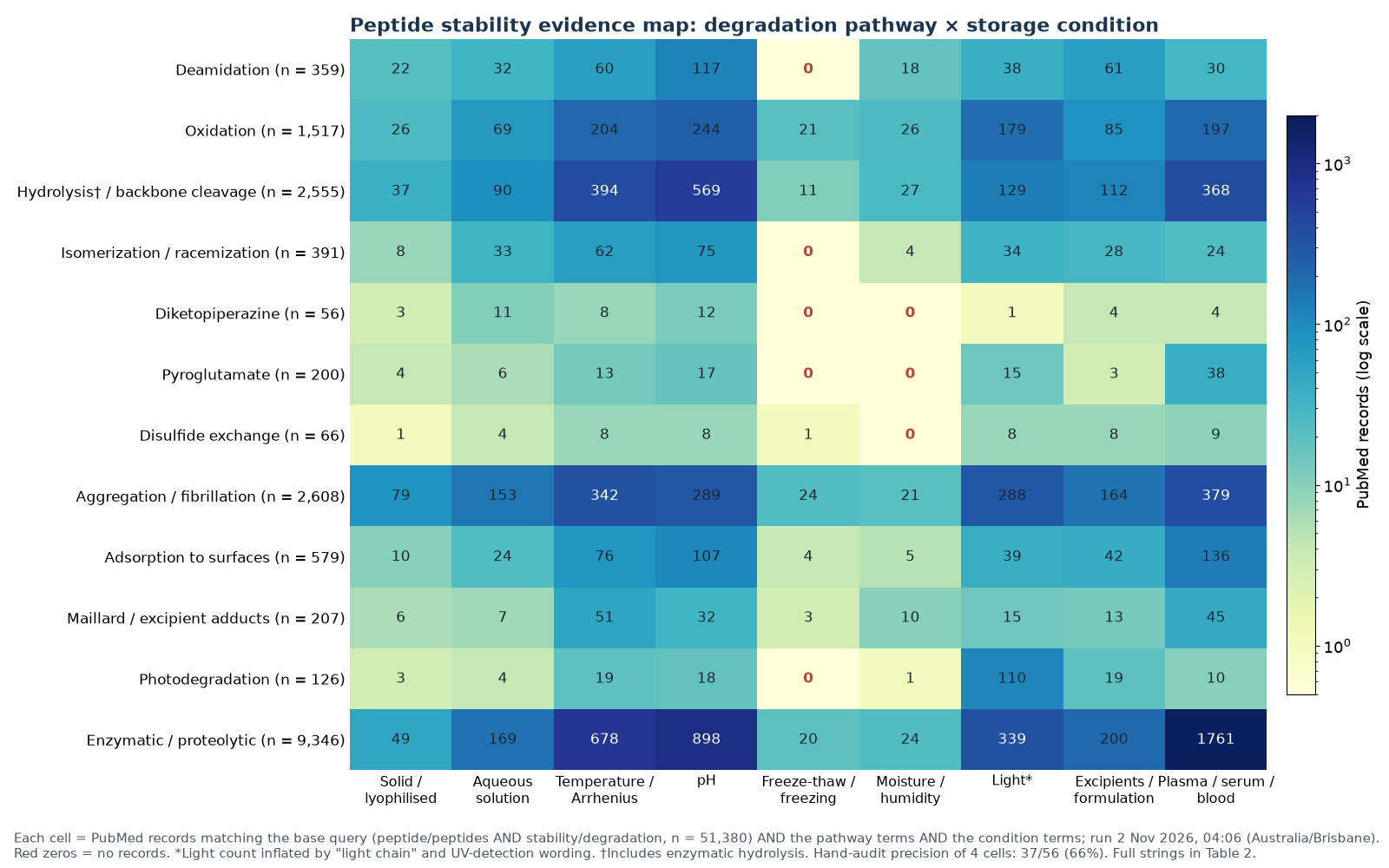
Testing references updated 1 November 2026 for the published Kovera Labs report set. Original research and catalogue snapshot dates remain as stated.