
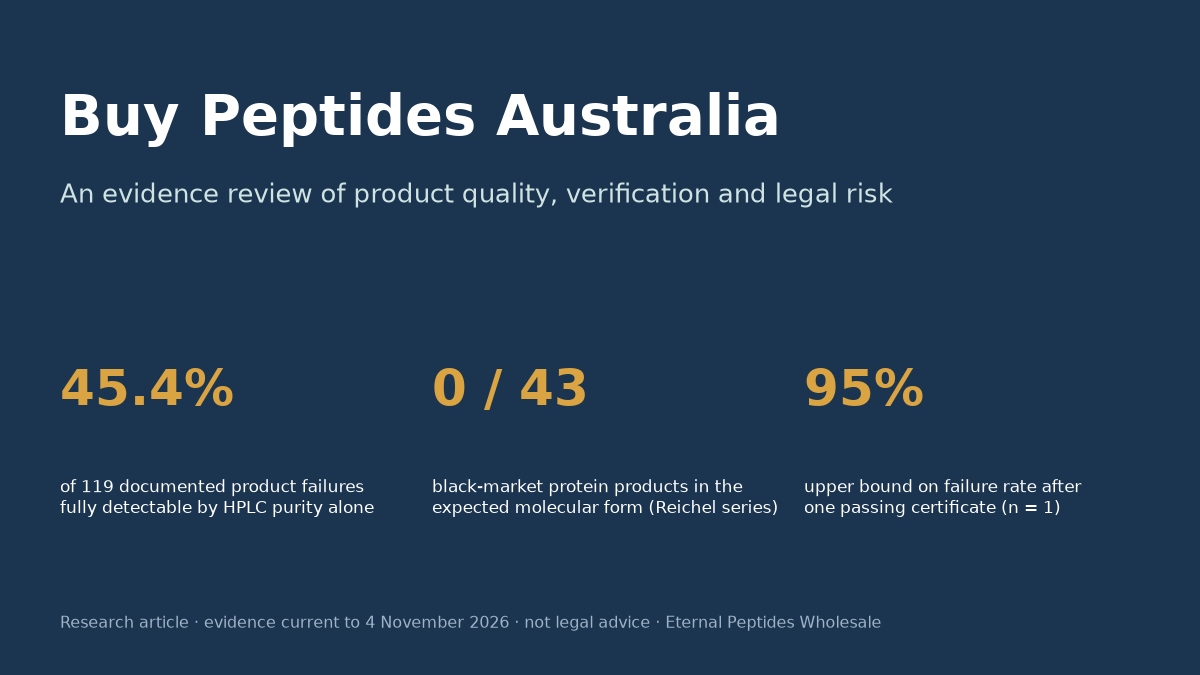
People who search buy peptides Australia are usually asking two questions together: what is actually inside the vial, and what the law says about bringing it into the country. This review answers both from primary sources. It re-analyses every published product-testing study we could find in which peptide or protein products from online, black-market or seized sources were measured in a laboratory. It then maps the documented failure modes against the tests that appear on a certificate of analysis and sets the Australian legal gates out at source.
Structured abstract
Background. Commercial pages for the phrase “buy peptides Australia” usually describe quality with a single number, such as a purity percentage printed on a certificate of analysis (COA), and describe legality with a “research use only” label. The Therapeutic Goods Administration (TGA) stated in 2026 that research-use disclaimers do not make supply lawful and do not change whether a product is a therapeutic good [1, 2]. Independent laboratory studies have reported products with no active ingredient, the wrong molecular form, or a content far from the label [3, 4, 5]. No published synthesis has asked how much of this documented failure a typical certificate would actually detect.
Objective. To build a reproducible, quantitative verification and risk framework for people researching the purchase of peptides in Australia. The framework has three parts: re-tabulated product-testing evidence, a failure-mode by test-coverage analysis of the COA, and the Australian legal gates cited at their primary source.
Methods. We ran ten documented PubMed searches through NCBI E-utilities on 4 November 2026, which returned 1,077 records before de-duplication, and used Europe PMC and citation chasing to find further studies [6, 7]. We included studies that reported a numerator and a denominator for product identity, form, content or purity. We re-calculated each proportion with a Wilson 95% confidence interval [8, 9, 10]. Each product-level failure was coded against nine laboratory tests. Zero-failure acceptance bounds were derived from the binomial model [11, 12, 13]. Legal gates were read from TGA, Australian Border Force (ABF), Office of Drug Control (ODC) and Federal Register of Legislation sources [14, 15, 16, 17].
Results. Across 17 extracted outcomes from 12 studies, black-market protein products contained the expected molecule in the expected molecular form in 0 of 43 cases (95% CI 0–8.2%) [3, 18, 19]. In a supplier-certified research set, 43 of 98 synthetic peptides (43.9%) met the purity printed on their certificates [20]. Products sold as retatrutide in Australia carried the correct molecule but contained 51% to 190% of the labelled amount [5]. Of 119 counted product-level failures, an HPLC purity figure alone would fully detect 54 (45.4%). Adding intact-mass spectrometry raises this to 108 (90.8%), and adding a quantitative content assay raises it to 117 (98.3%). Excluding the one purity-claim study, HPLC purity alone fully detects 0 of the 64 remaining failures. A single passing certificate, read as a sample of one, leaves a 95% upper bound of 95% on the batch failure rate. That bound falls below 10% only after 29 consecutive passing tests.
Conclusions. The published evidence shows that a purity percentage cannot verify identity, molecular form or quantity, and that one certificate is weak statistical evidence about a batch. Australian law turns on how a product is represented and imported, not on its label. A “research use only” statement is not legal clearance [1].
What is new here. As far as we could find, this is the first review to (1) re-tabulate published peptide product-testing results with per-study confidence intervals, keeping peptides separate from steroid comparators; (2) quantify, from 119 counted failures, how much documented product failure each COA test would detect; and (3) translate zero-failure binomial bounds into a plain reading of “one certificate”. These three analyses, together with the legal gates in Table 2, form an evidence-graded checklist. Every item in it traces to a cited standard or regulator statement.
Key findings
- In three black-market protein studies, 0 of 43 products contained the expected molecule in the expected form; 30 carried an undeclared tag or the wrong form and 13 contained none of the expected protein [3, 18, 19].
- A purity percentage measures chromatographic peak area. It cannot show that the main peak is the right molecule or that the vial holds the labelled amount [21, 22].
- Of 119 counted failures, HPLC purity alone fully detects 45.4%. Mass spectrometry plus a quantitative content assay raises coverage to 98.3%.
- One passing test leaves a 95% upper bound of 95% on a batch failure rate; 29 passes are needed to bring it below 10%, and 59 to bring it below 5% [12].
- The TGA says research-use-only disclaimers do not make supply lawful, and that code-only or unlabelled vials will not be released under the Personal Importation Scheme [1, 23].
- Importing prohibited goods without permission can lead to seizure and penalties of up to 2,500 penalty units or 10 years’ imprisonment [15].
Contents
- Introduction
- Methods
- Results 1: buy peptides Australia legal gates
- Results 2: what published product testing found
- Results 3: what a certificate of analysis can detect
- Results 4: how much one certificate proves
- Results 5: an evidence-graded verification checklist
- Discussion
- Limitations
- Relevance to Eternal Peptides Wholesale
- Conclusion
- Glossary
- Frequently asked questions
- References
Introduction
Australian searches for peptides grew sharply in 2026. So did regulator attention. Between April and October 2026 the TGA issued safety advisories on unapproved peptide products, announced a compliance focus, put promoters and suppliers on notice and reported enforcement outcomes [1, 23, 24, 25, 26]. The TGA and the Chief Medical Officer issued a joint statement on the public health risks [27]. NSW Health reported a rise in hospital presentations linked to peptide use [28]. Public health and consumer bodies, including healthdirect, the Alcohol and Drug Foundation and Healthy Male, published plain-language explainers [29, 30, 31].
The peer-reviewed literature has followed the same arc. Australian researchers have described illicit injectable peptides as a regulatory gap [32] and set out priorities for clinicians responding to injectable synthetic peptide use among young people [33]. They have also argued that harm-reduction thinking developed for steroids now needs to extend to peptides [34]. International reviews describe a grey market of products with uncertain identity, purity, potency and sterility, promoted through digital channels [35, 36, 37].
This article sits inside that context, but it asks a narrower and more technical question. When someone researches how to buy peptides in Australia, what can laboratory evidence and the law actually tell them before any purchase decision? The question has a quality half and a legal half, and the two are linked. The TGA’s own statements connect them: a product that is “not clearly labelled, including products identified only by codes” cannot be assessed for lawful importation, and the TGA lists “not knowing what’s in the vial” among the biggest risks [1, 23].
Why another review is needed
The companion paper on this site, Peptides Australia: An Evidence Map of the Regulatory Framework, classified 26 substances across the Poisons Standard, possession controls, import permits and the anti-doping list. It did not examine product quality. An earlier paper, Synthetic Peptides: Manufacture, Impurities and Analytical Verification, explained how peptides are made and tested. It did not ask how often products in the market fail, or which tests would catch those failures. This review fills the space between the two. It does not repeat their content. Readers who need the full scheduling history should go to the regulatory evidence map.
The existing pages that rank for buy peptides Australia have three gaps, which we describe in the Methods. First, they rarely cite primary product-testing studies, and none we found re-calculated those studies’ numbers. Second, they treat “HPLC purity” as if it answered the identity and quantity questions, which analytical guidelines say it does not [21, 22]. Third, they describe the law in general terms without quoting the regulator’s text on research-use labels, unlabelled vials or seizure [1, 23, 15].
Research questions
- What legal gates apply in Australia before a peptide product could be lawfully imported, supplied or possessed, as stated by the primary sources?
- In published studies that measured peptide and protein products from online, black-market or seized sources, how often did products contain the right molecule, in the right form and at the labelled amount?
- Which of those documented failures would each test commonly reported on a certificate of analysis detect?
- How much statistical assurance does a small number of passing certificates provide about a batch?
- What verification checklist follows from cited standards and regulator statements, rather than from marketing claims?
We do not address the effects of any peptide in the body. We make no claims about benefits or safety in use, and we give no information on dosing or administration. Several of the studies we cite concern products that people injected; we cite them only for what laboratories found in the products.
Methods
Design
This is a structured evidence review with three original secondary analyses. We did not buy, handle or test any product. Every number in the results is either taken directly from a cited source or calculated from such numbers, with the calculation shown. The review was planned and carried out between 3 and 4 November 2026 (Australia/Brisbane).
Review of existing search results
To define the gap, we read the leading results returned for “buy peptides australia” and three related phrases on 4 November 2026. Most were commercial storefront, “about” or certificate-library pages. The rest were regulator pages and legal commentary. The commercial pages typically showed a purity percentage and an “Australian” or “research use only” statement. None reported published product-testing numbers or explained which failures a purity figure cannot detect. The regulator and legal pages quoted the law accurately but did not address analytical verification. We do not name, rank or quote any vendor, and none of their text was reused. A generic description of these results is kept in the editorial file for this article.
Literature searches
We searched PubMed through the NCBI E-utilities interface [6] with the ten strings in Table 1, covering product quality from illicit, online or seized sources; mislabelling; internet sourcing; supplier certificates; research-chemical framing; Australian testing studies; counter-ion and net peptide content; endotoxin contamination; purity assignment methods; and binomial interval methods. The ten strings returned 1,077 records before de-duplication. We also searched Europe PMC [7], including its preprint index, and followed reference lists and citing articles of included studies. The Australian product-testing studies were found mainly in this way: search S6 returned 95 records, but none was an additional eligible product-testing study, because the term “composition” captured venom and food chemistry papers.
| Search | Concept | PubMed string (field tags as run) | Records |
|---|---|---|---|
| S1 | Product quality of peptides from illicit, online or seized sources | (peptide*[tiab] OR "peptide hormone*"[tiab] OR "growth hormone"[tiab] OR polypeptide*[tiab]) AND (counterfeit*[tiab] OR falsified[tiab] OR "black market"[tiab] OR confiscated[tiab] OR seized[tiab] OR illegal[tiab] OR illicit[tiab]) AND (identif*[tiab] OR purity[tiab] OR content[tiab] OR quantif*[tiab] OR impurit*[tiab]) | 124 |
| S2 | Mislabelling or adulteration of peptide products | (peptide*[tiab] OR "growth hormone"[tiab]) AND (mislabel*[tiab] OR adulterat*[tiab] OR "label accuracy"[tiab] OR "labelling accuracy"[tiab] OR "labeling accuracy"[tiab] OR "undeclared"[tiab]) | 186 |
| S3 | Internet-sourced peptide products | (peptide*[tiab] OR "growth hormone"[tiab]) AND (internet[tiab] OR online[tiab]) AND (purity[tiab] OR content[tiab] OR counterfeit*[tiab] OR quality[tiab]) AND (analys*[tiab] OR "mass spectrometry"[tiab] OR HPLC[tiab] OR chromatograph*[tiab]) | 322 |
| S4 | Supplier certificates for synthetic peptides | ("certificate of analysis"[tiab] OR "certificates of analysis"[tiab]) AND (peptide*[tiab] OR purity[tiab]) | 16 |
| S5 | Research-chemical framing | ("research peptide*"[tiab] OR "research chemical*"[tiab] OR "research use only"[tiab] OR "not for human consumption"[tiab]) AND (peptide*[tiab] OR purity[tiab] OR counterfeit*[tiab]) | 23 |
| S6 | Australian product-testing and drug-checking studies | (steroid*[tiab] OR peptide*[tiab] OR "performance and image enhancing"[tiab] OR PIED*[tiab] OR IPED*[tiab]) AND ("drug checking"[tiab] OR "drug testing service"[tiab] OR "steroid testing"[tiab] OR "community testing"[tiab] OR composition[tiab] OR "labelling accuracy"[tiab] OR contaminant*[tiab]) AND (Australia[tiab] OR Australian[tiab] OR Australia[mh]) | 95 |
| S7 | Counter-ion and net peptide content | (trifluoroacet*[tiab] OR TFA[tiab] OR counterion*[tiab] OR "counter-ion*"[tiab] OR "net peptide content"[tiab] OR "peptide content"[tiab]) AND (synthetic[tiab]) AND (peptide*[tiab]) AND (quantif*[tiab] OR determination[tiab] OR content[tiab]) | 88 |
| S8 | Endotoxin in synthetic or research peptide preparations | (endotoxin*[tiab] OR lipopolysaccharide[tiab] OR LPS[tiab]) AND (contaminat*[tiab]) AND (peptide*[tiab]) AND (commercial[tiab] OR synthetic[tiab] OR reagent*[tiab]) | 13 |
| S9 | Purity assignment methods for synthetic peptides | (peptide*[tiab]) AND ("mass balance"[tiab] OR "quantitative NMR"[tiab] OR qNMR[tiab] OR "amino acid analysis"[tiab] OR "isotope dilution"[tiab]) AND (purity[tiab] OR "reference standard*"[tiab]) | 123 |
| S10 | Zero-numerator and binomial interval methods | ("rule of three"[tiab] OR "zero numerator*"[tiab] OR "single proportion"[tiab]) AND (confidence[tiab]) | 87 |
| Total | Before de-duplication | — | 1,077 |
Eligibility for the re-tabulation
A study was eligible for Table 3 if it (a) analysed peptide or protein products obtained online, on the black market, by seizure, or with a supplier’s certificate; (b) used a stated analytical method; and (c) reported a numerator and denominator for at least one of identity, molecular form, content against label or purity against a stated specification. Single-product case reports were not tabulated as proportions but were used as qualitative evidence of failure modes. We added steroid and selective androgen receptor modulator (SARM) testing studies, including Australian community testing, as clearly labelled comparators. They are never pooled with the peptide results. One 2026 preprint was used only in the discussion and is flagged as not peer reviewed [38].
Extraction and statistics
For each outcome we extracted x (products meeting the criterion) and n (products tested) from the abstract or full text. We calculated the Wilson score interval, which performs well for small samples and proportions near 0 or 1 [8, 9, 10, 39]:
CI = [p + z²/2n ± z·√(p(1−p)/n + z²/4n²)] / (1 + z²/n), with p = x/n and z = 1.96.
For example, Verbeke and colleagues reported that 43 of 98 synthetic peptides met their ordered purity [20]. Here p = 0.4388, z²/n = 0.0392, the centre is (0.4388 + 0.0196)/1.0392 = 0.4411, and the half-width is 1.96 × √(0.002512 + 0.000100)/1.0392 = 0.0964. The interval is therefore 34.5% to 53.7%. We pooled only within a single research group’s method series (Reichel and colleagues) and reported a large community dataset separately [40]. Different designs, sources and outcomes make a pooled market-wide failure rate meaningless, so we did not calculate one.
Failure-mode by test-coverage analysis
We coded every counted product-level failure into one of eleven failure modes, for example “active ingredient absent” or “content outside ±10% of label”. We then rated nine laboratory tests against each mode as 2 (detects), 1 (partially or indirectly detects) or 0 (does not detect). The ratings are based on what each technique measures, as described in ICH Q2(R2), ICH Q6B, ICH Q3D(R2) and the European Medicines Agency (EMA) guideline on synthetic peptides [21, 41, 42, 22], and on the methods the source studies used. A failure was counted as “detected” by a test panel only when at least one test in the panel scored 2. The coding is our own, it is shown in full in Table 4, and readers can change it.
Acceptance-sampling bounds
If n independent samples all pass, the one-sided 95% upper confidence bound on the true failure proportion is 1 − 0.051/n, the Clopper-Pearson bound for a zero numerator [11]. The “rule of three”, 3/n, approximates this for large n [12, 13]. We compared both with lot acceptance-sampling principles from the NIST/SEMATECH handbook [43].
Legal sources
Legal statements were taken from the primary text of the Therapeutic Goods Act 1989, the Customs Act 1901, the Customs (Prohibited Imports) Regulations 1956, the Poisons Standard October 2026 (F2026L01327) and the Competition and Consumer Act 2010 on the Federal Register of Legislation [44, 45, 46, 17, 47], and from TGA, ABF, ODC, Sport Integrity Australia and WADA pages, each requested and read on 3 or 4 November 2026 [2, 15, 48, 49, 50]. Where a statement depends on interpretation, we flag it rather than resolve it.
Results 1: buy peptides Australia legal gates, cited at source
The legal half of the buy peptides Australia question is often answered with one word, “legal” or “illegal”. The primary sources show a series of gates instead. Each depends on what the product is, how it is represented and how it crosses the border. Table 2 sets out eleven gates. The detailed scheduling of individual substances is in the companion regulatory evidence map and is not repeated here.
Gate 1: is the product a therapeutic good?
Section 3 of the Therapeutic Goods Act 1989 defines therapeutic goods broadly. The definition includes goods represented or likely to be taken to be for use in humans in connection with “influencing, inhibiting or modifying a physiological process” [44, 51]. The TGA states that peptide products regulated as therapeutic goods “must be included in the ARTG before they can be imported, manufactured, supplied, exported or advertised”, unless an exemption, approval or authority applies [2, 52]. Products not in the Australian Register of Therapeutic Goods (ARTG) are “unapproved”, and the lawful routes to them are limited to defined access pathways [53].
The key point for anyone researching how to buy peptides is that classification turns on representation and likely use, not on the words on a label. The TGA says that disclaimers that a product is for “research use only” or “not for human use” “do not change whether a product is regulated as a therapeutic good” [2]. Its April 2026 advisory goes further. Such disclaimers “do not: change a product’s regulatory status, permit importation, or remove advertising or supply obligations” [1]. Sport Integrity Australia similarly notes that peptides are often sold labelled as research chemicals or “not for human consumption” [49]. Whether a particular product, sold in a particular way, is a therapeutic good is a question of fact and law that this review cannot answer for any reader. That is why we flag it rather than resolve it.
Gate 2: scheduling under the Poisons Standard
The Poisons Standard October 2026 (F2026L01327), registered on 30 September 2026, is the current instrument [17]. Many peptide substances, including growth-hormone-related peptides and melanotan II, sit in Schedule 4 (prescription only). Several growth-hormone-related substances are also listed in Appendix D, clause 5, which covers poisons that it is illegal to possess without authority [17]. The TGA notes that “many approved peptide-based medicines are prescription-only” [2]. States and territories give effect to scheduling through their own laws, and the TGA warns that “state and territory laws may impose additional controls” [1]. A substance-by-substance table is in the regulatory evidence map.
Gate 3: peptide import Australia rules and the Personal Importation Scheme
The Personal Importation Scheme (PIS) is the route most often discussed in relation to peptide import into Australia. Its conditions, quoted from the TGA page updated on 8 September 2026, are narrow [14]:
- the goods are for the importer or an immediate family member and “cannot be sold, supplied or given away”;
- for a prescription-only medicine, the importer must hold a valid Australian prescription, or written authority, at the time of importation, and eScripts are not accepted as that written authority;
- each import is no more than a 3-month supply at the maximum prescribed dose, and no more than a 15-month supply is imported in 12 months;
- the goods must not “contain a controlled substance” or be otherwise prohibited under customs or biosecurity law;
- “counterfeit (fake) medicines… are prohibited from being imported under any circumstances”.
The same page states that products imported under the scheme “are not evaluated by us, meaning their safety, quality and efficacy cannot be guaranteed”, and that non-compliant imports “may be seized resulting in the loss of both the items and the money spent” [14]. The scheme is therefore not a quality assurance route. It is a narrow legal exemption that leaves quality unverified.
Gate 4: labelling at the border
The TGA’s May 2026 warning is the clearest statement linking product quality and legality. “Products referred to the TGA by the ABF are often poorly labelled,” it says, and “unmarked vials, code‑only labels, or missing ingredient and dosing information are major red flags” [23]. Products that are not clearly labelled “cannot be assessed for lawful importation under the Personal Importation Scheme, and will not be considered for release” [1]. For those products the TGA “will notify the ABF to seize and destroy” them [23]. In July 2026 the TGA reported increasing interception of unlabelled vials and noted that labelling a blank vial can itself be a manufacturing step [25].
Gate 5: controlled imports
Regulation 5G and Schedule 7A of the Customs (Prohibited Imports) Regulations 1956 prohibit importing listed substances without a permit [46]. The list includes anabolic or androgenic substances, erythropoietin, gonadotrophins, and natural and manufactured growth hormones, including somatomedins, insulin-like growth factors and growth-hormone-releasing hormones and their synthetic analogues [46, 16]. The Office of Drug Control (ODC) states that import is prohibited unless the importer holds an ODC permit [48]. The ABF warns that it “may seize your goods” and that “penalties of up to 2,500 penalty units or 10 years imprisonment, or both” can apply [15, 45]. Which penalty provision applies to a given import is a legal question that we flag for review.
Gates 6 to 8: advertising, enforcement and consumer law
Prescription-only medicines and unapproved therapeutic goods cannot be advertised to the public [54, 1]. In 2026 the TGA added unapproved peptide products to its compliance priorities [24, 55]. It put promoters and suppliers on notice that consequences range from warning letters to prosecution [25], and it reported warrants, seizures and penalties [26, 56, 57]. The August 2026 release cites civil penalties of up to $1.82 million per breach for individuals and $18.2 million for corporations, and criminal penalties of up to 7 years’ imprisonment [26]. Representations made in trade are also subject to the Australian Consumer Law in Schedule 2 of the Competition and Consumer Act 2010 [47].
Gate 9: sport
For athletes, legality and eligibility are separate. The WADA Prohibited List 2027, published on 26 August 2026 and in force from 1 January 2027, names many peptide classes. Section S0 covers non-approved substances, which are prohibited at all times [50, 58, 59]. Sport Integrity Australia warns that a therapeutic use exemption is unlikely to be granted for an unregistered medicine [49]. Global DRO is the public lookup tool [60].
| Gate | What the primary source says | Source | Practical meaning |
|---|---|---|---|
| 1. Therapeutic good? | Represented or likely to be taken for use in humans, including modifying a physiological process | Therapeutic Goods Act s3; TGA [44, 51, 2] | A research-use label does not change the classification |
| 2. ARTG entry | Must be in the ARTG before import, manufacture, supply, export or advertising, unless an exemption applies | TGA [2, 52, 53] | Unapproved products give no assurance on labelling, sterility or quality |
| 3. Research-use disclaimer | Does not change regulatory status, permit importation or remove obligations | TGA advisory, 13 April 2026 [1] | Never treat as legal clearance |
| 4. Scheduling | Many peptides are Schedule 4; some are in Appendix D, clause 5; states add controls | Poisons Standard Oct 2026 (F2026L01327) [17, 1] | Substance-level detail in the regulatory evidence map |
| 5. Personal Importation Scheme | Personal or family use only; prescription for Sch 4; 3-month and 15-month limits; no controlled substances; counterfeits prohibited | TGA PIS page, 8 Sept 2026 [14] | Quality and safety are not evaluated |
| 6. Labelling at the border | Code-only or unlabelled vials will not be released and may be seized and destroyed | TGA, 13 April and 7 May 2026 [1, 23, 25] | Links legality directly to labelling quality |
| 7. Controlled imports | Schedule 7A substances need an ODC permit | Customs (Prohibited Imports) Regs r5G; ODC [46, 48, 16] | Includes growth hormones, IGFs and GHRH analogues |
| 8. Seizure and penalties | Goods may be seized; up to 2,500 penalty units or 10 years’ imprisonment | ABF; Customs Act [15, 45] | Applicable provision needs legal review |
| 9. Advertising | No public advertising of prescription-only or unapproved goods | TGA [54] | Applies to promoters as well as suppliers |
| 10. Enforcement | Infringement notices, seizure, civil penalties, prosecution | TGA releases, June to Sept 2026 [24, 25, 26, 56, 57, 61] | Active enforcement in 2026 |
| 11. Sport | Many peptide classes prohibited; S0 prohibited at all times | WADA 2027 List; SIA [50, 49, 60] | Separate from legality |
Two further points follow from Table 2. First, none of the gates is passed by a certificate of analysis. A COA is quality evidence, not legal authority, and the TGA’s own laboratories describe testing as no “replacement for other regulatory controls (such as GMP…)” [62, 63]. Second, several gates depend on facts only an expert can assess, such as whether a product is represented for human use, which schedule entry applies, and whether a state law adds controls. The editorial notes for this article list them as legal-review items.
Results 2: what published product testing found
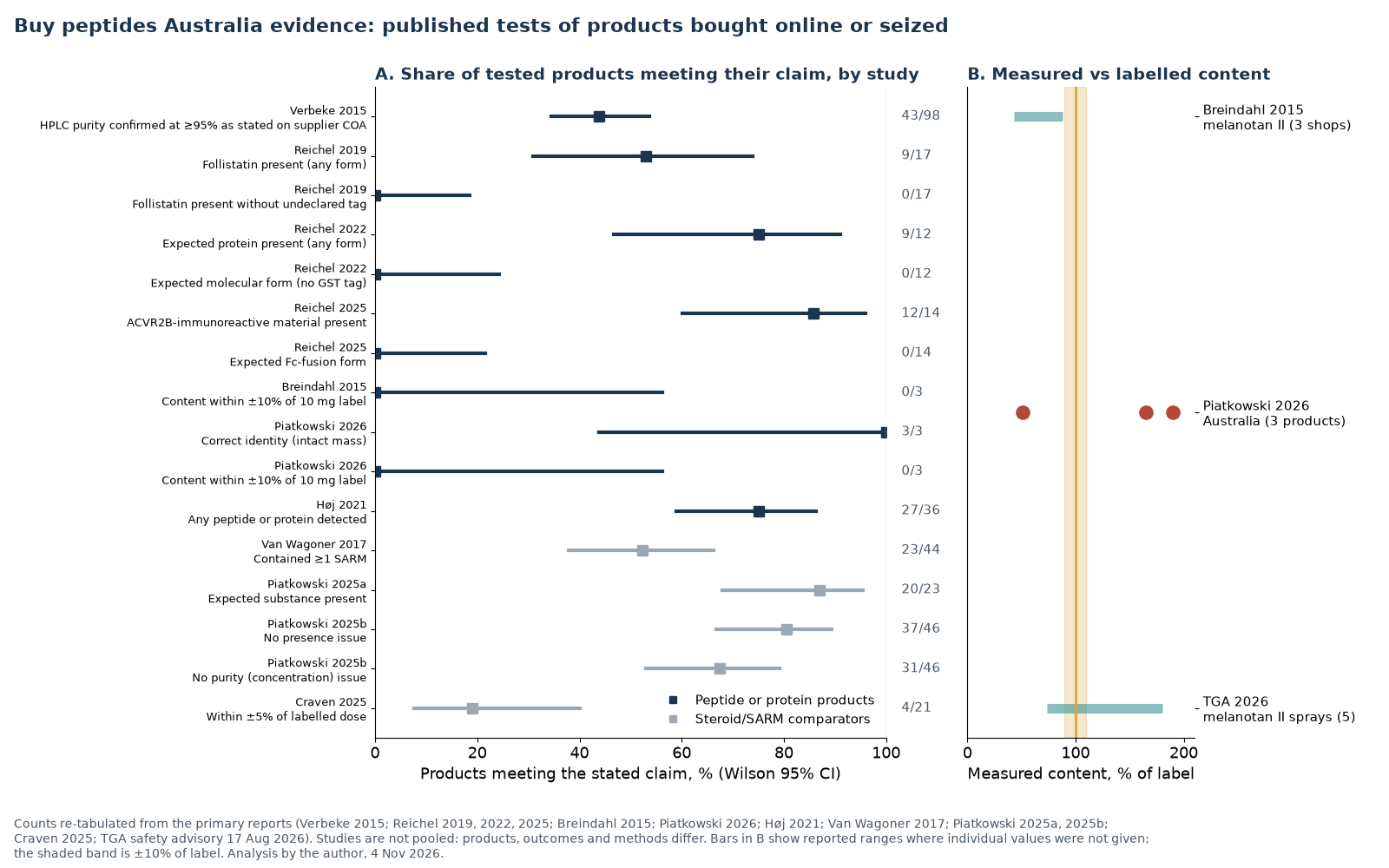
Twelve studies met the inclusion criteria and contributed 17 outcomes, which are shown with recalculated confidence intervals in Table 3 and Figure 1. A further group of studies documented failure modes in individual products without a usable denominator, and we use them qualitatively. The picture is consistent across countries, decades and laboratories. Products sold outside regulated supply chains often contain something, but less often the right thing in the right form at the right amount.
| Study and product set | Outcome (as defined by the source) | x/n | Proportion | Wilson 95% CI |
|---|---|---|---|---|
| Verbeke 2015: research-grade synthetic peptides, ordered at ≥95% purity [20] | HPLC purity confirmed at ≥95% as stated on supplier COA | 43/98 | 43.9% | 34.5–53.7% |
| Reichel 2019: black-market follistatin 344 [3] | Follistatin present (any form) | 9/17 | 52.9% | 31.0–73.8% |
| Reichel 2019: black-market follistatin 344 [3] | Follistatin present without undeclared tag | 0/17 | 0.0% | 0.0–18.4% |
| Reichel 2022: black-market myostatin propeptide [18] | Expected protein present (any form) | 9/12 | 75.0% | 46.8–91.1% |
| Reichel 2022: black-market myostatin propeptide [18] | Expected molecular form (no GST tag) | 0/12 | 0.0% | 0.0–24.2% |
| Reichel 2025: black-market ACE-031 [19] | ACVR2B-immunoreactive material present | 12/14 | 85.7% | 60.1–96.0% |
| Reichel 2025: black-market ACE-031 [19] | Expected Fc-fusion form | 0/14 | 0.0% | 0.0–21.5% |
| Breindahl 2015: melanotan II from 3 online shops [4] | Content within ±10% of 10 mg label | 0/3 | 0.0% | 0.0–56.1% |
| Piatkowski 2026: products sold as retatrutide, Australia [5] | Correct identity (intact mass) | 3/3 | 100.0% | 43.9–100.0% |
| Piatkowski 2026: products sold as retatrutide, Australia [5] | Content within ±10% of 10 mg label | 0/3 | 0.0% | 0.0–56.1% |
| Høj 2021: seized peptide/protein doping products, Denmark [64] | Any peptide or protein detected | 27/36 | 75.0% | 58.9–86.2% |
| Van Wagoner 2017: SARM products sold online (comparator) [65] | Contained ≥1 SARM | 23/44 | 52.3% | 37.9–66.2% |
| Piatkowski 2025a: CheQpoint AAS testing, Brisbane (comparator) [66] | Expected substance present | 20/23 | 87.0% | 67.9–95.5% |
| Piatkowski 2025b: AAS testing, Queensland (comparator) [67] | No presence issue | 37/46 | 80.4% | 66.8–89.3% |
| Piatkowski 2025b: AAS testing, Queensland (comparator) [67] | No purity (concentration) issue | 31/46 | 67.4% | 53.0–79.1% |
| Craven 2025: AAS samples, Australia (comparator) [68] | Within ±5% of labelled dose | 4/21 | 19.0% | 7.7–40.0% |
| Reichel series combined (same group and methods) [3, 18, 19] | Expected protein present (any form) | 30/43 | 69.8% | 54.9–81.4% |
| Reichel series combined [3, 18, 19] | Expected molecule in expected form | 0/43 | 0.0% | 0.0–8.2% |
| Bonenti 2026: PEDTest community reagent reports, Australia, 2022 to 2024 (comparator) [40] | Confirmed legitimate (reagent test) | 1,423/2,068* | 68.8% | 66.8–70.8% |
Identity and molecular form: the protein studies
The most striking results come from a series by Reichel and colleagues, who used SDS-PAGE, Western blotting and mass spectrometry on black-market protein products sold for “research purposes” [3, 18, 19]. Only 9 of 17 products labelled follistatin 344 contained follistatin. Growth-promoting peptides were found in some of the others, and all nine follistatin-containing products carried an undeclared His-tag and a high degree of oligomers [3]. Of 12 myostatin propeptide products, 9 contained the protein. In those nine the main compound had a mass of about 54 to 55 kDa rather than the expected 33 kDa, because a full-length glutathione S-transferase tag was still attached [18]. Of 14 products sold as ACE-031, an Fc-fusion protein, 12 contained activin receptor material, but it was the full-length receptor and not the fusion protein. A protease that cleaves Fc regions could not cleave the products [19].
Combining the three studies, which share a group and method, the expected protein was present in some form in 30 of 43 products (69.8%; 95% CI 54.9–81.4%). The expected molecule in the expected form was present in 0 of 43 (95% CI 0–8.2%). The upper limit uses the Wilson formula with x = 0, which reduces to z²/(n + z²) = 3.8415/46.8415 = 0.082. The same pattern of undeclared expression tags was reported earlier, when an unknown thioredoxin fusion protein with a His-tag was found in unlabelled black-market products from independent sources [69]. The Cologne laboratory has repeatedly reported vials labelled as growth hormone with no active content, unpurified growth-factor material, and analogue peptides with an extra N-terminal glycine [70, 71, 72]. Seized materials have also contained glycine-modified secretagogues and a previously undescribed analogue [73, 74].
These failures matter for verification because an HPLC purity figure cannot reveal them. A tagged protein or a glycine-extended peptide can give a clean main peak. Only a method that measures mass or sequence, or that separates by molecular size, shows that the main peak is the wrong molecule [41, 22].
Seized and confiscated products
Customs and forensic laboratories provide a second line of evidence. In Copenhagen in 2019, 36 seized samples were submitted for peptide or protein analysis using LC-UV, LC-TOF-MS, a colorimetric protein assay and an immunoassay. Fifteen contained a prohibited doping substance, 12 contained a non-prohibited substance and 9 contained no peptide or protein at all [64]. Peptide or protein material was therefore detected in 27 of 36 (75.0%; 95% CI 58.9–86.2%). In Norway, peptide and protein substances were identified in 28% of black-market products confiscated between 2011 and 2014 [75]. At the Swiss border, 146 (12%) of 1,190 seized products were peptide hormones or growth factors, and fewer than 20% of all products contained the claimed substance in the claimed amount [76]. Belgian control laboratories have repeatedly identified research peptides, including some with no completed clinical trials, in seized unknown preparations. They developed screening methods specifically because labels could not be trusted [77, 78, 79, 80, 81]. A Belgian study of samples containing molecules that have no international nonproprietary name or therapeutic code, a group that includes many research peptides, found that 83% came from the illegal market and 3% from the legal market [82]. Single-case analyses have characterised unlabelled vials by NMR and mass spectrometry [83] and confiscated research peptides by LC-MS [84].
Content against label
Identity alone is not enough. Content is a separate measurement, and in the studies that reported it, it was usually wrong. Breindahl and colleagues bought melanotan II from three online shops, each claiming 10 mg per vial. They measured 4.32 to 8.84 mg, which is 43.2% to 88.4% of the label, so none was within ±10% [4]. In 2026 the TGA reported that five melanotan II nasal sprays labelled 30 mg per 20 mL contained 22 to 54 mg, or 73% to 180% of the label (22/30 = 0.733; 54/30 = 1.80) [57]. An Australian study of products sold as retatrutide confirmed the correct molecule by intact mass in all three, but measured 5.13, 19.0 and 16.5 mg against a 10 mg label, or 51% to 190% [5]. Vida and colleagues found that somatropin products bought from websites contained significantly less active substance than labelled [85]. Janvier and colleagues reported large variation in the amount of active ingredient per unit, together with low purity, across the ten most common falsified peptide drugs bought from suspected illegal internet pharmacies in Belgium [86].
The direction of error was not consistent: some products were underfilled and some overfilled by almost double. This means that a purchaser cannot correct for mislabelling by assuming a typical shortfall. Only a quantitative content assay, reported against the label, answers the question [22, 21].
Purity claims on certificates
The most direct test of a supplier’s certificate comes from Verbeke and colleagues. They ordered 98 synthetic research peptides at a stated minimum purity of 95.0%, and “all the 98 peptides were accompanied by a certificate of analysis stating at least 95.0% purity”. Independent analysis confirmed that only 43 met this specification (43.9%; 95% CI 34.5–53.7%). One product (ID25) was a different, related sequence [20]. Choules and colleagues used quantitative NMR to show that two custom synthetic peptides contained 20% and 43% w/w of undeclared mannitol, which is transparent to UV detection and so invisible to standard HPLC. They concluded that “experimental verification supersedes trust” [87]. Esposito and colleagues identified a growth-hormone-releasing hormone analogue with incomplete C-terminal amidation [88]. Recombinant research proteins have also been shown to carry bacterial lipopolysaccharide [89, 90].
Microbial and elemental contamination
A Belgian case report found haemolytic Bacillus cereus in two illegal injectable peptide products [91]. Graham and colleagues cultured skin commensal organisms from underground-market vials [92]. Janvier and colleagues screened falsified peptides for elemental impurities and residual solvents [86, 93]. Craven and colleagues detected twelve heavy metals in Australian steroid products, and only 4 of 21 samples with a defined labelled dose were within ±5% of it [68]. A 2026 preprint that has not been peer reviewed analysed 6,441 test results for 14 consumer-marketed research peptides from a public independent-testing dataset. It reported measurable endotoxin in 15% of samples and failure rates of 41.6% to 71.1%, depending on the acceptance framework [38]. Because it is a preprint, we report it separately and do not count it in Table 4.
Australian comparators
Australia has one of the world’s most developed community testing programmes for performance and image-enhancing drugs. Most of its data concern steroids, not peptides, but they show what routine testing finds. In the CheQpoint pilot in Brisbane, 20 of 23 products contained the expected substance (87.0%) [66]. In a Queensland mixed-methods study, 37 of 46 had no presence issue and 31 of 46 had no concentration issue [67]. Across 2,068 PEDTest reagent reports from 2022 to 2024, 68.8% were confirmed legitimate, 12.9% were swapped, 7.0% contained no active ingredient and 11.4% were inconclusive [40]. Researchers have described how consumers respond to testing results and community notices [94, 95, 96], women’s particular difficulty obtaining genuine products [97], health care engagement among people who use these drugs [98], and international lessons for testing programmes [99]. In the United States, only 23 of 44 products marketed as SARMs (52.3%) contained one [65]. In a 2026 proof-of-concept study, a rapid mass-spectrometry screen detected at least one prohibited substance in each of 16 black-market products without false positives in certified supplements. Manual spectral review, however, identified only 68% of individual substances correctly [100].
The comparators are not evidence about peptides. They are included because they show that even well-established Australian testing services find a large minority of products to be mislabelled. They also show that the measurement chosen, whether a reagent colour test or quantitative chromatography, determines what can be found.
Results 3: what a peptide certificate of analysis can detect
A peptide certificate of analysis is a report of specific measurements on a specific sample. Its value depends on which measurements it contains, whether those measurements suit the failures that actually occur, and whether the sample represents the batch. This section deals with the first two questions. The third is in the next section.
What each test measures
Analytical guidelines are explicit that one test does not establish identity, purity and quantity together. ICH Q2(R2) sets different validation requirements for identification, impurity and assay procedures. It notes that a lack of specificity in one procedure can be compensated by “one or more other supporting analytical procedures” [21, 101]. ICH Q6B, which covers biotechnological products, states that a single test is often not enough to establish identity or purity [41]. The EMA guideline on synthetic peptides, adopted in December 2025, asks for identification by at least two orthogonal methods. It also asks for an assay on a “counter-ion free, anhydrous” basis, a stated counter ion, and the reporting, identification and qualification of peptide-related impurities “above 0.1%”, “above 0.5%” and “above 1.0%” respectively [22, 102]. In practice the tests divide as follows.
- HPLC-UV purity reports the main peak’s share of the UV-absorbing peak area. It does not identify the main peak. It cannot see compounds that do not absorb UV, such as mannitol [87], and its result can depend on chromatographic conditions, especially for basic peptides [103].
- Mass spectrometry of the intact molecule confirms that a component of the expected mass is present. It detects tags, wrong forms and most wrong substances, but it is not quantitative unless calibrated [22, 104].
- MS/MS or peptide mapping confirms the sequence and can locate modifications such as deamidation or incomplete amidation [104, 88, 4].
- Quantitative content, also called net peptide content or assay, measures how much peptide is actually present. It can be done by calibrated HPLC against a reference standard, by amino acid analysis or by quantitative NMR [22, 105, 106, 107, 108, 109].
- SDS-PAGE or size-exclusion chromatography separates proteins by size and reveals fusion tags, oligomers and aggregates [3, 18, 41].
- ICP-MS measures elemental impurities against the ICH Q3D permitted daily exposures [42].
- Bacterial endotoxin and sterility tests are separate microbiological measurements [90, 89, 91].
- Counter-ion analysis, usually ion chromatography for trifluoroacetate (TFA) or acetate, accounts for non-peptide mass [110, 111, 112].
Why purity is not content
Purity and content are often confused, and the difference can be large. Melanson and colleagues assigned a certified purity to an angiotensin II reference material by combining three orthogonal methods. TFA counter-ion made up nearly 25% of the mass, and the final assigned purity was 691 ± 9 mg/g, or 69.1% peptide by mass [106]. A peptide like this could show a single, clean HPLC peak and still contain less than 70% peptide by weight. Wang and colleagues used a mass balance approach for synthetic glucagon and oxytocin. They subtracted related impurities, water, counter-ions and residual solvents, which are measured separately, to reach an SI-traceable purity [107, 108]. Consensus work on TFA analysis recommends validated methods under ICH principles [112]. This is why the EMA asks for assay limits expressed on a counter-ion-free, anhydrous basis [22], and why pharmacopoeial reference standards underpin peptide quality control [105].
For a purchaser reading a peptide certificate of analysis, the practical point is this. A line saying “purity 99%” and a line saying “content 10 mg” are different claims, made with different tests. A certificate with only the first does not support the second.
Coverage of documented failures
Table 4 and Figure 2 cross the eleven documented failure modes against nine tests. Seven modes had countable product-level instances, giving 119 in total. Verbeke contributed 55 (54 purity failures plus one wrong sequence), the Reichel series 43 (30 tag or wrong-form products plus 13 with none of the expected protein), Høj 9, Breindahl 3, Piatkowski 3, Choules 2, Janvier 2, Esposito 1 and the TGA retatrutide alert 1. The sum is 55 + 43 + 9 + 3 + 3 + 2 + 2 + 1 + 1 = 119.
| Failure mode | Counted instances | Sources | HPLC-UV | MS mass | MS/MS | Content | SDS-PAGE/SEC | ICP-MS | Endotoxin | Sterility | Counter-ion |
|---|---|---|---|---|---|---|---|---|---|---|---|
| Active ingredient absent or a different substance | 23 | Reichel 2019/2022/2025 (8+3+2 = 13); Høj 2021 (9 with no peptide or protein); TGA 2026 retatrutide alert (1) | ◐ | ● | ● | ◐ | ◐ | — | — | — | — |
| Undeclared tag or wrong molecular form (proteins) | 30 | Reichel 2019 (9), 2022 (9), 2025 (12) | — | ● | ● | — | ● | — | — | — | — |
| Close analogue (e.g. N-terminal Gly) or wrong sequence | 1 | Verbeke 2015 ID25 (1); Krug 2018, Gajda 2019, Popławska 2019 (uncounted) | ◐ | ● | ● | — | — | — | — | — | — |
| Incomplete C-terminal amidation | 1 | Esposito 2014 (1) | ◐ | ◐ | ● | — | — | — | — | — | — |
| Purity below the stated specification | 54 | Verbeke 2015 (55 claims unconfirmed, less ID25 counted above) | ● | ◐ | ◐ | ◐ | — | — | — | — | — |
| Content outside ±10% of label | 6 | Breindahl 2015 (3); Piatkowski 2026 (3) | — | — | — | ● | — | — | — | — | — |
| Undeclared excipient (e.g. mannitol) | 2 | Choules 2020 (2) | — | — | — | ● | — | — | — | — | — |
| Elemental impurities (Pb, As) | 0 | Janvier 2018 (uncounted); Piatkowski 2026 (Pb below concern) | — | — | — | — | — | ● | — | — | — |
| Microbial contamination | 2 | Janvier 2018, Bacillus cereus case series (2) | — | — | — | — | — | — | — | ● | — |
| Bacterial endotoxin | 0 | Preprint dataset: 15% of samples (not counted here) | — | — | — | — | — | — | ● | — | — |
| Counter-ion (TFA) load not stated | 0 | Analytical literature; no counted product series | — | — | — | ◐ | — | — | — | — | ● |
| Total | 119 | ||||||||||
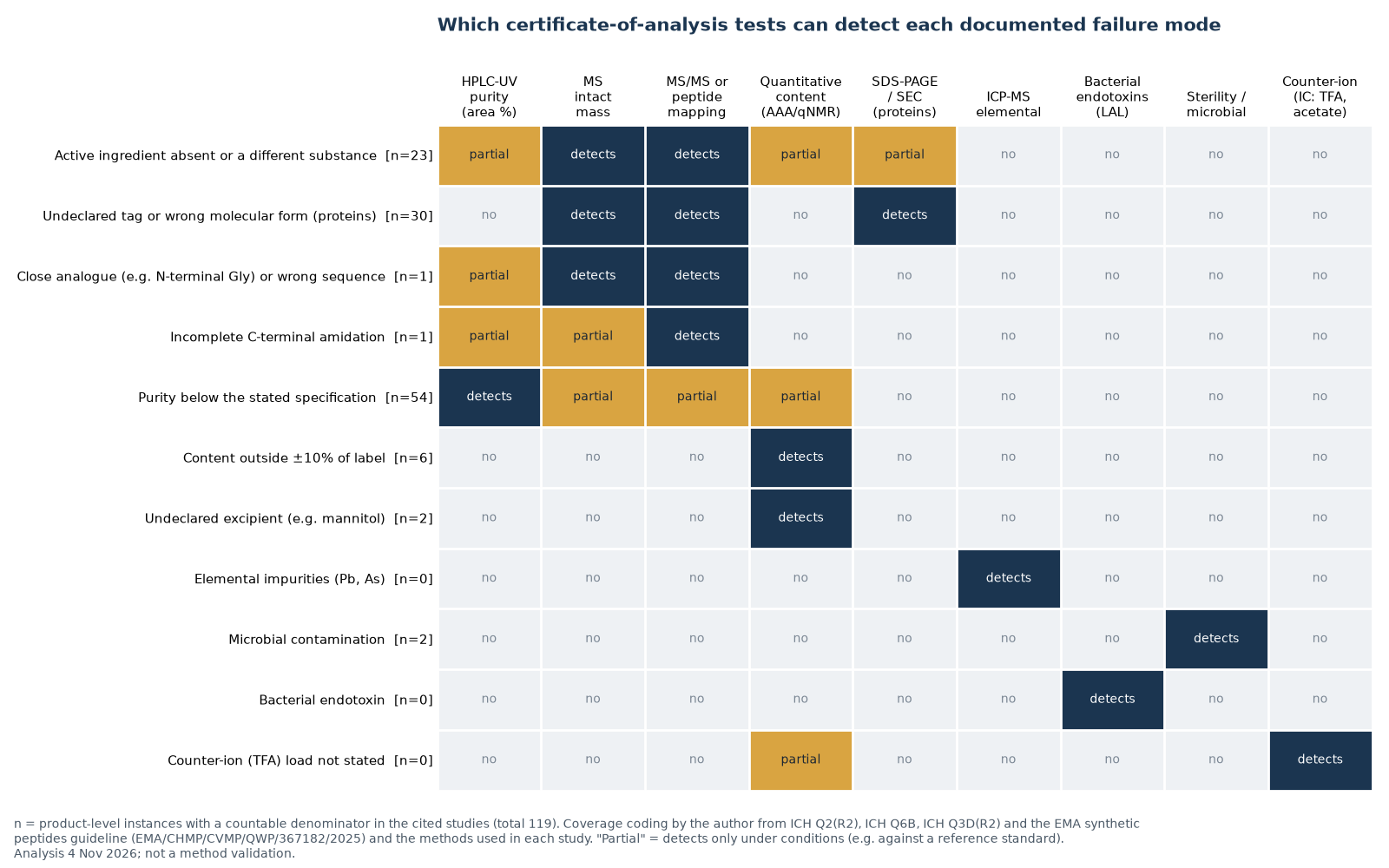
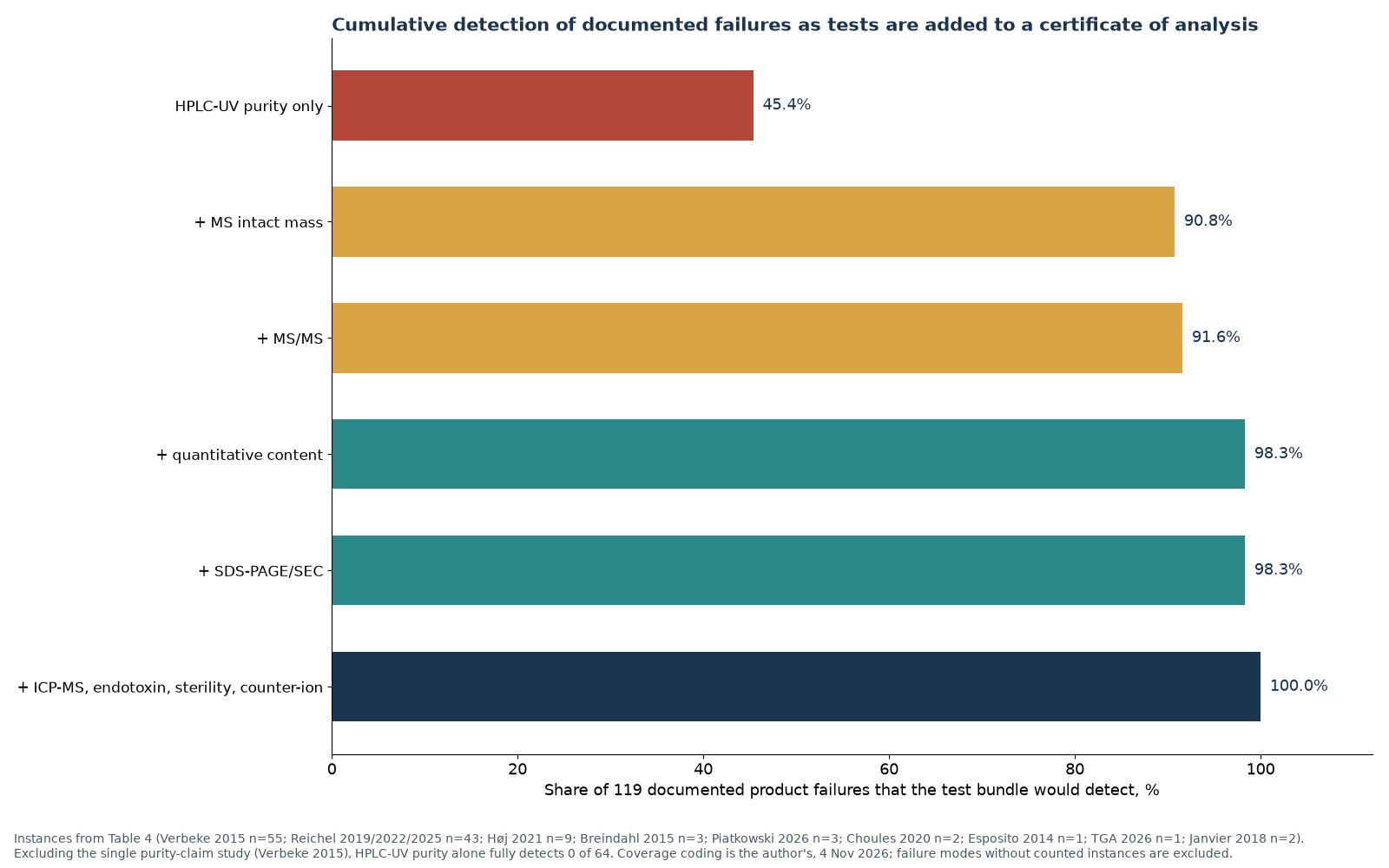
Figure 3 shows the cumulative result. HPLC-UV purity alone fully detects 54 of 119 documented failures (45.4%). All 54 are purity shortfalls from the single study in which the failure was defined as a purity shortfall [20]. Excluding that study, HPLC purity alone fully detects none of the remaining 64 failures. Adding intact-mass MS raises full detection to 108 of 119 (90.8%), because it catches the absent, substituted, tagged and wrong-form products. MS/MS adds the amidation defect, for 109 (91.6%). A quantitative content assay adds the six out-of-range contents and two undeclared-excipient cases, for 117 (98.3%). Microbial testing accounts for the last two. Elemental impurities and endotoxin had no counted instances in the peer-reviewed series, so the final step in Figure 3 reflects microbial testing only. Their absence from the count reflects how little they have been studied, not evidence that they are rare [86, 68, 38].
What “third-party tested” does and does not mean
“Third-party tested” describes who did the test, not what was tested or how well. A certificate from an independent laboratory is more informative than one from the seller, but only for the measurements it reports and only for the sample analysed. Accreditation is the recognised way to show that a laboratory is competent for a specific test. NATA describes accreditation as assurance of technical competence in accredited activities [113], and the ILAC Mutual Recognition Arrangement lets accreditation be recognised across borders, with directories showing which tests a laboratory is accredited for [114]. The TGA’s own laboratories are NATA-accredited to ISO/IEC 17025 and test about 1,500 samples a year. Their default standards are the British Pharmacopoeia, European Pharmacopoeia and United States Pharmacopeia [62]. A certificate’s claim of accreditation can be checked against the accreditation body’s public scope. The scope, not the laboratory’s name, shows whether a given method is covered.
Results 4: how much one certificate proves
Even a complete certificate describes one sample. The TGA notes that a sample is assumed to represent a batch only when there is assurance about how it was stored and handled [62]. Acceptance-sampling theory makes the limits precise [43].
The zero-failure bound
Suppose a purchaser sees n certificates for n independently sampled batches, and every one passes. What is the highest batch failure rate still consistent with that record? If the true failure proportion is p, the chance that n independent batches all pass is (1 − p)n. The one-sided 95% upper bound is the value of p at which that chance falls to 5%: (1 − p)n = 0.05, so p = 1 − 0.051/n [11, 12]. For example:
- n = 1: p = 1 − 0.05 = 0.95, or 95%;
- n = 3: 0.051/3 = 0.368, so p = 63.2%;
- n = 10: 0.050.1 = 0.741, so p = 25.9%;
- n = 29: 0.051/29 = exp(−2.9957/29) = exp(−0.1033) = 0.9019, so p = 9.8%;
- n = 59: p = 5.0%.
To push the bound below 10% requires the smallest n with 0.9n ≤ 0.05, which is n ≥ ln 0.05 / ln 0.9 = 28.4, so n = 29. Below 5% requires n ≥ ln 0.05 / ln 0.95 = 58.4, so n = 59. Below 1% requires n = 299. The familiar “rule of three” (3/n) gives 30% at n = 10, against an exact 25.9%. The two converge as n grows [12], but Ludbrook warns that the rule can “grossly” underestimate risk in small samples [13]. Figure 4 plots both.
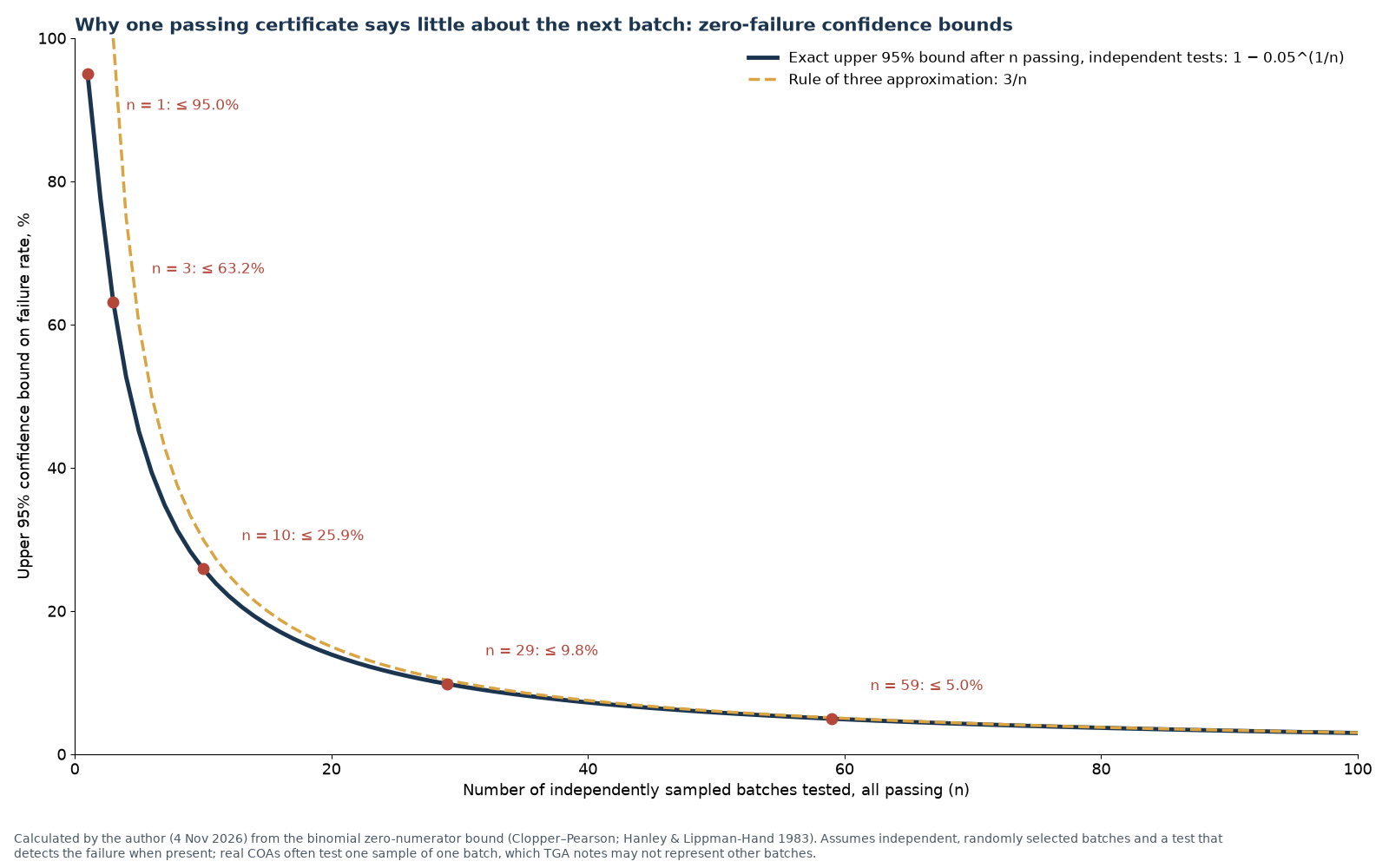
Interpreting a single certificate
One passing certificate is fully consistent with a process in which most batches fail. This is not a criticism of any laboratory. It is a property of sample size. A certificate is strong evidence about the vial or aliquot that was tested, and weak evidence about anything else. Three conditions are needed before a certificate says something about the product in hand:
- Traceability: the batch or lot number on the certificate matches the label on the product, and the laboratory’s report can be checked independently, for example through a verification link or report identifier.
- Representativeness: the tested sample was drawn from that batch and stored appropriately. The TGA assumes representativeness only with such assurance [62].
- Repetition: results for successive batches are published, including failures, so that a run of results can be judged, not one report.
The model assumes independent, randomly selected batches and a test that detects the failure when it is present. Real batches are not independent, and certificates are not randomly selected. A seller can choose which reports to publish. The bounds above are therefore the best case. They show how much a record of passes could justify, not how much it does.
Why Wilson intervals
Many of the studies in Table 3 have small denominators of 3, 12, 14 or 17. The simple Wald interval, p ± 1.96√(p(1−p)/n), collapses to zero width when x = 0 or x = n and has poor coverage at small n [10, 39]. Newcombe compared seven methods and recommended score-based intervals [9], which is the Wilson method [8]. For Breindahl’s 0 of 3, the Wald interval would be 0% to 0%, a meaningless result. The Wilson interval is 0% to 56.1% (z²/(n + z²) = 3.8415/6.8415 = 0.561). It correctly shows that three products cannot establish a market-wide failure rate, even though all three failed.
Results 5: an evidence-graded buy peptides Australia verification checklist
Table 5 turns the four analyses into sixteen questions. Each question is linked to the evidence behind it and graded by the type of source. The checklist is designed to be read in order. The legal questions come first because, under the TGA’s statements, no analytical result can make an otherwise unlawful import or supply lawful [1, 2]. The checklist is not a guide to buying anything. It is a way of judging how much a set of claims is worth.
| # | Domain | Question | Why it matters (evidence) | Grade | Source |
|---|---|---|---|---|---|
| 1 | Legal | Is the product in the ARTG, or is there a lawful access pathway that applies? | Unapproved goods need an exemption, approval or authority | A | [2, 52, 53] |
| 2 | Legal | Does the label or listing rely on “research use only” or “not for human use”? | These disclaimers do not change regulatory status or permit importation | A | [1, 2] |
| 3 | Legal | Is the substance scheduled, in Appendix D, or listed in Customs Schedule 7A? | Prescription, possession and permit requirements may apply | A | [17, 46, 48] |
| 4 | Legal | Would a personal import meet every Personal Importation Scheme condition? | Prescription, quantity, no controlled substances, no counterfeits | A | [14] |
| 5 | Legal | Is the vial clearly labelled with name and amount, not a code? | Code-only or unlabelled vials will not be released and may be destroyed | A | [23, 1] |
| 6 | Legal | For athletes: is the substance on the WADA List? | S0 and peptide classes are prohibited; TUEs unlikely for unregistered goods | A | [50, 49, 60] |
| 7 | Document | Does the certificate show a batch number that matches the product label? | A certificate describes only the sample tested | A | [62] |
| 8 | Document | Can the report be verified with the issuing laboratory? | Independent verification is the basis of trust in a report | C | [87, 20] |
| 9 | Document | Is the laboratory accredited for these specific methods? | Accreditation applies to the accredited scope | A | [113, 114, 62] |
| 10 | Analytical | Is identity shown by mass spectrometry, ideally with a second orthogonal method? | HPLC purity alone fully detected 0 of 64 non-purity failures | B | [22, 21, 41] |
| 11 | Analytical | Is quantitative content (assay or net peptide) reported against the label? | Content ranged from 43% to 190% of label | B | [22, 4, 5, 57] |
| 12 | Analytical | Is HPLC purity reported with the chromatogram and method conditions? | Purity depends on method; UV-transparent impurities are missed | B | [103, 87, 22] |
| 13 | Analytical | For proteins: is molecular size shown (SDS-PAGE or SEC)? | Tags and wrong forms were found in all 30 protein products that contained the expected protein | C | [3, 18, 19, 41] |
| 14 | Analytical | Are counter-ion and water content stated? | TFA can make up about a quarter of the mass | B | [106, 22, 110] |
| 15 | Analytical | Are endotoxin, sterility and elemental impurities reported, each as a separate test? | These are separate measurements with separate limits | B | [42, 90, 91] |
| 16 | Sampling | How many batches have published results, including any failures? | One pass leaves a 95% upper bound of 95%; 29 passes are needed for under 10% | D | [12, 11, 43] |
Reading the checklist
Three features of the checklist follow directly from the results. First, legal and analytical questions are separate. A certificate answers none of items 1 to 6. Second, items 10 and 11 carry the most weight among the analytical questions. In the documented failures, identity by mass spectrometry and quantitative content together account for most of the gain in detection (Figure 3). Third, item 16 limits all the others. Without repeated, traceable results, any single answer is a statement about one sample.
The checklist also explains why marketing language is uninformative. Terms such as “lab-grade”, “pharmaceutical grade”, “99% pure” or “third-party tested” do not answer any item on their own. “Pharmaceutical grade” in particular implies conformity to a pharmacopoeial monograph or a manufacturing standard. Such a claim would need evidence of good manufacturing practice, which the TGA regulates separately [63]. The World Health Organization’s definitions are useful here. A substandard product is an authorised product that fails its specification, and a falsified product deliberately misrepresents its identity, composition or source [115]. Most of the failures in Table 4 would meet one definition or the other if the products had been represented as medicines.
Buy research peptides Australia: what the label “research” changes
People searching to buy research peptides in Australia often assume that the word “research” places a product in a different legal category. The primary sources do not support that assumption. The TGA states that “research use only” and “not for human use” disclaimers do not change whether a product is a therapeutic good [2]. Sport Integrity Australia and the Alcohol and Drug Foundation both describe how such labels are used in the consumer market [49, 30]. Scientifically, “research grade” has no fixed meaning. It does not correspond to any pharmacopoeial or ICH specification, and the Verbeke study shows that a research-grade certificate stating at least 95.0% purity was confirmed for fewer than half of the products [20]. Genuine laboratory research uses the same analytical principles described here: reference standards, orthogonal identity tests and quantitative assay [105, 22].
Discussion
Principal findings on the buy peptides Australia question
This review set out to answer the buy peptides Australia question with evidence rather than assertion. Four findings stand out. First, the Australian legal position turns on representation, scheduling, import rules and labelling, and it is not changed by research-use disclaimers [2, 1, 14]. Second, published laboratory studies show that products sold outside regulated supply often fail on identity, molecular form and content. These failures are not limited to purity [3, 18, 19, 4, 5, 64]. Third, the most widely advertised quality metric, HPLC purity, fully detects fewer than half of the documented failures. Its share depends entirely on one study in which the failure was defined as a purity shortfall. Fourth, one certificate is weak statistical evidence about a batch, however well the test was done.
Comparison with other work
Our findings agree with recent reviews that describe the consumer peptide market as one of “uncertain identity, purity, potency, sterility, and safety” [35]. They also agree with Australian analyses that frame illicit injectable peptides as a regulatory gap [32, 33]. Commentators in the harm-reduction literature have argued that testing infrastructure built for steroids should extend to peptides [34, 37, 99]. Our coverage analysis adds a specific technical point to that argument: a peptide testing service built on purity measurement alone would miss most of the failure modes documented so far. Reviews of the scientific literature on growth-hormone-axis peptides make a related point from the clinical side, noting the gap between marketing claims and evidence [36]. We do not assess that evidence here.
Australian consumer and health sources reach the same practical conclusion in plainer language. NSW Health notes that the contents and strength of unapproved peptide products may vary between batches with the same label, and that approved medicines carry AUST R or AUST L numbers [116]. healthdirect and Healthy Male both note inaccurate labelling and the absence of TGA assessment [29, 31]. The joint statement by the TGA and the Chief Medical Officer says the TGA has no oversight of the composition or manufacturing standards of unapproved products [27]. Reported hospital presentations in NSW rose through 2026 [28]. That trend shows why regulators are concerned, although this review makes no claim about cause.
The 2026 preprint by Mendias and Awan is the largest dataset to date, covering 6,441 samples of 14 consumer-marketed research peptides from a public independent-testing dataset [38]. Its failure range of 41.6% to 71.1% overlaps the peer-reviewed estimates in Table 3, and its endotoxin finding addresses a gap in the peer-reviewed series. Until it has been peer reviewed, it should be treated as supporting, not decisive, evidence.
Implications for reading a peptide certificate of analysis
For anyone reading a peptide certificate of analysis, the analysis suggests a simple order of questions. Is the document traceable to this batch? Does it show identity by mass? Does it report quantity against the label? Does it show purity with the chromatogram and method? Are the microbiological and elemental tests reported separately? Then, how many batches have been reported? This order follows the coverage results (Figure 3) and the guideline hierarchy [22, 21, 41]. It also reflects the TGA laboratories’ approach of testing unregistered products mainly for undeclared ingredients [62], which in effect is identity testing first.
For regulators and researchers, the results support two practical recommendations. Product-testing studies should report identity, form, content and purity as separate outcomes, with numerators and denominators, so that results can be pooled within outcome. Community and laboratory testing services that publish certificates should also publish failures and the number of batches tested. Without that, purchasers cannot apply the sampling logic in Figure 4.
Are peptides legal in Australia? What the evidence allows us to say
The question “are peptides legal in Australia” has no single answer because “peptides” is not a legal category. Approved peptide medicines in the ARTG are lawful when supplied through the proper channels, many of them on prescription [2, 52]. Unapproved products are subject to the gates in Table 2, and the TGA has stated what research-use labels do not do [1]. Many peptide classes are prohibited in sport regardless of their legal status [50]. Beyond that, legality depends on the specific substance, how it is represented, the route of import and state law. These are matters for legal advice, and the regulatory evidence map on this site sets out the scheduling detail.
Limitations
This review has several limitations. First, the product-testing literature is small and heterogeneous. The denominators range from 3 to 2,068, and the products, sources, years and methods differ. We have therefore not estimated a market-wide failure rate, and none should be inferred from Table 3. Second, the studies are not a random sample of products. Seized products may be worse than average, and supplier-certified research peptides may be better. Third, the failure-mode coding in Table 4 is our own. Another analyst could reasonably rate some cells differently, for example giving HPLC partial credit for detecting gross substitution. We publish the coding so that it can be changed. Fourth, the coverage analysis counts only product-level failures with a denominator. Failure modes that have not been studied systematically, notably endotoxin and elemental impurities in peptides, score zero instances, and this understates their importance. Fifth, we searched PubMed and Europe PMC only. Our title screening of the larger search sets used keyword filtering, so some eligible studies may have been missed. Sixth, the comparator studies concern steroids and SARMs, not peptides. Seventh, legal statements reflect sources read on 3 and 4 November 2026. Law and regulator guidance can change, and the interpretation of several gates needs expert legal review. Finally, we did not test any product, and this review cannot say anything about the quality of any specific product or supplier.
Relevance to Eternal Peptides Wholesale
This article is published by Eternal Peptides Wholesale, a distributor of research peptides for laboratory research. We publish it because the questions it examines are the ones any reader should ask of any supplier’s documentation, including ours. The framework is not an endorsement of any product, and nothing in it states or implies that any product or activity is lawful, approved or suitable for human use.
Eternal Peptides Wholesale publishes a certificate of analysis library organised by batch. Its reports carry report identifiers and verification links to the issuing laboratory. Readers can apply Table 5 to those documents in the same way as to any others: check the batch match, the identity method, whether content is reported separately from purity, whether microbiological and elemental results appear as separate reports, and how many batches are covered. The testing standards page explains, consistent with the evidence above, that purity percentage, compound identity and measured vial content are different measurements. More about the business is on the About page. Laboratory accreditation scope should always be checked directly with the accreditation body, as described in the section on third-party testing [113, 114].
Readers who want more depth on particular points can turn to earlier research on this site. The supplier qualification review covers how organisations assess suppliers. The synthetic peptides analytical review explains impurity formation in detail. The stability and storage evidence map explains why sample handling affects whether a result represents a batch.
Conclusion
For people researching how to buy peptides in Australia, the evidence supports three conclusions. Legally, a “research use only” label is not legal clearance. The TGA has said so, and unlabelled or code-only vials will not be released at the border [1, 23]. Analytically, the published product-testing record shows frequent failures of identity, molecular form and content, which a purity percentage cannot detect. Mass spectrometry and quantitative content assays catch most of them [22, 21]. Statistically, one passing certificate supports a claim about one sample, and only a long, traceable record of results, including failures, supports a claim about a supply. The checklist in Table 5 brings these conclusions together into questions that can be checked against primary sources. They apply to every supplier equally.
Glossary
- ARTG
- Australian Register of Therapeutic Goods: the public register of therapeutic goods that can be lawfully supplied in Australia [52].
- Certificate of analysis (COA)
- A laboratory report of specific test results on a specific sample, usually identified by a batch or lot number.
- Counter ion
- A non-peptide ion, such as trifluoroacetate or acetate, that is present in a peptide salt and adds to its mass without being peptide [110, 112].
- HPLC-UV purity
- The main peak’s share of total UV-absorbing peak area in a chromatogram. It is not a measure of identity or content.
- Intact mass (MS)
- Mass spectrometric measurement of the whole molecule’s mass, used to confirm identity.
- Net peptide content (assay)
- The amount of peptide actually present, measured against a reference standard or by amino acid analysis or quantitative NMR.
- Orthogonal methods
- Analytical methods based on different principles, used together so that one method’s blind spots are covered by another [21, 22].
- Personal Importation Scheme
- A narrow TGA exemption allowing some unapproved goods to be imported for personal use under strict conditions [14].
- Schedule 7A
- The schedule to the Customs (Prohibited Imports) Regulations 1956 listing substances that need a permit to import [46].
- Substandard and falsified
- WHO terms for authorised products that fail specification, and products that deliberately misrepresent identity, composition or source [115].
- Wilson interval
- A confidence interval for a proportion that performs well at small sample sizes [8].
- Zero-failure bound
- The highest failure rate consistent, at a chosen confidence level, with observing no failures in n tests: 1 − 0.051/n at 95% [11].
Frequently asked questions
Are peptides legal in Australia?
It depends on the product. Approved peptide medicines in the ARTG are lawful when supplied through proper channels, often on prescription. Unapproved peptide products regulated as therapeutic goods generally cannot be imported, supplied or advertised without an exemption or authority, and research-use labels do not change that [2, 1].
What does the evidence say for people searching buy peptides Australia?
For anyone researching how to buy peptides in Australia, published testing shows that products from unregulated sources often had the wrong identity, the wrong molecular form or the wrong content. The TGA states that research-use disclaimers do not make supply lawful. This review sets out the legal gates and verification questions; it does not recommend buying any product.
Can I import peptides into Australia for personal use?
Only within the Personal Importation Scheme’s conditions: personal or family use, a valid Australian prescription for prescription-only medicines, quantity limits, no controlled substances and no counterfeits. Clearly labelled products are also required, and non-compliant imports may be seized [14, 23].
Does a “research use only” label make peptides legal?
No. The TGA states that such disclaimers do not change a product’s regulatory status, permit importation, or remove advertising or supply obligations [1].
How do you verify a peptide certificate of analysis?
Check that the batch number matches the product, that the report can be verified with the issuing laboratory, and that the laboratory is accredited for the methods used. Then check whether identity by mass spectrometry and quantitative content are reported as well as purity, and how many batches have results [22, 113, 62].
Is HPLC purity enough to confirm a peptide?
No. In this review, HPLC purity alone fully detected 54 of 119 documented product failures (45.4%), and none of the 64 that were not purity shortfalls. Identity needs mass spectrometry, and quantity needs a separate content assay [21, 22].
What does “third-party tested” mean?
It means a laboratory other than the seller tested a sample. It says nothing on its own about which tests were run, whether the laboratory is accredited for them, or whether the sample represents the batch [113, 62].
Can Australian customs seize peptides?
Yes. The ABF may seize prohibited or restricted goods imported without a required permit, and the TGA has said poorly labelled peptide imports will not be released and may be seized and destroyed [15, 23].
References
- Therapeutic Goods Administration. Understanding your responsibilities when importing, compounding and supplying unapproved peptide products. Safety advisory, 13 April 2026. Available at: https://www.tga.gov.au/safety/safety-monitoring-and-information/safety-alerts/understanding-your-responsibilities-when-importing-compounding-and-supplying-unapproved-peptide-products. Accessed 4 November 2026.
- Therapeutic Goods Administration. How we regulate therapeutic peptide products. Page updated 2026. Available at: https://www.tga.gov.au/products/medicines/monitoring-and-compliance/how-we-regulate-therapeutic-peptide-products. Accessed 4 November 2026.
- Reichel C, Gmeiner G, Thevis M. Detection of black market follistatin 344. Drug Test Anal. 2019;11(11-12):1675-1697. doi:10.1002/dta.2741 PMID: 31758732. Available at: https://doi.org/10.1002/dta.2741. Accessed 4 November 2026.
- Breindahl T, Evans-Brown M, Hindersson P, et al. Identification and characterization by LC-UV-MS/MS of melanotan II skin-tanning products sold illegally on the Internet. Drug Test Anal. 2015;7(2):164-72. doi:10.1002/dta.1655 PMID: 24771717. Available at: https://doi.org/10.1002/dta.1655. Accessed 4 November 2026.
- Piatkowski T, Craven A, Cornell S, et al. Composition and Labelling Accuracy of Products Sold as Retatrutide in Australia. Drug Alcohol Rev. 2026;45(6):e70231. doi:10.1111/dar.70231 PMID: 42559975. Available at: https://doi.org/10.1111/dar.70231. Accessed 4 November 2026.
- National Center for Biotechnology Information. Entrez Programming Utilities (E-utilities) Help. Bethesda (MD): National Library of Medicine. Available at: https://www.ncbi.nlm.nih.gov/books/NBK25501/. Accessed 4 November 2026.
- Europe PMC. Europe PMC RESTful Web Service (Articles API). EMBL-EBI. Available at: https://www.ebi.ac.uk/europepmc/webservices/rest/search?query=peptide&format=json. Accessed 4 November 2026.
- Wilson EB. Probable inference, the law of succession, and statistical inference. J Am Stat Assoc. 1927;22(158):209-212. doi:10.1080/01621459.1927.10502953 Available at: https://doi.org/10.1080/01621459.1927.10502953. Accessed 4 November 2026.
- Newcombe RG. Two-sided confidence intervals for the single proportion: comparison of seven methods. Stat Med. 1998;17(8):857-72. doi:10.1002/(sici)1097-0258(19980430)17:8<857::aid-sim777>3.0.co;2-e PMID: 9595616. Available at: https://doi.org/10.1002/(sici)1097-0258(19980430)17:8<857::aid-sim777>3.0.co;2-e. Accessed 4 November 2026.
- Brown LD, Cai TT, DasGupta A. Interval estimation for a binomial proportion. Stat Sci. 2001;16(2):101-133. doi:10.1214/ss/1009213286 Available at: https://doi.org/10.1214/ss/1009213286. Accessed 4 November 2026.
- Clopper CJ, Pearson ES. The use of confidence or fiducial limits illustrated in the case of the binomial. Biometrika. 1934;26(4):404-413. doi:10.1093/biomet/26.4.404 Available at: https://doi.org/10.1093/biomet/26.4.404. Accessed 4 November 2026.
- Hanley JA, Lippman-Hand A. If nothing goes wrong, is everything all right? Interpreting zero numerators. JAMA. 1983;249(13):1743-5. PMID: 6827763. Available at: https://pubmed.ncbi.nlm.nih.gov/6827763/. Accessed 4 November 2026.
- Ludbrook J, Lew MJ. Estimating the risk of rare complications: is the 'rule of three' good enough?. ANZ J Surg. 2009;79(7-8):565-70. doi:10.1111/j.1445-2197.2009.04994.x PMID: 19694672. Available at: https://doi.org/10.1111/j.1445-2197.2009.04994.x. Accessed 4 November 2026.
- Therapeutic Goods Administration. Personal Importation Scheme. Page updated 8 September 2026. Available at: https://www.tga.gov.au/products/unapproved-therapeutic-goods/access-pathways/personal-importation-scheme. Accessed 4 November 2026.
- Australian Border Force. Prohibited goods (importing and exporting). Available at: https://www.abf.gov.au/importing-exporting-and-manufacturing/prohibited-goods. Accessed 4 November 2026.
- Office of Drug Control. Growth hormones (natural and manufactured): list of controlled substances. Available at: https://www.odc.gov.au/controlled-substances/list/growth-hormones-natural-and-manufactured. Accessed 4 November 2026.
- Therapeutic Goods (Poisons Standard—October 2026) Instrument 2026 (F2026L01327). Federal Register of Legislation; registered 30 September 2026. Available at: https://www.legislation.gov.au/F2026L01327/asmade/text. Accessed 4 November 2026.
- Reichel C, Gmeiner G, Thevis M. Electrophoretic detection of black market myostatin propeptide. Drug Test Anal. 2022;14(11-12):1812-1824. doi:10.1002/dta.3398 PMID: 36336354. Available at: https://doi.org/10.1002/dta.3398. Accessed 4 November 2026.
- Reichel C, Filip T, Gmeiner G, et al. Gel Electrophoretic Detection of Black Market ACE-031. Drug Test Anal. 2025;17(10):1934-1946. doi:10.1002/dta.3898 PMID: 40312924. Available at: https://doi.org/10.1002/dta.3898. Accessed 4 November 2026.
- Verbeke F, Wynendaele E, Braet S, et al. Quality evaluation of synthetic quorum sensing peptides used in R&D. J Pharm Anal. 2015;5(3):169-181. doi:10.1016/j.jpha.2014.12.002 PMID: 29403929. Available at: https://doi.org/10.1016/j.jpha.2014.12.002. Accessed 4 November 2026.
- International Council for Harmonisation. ICH Q2(R2): Validation of analytical procedures. Step 4, 1 November 2023. Available at: https://database.ich.org/sites/default/files/ICH_Q2%28R2%29_Guideline_2023_1130.pdf. Accessed 4 November 2026.
- European Medicines Agency. Guideline on the development and manufacture of synthetic peptides (EMA/CHMP/CVMP/QWP/367182/2025). Adopted by CHMP 1 December 2025 and CVMP 4 December 2025; effective 1 June 2026. Available at: https://www.ema.europa.eu/en/documents/scientific-guideline/guideline-development-manufacture-synthetic-peptides_en.pdf. Accessed 4 November 2026.
- Therapeutic Goods Administration. TGA warning on the risks of importing unapproved peptide products. Safety advisory, 7 May 2026. Available at: https://www.tga.gov.au/safety/safety-monitoring-and-information/safety-alerts/tga-warning-risks-importing-unapproved-peptide-products. Accessed 4 November 2026.
- Therapeutic Goods Administration. TGA strengthens compliance focus on unapproved peptide products as part of evolving risk response. Media release, 10 June 2026. Available at: https://www.tga.gov.au/news/media-releases/tga-strengthens-compliance-focus-unapproved-peptide-products-part-evolving-risk-response. Accessed 4 November 2026.
- Therapeutic Goods Administration. Unapproved peptide product promoters and suppliers are put on notice. Media release, 20 July 2026. Available at: https://www.tga.gov.au/news/media-releases/unapproved-peptide-product-promoters-and-suppliers-are-put-notice. Accessed 4 November 2026.
- Therapeutic Goods Administration. TGA flexes its muscle against illegal peptides and steroids. Media release, 17 August 2026. Available at: https://www.tga.gov.au/news/media-releases/tga-flexes-its-muscle-against-illegal-peptides-and-steroids. Accessed 4 November 2026.
- Therapeutic Goods Administration; Chief Medical Officer. Concerns regarding the public health risks associated with unapproved peptide products. Joint statement, 19 June 2026. Available at: https://www.tga.gov.au/news/media-releases/concerns-regarding-public-health-risks-associated-unapproved-peptide-products. Accessed 4 November 2026.
- NSW Government. NSW Health warns of surge in hospital presentations linked to peptide use. Ministerial release, 19 October 2026. Available at: https://www.nsw.gov.au/ministerial-releases/nsw-health-warns-of-surge-hospital-presentations-linked-to-peptide-use. Accessed 4 November 2026.
- healthdirect Australia. Peptides and your health in Australia: facts versus hype. Blog, 20 October 2026. Available at: https://www.healthdirect.gov.au/blog/peptides-and-your-health-in-australia-facts-versus-hype. Accessed 4 November 2026.
- Alcohol and Drug Foundation. Peptides (Insights). Available at: https://adf.org.au/insights/peptides/. Accessed 4 November 2026.
- Healthy Male (Andrology Australia). Peptides in Australia: what you need to know. Available at: https://healthymale.org.au/health-article/peptides-australia-what-you-need-know. Accessed 4 November 2026.
- Piatkowski T, Ganson KT, Nagata JM. Illicit Injectable Peptides and Regulatory Gaps. JAMA. 2026;336(3):189-190. doi:10.1001/jama.2026.10690 PMID: 42295803. Available at: https://doi.org/10.1001/jama.2026.10690. Accessed 4 November 2026.
- Piatkowski T, Ganson KT, Nagata JM. Responding to injectable synthetic peptide use among young people: priorities for clinicians and public health. Lancet Child Adolesc Health. 2026;10(8):547-549. doi:10.1016/S2352-4642(26)00099-4 PMID: 42114544. Available at: https://doi.org/10.1016/S2352-4642(26)00099-4. Accessed 4 November 2026.
- Piatkowski T, Nagata JM, Nielsen S. Where next for human enhancement and harm reduction? From steroids to peptides. Addiction. 2026;121(11):2878-2879. doi:10.1111/add.70625 PMID: 42802609. Available at: https://doi.org/10.1111/add.70625. Accessed 4 November 2026.
- Hailu KT, Abriha FN, Duguma YM, et al. Unregulated Peptide Use in the Age of Biohacking: Digital Promotion, Gray-Market Access, and Emerging Public Health Risks. Cureus. 2026;18(6):e110657. doi:10.7759/cureus.110657 PMID: 42437212. Available at: https://doi.org/10.7759/cureus.110657. Accessed 4 November 2026.
- Dominikowski A, Rękoś Z, Olejarz M, et al. The emerging landscape of performance-enhancing peptides modulating GH-IGF1 axis: bridging the gap between clinical evidence and patient self-administration. Front Endocrinol (Lausanne). 2026;17:1822475. doi:10.3389/fendo.2026.1822475 PMID: 42395176. Available at: https://doi.org/10.3389/fendo.2026.1822475. Accessed 4 November 2026.
- Turnock LA, Lazuras L. Experimental peptides, GLP-1s and polypharmacy: Future directions for image- and performance-enhancing drug harm reduction. Addiction. 2026;121(11):2872-2873. doi:10.1111/add.70545 PMID: 42427135. Available at: https://doi.org/10.1111/add.70545. Accessed 4 November 2026.
- Mendias CL, Awan TM. Evaluation of research grade peptides marketed directly to consumers reveals extensive variability in purity and measured abundance. Preprints.org, posted 24 April 2026 (preprint, not peer reviewed). doi:10.20944/preprints202604.1748.v1 Available at: https://doi.org/10.20944/preprints202604.1748.v1. Accessed 4 November 2026.
- Agresti A, Coull BA. Approximate is better than "exact" for interval estimation of binomial proportions. Am Stat. 1998;52(2):119-126. doi:10.1080/00031305.1998.10480550 Available at: https://doi.org/10.1080/00031305.1998.10480550. Accessed 4 November 2026.
- Bonenti B, Craven A, Ferris J, et al. Investigating the Legitimacy of Anabolic-Androgenic Steroids in Australia's Unregulated Market Using Community Testing Data. Subst Use Addctn J. 2026;47(3):884-889. doi:10.1177/29767342261426103 PMID: 41923329. Available at: https://doi.org/10.1177/29767342261426103. Accessed 4 November 2026.
- International Council for Harmonisation. ICH Q6B: Specifications: test procedures and acceptance criteria for biotechnological/biological products. Step 4, 10 March 1999. Available at: https://database.ich.org/sites/default/files/Q6B%20Guideline.pdf. Accessed 4 November 2026.
- International Council for Harmonisation. ICH Q3D(R2): Guideline for elemental impurities. Step 4, 26 April 2022. Available at: https://database.ich.org/sites/default/files/Q3D-R2_Guideline_Step4_2022_0308.pdf. Accessed 4 November 2026.
- NIST/SEMATECH. e-Handbook of Statistical Methods, section 6.2: Test product for acceptability: lot acceptance sampling. Available at: https://www.itl.nist.gov/div898/handbook/pmc/section2/pmc2.htm. Accessed 4 November 2026.
- Therapeutic Goods Act 1989 (Cth). Federal Register of Legislation, C2004A03952, latest compilation. Available at: https://www.legislation.gov.au/C2004A03952/latest/text. Accessed 4 November 2026.
- Customs Act 1901 (Cth). Federal Register of Legislation, C1901A00006, latest compilation. Available at: https://www.legislation.gov.au/C1901A00006/latest/text. Accessed 4 November 2026.
- Customs (Prohibited Imports) Regulations 1956 (Cth). Federal Register of Legislation, F1996B03651; Compilation No. 147 (F2026C00751, compilation date 13 July 2026). Available at: https://www.legislation.gov.au/F1996B03651/latest/text. Accessed 4 November 2026.
- Competition and Consumer Act 2010 (Cth). Federal Register of Legislation, C2004A00109, latest compilation. Available at: https://www.legislation.gov.au/C2004A00109/latest/text. Accessed 4 November 2026.
- Office of Drug Control. Anabolic, androgenic, hormones and other controlled substances. Available at: https://www.odc.gov.au/anabolic-androgenic-hormones-and-other-controlled-substances. Accessed 4 November 2026.
- Sport Integrity Australia. Peptides (substance education). Available at: https://www.sportintegrity.gov.au/what-we-do/anti-doping/substance-education/peptides. Accessed 4 November 2026.
- World Anti-Doping Agency. World Anti-Doping Code International Standard: Prohibited List 2027 (final, 26 August 2026). Available at: https://www.wada-ama.org/sites/default/files/2026-09/2027list_en_final_clean_26_august_2026_2.pdf. Accessed 4 November 2026.
- Therapeutic Goods Administration. What are therapeutic goods? Available at: https://www.tga.gov.au/products/regulations-all-products/regulation-essentials/what-are-therapeutic-goods. Accessed 4 November 2026.
- Therapeutic Goods Administration. About the Australian Register of Therapeutic Goods (ARTG). Available at: https://www.tga.gov.au/products/regulations-all-products/about-australian-register-therapeutic-goods-artg. Accessed 4 November 2026.
- Therapeutic Goods Administration. Access pathways for unapproved therapeutic goods. Available at: https://www.tga.gov.au/products/unapproved-therapeutic-goods/access-pathways. Accessed 4 November 2026.
- Therapeutic Goods Administration. What can and cannot be advertised to the general public. Available at: https://www.tga.gov.au/products/regulations-all-products/advertising/advertising-basics/what-can-and-cannot-be-advertised-general-public. Accessed 4 November 2026.
- Therapeutic Goods Administration. Compliance Principles 2026 and 2027. Last updated 10 June 2026. Available at: https://www.tga.gov.au/safety/compliance-and-enforcement/compliance-management-enforcement/compliance-principles-2026-and-2027. Accessed 4 November 2026.
- Therapeutic Goods Administration. Three Victorians arrested following seizure of over $2 million worth of steroids and peptides by the ABF and TGA. Media release, 17 April 2026. Available at: https://www.tga.gov.au/news/media-releases/three-victorians-arrested-following-seizure-over-2-million-worth-steroids-and-peptides-abf-and-tga. Accessed 4 November 2026.
- Therapeutic Goods Administration. Melanotan II tanning peptide products found to be inconsistently dosed. Safety advisory, 17 August 2026. Available at: https://www.tga.gov.au/safety/safety-monitoring-and-information/safety-alerts/melanotan-ii-tanning-peptide-products-found-be-inconsistently-dosed. Accessed 4 November 2026.
- World Anti-Doping Agency. WADA publishes 2027 Prohibited List. News, September 2026. Available at: https://www.wada-ama.org/en/news/wada-publishes-2027-prohibited-list. Accessed 4 November 2026.
- Sport Integrity Australia. The Prohibited List explained. Available at: https://www.sportintegrity.gov.au/what-we-do/anti-doping/substance-education/prohibited-list-explained. Accessed 4 November 2026.
- Global DRO. Australia search portal. Available at: https://www.globaldro.com/AU/search. Accessed 4 November 2026.
- Therapeutic Goods Administration. TGA tests counterfeit retatrutide product following serious adverse event report. Safety alert, 14 September 2026. Available at: https://www.tga.gov.au/safety/safety-monitoring-and-information/safety-alerts/tga-tests-counterfeit-retatrutide-product-following-serious-adverse-event-report. Accessed 4 November 2026.
- Therapeutic Goods Administration. TGA Laboratories: what we test, how we test and what we do with our results. Available at: https://www.tga.gov.au/safety/safety-monitoring-and-information/product-testing-and-investigations/tga-laboratories/tga-laboratories-what-we-test-how-we-test-and-what-we-do-our-results. Accessed 4 November 2026.
- Therapeutic Goods Administration. Good manufacturing practice (GMP). Available at: https://www.tga.gov.au/how-we-regulate/manufacturing/manufacture-medicine/good-manufacturing-practice-gmp. Accessed 4 November 2026.
- Høj LJ, Rasmussen BS, Dalsgaard PW, et al. Analysis of seized peptide and protein-based doping agents using four complimentary methods: Liquid chromatography coupled with time of flight mass spectrometry, liquid chromatography-ultraviolet, Bradford, and immunoassays. Drug Test Anal. 2021;13(7):1457-1463. doi:10.1002/dta.3026 PMID: 33686802. Available at: https://doi.org/10.1002/dta.3026. Accessed 4 November 2026.
- Van Wagoner RM, Eichner A, Bhasin S, et al. Chemical Composition and Labeling of Substances Marketed as Selective Androgen Receptor Modulators and Sold via the Internet. JAMA. 2017;318(20):2004-2010. doi:10.1001/jama.2017.17069 PMID: 29183075. Available at: https://doi.org/10.1001/jama.2017.17069. Accessed 4 November 2026.
- Piatkowski T, Coomber R, Francis C, et al. The world's first anabolic-androgenic steroid testing trial: A two-phase pilot combining chemical analysis, results dissemination and community feedback. Addiction. 2025;120(7):1366-1377. doi:10.1111/add.70009 PMID: 39911049. Available at: https://doi.org/10.1111/add.70009. Accessed 4 November 2026.
- Piatkowski T, Coomber R, Francis C, et al. Anabolic-androgenic steroid testing as a tool for consumer engagement and harm reduction: a sequential explanatory mixed-method study. Harm Reduct J. 2025;22(1):114. doi:10.1186/s12954-025-01270-4 PMID: 40616139. Available at: https://doi.org/10.1186/s12954-025-01270-4. Accessed 4 November 2026.
- Craven A, Ferris J, Nielsen S, et al. Lead Astray? The Hidden Contaminants in Australian Anabolic-Androgenic Steroid Market and Their Potential Health Impact. Drug Alcohol Rev. 2025;44(6):1641-1647. doi:10.1111/dar.70007 PMID: 40898878. Available at: https://doi.org/10.1111/dar.70007. Accessed 4 November 2026.
- Walpurgis K, Krug O, Thomas A, et al. Detection of an unknown fusion protein in confiscated black market products. Drug Test Anal. 2014;6(11-12):1117-24. doi:10.1002/dta.1713 PMID: 25219942. Available at: https://doi.org/10.1002/dta.1713. Accessed 4 November 2026.
- Kohler M, Thomas A, Geyer H, et al. Confiscated black market products and nutritional supplements with non-approved ingredients analyzed in the Cologne Doping Control Laboratory 2009. Drug Test Anal. 2010;2(11-12):533-7. doi:10.1002/dta.186 PMID: 21204286. Available at: https://doi.org/10.1002/dta.186. Accessed 4 November 2026.
- Krug O, Thomas A, Malerød-Fjeld H, et al. Analysis of new growth promoting black market products. Growth Horm IGF Res. 2018;41:1-6. doi:10.1016/j.ghir.2018.05.001 PMID: 29864719. Available at: https://doi.org/10.1016/j.ghir.2018.05.001. Accessed 4 November 2026.
- Krug O, Thomas A, Walpurgis K, et al. Identification of black market products and potential doping agents in Germany 2010-2013. Eur J Clin Pharmacol. 2014;70(11):1303-11. doi:10.1007/s00228-014-1743-5 PMID: 25168622. Available at: https://doi.org/10.1007/s00228-014-1743-5. Accessed 4 November 2026.
- Gajda PM, Holm NB, Hoej LJ, et al. Glycine-modified growth hormone secretagogues identified in seized doping material. Drug Test Anal. 2019;11(2):350-354. doi:10.1002/dta.2489 PMID: 30136411. Available at: https://doi.org/10.1002/dta.2489. Accessed 4 November 2026.
- Popławska M, Błażewicz A. Identification of a novel growth hormone releasing peptide (a glycine analogue of GHRP-2) in a seized injection vial. Drug Test Anal. 2019;11(1):162-167. doi:10.1002/dta.2467 PMID: 30051972. Available at: https://doi.org/10.1002/dta.2467. Accessed 4 November 2026.
- Hullstein IR, Malerod-Fjeld H, Dehnes Y, et al. Black market products confiscated in Norway 2011-2014 compared to analytical findings in urine samples. Drug Test Anal. 2015;7(11-12):1025-9. doi:10.1002/dta.1900 PMID: 26607218. Available at: https://doi.org/10.1002/dta.1900. Accessed 4 November 2026.
- Weber C, Krug O, Kamber M, et al. Qualitative and Semiquantitative Analysis of Doping Products Seized at the Swiss Border. Subst Use Misuse. 2017;52(6):742-753. doi:10.1080/10826084.2016.1263665 PMID: 28156209. Available at: https://doi.org/10.1080/10826084.2016.1263665. Accessed 4 November 2026.
- Vanhee C, Moens G, Deconinck E, et al. Identification and characterization of peptide drugs in unknown pharmaceutical preparations seized by the Belgian authorities: case report on AOD9604. Drug Test Anal. 2014;6(9):964-8. doi:10.1002/dta.1687 PMID: 24976118. Available at: https://doi.org/10.1002/dta.1687. Accessed 4 November 2026.
- Vanhee C, Moens G, Van Hoeck E, et al. Identification of the small research tetra peptide Epitalon, assumed to be a potential treatment for cancer, old age and Retinitis Pigmentosa in two illegal pharmaceutical preparations. Drug Test Anal. 2015;7(3):259-64. doi:10.1002/dta.1771 PMID: 25535022. Available at: https://doi.org/10.1002/dta.1771. Accessed 4 November 2026.
- Vanhee C, Francotte A, Janvier S, et al. The occurrence of putative cognitive enhancing research peptides in seized pharmaceutical preparations: An incentive for controlling agencies to prepare for future encounters of the kind. Drug Test Anal. 2020;12(3):371-381. doi:10.1002/dta.2717 PMID: 31667971. Available at: https://doi.org/10.1002/dta.2717. Accessed 4 November 2026.
- Vanhee C, Janvier S, Desmedt B, et al. Analysis of illegal peptide biopharmaceuticals frequently encountered by controlling agencies. Talanta. 2015;142:1-10. doi:10.1016/j.talanta.2015.04.022 PMID: 26003685. Available at: https://doi.org/10.1016/j.talanta.2015.04.022. Accessed 4 November 2026.
- Janvier S, De Sutter E, Wynendaele E, et al. Analysis of illegal peptide drugs via HILIC-DAD-MS. Talanta. 2017;174:562-571. doi:10.1016/j.talanta.2017.06.034 PMID: 28738623. Available at: https://doi.org/10.1016/j.talanta.2017.06.034. Accessed 4 November 2026.
- Deconinck E, Vanhee C, Keizers P, et al. The occurrence of non-anatomical therapeutic chemical-international nonproprietary name molecules in suspected illegal or illegally traded health products in Europe: A retrospective and prospective study. Drug Test Anal. 2021;13(4):833-840. doi:10.1002/dta.3001 PMID: 33453144. Available at: https://doi.org/10.1002/dta.3001. Accessed 4 November 2026.
- Gaudiano MC, Valvo L, Borioni A. Identification and quantification of the doping agent GHRP-2 in seized unlabelled vials by NMR and MS: a case-report. Drug Test Anal. 2014;6(3):295-300. doi:10.1002/dta.1603 PMID: 24446112. Available at: https://doi.org/10.1002/dta.1603. Accessed 4 November 2026.
- Cox HD, Miller GD, Eichner D. Detection and in vitro metabolism of the confiscated peptides BPC 157 and MGF R23H. Drug Test Anal. 2017;9(10):1490-1498. doi:10.1002/dta.2152 PMID: 28035768. Available at: https://doi.org/10.1002/dta.2152. Accessed 4 November 2026.
- Vida RG, Fittler A, Mikulka I, et al. Availability and quality of illegitimate somatropin products obtained from the Internet. Int J Clin Pharm. 2017;39(1):78-87. doi:10.1007/s11096-016-0398-y PMID: 27888454. Available at: https://doi.org/10.1007/s11096-016-0398-y. Accessed 4 November 2026.
- Janvier S, Cheyns K, Canfyn M, et al. Impurity profiling of the most frequently encountered falsified polypeptide drugs on the Belgian market. Talanta. 2018;188:795-807. doi:10.1016/j.talanta.2018.06.023 PMID: 30029448. Available at: https://doi.org/10.1016/j.talanta.2018.06.023. Accessed 4 November 2026.
- Choules MP, Bisson J, Simmler C, et al. NMR reveals an undeclared constituent in custom synthetic peptides. J Pharm Biomed Anal. 2020;178:112915. doi:10.1016/j.jpba.2019.112915 PMID: 31671336. Available at: https://doi.org/10.1016/j.jpba.2019.112915. Accessed 4 November 2026.
- Esposito S, Deventer K, Van Eenoo P. Identification of the growth hormone-releasing hormone analogue [Pro1, Val14]-hGHRH with an incomplete C-term amidation in a confiscated product. Drug Test Anal. 2014;6(11-12):1155-9. doi:10.1002/dta.1730 PMID: 25283153. Available at: https://doi.org/10.1002/dta.1730. Accessed 4 November 2026.
- Abouelasrar Salama S, De Bondt M, Berghmans N, et al. Biological Characterization of Commercial Recombinantly Expressed Immunomodulating Proteins Contaminated with Bacterial Products in the Year 2020: The SAA3 Case. Mediators Inflamm. 2020;2020:6087109. doi:10.1155/2020/6087109 PMID: 32694927. Available at: https://doi.org/10.1155/2020/6087109. Accessed 4 November 2026.
- Weinstein JR, Swarts S, Bishop C, et al. Lipopolysaccharide is a frequent and significant contaminant in microglia-activating factors. Glia. 2008;56(1):16-26. doi:10.1002/glia.20585 PMID: 17910052. Available at: https://doi.org/10.1002/glia.20585. Accessed 4 November 2026.
- Janvier S, Wattijn E, Botteldoorn N, et al. Are injectable illegal polypeptide drugs safe? Case report demonstrating the presence of haemolytic Bacillus cereus in 2 illegal peptide drugs. Drug Test Anal. 2018;10(4):791-795. doi:10.1002/dta.2304 PMID: 28941153. Available at: https://doi.org/10.1002/dta.2304. Accessed 4 November 2026.
- Graham MR, Ryan P, Baker JS, et al. Counterfeiting in performance- and image-enhancing drugs. Drug Test Anal. 2009;1(3):135-42. doi:10.1002/dta.30 PMID: 20355187. Available at: https://doi.org/10.1002/dta.30. Accessed 4 November 2026.
- Janvier S, De Spiegeleer B, Vanhee C, et al. Falsification of biotechnology drugs: current dangers and/or future disasters?. J Pharm Biomed Anal. 2018;161:175-191. doi:10.1016/j.jpba.2018.08.037 PMID: 30165334. Available at: https://doi.org/10.1016/j.jpba.2018.08.037. Accessed 4 November 2026.
- Piatkowski T, Puljevic C, Francis C, et al. "They sent it away for testing and it was all bunk": Exploring perspectives on drug checking among steroid consumers in Queensland, Australia. Int J Drug Policy. 2023;119:104139. doi:10.1016/j.drugpo.2023.104139 PMID: 37481876. Available at: https://doi.org/10.1016/j.drugpo.2023.104139. Accessed 4 November 2026.
- Piatkowski T, Volpe I, Brien R, et al. Development, dissemination and community response towards the first community notice regarding misrepresented illicit anabolic-androgenic steroids in circulation in Australia. Drug Alcohol Rev. 2025;44(3):735-741. doi:10.1111/dar.14015 PMID: 39930659. Available at: https://doi.org/10.1111/dar.14015. Accessed 4 November 2026.
- Piatkowski T, Coomber R, Francis C, et al. Behavioural Intentions Associated with Exposure to Anabolic-Androgenic Steroid Testing Results: A Two-Phase, Multi-Wave Intervention Trial. Subst Use Addctn J. 2026;47(3):826-833. doi:10.1177/29767342261427145 PMID: 41923393. Available at: https://doi.org/10.1177/29767342261427145. Accessed 4 November 2026.
- Piatkowski T, Havnes IA, Kill E, et al. "The compounds for females are really commonly faked!": Women's challenges in anabolic steroid acquisition and the place of drug checking interventions. Drug Alcohol Rev. 2024;43(7):1962-1966. doi:10.1111/dar.13931 PMID: 39187954. Available at: https://doi.org/10.1111/dar.13931. Accessed 4 November 2026.
- Jacka B, Larance B, Copeland J, et al. Health care engagement behaviors of men who use performance- and image-enhancing drugs in Australia. Subst Abus. 2020;41(1):139-145. doi:10.1080/08897077.2019.1635954 PMID: 31545138. Available at: https://doi.org/10.1080/08897077.2019.1635954. Accessed 4 November 2026.
- Piatkowski T, Magnolini R. Toward a Coordinated Global Response to Anabolic-Androgenic Steroid Consumption: Lessons From the World's Current Steroid Checking Initiatives. Drug Alcohol Rev. 2026;45(1):e70075. doi:10.1111/dar.70075 PMID: 41309059. Available at: https://doi.org/10.1111/dar.70075. Accessed 4 November 2026.
- Henderson A, Krug O, Sage A, et al. Rapid Analysis of Sports Prohibited Substances in Black Market Pharmaceutical Products Using Atmospheric Solids Analysis Probe-Mass Spectrometry. Anal Sci Adv. 2026;7(1):e70088. doi:10.1002/ansa.70088 PMID: 42058445. Available at: https://doi.org/10.1002/ansa.70088. Accessed 4 November 2026.
- International Council for Harmonisation. Quality guidelines (web page). Available at: https://www.ich.org/page/quality-guidelines. Accessed 4 November 2026.
- European Medicines Agency. Development and manufacture of synthetic peptides: scientific guideline (web page). Available at: https://www.ema.europa.eu/en/development-manufacture-synthetic-peptides-scientific-guideline. Accessed 4 November 2026.
- Stalmans S, Gevaert B, Verbeke F, et al. Quality control of cationic cell-penetrating peptides. J Pharm Biomed Anal. 2016;117:289-97. doi:10.1016/j.jpba.2015.09.011 PMID: 26397208. Available at: https://doi.org/10.1016/j.jpba.2015.09.011. Accessed 4 November 2026.
- Jiang H, Wu SL, Karger BL, et al. Mass spectrometric analysis of innovator, counterfeit, and follow-on recombinant human growth hormone. Biotechnol Prog. 2009;25(1):207-18. doi:10.1002/btpr.72 PMID: 19224592. Available at: https://doi.org/10.1002/btpr.72. Accessed 4 November 2026.
- McCarthy D, Han Y, Carrick K, et al. Reference Standards to Support Quality of Synthetic Peptide Therapeutics. Pharm Res. 2023;40(6):1317-1328. doi:10.1007/s11095-023-03493-1 PMID: 36949371. Available at: https://doi.org/10.1007/s11095-023-03493-1. Accessed 4 November 2026.
- Melanson JE, Thibeault MP, Stocks BB, et al. Purity assignment for peptide certified reference materials by combining qNMR and LC-MS/MS amino acid analysis results: application to angiotensin II. Anal Bioanal Chem. 2018;410(26):6719-6731. doi:10.1007/s00216-018-1272-7 PMID: 30143839. Available at: https://doi.org/10.1007/s00216-018-1272-7. Accessed 4 November 2026.
- Wang X, Zhang F, Li H, et al. Purity determination of synthetic glucagon using a mass balance approach. Sci Rep. 2020;10(1):4423. doi:10.1038/s41598-020-61109-9 PMID: 32157163. Available at: https://doi.org/10.1038/s41598-020-61109-9. Accessed 4 November 2026.
- Wang S, Wu P, Li M, et al. Mass balance method for SI-traceable purity assignment of synthetic oxytocin. J Pharm Biomed Anal. 2022;207:114401. doi:10.1016/j.jpba.2021.114401 PMID: 34656934. Available at: https://doi.org/10.1016/j.jpba.2021.114401. Accessed 4 November 2026.
- Cueto Díaz S, Ruiz Encinar J, García Alonso JI. Evaluation of online carbon isotope dilution mass spectrometry for the purity assessment of synthetic peptide standards. Anal Chim Acta. 2014;844:48-53. doi:10.1016/j.aca.2014.07.041 PMID: 25172815. Available at: https://doi.org/10.1016/j.aca.2014.07.041. Accessed 4 November 2026.
- Mrozik W, Markowska A, Guzik L, et al. Determination of counter-ions in synthetic peptides by ion chromatography, capillary isotachophoresis and capillary electrophoresis. J Pept Sci. 2012;18(3):192-8. doi:10.1002/psc.1436 PMID: 22252914. Available at: https://doi.org/10.1002/psc.1436. Accessed 4 November 2026.
- Streuli A, Coxon CR, Steuer C. Simultaneous Quantification of Commonly Used Counter Ions in Peptides and Active Pharmaceutical Ingredients by Mixed Mode Chromatography and Evaporative Light Scattering Detection. J Pharm Sci. 2021;110(8):2997-3003. doi:10.1016/j.xphs.2021.04.008 PMID: 33864781. Available at: https://doi.org/10.1016/j.xphs.2021.04.008. Accessed 4 November 2026.
- Erckes V, Streuli A, Chamera Rendueles L, et al. Towards a Consensus for the Analysis and Exchange of TFA as a Counterion in Synthetic Peptides and Its Influence on Membrane Permeation. Pharmaceuticals (Basel). 2025;18(8). doi:10.3390/ph18081163 PMID: 40872554. Available at: https://doi.org/10.3390/ph18081163. Accessed 4 November 2026.
- National Association of Testing Authorities, Australia (NATA). Accreditation. Available at: https://nata.com.au/accreditation/. Accessed 4 November 2026.
- International Laboratory Accreditation Cooperation. ILAC MRA and signatories. Available at: https://ilac.org/ilac-mra-and-signatories/. Accessed 4 November 2026.
- World Health Organization. Substandard and falsified medical products. Fact sheet, 3 December 2024. Available at: https://www.who.int/news-room/fact-sheets/detail/substandard-and-falsified-medical-products. Accessed 4 November 2026.
- NSW Health. Peptides (consumer information). Available at: https://www.health.nsw.gov.au/pharmaceutical/patients/Pages/peptides.aspx. Accessed 4 November 2026.
Related research from Eternal Peptides Wholesale
- Peptides Australia: an evidence map of the regulatory framework
- Peptides wholesale: supplier qualification, quality and regulation
- Synthetic peptides: manufacture, impurities and analytical verification
- Peptide stability, storage and degradation: an evidence map
- BPC-157: an evidence map of preclinical, clinical and regulatory evidence
About this article
This is a research article in the Eternal Peptides Wholesale research blog. It reviews published evidence and primary regulatory sources current to 4 November 2026. It is not legal or medical advice. It makes no claim that any product is safe, effective or lawful, and it contains no information about use in humans or animals. Readers should seek independent legal advice about their own circumstances.
Related reading
About the author
Dr. Sarah Chen, PhD Pharmacology. Author and reviewer attribution for this article is as confirmed by Eternal Peptides Wholesale.