
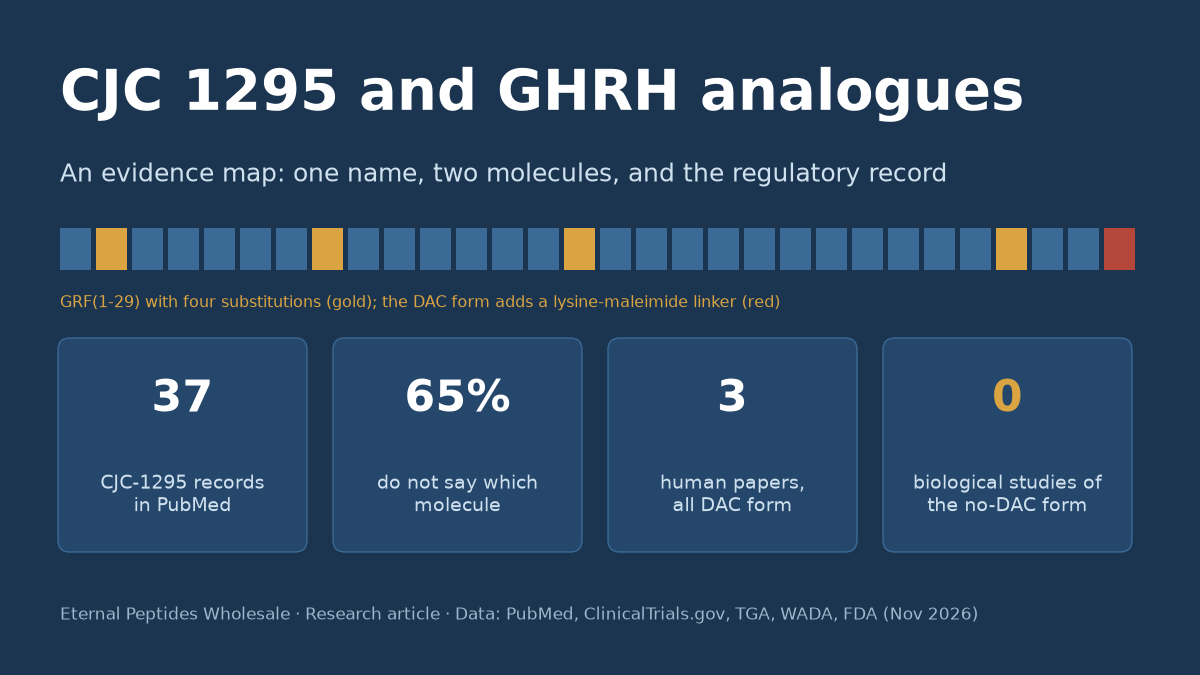
Abstract
Background. CJC 1295 is a code name for a synthetic analogue of growth hormone-releasing hormone (GHRH), the hypothalamic peptide that signals the pituitary to release growth hormone. The name is used for two different molecules. One is CJC-1295 DAC, a modified GHRH(1-29) fragment carrying a chemical group that binds to albumin in the blood. The other, known as “CJC-1295 without DAC” or “modified GRF 1-29”, is the same 29-residue peptide without that group [1, 2, 3]. Sermorelin (GHRH(1-29)NH2) and tesamorelin are better-documented members of the same GHRH analogue class. In Australia, CJC-1295 and the GHRH group are Schedule 4 substances listed in Appendix D of the Poisons Standard. WADA prohibits all four peptides at all times [4, 5].
Objective. To measure the published and registered evidence for CJC 1295 against two comparators, sermorelin and tesamorelin. A second aim was to record which of the two CJC-1295 molecules each paper actually concerns. The review also sets out the half-life record for the class with the arithmetic shown, and rebuilds the regulatory history from primary documents.
Methods. A systematic evidence map, with reporting informed by PRISMA 2020 and its scoping-review extension [6, 7]. PubMed was searched through NCBI E-utilities on 1 November 2026 (Australia/Brisbane), with Europe PMC and the ClinicalTrials.gov API as cross-checks [8, 9, 10]. Every CJC-1295 record was read in full abstract, and open full text was read where it was available. Each record was classified by evidence tier and by which molecule it described. The sermorelin and tesamorelin sets were classified by rules applied to titles, abstracts and indexing. The rules were then checked against a hand-read random sample. Half-lives were taken only from primary studies, and one value was derived from published population pharmacokinetic parameters. Regulatory status was read from the instruments and agency pages themselves.
Results. The CJC-1295 searches returned 41 PubMed records; 37 were relevant and 4 were false matches. Of the 37, 3 were human studies, 3 were animal studies, 18 were analytical or anti-doping papers, 10 were reviews (all published in 2026), 2 studied the online market and 1 mentioned the peptide incidentally. Only 13 of the 37 records (35%) identify which molecule they mean: 8 concern the albumin-binding DAC form, 3 the form without DAC, and 2 distinguish both. All three human studies concern the DAC form and come from one development programme, published between 2006 and 2009. The only registered trial was a Phase 2 study that was terminated in 2006 after a participant died. The company said a causal link was not established, and no results were ever posted. The no-DAC peptide has no published human or animal study under either name. By contrast, the closely related D-Ala2 GHRH(1-29) analogue has 50 chemical-name records from 1984 to 2014, including human data that showed a smaller potency gain than in rats. Published half-lives range from about 4 minutes for GHRH(1-29) to 5.8 to 8.1 days for the DAC form, a ratio of about 1,250 to 2,700. Sermorelin (568 records) and tesamorelin (125 records, 24 registered trials) have far larger clinical records. CJC-1295 has been a named Schedule 4 and Appendix D entry since 1 June 2015.
Conclusions. The CJC 1295 evidence base is small, old and split between two molecules. Human data exist only for the DAC form, from one sponsor’s programme, which stopped in 2006. The form most often sold without DAC has an analytical and forensic literature but no published biology under its own name. In Australia, a research-use-only label does not change the Schedule 4 and Appendix D status of either form [11, 12].
What is new here. To our knowledge, this is the first evidence map to classify, record by record, which of the two CJC-1295 molecules each published paper concerns. It shows that all of the human data concern the DAC form, while the no-DAC peptide has no published biological study. It reports reproducible database counts with their search strings, compared with sermorelin and tesamorelin, and a registry audit that finds a discrepancy in the only CJC-1295 trial record. It also sets out a half-life comparison with every step of the arithmetic shown. The Australian regulatory timeline was rebuilt from the March 2015 scheduling decision and the Poisons Standard instruments. It finds that the CAS number in the Schedule 4 entry resolves in PubChem to a record whose computed structure is the no-DAC peptide, while the 2015 decision relied on human data for the DAC form.
Key findings
- PubMed holds 37 relevant CJC-1295 records against 568 for sermorelin and its GRF(1-29) synonyms and 125 for tesamorelin. Only 3 of the CJC-1295 records report human studies, and 10 are 2026 reviews [8].
- “CJC-1295” names two molecules: a 3,647 Da albumin-binding DAC form and a 3,368 Da tetrasubstituted GRF(1-29) amide. Of 37 records, 24 never say which they mean [2, 3, 1, 13].
- All human CJC-1295 data concern the DAC form and come from one programme, with three papers published between 2006 and 2009. The estimated half-life was 5.8 to 8.1 days [14, 15, 16].
- The only registered CJC-1295 trial (NCT00267527) was terminated in 2006 after a participant died. Causality was not established, and no results were posted [17, 18, 19].
- Sermorelin was withdrawn by its manufacturer. Tesamorelin was approved by the FDA in November 2010 for one specific indication. Neither approval history transfers to CJC-1295 [20, 21].
- CJC-1295 (CAS 863288-34-0) and the GHRH group have been in Schedule 4 and Appendix D since 1 June 2015. The Therapeutic Goods Administration (TGA) named CJC-1295 in its 2026 peptide warnings, and WADA’s 2027 list names CJC-1293, CJC-1295, sermorelin and tesamorelin [22, 4, 11, 5].
Contents
- Introduction: why CJC 1295 needs an evidence map
- What CJC 1295 is: one name, two molecules
- Methods: searches, classification and audits
- Results: search yield and publication trends
- Results: the GHRH analogue evidence map
- Results: which CJC-1295 the literature describes
- Results: CJC 1295 human studies and trial registrations
- Results: half-life of GHRH analogues, with the arithmetic
- Results: CJC 1295 regulatory status in Australia, sport and the United States
- Discussion
- Gap analysis: research questions for GHRH analogues
- Limitations
- Conclusion
- Relevance to Eternal Peptides Wholesale
- Glossary
- Frequently asked questions about CJC 1295
- References
- Related research
- About this article
Introduction: why CJC 1295 needs an evidence map
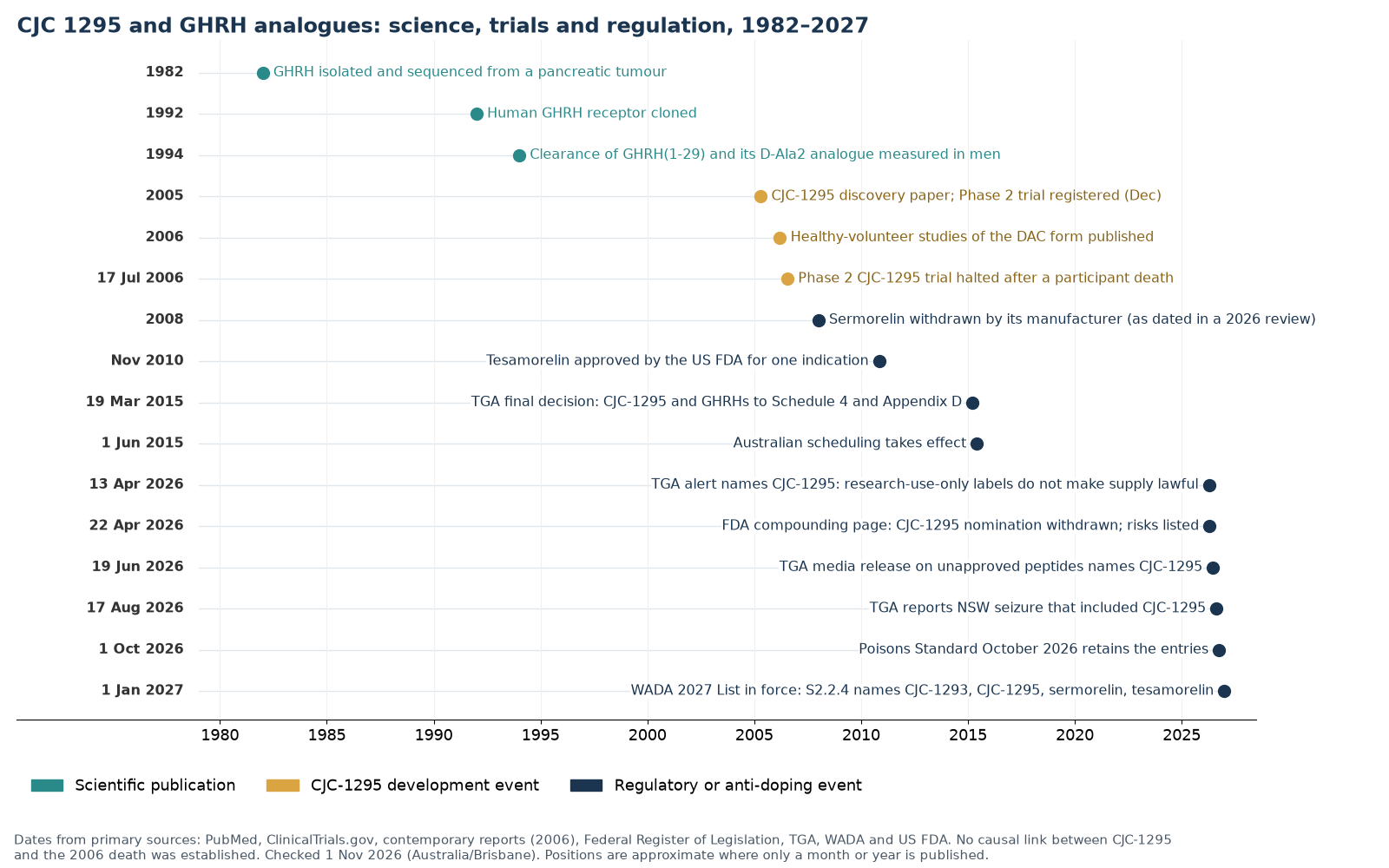
Growth hormone-releasing hormone was isolated in 1982 from pancreatic tumours that had caused acromegaly. Two groups reported the 40- and 44-residue peptides within weeks of each other [23, 24, 25]. It was soon found that the first 29 residues, GHRH(1-29)NH2, kept most of the native hormone’s activity. That fragment became the clinical compound later named sermorelin, and the template for most synthetic analogues that followed [26, 27]. A decade later the pituitary GHRH receptor was cloned and placed in the class B family of G protein-coupled receptors [28, 29]. The main practical problem with native GHRH and its 29-residue fragment was well documented by the late 1980s: in plasma, both are cleaved within minutes by dipeptidyl peptidase-4 (DPP-IV) between residues 2 and 3, giving an inactive product [30, 31]. Much of the chemistry in this field since then has been an effort to slow that clearance. Approaches included D-amino acid substitution at position 2, replacement of the residues most prone to chemical degradation, attachment of fatty acids or polymers, and, in the case of CJC-1295, covalent binding to albumin [32, 33, 34, 1, 35].
CJC 1295 is the most widely discussed product of that effort outside the clinic. It was developed by the Canadian company ConjuChem in the early 2000s, under the “Drug Affinity Complex” (DAC) approach. In that design, a reactive maleimide group is attached to a peptide so that, after injection, it forms a covalent bond with a free thiol group (Cys34) on serum albumin [1]. Healthy-volunteer studies published in 2006 reported a half-life of several days, a very large change for a peptide whose parent fragment lasts minutes [14, 15]. The development programme ended in 2006. Since then, “CJC-1295” has had a second life as a name used in anti-doping science, in customs seizures and in online markets [36, 37, 38]. In those settings the name usually refers to a different molecule: the same modified 29-residue peptide without the albumin-binding group [13, 39].
That naming split matters for anyone who reads the CJC 1295 literature. A reader who searches for “CJC-1295” will find a human half-life of six to eight days, a set of growth hormone and IGF-1 measurements from healthy volunteers, and a sizeable anti-doping literature. It is not obvious which of those findings applies to which molecule. Commercial and informal sources routinely merge the two. For example, they cite the DAC-form human data when describing the no-DAC product, or quote a half-life of about 30 minutes for the no-DAC form that has no traceable primary source (Section 8). Meanwhile, the two GHRH analogues that did reach regulatory approval, sermorelin and tesamorelin, have very different evidence records that are often cited loosely alongside CJC-1295 [26, 21].
Several narrative reviews of performance and “wellness” peptides appeared in 2026. They describe CJC-1295 alongside other peptides in the growth hormone axis, but none set out to count its literature, to classify which molecule each study concerned or to audit its trial registration [40, 41, 42, 43]. This article does those things. It belongs to a series of evidence maps from the Eternal Peptides Wholesale research library that use the same method, including maps of TB-500 and BPC-157. It is written for laboratory researchers, compliance staff and readers who want to know what the CJC 1295 evidence actually is before they rely on any claim about it.
The review addresses five questions. First, how large is the CJC-1295 literature compared with the literature on sermorelin and tesamorelin, and how is it distributed across human, animal, analytical and review work? Second, which of the two CJC-1295 molecules does each record describe? Third, what human data exist, and how was the only registered trial reported? Fourth, what do primary pharmacokinetic studies show about the half-lives of GHRH analogues, and how large are the differences between them? Fifth, what is the regulatory status of CJC-1295, sermorelin and tesamorelin in Australia, in sport and in the United States, and when did it arise?
What CJC 1295 is: one name, two molecules
All the peptides in this review are built on human GHRH. The native hormone has 44 amino acids and a C-terminal amide. Its first 29 residues, Tyr-Ala-Asp-Ala-Ile-Phe-Thr-Asn-Ser-Tyr-Arg-Lys-Val-Leu-Gly-Gln-Leu-Ser-Ala-Arg-Lys-Leu-Leu-Gln-Asp-Ile-Met-Ser-Arg-NH2, form the shortest sequence with full activity, and this fragment is sermorelin [26, 13]. The fragment has three known weak points. DPP-IV cleaves the bond between Ala2 and Asp3. Asn8 rearranges in solution to aspartate and β-aspartate forms. Met27 oxidises. Each of these reduces activity [31, 33, 44].
The analogues discussed here were designed to address one or more of those weak points:
- D-Ala2 GHRH(1-29)NH2. L-alanine at position 2 is replaced by D-alanine, which slows DPP-IV cleavage. Anti-doping papers call this molecule “CJC-1293” [13, 32].
- The tetrasubstituted peptide. D-Ala2 is combined with Gln8, Ala15 and Leu27, to resist DPP-IV, avoid Asn8 rearrangement, raise receptor affinity and avoid Met27 oxidation [1, 33, 45].
- The DAC form. A lysine carrying a maleimidopropionyl group is added at the C-terminus of the tetrasubstituted peptide [1].
Tesamorelin takes a different route. It keeps the full 44-residue human sequence and adds a trans-3-hexenoyl group to Tyr1, which also confers resistance to DPP-IV [35].
The name CJC-1295 is attached to both the tetrasubstituted peptide and its DAC version. In ConjuChem’s 2005 paper, CJC-1295 is the DAC compound, described as “a tetrasubstituted form of hGRF(1-29) with an added N epsilon-3-maleimidopropionamide derivative of lysine at the C terminus” [1]. In the anti-doping literature the label is often used for the peptide without the lysine-maleimide group. For instance, a 2016 plasma method used a custom-synthesised reference standard listed as “CJC-1295 ((D-Ala2, Gln8, Ala15, Leu27)-GRF amide)” [13]. An unknown pharmaceutical preparation analysed in 2009 contained “a 29 amino acid peptide with a C-terminal amide function”, consistent with “a peptide currently marketed under the name CJC-1295” [36]. Powders seized by Danish customs were identified as analogues of “modified growth hormone releasing factor (modified GRF 1-29)” carrying an extra N-terminal glycine [39]. Commercial usage has settled on “CJC-1295 with DAC” and “CJC-1295 without DAC”. The second is also called “modified GRF 1-29” or “mod GRF 1-29”. A 2026 review uses both terms explicitly [40].
Chemical databases show the same confusion. In PubChem, the CAS number used in the Australian Schedule 4 entry, 863288-34-0, resolves to compound 56841945. That record’s computed structure is the 29-residue amide, formula C152H252N44O42, with a molecular weight of 3,367.9 [3]. The same record also carries depositor synonyms that name the DAC form, including “CJC 1295 with DAC” and “DAC:GRF acetate”, and one that names the no-DAC form. A separate record, compound 91971820, has formula C165H269N47O46, a molecular weight of 3,647.2 and the synonym CJC-1295 with CAS 446262-90-4. It corresponds to the DAC structure [2]. The formula difference between the two records is C13H17N3O4. Its mass, 3,647.2 − 3,367.9 = 279.3 Da, is consistent with the added lysine and maleimidopropionyl group described by the developers [1]. These are database assignments, not legal determinations. Section 9 returns to what the CAS number means for the Australian schedule entry.
Table 1. Identity and nomenclature of GHRH analogues discussed in this review.
| Name used | Structure (as reported) | Mass / formula | Key design feature | Main literature |
|---|---|---|---|---|
| GHRH(1-44)NH2 (native) | 44-residue human hormone | about 5.0 kDa | Endogenous ligand of the GHRH receptor | Physiology; diagnostic testing |
| Sermorelin, GRF(1-29), GHRH(1-29)NH2 | Residues 1-29 of human GHRH, C-terminal amide | about 3.36 kDa | Shortest fully active fragment | Clinical and diagnostic studies, 1980s-1990s |
| CJC-1293, D-Ala2 GRF(1-29) | [D-Ala2]GHRH(1-29)NH2 | Same formula as sermorelin; differs only in chirality at residue 2 | Slows DPP-IV cleavage | Structure-activity and human pharmacology papers, 1984-2014; anti-doping |
| CJC-1295 without DAC, “modified GRF 1-29” | [D-Ala2, Gln8, Ala15, Leu27]GHRH(1-29)NH2 | C152H252N44O42; 3,367.9 | Four substitutions for stability and receptor binding | Analytical, anti-doping and seizure reports |
| CJC-1295 with DAC (DAC:GRF) | Tetrasubstituted GRF(1-29) plus C-terminal Lys(ε-maleimidopropionyl) | C165H269N47O46; 3,647.2 | Binds covalently to albumin Cys34 after injection | One development programme, 2005-2009; equine anti-doping |
| Tesamorelin (TH9507) | trans-3-hexenoyl-GHRH(1-44)NH2 | about 5.1 kDa | N-terminal acyl group blocks DPP-IV | Phase 3 trials; FDA approval November 2010 |
Sources for Table 1: [1, 13, 46, 3, 2, 35, 26, 32, 21]. Approximate masses for the native hormone, sermorelin and tesamorelin are given for orientation only.
The CJC-1293 and sermorelin row needs a note. The two molecules have the same amino acid composition and the same mass, and differ only in whether residue 2 is L- or D-alanine. A 2023 capillary electrophoresis method reported separating these “enantiopeptides” for the first time [46]. A 2022 urine method reported them as a single combined analyte (“sermorelin/CJC-1293”) [47]. So, in practice, whether a mass spectrometry result can tell sermorelin from CJC-1293 depends on the separation method used.
Methods: searches, classification and audits
Design and reporting framework
This is a systematic evidence map. It describes what research exists, by molecule, design and domain, and does not pool or rank results. Reporting follows the relevant items of PRISMA 2020 and the PRISMA extension for scoping reviews [6, 7]. No protocol was registered. All searches were run on 1 November 2026 between 04:00 and 05:00 Australia/Brisbane time. The search strings, record lists and classification rules are kept with the article so the counts can be reproduced.
Database searches for CJC 1295, sermorelin and tesamorelin
PubMed was searched through NCBI E-utilities [8]. CJC-1295 was searched as a title or abstract term in all common spellings (“CJC-1295”, “CJC 1295”, CJC1295) and as “DAC:GRF”. An all-fields version returned the same records. The no-DAC form was searched separately as “modified GRF”, “mod GRF”, “modGRF”, “CJC-1293” and “tetrasubstituted GRF”. The underlying structures were also searched by chemical description. One query looked for papers reporting Gln8 and Ala15 substitutions in a GRF or GHRH peptide. A second looked for D-Ala2 analogues of GRF(1-29), because a structural search can find studies that never use the code names. Sermorelin was searched as sermorelin and the common GRF(1-29) and GHRH(1-29) synonyms in title or abstract, combined with the sermorelin substance index term. Tesamorelin was searched as tesamorelin, TH9507 and “TH 9507”, combined with its substance term. For context, the whole GHRH literature was counted under the MeSH heading and under free-text synonyms. Europe PMC was searched with comparable strings as a cross-check, and its preprint source was counted separately [9].
Table 2. Search strings and yields, 1 November 2026.
| Concept | Search (summary) | Database | Records |
|---|---|---|---|
| GHRH, whole field | “Growth Hormone-Releasing Hormone”[Mesh] | PubMed | 5,219 |
| GHRH, whole field (broad) | MeSH OR GHRH / GRF synonyms [tiab] | PubMed | 7,191 |
| CJC-1295 | “CJC-1295” OR “CJC 1295” OR CJC1295 OR “DAC:GRF” and variants [tiab] | PubMed | 35 |
| No-DAC form | “modified GRF” OR “mod GRF” OR modGRF OR “CJC-1293” OR “tetrasubstituted GRF” [tiab] | PubMed | 8 |
| CJC-1293 only | “CJC-1293” OR “CJC 1293” [tiab] | PubMed | 3 |
| CJC sets combined | Union of the two rows above | PubMed | 41 (37 relevant) |
| Gln8 + Ala15 analogues | (Gln8 OR “Gln 8”) AND (Ala15 OR “Ala 15”) AND GRF/GHRH [tiab] | PubMed | 3 |
| D-Ala2 GRF(1-29) analogues | “D-Ala2” variants AND “1-29” AND GRF/GHRH/GRH [tiab] | PubMed | 50 |
| Sermorelin (text words) | sermorelin OR GRF(1-29) / GHRH(1-29) synonyms [tiab] | PubMed | 373 |
| Sermorelin (substance term) | sermorelin[nm] | PubMed | 316 |
| Sermorelin (union) | Text words OR substance term | PubMed | 568 |
| Tesamorelin (union) | tesamorelin OR TH9507 OR “TH 9507” [tiab] OR tesamorelin[nm] | PubMed | 125 |
| CJC-1295 cross-check | “CJC-1295” OR “CJC 1295” OR CJC1295 | Europe PMC | 63 (4 preprints) |
| CJC-1293 / modified GRF cross-check | “CJC-1293” variants; “modified GRF” variants | Europe PMC | 10; 13 |
| Sermorelin / tesamorelin cross-check | sermorelin; tesamorelin | Europe PMC | 486; 376 |
Sources for Table 2: [8, 9]. Europe PMC searches all indexed text, including full text where available, so its counts are higher and are not directly comparable with the PubMed title and abstract counts.
Classification of records
Every record in the combined CJC-1295 set was read at abstract level, and open full text was read for analytical papers where it was available. Records were coded on two axes. The first axis was the evidence tier: human study, animal study, analytical or anti-doping method, review, study of the online market, incidental mention, or false match (for example, “GRF” meaning glutinous rice flour). The second axis was molecular identity: DAC form stated, no-DAC form stated, both forms distinguished, or not specified. A record was coded as DAC if it described albumin binding, a maleimide group, a drug affinity complex or a C-terminal lysine extension. It was coded as no-DAC if it gave the 29-residue amide structure or used the name “modified GRF 1-29”. One human paper that did not describe the structure, but reported a half-life of 5.8 to 8.1 days from the developer’s programme, was coded as DAC by inference. That inference is flagged in the results.
The sermorelin and tesamorelin sets were too large to read in full in one day, so they were classified automatically. The rules, applied in order, used publication type, title and abstract terms for analytical and anti-doping work, terms for human participants and for animal or cell work, and MeSH “Humans” and “Animals” tags. Records without MeSH indexing were kept as “unindexed”. Four tesamorelin records were NCBI Bookshelf documents that could not be classified from PubMed fields: one drug-information monograph and three health technology assessment reports. These were grouped with reviews. Twenty sermorelin and twenty tesamorelin records were drawn at random (fixed seed) and hand-checked. The results of that check are reported in Section 5, including a rule change made after it.
Registry audit
ClinicalTrials.gov was searched through its version 2 API on 1 November 2026 for CJC-1295 in three spellings, and for DAC:GRF, CJC-1293, “modified GRF”, “GRF 1-29”, sermorelin, tesamorelin, TH9507 and “growth hormone releasing hormone” [10]. For every record, the status, phase, start date, first-posted date, enrolment, sponsor type, interventions and whether results were posted were extracted. The CJC-1295 record was compared with contemporaneous public reports of the trial’s termination [18, 19]. One record that describes itself as a mock or test record was flagged and excluded from counts of genuine trials [48].
Half-life data and arithmetic
Half-lives were taken only from primary studies that reported them, with the species, route and analytical method noted. No value from a secondary website or review was used unless the primary source could be identified. Tesamorelin’s human population pharmacokinetic analysis reported clearance and volume of distribution but not a half-life in its abstract [49]. A half-life was therefore derived with the standard one-compartment relation t½ = ln 2 × V / CL, and is labelled as derived. Ratios and fractions remaining were calculated with first-order kinetics: the fraction remaining after time t is 0.5t / t½. Every calculation is shown so that it can be checked.
Regulatory sources
Australian status was read from the Poisons Standard instruments on the Federal Register of Legislation (February 2016 and October 2026), from the TGA’s March 2015 delegate’s final scheduling decision, and from TGA pages and media releases published in 2026 [50, 4, 22, 12, 11, 51, 52]. Anti-doping status was read from the WADA 2027 Prohibited List and WADA’s announcement of it [5, 53]. United States status was read from the FDA’s list of compounding bulk substances that may present significant safety risks, and from the materials for the July 2026 Pharmacy Compounding Advisory Committee meeting [54, 55]. Summaries of instruments in this article are descriptions, not legal advice.
Results: search yield and publication trends
The two CJC-1295 searches together returned 41 PubMed records. Four were false matches, in which “GRF” or “CJC” stood for something unrelated: two papers on glutinous rice flour, one on graphene and one on ground reaction forces [8]. That left 37 relevant records, published between 2005 and 2026. For comparison, the GHRH field as a whole holds 5,219 records indexed under the MeSH heading and 7,191 when free-text synonyms are added. CJC-1295 is therefore less than 1% of the literature on its own hormone class.
The comparators are much larger. Sermorelin and its GRF(1-29) and GHRH(1-29) synonyms appear in the title or abstract of 373 records. The word “sermorelin” itself appears in only 25 of them, because most of the literature uses the chemical description rather than the drug name. A further 195 records are indexed under the sermorelin substance term without using any of these words, giving a union of 568. Tesamorelin has 125 records: 105 by text words (95 using the name tesamorelin) and 20 more found only through indexing [8]. Europe PMC, which also searches full text, returned 63 records for CJC-1295, 486 for sermorelin and 376 for tesamorelin. Four of the CJC-1295 records were preprints [9]. The roughly twofold difference for CJC-1295 between Europe PMC (63) and PubMed (35) suggests that much of the peptide’s presence in the literature is as a passing mention in the full text of papers about other subjects.
Figure 1 shows how the three literatures are spread over time. They peaked in different decades. Sermorelin text-word records peaked between 1988 and 1994, with a high of 38 in 1991, reflecting the clinical and diagnostic research that followed the hormone’s discovery. They then fell to between one and three records a year after 2003. Tesamorelin records grew in the years around its Phase 3 programme and approval, with 10 in 2007 and 14 in 2011. CJC-1295 records were sparse, never more than three a year, until 2026, which accounts for 12 of the 37 records (32%). Ten of those 12 are reviews [8].
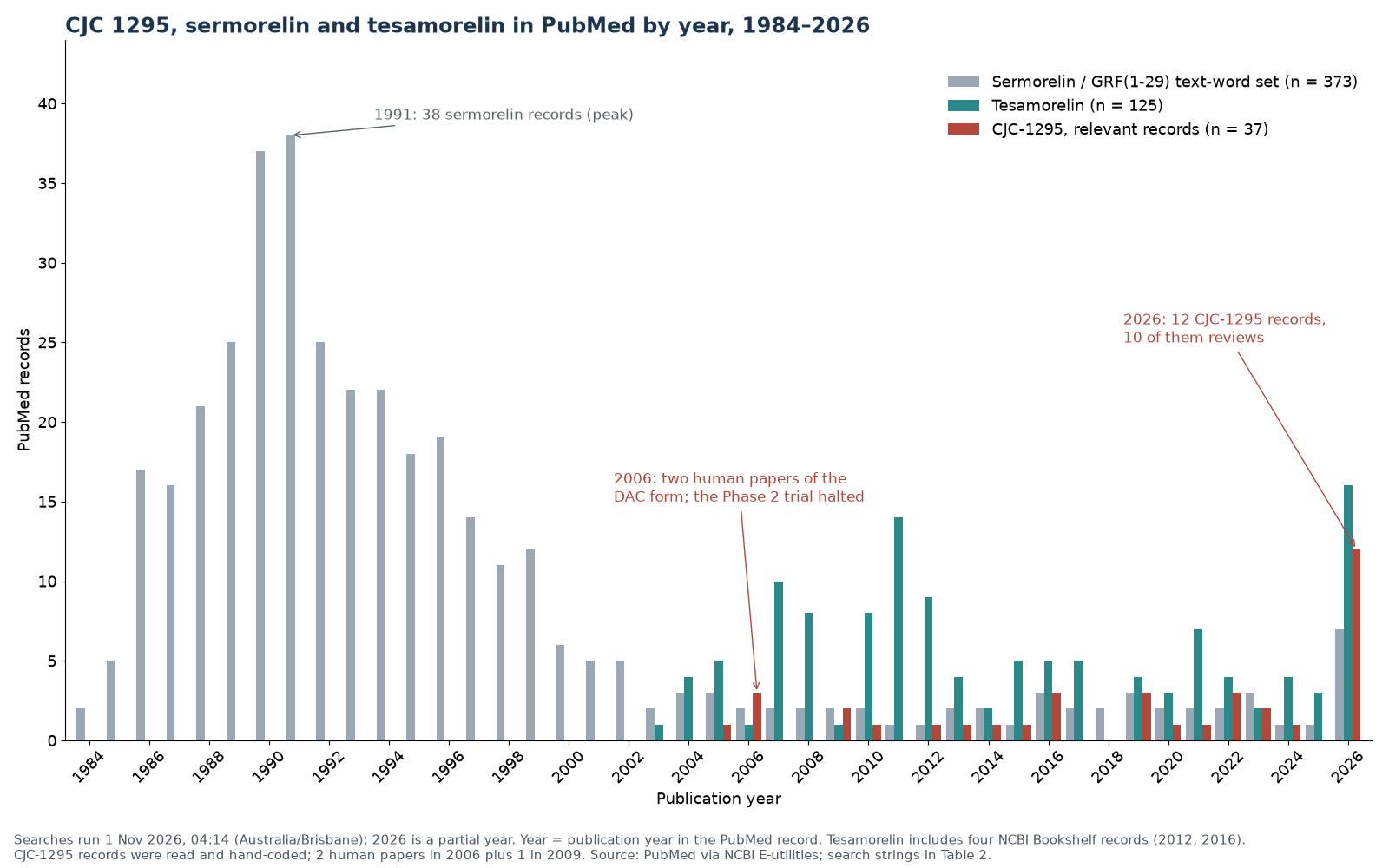
The 2026 increase does not reflect new experimental work. No new human or animal CJC-1295 study appeared in 2026. The new records were narrative reviews of “peptide therapies” in sports medicine, aesthetics and performance, together with two analytical papers, one of which reports an equine ELISA [41, 56, 42, 57, 43, 40, 58, 59]. CJC 1295 now has more reviews than primary human studies, by 10 to 3.
Results: the GHRH analogue evidence map
CJC 1295 records by evidence tier
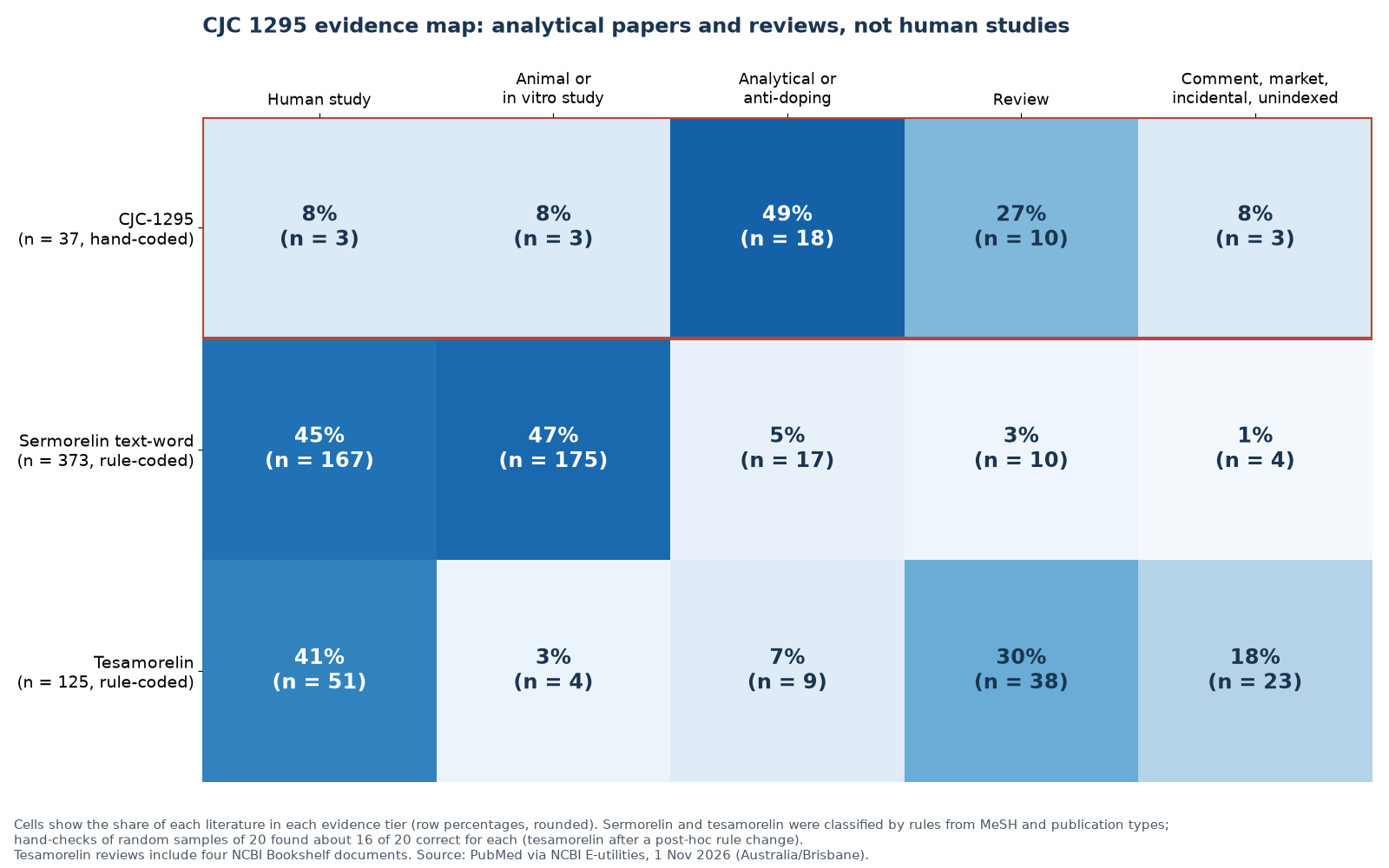
All 37 CJC-1295 records were read and coded by hand. Table 3 gives the distribution of evidence tiers, and Figure 2 compares it with the automatically classified sermorelin and tesamorelin sets. Analytical and anti-doping work is the largest CJC-1295 category, with 18 records (49%). This includes mass spectrometry methods for urine and plasma, immunoaffinity purification, an immuno-PCR screen and an ELISA for equine plasma, and two seizure reports [36, 60, 61, 62, 63, 64, 47, 65, 66, 67, 59, 58]. There are 10 reviews, all from 2026. Human and animal studies number three each. Two records studied online forums where the peptide was discussed [38, 37], and one mentioned it only in passing. That last paper incidentally described CJC-1295 as a “synthetic GHR mimetic” in an assay of the ghrelin receptor, a different receptor [68].
The three animal studies are worth noting individually. The 2005 rat paper identified CJC-1295 as the lead compound among albumin-binding GRF(1-29) conjugates, and reported its pharmacokinetics in rats [1]. A 2006 study in GHRH-knockout mice found that the compound maintained normal growth and body composition when given once daily, but not at longer intervals [69]. A 2009 study used CJC-1295 as a tool to test whether the growth deficit in mice lacking brain M3 muscarinic receptors arose above the pituitary [70]. None of the three studies concerned the no-DAC peptide.
Table 3. Evidence tiers for CJC-1295, sermorelin and tesamorelin in PubMed.
| Tier | CJC-1295 (n = 37, hand-coded) | Sermorelin text-word set (n = 373, rule-coded) | Sermorelin index-only set (n = 195, rule-coded) | Tesamorelin (n = 125, rule-coded) |
|---|---|---|---|---|
| Human study | 3 (8%) | 167 (45%) | 48 (25%) | 51 (41%) |
| Animal or in vitro study | 3 (8%) | 175 (47%) | 136 (70%) | 4 (3%) |
| Analytical or anti-doping | 18 (49%) | 17 (5%) | 3 (2%) | 9 (7%) |
| Review (including Bookshelf documents) | 10 (27%) | 10 (3%) | 5 (3%) | 38 (30%) |
| Comment, market study, incidental or unindexed | 3 (8%) | 4 (1%) | 3 (2%) | 23 (18%) |
Sources for Table 3: PubMed records retrieved on 1 November 2026 [8]; classification rules as described in Methods. Percentages are rounded and may not sum to 100.
Sermorelin and tesamorelin: what the comparators show
The sermorelin text-word literature is split almost evenly between human studies (167) and animal or in vitro work (175). This reflects two decades in which GRF(1-29) was a standard tool in both pituitary physiology and diagnostic testing [26, 71, 72]. The tesamorelin literature is much smaller, but 41% of it consists of human studies. These include the Phase 3 programme in HIV-associated abdominal fat accumulation, its extension, and later investigator-led studies of liver fat [73, 74, 75, 76]. Health technology assessment and drug-information documents make up part of its review tier. Tesamorelin also has a separate, growing review literature and 18 comments, editorials or letters, the largest such group of the three peptides.
The two comparators carry different lessons. Sermorelin shows that a GHRH analogue can be studied in humans across many centres for years, reach approval, and still be withdrawn by its manufacturer. A 2006 review by an advocate of its off-label use stated that it “was withdrawn as a therapeutic entity by the manufacturer” [20]. A 2026 review dated the withdrawal to 2008 [40]. Tesamorelin shows what a complete development programme for a GHRH analogue looks like. It included a non-clinical safety package, Phase 3 trials with an extension, a population pharmacokinetic analysis, and regulatory review for a narrow indication [35, 73, 49, 21]. This article does not summarise either compound’s efficacy results, which belong to their approved or formerly approved uses. Neither history can be borrowed by CJC-1295, which never completed any part of such a programme.
How reliable is the automatic classification?
The hand-check found the rules to be adequate for a map but not for counting individual studies. Of 20 randomly drawn sermorelin records, about 16 had the correct tier. Two that were coded as human studies were preclinical, and one comment was coded as preclinical. Tesamorelin initially scored about 13 of 20. After a rule change made in light of the sample, which gave priority to publication type and analytical terms before human-participant terms, it scored about 16 of 20. Three records were still wrongly coded as human studies. This change was made after looking at the data and is reported as such. The figures in Table 3 for the comparators should therefore be read as approximate, with an error of perhaps one record in five for any individual tier.
The hand-check also found a larger problem with the sermorelin index-only set. In at least 13 of the 20 sampled records from the full sermorelin union, sermorelin or GRF(1-29) was not the agent under study. Examples include GHRH antagonists, VIP receptor pharmacology, fish physiology and rat neuroendocrine studies that used native GHRH. The sermorelin substance term in PubMed’s indexing appears to cover the broader GHRH concept in many records. For this reason, the 373-record text-word set is used as the main sermorelin comparator throughout, and the 568-record union is reported only for transparency. Anyone repeating this map should expect the same noise.
Results: which CJC-1295 the literature describes
Each CJC-1295 record was coded for whether it identifies the molecule (Table 4). Only 13 of the 37 records do so (35%). Six explicitly describe the DAC form: the 2005 discovery paper, the knockout mouse study, the pulsatility study and three equine anti-doping papers. The pulsatility study describes an analogue “that binds permanently to endogenous albumin after injection” [1, 69, 15, 62, 63, 58]. Two human papers are coded as DAC by inference. The 2006 healthy-volunteer study reports a half-life of 5.8 to 8.1 days from the developer’s programme, and the 2009 proteomics study describes a “long-acting GHRH analog” in sera collected after a single injection [14, 16]. Neither abstract names the albumin-binding chemistry. Three records explicitly concern the no-DAC peptide: the 2009 unknown preparation, the plasma method using the tetrasubstituted reference standard, and the glycine-extended material seized in Denmark [36, 13, 39]. Two records explicitly distinguish both forms. A 2021 review of detection methods discusses “CJC-1295, and CJC-1295 with drug affinity complex”, and a 2026 review tabulates them separately [77, 40].
Table 4. Molecular identity of the 37 relevant CJC-1295 records.
| Identity coding | Records | Tiers represented | Examples |
|---|---|---|---|
| DAC form, stated | 6 | Animal (2), human (1), analytical (3) | Discovery paper; knockout mouse study; equine immuno-PCR, LC-MS/MS and ELISA methods |
| DAC form, inferred | 2 | Human (2) | Healthy-volunteer pharmacokinetic study; serum proteomics study |
| No-DAC form, stated | 3 | Analytical (3) | 2009 unknown preparation; plasma method with tetrasubstituted standard; Danish seizure |
| Both forms distinguished | 2 | Analytical review (1), review (1) | 2021 review of detection methods; 2026 performance-peptide review |
| Not specified | 24 | Analytical (11), review (9), market (2), animal (1), incidental (1) | Most urine and blood screening methods; most 2026 reviews |
Sources for Table 4: [1, 69, 15, 62, 63, 58, 14, 16, 36, 13, 39, 77, 40]. Coding by the author from abstracts and, where open, full text.
Two consequences follow. First, every human and animal finding for CJC-1295 concerns the albumin-binding form, made and supplied by its developer. In two of the three human papers, the link to the DAC form is an inference from the programme and the reported half-life rather than a stated structure. Second, the no-DAC peptide appears in the literature only as an analyte. It is something that laboratories identify in seized vials and screen for in athletes’ and horses’ samples, never something whose biology has been studied under its own name. A reader looking for human data on “CJC-1295 without DAC” or “modified GRF 1-29” will find none.
Searching by chemical name instead of code name
Because code names can hide a molecule, the no-DAC structure was also searched by chemical description. A search for GRF or GHRH peptides with both Gln8 and Ala15 substitutions found three records from the 1990s. All three concern a related His1, Val2, Gln8, Ala15, Leu27 GRF(1-32) series, not the D-Ala2 tetrasubstituted 1-29 amide [33, 78, 79]. Only the 2005 developer paper uses the term “tetrasubstituted” for a GRF or GHRH peptide [1]. On this evidence, no published paper describes the biology of the no-DAC peptide under either a code name or its chemical name.
The closest molecule with a real published biology is the D-Ala2 analogue of GRF(1-29), which anti-doping papers call CJC-1293. A search for D-Ala2 GRF(1-29) returned 50 records from 1984 to 2014 [8]. They include early structure-activity work, enzymatic degradation studies and human pharmacology. This literature contains a warning about extrapolating between species. In rats, D-Ala2 GRF(1-29)NH2 was about 50 times as potent as the parent peptide [80]. In normal men, one study found it about twice as potent [81], and another found it “no more potent” than the parent peptide [27]. A later study of a related D-Ala2 analogue concluded that its rat superactivity was not seen in humans and raised the possibility of a species difference at the receptor [82]. In rat tissue, GRF(1-29) analogues also act on VIP receptors in liver and pancreas membranes, which complicates their pharmacology in that species [83]. Any argument that runs from rat data to human effects for this peptide family has to deal with these findings.
Results: CJC 1295 human studies and trial registrations
The three published human studies
The three human papers all come from one programme. The first, published in 2006, reported two randomised, placebo-controlled, double-blind, ascending-dose studies in healthy adults aged 21 to 61, lasting 28 and 49 days. It measured growth hormone, IGF-I and pharmacokinetics [14]. The authors reported dose-dependent increases in GH and IGF-I and an estimated half-life of 5.8 to 8.1 days, and stated that no serious adverse reactions occurred in those studies. The second, also from 2006, sampled blood every 20 minutes overnight in healthy men before and one week after a single injection. It found that GH pulsatility was preserved while trough GH rose [15]. The third, from 2009, used two-dimensional gel electrophoresis on sera from 11 healthy young men before and one week after injection, to look for protein markers of GH and IGF-1 action [16].
These are small, short, mechanistic studies in healthy volunteers. None measured a clinical outcome, none ran longer than seven weeks, none enrolled the target population of the later trial, and none was independently replicated. Their reported safety statements apply only to the participants, durations and conditions studied. They cannot support conclusions about longer use, other populations or the no-DAC peptide. This article deliberately does not reproduce the dose levels studied.
The registry record and the 2006 termination
ClinicalTrials.gov holds one CJC-1295 record, NCT00267527, “A Study to Evaluate CJC 1295 in HIV Patients With Visceral Obesity” [17]. It is a Phase 2, multicentre, randomised, placebo-controlled study sponsored by ConjuChem, planned to run for 12 weeks of treatment and 6 weeks of follow-up. It was first posted on 21 December 2005 and started in December 2005. Its status is “Terminated”, and it gives a completion date of September 2006. It lists an enrolment of 120 without saying whether that number is actual or anticipated. No results have been posted, and the field for the reason the study stopped is empty. None of the alternative names (DAC:GRF, CJC-1293, modified GRF or “GRF 1-29”) returned any registered study.
Contemporaneous reports fill some of these gaps. On 31 July 2006, aidsmap reported that a 192-participant Phase II study had been halted on 17 July 2006 after the death of a participant at a site in Argentina [18]. On 9 August 2006, Pharmaceutical Business Review reported the company’s investigation: the participant had an acute myocardial infarction on 13 July 2006, in the eleventh week of the study, and died. The attending physician’s most likely explanation was asymptomatic coronary artery disease with plaque rupture and occlusion. The company stated that earlier studies had shown no evidence of cardiotoxic effects, and confirmed that it had terminated the study [19]. A causal link between the compound and the death was therefore neither established nor excluded in the public record. This article does not attribute the death to CJC-1295. The registry nevertheless differs from the contemporary reports on enrolment (120 against 192), and no results or explanation for stopping were ever posted. The only registered human trial of CJC 1295 therefore left no public outcome data. No registered human study of either form has appeared in the twenty years since.
Table 5. Registry audit of GHRH analogue records on ClinicalTrials.gov, 1 November 2026.
| Search | Records | Status breakdown | Results posted | Comment |
|---|---|---|---|---|
| CJC-1295 (3 spellings) | 1 | Terminated 1 | 0 | NCT00267527; Phase 2; first posted 21 Dec 2005 |
| DAC:GRF; CJC-1293; “modified GRF”; “GRF 1-29” | 0 | None | 0 | No registered study of the no-DAC form under any name |
| Sermorelin | 42 | Completed 28; terminated 6; withdrawn 4; recruiting 3; unknown 1 | 16 | None lists sermorelin as an intervention; matches are GHRH 1-44, GHRH-arginine testing, tesamorelin and unrelated studies |
| Tesamorelin or TH9507 | 25 | Completed 15; terminated 4; withdrawn 3; recruiting 3 | 10 | Includes one self-described mock record; 24 genuine records |
| “Growth hormone releasing hormone” | 41 | Overlaps with rows above | Not tallied separately | Mostly diagnostic and physiological studies |
| Union of all searches | 50 | Completed 31; terminated 10; withdrawn 4; recruiting 4; unknown 1 | 18 | Includes the mock record |
Sources for Table 5: ClinicalTrials.gov API v2, queried 1 November 2026 [10, 17, 84, 85, 86, 87, 48].
The sermorelin result is a lesson in itself. The registry’s search returns 42 records for “sermorelin”, but not one lists sermorelin as an intervention. The search engine evidently expands the term to the broader GHRH concept, so the matches are studies of native GHRH(1-44), GHRH-arginine stimulation tests, tesamorelin and some unrelated studies. Sermorelin’s clinical record therefore predates trial registration. It exists in journals of the 1980s and 1990s, not in the registry. Tesamorelin, by contrast, has a registry record that matches its published programme. It includes the 412-participant Phase 3 study that started in 2005 [84], its 263-participant extension with posted results [85], and later investigator-led studies with posted results [86, 87]. One tesamorelin record registered in 2026 describes itself in its title as a “Mock Study”. It was excluded from the count of genuine records, and it shows that registry counts need to be read record by record [48].
Results: half-life of GHRH analogues, with the arithmetic
Primary half-life values
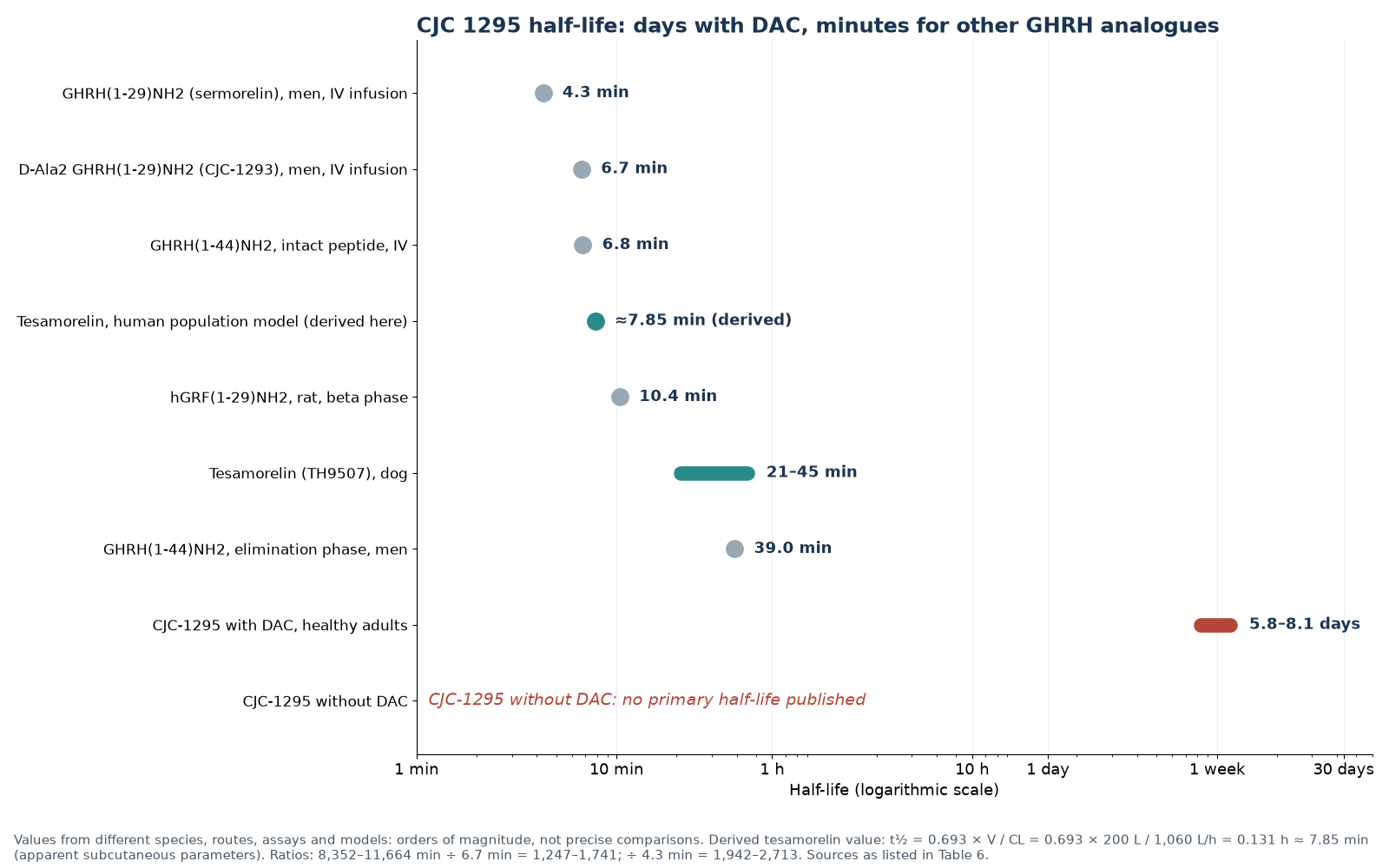
Table 6 lists every primary half-life value found for the peptides in this review, with the study conditions, and Figure 3 plots them on a logarithmic scale. These values were not all measured the same way. Some are disappearance half-times during and after intravenous infusion, measured by immunoassay. Some are elimination half-lives from biexponential fits after bolus injection. One comes from a rat study, one from dogs, and one is derived by the author from population pharmacokinetic parameters. They show orders of magnitude, not precise comparisons.
Table 6. Published half-life values for GHRH and its analogues, with derived quantities.
| Peptide | Value reported | Species and design | Source type |
|---|---|---|---|
| GHRH(1-29)NH2 (sermorelin) | Disappearance half-time 4.3 ± 1.4 min | 10 normal men, constant intravenous infusion, immunoassay | Primary [32] |
| D-Ala2 GHRH(1-29)NH2 (CJC-1293) | Disappearance half-time 6.7 ± 0.5 min; MCR 21 vs 39.7 mL/kg·min for parent | Same 10 men, same design | Primary [32] |
| GHRH(1-44)NH2 | 6.8 min (intact peptide by HPLC); 17 min in plasma in vitro | Normal subjects after intravenous injection; human plasma incubation | Primary [30] |
| GHRH(1-44)NH2 | Distribution 6.6 min; elimination 39.0 min (harmonic means) | Normal men, intravenous, biexponential fit of immunoreactivity | Primary [88] |
| hGRF(1-29)NH2 | Alpha 1.9 min; beta 10.4 min; subcutaneous exposure 4% of intravenous | Anaesthetised rats, immunoassay | Primary [89] |
| Tesamorelin (TH9507) | Apparent half-life 21-45 min | Dogs, non-clinical programme | Primary [35] |
| Tesamorelin (TH9507) | CL 1,060 L/h (CV 33.6%); V 200 L; derived t½ ≈ 7.85 min | 38 people with HIV and healthy participants, population model after subcutaneous dosing | Parameters primary [49]; t½ derived here |
| CJC-1295 with DAC | Estimated half-life 5.8-8.1 days | Healthy adults, subcutaneous, ascending-dose studies | Primary [14] |
| CJC-1295 without DAC | No primary value found | Not applicable | Gap; see text |
Sources for Table 6: as cited in each row. The derived tesamorelin value is the author’s calculation, not a published figure.
The arithmetic
Four calculations put these numbers in context. All assume first-order elimination.
- Tesamorelin derived half-life. With a one-compartment model, t½ = ln 2 × V / CL = 0.693 × 200 L / 1,060 L/h = 0.131 h, or about 7.85 minutes [49]. Because the parameters came from subcutaneous dosing, they are apparent values, and the time course actually seen after an injection will also depend on absorption. The 7.85-minute figure describes elimination only and is not a reported value.
- DAC half-life in minutes. 5.8 days × 1,440 minutes per day = 8,352 minutes, and 8.1 days × 1,440 = 11,664 minutes [14].
- Fold difference. Against the 6.7-minute D-Ala2 value, 8,352 / 6.7 ≈ 1,247 and 11,664 / 6.7 ≈ 1,741. Against the 4.3-minute GHRH(1-29) value, 8,352 / 4.3 ≈ 1,942 and 11,664 / 4.3 ≈ 2,713. Adding the albumin-binding group to the tetrasubstituted peptide is therefore associated with a half-life increase of roughly three orders of magnitude [32, 14].
- Fraction remaining. With a half-life of 4.3 minutes, the fraction left after 60 minutes is 0.560/4.3 ≈ 0.006%. With 6.7 minutes it is about 0.2%. With a 5.8 to 8.1-day half-life, the fraction left after 24 hours is 0.51/5.8 to 0.51/8.1, or 88.7% to 91.8%. Five half-lives, after which about 3% remains, correspond to 29.0 to 40.5 days.
These figures matter for laboratory and analytical work more than for anything else. The five-half-life figure of 29 to 40.5 days explains why anti-doping laboratories value a compound-specific method for the DAC form, since it remains in circulation for weeks after exposure [63, 62]. The minute-scale values for the short peptides explain why their detection depends on finding metabolites or sampling soon after exposure [47, 77]. Elimination half-life is not a measure of biological effect. Growth hormone responses depend on pituitary physiology, somatostatin tone and feedback, which the half-life does not capture [15, 29].
The missing half-life of CJC-1295 without DAC
No primary study reports a half-life for the tetrasubstituted GRF(1-29) amide. A half-life of about 30 minutes for the no-DAC form circulates widely on commercial and informal websites. The only document found in this review that states such a figure was a presentation by a party nominating the substance to the FDA’s compounding process. That is advocacy material, not a peer-reviewed measurement, and it gives no primary source for the number. This article therefore treats the no-DAC half-life as unknown. The design rationale for the substitutions, slowing DPP-IV cleavage and avoiding Asn8 rearrangement and Met27 oxidation, makes a half-life longer than that of GRF(1-29) plausible. Plausibility is not measurement [33, 45, 31]. Studies of other D-Ala2 and Ala15 analogues in animal plasma, tissue and animals show that such substitutions can change metabolic stability. It also shows that the size of the change differs between species and between assays [45, 90, 91].
Results: CJC 1295 regulatory status in Australia, sport and the United States
Australia: Schedule 4 and Appendix D since 2015
CJC-1295 first entered the Australian Poisons Standard through a 2015 scheduling decision. In the delegate’s final decisions published in March 2015, the TGA recorded that CJC-1295 had not previously been considered for scheduling. The matter had gone to the Advisory Committee on Medicines Scheduling at its meeting of 18 November 2014. An interim decision was published on 5 February 2015, the final decision was dated 19 March 2015, and the implementation date was 1 June 2015. The delegate’s reasons cited the 2006 healthy-volunteer study of the DAC form [22, 14]. The entry was then carried into later consolidations. The Poisons Standard of February 2016 lists “CJC-1295 (CAS No. 863288-34-0)” in Schedule 4, marked with the symbol for substances listed in Appendix D. In the same instrument, “GROWTH HORMONE RELEASING HORMONES (GHRHs)” also appear in Schedule 4 and Appendix D [50].
The current instrument, the Therapeutic Goods (Poisons Standard—October 2026) Instrument 2026 (F2026L01327), commenced on 1 October 2026 and keeps these entries [4]. Schedule 4 lists “# CJC‑1295 (CAS No. 863288‑34‑0)”, “# GROWTH HORMONE RELEASING HORMONES * (GHRHs)” and, as a separate entry without the # symbol, SERMORELIN. Tesamorelin is not named. Appendix D, clause 5, lists “Poisons for which possession without authority is illegal”. The table includes item 7, “CJC‑1295 (CAS No. 863288‑34‑0)”, and item 18, “GROWTH HORMONE RELEASING HORMONES (GHRHs) including those separately specified in Schedule 4”. The operative provision states: “A poison included in the table in clause 5 of Appendix D must not be possessed by a person without authority under the law of the jurisdiction in which the possession occurs” [4].
Two interpretive points follow from the documents. Both are flagged for legal review rather than resolved here. First, the CAS number in the schedule entry resolves in PubChem to a record whose computed structure is the no-DAC peptide, while the 2015 decision relied on human data for the DAC form [3, 22]. Whether the entry, the group entry for GHRHs, or both apply to a given form is a legal question, and the evidence in this review only shows that the two forms are chemically distinct. Second, sermorelin is not marked as an Appendix D substance in its own entry, but the GHRH group item in Appendix D says it includes GHRHs “separately specified in Schedule 4”. Tesamorelin is not named anywhere, but it is a GHRH analogue. How these group entries apply to specific molecules is for regulators and lawyers, not for an evidence map.
The TGA’s 2026 communications are more direct. Its April 2026 guidance on importing, compounding and supplying unapproved peptide products named CJC-1295 among the examples of unapproved peptide products. It stated that “Disclaimers that a product is for ‘research use only’ does not make its supply lawful”, and that such disclaimers alone do not change a product’s regulatory status, permit importation, or remove advertising or supply obligations [11]. Its June 2026 media release on public health risks from unapproved peptide products also named CJC-1295. It reported that serious adverse effects had been identified in association with unapproved peptides, including liver damage and severe allergic reactions requiring hospitalisation. These were described for unapproved peptides as a group and were not attributed to any single peptide [51]. In August 2026 the TGA announced seizures in New South Wales worth more than $120,000 that included CJC-1295. The release said search warrants had been executed on 4 August 2026, and that penalties under the Therapeutic Goods Act 1989 include civil penalties of up to $1.82 million per breach for individuals and $18.2 million per breach for corporations, and criminal penalties of up to seven years’ imprisonment [52, 92]. The TGA’s page on how it regulates therapeutic peptide products sets out the general framework [12]. None of these documents relies on the distinction between the DAC and no-DAC forms.
Sport: WADA S2.2.4, prohibited at all times
The WADA 2027 Prohibited List was published on 21 September 2026 and takes effect on 1 January 2027 [53]. Section S2 covers peptide hormones, growth factors, related substances and mimetics. These are prohibited at all times, in and out of competition, and the list states that “All prohibited substances in this class are non-Specified Substances”. Item S2.2.4, “Growth hormone releasing factors”, includes “growth hormone-releasing hormone (GHRH) and its analogues (e.g. CJC-1293, CJC-1295, sermorelin and tesamorelin)” [5]. The list names CJC-1295 without distinguishing between the two forms. The S2 heading also extends to related substances with similar chemical structure or biological effects, so the WADA status does not depend on which molecule a vial contains. The large analytical literature mapped in Section 5 exists because of this prohibition [77, 93, 66].
United States: FDA compounding position
The FDA’s page on bulk drug substances used in compounding that may present significant safety risks (content current as of 22 April 2026) lists CJC-1295 among substances nominated for the bulk drug substances lists but later withdrawn. It states that CJC-1295 “may pose risk for immunogenicity” in connection with “peptide-related impurities and API characterization”. It also states that “FDA has identified serious adverse events associated with CJC-1295 including increased heart rate and systemic vasodilatory reaction”, and that “Available clinical data are limited” [54]. Sermorelin and tesamorelin do not appear on that page. The materials for the July 2026 meeting of the Pharmacy Compounding Advisory Committee covered a group of other peptides and did not include CJC-1295, sermorelin or tesamorelin [55]. Tesamorelin received FDA approval in November 2010 for a single indication in HIV-associated lipodystrophy [21]. That approval relates to tesamorelin’s own molecule, formulation and programme, and says nothing about CJC-1295.
Table 7. Regulatory status of CJC-1295 and comparators, as read from primary sources on 1 November 2026.
| Jurisdiction or body | CJC-1295 | Sermorelin | Tesamorelin | Key date |
|---|---|---|---|---|
| Australia, Poisons Standard (F2026L01327) | Schedule 4, named with CAS 863288-34-0; Appendix D clause 5 item 7 | Schedule 4, named; GHRH group item in Appendix D includes GHRHs specified in Schedule 4 | Not named; GHRH group entry may be relevant (legal question) | Commenced 1 October 2026; CJC-1295 entry from 1 June 2015 |
| Australia, TGA communications 2026 | Named in April and June guidance and the August enforcement release | Not named in these releases | Not named in these releases | 13 April, 19 June and 17 August 2026 |
| WADA 2027 Prohibited List | S2.2.4, named; prohibited at all times; non-Specified | S2.2.4, named | S2.2.4, named | Published 21 September 2026; effective 1 January 2027 |
| FDA compounding safety page | Listed: nominated, then withdrawn; immunogenicity and serious adverse event concerns | Not listed | Not listed | Content current as of 22 April 2026 |
| FDA approval history | Never approved | Previously approved; withdrawn by the manufacturer | Approved November 2010, single indication | 2010 |
Sources for Table 7: [4, 22, 11, 51, 52, 5, 53, 54, 20, 40, 21]. This table describes documents; it is not legal advice.
Discussion
Principal findings
This evidence map leads to one main conclusion. The CJC 1295 literature is small and dated, and it describes two molecules that are rarely told apart. The human evidence comes from three short mechanistic studies of the albumin-binding DAC form in healthy volunteers, all from one development programme. The only registered trial of that form was terminated in 2006 after a participant died. The death was not shown to be caused by the compound, and the trial’s results were never posted. The no-DAC peptide, also called “CJC-1295 without DAC” or “modified GRF 1-29”, has no published human or animal study under any name found in this review. It exists in the literature as an analyte that forensic and anti-doping laboratories identify. Because 65% of CJC-1295 records do not specify which molecule they mean, the confusion is built into the literature itself and not only into marketing.
The comparator literatures show what a fuller record looks like. Sermorelin has 373 text-word records, about equally split between human and preclinical work. Most of them date from 1986 to 1999, before trial registration became routine, and the product was later withdrawn by its manufacturer [20, 26]. Tesamorelin has a smaller literature but a complete development record: non-clinical safety studies, Phase 3 trials and an extension, population pharmacokinetics and an FDA approval for a single indication [35, 73, 49, 21]. CJC-1295 is at an earlier stage than either. It has one sponsor’s early-phase work and nothing after 2009 except analytical methods and reviews.
Why molecular identity matters for CJC 1295 research
Identity matters for three reasons. The first is pharmacological. The DAC form was designed to bind covalently to albumin and circulate for days [1, 14]. The no-DAC form has no such mechanism, and nothing in the published record shows how long it lasts in humans. The second concerns the interpretation of studies. A finding from a study of one form cannot be used for the other. This includes growth hormone and IGF-I changes, the preservation of GH pulsatility, the serum protein changes and the safety statements in the healthy-volunteer studies [14, 15, 16]. The third concerns analysis. The two forms differ by 279.3 Da and in chromatographic behaviour, and an analytical method validated for one does not automatically detect the other [13, 63, 2, 3]. The glycine-extended material in the Danish seizure shows that unregistered products can also differ from both reference structures [39].
Laboratory researchers can draw a practical lesson from this. A certificate of analysis for a CJC-1295 product means little unless it states which form was tested and compares the result with the right reference mass and sequence. The same applies to anyone reading a published paper: if the methods section does not say which form was used, the result cannot be assigned to either. Identity, purity and content testing addresses what is in a vial. It cannot supply the biological evidence that the literature lacks.
The species problem in GHRH analogue pharmacology
The D-Ala2 literature contains a direct warning for anyone who extrapolates from animals. A substitution that made GRF(1-29) about 50 times more potent in the rat produced, at most, a twofold increase in normal men, and in one study no increase [80, 81, 27]. A later group concluded that the greatly enhanced rat activity of a related D-Ala2 analogue “is not found in humans”, and suggested a species difference at the GHRH receptor [82]. In rats, GRF(1-29) analogues also act on VIP receptors in liver and pancreas, which adds another species-specific complication [83]. Two of the three CJC-1295 animal studies were in mice and the third in rats [1, 69, 70]. Their findings therefore need human data for confirmation, and such data exist only for the DAC form.
Reviews outnumber primary studies
The 2026 rise in CJC-1295 records consists of reviews. Ten reviews were published in a single year, against three human studies in twenty years. Most of these reviews cover many peptides at once, and they draw on the same small set of primary papers [41, 56, 42, 57, 43, 40]. Reviews are useful for orientation, but they do not add evidence, and their number can give a misleading sense of how established a topic is. The same pattern appeared in this series’ evidence maps of TB-500 and BPC-157, and it seems to be a general feature of the 2026 peptide literature. Interest in these compounds has grown much faster than primary research on them.
Regulation follows the name, not the molecule
The regulatory documents reviewed here mostly do not distinguish between the two forms. WADA names CJC-1295 without qualification and prohibits related substances by structure or effect [5]. The TGA’s 2026 releases name CJC-1295 without specifying a form [11, 51, 52]. The FDA’s compounding page also refers to CJC-1295 without a form [54]. The Australian schedule entry is the exception, since it cites a CAS number. That number resolves in PubChem to the no-DAC structure, yet the 2015 decision was based on human data for the DAC form, and the GHRH group entry sits alongside it [4, 22, 3]. For a researcher, the practical point is simple. No reading of these documents suggests that either form is unregulated in Australia, and the TGA has said that research-use-only labelling does not change a product’s status [11].
How this map differs from existing summaries
Most online summaries of CJC 1295 restate the 2006 half-life, describe the DAC and no-DAC forms in a sentence, and then make claims that the primary literature does not support. This map makes four contributions that such summaries do not. It gives reproducible counts with the search strings and dates. It codes each record by molecular identity. It audits the registry record against contemporary reports. It sets out the half-life arithmetic with every step shown. It also rebuilds the Australian regulatory timeline from the 2015 decision and successive instruments, rather than from secondary summaries.
Gap analysis: research questions for GHRH analogues
The map points to specific gaps. Table 8 lists them with the kind of study that could address each, stated as research questions rather than recommendations for any use.
Table 8. Evidence gaps and research questions for CJC-1295 and related GHRH analogues.
| Gap | Evidence now | Research question | Suitable design |
|---|---|---|---|
| Half-life of the no-DAC form | No primary value | What are the plasma stability and clearance of the tetrasubstituted GRF(1-29) amide? | In vitro plasma stability and DPP-IV assays with validated LC-MS methods |
| Identity of commercial material | Seizure reports show variants, including glycine-extended peptides | How often does material labelled CJC-1295 match either reference structure? | Systematic analytical surveys with sequence confirmation |
| Human data for the DAC form | Three short studies from one sponsor; one terminated trial without posted results | Are there unpublished data from the 2005-2006 programme? | Registry follow-up; document requests to regulators |
| Reporting standards | 65% of CJC-1295 records do not specify the form | Would a naming convention reduce ambiguity in analytical and review papers? | Reporting guidance for peptide analogues |
| Species translation | Rat potency gains for D-Ala2 analogues largely not reproduced in humans | How do GHRH receptor species differences affect analogue potency? | Comparative receptor pharmacology in cell systems |
| Detection windows | Equine methods for the DAC form; human urine methods for short analogues | Can human methods distinguish the two forms and their metabolites? | Validated anti-doping method development |
Sources for Table 8: gaps derived from the evidence mapped in Sections 4 to 8 [14, 17, 39, 13, 80, 82, 63, 47].
Limitations
This map has several limitations. First, the searches covered PubMed, Europe PMC and ClinicalTrials.gov only. Embase, Scopus, conference abstracts, regulatory dossiers and non-English databases were not searched, so some records may have been missed, especially older work in conference proceedings. Second, the CJC-1295 records were coded by a single reviewer. There was no independent second coding, so the identity and tier assignments, particularly the two DAC inferences, may contain errors. Third, the sermorelin and tesamorelin sets were classified by rules. The hand-check suggested an error rate of roughly one record in five, and a rule change was made after the sample had been examined. The sermorelin substance term also proved noisy, with at least 13 of 20 sampled union records not concerning sermorelin as the agent studied. Comparator percentages should therefore be read as approximate.
Fourth, half-life values came from studies with different species, routes, assays and models, and the tesamorelin value was derived, not reported. Fold differences describe orders of magnitude, not precise ratios. Fifth, the PubChem identity mapping relies on database records with inconsistent depositor synonyms, and CAS assignments in databases are not legal determinations. Sixth, the account of the 2006 trial termination relies on two contemporary news reports and the company’s statements as reported. The primary investigation report was not available. Seventh, regulatory documents were read as published on 1 November 2026. The Poisons Standard, TGA guidance, the WADA list and the FDA page are all revised from time to time, and this article does not give legal advice. Finally, some publisher and agency sites block automated access, and a few sources were read through a fetching tool rather than direct download. The verification method used for each reference is recorded in the reference ledger kept with this article.
Conclusion
CJC 1295 is two molecules sharing one name, and the evidence belongs almost entirely to only one of them. The albumin-binding DAC form has three small human studies from 2006 to 2009, three animal studies and a terminated trial without posted results. The no-DAC peptide has an analytical literature but no published biology. Sermorelin and tesamorelin, the GHRH analogues with real clinical histories, show how much more evidence regulatory approval required, and those histories cannot be transferred to CJC-1295. In Australia, CJC-1295 and the GHRH group have been Schedule 4 and Appendix D substances since 2015. The TGA has stated that research-use-only labels do not change that, and WADA prohibits the whole class at all times. For researchers, the most useful next steps are analytical: confirming which molecule a sample contains, measuring the no-DAC peptide’s stability, and reporting the form used in every paper.
Relevance to Eternal Peptides Wholesale
Eternal Peptides Wholesale distributes research peptides in wholesale boxes of 10 vials, for laboratory research use only and not for human consumption (company background). This review is relevant to that work in one specific way. Its central finding is that the name CJC 1295 covers two chemically distinct molecules, and that a third, glycine-extended variant has been found in seized material. Documentation of identity therefore matters for anyone handling GHRH analogue material in a laboratory. The company’s certificate of analysis library transcribes batch-specific reports from Kovera Labs. The testing standards page explains how identity, purity and content results are read, including why an identity result needs to be compared with the expected mass. Such reports address what is in a vial. They say nothing about effects in people and do not establish regulatory approval, clinical suitability or safety for human use. As the TGA has made clear, a research-use-only description is not a legal clearance, and CJC-1295 is a Schedule 4 and Appendix D substance in Australia [11, 4].
This review adds to earlier work in the Eternal Peptides Wholesale research library. The same evidence-map method was applied in the TB-500 and thymosin beta-4 evidence map and the BPC-157 evidence map, both of which found a similar gap between name and molecule. The broader growth hormone axis is covered in the evidence review of peptides discussed for muscle gain, and the analytical questions raised here are treated in more depth in the paper on synthetic peptide manufacture, impurities and analytical verification.
Glossary
- Albumin binding (DAC): the “Drug Affinity Complex” approach, in which a reactive maleimide group on a peptide forms a covalent bond with the free thiol of Cys34 on serum albumin after injection, extending circulation time.
- Appendix D (clause 5): the part of the Poisons Standard that lists poisons for which possession without authority is illegal. CJC-1295 and the GHRH group are both listed.
- CAS number: a registry number assigned by the Chemical Abstracts Service to a defined substance. Database assignments of CAS numbers to structures can be inconsistent.
- CJC-1293: a code name used in anti-doping papers for [D-Ala2]GHRH(1-29)NH2, a single-substitution analogue of sermorelin.
- CJC-1295 with DAC: tetrasubstituted GRF(1-29) carrying a C-terminal lysine with a maleimidopropionyl group, which binds albumin. Molecular formula C165H269N47O46.
- CJC-1295 without DAC (modified GRF 1-29): [D-Ala2, Gln8, Ala15, Leu27]GHRH(1-29)NH2, the same peptide without the albumin-binding group. Molecular formula C152H252N44O42.
- DPP-IV (dipeptidyl peptidase-4): a plasma and membrane enzyme that removes the first two residues of GHRH, inactivating it within minutes.
- Evidence map: a systematic description of what research exists on a topic, by molecule, design and domain, without pooling results.
- GHRH analogue: any synthetic peptide derived from growth hormone-releasing hormone and designed to act at the GHRH receptor, including sermorelin, CJC-1295 and tesamorelin.
- GHRH receptor: a class B G protein-coupled receptor on pituitary somatotroph cells that mediates growth hormone release in response to GHRH.
- Half-life (t½): the time for a concentration to fall by half under first-order elimination. It is not a measure of biological effect.
- Non-Specified substance: a WADA classification for substances whose detection is not treated as potentially unrelated to performance enhancement. It affects the sanctions available.
- Schedule 4: the Poisons Standard schedule for prescription-only medicines.
- Sermorelin: GHRH(1-29)NH2, the first 29 residues of human GHRH. It was formerly approved and was later withdrawn by its manufacturer.
- Tesamorelin: trans-3-hexenoyl-GHRH(1-44)NH2, a full-length GHRH analogue approved by the FDA in 2010 for a single indication.
Frequently asked questions about CJC 1295
What is CJC 1295?
CJC 1295 is a code name for a synthetic analogue of growth hormone-releasing hormone, developed in the early 2000s by the company ConjuChem. The name is used for two molecules: CJC-1295 with DAC, a modified GHRH(1-29) fragment that binds to albumin in the blood, and CJC-1295 without DAC, also called modified GRF 1-29, which lacks the albumin-binding group. It is not an approved medicine in Australia, the United States or elsewhere.
What is the difference between CJC-1295 with DAC and without DAC?
Both share the tetrasubstituted GRF(1-29) sequence. The DAC form adds a C-terminal lysine carrying a maleimidopropionyl group, raising its mass from about 3,368 to about 3,647 Da and allowing covalent binding to albumin. The DAC form had an estimated half-life of 5.8 to 8.1 days in healthy volunteers. No primary half-life has been published for the form without DAC.
Is modified GRF 1-29 the same as sermorelin?
No. Sermorelin is the unmodified GHRH(1-29)NH2 sequence. Modified GRF 1-29 carries four substitutions, D-Ala2, Gln8, Ala15 and Leu27, intended to slow enzymatic breakdown and improve receptor binding. A third molecule, CJC-1293, carries only the D-Ala2 substitution and has the same formula as sermorelin.
Are there human studies of CJC 1295?
Three small human studies were published between 2006 and 2009, all in healthy volunteers and all from one development programme concerning the DAC form. The only registered trial, a Phase 2 study, was terminated in 2006 after a participant died. A causal link was not established, and no results were posted. No published human study of the form without DAC was found.
How does CJC-1295 compare with tesamorelin?
Tesamorelin is a different molecule: the full 44-residue GHRH sequence with an N-terminal hexenoyl group. It completed Phase 3 trials and received FDA approval in November 2010 for a single indication. CJC-1295 never completed clinical development. Tesamorelin’s approval and data do not apply to CJC-1295.
Is CJC 1295 legal in Australia?
CJC-1295 has been listed in Schedule 4 of the Poisons Standard since 1 June 2015 and in Appendix D, clause 5, which lists poisons whose possession without authority is illegal. The October 2026 Poisons Standard keeps both entries, alongside a group entry for growth hormone releasing hormones. The TGA named CJC-1295 in its 2026 warnings about unapproved peptides. This is a summary of the published instruments, not legal advice.
Is CJC-1295 banned in sport?
Yes. The WADA 2027 Prohibited List names CJC-1293, CJC-1295, sermorelin and tesamorelin under S2.2.4 as growth hormone-releasing hormone analogues. Substances in class S2 are prohibited at all times, in and out of competition, and are non-Specified. The 2027 list takes effect on 1 January 2027.
Does a “research use only” label change CJC 1295’s legal status?
No. The Therapeutic Goods Administration has stated that disclaimers that a product is for research use only do not make its supply lawful and do not change a product’s regulatory status. In Australia, CJC-1295 remains a Schedule 4 substance listed in Appendix D, clause 5, whatever the label says.
References
- Jetté L, Léger R, Thibaudeau K, et al. Human growth hormone-releasing factor (hGRF)1-29-albumin bioconjugates activate the GRF receptor on the anterior pituitary in rats: identification of CJC-1295 as a long-lasting GRF analog. Endocrinology. 2005;146(7):3052-8. doi:10.1210/en.2004-1286 PMID: 15817669. Available at: https://doi.org/10.1210/en.2004-1286. Accessed 1 November 2026.
- National Center for Biotechnology Information. PubChem Compound Summary for CID 91971820 (CJC-1295). Available at: https://pubchem.ncbi.nlm.nih.gov/compound/91971820. Accessed 1 November 2026.
- National Center for Biotechnology Information. PubChem Compound Summary for CID 56841945. Available at: https://pubchem.ncbi.nlm.nih.gov/compound/56841945. Accessed 1 November 2026.
- Therapeutic Goods (Poisons Standard—October 2026) Instrument 2026 (F2026L01327). Federal Register of Legislation. Available at: https://www.legislation.gov.au/F2026L01327/asmade/text. Accessed 1 November 2026.
- World Anti-Doping Agency. World Anti-Doping Code International Standard: Prohibited List 2027. Montreal: WADA; 2026. Available at: https://www.wada-ama.org/sites/default/files/2026-09/2027list_en_final_clean_26_august_2026_2.pdf. Accessed 1 November 2026.
- Page MJ, McKenzie JE, Bossuyt PM, et al. The PRISMA 2020 statement: an updated guideline for reporting systematic reviews. BMJ. 2021;372:n71. doi:10.1136/bmj.n71 PMID: 33782057. Available at: https://doi.org/10.1136/bmj.n71. Accessed 1 November 2026.
- Tricco AC, Lillie E, Zarin W, et al. PRISMA Extension for Scoping Reviews (PRISMA-ScR): Checklist and Explanation. Ann Intern Med. 2018;169(7):467-473. doi:10.7326/M18-0850 PMID: 30178033. Available at: https://doi.org/10.7326/M18-0850. Accessed 1 November 2026.
- National Center for Biotechnology Information. Entrez Programming Utilities (E-utilities) Help. Bethesda (MD): National Library of Medicine. Available at: https://www.ncbi.nlm.nih.gov/books/NBK25501/. Accessed 1 November 2026.
- Europe PMC. Europe PMC RESTful Web Service: search for CJC-1295. Available at: https://www.ebi.ac.uk/europepmc/webservices/rest/search?query=%22CJC-1295%22&format=json. Accessed 1 November 2026.
- ClinicalTrials.gov. ClinicalTrials.gov API (version 2). U.S. National Library of Medicine. Available at: https://clinicaltrials.gov/data-api/api. Accessed 1 November 2026.
- Therapeutic Goods Administration. Understanding your responsibilities when importing, compounding and supplying unapproved peptide products. Safety alert, 13 April 2026. Available at: https://www.tga.gov.au/safety/safety-monitoring-and-information/safety-alerts/understanding-your-responsibilities-when-importing-compounding-and-supplying-unapproved-peptide-products. Accessed 1 November 2026.
- Therapeutic Goods Administration. How we regulate therapeutic peptide products. Available at: https://www.tga.gov.au/products/medicines/monitoring-and-compliance/how-we-regulate-therapeutic-peptide-products. Accessed 1 November 2026.
- Knoop A, Thomas A, Fichant E, et al. Qualitative identification of growth hormone-releasing hormones in human plasma by means of immunoaffinity purification and LC-HRMS/MS. Anal Bioanal Chem. 2016;408(12):3145-53. doi:10.1007/s00216-016-9377-3 PMID: 26879649. Available at: https://doi.org/10.1007/s00216-016-9377-3. Accessed 1 November 2026.
- Teichman SL, Neale A, Lawrence B, et al. Prolonged stimulation of growth hormone (GH) and insulin-like growth factor I secretion by CJC-1295, a long-acting analog of GH-releasing hormone, in healthy adults. J Clin Endocrinol Metab. 2006;91(3):799-805. doi:10.1210/jc.2005-1536 PMID: 16352683. Available at: https://doi.org/10.1210/jc.2005-1536. Accessed 1 November 2026.
- Ionescu M, Frohman LA. Pulsatile secretion of growth hormone (GH) persists during continuous stimulation by CJC-1295, a long-acting GH-releasing hormone analog. J Clin Endocrinol Metab. 2006;91(12):4792-7. doi:10.1210/jc.2006-1702 PMID: 17018654. Available at: https://doi.org/10.1210/jc.2006-1702. Accessed 1 November 2026.
- Sackmann-Sala L, Ding J, Frohman LA, et al. Activation of the GH/IGF-1 axis by CJC-1295, a long-acting GHRH analog, results in serum protein profile changes in normal adult subjects. Growth Horm IGF Res. 2009;19(6):471-7. doi:10.1016/j.ghir.2009.03.001 PMID: 19386527. Available at: https://doi.org/10.1016/j.ghir.2009.03.001. Accessed 1 November 2026.
- ClinicalTrials.gov. NCT00267527: A Study to Evaluate CJC 1295 in HIV Patients With Visceral Obesity. Sponsor: ConjuChem. Record status: terminated. Available at: https://clinicaltrials.gov/study/NCT00267527. Accessed 1 November 2026.
- Bernard EJ. Lipodystrophy study halted after patient death. aidsmap. 31 July 2006. Available at: https://www.aidsmap.com/news/jul-2006/lipodystrophy-study-halted-after-patient-death. Accessed 1 November 2026.
- PBR Staff Writer. ConjuChem reveals findings of patient death investigation. Pharmaceutical Business Review. 9 August 2006. Available at: https://www.pharmaceutical-business-review.com/news/97488conjuchem_reveals_findings_of_patient_death_investig/. Accessed 1 November 2026.
- Walker RF. Sermorelin: a better approach to management of adult-onset growth hormone insufficiency?. Clin Interv Aging. 2006;1(4):307-8. doi:10.2147/ciia.2006.1.4.307 PMID: 18046908. Available at: https://doi.org/10.2147/ciia.2006.1.4.307. Accessed 1 November 2026.
- Spooner LM, Olin JL. Tesamorelin: a growth hormone-releasing factor analogue for HIV-associated lipodystrophy. Ann Pharmacother. 2012;46(2):240-7. doi:10.1345/aph.1Q629 PMID: 22298602. Available at: https://doi.org/10.1345/aph.1Q629. Accessed 1 November 2026.
- Therapeutic Goods Administration. Final decisions and reasons for decisions by delegates of the Secretary to the Department of Health, March 2015 (ACMS meeting 18 November 2014), item 1.1 Performance and image enhancing drugs. 19 March 2015. Available at: https://www.tga.gov.au/sites/default/files/reasons-medicines-scheduling-delegates-final-decisions-march-2015.pdf. Accessed 1 November 2026.
- Guillemin R, Brazeau P, Böhlen P, et al. Growth hormone-releasing factor from a human pancreatic tumor that caused acromegaly. Science. 1982;218(4572):585-7. doi:10.1126/science.6812220 PMID: 6812220. Available at: https://doi.org/10.1126/science.6812220. Accessed 1 November 2026.
- Rivier J, Spiess J, Thorner M, et al. Characterization of a growth hormone-releasing factor from a human pancreatic islet tumour. Nature. 1982;300(5889):276-8. doi:10.1038/300276a0 PMID: 6292724. Available at: https://doi.org/10.1038/300276a0. Accessed 1 November 2026.
- Esch FS, Böhlen P, Ling NC, et al. Characterization of a 40 residue peptide from a human pancreatic tumor with growth hormone releasing activity. Biochem Biophys Res Commun. 1982;109(1):152-8. doi:10.1016/0006-291x(82)91578-9 PMID: 7159418. Available at: https://doi.org/10.1016/0006-291x(82)91578-9. Accessed 1 November 2026.
- Prakash A, Goa KL. Sermorelin: a review of its use in the diagnosis and treatment of children with idiopathic growth hormone deficiency. BioDrugs. 1999;12(2):139-57. doi:10.2165/00063030-199912020-00007 PMID: 18031173. Available at: https://doi.org/10.2165/00063030-199912020-00007. Accessed 1 November 2026.
- Grossman A, Savage MO, Lytras N, et al. Responses to analogues of growth hormone-releasing hormone in normal subjects, and in growth-hormone deficient children and young adults. Clin Endocrinol (Oxf). 1984;21(3):321-30. doi:10.1111/j.1365-2265.1984.tb03477.x PMID: 6236914. Available at: https://doi.org/10.1111/j.1365-2265.1984.tb03477.x. Accessed 1 November 2026.
- Mayo KE. Molecular cloning and expression of a pituitary-specific receptor for growth hormone-releasing hormone. Mol Endocrinol. 1992;6(10):1734-44. doi:10.1210/mend.6.10.1333056 PMID: 1333056. Available at: https://doi.org/10.1210/mend.6.10.1333056. Accessed 1 November 2026.
- Halmos G, Szabo Z, Dobos N, et al. Growth hormone-releasing hormone receptor (GHRH-R) and its signaling. Rev Endocr Metab Disord. 2025;26(3):343-352. doi:10.1007/s11154-025-09952-x PMID: 39934495. Available at: https://doi.org/10.1007/s11154-025-09952-x. Accessed 1 November 2026.
- Frohman LA, Downs TR, Williams TC, et al. Rapid enzymatic degradation of growth hormone-releasing hormone by plasma in vitro and in vivo to a biologically inactive product cleaved at the NH2 terminus. J Clin Invest. 1986;78(4):906-13. doi:10.1172/JCI112679 PMID: 3093533. Available at: https://doi.org/10.1172/JCI112679. Accessed 1 November 2026.
- Frohman LA, Downs TR, Heimer EP, et al. Dipeptidylpeptidase IV and trypsin-like enzymatic degradation of human growth hormone-releasing hormone in plasma. J Clin Invest. 1989;83(5):1533-40. doi:10.1172/JCI114049 PMID: 2565342. Available at: https://doi.org/10.1172/JCI114049. Accessed 1 November 2026.
- Soule S, King JA, Millar RP. Incorporation of D-Ala2 in growth hormone-releasing hormone-(1-29)-NH2 increases the half-life and decreases metabolic clearance in normal men. J Clin Endocrinol Metab. 1994;79(4):1208-11. doi:10.1210/jcem.79.4.7962295 PMID: 7962295. Available at: https://doi.org/10.1210/jcem.79.4.7962295. Accessed 1 November 2026.
- Campbell RM, Stricker P, Miller R, et al. Enhanced stability and potency of novel growth hormone-releasing factor (GRF) analogues derived from rodent and human GRF sequences. Peptides. 1994;15(3):489-95. doi:10.1016/0196-9781(94)90211-9 PMID: 7937325. Available at: https://doi.org/10.1016/0196-9781(94)90211-9. Accessed 1 November 2026.
- Esposito P, Barbero L, Caccia P, et al. PEGylation of growth hormone-releasing hormone (GRF) analogues. Adv Drug Deliv Rev. 2003;55(10):1279-91. doi:10.1016/s0169-409x(03)00109-1 PMID: 14499707. Available at: https://doi.org/10.1016/s0169-409x(03)00109-1. Accessed 1 November 2026.
- Ferdinandi ES, Brazeau P, High K, et al. Non-clinical pharmacology and safety evaluation of TH9507, a human growth hormone-releasing factor analogue. Basic Clin Pharmacol Toxicol. 2007;100(1):49-58. doi:10.1111/j.1742-7843.2007.00008.x PMID: 17214611. Available at: https://doi.org/10.1111/j.1742-7843.2007.00008.x. Accessed 1 November 2026.
- Henninge J, Pepaj M, Hullstein I, et al. Identification of CJC-1295, a growth-hormone-releasing peptide, in an unknown pharmaceutical preparation. Drug Test Anal. 2010;2(11-12):647-50. doi:10.1002/dta.233 PMID: 21204297. Available at: https://doi.org/10.1002/dta.233. Accessed 1 November 2026.
- Pineau T, Schopfer A, Grossrieder L, et al. The study of doping market: How to produce intelligence from Internet forums. Forensic Sci Int. 2016;268:103-115. doi:10.1016/j.forsciint.2016.09.017 PMID: 27710891. Available at: https://doi.org/10.1016/j.forsciint.2016.09.017. Accessed 1 November 2026.
- Van Hout MC, Hearne E. Netnography of Female Use of the Synthetic Growth Hormone CJC-1295: Pulses and Potions. Subst Use Misuse. 2016;51(1):73-84. doi:10.3109/10826084.2015.1082595 PMID: 26771670. Available at: https://doi.org/10.3109/10826084.2015.1082595. Accessed 1 November 2026.
- Gajda PM, Holm NB, Hoej LJ, et al. Glycine-modified growth hormone secretagogues identified in seized doping material. Drug Test Anal. 2019;11(2):350-354. doi:10.1002/dta.2489 PMID: 30136411. Available at: https://doi.org/10.1002/dta.2489. Accessed 1 November 2026.
- Dominikowski A, Rękoś Z, Olejarz M, et al. The emerging landscape of performance-enhancing peptides modulating GH-IGF1 axis: bridging the gap between clinical evidence and patient self-administration. Front Endocrinol (Lausanne). 2026;17:1822475. doi:10.3389/fendo.2026.1822475 PMID: 42395176. Available at: https://doi.org/10.3389/fendo.2026.1822475. Accessed 1 November 2026.
- Coutinho LFD, DE Oliveira Neves LF, Camilo RP. A new era of doping? Use of peptide and peptide-analog drugs in recreational and professional sport and bodybuilding: a critical review. J Sports Med Phys Fitness. 2026;66(7):880-885. doi:10.23736/S0022-4707.26.17773-1 PMID: 41880199. Available at: https://doi.org/10.23736/S0022-4707.26.17773-1. Accessed 1 November 2026.
- Renke G, Chinellato L. Therapeutic Peptides in Aesthetic, Metabolic and Endocrine Conditions: Effects, Safety, Clinical Applications, and Future Perspectives. Int J Mol Sci. 2026;27(9). doi:10.3390/ijms27093890 PMID: 42123471. Available at: https://doi.org/10.3390/ijms27093890. Accessed 1 November 2026.
- Tewari K, Liu TP, Im C, et al. Peptide Supplements and Their Therapeutic Applications in Sports Medicine. Am J Sports Med. 2026:3635465261464420. doi:10.1177/03635465261464420 PMID: 42578445. Available at: https://doi.org/10.1177/03635465261464420. Accessed 1 November 2026.
- Stevenson CL, Friedman AR, Kubiak TM, et al. Effect of secondary structure on the rate of deamidation of several growth hormone releasing factor analogs. Int J Pept Protein Res. 1993;42(6):497-503. doi:10.1111/j.1399-3011.1993.tb00356.x PMID: 8307680. Available at: https://doi.org/10.1111/j.1399-3011.1993.tb00356.x. Accessed 1 November 2026.
- Kubiak TM, Friedman AR, Martin RA, et al. Position 2 and position 2/Ala15-substituted analogs of bovine growth hormone-releasing factor (bGRF) with enhanced metabolic stability and improved in vivo bioactivity. J Med Chem. 1993;36(7):888-97. doi:10.1021/jm00059a014 PMID: 8464043. Available at: https://doi.org/10.1021/jm00059a014. Accessed 1 November 2026.
- Otin J, Tran NT, Benoit A, et al. Online large volume sample staking preconcentration and separation of enantiomeric GHRH analogs by capillary electrophoresis. Electrophoresis. 2023;44(9-10):807-817. doi:10.1002/elps.202200278 PMID: 36787346. Available at: https://doi.org/10.1002/elps.202200278. Accessed 1 November 2026.
- Coppieters G, Deventer K, Polet M, et al. An antibody-free, ultrafiltration-based assay for the detection of growth hormone-releasing hormones in urine at low pg/mL concentrations using nanoLC-HRMS/MS. J Pharm Biomed Anal. 2022;214:114726. doi:10.1016/j.jpba.2022.114726 PMID: 35298973. Available at: https://doi.org/10.1016/j.jpba.2022.114726. Accessed 1 November 2026.
- ClinicalTrials.gov. NCT07481734: Tesamorelin for Reduction of Liver Fat in Adults With Fatty Liver Disease (Mock Study). Sponsor: Hudson Biotech. Record status: recruiting. Available at: https://clinicaltrials.gov/study/NCT07481734. Accessed 1 November 2026.
- González-Sales M, Barrière O, Tremblay PO, et al. Population pharmacokinetic analysis of tesamorelin in HIV-infected patients and healthy subjects. Clin Pharmacokinet. 2015;54(3):285-94. doi:10.1007/s40262-014-0202-x PMID: 25358450. Available at: https://doi.org/10.1007/s40262-014-0202-x. Accessed 1 November 2026.
- Poisons Standard February 2016 (F2016L00036). Federal Register of Legislation. Available at: https://www.legislation.gov.au/F2016L00036/asmade/text. Accessed 1 November 2026.
- Therapeutic Goods Administration. Concerns regarding the public health risks associated with unapproved peptide products. Media release, 19 June 2026. Available at: https://www.tga.gov.au/news/media-releases/concerns-regarding-public-health-risks-associated-unapproved-peptide-products. Accessed 1 November 2026.
- Therapeutic Goods Administration. TGA flexes its muscle against illegal peptides and steroids. Media release, 17 August 2026. Available at: https://www.tga.gov.au/news/media-releases/tga-flexes-its-muscle-against-illegal-peptides-and-steroids. Accessed 1 November 2026.
- World Anti-Doping Agency. WADA publishes 2027 Prohibited List. News release, 21 September 2026. Available at: https://www.wada-ama.org/en/news/wada-publishes-2027-prohibited-list. Accessed 1 November 2026.
- U.S. Food and Drug Administration. Certain bulk drug substances for use in compounding that may present significant safety risks. Content current as of 22 April 2026. Available at: https://www.fda.gov/drugs/human-drug-compounding/certain-bulk-drug-substances-use-compounding-may-present-significant-safety-risks. Accessed 1 November 2026.
- U.S. Food and Drug Administration. Pharmacy Compounding Advisory Committee, 23–24 July 2026: meeting materials. Silver Spring (MD): FDA; 2026. Available at: https://www.fda.gov/media/193342/download. Accessed 1 November 2026.
- Mendias CL, Awan TM. Safety and Efficacy of Approved and Unapproved Peptide Therapies for Musculoskeletal Injuries and Athletic Performance. Sports Med. 2026;56(8):1921-1935. doi:10.1007/s40279-026-02437-0 PMID: 41966639. Available at: https://doi.org/10.1007/s40279-026-02437-0. Accessed 1 November 2026.
- Villegas Meza AD, Nocek M, Mitchell BC, et al. Injectable Peptides in Sports Medicine: A Structured Narrative Review of Evidence, Safety, and Antidoping Implications. JBJS Rev. 2026;14(5). doi:10.2106/JBJS.RVW.26.00027 PMID: 42160466. Available at: https://doi.org/10.2106/JBJS.RVW.26.00027. Accessed 1 November 2026.
- Timms M, Cawley A, Steel R. Detection of CJC-1295 in Equine Plasma by ELISA. Drug Test Anal. 2026. doi:10.1002/dta.70171 PMID: 42876013. Available at: https://doi.org/10.1002/dta.70171. Accessed 1 November 2026.
- Uçaktürk E, Nemutlu E. Analysis of growth hormone releasing hormone and its analogs in urine using nano liquid chromatography coupled with quadrupole/orbitrap mass spectrometry. J Pharm Biomed Anal. 2026;268:117207. doi:10.1016/j.jpba.2025.117207 PMID: 41138283. Available at: https://doi.org/10.1016/j.jpba.2025.117207. Accessed 1 November 2026.
- Kwok WH, Ho EN, Lau MY, et al. Doping control analysis of seven bioactive peptides in horse plasma by liquid chromatography-mass spectrometry. Anal Bioanal Chem. 2013;405(8):2595-606. doi:10.1007/s00216-012-6697-9 PMID: 23318763. Available at: https://doi.org/10.1007/s00216-012-6697-9. Accessed 1 November 2026.
- Thomas A, Walpurgis K, Tretzel L, et al. Expanded test method for peptides >2 kDa employing immunoaffinity purification and LC-HRMS/MS. Drug Test Anal. 2015;7(11-12):990-8. doi:10.1002/dta.1868 PMID: 26382721. Available at: https://doi.org/10.1002/dta.1868. Accessed 1 November 2026.
- Timms M, Ganio K, Forbes G, et al. An immuno polymerase chain reaction screen for the detection of CJC-1295 and other growth-hormone-releasing hormone analogs in equine plasma. Drug Test Anal. 2019;11(6):804-812. doi:10.1002/dta.2554 PMID: 30489688. Available at: https://doi.org/10.1002/dta.2554. Accessed 1 November 2026.
- Timms M, Ganio K, Steel R. A method for confirming CJC-1295 abuse in equine plasma samples by LC-MS/MS. Drug Test Anal. 2019;11(8):1248-1257. doi:10.1002/dta.2599 PMID: 30938069. Available at: https://doi.org/10.1002/dta.2599. Accessed 1 November 2026.
- Pont L, Alechaga É, Terrero A, et al. Comparison of magnetic bead surface functionalities for the immunopurification of growth hormone-releasing hormones prior to liquid chromatography-high resolution mass spectrometry. J Chromatogr A. 2020;1631:461548. doi:10.1016/j.chroma.2020.461548 PMID: 32971474. Available at: https://doi.org/10.1016/j.chroma.2020.461548. Accessed 1 November 2026.
- Cristea CD, Radu M, Toboc A, et al. Cationic exchange SPE combined with triple quadrupole UHPLC-MS/MS for detection of GHRHs in urine samples. Anal Biochem. 2023;682:115336. doi:10.1016/j.ab.2023.115336 PMID: 37806509. Available at: https://doi.org/10.1016/j.ab.2023.115336. Accessed 1 November 2026.
- Thomas A, Walpurgis K, Thevis M. Chromatographic-mass spectrometric analysis of peptidic analytes (2-10 kDa) in doping control urine samples. J Mass Spectrom. 2024;59(1):e4996. doi:10.1002/jms.4996 PMID: 38197510. Available at: https://doi.org/10.1002/jms.4996. Accessed 1 November 2026.
- Thomas A, Thilmany S, Hofmann A, et al. Probing for peptidic drugs (2-10 kDa) in doping control blood samples. Anal Sci Adv. 2022;3(7-8):235-243. doi:10.1002/ansa.202200027 PMID: 38716080. Available at: https://doi.org/10.1002/ansa.202200027. Accessed 1 November 2026.
- Danila GM, Puiu M, Zamfir LG, et al. Early detection of cannabinoids in biological samples based on their affinity interaction with the growth hormone secretagogue receptor. Talanta. 2022;237:122905. doi:10.1016/j.talanta.2021.122905 PMID: 34736642. Available at: https://doi.org/10.1016/j.talanta.2021.122905. Accessed 1 November 2026.
- Alba M, Fintini D, Sagazio A, et al. Once-daily administration of CJC-1295, a long-acting growth hormone-releasing hormone (GHRH) analog, normalizes growth in the GHRH knockout mouse. Am J Physiol Endocrinol Metab. 2006;291(6):E1290-4. doi:10.1152/ajpendo.00201.2006 PMID: 16822960. Available at: https://doi.org/10.1152/ajpendo.00201.2006. Accessed 1 November 2026.
- Gautam D, Jeon J, Starost MF, et al. Neuronal M3 muscarinic acetylcholine receptors are essential for somatotroph proliferation and normal somatic growth. Proc Natl Acad Sci U S A. 2009;106(15):6398-403. doi:10.1073/pnas.0900977106 PMID: 19332789. Available at: https://doi.org/10.1073/pnas.0900977106. Accessed 1 November 2026.
- Vittone J, Blackman MR, Busby-Whitehead J, et al. Effects of single nightly injections of growth hormone-releasing hormone (GHRH 1-29) in healthy elderly men. Metabolism. 1997;46(1):89-96. doi:10.1016/s0026-0495(97)90174-8 PMID: 9005976. Available at: https://doi.org/10.1016/s0026-0495(97)90174-8. Accessed 1 November 2026.
- Corpas E, Harman SM, Piñeyro MA, et al. Growth hormone (GH)-releasing hormone-(1-29) twice daily reverses the decreased GH and insulin-like growth factor-I levels in old men. J Clin Endocrinol Metab. 1992;75(2):530-5. doi:10.1210/jcem.75.2.1379256 PMID: 1379256. Available at: https://doi.org/10.1210/jcem.75.2.1379256. Accessed 1 November 2026.
- Falutz J, Allas S, Blot K, et al. Metabolic effects of a growth hormone-releasing factor in patients with HIV. N Engl J Med. 2007;357(23):2359-70. doi:10.1056/NEJMoa072375 PMID: 18057338. Available at: https://doi.org/10.1056/NEJMoa072375. Accessed 1 November 2026.
- Falutz J, Mamputu JC, Potvin D, et al. Effects of tesamorelin (TH9507), a growth hormone-releasing factor analog, in human immunodeficiency virus-infected patients with excess abdominal fat: a pooled analysis of two multicenter, double-blind placebo-controlled phase 3 trials with safety extension data. J Clin Endocrinol Metab. 2010;95(9):4291-304. doi:10.1210/jc.2010-0490 PMID: 20554713. Available at: https://doi.org/10.1210/jc.2010-0490. Accessed 1 November 2026.
- Stanley TL, Feldpausch MN, Oh J, et al. Effect of tesamorelin on visceral fat and liver fat in HIV-infected patients with abdominal fat accumulation: a randomized clinical trial. JAMA. 2014;312(4):380-9. doi:10.1001/jama.2014.8334 PMID: 25038357. Available at: https://doi.org/10.1001/jama.2014.8334. Accessed 1 November 2026.
- Stanley TL, Fourman LT, Feldpausch MN, et al. Effects of tesamorelin on non-alcoholic fatty liver disease in HIV: a randomised, double-blind, multicentre trial. Lancet HIV. 2019;6(12):e821-e830. doi:10.1016/S2352-3018(19)30338-8 PMID: 31611038. Available at: https://doi.org/10.1016/S2352-3018(19)30338-8. Accessed 1 November 2026.
- Memdouh S, Gavrilović I, Ng K, et al. Advances in the detection of growth hormone releasing hormone synthetic analogs. Drug Test Anal. 2021;13(11-12):1871-1887. doi:10.1002/dta.3183 PMID: 34665524. Available at: https://doi.org/10.1002/dta.3183. Accessed 1 November 2026.
- Campbell RM, Bongers J, Felix AM. Rational design, synthesis, and biological evaluation of novel growth hormone releasing factor analogues. Biopolymers. 1995;37(2):67-88. doi:10.1002/bip.360370204 PMID: 7893948. Available at: https://doi.org/10.1002/bip.360370204. Accessed 1 November 2026.
- Campbell RM, Heimer EP, Ahmad M, et al. Pegylated peptides. V. Carboxy-terminal PEGylated analogs of growth hormone-releasing factor (GRF) display enhanced duration of biological activity in vivo. J Pept Res. 1997;49(6):527-37. doi:10.1111/j.1399-3011.1997.tb01160.x PMID: 9266480. Available at: https://doi.org/10.1111/j.1399-3011.1997.tb01160.x. Accessed 1 November 2026.
- Lance VA, Murphy WA, Sueiras-Diaz J, et al. Super-active analogs of growth hormone-releasing factor (1-29)-amide. Biochem Biophys Res Commun. 1984;119(1):265-72. doi:10.1016/0006-291x(84)91647-4 PMID: 6231028. Available at: https://doi.org/10.1016/0006-291x(84)91647-4. Accessed 1 November 2026.
- Barron JL, Coy DH, Millar RP. Growth hormone responses to growth hormone-releasing hormone (1-29)-NH2 and a D-Ala2 analog in normal men. Peptides. 1985;6(3):575-7. doi:10.1016/0196-9781(85)90124-x PMID: 2866496. Available at: https://doi.org/10.1016/0196-9781(85)90124-x. Accessed 1 November 2026.
- Aitman TJ, Rafferty B, Coy D, et al. Bioactivity of growth hormone releasing hormone (1-29) analogues after SC injection in man. Peptides. 1989;10(1):1-4. doi:10.1016/0196-9781(89)90065-x PMID: 2546126. Available at: https://doi.org/10.1016/0196-9781(89)90065-x. Accessed 1 November 2026.
- Robberecht P, Waelbroeck M, Coy D, et al. Comparative structural requirements of thirty GRF analogs for interaction with GRF- and VIP receptors and coupling to adenylate cyclase in rat adenopituitary, liver and pancreas. Peptides. 1986;7 Suppl 1:53-9. doi:10.1016/0196-9781(86)90164-6 PMID: 3018703. Available at: https://doi.org/10.1016/0196-9781(86)90164-6. Accessed 1 November 2026.
- ClinicalTrials.gov. NCT00123253: TH9507 in Patients With HIV-Associated Lipodystrophy. Sponsor: Theratechnologies. Record status: completed. Available at: https://clinicaltrials.gov/study/NCT00123253. Accessed 1 November 2026.
- ClinicalTrials.gov. NCT00608023: TH9507 Extension Study in Patients With HIV-Associated Lipodystrophy. Sponsor: Theratechnologies. Record status: completed. Available at: https://clinicaltrials.gov/study/NCT00608023. Accessed 1 November 2026.
- ClinicalTrials.gov. NCT02196831: Tesamorelin Effects on Liver Fat and Histology in HIV. Sponsor: Massachusetts General Hospital. Record status: completed. Available at: https://clinicaltrials.gov/study/NCT02196831. Accessed 1 November 2026.
- ClinicalTrials.gov. NCT01263717: Effects of Growth Hormone Releasing Hormone in HIV. Sponsor: Massachusetts General Hospital. Record status: completed. Available at: https://clinicaltrials.gov/study/NCT01263717. Accessed 1 November 2026.
- Girard P, Cohen R, Sassolas G, et al. Pharmacokinetics of human growth hormone releasing factor (hGRF-44 NH2) in normal men after intravenous administration of a large range of doses. Eur J Clin Pharmacol. 1987;32(5):507-13. doi:10.1007/BF00637679 PMID: 3113974. Available at: https://doi.org/10.1007/BF00637679. Accessed 1 November 2026.
- Rafferty B, Poole S, Clarke R, et al. Growth hormone-releasing factor analogue (hGRF1-29NH2): immunoreactive-GRF plasma levels after intravenous and subcutaneous administration. J Endocrinol. 1985;107(3):R5-8. doi:10.1677/joe.0.107r005 PMID: 2866222. Available at: https://doi.org/10.1677/joe.0.107r005. Accessed 1 November 2026.
- Kubiak TM, Kelly CR, Krabill LF. In vitro metabolic degradation of a bovine growth hormone-releasing factor analog Leu27-bGRF(1-29)NH2 in bovine and porcine plasma. Correlation with plasma dipeptidylpeptidase activity. Drug Metab Dispos. 1989;17(4):393-7. PMID: 2571478. Available at: https://pubmed.ncbi.nlm.nih.gov/2571478/. Accessed 1 November 2026.
- Kloosterman DA, Scahill TA, Hillman RM, et al. 1H NMR analysis and in vitro bioactivity of Leu27-bGRF(1-29)NH2 and its D-Ala2 and des-(Tyr1-Ala2)-analogs. Pept Res. 1991;4(2):72-8. PMID: 1667740. Available at: https://pubmed.ncbi.nlm.nih.gov/1667740/. Accessed 1 November 2026.
- Therapeutic Goods Act 1989 (Cth). Federal Register of Legislation, C2004A03952, latest compilation. Available at: https://www.legislation.gov.au/C2004A03952/latest/text. Accessed 1 November 2026.
- Thevis M, Thomas A, Schänzer W. Detecting peptidic drugs, drug candidates and analogs in sports doping: current status and future directions. Expert Rev Proteomics. 2014;11(6):663-73. doi:10.1586/14789450.2014.965159 PMID: 25382550. Available at: https://doi.org/10.1586/14789450.2014.965159. Accessed 1 November 2026.
Related research
- TB-500 and thymosin beta-4: an evidence map: the same method applied to a peptide whose trade name and molecule also diverge.
- BPC157 evidence map: preclinical, clinical and regulatory record: a parallel evidence map of BPC-157.
- Peptides for muscle gain: an evidence review: how the growth hormone axis features in claims about muscle, and what the evidence shows.
- Peptide research evidence: how to judge a claim: how to weigh animal studies, case reports and trials when reading peptide research.
- Synthetic peptides: manufacture, impurities and analytical verification: how identity and purity are established for synthetic peptides.
- Peptides wholesale: supplier qualification, quality standards and Australian regulation: what supplier documentation can show, and the 2026 TGA position.
About this article
This article is an educational evidence review of published research and of Australian and international regulatory documents. It is not medical or regulatory advice, and it does not describe or recommend any use of CJC-1295, sermorelin, tesamorelin or other peptides in people or animals. Database searches were run, and every reference and link was checked against its source, on 1 November 2026 (Australia/Brisbane). Sources that block automated access were verified through DOI and NCBI records or by reading the page in full through a fetching tool, as noted in the reference list.
Related reading
- What do peptides do? Signalling and approved medicines
- IGF-1 LR3: what the research evidence shows
- Peptides wholesale: supplier qualification, quality and regulation
About the author
Dr. Sarah Chen, PhD Pharmacology. Author and reviewer attribution for this article is as confirmed by Eternal Peptides Wholesale.
Testing references updated 1 November 2026 for the published Kovera Labs report set. Original research and catalogue snapshot dates remain as stated.