
Structured abstract
Background. Searches for peptides Australia mostly lead to regulator advisories, consumer journalism and commercial directories. Each of these explains one part of the law. None of them shows, substance by substance, how the Therapeutic Goods Act 1989, the Poisons Standard, the Appendix D possession controls, the Customs import-permit schedule and the anti-doping Prohibited List overlap, or how that overlap built up over time. In 2026 the Therapeutic Goods Administration (TGA) made unapproved peptide products a compliance priority, issued a run of safety advisories and enforcement releases, and the October 2026 Poisons Standard extended possession controls again [1, 2, 3].
Objective. To build a reproducible, source-traced evidence map of the Australian regulatory framework for peptides, to measure how it changed from 2010 to 2026, and to measure how much peer-reviewed research has examined it.
Methods. We read the authorised text of 52 Poisons Standard instruments registered on the Federal Register of Legislation between August 2010 and September 2026, together with the primary Acts and Regulations. We extracted every peptide, protein and growth-hormone-axis entry in Appendix D clause 5 (previously Item 5). Twenty-six substances were classified across five regimes using a three-level code (named, captured only by a group or interpretive entry, not named). TGA, state, Sport Integrity Australia and World Anti-Doping Agency (WADA) publications from 2026 were compiled into a dated timeline. PubMed was searched through NCBI E-utilities on 3 November 2026 with 8 theme filters and 20 substance-level queries, each run globally and with an Australia filter [4].
Results. Appendix D possession-controlled peptide and protein entries rose from 4 in 2010 to 21 in October 2026, in five steps (2012, 2015, 2016, 2024, 2026). Of the 26 substances, 16 are named in Schedule 4 and 11 are named in Appendix D clause 5. Only somatropin is named outright in the Customs import-permit schedule, although six more may be captured by its class wording. Seven substances promoted online are not named in any Australian scheduling or import instrument. This does not make them unregulated: products that meet the statutory definition of a therapeutic good still need inclusion in the Australian Register of Therapeutic Goods (ARTG), or an exemption, before supply [5, 6, 7]. Of 13,328 PubMed records on the named peptides, 16 carried an Australia term and about 4 were relevant on audit. Not one Australian record addressed importation, product quality, compounding or harms.
Conclusions. In Australia, peptide regulation is layered and has expanded in steps. It does not depend on whether a substance appears on any single list. “Unscheduled” does not mean “unregulated”, and the TGA states that “research use only” disclaimers do not change a product’s regulatory status [1]. The research base needed to evaluate these controls is almost absent.
What is new here. This is, to our knowledge, the first substance-by-regime crosswalk of 26 peptides across Australian scheduling, possession, import, advertising-relevant and anti-doping instruments. Each group-entry or interpretive classification is flagged rather than assumed. It is also the first count of Appendix D possession entries across all 52 Poisons Standard instruments from 2010 to 2026, including an undocumented 2015 misprint (“AOD-9694”). The third contribution is a measured gap: an audit of what Australian research exists, ending in a prioritised research agenda (Table 5).
Key findings
- Several laws at once. A peptide product in Australia can be caught at the same time by therapeutic goods law, the Poisons Standard (as adopted by each state and territory), Appendix D possession controls, Customs import permits, advertising law and the WADA Code [5, 3, 8, 9, 10].
- Possession controls grew in five steps. Peptide and protein entries in Appendix D clause 5 went from 4 (2010) to 5 (2012), 14 (2015), 17 (2016), 18 (2024) and 21 (October 2026) (Figure 2).
- Not named is not the same as unregulated. Seven promoted substances, including retatrutide, MOTS-c, selank and semax, are not named in any Australian scheduling or import instrument. The ARTG requirement still applies to them when they are therapeutic goods [11, 7].
- Labels do not change legal status. The TGA states that “research use only” disclaimers do not change a product’s regulatory status, permit importation or remove advertising and supply obligations [1].
- 2026 was an enforcement year. The year saw a compliance-priority designation, a joint CMO statement, 27 paid infringement notices (melanotan II), multi-agency seizures, and NSW data showing 1,180 emergency department presentations linked to peptides [2, 12, 13, 14, 15].
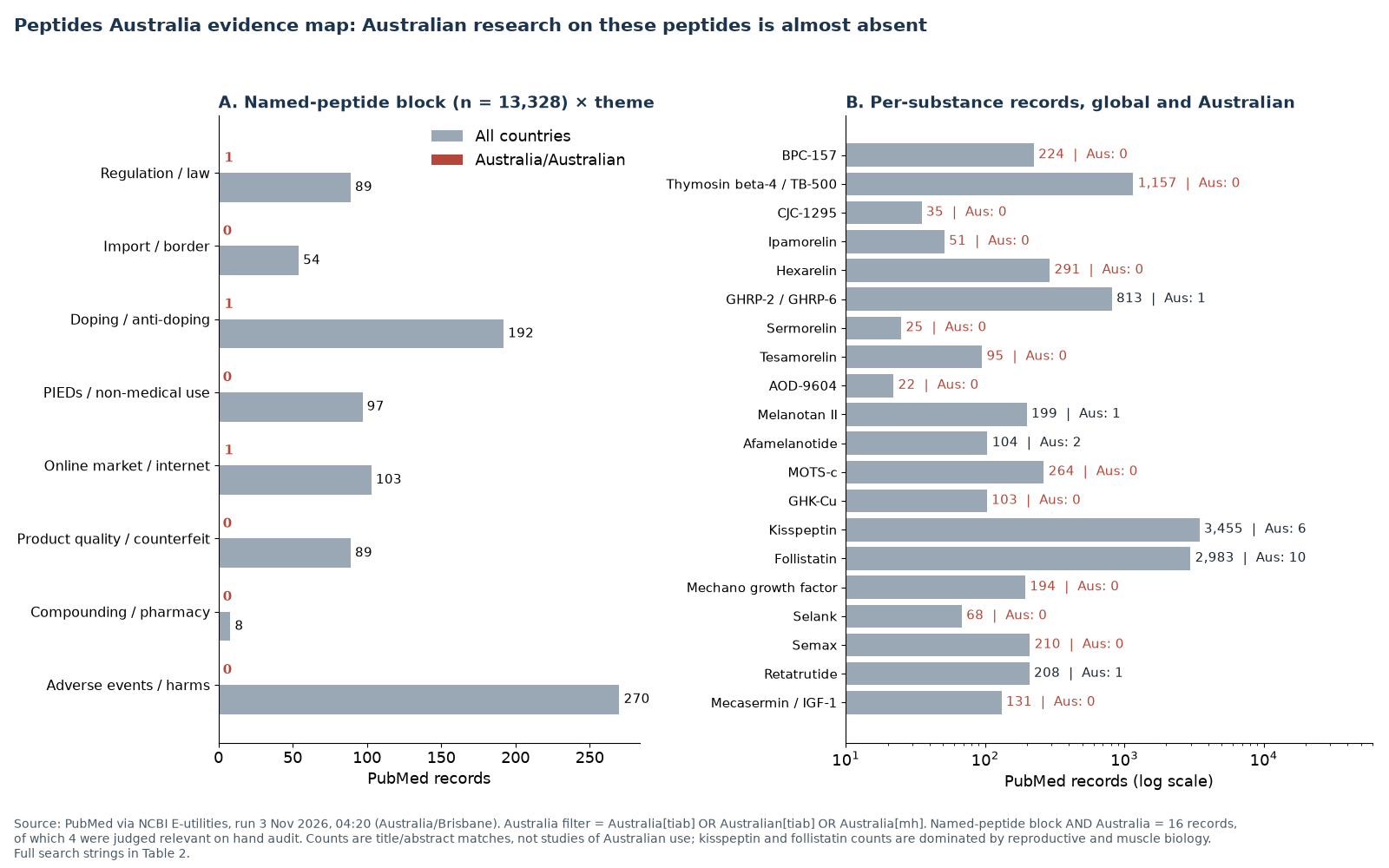
- Australian research is almost absent. Only 16 of 13,328 PubMed records on these peptides mention Australia, and none studies Australian importation, product quality or compounding (Figure 4).
Contents
- Introduction: why “peptides Australia” needs an evidence map
- Methods: instruments, classification and searches
- Results 1: the layers of the Australian regulatory framework for peptides
- Results 2: a substance-by-regime classification of 26 peptides
- Results 3: Appendix D possession controls, 2010–2026
- Results 4: TGA peptides regulation in 2026
- Results 5: what Australian research exists
- Discussion
- Limitations
- Relevance to Eternal Peptides Wholesale
- Conclusion
- Glossary
- Frequently asked questions
- References
Introduction: why “peptides Australia” needs an evidence map
Peptides are short chains of amino acids. As a chemical class they sit between small-molecule drugs and full-sized proteins. Medicine has used them for a century. Insulin, oxytocin and the gonadotrophin-releasing hormone analogues are familiar examples, and analyses of the pharmaceutical pipeline count more than 80 peptide drugs on the global market, with many more in clinical development [16, 17]. Cyclic peptides alone accounted for 18 new approvals between 2001 and 2021 [18]. “Peptide” is therefore a chemical description, not a legal category. There is no Australian Act called a peptide law, and no regulator keeps a single list of permitted and prohibited peptides. In Australia the legal position of a peptide product comes from several separate instruments, each written for its own purpose. Taken together, they decide whether the product may be imported, manufactured, supplied, advertised, possessed or used in sport.
The question has become urgent. In 2026 Australian regulators treated unapproved peptide products as a public-health problem. On 13 April 2026 the TGA published a safety advisory on importing, compounding and supplying unapproved peptide products. It stated that these products are regulated as therapeutic goods and that adverse events, including severe allergic reactions, had been reported [1]. A warning about poorly labelled imports followed in May [19]. In June the TGA added unapproved peptide products to its priority compliance areas [2, 20]. Later that month the Chief Medical Officer co-signed a statement on the public-health risks of these products [12]. By October, NSW Health was reporting a steep rise in emergency department presentations linked to peptide use [15]. Sport Integrity Australia (SIA) issued its own warning to athletes [21]. At the same time, several peer-reviewed reviews described a growing market for injectable peptides sold outside medical supervision. They noted that it is promoted through social media and “health optimisation” settings and supported by little or no human evidence [22, 23, 24, 25]. A 2026 review titled “Dangers of Injectable Peptides and Other Unregulated ‘Biohacking’ Drugs” is another example of the same trend [26].
Online information about peptides Australia does not match the complexity of the law. Regulator pages are authoritative, but each one covers a single regime: the TGA pages explain therapeutic goods obligations, SIA pages explain the Prohibited List, and state health pages give consumer advice [7, 27, 28]. Journalism reports particular events. Commercial directories and supplier pages often reduce the subject to a yes-or-no answer about whether a named peptide is “legal”. From the instruments themselves, we found no publicly available source that does three things at once: (i) classifies a defined set of peptides against every relevant Australian instrument; (ii) shows how those instruments changed over time; and (iii) measures how much independent research has examined the Australian framework. This article sets out to do those three things. Related searches such as “research peptides Australia” and “buy peptides Australia” lead to the same mix of sources. This article answers them only in informational, regulatory terms and does not advise on purchasing.
Research questions for the peptides Australia evidence map
The study asked four questions.
- What legal regimes apply to peptide products in Australia, and what does each one control?
- How are 26 peptides and comparator substances, including those named most often in 2026 Australian government warnings, classified across those regimes? Where does classification depend on group or interpretive entries rather than on names?
- How have Appendix D possession controls on peptides changed across every Poisons Standard instrument from 2010 to 2026?
- How much peer-reviewed research addresses peptide regulation, importation, product quality and harms in Australia, and where are the gaps?
This article is a regulatory and bibliometric analysis. It does not assess whether any peptide is safe or effective. It contains no information on use, quantities or administration, and it does not advise any person on whether a particular activity is lawful. Earlier Eternal Peptides Wholesale research papers examined the scientific literature on individual molecules, for example the BPC-157 evidence map and the thymosin beta-4 and TB-500 evidence map. This paper looks instead at the legal framework that surrounds all of them.
Why “unscheduled” and “unregulated” are different questions
A common mistake in public discussion of peptides legal Australia questions is to treat the Poisons Standard as the whole of the law. The Poisons Standard decides the level of access control for a substance, such as prescription-only (Schedule 4). Most of its effect comes through state and territory adoption [3]. A separate and earlier question is whether a product is a therapeutic good. Under section 3 of the Therapeutic Goods Act 1989, therapeutic goods are defined broadly. The definition includes products represented for, or likely to be taken to be for, use in humans in connection with preventing, diagnosing, curing or alleviating a disease or injury, or influencing, inhibiting or modifying a physiological process [5, 6]. Unless an exemption, approval or authority applies, a therapeutic good must be entered on the Australian Register of Therapeutic Goods (ARTG) before it is imported, manufactured, supplied or exported [11, 7]. A substance that appears in no schedule can therefore still be unlawful to supply, if the product is a therapeutic good that is not on the ARTG. The reverse also holds: naming a substance in a schedule does not on its own make every product containing it unlawful. This distinction runs through the rest of the article.
Methods: instruments, classification and searches
The study had four components: a regime inventory, a substance-level classification, a longitudinal analysis of the Poisons Standard and a bibliometric evidence map. Every statement of law or regulator position in this article was checked against the primary source on 3 November 2026 (Australia/Brisbane). Every reference was requested from its URL or identifier and confirmed to resolve; the references section records how each was checked. We did not rely on secondary summaries of the law.
Regime inventory: primary legislation and regulator publications
We read the current compilations of the Therapeutic Goods Act 1989 [5] and Therapeutic Goods Regulations 1990 [29], the Customs Act 1901 [30], the Customs (Prohibited Imports) Regulations 1956 [8] and the Competition and Consumer Act 2010, which contains the Australian Consumer Law [31]. All were obtained from the Federal Register of Legislation. For the Customs regulations we used Compilation No. 147 (F2026C00751, compiled 13 July 2026), the latest compilation available on the search date [8]. Regulator publications were taken from the TGA, the Office of Drug Control (ODC), NSW Health, SIA and the World Anti-Doping Agency (WADA), restricted to pages and statements that deal with peptides, unapproved therapeutic goods, importation, advertising or anti-doping [7, 32, 33, 9, 34, 35, 36, 28, 37, 38]. A regime counted as relevant if it either (a) controls a step in a peptide product’s life cycle (import, manufacture, supply, advertising, possession) or (b) applies a separate legal consequence to use, as the WADA Code does for athletes.
Poisons Standard instruments, 2010–2026
We identified every principal Poisons Standard instrument registered on the Federal Register of Legislation from the Poisons Standard 2010 (F2010L02386) to the Therapeutic Goods (Poisons Standard—October 2026) Instrument 2026 (F2026L01327, registered 30 September 2026), 52 instruments in all [39, 3]. Each authorised PDF was downloaded and converted to text with poppler-utils. A script located the Appendix D section headed “Poisons for which possession without authority is illegal”. This was Item 5 in older instruments and clause 5 after the 2021 restructure of the Standard. The script then searched that section for a predefined list of 24 peptide, protein and growth-hormone-axis terms. Any count that changed between consecutive instruments was checked by reading the instrument text directly [40, 41, 42, 43, 44, 45, 46, 47, 48]. That manual check found a misprint. In the June 2015 and July 2015 instruments the Item 5 list prints “AOD-9694” next to CAS number 221231-10-3, which is the CAS number of AOD-9604, while Schedule 4 and the index print AOD-9604. The October 2015 instrument corrects the spelling [42, 43, 44]. Because the CAS number identifies the substance, we counted these entries as AOD-9604 and report the uncorrected series alongside. The scheduling decisions behind each change were traced to published delegate reasons where they were available [49, 50, 51].
Substance selection and classification rules
Twenty-six substances were chosen in advance. They comprise (a) every peptide named in the 2026 TGA, NSW Health and SIA publications [1, 15, 21, 27]; (b) peptides commonly promoted online in Australia and named in the peer-reviewed literature on unregulated peptide markets [22, 23, 52]; and (c) three comparators: somatropin (an approved protein with long-standing controls), gonadorelin (an approved peptide), and ibutamoren (a non-peptide growth-hormone secretagogue listed beside the peptides). Each substance was classified against five regimes: Poisons Standard Schedule 4, Appendix D clause 5, Customs Schedule 7A, the WADA 2027 Prohibited List (approved 10 September 2026, in force 1 January 2027) and the 2026 Australian government warnings [3, 8, 10, 53]. We used three codes. Named means the substance or an unambiguous synonym appears in the instrument. Group or interpretive means the substance is not named but may fall within a group entry (for example “growth hormone releasing hormones”), a class entry in Schedule 7A, or a chemical-family entry (for example “copper compounds”). Not named covers everything else. The middle code is deliberately conservative. It marks where a lawyer would have to interpret the instrument, and it is not a finding that the substance is or is not captured. The WADA column relies on WADA’s own naming, and on the S0 non-approved-substances class only where WADA or SIA names the substance [54, 55, 56].
2026 regulatory timeline
We collected every TGA safety advisory, media release and joint statement on peptides published between 1 January and 3 November 2026, along with the NSW Government release of 19 October 2026 and the SIA media statement of 13 May 2026 [1, 19, 2, 12, 57, 58, 13, 14, 15, 21]. For each item we recorded the date, issuing body, type of action and any numbers it reported. Only numbers stated in the source were recorded. None were estimated.
Bibliometric evidence map: PubMed searches and screening
PubMed was searched through NCBI E-utilities (esearch for counts, esummary and efetch for metadata and abstracts) on 3 November 2026 [4]. A peptide block (P) combined title/abstract terms for the peptides most associated with non-medical markets with generic terms such as “peptide hormone”, “research peptide” and “unapproved peptide”. An Australia filter (A) combined title/abstract terms with the MeSH heading Australia. Eight theme filters were each crossed with P, and with P AND A: regulation and law, import and border, doping and anti-doping, performance- and image-enhancing drug (PIED) use, online markets, product quality and counterfeiting, compounding and pharmacy, and adverse events. Twenty substance-specific queries were each run globally, with A, with doping terms and with regulation terms. Three supplementary searches captured Australian regulatory and PIED literature that does not use peptide terms. Table 2 gives the exact strings and counts so that the searches can be re-run. All 16 records retrieved by P AND A were screened at title and abstract level for relevance to Australian peptide regulation, markets or harms. The supplementary Australian PIED, personal-importation and regulatory records, and the international product-quality and detection records, were screened and synthesised narratively. We did not formally appraise study quality, because the aim was to map what evidence exists rather than to pool effect estimates.
| Search | PubMed string (field tags as run) | Global records | With Australia filter (A) |
|---|---|---|---|
| P (peptide block) | ("BPC-157"[tiab] OR "BPC 157"[tiab] OR "TB-500"[tiab] OR "thymosin beta-4"[tiab] OR "thymosin beta 4"[tiab] OR "CJC-1295"[tiab] OR ipamorelin[tiab] OR hexarelin[tiab] OR pralmorelin[tiab] OR GHRP*[tiab] OR "growth hormone releasing peptide"[tiab] OR "growth hormone-releasing peptide"[tiab] OR "growth hormone secretagogue*"[tiab] OR "AOD-9604"[tiab] OR "AOD9604"[tiab] OR melanotan[tiab] OR "peptide hormone"[tiab] OR "peptide hormones"[tiab] OR "research peptide*"[tiab] OR "unapproved peptide*"[tiab] OR "mechano growth factor"[tiab] OR "MOTS-c"[tiab] OR "GHK-Cu"[tiab]) | 13,328 | — |
| A (Australia filter) | (Australia[tiab] OR Australian[tiab] OR Australia[mh]) | — | 16 |
| P AND Regulation / law | (legislation[tiab] OR legislative[tiab] OR "legal status"[tiab] OR illegal[tiab] OR illicit[tiab] OR unapproved[tiab] OR "regulatory status"[tiab] OR "regulatory agency"[tiab] OR "regulatory authorities"[tiab] OR "drug and narcotic control"[mh] OR "prescription-only"[tiab] OR "controlled substance*"[tiab] OR "Therapeutic Goods"[tiab] OR FDA[tiab]) | 89 | 1 |
| P AND Import / border | (importation[tiab] OR imported[tiab] OR importing[tiab] OR "personal import*"[tiab] OR border[tiab] OR customs[tiab] OR seized[tiab] OR confiscated[tiab]) | 54 | 0 |
| P AND Doping / anti-doping | (doping[tiab] OR "anti-doping"[tiab] OR antidoping[tiab] OR WADA[tiab] OR "doping in sports"[mh] OR athlete*[tiab]) | 192 | 1 |
| P AND PIEDs / non-medical use | ("performance and image enhancing"[tiab] OR "image and performance enhancing"[tiab] OR PIED[tiab] OR PIEDs[tiab] OR IPED[tiab] OR IPEDs[tiab] OR "non-medical use"[tiab] OR "nonmedical use"[tiab] OR misuse[tiab] OR abuse[tiab]) | 97 | 0 |
| P AND Online market / internet | (internet[tiab] OR online[tiab] OR website*[tiab] OR "social media"[tiab] OR "black market"[tiab] OR "illicit market"[tiab]) | 103 | 1 |
| P AND Product quality / counterfeit | (counterfeit*[tiab] OR falsified[tiab] OR adulterat*[tiab] OR substandard[tiab] OR mislabel*[tiab] OR "product quality"[tiab] OR contaminat*[tiab] OR purity[tiab]) | 89 | 0 |
| P AND Compounding / pharmacy | (compounded[tiab] OR compounding[tiab] OR pharmacist*[tiab] OR pharmacy[tiab]) | 8 | 0 |
| P AND Adverse events / harms | ("adverse event*"[tiab] OR "adverse effect*"[tiab] OR "adverse reaction*"[tiab] OR toxicity[tiab] OR "case report"[pt] OR poisoning[tiab]) | 270 | 0 |
| Generic: (peptide*[tiab] OR "Peptides"[mh]) AND A AND regulation filter | see regulation filter above | — | 52 |
| Australian regulatory terms R AND A | ("Therapeutic Goods Administration"[tiab] OR TGA[tiab] OR "Poisons Standard"[tiab] OR "performance and image enhancing"[tiab] OR "image and performance enhancing"[tiab] OR PIEDs[tiab] OR IPEDs[tiab]) | — | 478 |
| R AND A AND generic peptide terms | as above | — | 9 |
| PIED/IPED terms AND A | ("performance and image enhancing"[tiab] OR "image and performance enhancing"[tiab] OR PIEDs[tiab] OR IPEDs[tiab]) | — | 33 |
Results 1: the layers of the Australian regulatory framework for peptides
The inventory found nine regimes that can apply to a peptide product in Australia (Table 1). They differ in who administers them, what step in a product’s life cycle they control and what triggers them. Several can apply to the same product at once, and none of them gives a complete answer by itself.
| Regime | Instrument and administering body | What it controls | What triggers it | Peptide relevance in 2026 |
|---|---|---|---|---|
| Therapeutic goods and the ARTG | Therapeutic Goods Act 1989 and Regulations; TGA | Import, export, manufacture and supply of therapeutic goods | Product meets the s 3 definition of a therapeutic good (including by presentation or likely use) | TGA states peptide products are regulated as therapeutic goods and names commonly promoted peptides as unapproved products [5, 1, 7] |
| Manufacturing licensing | TG Act Part 3-3; Schedule 8 of the Regulations; TGA GMP | Manufacture, including steps such as labelling, packaging and storage | Any manufacturing step for supply, unless an exemption applies | TGA states that labelling a blank vial can be a step in manufacture [29, 34, 57] |
| Unapproved-goods access pathways | Special Access, Authorised Prescriber, clinical trial and Personal Importation schemes; TGA | Lawful access to goods not in the ARTG | Prescriber, trial sponsor or individual importer meeting scheme conditions | The Personal Importation Scheme is limited to personal use and does not permit commercial supply or advertising [32, 33, 7] |
| Poisons Standard scheduling | Poisons Standard (legislative instrument under the TG Act); adopted by state and territory law | Level of access control (for example Schedule 4, prescription-only) | Substance named in a schedule, or captured by a group entry | 16 of the 26 study substances are named in Schedule 4 [3] |
| Appendix D possession controls | Poisons Standard Appendix D clause 5 and section 64; state and territory law | Possession without authority | Substance listed in clause 5 | 21 peptide or protein entries in October 2026 [3] |
| Border control (import permits) | Customs Act 1901; Customs (Prohibited Imports) Regulations 1956, reg 5G and Schedule 7A; ODC permits; ABF | Importation of listed hormones and growth factors without a permit | Goods fall within a Schedule 7A item | Growth hormones, IGFs and GHRH analogues require a permit; other goods can be seized if imported unlawfully [30, 8, 35, 36] |
| Therapeutic goods advertising | TG Act Chapter 5 and the Advertising Code; TGA | Advertising to the public | Promotion of therapeutic goods, including through social media and affiliates | Prescription-only and unapproved goods cannot be advertised to the public [9, 57] |
| Consumer law | Australian Consumer Law (Schedule 2, Competition and Consumer Act 2010); ACCC and state regulators | Misleading conduct and representations in trade | Conduct in trade or commerce | Applies alongside therapeutic goods law [31] |
| Anti-doping | World Anti-Doping Code and Prohibited List; SIA | Use and possession by athletes under the Code | Athlete bound by the Code | Most growth-hormone-axis peptides, BPC-157 and TB-500 are prohibited [10, 37, 27] |
TGA peptides regulation starts with the therapeutic goods definition
Therapeutic goods law is the foundation. The TGA explains that therapeutic goods are defined broadly by reference to use in humans in connection with disease, injury or modification of a physiological process, and that how a product is represented can matter as much as what it contains [6, 5]. Unless an exemption, approval or authority applies, a therapeutic good must be in the ARTG before it is imported, manufactured, supplied, exported or advertised. The ARTG is the public database of goods that can be lawfully supplied [11, 7]. In its April 2026 advisory the TGA stated directly that peptide products are regulated as therapeutic goods under the Act, named several commonly promoted unapproved peptides and described the exemptions that do and do not apply [1]. Two exemptions matter most. Pharmacists may dispense or compound extemporaneously for a particular person, within limits. Schedule 8 of the Regulations sets out the persons exempt from manufacturing-licence requirements [1, 29]. The TGA has also said that the Pharmacy Board and Ahpra have a role where registered health practitioners are involved [1].
The TGA’s position on product labels is just as clear. Its April advisory states that disclaimers describing a product as for “research use only” do not change the product’s regulatory status, do not permit importation and do not remove advertising or supply obligations [1]. Its page on how it regulates therapeutic peptide products makes the same point about “not for human use” style disclaimers [7]. NSW Health tells consumers that unapproved peptide products have not been assessed by the TGA and that contents and strength can vary between batches carrying the same label. It adds that approved medicines carry an AUST R or AUST L number [28].
Lawful access pathways and the Personal Importation Scheme
Australia allows several controlled routes to goods that are not in the ARTG: the Special Access Scheme, the Authorised Prescriber Scheme, the clinical trial schemes and the Personal Importation Scheme [32]. The Personal Importation Scheme is often misunderstood in discussions of peptide importation Australia rules. According to the TGA, it covers goods for the importer’s own use or that of their immediate family and not for sale or supply. A prescription-only medicine requires a valid Australian prescription or written authority at the time of import (eScripts are not accepted). Each import is limited to three months’ supply, and no more than 15 months’ supply may be imported in 12 months. Goods must be in original or identifying packaging. The scheme does not cover controlled substances or goods prohibited under Customs or quarantine rules [33]. In May 2026 the TGA added that personal importation is permitted only if goods are clearly and accurately labelled. Unmarked vials, or vials labelled only with a code, will not be released, and the TGA will ask the Australian Border Force (ABF) to seize and destroy them [19]. The TGA also states that the scheme does not permit commercial supply or advertising [7]. Legal scholarship has examined personal importation as an access pathway for patients facing cost barriers, and the 2022 changes to advertising rules about promoting personal importation [59, 60, 61, 62, 63]. That work concerns access to medicines, not peptides specifically.
Import permits under Customs Schedule 7A
The Customs regime runs alongside therapeutic goods law and works in a different way. Regulation 5G of the Customs (Prohibited Imports) Regulations 1956 prohibits importing the goods in Schedule 7A without permission. The listed goods are anabolic or androgenic substances, erythropoietin, gonadotrophins, natural and manufactured growth hormones, and darbepoetin alfa. The growth hormone item expressly includes somatropin, somatrem, somatomedins, insulin-like growth factors (other than insulins) and growth hormone releasing hormones (somatorelin and synthetic analogues) [8]. The ODC administers these permits and lists growth hormones and IGFs among the controlled substances that need one [35, 36]. Among the 26 study substances, only somatropin is named in Schedule 7A. Six others are coded as possibly captured by its class wording (Table 3). The Customs Act 1901 is the head Act under which these regulations are made and under which prohibited imports can be seized [30].
Advertising rules and the Australian Consumer Law
Therapeutic goods advertising law applies whether or not a product is lawfully supplied. The TGA states that prescription-only medicines and substances, and unapproved therapeutic goods, cannot be advertised to the general public [9]. Its page on peptide products says the same about advertising unapproved goods or prescription-only medicines [7]. In July 2026 the TGA said that its head had written to social media and e-commerce platforms, and that influencers and affiliates who promote unapproved peptide products could be held accountable [57]. The Australian Consumer Law, in Schedule 2 of the Competition and Consumer Act 2010, applies to conduct in trade alongside the therapeutic goods regime [31].
The anti-doping layer: WADA Prohibited List and Sport Integrity Australia
Anti-doping rules are not part of the general law of supply, but for athletes they have a separate and serious legal effect. The 2027 Prohibited List was approved on 10 September 2026 and takes effect on 1 January 2027 [53, 38]. It names BPC-157 under S0 (non-approved substances). Under S2 it names growth hormone fragments including AOD-9604, GHRH analogues such as CJC-1295, sermorelin and tesamorelin, growth hormone secretagogues and GHRPs such as ipamorelin, GHRP-2, GHRP-6 and hexarelin, kisspeptin, and IGF-1 analogues, mechano growth factors, FGFs and thymosin β4 derivatives such as TB-500. MOTS-c is listed under S4 [10]. SIA explains that S0 covers substances with no approval from any government health regulator for human therapeutic use, prohibited at all times [37]. It confirms that BPC-157 sits under S0 and thymosin β4 under S2 [54, 55]. The US Anti-Doping Agency gives the same S0 explanation for BPC-157 [56]. SIA warns that peptides are sold labelled as research chemicals or “not for human consumption” and that a therapeutic use exemption is unlikely to be granted for an unregistered medicine [27]. The 2026 List remains in force until 31 December 2026 [64]. Athletes can check substance status in Australia with Global DRO [65].
Results 2: a substance-by-regime classification of 26 peptides
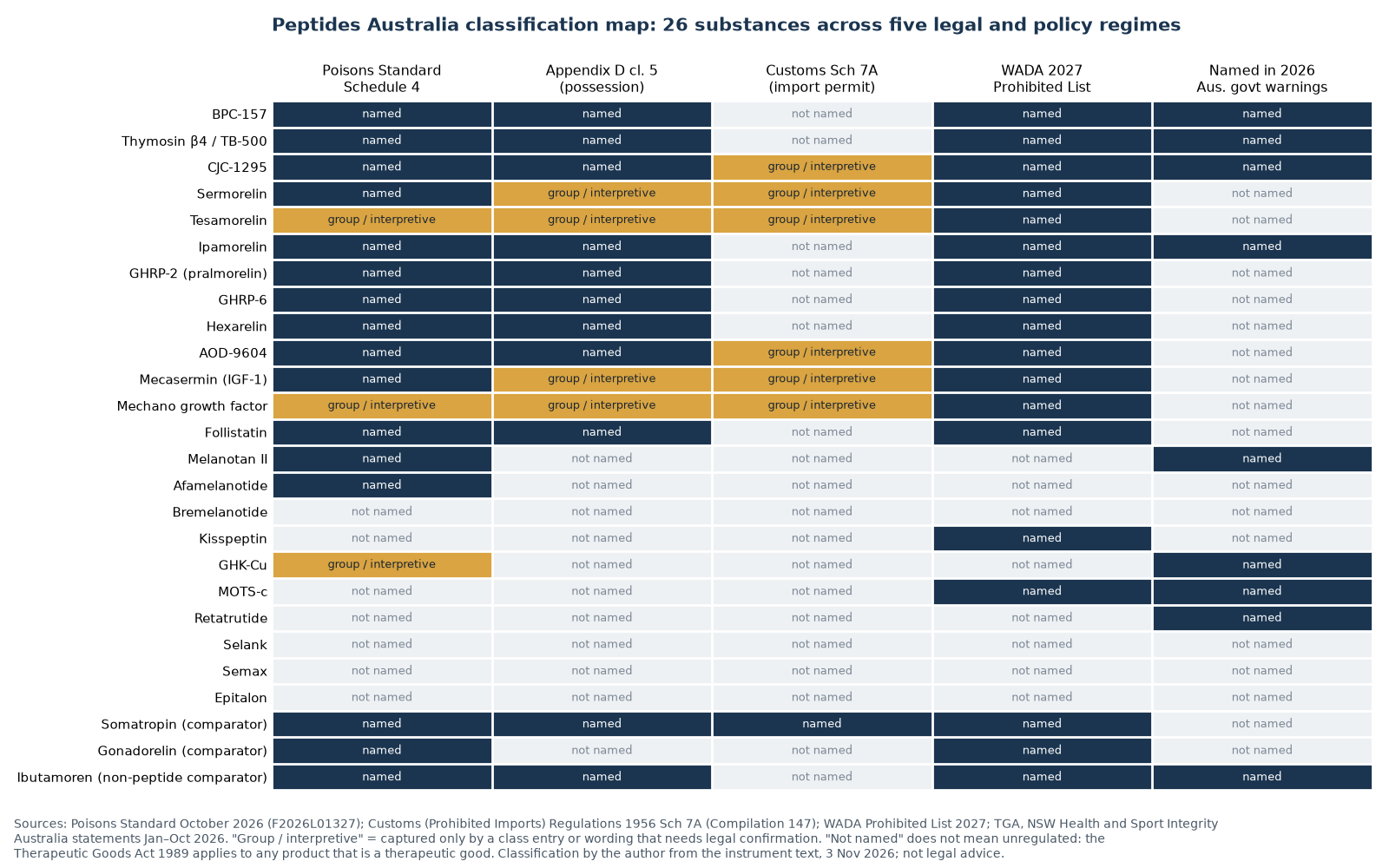
Figure 1 and Table 3 show how the 26 study substances are classified across the five regimes. The matrix shows several patterns that do not appear in any single regulator page or list.
Schedule 4: TGA peptides scheduling covers most, but not all, promoted peptides
Sixteen of the 26 substances are named in Schedule 4 of the October 2026 Poisons Standard. Three more (tesamorelin, mechano growth factor and GHK-Cu) are captured only by group or chemical-family entries, and seven are not named [3]. The named set includes the growth-hormone-axis peptides added in 2015: AOD-9604, CJC-1295, GHRP-2 (pralmorelin), GHRP-6, hexarelin and ipamorelin. It also includes BPC-157, added in 2024, and the older therapeutic proteins and peptides such as somatropin and follistatin [49, 51, 47]. Melanotan II and afamelanotide are both named in Schedule 4 [3]. Tesamorelin is a GHRH analogue. It is not named. The 2015 decision introduced group entries for growth hormone releasing hormones, growth hormone releasing peptides and growth hormone secretagogues alongside the individually named substances [49], and the Appendix D clause 5 group entries state that they include substances separately specified in Schedule 4 [3]. Whether a particular unnamed analogue falls within a group entry is a question of interpretation, so we have flagged it rather than decided it. GHK-Cu is not named. The Schedule 4 entry for copper compounds for human use, with its concentration-based exceptions, may be relevant to some copper-peptide products [3]. Whether that entry reaches a particular GHK-Cu product depends on the product’s formulation and use, which is also a legal-review question.
Appendix D clause 5: possession offences
Appendix D clause 5 is headed “Poisons for which possession without authority is illegal”. Section 64 of the October 2026 Poisons Standard provides that a poison included in the clause 5 table must not be possessed by a person without authority under the law of the jurisdiction where the possession occurs. The instrument gives possession other than in accordance with a lawful prescription as an example [3]. The table has 41 items in October 2026. Many are not peptides: anabolic steroids, selective androgen receptor modulators and several other drug classes are also listed. Of the 41, 21 are peptide or protein entries, and two more are non-peptide growth hormone secretagogues (capromorelin and ibutamoren) [3]. Eleven of the study substances are named in clause 5, four are captured only by group entries (sermorelin and tesamorelin through the GHRH group, mecasermin through the IGF entry and mechano growth factor as an IGF-1 splice variant) and eleven are not named. Melanotan II and afamelanotide are in Schedule 4 but not in clause 5. Schedule 4 status and Appendix D status are therefore separate questions [3].
Customs Schedule 7A: one named substance, six interpretive
Schedule 7A is drafted by class. Somatropin is the only study substance named in it. CJC-1295, sermorelin and tesamorelin are synthetic GHRH analogues, and the growth hormone item includes “growth hormone releasing hormones (somatorelin and synthetic analogues)” [8]. Mecasermin and mechano growth factor relate to the “insulin-like growth factors” wording, and AOD-9604, a growth hormone fragment, relates to the “manufactured growth hormones” wording. We coded all six as interpretive [8, 36]. The growth hormone secretagogues (ipamorelin, GHRP-2, GHRP-6, hexarelin) and BPC-157 and TB-500 are not named in Schedule 7A. That does not make importing them lawful. Any import of a therapeutic good not in the ARTG still needs an exemption, approval or authority, and the TGA states that the ABF may seize and destroy unlawful imports [7, 19].
The WADA Prohibited List names more peptides than Australian law
Eighteen of the 26 substances are named on the WADA 2027 Prohibited List, more than in any Australian instrument [10]. Kisspeptin and MOTS-c are named by WADA but appear in no Australian scheduling instrument. The difference reflects the List’s purpose. WADA prohibits substances that may enhance performance or that have no regulatory approval for human therapeutic use [37, 38]. The Poisons Standard grades access according to public-health risk.
Seven peptides not named in any Australian scheduling or import instrument
Seven substances are not named in Schedule 4, Appendix D or Schedule 7A: bremelanotide, kisspeptin, MOTS-c, retatrutide, selank, semax and epitalon [3, 8]. Retatrutide and MOTS-c are among the peptides named in the 2026 Australian government warnings [1, 15, 21]. This is the clearest example of the gap between “unscheduled” and “unregulated”. The TGA’s position is that a peptide product that is a therapeutic good must be in the ARTG, or covered by an exemption, approval or authority, before it is imported, manufactured or supplied, whatever its scheduling status [7, 11]. The NSW Government stated in October 2026 that none of the peptides it named (BPC-157, GHK-Cu, TB-500, retatrutide and CJC-1295) is currently approved in Australia for any purpose [15]. Two of those five (retatrutide and GHK-Cu) are not named in Schedule 4 at all. A “not scheduled” result from a list lookup therefore says nothing about whether supply is lawful.
Which peptides the 2026 warnings named
Nine of the 26 substances were named in at least one 2026 TGA, NSW Health or SIA publication [1, 15, 21, 13]. These include the five peptides the TGA and NSW named repeatedly (BPC-157, TB-500, GHK-Cu, CJC-1295 and retatrutide), as well as melanotan II, which was the subject of a separate TGA laboratory-testing advisory. Seven of the nine are named in Schedule 4 or captured by a group entry. The warnings therefore cover both scheduled and unscheduled substances. Regulators appear to have chosen which peptides to warn about by market prominence and reported harms, not by scheduling status.
| Substance | Type | Poisons Standard Schedule 4 | Appendix D clause 5 (possession) | Customs Schedule 7A (import permit) | WADA 2027 Prohibited List | Named in 2026 Australian government warnings |
|---|---|---|---|---|---|---|
| BPC-157 | peptide | Named | Named | — | Named | Named |
| Thymosin β4 / TB-500 | peptide | Named | Named | — | Named | Named |
| CJC-1295 | peptide | Named | Named | Group / interpretive † | Named | Named |
| Sermorelin | peptide | Named | Group / interpretive † | Group / interpretive † | Named | — |
| Tesamorelin | peptide | Group / interpretive † | Group / interpretive † | Group / interpretive † | Named | — |
| Ipamorelin | peptide | Named | Named | — | Named | Named |
| GHRP-2 (pralmorelin) | peptide | Named | Named | — | Named | — |
| GHRP-6 | peptide | Named | Named | — | Named | — |
| Hexarelin | peptide | Named | Named | — | Named | — |
| AOD-9604 | peptide | Named | Named | Group / interpretive † | Named | — |
| Mecasermin (IGF-1) | protein | Named | Group / interpretive † | Group / interpretive † | Named | — |
| Mechano growth factor | peptide | Group / interpretive † | Group / interpretive † | Group / interpretive † | Named | — |
| Follistatin | protein | Named | Named | — | Named | — |
| Melanotan II | peptide | Named | — | — | — | Named |
| Afamelanotide | peptide | Named | — | — | — | — |
| Bremelanotide | peptide | — | — | — | — | — |
| Kisspeptin | peptide | — | — | — | Named | — |
| GHK-Cu | peptide | Group / interpretive † | — | — | — | Named |
| MOTS-c | peptide | — | — | — | Named | Named |
| Retatrutide | peptide | — | — | — | — | Named |
| Selank | peptide | — | — | — | — | — |
| Semax | peptide | — | — | — | — | — |
| Epitalon | peptide | — | — | — | — | — |
| Somatropin (comparator) | protein | Named | Named | Named | Named | — |
| Gonadorelin (comparator) | peptide | Named | — | — | Named | — |
| Ibutamoren (non-peptide comparator) | small molecule | Named | Named | — | Named | Named |
Results 3: Appendix D possession controls on peptides, 2010–2026
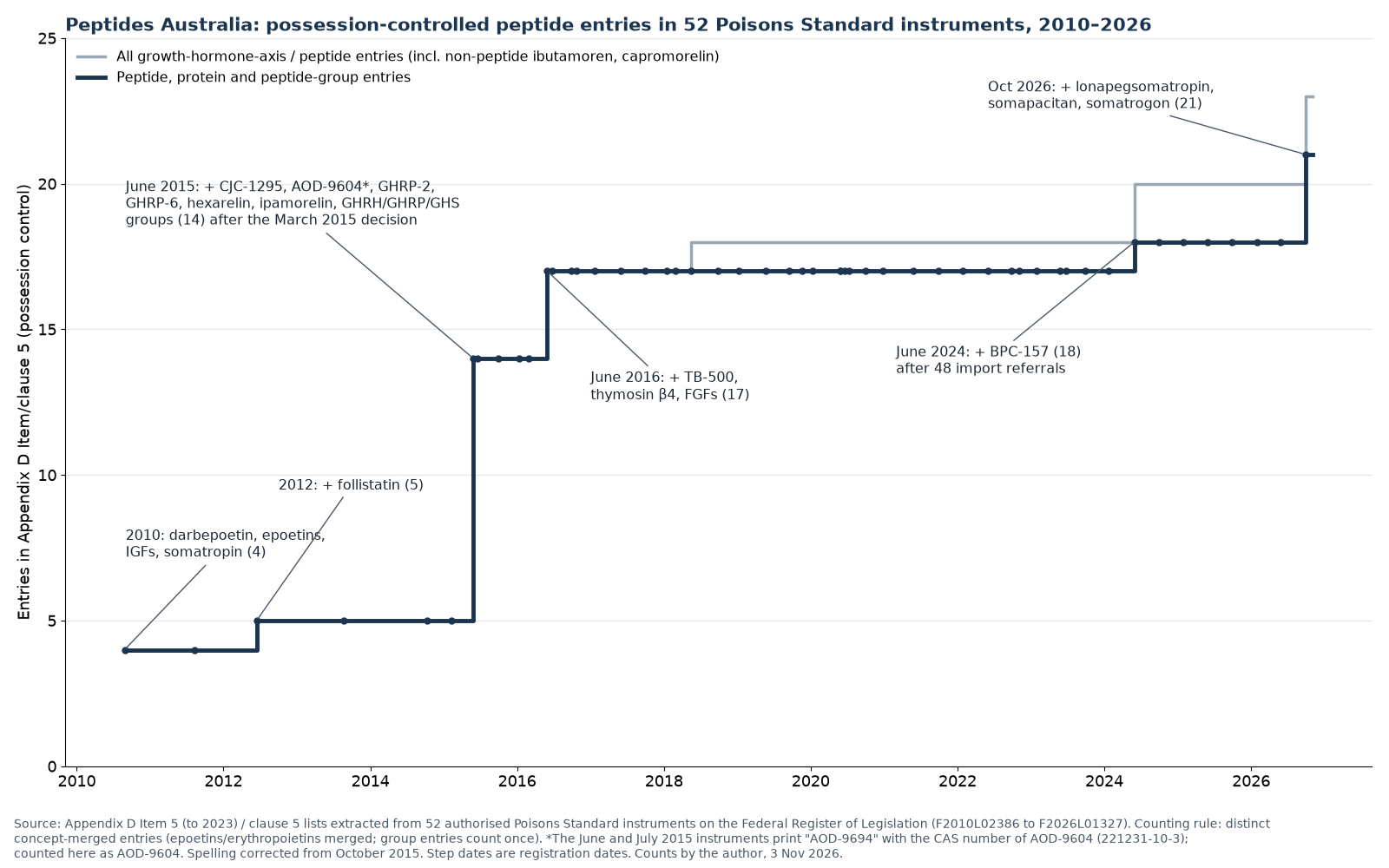
Figure 2 follows the number of peptide and protein entries in Appendix D clause 5 (previously Item 5) across all 52 Poisons Standard instruments. The series does not rise gradually. It is flat for long stretches and then jumps when a scheduling decision is made, in five steps.
2010–2012: a short list of therapeutic proteins
The Poisons Standard 2010 lists four peptide or protein entries in Appendix D Item 5: darbepoetin, the epoetins, insulin-like growth factors and somatropin [39]. All of these are therapeutic proteins with medical uses and a known history of misuse in sport. Follistatin was added by June 2012, bringing the total to five [40], and the list then stayed the same until early 2015 [41].
2015: the growth hormone secretagogue decision
The largest single step came on 1 June 2015. In its March 2015 decision the scheduling delegate created Schedule 4 and Appendix D Item 5 entries for AOD-9604, CJC-1295, pralmorelin (GHRP-2), GHRP-6, hexarelin and ipamorelin, and group entries for growth hormone releasing hormones, growth hormone releasing peptides and growth hormone secretagogues [49]. The published reasons refer to misuse in sport and bodybuilding, supply over the internet, organised crime involvement and unproven claims by suppliers. They also record that one public submission opposed the Appendix D entry for AOD-9604 [49]. The decision followed the investigation into the Australian Football League, which had made peptide misuse a matter of national attention. A forensic case study of that investigation has been published [66], and the Court of Arbitration for Sport later upheld WADA’s appeal concerning 34 players and thymosin β4 [67]. With the misprint corrected, Item 5 went from 5 to 14 peptide or protein entries [42, 44].
An undocumented 2015 misprint: “AOD-9694”
Reading the instruments directly revealed something not reported elsewhere. In the June 2015 Poisons Standard (F2015L00749), the Appendix D Item 5 list prints “AOD-9694” next to CAS number 221231-10-3. That is the CAS number of AOD-9604. Schedule 4 and the index of the same instrument print “AOD-9604”. The misprint carries into the July 2015 instrument (F2015L00844) and is corrected in October 2015 (F2015L01534) [42, 43, 44]. Because the CAS number identifies the intended substance, we treated the entry as AOD-9604. Our script’s uncorrected count shows 13 entries for those two instruments, and the corrected count shows 14. We did not find this misprint discussed in any regulator publication or in the literature. Whether it had any legal effect during that window is a question for legal review, not for this study. It also shows a wider point: a lookup that matches names exactly can give wrong answers about a peptide’s status.
2016–2018: growth factors and thymosin β4
The June 2016 instrument added fibroblast growth factors, TB-500 and thymosin β4, raising the peptide and protein count to 17 [45]. It came five months after the Court of Arbitration for Sport decision in the AFL matter [67]. In June 2018 the non-peptide growth hormone secretagogue ibutamoren was added [46]. The peptide and protein count did not change, but the all-entries line in Figure 2 rises. After that the peptide and protein count stayed at 17 for six years, across 33 consecutive instruments.
2024: BPC-157, after 48 import referrals
In 2023 the scheduling delegate proposed new Schedule 4 and Appendix D entries for BPC-157. The interim decision notice states that the proposal responded to 48 referrals for importation received since 1 July 2022. Its stated aims were to align BPC-157 with other performance- and image-enhancing substances and to address the lack of clinical data and the inadequately characterised toxicity [50]. The final decision added BPC-157, and capromorelin, to Schedule 4 and Appendix D clause 5 from 1 June 2024 [51, 47]. This was the first new peptide possession control in eight years. Unlike the 2015 decision, it was driven by evidence from border referrals rather than by a sporting scandal. The peer-reviewed literature on BPC-157 is still almost entirely preclinical. A 2025 systematic review found no human clinical safety data and noted risks arising from unregulated production [68].
October 2026: long-acting growth hormones
The June 2026 instrument kept the 2024 set of 18 [48]. The October 2026 instrument added three long-acting growth hormone products to clause 5: lonapegsomatropin, somapacitan and somatrogon. That brought the count to 21 peptide or protein entries, or 23 including the non-peptide secretagogues [3]. All three are modified forms of growth hormone. Their addition brings possession controls into line with the way somatropin was already treated, rather than responding to a newly promoted research peptide.
What the step pattern shows
Three things follow from the series. First, possession controls react to events. They change after a specific trigger (a sporting investigation, a build-up of border referrals, new medicines entering the market) and do not track the overall size of the market. Second, the lag can be long. Retatrutide, MOTS-c and the other substances named in 2026 warnings had no possession control when this study was done, even though regulators had already warned about them [1, 15]. Third, this pattern tells us nothing about the many substances outside Appendix D. Those remain subject to therapeutic goods law, and the 2026 enforcement actions show that the TGA uses that law directly [2, 57, 58].
Results 4: TGA peptides regulation in 2026
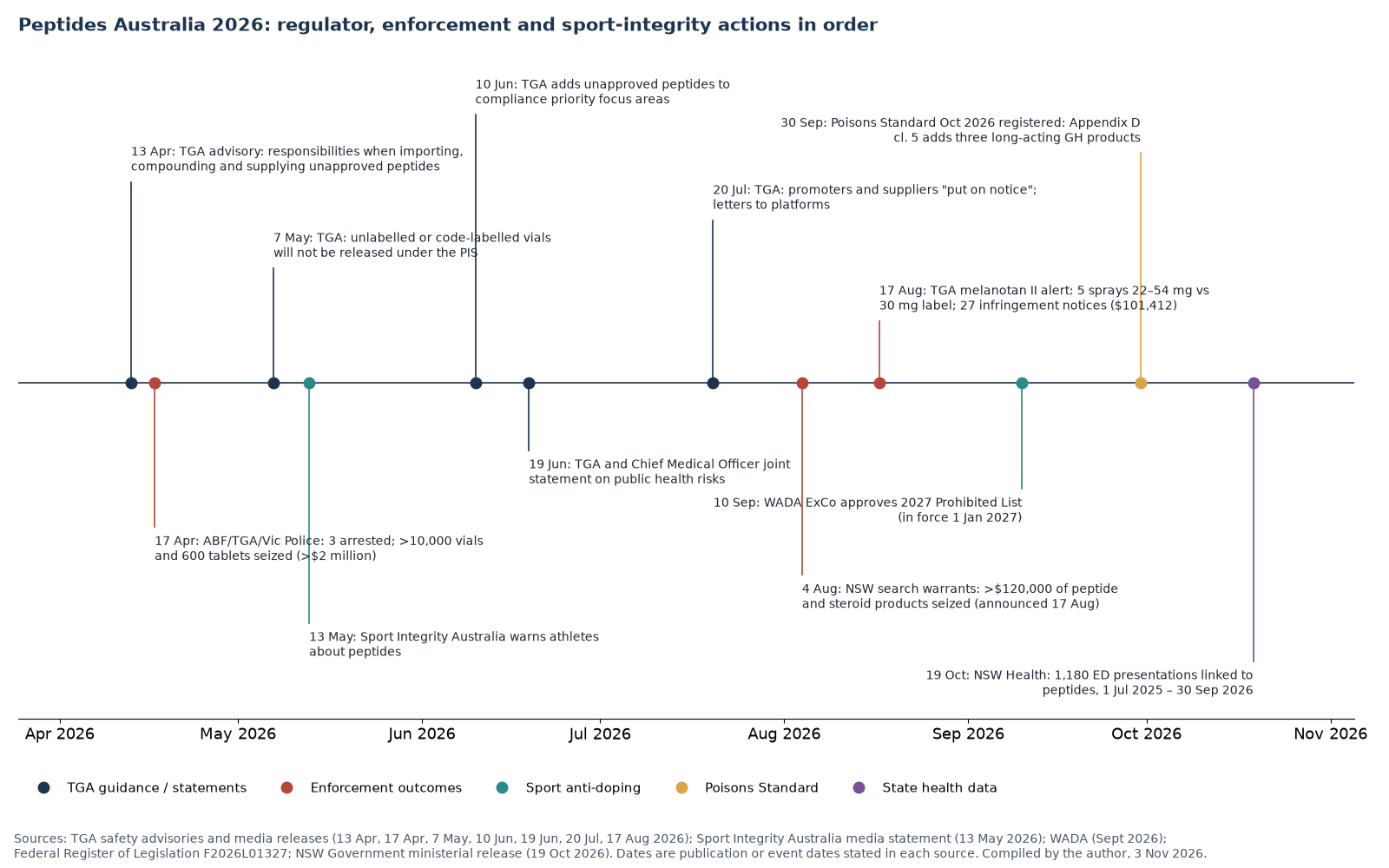
2026 brought more regulatory activity on peptides in Australia than any previous year. We found 12 dated events between 13 April and 19 October 2026 (Figure 3, Table 4). Taken in order, they show the regulators’ response moving from education, to formal priority-setting, to enforcement, and then to monitoring of harms.
| Date (2026) | Body | Event | Figures reported in the source |
|---|---|---|---|
| 13 April | TGA | Safety advisory on responsibilities when importing, compounding and supplying unapproved peptide products | Adverse events reported, including severe allergic reactions requiring adrenaline or hospitalisation [1] |
| 17 April | ABF, TGA, Victoria Police | Three arrests after a joint investigation | 640 vials intercepted (Aug 2025); more than 10,000 vials and 600 tablets seized; estimated value over $2 million [14] |
| 7 May | TGA | Warning on the risks of importing unapproved peptide products | Unmarked or code-only vials will not be released under the Personal Importation Scheme [19] |
| 13 May | SIA | Warning to athletes on anti-doping and health risks | Many peptides prohibited under the Code [21] |
| 10 June | TGA | Unapproved peptide products added to priority compliance focus areas | Responses may include infringement notices, seizures, import interventions and civil or criminal penalties [2, 20] |
| 19 June | TGA and Chief Medical Officer | Joint statement on public health risks | Liver damage, severe allergic reactions and inflammation identified in reports and hospital data [12] |
| 20 July | TGA | Promoters and suppliers put on notice | Letters to social media and e-commerce platforms; influencer and affiliate accountability [57] |
| 4 August (announced 17 August) | TGA | Warrants executed at two NSW premises | More than $120,000 of peptide and steroid products seized [58] |
| 17 August | TGA | Melanotan II laboratory-testing safety advisory | 5 nasal sprays labelled 30 mg/20 mL measured 22–54 mg; 27 infringement notices totalling $101,412 paid in May 2026 [13] |
| 10 September | WADA | 2027 Prohibited List approved | In force from 1 January 2027 [53, 10] |
| 30 September | TGA (scheduling) | October 2026 Poisons Standard registered | 21 peptide/protein entries in Appendix D clause 5 [3] |
| 19 October | NSW Government | Warning on surge in hospital presentations | 1,180 emergency department presentations, 1 July 2025 to 30 September 2026 [15] |
April–May: clarifying the law and border practice
The April advisory set out the TGA’s interpretation in plain terms. Peptide products are regulated as therapeutic goods, the compounding exemptions are narrow, labels do not alter legal status, and state and territory laws may add further controls [1]. The 17 April release described a joint investigation by the ABF, the TGA and Victoria Police. It had begun with 640 vials intercepted in August 2025 and ended with warrants executed on 26 March 2026 [14]. The 7 May warning described the poor labelling of imports referred by the ABF, including unmarked vials, code-only labels and missing names and concentrations. It stated that such vials would not be released under the Personal Importation Scheme [19]. SIA’s 13 May statement took the same message to athletes. Its chief executive said peptides were often falsely marketed to athletes as safe or low-risk [21].
June: compliance priority and the Chief Medical Officer statement
On 10 June the TGA added unapproved peptide products to the priority focus areas under its Compliance Principles for 2026 and 2027. Those principles set the priorities for 1 January 2026 to 31 December 2027 and are reviewed each quarter [2, 20]. Nine days later the TGA and the Chief Medical Officer issued a joint statement. It reported liver damage, severe allergic reactions requiring hospitalisation, and inflammation and other complications, drawn from TGA reports and state and territory hospital data. It also stated that the TGA has no oversight of the composition or manufacturing standards of unapproved products [12].
July–August: putting promoters on notice and enforcement
The 20 July release described the possible consequences for promoters and suppliers, ranging from warning letters and infringement notices to seizure, civil penalties and prosecution. It said the TGA head had written to social media and e-commerce platforms. It also noted that more unlabelled vials were being intercepted and that manufacturing includes steps such as labelling a blank vial, packaging and storage [57]. On 17 August the TGA reported warrants executed on 4 August 2026 at two NSW premises and more than $120,000 of peptide and steroid products seized. It noted that civil penalties can reach $1.82 million per breach for individuals and $18.2 million for corporations, and that criminal penalties can include up to seven years’ imprisonment [58]. On the same day the TGA published laboratory results for melanotan II nasal sprays. Five products labelled 30 mg/20 mL contained between 22 and 54 mg, no melanotan II product is in the ARTG, and 27 infringement notices totalling $101,412 had been paid in May 2026 [13].
September–October: scheduling and harm surveillance
The October 2026 Poisons Standard was registered on 30 September and extended Appendix D possession controls to three long-acting growth hormones [3]. On 19 October the NSW Government reported 1,180 emergency department presentations linked to peptide use between 1 July 2025 and 30 September 2026. Monthly presentations rose from about 5 in July 2025 to more than 217 in September 2026. The release named five peptides and said none is currently approved in Australia for any purpose [15]. These are the first population-level Australian harm figures for peptides that we found. They come from a government release and have not been peer reviewed. Case definitions, coding practice and changes in clinician awareness over the period could all affect the trend (see Limitations).
Results 5: what Australian research exists on peptides regulation
The bibliometric searches show a large gap. The peptide block (P) returned 13,328 PubMed records. Adding the Australia filter left 16, about 0.12% of the total (Table 2) [4]. Crossing P with the theme filters gave 270 records on adverse events worldwide, 192 on doping, 103 on online markets, 97 on non-medical use, 89 each on regulation and on product quality, 54 on import and border topics, and 8 on compounding. With the Australia filter added, every theme returned either one record or none. Regulation, doping and online markets had one each. Import and border, non-medical use, product quality, compounding and adverse events had none (Figure 4A).
Substance-level counts: research peptides in Australia are barely studied
At the substance level (Figure 4B), Australian records clustered around two molecules with long-established basic-science literatures: follistatin (10 Australian records of 2,983) and kisspeptin (6 of 3,455). Afamelanotide had 2, and melanotan II, GHRP-2/GHRP-6 and retatrutide had one each. BPC-157 (224 global records), thymosin β4/TB-500 (1,157), CJC-1295 (35), ipamorelin (51), AOD-9604 (22), MOTS-c (264), GHK-Cu (103), selank (68) and semax (210) had no Australian records at all [4]. Several of these global literatures are small in absolute terms. Searches combining AOD-9604 with regulation terms returned 4 records, and CJC-1295 with regulation terms returned 8. The substances most visible in Australian warnings are among the least studied in the peer-reviewed literature.
The Australian records: sport, dermatology and anti-doping knowledge
About four of the 16 P AND A records were directly relevant on screening, and they fall into two groups. The first is sport. A forensic case study of the AFL peptide investigation describes how the anti-doping investigation was carried out [66]. A survey of Australian athletes found limited knowledge of the WADA Prohibited List [69]. An earlier analysis of 900 urine tests in senior Australian rules football between 1990 and 1995 reported no positive results for peptide hormones [70]. The second group is dermatology. Australian dermatologists have described melanotan II use as a matter of public health interest [71] and reported a case of melanoma in situ in a person who had used melanotan, noting that the product was available online despite being unlicensed [72]. A historical study of tanning technologies places melanotan injections within a longer history of products promoted as “safe” tanning [73]. None of the Australian records examined the scheduling, importation or supply framework itself.
Australian performance- and image-enhancing drug research
A broader search for Australian PIED literature found 33 records [4], and these give more context. Australian studies have described PIED trafficking cases. One found 31 cases in which 19 of 37 individuals were health professionals and 7 cases involved importation [74]. Others have examined insulin use in image- and performance-enhancing communities [75], health risks and service use among people who inject PIEDs [76, 77, 78], trends among needle and syringe program clients in Queensland from 2007 to 2015 [79], whether people who inject PIEDs are a growing group of needle and syringe program attendees [80], the effect of COVID-19 on use [81] and the value of monitoring “enhanced” bodybuilders as a sentinel population [82]. A systematic review of injecting IPED use in the general population sets these Australian studies in an international context [83]. Two recent Australian studies tested anabolic steroids from the community market. One found that oral products were more prone to quality problems [84]. The other found that 13% of 23 samples contained something other than what the person expected [85]. These studies are about steroids, not peptides, but they show that community drug-checking methods could be applied to peptides. On personal importation, a survey of 1,180 Australians aged 45 and over found that 1.8% had personally imported a prescription medicine. A doctor raising the option was the strongest predictor, and 44.4% said they would consider importing [86]. Two older papers examined overseas online pharmacies as a supply source and the regulation of online pharmacy in Australia [87, 88].
International evidence on product quality and identity
Almost all analytical evidence on the quality of peptide products sold outside regulated channels comes from overseas laboratories, mostly anti-doping and customs laboratories in Europe. That research consistently finds problems with identity, content and labelling. Analyses of black-market products confiscated in Germany found growth hormone vials with no active content and supplements containing non-approved ingredients [89], and a separate analysis identified GHRP-2 in a nutritional supplement [90]. A 2010–2013 German series found that 12.8% of products examined were peptide hormones or growth factors [91]. Laboratories have identified BPC-157 and an MGF analogue in confiscated vials [92], glycine-modified GHRP analogues in seized material [93, 94, 95], a GHRH analogue with incomplete C-terminal amidation [96], and His-tagged follistatin 344 in all nine black-market follistatin products examined [97]. Melanotan II products sold online contained 4.32–8.84 mg per vial against a claimed 10 mg, with impurities of 4.1–5.9% [98]. A report on the underground melanotan market describes how such products are sold [99]. A nuclear magnetic resonance study found an undeclared constituent in custom synthetic peptides and concluded that experimental verification should take precedence over trust [100]. Reviews of falsified biotechnology medicines and of injectables seized in Europe describe a general lack of labelling and traceability [101, 102]. These findings match the 2026 TGA observations on unlabelled vials and inconsistent content [19, 13, 12]. We found no Australian peer-reviewed analytical study of peptide products.
Detection science and published harm reports
Anti-doping science has developed methods to detect peptides and their metabolites. Examples include methods for synthetic GHRH analogues and for the metabolism of growth hormone releasing peptides, and characterisation of the thymosin β4 fragment found in TB-500 products [103, 104, 105]. Reviews summarise how peptidic drug candidates and non-approved substances are detected in doping control [106, 107]. Studies of internet forums have used open-source information to describe doping markets [108], and a netnography of women’s forum discussions of CJC-1295 examined how users talk about the product [109]. Published harm reports are mostly case reports and reviews. They include systemic toxicity after melanotan II injection [110], reviews of the risks of unregulated use of alpha-melanocyte-stimulating hormone analogues [52, 111], social-media promotion of melanotan [112], and a 2026 case of refractory nausea in a person using peptide injections in a health-optimisation setting [25]. Recent reviews describe the evidence for growth-hormone-axis peptides as ranging from randomised data for approved medicines to no human studies at all for many promoted products [22]. They also note that good prevalence data are lacking [23], and editorial commentary has questioned the evidence base for injectable peptides in sports medicine [24]. These sources are cited to describe the state of the evidence. This article makes no claim about the effects of any substance.
Discussion: what the evidence map means for peptides Australia
This study gives three main findings. The Australian regulatory framework for peptides has several layers, and no single list decides legal status. Possession controls have grown in five distinct steps over sixteen years. And the peer-reviewed research needed to evaluate the framework hardly exists. Each finding is discussed below, with the points that most need further work.
Layered regulation: why list lookups mislead
Most public answers to the question “are peptides legal in Australia?” check a list, usually the Poisons Standard or the WADA Prohibited List, and report whether a name appears on it. Our matrix shows why that approach is unreliable. First, schedules and lists differ. Melanotan II is in Schedule 4 but not in Appendix D. Kisspeptin is prohibited by WADA but not scheduled. Somatropin is named in every regime [3, 10, 8]. Second, group and class entries capture substances that are not named. Of the 78 cells for the three Australian scheduling and import instruments (26 substances across Schedule 4, Appendix D and Schedule 7A), 13 depended on interpretation rather than on a name. Third, and most important, the therapeutic goods definition works independently of all the lists. The TGA’s 2026 publications are framed almost entirely in terms of the ARTG, exemptions, manufacturing and advertising. Scheduling plays a secondary role [1, 7, 57]. For a product presented or likely to be taken as being for human therapeutic use, the starting question is whether it is in the ARTG or covered by an exemption, approval or authority. Whether it is scheduled comes later [6, 11].
The same reasoning applies to labelling. Research use only labels are widely used, and SIA has noted that peptides are sold as research chemicals or as “not for human consumption” [27]. The TGA has said directly that such disclaimers do not change regulatory status, permit importation or remove obligations [1, 7]. In the TGA’s view, how a product is actually represented and likely to be used counts for more than the label. Whether any particular product is a therapeutic good depends on its facts. That question should go to a qualified legal adviser and cannot be answered from a label or a list.
Step changes in the Poisons Standard and their triggers
Appendix D possession controls changed in response to specific events. The 2015 decision followed the AFL investigation and cited misuse in sport, online supply and organised crime [49, 66]. The 2016 additions came after the Court of Arbitration for Sport decision on thymosin β4 [45, 67]. The 2024 BPC-157 decision was based on 48 border referrals [50]. The 2026 additions brought new long-acting growth hormone medicines into line with somatropin [3]. This pattern has costs and benefits. Scheduling by event lets the system respond to evidence, but substances can circulate widely before any possession control applies. Retatrutide, MOTS-c and GHK-Cu were all named in 2026 warnings without being named in Appendix D [1, 15, 21]. The 2026 response relied instead on therapeutic goods enforcement, border action, advertising controls and public warnings [2, 58, 13]. Whether scheduling should change further is a policy question for the scheduling process and is beyond the scope of this study. The point here is that a gap in the possession controls does not leave a gap in the overall framework.
Importation: the busiest point of control
The 2026 record shows that the border is where enforcement happens most. The Victorian investigation began with vials intercepted at the border [14]. The BPC-157 scheduling decision rested on import referrals [50]. The TGA’s May warning and July notice describe the ABF referring poorly labelled vials and the TGA directing their seizure [19, 57]. The Personal Importation Scheme has strict limits. It covers personal or family use only, requires a prescription for prescription-only medicines, caps quantities, requires original packaging and excludes controlled substances [33]. Australian legal research has looked at personal importation as a route for patients with legitimate needs [59, 62, 61], and at the advertising changes affecting promotion of personal importation [60]. No Australian study has measured the volume or content of peptide imports, despite the regulator’s repeated references to them. The ABF and TGA referral data that informed the 2024 scheduling decision show that such data exist [50]. Publishing them in aggregate would help research.
Product quality: international evidence, Australian silence
The international analytical literature consistently reports substitution, under-dosing, unexpected modifications and poor labelling [89, 91, 97, 98, 94, 102]. The TGA’s own testing of melanotan II sprays fits that pattern [13], and NSW Health warns that contents and strength can vary between batches with the same label [28]. Even so, we found no Australian peer-reviewed analytical study of peptide products. Australian community testing of anabolic steroids shows that such studies can be done [84, 85]. The NMR finding of an undeclared constituent in custom synthetic peptides also shows the limits of documents compared with direct measurement [100]. Product quality and legal status are separate questions. A well-characterised product is not lawful to supply because of its quality, and the TGA has noted that it has no oversight of the composition of unapproved products [12].
Harm surveillance and the NSW signal
The NSW figure of 1,180 emergency department presentations is the most significant new dataset of 2026 [15]. The rise from about 5 a month to more than 217 a month over fifteen months is steep. There is no published case definition, and coding and awareness may have changed over the period, so the trend should be read with caution. The TGA–CMO statement and the April advisory describe the kinds of harm reported, including allergic reactions, liver injury and inflammation [12, 1]. The published case literature is consistent with those concerns but small [110, 25, 72]. A peer-reviewed analysis of the NSW data, with case definitions and substances identified, would be a high-value next step.
Research agenda: priorities for Australian peptide regulation research
Table 5 sets the gaps from this map against the data sources that already exist and the study designs that could fill them.
| Gap identified | Evidence from this map | Existing data that could be used | Suggested study design |
|---|---|---|---|
| Volume and content of peptide imports | 0 Australian import/border records; regulator cites 48 referrals and repeated interceptions | ABF and TGA referral and seizure data [50, 19] | Descriptive analysis of de-identified aggregate referral data |
| Product identity and content in the Australian market | 0 Australian product-quality records; international studies show substitution and under-dosing | TGA laboratory testing; community drug-checking models [13, 84] | Cross-sectional analytical survey with published methods |
| Population harms | 0 Australian adverse-event records; NSW reports 1,180 presentations | NSW emergency department data; Poisons Information Centre calls [15] | Peer-reviewed surveillance analysis with case definitions |
| Prevalence and motives of use | Australian PIED research exists but does not separate out peptides | Needle and syringe program surveys; PIED cohort studies [79, 77] | Adding peptide-specific items to existing surveys |
| Compounding practice | 0 Australian compounding records; TGA highlights compounding exemptions | Pharmacy Board and TGA compliance data [1] | Regulatory document analysis; practitioner survey |
| Legal interpretation of group entries | 13 interpretive cells in the matrix | Poisons Standard text; delegate reasons [3, 49] | Doctrinal legal analysis |
| Online promotion | 1 Australian online-market record; TGA letters to platforms | Platform takedown data; advertising complaints [57] | Content analysis of promotional material |
Limitations
The study has several limitations. First, it is a reading of public instruments and regulator publications, not legal advice. The classification codes describe what the instruments say. The “group or interpretive” code marks where interpretation is needed, and the cells flagged as legal-review items have not been resolved. Second, the Poisons Standard takes effect largely through state and territory law, and those laws were not analysed. Adoption, exemptions and possession offences may differ between jurisdictions [3, 1]. Third, the Appendix D series was built by automated extraction checked by hand at every change point. A substance listed under a name not in our term list could have been missed, although the manual review of each changed instrument reduces that risk. Fourth, the bibliometric searches used PubMed only and title/abstract fields. Grey literature, legal databases, government reports and non-indexed journals were not searched, so the Australian evidence base is probably larger than PubMed suggests, though unlikely to be different in kind. The Australia filter needs an Australian term in the title, abstract or MeSH headings, so Australian authors writing on general topics will not be captured [4]. Fifth, the NSW emergency department figures come from a government release without a published method [15], and the TGA’s harm descriptions are summaries, not datasets [12]. Sixth, the 2026 timeline covers events up to 3 November 2026. Regulatory positions are changing, and readers should check current instruments and TGA guidance before relying on any statement here [7]. Finally, substances were selected for their relevance to 2026 Australian warnings and online markets. They are not a random sample of all peptides.
Relevance to Eternal Peptides Wholesale
This article is published by Eternal Peptides Wholesale. The About page describes the business as a distributor of wholesale research peptides for laboratory research. That makes the Australian regulatory framework directly relevant to it and to its readers. Eternal Peptides Wholesale publishes batch-specific Kovera Labs certificates for its listed products on its COA library. It explains how purity, identity, endotoxin, heavy-metal and sterility reports should be read on its Kovera Labs testing standards page. Those documents describe the analytical results for a tested batch. As this article shows, analytical quality and legal status are separate questions. A certificate of analysis is not a regulatory approval, and the TGA has stated that “research use only” wording does not change a product’s regulatory status [1, 7]. Readers who need to know whether a particular activity is lawful should get independent legal advice and consult the TGA directly.
Conclusion
Peptide regulation in Australia does not depend on a single list. It is a set of overlapping regimes: therapeutic goods law and the ARTG, manufacturing licensing, access pathways for unapproved goods, Poisons Standard scheduling, Appendix D possession controls, Customs import permits, advertising and consumer law, and, for athletes, the WADA Code. Our classification of 26 substances shows that their status differs from one regime to the next, that a considerable share of cells depends on group or interpretive entries, and that seven substances promoted online are not named in any Australian scheduling or import instrument. As the TGA has made clear, that does not take them outside therapeutic goods law. The Appendix D series shows possession controls growing from 4 peptide or protein entries in 2010 to 21 in October 2026, in steps that followed sporting investigations, border referrals and new medicines. 2026 was the most active year for peptide regulation on record, and over the same period the first population-level harm signal appeared. The research base has not kept up. Of 13,328 PubMed records on these peptides, 16 mention Australia and none examines Australian importation, product quality or compounding. The research agenda in Table 5 identifies where existing data could close those gaps. For anyone reading about peptides Australia, the most important conclusion is this: “unscheduled” does not mean “unregulated”, and a “research use only” label is not legal clearance [1, 7].
Glossary
- Appendix D clause 5
- The part of the Poisons Standard that lists poisons for which possession without authority is illegal. It was called Item 5 in instruments before the 2021 restructure.
- ARTG
- Australian Register of Therapeutic Goods. The public register of therapeutic goods that can lawfully be supplied in Australia.
- AUST R / AUST L
- Numbers shown on the labels of registered (R) and listed (L) medicines included in the ARTG.
- ABF
- Australian Border Force. The agency that intercepts and seizes prohibited or unlawfully imported goods at the border.
- Group entry
- A Poisons Standard entry that covers a class of substances (for example, growth hormone releasing peptides) rather than a single named substance.
- ODC
- Office of Drug Control. Issues import permits for substances in Customs Schedule 7A.
- Personal Importation Scheme
- A TGA scheme that lets individuals import limited quantities of some unapproved therapeutic goods for their own use, subject to conditions.
- PIEDs / IPEDs
- Performance- and image-enhancing drugs, a term used in Australian public health research.
- Poisons Standard
- A legislative instrument under the Therapeutic Goods Act 1989 that classifies substances into schedules. It is given effect mainly through state and territory law.
- Schedule 4
- Prescription-only medicines in the Poisons Standard.
- Schedule 7A (Customs)
- The schedule to the Customs (Prohibited Imports) Regulations 1956 listing hormones and growth factors that need a permit to import.
- S0 (WADA)
- The Prohibited List class for non-approved substances, meaning those with no government regulatory approval for human therapeutic use. They are prohibited at all times.
- Therapeutic good
- A product defined in section 3 of the Therapeutic Goods Act 1989 by reference to use in humans in connection with disease, injury or modifying a physiological process, including how it is represented.
- Unapproved therapeutic good
- A therapeutic good not included in the ARTG.
Frequently asked questions about peptides in Australia
Are peptides legal in Australia?
There is no single answer, because “peptide” is not a legal category. In Australia the legal position of a peptide product depends on whether it is a therapeutic good, whether it is in the ARTG or covered by an exemption, how it is scheduled in the Poisons Standard, whether it is listed in Appendix D, whether it needs an import permit and, for athletes, the WADA Prohibited List. The TGA states that peptide products are regulated as therapeutic goods and has named several commonly promoted peptides as unapproved.
Does the TGA regulate peptides?
Yes. The TGA states that peptide products are regulated as therapeutic goods under the Therapeutic Goods Act 1989. Unless an exemption, approval or authority applies, they must be in the ARTG before they are imported, manufactured, supplied, exported or advertised. In June 2026 the TGA made unapproved peptide products a compliance priority.
Can you buy peptides in Australia legally?
This article does not advise on purchasing. In regulatory terms, approved peptide medicines are supplied through the ARTG and, where they are prescription-only, on prescription. The TGA states that unapproved peptide products cannot lawfully be supplied or advertised without an exemption, approval or authority, and NSW Health states that the peptides it named are not approved in Australia for any purpose. Individuals with questions about their own circumstances should talk to a doctor or pharmacist, or to a legal adviser.
Can I import peptides into Australia for personal use?
The Personal Importation Scheme has strict conditions. It covers personal or immediate-family use only, requires a valid Australian prescription for prescription-only medicines, limits each import to three months’ supply and 15 months’ supply in any 12 months, and requires original or identifying packaging. It excludes controlled substances and goods prohibited under Customs rules. The TGA has said that unlabelled or code-only vials will not be released and may be seized.
Is BPC-157 a Schedule 4 substance in Australia?
Yes. BPC-157 has been in Schedule 4 and in Appendix D clause 5 of the Poisons Standard since 1 June 2024, after a scheduling decision that cited 48 import referrals. It is also listed under S0 of the WADA Prohibited List, and the NSW Government has stated that it is not approved in Australia for any purpose.
Does a “research use only” label make a peptide legal in Australia?
No. The TGA states that “research use only” and similar disclaimers do not change a product’s regulatory status, do not permit importation and do not remove advertising or supply obligations. Whether a product is a therapeutic good depends on how it is presented and likely to be used, not on its label alone.
Are peptides banned in sport in Australia?
Many are. Sport Integrity Australia applies the WADA Prohibited List, which names BPC-157 under S0 and many growth-hormone-axis peptides, thymosin β4 derivatives and growth factors under S2. Athletes can check a substance’s status through Global DRO. SIA says a therapeutic use exemption is unlikely to be granted for an unregistered medicine.
What is Appendix D of the Poisons Standard?
Appendix D sets extra controls on some poisons. Clause 5 lists poisons for which possession without authority is illegal. In the October 2026 Poisons Standard, clause 5 contains 41 items, 21 of them peptide or protein entries, up from 4 in 2010. Possession offences are given effect through state and territory law.
References
- Therapeutic Goods Administration. Understanding your responsibilities when importing, compounding and supplying unapproved peptide products. Safety advisory, 13 April 2026. Available at: https://www.tga.gov.au/safety/safety-monitoring-and-information/safety-alerts/understanding-your-responsibilities-when-importing-compounding-and-supplying-unapproved-peptide-products. Accessed 3 November 2026.
- Therapeutic Goods Administration. TGA strengthens compliance focus on unapproved peptide products as part of evolving risk response. Media release, 10 June 2026. Available at: https://www.tga.gov.au/news/media-releases/tga-strengthens-compliance-focus-unapproved-peptide-products-part-evolving-risk-response. Accessed 3 November 2026.
- Therapeutic Goods (Poisons Standard—October 2026) Instrument 2026 (F2026L01327). Federal Register of Legislation; registered 30 September 2026. Available at: https://www.legislation.gov.au/F2026L01327/asmade/text. Accessed 3 November 2026.
- National Center for Biotechnology Information. Entrez Programming Utilities (E-utilities) Help. Bethesda (MD): National Library of Medicine. Available at: https://www.ncbi.nlm.nih.gov/books/NBK25501/. Accessed 3 November 2026.
- Therapeutic Goods Act 1989 (Cth). Federal Register of Legislation, C2004A03952, latest compilation. Available at: https://www.legislation.gov.au/C2004A03952/latest/text. Accessed 3 November 2026.
- Therapeutic Goods Administration. What are therapeutic goods? Available at: https://www.tga.gov.au/products/regulations-all-products/regulation-essentials/what-are-therapeutic-goods. Accessed 3 November 2026.
- Therapeutic Goods Administration. How we regulate therapeutic peptide products. Page updated 2026. Available at: https://www.tga.gov.au/products/medicines/monitoring-and-compliance/how-we-regulate-therapeutic-peptide-products. Accessed 3 November 2026.
- Customs (Prohibited Imports) Regulations 1956 (Cth). Federal Register of Legislation, F1996B03651; Compilation No. 147 (F2026C00751, compilation date 13 July 2026). Available at: https://www.legislation.gov.au/F1996B03651/latest/text. Accessed 3 November 2026.
- Therapeutic Goods Administration. What can and cannot be advertised to the general public. Available at: https://www.tga.gov.au/products/regulations-all-products/advertising/advertising-basics/what-can-and-cannot-be-advertised-general-public. Accessed 3 November 2026.
- World Anti-Doping Agency. World Anti-Doping Code International Standard: Prohibited List 2027 (final, 26 August 2026). Available at: https://www.wada-ama.org/sites/default/files/2026-09/2027list_en_final_clean_26_august_2026_2.pdf. Accessed 3 November 2026.
- Therapeutic Goods Administration. About the Australian Register of Therapeutic Goods (ARTG). Available at: https://www.tga.gov.au/products/regulations-all-products/about-australian-register-therapeutic-goods-artg. Accessed 3 November 2026.
- Therapeutic Goods Administration; Chief Medical Officer. Concerns regarding the public health risks associated with unapproved peptide products. Joint statement, 19 June 2026. Available at: https://www.tga.gov.au/news/media-releases/concerns-regarding-public-health-risks-associated-unapproved-peptide-products. Accessed 3 November 2026.
- Therapeutic Goods Administration. Melanotan II tanning peptide products found to be inconsistently dosed. Safety advisory, 17 August 2026. Available at: https://www.tga.gov.au/safety/safety-monitoring-and-information/safety-alerts/melanotan-ii-tanning-peptide-products-found-be-inconsistently-dosed. Accessed 3 November 2026.
- Therapeutic Goods Administration. Three Victorians arrested following seizure of over $2 million worth of steroids and peptides by the ABF and TGA. Media release, 17 April 2026. Available at: https://www.tga.gov.au/news/media-releases/three-victorians-arrested-following-seizure-over-2-million-worth-steroids-and-peptides-abf-and-tga. Accessed 3 November 2026.
- NSW Government. NSW Health warns of surge in hospital presentations linked to peptide use. Ministerial release, 19 October 2026. Available at: https://www.nsw.gov.au/ministerial-releases/nsw-health-warns-of-surge-hospital-presentations-linked-to-peptide-use. Accessed 3 November 2026.
- Muttenthaler M, King GF, Adams DJ, et al. Trends in peptide drug discovery. Nat Rev Drug Discov. 2021;20(4):309-325. doi:10.1038/s41573-020-00135-8 PMID: 33536635. Available at: https://doi.org/10.1038/s41573-020-00135-8. Accessed 3 November 2026.
- Wang L, Wang N, Zhang W, et al. Therapeutic peptides: current applications and future directions. Signal Transduct Target Ther. 2022;7(1):48. doi:10.1038/s41392-022-00904-4 PMID: 35165272. Available at: https://doi.org/10.1038/s41392-022-00904-4. Accessed 3 November 2026.
- Zhang H, Chen S. Cyclic peptide drugs approved in the last two decades (2001-2021). RSC Chem Biol. 2022;3(1):18-31. doi:10.1039/d1cb00154j PMID: 35128405. Available at: https://doi.org/10.1039/d1cb00154j. Accessed 3 November 2026.
- Therapeutic Goods Administration. TGA warning on the risks of importing unapproved peptide products. Safety advisory, 7 May 2026. Available at: https://www.tga.gov.au/safety/safety-monitoring-and-information/safety-alerts/tga-warning-risks-importing-unapproved-peptide-products. Accessed 3 November 2026.
- Therapeutic Goods Administration. Compliance Principles 2026 and 2027. Last updated 10 June 2026. Available at: https://www.tga.gov.au/safety/compliance-and-enforcement/compliance-management-enforcement/compliance-principles-2026-and-2027. Accessed 3 November 2026.
- Sport Integrity Australia. Sport Integrity Australia warns athletes peptides pose serious anti-doping and health risks. Media statement, 13 May 2026. Available at: https://www.sportintegrity.gov.au/news/media-statements/2026-05/sport-integrity-australia-warns-athletes-peptides-pose-serious-anti-doping-and-health-risks. Accessed 3 November 2026.
- Dominikowski A, Rękoś Z, Olejarz M, et al. The emerging landscape of performance-enhancing peptides modulating GH-IGF1 axis: bridging the gap between clinical evidence and patient self-administration. Front Endocrinol (Lausanne). 2026;17:1822475. doi:10.3389/fendo.2026.1822475 PMID: 42395176. Available at: https://doi.org/10.3389/fendo.2026.1822475. Accessed 3 November 2026.
- Coutinho LFD, DE Oliveira Neves LF, Camilo RP. A new era of doping? Use of peptide and peptide-analog drugs in recreational and professional sport and bodybuilding: a critical review. J Sports Med Phys Fitness. 2026;66(7):880-885. doi:10.23736/S0022-4707.26.17773-1 PMID: 41880199. Available at: https://doi.org/10.23736/S0022-4707.26.17773-1. Accessed 3 November 2026.
- DeFoor MT, Dekker TJ. Injectable Therapeutic Peptides-An Adjunct to Regenerative Medicine and Sports Performance?. Arthroscopy. 2025;41(2):150-152. doi:10.1016/j.arthro.2024.09.005 PMID: 39265666. Available at: https://doi.org/10.1016/j.arthro.2024.09.005. Accessed 3 November 2026.
- Buzzi RM, Huber LC. Emerging risks of health optimisation: refractory nausea associated with peptide injections reported to contain retatrutide. BMJ Case Rep. 2026;19(10). doi:10.1136/bcr-2026-276106 PMID: 42843917. Available at: https://doi.org/10.1136/bcr-2026-276106. Accessed 3 November 2026.
- Moiz A, O’Keefe EL, O’Keefe JH. Dangers of Injectable Peptides and Other Unregulated "Biohacking" Drugs. Mo Med. 2026;123(4):337-343. PMID: 42757290. Available at: https://pubmed.ncbi.nlm.nih.gov/42757290/. Accessed 3 November 2026.
- Sport Integrity Australia. Peptides (substance education). Available at: https://www.sportintegrity.gov.au/what-we-do/anti-doping/substance-education/peptides. Accessed 3 November 2026.
- NSW Health. Peptides (consumer information). Available at: https://www.health.nsw.gov.au/pharmaceutical/patients/Pages/peptides.aspx. Accessed 3 November 2026.
- Therapeutic Goods Regulations 1990 (Cth). Federal Register of Legislation, F1996B00406, latest compilation. Available at: https://www.legislation.gov.au/F1996B00406/latest/text. Accessed 3 November 2026.
- Customs Act 1901 (Cth). Federal Register of Legislation, C1901A00006, latest compilation. Available at: https://www.legislation.gov.au/C1901A00006/latest/text. Accessed 3 November 2026.
- Competition and Consumer Act 2010 (Cth). Federal Register of Legislation, C2004A00109, latest compilation. Available at: https://www.legislation.gov.au/C2004A00109/latest/text. Accessed 3 November 2026.
- Therapeutic Goods Administration. Access pathways for unapproved therapeutic goods. Available at: https://www.tga.gov.au/products/unapproved-therapeutic-goods/access-pathways. Accessed 3 November 2026.
- Therapeutic Goods Administration. Personal Importation Scheme. Page updated 8 September 2026. Available at: https://www.tga.gov.au/products/unapproved-therapeutic-goods/access-pathways/personal-importation-scheme. Accessed 3 November 2026.
- Therapeutic Goods Administration. Good manufacturing practice (GMP). Available at: https://www.tga.gov.au/how-we-regulate/manufacturing/manufacture-medicine/good-manufacturing-practice-gmp. Accessed 3 November 2026.
- Office of Drug Control. Anabolic, androgenic, hormones and other controlled substances. Available at: https://www.odc.gov.au/anabolic-androgenic-hormones-and-other-controlled-substances. Accessed 3 November 2026.
- Office of Drug Control. Growth hormones (natural and manufactured): list of controlled substances. Available at: https://www.odc.gov.au/controlled-substances/list/growth-hormones-natural-and-manufactured. Accessed 3 November 2026.
- Sport Integrity Australia. The Prohibited List explained. Available at: https://www.sportintegrity.gov.au/what-we-do/anti-doping/substance-education/prohibited-list-explained. Accessed 3 November 2026.
- World Anti-Doping Agency. Prohibited List (web page). Available at: https://www.wada-ama.org/en/prohibited-list. Accessed 3 November 2026.
- Poisons Standard 2010 (F2010L02386). Federal Register of Legislation; registered 27 August 2010. Available at: https://www.legislation.gov.au/F2010L02386/asmade/text. Accessed 3 November 2026.
- Poisons Standard 2012 (F2012L01200). Federal Register of Legislation; registered 14 June 2012. Available at: https://www.legislation.gov.au/F2012L01200/asmade/text. Accessed 3 November 2026.
- Poisons Standard 2015 (F2015L00128). Federal Register of Legislation; registered 10 February 2015. Available at: https://www.legislation.gov.au/F2015L00128/asmade/text. Accessed 3 November 2026.
- Poisons Standard June 2015 (F2015L00749). Federal Register of Legislation; registered 28 May 2015. Available at: https://www.legislation.gov.au/F2015L00749/asmade/text. Accessed 3 November 2026.
- Poisons Standard July 2015 (F2015L00844). Federal Register of Legislation; registered 18 June 2015. Available at: https://www.legislation.gov.au/F2015L00844/asmade/text. Accessed 3 November 2026.
- Poisons Standard October 2015 (F2015L01534). Federal Register of Legislation; registered 30 September 2015. Available at: https://www.legislation.gov.au/F2015L01534/asmade/text. Accessed 3 November 2026.
- Poisons Standard June 2016 (F2016L00849). Federal Register of Legislation; registered 30 May 2016. Available at: https://www.legislation.gov.au/F2016L00849/asmade/text. Accessed 3 November 2026.
- Poisons Standard June 2018 (F2018L00625). Federal Register of Legislation; registered 17 May 2018. Available at: https://www.legislation.gov.au/F2018L00625/asmade/text. Accessed 3 November 2026.
- Therapeutic Goods (Poisons Standard—June 2024) Instrument 2024 (F2024L00589). Federal Register of Legislation; registered 30 May 2024. Available at: https://www.legislation.gov.au/F2024L00589/asmade/text. Accessed 3 November 2026.
- Therapeutic Goods (Poisons Standard—June 2026) Instrument 2026 (F2026L00633). Federal Register of Legislation; registered 28 May 2026. Available at: https://www.legislation.gov.au/F2026L00633/asmade/text. Accessed 3 November 2026.
- Therapeutic Goods Administration. Delegates final decisions and reasons for decisions (medicines scheduling). 19 March 2015. Available at: https://www.tga.gov.au/sites/default/files/reasons-medicines-scheduling-delegates-final-decisions-march-2015.pdf. Accessed 3 November 2026.
- Therapeutic Goods Administration. Notice of interim decisions to amend (or not amend) the current Poisons Standard: ACMS #43, ACCS #37, joint ACMS-ACCS #35 (November 2023). Published 3 April 2024. Available at: https://www.tga.gov.au/sites/default/files/2024-04/public-notice-of-interim-decisions-acms-43-accs-37-joint-acms-accs-35.pdf. Accessed 3 November 2026.
- Therapeutic Goods Administration. Notice of final decisions to amend (or not amend) the current Poisons Standard (November 2023). Published May 2024. Available at: https://www.tga.gov.au/sites/default/files/2024-05/notice-final-decisions-amend-not-amend-current-poisons-standard-november-2023.pdf. Accessed 3 November 2026.
- Habbema L, Halk AB, Neumann M, et al. Risks of unregulated use of alpha-melanocyte-stimulating hormone analogues: a review. Int J Dermatol. 2017;56(10):975-980. doi:10.1111/ijd.13585 PMID: 28266027. Available at: https://doi.org/10.1111/ijd.13585. Accessed 3 November 2026.
- World Anti-Doping Agency. WADA publishes 2027 Prohibited List. News, September 2026. Available at: https://www.wada-ama.org/en/news/wada-publishes-2027-prohibited-list. Accessed 3 November 2026.
- Sport Integrity Australia. BPC-157 (substance education). Available at: https://www.sportintegrity.gov.au/what-we-do/anti-doping/substance-education/bpc-157. Accessed 3 November 2026.
- Sport Integrity Australia. Thymosin beta-4 (substance education). Available at: https://www.sportintegrity.gov.au/what-we-do/anti-doping/substance-education/thymosin-beta-4. Accessed 3 November 2026.
- US Anti-Doping Agency. BPC-157: experimental peptide creates risk for athletes. Available at: https://www.usada.org/spirit-of-sport/bpc-157-peptide-prohibited/. Accessed 3 November 2026.
- Therapeutic Goods Administration. Unapproved peptide product promoters and suppliers are put on notice. Media release, 20 July 2026. Available at: https://www.tga.gov.au/news/media-releases/unapproved-peptide-product-promoters-and-suppliers-are-put-notice. Accessed 3 November 2026.
- Therapeutic Goods Administration. TGA flexes its muscle against illegal peptides and steroids. Media release, 17 August 2026. Available at: https://www.tga.gov.au/news/media-releases/tga-flexes-its-muscle-against-illegal-peptides-and-steroids. Accessed 3 November 2026.
- Ghinea N. Personal Importation and the Law: Protecting Patients Who Import Medicines for Legitimate Health Care Needs. J Law Med. 2022;29(3):829-846. PMID: 36056668. Available at: https://pubmed.ncbi.nlm.nih.gov/36056668/. Accessed 3 November 2026.
- Rudge C, Ghinea N. Promoting the personal importation of therapeutic goods: recent legislative amendments to advertising regulations may impact consumer access and understanding. Aust Health Rev. 2023;47(2):182-191. doi:10.1071/AH22209 PMID: 36774826. Available at: https://doi.org/10.1071/AH22209. Accessed 3 November 2026.
- Ghinea N. An Analysis of Australia's Legal Framework for Access to More Affordable but Unapproved Medicines and Biologics. J Bioeth Inq. 2025;22(3):639-649. doi:10.1007/s11673-024-10392-6 PMID: 39602029. Available at: https://doi.org/10.1007/s11673-024-10392-6. Accessed 3 November 2026.
- Ghinea N, Heal H, Danta M. Patient-driven personal importation in the face of cost barriers to care: can we do better?. Intern Med J. 2025;55(1):130-133. doi:10.1111/imj.16569 PMID: 39815690. Available at: https://doi.org/10.1111/imj.16569. Accessed 3 November 2026.
- Donovan P. Access to unregistered drugs in Australia. Aust Prescr. 2017;40(5):194-196. doi:10.18773/austprescr.2017.062 PMID: 29109604. Available at: https://doi.org/10.18773/austprescr.2017.062. Accessed 3 November 2026.
- World Anti-Doping Agency. Prohibited List 2026 (final, September 2025). Available at: https://www.wada-ama.org/sites/default/files/2025-09/2026list_en_final_clean_september_2025.pdf. Accessed 3 November 2026.
- Global DRO. Australia search portal. Available at: https://www.globaldro.com/AU/search. Accessed 3 November 2026.
- Harcourt PR, Marclay F, Clothier B. A forensic perspective of the AFL investigation into peptides: an antidoping investigation case study. Br J Sports Med. 2014;48(10):810-3. doi:10.1136/bjsports-2014-093531 PMID: 24642697. Available at: https://doi.org/10.1136/bjsports-2014-093531. Accessed 3 November 2026.
- World Anti-Doping Agency. WADA commends CAS decision to uphold Agency's appeal in AFL case. News, 11 January 2016. Available at: https://www.wada-ama.org/en/news/wada-commends-cas-decision-uphold-agencys-appeal-afl-case. Accessed 3 November 2026.
- Vasireddi N, Hahamyan H, Salata MJ, et al. Emerging Use of BPC-157 in Orthopaedic Sports Medicine: A Systematic Review. HSS J. 2025;21(4):485-495. doi:10.1177/15563316251355551 PMID: 40756949. Available at: https://doi.org/10.1177/15563316251355551. Accessed 3 November 2026.
- Orr R, Grassmayr M, Macniven R, et al. Australian athletes' knowledge of the WADA Prohibited Substances List and performance enhancing substances. Int J Drug Policy. 2018;56:40-45. doi:10.1016/j.drugpo.2018.02.025 PMID: 29550541. Available at: https://doi.org/10.1016/j.drugpo.2018.02.025. Accessed 3 November 2026.
- Hardy KJ, McNeil JJ, Capes AG. Drug doping in senior Australian rules football: a survey for frequency. Br J Sports Med. 1997;31(2):126-8. doi:10.1136/bjsm.31.2.126 PMID: 9192125. Available at: https://doi.org/10.1136/bjsm.31.2.126. Accessed 3 November 2026.
- Adler NR, Dowling JP, Pan Y. The unregulated use of melanotan-II is of public health interest to Australian dermatologists. Australas J Dermatol. 2017;58(4):327-329. doi:10.1111/ajd.12711 PMID: 28905366. Available at: https://doi.org/10.1111/ajd.12711. Accessed 3 November 2026.
- Ong S, Bowling J. Melanotan-associated melanoma in situ. Australas J Dermatol. 2012;53(4):301-2. doi:10.1111/j.1440-0960.2012.00915.x PMID: 22724573. Available at: https://doi.org/10.1111/j.1440-0960.2012.00915.x. Accessed 3 November 2026.
- Creed F. Sunbeds, dihydroxyacetone (DHA) fake tan, and MelanoTan injections: A history of ‘safe’ tanning technologies. In: Elder R, Schlich T, editors. Technology, Health, and the Patient Consumer in the Twentieth Century. Manchester (UK): Manchester University Press; Chapter 6. 2025. PMID: 40300020. Available at: https://pubmed.ncbi.nlm.nih.gov/40300020/. Accessed 3 November 2026.
- Dunn M, Bright D, Fletcher P. Investigating the methods and characteristics of the trafficking of performance and image enhancing drugs in Australia. Drug Alcohol Rev. 2024;43(1):278-282. doi:10.1111/dar.13751 PMID: 37718272. Available at: https://doi.org/10.1111/dar.13751. Accessed 3 November 2026.
- Piatkowski T, Cox LTJ. 'Insulin is super dangerous if you don't know what you're doing': Situating the risks of insulin within the image and performance enhancing drug community. Drug Alcohol Rev. 2024;43(7):1976-1984. doi:10.1111/dar.13857 PMID: 38665042. Available at: https://doi.org/10.1111/dar.13857. Accessed 3 November 2026.
- Van de Ven K, Maher L, Wand H, et al. Health risk and health seeking behaviours among people who inject performance and image enhancing drugs who access needle syringe programs in Australia. Drug Alcohol Rev. 2018;37(7):837-846. doi:10.1111/dar.12831 PMID: 29968372. Available at: https://doi.org/10.1111/dar.12831. Accessed 3 November 2026.
- Jacka B, Larance B, Copeland J, et al. Health care engagement behaviors of men who use performance- and image-enhancing drugs in Australia. Subst Abus. 2020;41(1):139-145. doi:10.1080/08897077.2019.1635954 PMID: 31545138. Available at: https://doi.org/10.1080/08897077.2019.1635954. Accessed 3 November 2026.
- Dunn M, Henshaw R, McKay FH. Do performance and image enhancing drug users in regional Queensland experience difficulty accessing health services?. Drug Alcohol Rev. 2016;35(4):377-82. doi:10.1111/dar.12363 PMID: 26644363. Available at: https://doi.org/10.1111/dar.12363. Accessed 3 November 2026.
- Jacka B, Peacock A, Degenhardt L, et al. Trends in PIEDs use among male clients of needle-syringe programs in Queensland, Australia; 2007-2015. Int J Drug Policy. 2017;46:74-78. doi:10.1016/j.drugpo.2017.05.048 PMID: 28651113. Available at: https://doi.org/10.1016/j.drugpo.2017.05.048. Accessed 3 November 2026.
- Iversen J, Topp L, Wand H, et al. Are people who inject performance and image-enhancing drugs an increasing population of Needle and Syringe Program attendees?. Drug Alcohol Rev. 2013;32(2):205-7. doi:10.1111/j.1465-3362.2012.00499.x PMID: 22931298. Available at: https://doi.org/10.1111/j.1465-3362.2012.00499.x. Accessed 3 November 2026.
- Dunn M, Piatkowski T. Investigating the impact of COVID-19 on performance and image enhancing drug use. Harm Reduct J. 2021;18(1):124. doi:10.1186/s12954-021-00571-8 PMID: 34863199. Available at: https://doi.org/10.1186/s12954-021-00571-8. Accessed 3 November 2026.
- McVeigh J, Salinas M, Ralphs R. A sentinel population: The public health benefits of monitoring enhanced body builders. Int J Drug Policy. 2021;95:102890. doi:10.1016/j.drugpo.2020.102890 PMID: 32912824. Available at: https://doi.org/10.1016/j.drugpo.2020.102890. Accessed 3 November 2026.
- Brennan R, Wells JSG, Van Hout MC. The injecting use of image and performance-enhancing drugs (IPED) in the general population: a systematic review. Health Soc Care Community. 2017;25(5):1459-1531. doi:10.1111/hsc.12326 PMID: 26806443. Available at: https://doi.org/10.1111/hsc.12326. Accessed 3 November 2026.
- Bonenti B, Craven A, Ferris J, et al. Investigating the Legitimacy of Anabolic-Androgenic Steroids in Australia's Unregulated Market Using Community Testing Data. Subst Use Addctn J. 2026;47(3):884-889. doi:10.1177/29767342261426103 PMID: 41923329. Available at: https://doi.org/10.1177/29767342261426103. Accessed 3 November 2026.
- Piatkowski T, Coomber R, Francis C, et al. The world's first anabolic-androgenic steroid testing trial: A two-phase pilot combining chemical analysis, results dissemination and community feedback. Addiction. 2025;120(7):1366-1377. doi:10.1111/add.70009 PMID: 39911049. Available at: https://doi.org/10.1111/add.70009. Accessed 3 November 2026.
- Ghinea N, Roberts A, Prvan T, et al. The incidence of personal importation of prescription medicines among Australians 45 and older: a cross-sectional survey. Aust Health Rev. 2023;47(6):694-699. doi:10.1071/AH23143 PMID: 37980715. Available at: https://doi.org/10.1071/AH23143. Accessed 3 November 2026.
- St George BN, Emmanuel JR, Middleton KL. Overseas-based online pharmacies: a source of supply for illicit drug users?. Med J Aust. 2004;180(3):118-9. doi:10.5694/j.1326-5377.2004.tb05832.x PMID: 14748673. Available at: https://doi.org/10.5694/j.1326-5377.2004.tb05832.x. Accessed 3 November 2026.
- Bernath P. Regulation of online pharmacy: an Australian perspective. J Law Med. 2003;10(3):339-63. PMID: 12650004. Available at: https://pubmed.ncbi.nlm.nih.gov/12650004/. Accessed 3 November 2026.
- Kohler M, Thomas A, Geyer H, et al. Confiscated black market products and nutritional supplements with non-approved ingredients analyzed in the Cologne Doping Control Laboratory 2009. Drug Test Anal. 2010;2(11-12):533-7. doi:10.1002/dta.186 PMID: 21204286. Available at: https://doi.org/10.1002/dta.186. Accessed 3 November 2026.
- Thomas A, Kohler M, Mester J, et al. Identification of the growth-hormone-releasing peptide-2 (GHRP-2) in a nutritional supplement. Drug Test Anal. 2010;2(3):144-8. doi:10.1002/dta.120 PMID: 20878896. Available at: https://doi.org/10.1002/dta.120. Accessed 3 November 2026.
- Krug O, Thomas A, Walpurgis K, et al. Identification of black market products and potential doping agents in Germany 2010-2013. Eur J Clin Pharmacol. 2014;70(11):1303-11. doi:10.1007/s00228-014-1743-5 PMID: 25168622. Available at: https://doi.org/10.1007/s00228-014-1743-5. Accessed 3 November 2026.
- Cox HD, Miller GD, Eichner D. Detection and in vitro metabolism of the confiscated peptides BPC 157 and MGF R23H. Drug Test Anal. 2017;9(10):1490-1498. doi:10.1002/dta.2152 PMID: 28035768. Available at: https://doi.org/10.1002/dta.2152. Accessed 3 November 2026.
- Krug O, Thomas A, Malerød-Fjeld H, et al. Analysis of new growth promoting black market products. Growth Horm IGF Res. 2018;41:1-6. doi:10.1016/j.ghir.2018.05.001 PMID: 29864719. Available at: https://doi.org/10.1016/j.ghir.2018.05.001. Accessed 3 November 2026.
- Popławska M, Błażewicz A. Identification of a novel growth hormone releasing peptide (a glycine analogue of GHRP-2) in a seized injection vial. Drug Test Anal. 2019;11(1):162-167. doi:10.1002/dta.2467 PMID: 30051972. Available at: https://doi.org/10.1002/dta.2467. Accessed 3 November 2026.
- Gajda PM, Holm NB, Hoej LJ, et al. Glycine-modified growth hormone secretagogues identified in seized doping material. Drug Test Anal. 2019;11(2):350-354. doi:10.1002/dta.2489 PMID: 30136411. Available at: https://doi.org/10.1002/dta.2489. Accessed 3 November 2026.
- Esposito S, Deventer K, Van Eenoo P. Identification of the growth hormone-releasing hormone analogue [Pro1, Val14]-hGHRH with an incomplete C-term amidation in a confiscated product. Drug Test Anal. 2014;6(11-12):1155-9. doi:10.1002/dta.1730 PMID: 25283153. Available at: https://doi.org/10.1002/dta.1730. Accessed 3 November 2026.
- Reichel C, Gmeiner G, Thevis M. Detection of black market follistatin 344. Drug Test Anal. 2019;11(11-12):1675-1697. doi:10.1002/dta.2741 PMID: 31758732. Available at: https://doi.org/10.1002/dta.2741. Accessed 3 November 2026.
- Breindahl T, Evans-Brown M, Hindersson P, et al. Identification and characterization by LC-UV-MS/MS of melanotan II skin-tanning products sold illegally on the Internet. Drug Test Anal. 2015;7(2):164-72. doi:10.1002/dta.1655 PMID: 24771717. Available at: https://doi.org/10.1002/dta.1655. Accessed 3 November 2026.
- Callaghan Iii DJ. A glimpse into the underground market of melanotan. Dermatol Online J. 2018;24(5). PMID: 30142729. Available at: https://pubmed.ncbi.nlm.nih.gov/30142729/. Accessed 3 November 2026.
- Choules MP, Bisson J, Simmler C, et al. NMR reveals an undeclared constituent in custom synthetic peptides. J Pharm Biomed Anal. 2020;178:112915. doi:10.1016/j.jpba.2019.112915 PMID: 31671336. Available at: https://doi.org/10.1016/j.jpba.2019.112915. Accessed 3 November 2026.
- Janvier S, De Spiegeleer B, Vanhee C, et al. Falsification of biotechnology drugs: current dangers and/or future disasters?. J Pharm Biomed Anal. 2018;161:175-191. doi:10.1016/j.jpba.2018.08.037 PMID: 30165334. Available at: https://doi.org/10.1016/j.jpba.2018.08.037. Accessed 3 November 2026.
- Venhuis BJ, Keizers PH, Klausmann R, et al. Operation resistance: A snapshot of falsified antibiotics and biopharmaceutical injectables in Europe. Drug Test Anal. 2016;8(3-4):398-401. doi:10.1002/dta.1888 PMID: 26456392. Available at: https://doi.org/10.1002/dta.1888. Accessed 3 November 2026.
- Memdouh S, Gavrilović I, Ng K, et al. Advances in the detection of growth hormone releasing hormone synthetic analogs. Drug Test Anal. 2021;13(11-12):1871-1887. doi:10.1002/dta.3183 PMID: 34665524. Available at: https://doi.org/10.1002/dta.3183. Accessed 3 November 2026.
- Thomas A, Delahaut P, Krug O, et al. Metabolism of growth hormone releasing peptides. Anal Chem. 2012;84(23):10252-9. doi:10.1021/ac302034w PMID: 23101768. Available at: https://doi.org/10.1021/ac302034w. Accessed 3 November 2026.
- Esposito S, Deventer K, Goeman J, et al. Synthesis and characterization of the N-terminal acetylated 17-23 fragment of thymosin beta 4 identified in TB-500, a product suspected to possess doping potential. Drug Test Anal. 2012;4(9):733-8. doi:10.1002/dta.1402 PMID: 22962027. Available at: https://doi.org/10.1002/dta.1402. Accessed 3 November 2026.
- Thevis M, Thomas A, Schänzer W. Detecting peptidic drugs, drug candidates and analogs in sports doping: current status and future directions. Expert Rev Proteomics. 2014;11(6):663-73. doi:10.1586/14789450.2014.965159 PMID: 25382550. Available at: https://doi.org/10.1586/14789450.2014.965159. Accessed 3 November 2026.
- Thevis M, Schänzer W. Analytical approaches for the detection of emerging therapeutics and non-approved drugs in human doping controls. J Pharm Biomed Anal. 2014;101:66-83. doi:10.1016/j.jpba.2014.05.020 PMID: 24906629. Available at: https://doi.org/10.1016/j.jpba.2014.05.020. Accessed 3 November 2026.
- Pineau T, Schopfer A, Grossrieder L, et al. The study of doping market: How to produce intelligence from Internet forums. Forensic Sci Int. 2016;268:103-115. doi:10.1016/j.forsciint.2016.09.017 PMID: 27710891. Available at: https://doi.org/10.1016/j.forsciint.2016.09.017. Accessed 3 November 2026.
- Van Hout MC, Hearne E. Netnography of Female Use of the Synthetic Growth Hormone CJC-1295: Pulses and Potions. Subst Use Misuse. 2016;51(1):73-84. doi:10.3109/10826084.2015.1082595 PMID: 26771670. Available at: https://doi.org/10.3109/10826084.2015.1082595. Accessed 3 November 2026.
- Nelson ME, Bryant SM, Aks SE. Melanotan II injection resulting in systemic toxicity and rhabdomyolysis. Clin Toxicol (Phila). 2012;50(10):1169-73. doi:10.3109/15563650.2012.740637 PMID: 23121206. Available at: https://doi.org/10.3109/15563650.2012.740637. Accessed 3 November 2026.
- Evans-Brown M, Dawson RT, Chandler M, et al. Use of melanotan I and II in the general population. BMJ. 2009;338:b566. doi:10.1136/bmj.b566 PMID: 19224885. Available at: https://doi.org/10.1136/bmj.b566. Accessed 3 November 2026.
- Sidhu AS, Konig DJ, Yu-Corpuz BX, et al. Unregulated Melanotan Use Promoted via Social Media: Emerging Dermatologic and Public Health Risks. Int J Dermatol. 2026;65(6):1343-1344. doi:10.1111/ijd.70286 PMID: 41559011. Available at: https://doi.org/10.1111/ijd.70286. Accessed 3 November 2026.
Related research from Eternal Peptides Wholesale
- BPC157: An Evidence Map of 236 Publications, the Human Studies and Australian Regulation
- TB 500 and Thymosin Beta-4: An Evidence Map of 1,254 Studies, 19 Trials and the Regulatory Record
- CJC 1295 and GHRH Analogues: An Evidence Map of Two Molecules, 37 Studies, One Terminated Trial and the Regulatory Record
- Peptides Stability, Storage and Degradation: An Evidence Map of 51,380 Records, Published Kinetics and the Regulatory Conditions
- Peptides Wholesale: A Structured Evidence Review of Supplier Qualification, Quality Standards and Australian Regulation
About this article
This is a research article published on the Eternal Peptides Wholesale blog. It maps laws, regulator publications and peer-reviewed literature as they stood on 3 November 2026. It is not legal or medical advice, does not state that any product or activity is lawful, and makes no claims about the effects of any substance. Every statistic is taken from the cited source or from searches and extractions described in the Methods.
Related reading
For quality documentation, see the Kovera Labs testing standards page. For earlier analyses of individual molecules, see the CJC-1295 evidence map and the supplier qualification paper.
About the author
Dr. Sarah Chen, PhD Pharmacology. Author and reviewer attribution for this article is as confirmed by Eternal Peptides Wholesale.