
Posted on

Beyond Purity: Four Areas of Peptide Testing at Eternal Peptides Wholesale

Wholesale research peptides should offer more than a competitive box price and a purity headline. At Eternal Peptides Wholesale, our value proposition brings together bulk quantities, accessible laboratory documentation and a testing programme covering purity, endotoxins, sterility testing and heavy metals. The published report directory puts the available documents within reach before you order. [1]

For buyers comparing peptides wholesale in Australia, that means a more informed purchase: review the evidence relevant to your material, understand the box quantity, and compare the price on the same basis. You do not have to choose between looking at cost and asking detailed quality questions.

Four testing areas. Four different questions answered.

Purity: assess the chromatographic result for the submitted sample. Purity and the quantity of peptide are different measurements; a percentage does not describe every possible contaminant. [2]

Endotoxins: Read the bacterial-endotoxin result with its exact unit and reporting limit. The supplied detailed Kovera Labs certificates express results in EU/mL; that is not automatically an EU/vial or EU/mg result. Obtain the sample-preparation, dilution and quantity basis before converting units. An endotoxin result does not replace microbial testing or establish suitability for human use. [3]

Sterility testing: Kovera Labs sterility testing reports record bacterial and fungal/yeast findings after two days at 30–35°C. View the certificate for the tested sample and batch. [4] [5] [6]

Heavy metals: The supplied Kovera Labs heavy-metal reports list lead, arsenic, cadmium and mercury, with numerical reporting limits and the certificate’s acceptance criteria. Read the actual analytes and limits for the selected batch. A less-than result is not zero, and the listed panel does not exclude every possible contaminant. [7]

Why testing beyond purity matters to a wholesale buyer

A purity-only report and a set of reports covering additional analytical areas are not interchangeable. The latter can answer more questions about the submitted material. Our guide explains where synthetic peptide impurities come from and how they are checked analytically. That is a practical documentation advantage over assessing a purchase from a purity percentage alone—not a claim that every competitor lacks those tests or that testing guarantees a research outcome.

With a bulk order, the documentation decision comes before the quantity decision. Check the product name, strength, batch, analysis date and tests reported. Keep the relevant documents with your procurement records so colleagues can see what was assessed. Our batch-verification checklist makes that review easier.

Evidence you can inspect, not just a badge

Our testing directory and COA library collect the available Kovera Labs documents. Our published Kovera Labs documents include a purity and identity COA for each tested listing, and most listings also carry endotoxin, heavy-metal and sterility reports. Each product page lists the reports for its batch, with the batch number and report ID. Use the “Verify on Kovera Labs” link for the individual certificate, then compare the laboratory record with the displayed report: sample or report identifier, product, strength, batch, dates, tests and results. Each certificate links to its Kovera Labs verification record, so the report ID and batch can be matched to the supplied stock. Document authentication and matching the report to the material offered are separate checks. [1] [8]

Wholesale value with the numbers visible

Our catalogue uses boxes of ten vials, making both the upfront commitment and the per-vial equivalent straightforward to compare. [9] Our dated wholesale-price comparison shows where our published item prices beat a named competitor’s published ten-vial tier—and explains the limits of that comparison.

The offer is more than an isolated price: bulk quantities, published product reports, free shipping under our Shipping Policy, and a team you can contact about specifications before placing an order. Check processing, delivery estimates and destination conditions in the policy rather than assuming immediate local dispatch. [10]

Make your next wholesale enquiry specific

Send us the product code, strength, number of boxes and the testing documents your laboratory needs. We can help you locate the published information and address questions about the proposed order. Choose wholesale value with the evidence in view.

Explore the wholesale catalogue · View product test reports · Discuss your wholesale requirements

Laboratory reports are analytical evidence, not proof of therapeutic approval or suitability for human use. Products are offered for laboratory research; applicable supply and research requirements still need to be met. [11]

Related from Eternal Peptides Wholesale

Eternal Peptides Wholesale publishes batch-specific Kovera Labs reports in its certificate of analysis library, so the documentation for a listed batch can be read alongside the evidence discussed in this article.

Related reading: Peptide Testing for Researchers in Brisbane, Sydney, Melbourne, Adelaide, Perth and Darwin; Searching for the Most Tested Peptides in Australia? Start With the Evidence

References and bibliography

  1. Eternal Peptides Wholesale. Published product-report directory. Accessed 29 September 2026.
  2. Bachem. FAQ: analysis of peptides, HPLC purity and net peptide content. Accessed 29 September 2026.
  3. Kovera Labs. Bacterial endotoxin certificates: sample, result, reporting units and limits. Reports reviewed 1 November 2026; open the individual certificate and its laboratory verification link.
  4. Kovera Labs. Sterility testing certificates: results and test conditions. Reports reviewed 1 November 2026; open the individual certificate and its laboratory verification link.
  5. United States Pharmacopeia. General Chapter 61: Microbial Enumeration Tests. Accessed 29 September 2026.
  6. United States Pharmacopeia. General Chapter 71: Sterility Tests. Accessed 29 September 2026.
  7. Kovera Labs. Heavy-metal certificates: analytes, reporting limits and acceptance criteria. Reports reviewed 1 November 2026; open the individual certificate and its laboratory verification link.
  8. Kovera Labs. Certificate verification links and sample/batch checks. Reports reviewed 1 November 2026; open the individual certificate and its laboratory verification link.
  9. Eternal Peptides Wholesale. Wholesale research peptide catalogue. Accessed 29 September 2026.
  10. Eternal Peptides Wholesale. Shipping Policy. Accessed 29 September 2026.
  11. Therapeutic Goods Administration. How we regulate therapeutic peptide products. Accessed 29 September 2026.

Testing references updated 1 November 2026 for the published Kovera Labs report set. Original research and catalogue snapshot dates remain as stated.

Posted on

Peptide Quality in Australia: The Eternal Peptides Wholesale Approach

When you choose a research peptide supplier, you are choosing the material your work will depend on. You deserve clear answers about its composition, the testing performed and the evidence behind the product.

At Eternal Peptides Wholesale, we make laboratory documentation part of that buying decision. Our published testing library brings together reports covering peptide purity and measured content, sterility testing, endotoxins and specified heavy metals. It gives researchers a place to examine the evidence associated with a product before placing an order. 1

We are an Australian-owned distributor serving the research and wholesale market. For buyers comparing research peptides in Australia, our value begins with access to product information, laboratory documents and a local business they can contact with specific questions. 2

This guide explains that approach, the Australian standards relevant to assessing peptide quality, and what meaningful evidence of compliance should contain.

Quality you can examine before you buy

A useful quality report connects a result to an identified sample. The sample name, batch identifier, analysis date and test scope allow a buyer to understand what the document establishes and compare it with the material being considered.

Our testing page links the available Kovera Labs certificates with product and batch details. Use the “Verify on Kovera Labs” link for the individual certificate, then compare the laboratory record with the displayed report: sample or report identifier, product, strength, batch, dates, tests and results. Each certificate links to its Kovera Labs verification record, so the report ID and batch can be matched to the supplied stock. Document authentication and matching the report to the material offered are separate checks.

That access has practical value. A procurement team can retain the evidence with its purchasing records, raise a precise question and review the information against its own research requirements. The same disciplined assessment can be used for an individual product or a larger peptides wholesale enquiry.

Four areas of peptide testing, each with a purpose

Our published testing programme addresses four analytical areas. Read the documents associated with the selected product and batch to establish which results apply. 1

1. Peptide purity and measured content

Purity and quantity are different measurements. Chromatographic purity describes the relative analytical response attributed to the target under the method used. A content result addresses how much material was measured. A percentage alone does not establish the number of milligrams in a vial.

Bachem’s technical guidance makes a related distinction between HPLC purity, gross sample weight and net peptide content. Water and counter-ions can contribute to sample weight, while the chromatographic result depends on what the method detects. These distinctions matter when comparing laboratory documents. 4

For a research purchase, assess the identity information, reported purity and measured amount together. For a blend, look for information about the individual components. This gives you a more useful basis for choosing material than a purity headline on its own.

2. Microbial quality

Sterility testing addresses microbial findings for the submitted sample. Review the stated method, test conditions and results on the certificate. 5 6

Compare the method, findings and acceptance criteria stated on the selected report. Keep the sample and batch details with the result when recording your assessment.

3. Bacterial endotoxins

Endotoxin testing provides another defined measurement. Regulatory guidance treats bacterial endotoxin testing as a separate analytical requirement, with methods and limits appropriate to the product concerned. 7

Read the unit with the result: EU/vial expresses endotoxin units per vial, while EU/mg expresses units per milligram. When comparing reports, keep the units and the basis of any calculation consistent. Record sterility testing and endotoxin measurements separately.

4. Specified heavy metals and elemental impurities

An elemental analysis identifies which elements were assessed and what the laboratory found. Read each result alongside the method and reporting limits. A finding below a detection limit establishes a limit on what was detected under those conditions; it does not establish an absolute absence of every possible contaminant.

For medicines, the TGA has adopted ICH Q3D(R2), which takes a risk-based approach to elemental impurities. That broader assessment considers potential sources and the relevant product context. A limited metals panel should therefore be evaluated for its stated scope, rather than treated as proof that every requirement of the guideline has been met. 8

Australian standards and what compliance actually demonstrates

Australian quality requirements operate at several levels: the organisation, the laboratory, the manufacturing process and the product. Naming the applicable standard makes a quality claim more useful because it identifies what has been assessed.

The frameworks below explain the relevant benchmarks. Their inclusion here is not a claim that Eternal Peptides Wholesale holds each certification or that every catalogue product meets medicinal-product requirements.

Standard or framework What it covers Evidence relevant to a compliance claim
AS/NZS ISO 9001:2026 — quality management systems An organisation’s management of quality, processes and improvement. Standards Australia announced availability of the 2026 Australian/New Zealand edition in September 2026. 9 Documented implementation; where certification is claimed, a current certificate identifying the organisation, activities and scope.
AS ISO/IEC 17025:2018 and ISO/IEC 17025:2017 — laboratory competence The Australian standard addresses testing and calibration laboratory competence. NATA uses ISO/IEC 17025:2017 when assessing laboratories and their defined scopes. 10 11 The laboratory’s accreditation record and scope covering the relevant test.
PIC/S Guide to GMP, PE009-17, as adopted by the TGA Australian medicinal manufacturing requirements, subject to the applicable exemptions. Part I covers finished medicines; Part II covers active pharmaceutical ingredients. 12 Appropriate manufacturing authorisation or GMP evidence for the relevant site, activities and products.
British Pharmacopoeia, European Pharmacopoeia and USP–NF Recognised default standards under Australia’s therapeutic-goods framework. 13 Evidence addressing the applicable monograph, tests and specifications.
Therapeutic Goods (Microbiological Standards for Medicines) (TGO 100) Order 2018 Microbiological quality requirements for medicines within its scope, including requirements relevant to sterility and bacterial endotoxins. 14 Applicable specifications, suitable test methods and evidence supporting quality throughout shelf life.
ISO 14644-1:2015 — cleanroom air classification Classification by airborne particle concentration. This international standard addresses a defined environmental characteristic. 15 A classification report identifying the room, conditions and assessment; this alone does not establish product sterility.

These distinctions help buyers ask better questions. A laboratory accreditation demonstrates competence within its assessed scope. A management-system certificate concerns the named organisation and activities. A medicinal manufacturing authorisation addresses a different set of responsibilities again.

ISO protocols, certification and accreditation

Following selected ISO principles, implementing a complete management system and obtaining independent certification are different claims. ISO develops standards; certification is carried out by external certification bodies. A credible certification statement should therefore name the standard, certificate holder, issuing body and scope. 16

For laboratory work, NATA’s assessment includes technical competence, methods, equipment and the handling and reporting of results. The relevant accreditation belongs to the laboratory and applies to the activities in its scope; commissioning a test does not transfer that accreditation to a supplier. 11

The recent ISO 9001 revision also makes edition dates important. Existing ISO 9001:2015 certifications are subject to a transition process, so an earlier edition on a certificate is not, by itself, evidence that the certificate is invalid. 17

How to compare peptide quality with established suppliers

A meaningful comparison starts with equivalent materials, intended use and specifications. Compare the identity and purity methods, measured content, relevant impurity results, batch documentation and the manufacturing or laboratory evidence supporting each product.

Bachem publishes site-specific quality and regulatory documents, including Swiss manufacturing licences, GMP certificates and an ISO 13485 certificate for its St. Helens operation. Those documents provide context for assessing its activities within their stated scopes. 18

A claim of equivalent or superior quality control would require a documented comparison across the relevant criteria. Similar purity percentages alone cannot establish that conclusion. For Eternal Peptides Wholesale, the practical starting point is the evidence available for the product you are considering: inspect the documents, verify the report and confirm its connection to the supplied batch.

Research quality and Australian therapeutic requirements

Quality documentation and permission to supply a therapeutic product answer different questions. The TGA explains that peptide products regulated as therapeutic goods generally require inclusion in the Australian Register of Therapeutic Goods unless a specific exemption or approval applies. A “research use only” label does not, on its own, determine the regulatory position. 19

A laboratory result should be used for the analytical question it answers. It does not establish clinical effectiveness or therapeutic approval. For context, see our overview of peptide medicines included in the ARTG and how peptides act as signalling molecules.

Choose research peptides with a clear basis for your decision

For an Australian laboratory or wholesale buyer, value includes the ability to examine a product’s supporting information and keep a clear record of the purchasing decision. The useful questions are specific: which material, which batch, which test and which result?

Start with our research peptide catalogue, then open the documents associated with the selected product. Our guide to reading a peptide certificate of analysis explains how to assess the detail. For bulk peptides enquiries, include the product, presentation, quantity and documentation requirements when you contact Eternal Peptides Wholesale.

Choose with the evidence in view. Explore the product, examine the reports and bring us the questions that matter to your research.

Related from Eternal Peptides Wholesale

Eternal Peptides Wholesale publishes batch-specific Kovera Labs reports in its certificate of analysis library, so the documentation for a listed batch can be read alongside the evidence discussed in this article.

Related reading: Certificate of Analysis: 2026 Research Peptides Guide

References

Sources checked 27 September 2026. Company pages document published information; the external standards and regulatory sources explain the relevant frameworks and do not independently certify the company.

  1. Eternal Peptides Wholesale. Our peptide testing standards and published report directory.
  2. Eternal Peptides Wholesale. About Eternal Peptides Wholesale.
  3. Kovera Labs. Certificate verification links and sample/batch checks. Reports reviewed 1 November 2026; open the individual certificate and its laboratory verification link.
  4. Bachem. FAQ: analysis of peptides, HPLC purity and net peptide content.
  5. United States Pharmacopeia. General Chapter 〈61〉: Microbiological Examination of Nonsterile Products—Microbial Enumeration Tests.
  6. United States Pharmacopeia. General Chapter 〈71〉: Sterility Tests.
  7. US Food and Drug Administration. Pyrogen and Endotoxins Testing: Questions and Answers.
  8. Therapeutic Goods Administration. ICH guideline Q3D(R2) on elemental impurities.
  9. Standards Australia. Spotlight on AS/NZS ISO 9001. Updated 18 September 2026 to announce the 2026 edition; the page retains its earlier title.
  10. DIN Media. AS ISO/IEC 17025:2018: General requirements for the competence of testing and calibration laboratories. Standards catalogue record.
  11. National Association of Testing Authorities, Australia. Testing and calibration laboratory accreditation: ISO/IEC 17025.
  12. Therapeutic Goods Administration. Complying with the PIC/S Guide to Good Manufacturing Practice for medicinal products. PE009-17; Australian adoption excludes Annexes 4, 5 and 14.
  13. Therapeutic Goods Administration. Complying with ministerial and default standards for medicines.
  14. Therapeutic Goods Administration. Meeting microbiological standards for non-prescription and prescription medicines.
  15. International Organization for Standardization. ISO 14644-1:2015: Cleanrooms and associated controlled environments—Part 1.
  16. International Organization for Standardization. Certification.
  17. International Organization for Standardization. ISO 9001:2026: What businesses need to know.
  18. Bachem. Quality and regulatory.
  19. Therapeutic Goods Administration. How we regulate therapeutic peptide products.

Testing references updated 1 November 2026 for the published Kovera Labs report set. Original research and catalogue snapshot dates remain as stated.

Posted on

Peptide Research Explained: How to Judge the Evidence Behind a Claim

An article about peptides may cite a genuine scientific paper and still give the reader the wrong impression. The useful question is whether the study supports the specific claim being made about a particular compound, formulation and outcome. This guide sets out how to weigh peptide research evidence step by step.

This matters when reading about skin, hair, weight management, recovery or ageing. Those topics contain different research questions, and evidence from one setting does not automatically answer another. A clear reading process helps separate a promising finding from a conclusion the study was not designed to establish. For background, see how peptides signal and which peptide medicines are approved.

Start with the exact claim

Write the claim in one sentence before opening its reference. Does it say that a material changed a laboratory marker, affected a measured outcome in a study, or reliably produces a benefit for anyone who uses a product?

These claims require different evidence. A useful reference should allow you to identify the material tested, the study setting and the actual result. If a citation leads only to a broad review, follow its references to the relevant original experiment before repeating a precise numerical claim.

Identify the material that was studied

Check the full compound name rather than relying on the broad word “peptide”. Similar names or membership of the same family do not make two materials interchangeable.

One useful example comes from hair research. Pyo and colleagues studied AHK-Cu using isolated human hair follicles and cultured dermal papilla cells. That experiment did not test GHK-Cu as a treatment in a group of people. A claim about a GHK-Cu product therefore needs evidence specific to that material and use; the shared description “copper peptide” does not close the gap. [1]

The same reading habit applies to blends. A paper on one ingredient does not, by itself, demonstrate the outcome of a particular combination or establish that its ingredients have a beneficial interaction. Look for evidence matching the formulation actually discussed.

Establish the study setting

Study setting What to look for when interpreting it
Cells in a laboratory The cell model, measured response and experimental conditions
Isolated tissue Whether the work used tissue outside a living person
Animal study Species, model and the limits of translating the finding
Observational human study Who was observed and what other factors could explain the association
Controlled human trial Comparison group, allocation method, outcomes and safety reporting

Randomisation can reduce bias when assigning participants to comparison groups. The US National Cancer Institute's explanation of trial design describes why these comparisons matter. Its examples are from cancer research, but the design concepts help a reader recognise how a controlled study addresses a question. [2]

The setting determines what the finding can establish. A laboratory mechanism can be scientifically valuable while leaving the practical clinical question unanswered.

Read the outcome and the time period together

Identify what was measured and when. A change in a biomarker, a participant's report and a clinical outcome are different endpoints. Check the comparison group and whether the article reports an average result or a selected example.

For instance, the 2023 Retatrutide phase 2 trial reported by Jastreboff and colleagues enrolled 338 adults in a randomised, double-blind, placebo-controlled study. Its principal assessment concerned body-weight change at 24 weeks, with further results at 48 weeks and safety assessments. Those details define the evidence being discussed. They do not establish equivalence between the trial material and an independently sold research product. [3]

This paper is used here as an example of reading study design, not as a statement of the compound's complete current development programme or approval status.

Look for uncertainty and limitations

Read the abstract and, where available, the full methods and discussion. Useful questions include:

  • How many participants or experimental samples were included?
  • Was there a relevant comparison group?
  • Did the analysis measure the outcome described in the headline?
  • How long were outcomes observed?
  • Were adverse events and withdrawals reported?
  • Who funded the work, and were relevant interests disclosed?

These questions are a reading aid rather than a scoring system. A small mechanistic study and a larger human trial can both make useful contributions while supporting different conclusions. Funding disclosure is context to examine; it does not by itself determine whether a result is correct.

Separate analytical evidence from outcome evidence

A laboratory report about a product sample and a research paper about an effect serve different purposes. A reader should ask both what was tested analytically and whether the claimed biological or clinical outcome has appropriate supporting research.

Australian regulatory status is another separate question. The TGA explains that therapeutic goods and their claims are regulated, and that a research-use statement does not remove those obligations. An article should not turn a publication or a laboratory result into an unsupported claim of approval. [4]

Use references to answer a question

A useful article places a reference close to the claim it supports and describes the study's limits in plain language. A long bibliography is most valuable when the reader can see why each source is there.

For further educational reading, explore GHK-Cu and skin research, Retatrutide research explained and the Eternal Peptides Wholesale research blog. Questions about personal treatment should be discussed with an appropriate health practitioner; these articles explain evidence rather than select a treatment.

What are peptides?

Peptides are molecules made from amino acids linked together; the National Cancer Institute describes them as containing two or more amino acids. The category is broad, so the word alone does not identify a particular biological effect, formulation or intended use. Start by naming the actual compound before interpreting a claim about it. [5]

Peptide benefits: match the question to the evidence

Peptide research in Australia covers many different scientific questions. The broad phrase “peptide benefits” becomes useful only when the reader identifies the compound, population or experimental model and the outcome being measured. The following examples show how to make that distinction; they are not a systematic review or a ranking of treatments.

Peptides for muscle growth and muscle recovery

A change in a hormone concentration does not, on its own, demonstrate increased strength or faster recovery. Teichman and colleagues studied a long-acting CJC-1295 analogue and measured growth-hormone and IGF-I responses in healthy adults. Those endpoints do not establish a performance benefit for a separately sold CJC-1295 without DAC and ipamorelin blend. [6]

When reading claims about peptides for muscle growth or peptides for muscle recovery, look for direct measures such as strength, function or return to activity, alongside adverse events. A claim about the “best peptides for muscle growth and fat loss” would also require a relevant comparison across both outcomes. A hormone-response paper cannot supply that comparison.

Peptides for recovery, injuries and joint pain

Recovery after exercise, a torn tendon and persistent joint pain are different questions. A BPC-157 study examined healing of surgically transected rat Achilles tendons and tendon-cell growth in vitro. It does not establish a clinical recovery time, pain benefit or treatment recommendation for a person. [7]

For claims about peptides for injuries or peptides for joint pain, check that the cited study concerns the actual condition and measures a meaningful clinical outcome. “Peptides for recovery” is too broad to tell the reader which problem was investigated. A description of BPC-157 benefits should retain the model and limitations rather than translate experimental healing into a personal promise.

Peptides for sleep

The DSIP peptide has been investigated in sleep research, but its name does not settle whether it helps insomnia. A double-blind study involving 16 people with chronic insomnia found weak effects and did not support a major therapeutic benefit from the short-term treatment examined. This is a useful example of why the conclusion and limitations matter as much as a favourable individual measurement. [8]

Peptides for anxiety

One Selank study investigated gene expression associated with neurotransmission in rat frontal cortex. Its findings concern a possible mechanism in that model. They do not establish symptom improvement, long-term safety or an appropriate treatment for an Australian reader seeking help with anxiety. [9]

Peptides for gut health

“Gut health” can refer to many symptoms and diseases. Dalmasso and colleagues studied the KPV peptide in cellular systems and mouse colitis models, examining uptake and inflammatory responses. Those models should remain visible in any account of the findings. They do not establish a general digestive-health benefit or a personal treatment plan. [10]

Peptides for women and peptides for men

Start with the condition and the studied population rather than a gender-based product list. Check participant eligibility, age range, exclusions and whether results were analysed for the group in question. A study's inclusion of some women or men is not enough to establish a distinct benefit for every member of that group. These are applicability questions to raise when assessing the trial design. [2]

Are peptides safe? Reading side-effect claims

There is no single safety finding that applies to all peptides, formulations and uses. Read the adverse-event results for the exact study and distinguish observed effects, withdrawals and unanswered long-term questions. The Retatrutide phase 2 trial, for example, reported gastrointestinal adverse events; its findings concern its participants and trial material. [3]

For BPC-157 side effects or GHK-Cu side effects, a mechanistic or animal paper is not a substitute for an adequate human safety assessment. A purity report answers analytical questions about a sample and cannot establish that self-administration is safe. Where an article has insufficient evidence to quantify risk, it should say so rather than invent a reassuring percentage. Personal treatment decisions require advice from a qualified health practitioner.

Related from Eternal Peptides Wholesale

Eternal Peptides Wholesale publishes batch-specific Kovera Labs reports in its certificate of analysis library, so the documentation for a listed batch can be read alongside the evidence discussed in this article.

References and bibliography

  1. Pyo HK, Yoo HG, Won CH, Lee SH, Kang YJ, Eun HC, Cho KH, Kim KH. (2007). The effect of tripeptide-copper complex on human hair growth in vitro. Archives of Pharmacal Research. 30(7):834–839. DOI: 10.1007/BF02978833. Accessed 27 September 2026.
  2. US National Cancer Institute. How Do Clinical Trials Work?. Accessed 27 September 2026.
  3. Jastreboff AM et al.. (2023). Triple-Hormone-Receptor Agonist Retatrutide for Obesity—A Phase 2 Trial. New England Journal of Medicine. PMID: 37366315. Accessed 27 September 2026.
  4. Therapeutic Goods Administration. How we regulate therapeutic peptide products. Accessed 27 September 2026.
  5. National Cancer Institute. Peptide — NCI Dictionary of Cancer Terms. Accessed 27 September 2026.
  6. Teichman SL, Neale A, Lawrence B, Gagnon C, Castaigne JP, Frohman LA.. (2006). Prolonged stimulation of growth hormone (GH) and insulin-like growth factor I secretion by CJC-1295, a long-acting analog of GH-releasing hormone, in healthy adults.. The Journal of clinical endocrinology and metabolism DOI: 10.1210/jc.2005-1536. Accessed 27 September 2026.
  7. Staresinic M, Sebecic B, Patrlj L, Jadrijevic S, Suknaic S, Perovic D, Aralica G, Zarkovic N, Borovic S, Srdjak M, Hajdarevic K, Kopljar M, Batelja L, Boban-Blagaic A, Turcic I, Anic T, Seiwerth S, Sikiric P.. (2003). Gastric pentadecapeptide BPC 157 accelerates healing of transected rat Achilles tendon and in vitro stimulates tendocytes growth.. Journal of orthopaedic research : official publication of the Orthopaedic Research Society DOI: 10.1016/s0736-0266(03)00110-4. Accessed 27 September 2026.
  8. Bes F, Hofman W, Schuur J, Van Boxtel C.. (1992). Effects of delta sleep-inducing peptide on sleep of chronic insomniac patients. A double-blind study.. Neuropsychobiology DOI: 10.1159/000118919. Accessed 27 September 2026.
  9. Volkova A, Shadrina M, Kolomin T, Andreeva L, Limborska S, Myasoedov N, Slominsky P.. (2016). Selank Administration Affects the Expression of Some Genes Involved in GABAergic Neurotransmission.. Frontiers in pharmacology DOI: 10.3389/fphar.2016.00031. Accessed 27 September 2026.
  10. Dalmasso G, Charrier-Hisamuddin L, Nguyen HT, Yan Y, Sitaraman S, Merlin D.. (2008). PepT1-mediated tripeptide KPV uptake reduces intestinal inflammation.. Gastroenterology DOI: 10.1053/j.gastro.2007.10.026. Accessed 27 September 2026.

Testing references updated 1 November 2026 for the published Kovera Labs report set. Original research and catalogue snapshot dates remain as stated.

Posted on

Peptide Vial Sizes and Blends Explained: Reading mg, Box Quantities and Product Codes

A peptide listing may show a compound name, a product code, an amount in milligrams and a box quantity. Each describes a different part of the offer. Reading them separately helps prevent errors when comparing products or preparing a research order. This guide explains peptide vial sizes and the related labels one at a time.

The most useful first step is to write the specification in one line: exact material, nominal amount per vial, number of vials and product code. For a blend, add the individual component amounts where these are stated and identify any missing information.

Milligrams describe mass

The amount in milligrams on a dry-material listing describes a nominal mass. It does not, by itself, state a solution concentration, an experimental working concentration or an instruction for personal use. Those are different questions requiring the appropriate product-specific information and professional context.

Similarly, the volume of a container does not determine how much peptide it contains. Compare the written amount and specification rather than inferring quantity from a photograph or the physical size of a vial.

The International System of Units defines mass and volume as distinct quantities. A concentration must relate a stated quantity to another quantity, such as mass per volume; a stand-alone mass value does not supply that relationship. [1]

Separate the vial amount from the box total

The following examples use the written catalogue descriptions checked on 27 September 2026. Totals are arithmetic based on the stated presentation; they are not independent laboratory measurements.

Catalogue presentation Nominal amount per vial Vials per box Nominal box total
GHK-Cu CU50 50mg 10 500mg
GHK-Cu CU10 100mg 10 1,000mg
MOTS-C MC10 10mg 10 100mg
CJC-1295 / Ipamorelin CP10 5mg + 5mg 10 50mg + 50mg
Glow GL70 70mg combined total 10 700mg combined total
KLOW KLOW80 80mg combined total 10 800mg combined total

Sources for the presentations: the corresponding product listings. [2] [3] [4] [5] [6] [7]

Product codes are identifiers. For example, CU10 is the code used for the 100mg GHK-Cu presentation. Read the full description instead of decoding the amount from the letters and numbers in a code.

Read a blend as a set of components

In the CP10 example, “5mg/5mg” identifies two stated component amounts. It should not be read as 10mg of each component. Across ten vials, the arithmetic gives 50mg of each listed component. [5]

For Glow and KLOW, the headline amounts are combined totals. Those totals do not supply the amount of every individual ingredient. If the component split matters to the proposed work, obtain the exact formulation information and read the relevant report before treating either blend as an equivalent to a single-compound product. [6] [7]

Avoid filling a specification gap with a formula copied from another supplier. A shared blend name is not sufficient evidence that two products use the same component ratios. Keep any supplier clarification with the specification record it answers.

Confirm the precise material name

Small differences in a product name can matter to a literature search or purchasing comparison. For CJC-labelled materials, record the stated DAC status and whether the listing is for a single material or an Ipamorelin combination. Do not shorten the name until it obscures that distinction.

For any item, a useful enquiry repeats the full listing name and product code. If an article, label and report use different wording, ask how the descriptions relate. This is particularly important when translating a general research discussion into a precise material requirement.

Keep nominal quantity and analytical content separate

The table above describes catalogue quantities. A report may give additional information about an analysed sample, but it must be interpreted using the method and units supplied.

Bachem's analytical guidance distinguishes gross sample weight, net peptide content and chromatographic purity. Water and counter-ions can contribute to sample mass. This is why a buyer should establish the reporting basis instead of assuming that every mass or percentage on different documents means the same thing. [8]

A specification you can use in an enquiry

Before contacting a supplier, prepare these details:

  • The complete product name and product code.
  • Whether the requirement is for a single compound or a particular blend.
  • The nominal amount per vial and the number of boxes required.
  • Any component ratio or material-identity question that needs clarification.
  • The batch documentation or analytical information required for the planned work.

For Eternal Peptides Wholesale, link the selected catalogue page in your enquiry. A precise specification reduces the chance of comparing the wrong quantities and makes any remaining question easier to answer.

Matching popular product names to the actual listing

If you plan to buy copper peptides for laboratory research, begin with the full chemical description. The GHK-Cu 50mg option in Australia is listed as CU50; CU10 is the separate 100mg presentation. A generic reference to GHK copper peptides does not specify the amount, box quantity or whether the offer is a research material or a finished cosmetic. [2] [3]

The same distinction helps when comparing a Glow peptide or KLOW peptide listing. Eternal Peptides Wholesale identifies these as Glow Blend GL70 and KLOW Blend KLOW80. Record the combined nominal amount and ask for the composition where the work requires it. Do not interpret the total as the amount of every ingredient. [6] [7]

For the full purchasing context, read the Glow Blend guide and KLOW Blend guide. A decision to buy either blend in Australia should preserve the exact specification throughout the enquiry and order record.

Related from Eternal Peptides Wholesale

Eternal Peptides Wholesale publishes batch-specific Kovera Labs reports in its certificate of analysis library, so the documentation for a listed batch can be read alongside the evidence discussed in this article.

Related reading: Melanotan II Bulk Wholesale: Technical Specifications for Australian Research

References and bibliography

  1. Bureau International des Poids et Mesures. (2026). The International System of Units (SI), 9th edition, updated in 2026. DOI: 10.59161/AUEZ1291. Accessed 27 September 2026.
  2. Eternal Peptides Wholesale. GHK-Cu (50mg), product CU50. Accessed 27 September 2026.
  3. Eternal Peptides Wholesale. GHK-Cu (100mg), product CU10. Accessed 27 September 2026.
  4. Eternal Peptides Wholesale. MOTS-C (10mg), product MC10. Accessed 27 September 2026.
  5. Eternal Peptides Wholesale. CJC-1295 / Ipamorelin (5mg/5mg), product CP10. Accessed 27 September 2026.
  6. Eternal Peptides Wholesale. Glow Blend (70mg), product GL70. Accessed 27 September 2026.
  7. Eternal Peptides Wholesale. KLOW Blend (80mg), product KLOW80. Accessed 27 September 2026.
  8. Bachem. (2021). FAQ – frequently asked questions: analysis of peptides. Accessed 27 September 2026.

Testing references updated 1 November 2026 for the published Kovera Labs report set. Original research and catalogue snapshot dates remain as stated.

Posted on

How to Read a Peptide Certificate of Analysis: Purity, Content and Batch Details

A peptide certificate of analysis, often shortened to COA, is useful when it answers a defined question about an identified sample. To read it well, start with the sample and the method, then interpret the result. Beginning with the largest percentage on the page can leave important details unchecked.

This guide explains a practical reading sequence for Australian research buyers. It also separates document verification from the question of whether the tested sample represents the product being offered.

1. Identify the sample before interpreting the numbers

Find the product or sample name, nominal presentation, report number, laboratory and analysis date. Look for a batch or lot identifier and compare it with the information attached to the order.

If the identifiers do not match, record the discrepancy and ask for clarification. A missing link does not by itself establish that a report is false, but it leaves a question unresolved. Do not silently substitute a report for another strength or a different lot.

Keep a copy of the complete report. A cropped image showing only the result may omit information needed to interpret it. Your record should preserve enough context for another person to follow the same verification steps.

2. Understand the difference between identity, purity and content

Analytical specifications distinguish questions about identity, content and impurities. ICH Q6A discusses these as separate elements of drug-substance and product specifications. Those distinctions help explain reports; citing the guideline does not establish that a catalogue material meets pharmaceutical manufacturing requirements. [1]

Report item Question it helps address Detail to check
Identity What material was detected? Method and identification conclusion
Chromatographic purity What proportion of the measured chromatographic response is assigned to the target? Method, detector and reporting basis
Content or amount How much material was measured in the submitted sample? Units, method and whether the result is per vial
Specified contaminants What was found for the substances or organisms tested? Test scope and detection or reporting limits

For HPLC with UV detection, Bachem explains purity in relation to the material detected under the analytical conditions. It separately explains net peptide content and the contribution of counter-ions and water to gross sample weight. A chromatographic percentage therefore should not be read as a universal statement about everything in a vial. [2]

3. Read each result with its units and limits

Write the result exactly as reported, including the unit and any “less than” sign. Ask for an explanation if a report gives a conclusion without enough context to understand it.

An amount per vial and a purity percentage answer different questions. Neither should be substituted for the other. For a blend, establish which components were identified or quantified; a total label amount does not supply an individual analytical result for every component.

Comparisons also need comparable methods. A small numerical difference between two reports should not automatically become a quality ranking. Work on peptide reference materials by Josephs and colleagues examined several approaches to assigning purity mass fraction, illustrating the importance of measurement method and traceability. [3]

4. Check the microbiological test by name

Read the test method rather than relying solely on the heading above a report image. USP lists microbial enumeration under Chapter 61 and sterility testing under Chapter 71. A microbial count result and a sterility test should be described using their actual methods. [4] [5]

For sterility testing, record the findings and test conditions exactly as printed. Keep the sample identifier, report date and batch with the result. [4]

Bacterial endotoxin testing is another defined analytical question. The FDA's current guidance addresses specific methods and acceptance criteria for regulated products; it does not create one universal “safe” endotoxin number for every material or purpose. [6]

5. Verify the report and the batch connection

Use the “Verify on Kovera Labs” link for the individual certificate, then compare the laboratory record with the displayed report: sample or report identifier, product, strength, batch, dates, tests and results. Each certificate links to its Kovera Labs verification record, so the report ID and batch can be matched to the supplied stock. Document authentication and matching the report to the material offered are separate checks. See our report-reading guide. [7]

Then confirm the connection to the selected product. The following are useful questions to send together:

  • Which report applies to the exact product presentation I have selected?
  • How is the supplied lot identified on the order or packaging?
  • Which identity, amount and other test results are available for that sample?
  • Are any relevant tests absent or awaiting clarification?

This is a document-reading checklist. It is not a replacement for the laboratory's interpretation or your organisation's acceptance procedure.

Reading reports alongside the catalogue

The Eternal Peptides Wholesale testing page provides context for the published laboratory information. Individual pages, including MOTS-C 10mg, display report sections alongside the product description. Read the underlying documents for their actual scope. You can also browse published COAs by product in the COA library. [8] [9]

A complete review ends with a clear record of what has been established and what still requires an answer. If a report or batch link is unclear, use the contact page with the product code and report identifier so the question can be addressed precisely.

Peptide purity testing and peptide batch testing: what to request

Peptide purity testing should name the method and explain the reported result. Peptide batch testing should also make the sample-to-lot connection clear. Before comparing two certificates, check that they answer the same analytical question: a purity percentage and a measured mass are not interchangeable results. [1]

If you request a peptide supplier certificate of analysis, specify the product code and offered lot, then ask for the full document. Record any test that your project needs but that the document does not cover. A missing result is an open question, not a result you can infer from another measurement.

Checking Kovera Labs reports in Australia

For Australian buyers reviewing Kovera Labs peptide reports, verify the document through its laboratory link, compare the sample description with the offer, and confirm the lot connection with the seller. The verification page supports the document check; it does not establish the delivery’s traceability on your behalf. [7]

When comparing peptide testing in Australia, separately identify the seller's location and the laboratory that performed the work. Local purchasing does not establish where analysis occurred or which activities an accreditation covers. [10]

Related from Eternal Peptides Wholesale

Eternal Peptides Wholesale publishes batch-specific Kovera Labs reports in its certificate of analysis library, so the documentation for a listed batch can be read alongside the evidence discussed in this article.

Related reading: Certificate of Analysis: 2026 Research Peptides Guide

References and bibliography

  1. International Council for Harmonisation; US Food and Drug Administration. (2000). Q6A Specifications: Test Procedures and Acceptance Criteria for New Drug Substances and New Drug Products: Chemical Substances. Accessed 27 September 2026.
  2. Bachem. (2021). FAQ – frequently asked questions: analysis of peptides. Accessed 27 September 2026.
  3. Josephs RD, Stoppacher N, Daireaux A, Choteau T, Lippa K, Phinney K, Westwood S, Wielgosz R. (2018). State-of-the-art and trends for the SI traceable value assignment of the purity of peptides using the model compound angiotensin I. TrAC Trends in Analytical Chemistry. 101. DOI: 10.1016/j.trac.2017.09.026. Accessed 27 September 2026.
  4. United States Pharmacopeia. (2024). General Chapter 61: Microbiological Examination of Nonsterile Products—Microbial Enumeration Tests. DOI: 10.31003/USPNF_M98800_01_01. Accessed 27 September 2026.
  5. United States Pharmacopeia. (2017). General Chapter 71: Sterility Tests. DOI: 10.31003/USPNF_M98810_01_01. Accessed 27 September 2026.
  6. US Food and Drug Administration. (2026). Pyrogen and Endotoxins Testing: Questions and Answers. Accessed 27 September 2026.
  7. Kovera Labs. Certificate verification links and sample/batch checks. Reports reviewed 1 November 2026; open the individual certificate and its laboratory verification link.
  8. Eternal Peptides Wholesale. Our Peptide Testing Standards. Accessed 27 September 2026.
  9. Eternal Peptides Wholesale. MOTS-C (10mg), product MC10. Accessed 27 September 2026.
  10. National Association of Testing Authorities, Australia. ISO/IEC 17025 Testing & Calibration. Accessed 27 September 2026.

Testing references updated 1 November 2026 for the published Kovera Labs report set. Original research and catalogue snapshot dates remain as stated.

Posted on

Buy Peptides Adelaide: A Guide to Wholesale Quantities and Research Value

If your search is buy peptides Adelaide, comparing offers involves more than choosing the lowest box price. A useful research purchase brings together the required material, a suitable quantity and documentation your laboratory can assess before ordering.

Eternal Peptides Wholesale lists its Adelaide location at 160 Grote St, Adelaide SA 5000. The Adelaide contact entry includes its Google Maps profile. Please contact the team before visiting and confirm any proposed collection arrangement directly. 1

This guide is for qualified laboratory research buyers comparing wholesale peptide listings. Its focus is on reading quantities correctly, comparing equivalent offers and keeping enough information for a later reorder.

Where to buy research peptides in Adelaide

The Eternal Peptides Wholesale catalogue lists research products in wholesale boxes, with product pages showing the offered vial amounts and box sizes. Use the current listing to confirm the precise option under consideration. 2

Start an Adelaide enquiry with the product URL, SKU and quantity required. Ask about the associated batch and documents at the same time, so that the commercial offer and evidence review refer to the same material.

The Grote Street address is a listed business location. It does not by itself confirm stock held there, immediate access to a product or a walk-in purchasing service. Resolve those practical details with the team before making plans.

Understand the amount offered in a peptide box

A nominal vial amount and a box quantity describe different parts of the offer. Write both down before comparing prices. For example, the catalogue lists BPC-157 5mg and BPC-157 10mg in boxes of ten vials. 2

Catalogue option Nominal amount per vial Listed vials per box Calculated nominal box amount
BPC-157 5mg 5mg 10 50mg
BPC-157 10mg 10mg 10 100mg

These totals are arithmetic based on the labels. They are not independent measurements of a supplied box, concentrations or instructions for use. Compare the selected quantity with the laboratory's actual project requirement.

For blends, retain the individual component amounts in your comparison. A combined total can hide a different composition, making an apparently similar price comparison misleading for the intended experiment.

Separate labelled quantity from measured content

Li and colleagues used oxytocin in a collaborative study comparing HPLC, quantitative NMR and amino acid analysis for peptide quantification. The study illustrates that quantitative assessment depends on the method and its evaluation. It does not test any Eternal Peptides Wholesale product. 3

For a purchasing file, place the supplier's nominal amount in one field and any relevant measured content result in another. Add the method, sample identifier and unit. This helps the reviewer see what is advertised, what has been measured and which connection still needs confirmation.

If a report's result is difficult to interpret, ask for a readable document or explanation of the stated method. Avoid converting a label or a single reported percentage into a claim that all containers have identical contents.

Compare wholesale value on a like-for-like basis

When the current price is available, dividing the box price by the listed number of vials gives a nominal price per vial. Comparing price per nominal milligram can also help for equivalent specifications, provided the denominator is clearly labelled and the material is otherwise comparable.

Neither calculation accounts for every purchasing consideration. Keep a separate record of:

  • The exact product identity and composition.
  • The quantity the project can reasonably use.
  • The reports available for the offered batch.
  • Any unresolved specification questions.
  • The handling and storage information required by the laboratory.

A larger box amount should earn its place in the project plan. Avoid buying surplus simply because a unit calculation looks favourable. The decision should remain tied to the work, evidence and material-management arrangements actually in place.

Check the documents before approving the order

Use the testing directory to find the reports linked to the shortlisted product. Review the submitted sample and the scope of each analysis; document availability is not uniform across the catalogue. 4

For each proposed order, record the product, lot clarification, report identifiers and any issuing-laboratory verification you performed. If the relevant report is unavailable, make that visible in the approval record.

Published work on peptide reference standards also addresses stability assessment and differences between materials. It supports asking for product-specific evidence where storage duration matters, rather than assuming one peptide's behaviour applies to another. 5

Make repeat purchases easier to assess

Create a short reorder note when the first purchase is approved. Save the selected SKU, quantity, documentation reviewed and the questions that required clarification. On the next enquiry, compare the new offer with that note.

This is particularly useful when a project changes scale. A familiar name can conceal a different labelled amount, component ratio or batch. Use the earlier record to guide the review, while checking the details of the new material independently.

Research purchasing and product approval

Eternal Peptides Wholesale describes its products as laboratory research materials. 4 The Therapeutic Goods Administration explains that research-only labelling does not itself remove the regulatory obligations applying to therapeutic peptide products. 6

This article is a procurement guide, not evidence of approval for human use. Assess any purchase within your institution's requirements and intended research scope.

Frequently asked questions about buying peptides in Adelaide

Where is the Adelaide location?

The listed address is 160 Grote St, Adelaide SA 5000. Contact the team through the Adelaide location entry before visiting. 1

Does a 10mg vial represent a better grade than a 5mg vial?

The amount alone does not establish a grade. Compare the specification and relevant analytical evidence separately from the labelled quantity.

Are the box totals in this guide measured results?

No. They multiply the nominal amount per vial by the listed vial count. Refer to the actual reports for measured sample results.

Can I rely on the previous batch's report for a reorder?

Ask which documents relate to the newly offered material. A saved report is useful history, but it does not automatically establish coverage of a later batch.

Compare your Adelaide research options

Review the current catalogue, keep the quantity comparison with your report notes and contact Eternal Peptides Wholesale in Adelaide for the details needed to assess your proposed order.

Related from Eternal Peptides Wholesale

Eternal Peptides Wholesale publishes batch-specific Kovera Labs reports in its certificate of analysis library, so the documentation for a listed batch can be read alongside the evidence discussed in this article.

Related reading: Research peptide guide for Sydney: product Specifications and Supplier Checks; Research peptide guide for Brisbane: research Suppliers and Batch Reports

References

  1. Eternal Peptides Wholesale. Contact and Adelaide location. Checked 27 September 2026.

  1. Eternal Peptides Wholesale. Research product catalogue, BPC-157 5mg and BPC-157 10mg. Current listings govern the offer.

  1. Li C, et al. Survey of peptide quantification methods and comparison of their reproducibility: A case study using oxytocin. Journal of Pharmaceutical and Biomedical Analysis. 2019;166:105–112. doi:10.1016/j.jpba.2018.12.028.

  1. Eternal Peptides Wholesale. Peptide testing standards and report directory. Supplier information, not independent authentication of individual reports.

  1. McCarthy D, et al. Reference Standards to Support Quality of Synthetic Peptide Therapeutics. Pharmaceutical Research. 2023;40:1317–1328. doi:10.1007/s11095-023-03493-1.

  1. Therapeutic Goods Administration. How we regulate therapeutic peptide products. Checked 27 September 2026.

Testing references updated 1 November 2026 for the published Kovera Labs report set. Original research and catalogue snapshot dates remain as stated.

Posted on

Melanotan II Bulk Wholesale: Technical Specifications for Australian Research

Melanotan II Bulk Wholesale: Technical Specifications for Australian Research

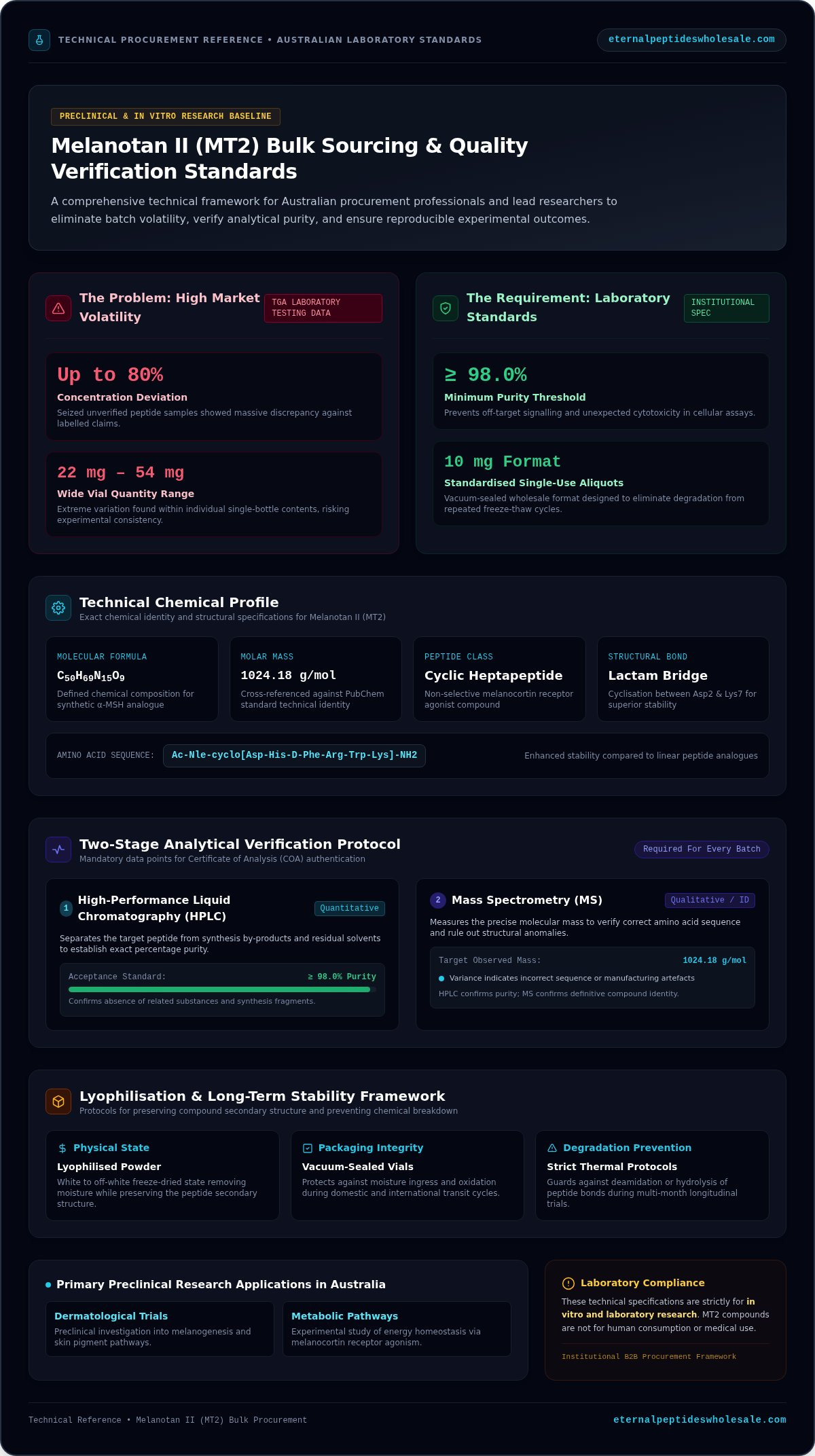
Recent TGA laboratory testing revealed that some seized peptide samples contained up to an 80% deviation from their labelled concentration, with quantities ranging from 22 mg to 54 mg in a single bottle. For procurement professionals and lead researchers in Australia, this level of volatility makes securing a reliable melanotan ii bulk wholesale partner a matter of scientific integrity rather than just cost. You’ve likely dealt with the frustration of batch-to-batch inconsistency or the logistical headaches of long international lead times that stall your projects. We understand that laboratory environments require precision, not guesswork.

This article provides a definitive technical reference for sourcing research-grade Melanotan II, ensuring your operations are backed by verifiable purity and stable supply chains. It’s designed to help you move past the uncertainty of unverified reports and towards a more professional B2B procurement model. We’ll examine critical HPLC and MS verification standards, logistical strategies to streamline your acquisition process, and the specific technical requirements for maintaining the stability of lyophilised powder in a professional setting. By the end of this guide, you’ll have the data needed to organise a more resilient and transparent procurement process for your institution.

Key Takeaways

  • Identify the essential chemical specifications and physical properties required to ensure the stability of Melanotan II acetate in professional research environments.
  • Master the interpretation of HPLC and Mass Spectrometry data to confirm batch-to-batch purity and precise molecular weight before deployment.
  • Optimise your procurement strategy by evaluating minimum order quantities and technical tiers for melanotan ii bulk wholesale to support large-scale laboratory operations.
  • Implement rigorous storage protocols to maintain the chemical integrity of lyophilised powder and prevent degradation during long-term experimental cycles.
  • Streamline institutional acquisition through professional B2B frameworks that prioritise logistical reliability and transparent batch verification within Australia.

Technical Specifications of Melanotan II (MT2) for Laboratory Study

Establishing a rigorous technical baseline is the first step in successful procurement for Australian research institutions. Melanotan II (MT2) is a synthetic analogue of the naturally occurring alpha-melanocyte stimulating hormone (α-MSH). In a laboratory setting, it’s identified as a cyclic heptapeptide that acts as a non-selective melanocortin receptor agonist. For procurement officers managing melanotan ii bulk wholesale acquisitions, verifying the chemical identity is paramount. The molecular formula is C50H69N15O9, and it possesses a precise molar mass of 1024.18 g/mol. These specifications are strictly for in vitro and laboratory research; these compounds are not for human consumption or medical use.

High-purity sourcing reduces experimental variables that can otherwise compromise longitudinal data. Impurities or residual solvents from the synthesis process can lead to off-target signalling or unexpected cytotoxicity in cellular assays. Securing melanotan ii bulk wholesale supplies that meet a minimum purity threshold of 98% ensures that researchers can attribute observed biological responses solely to the peptide itself, maintaining the integrity of the scientific record.

Molecular Profile and Research Utility

The amino acid sequence follows a specific lactam bridge structure: Ac-Nle-cyclo[Asp-His-D-Phe-Arg-Trp-Lys]-NH2. This cyclisation between the Asp2 and Lys7 residues provides the molecule with enhanced chemical stability compared to linear analogues. This structural robustness allows researchers to study its effects on various physiological pathways, including melanogenesis and energy homeostasis. In Australia, MT2 is frequently utilised in preclinical dermatological trials and metabolic studies. Because these trials often span several months, the use of research-grade standards is essential for producing reproducible, peer-reviewed outcomes.

Lyophilisation and Compound Integrity

The standard physical state for bulk MT2 is a white to off-white lyophilised powder. This state is achieved through a controlled freeze-drying process that removes moisture while preserving the peptide’s secondary structure. Vacuum-sealed vials are necessary to prevent oxidation and moisture ingress during international or domestic transit. Lyophilisation is a critical step for wholesale longevity, as it allows the compound to remain stable at ambient temperatures for short durations. For long-term storage, however, researchers must adhere to strict thermal protocols to prevent deamidation or hydrolysis of the peptide bonds. Using 10mg vials in a wholesale format allows for single-use aliquoting, which minimises the risk of degradation caused by repeated freeze-thaw cycles.

Verifying Purity: HPLC and Mass Spectrometry in Bulk Procurement

In the specialised field of melanotan ii bulk wholesale, the primary concern for any procurement professional is batch-to-batch consistency. Large-scale research projects depend on the premise that every vial in a 100-unit order performs identically to the last. Laboratory-grade verification relies on two primary analytical techniques: High-Performance Liquid Chromatography (HPLC) and Mass Spectrometry (MS). While HPLC determines the purity percentage by separating the peptide from any related substances, it doesn’t confirm that the substance is actually the intended compound. Accuracy defines the result. This is where MS becomes essential, as it measures the precise molecular mass of the sample.

A standard Certificate of Analysis (COA) for a bulk order should be scrutinised for specific data points. Buyers must cross-reference the observed molecular weight against the PubChem technical specifications for Melanotan II, which confirms a molar mass of 1024.18 g/mol. Any significant variance suggests either an incorrect amino acid sequence or the presence of manufacturing by-products. For those managing complex institutional supply chains, understanding these reports is vital to ensuring that the research remains reproducible and scientifically sound.

Analytical Standards for Wholesale Batches

Institutional buyers must distinguish between technical-grade materials and research-grade purity. Technical grade may suffice for basic calibration, but longitudinal research requires a purity level typically exceeding 98%. Beyond the peptide itself, the COA should report on residual solvents and Trifluoroacetic Acid (TFA) levels. TFA is a common counter-ion used during the purification process; however, excessive levels can alter the pH of laboratory assays. You can find further details in our guide on research peptide quality assurance to better understand these technical thresholds.

Third-Party Verification Protocols

Relying solely on in-house manufacturer reports can introduce a single point of failure in the procurement process. Independent third-party laboratory testing provides an objective layer of transparency, ensuring the supply chain isn’t compromised by batch substitution. Mass Spectrometry analysis is non-negotiable for identity confirmation because it provides the unique molecular fingerprint that HPLC alone cannot replicate. This rigorous approach to validation allows research institutions to maintain a dependable logistical backbone. If you’re looking to secure verified reference materials for your next project, you can view our wholesale catalogue for batch-tested options.

Strategic Wholesale Sourcing: Comparing Bulk Tiers and MOQs

Procuring reference materials for large-scale studies requires a shift from transactional purchasing to strategic logistical planning. When evaluating melanotan ii bulk wholesale options, research institutions must weigh the benefits of tiered pricing against their specific inventory turnover rates. Minimum Order Quantities (MOQs) serve as a baseline for B2B engagement; they ensure that the cost of analytical verification and logistical overhead is distributed efficiently across the batch. For many Australian laboratories, the 10mg vial format has become the industry standard for wholesale procurement. This specific volume allows for precise aliquoting and reduces the risk of sample contamination that often occurs with larger multi-gram bulk formats. It’s a practical approach that balances volume with the delicate nature of peptide stability.

Effective procurement management involves balancing the immediate needs of a study with the long-term stability of the compound. While larger tiers offer economies of scale, they also require more robust storage infrastructure to maintain chemical integrity over time. Researchers can verify the specific properties of their order by consulting the PubChem compound database for Melanotan II, which provides the necessary CAS registry data and molecular identifiers to ensure the batch matches institutional records. This technical alignment is essential for maintaining the high-purity standards required in longitudinal trials. Managing a procurement budget through these tiered structures allows for better allocation of grant funding across a multi-year research programme.

Optimising Laboratory Procurement

Consolidating orders into larger wholesale batches significantly reduces administrative labour and shipping costs. When conducting multi-phase studies, a cost-benefit analysis often reveals that sourcing a single large batch provides better data consistency than multiple smaller orders. You can learn more about navigating these complexities in our guide to wholesale research peptides australia. By streamlining the B2B process, institutions can lower their operational overhead and focus resources on the actual scientific output. This methodical approach ensures that inventory turnover aligns perfectly with the experimental timeline.

Australian Logistical Advantages

The “procurement lag” often associated with international peptide shipments can stall time-sensitive trials for weeks. Sourcing from a partner with a dependable logistical backbone in Australia minimises these transit risks. Local distribution ensures that temperature-sensitive lyophilised powders aren’t subjected to prolonged customs delays or uncontrolled environmental conditions at international borders. This reliability is vital for maintaining a consistent supply chain, especially when experimental timelines are rigid. By prioritising logistical integrity, Australian research sectors can ensure their projects remain on schedule without compromising on the quality of their reference materials. It’s about building a predictable supply chain that supports scientific excellence. Institutions seeking to formalise their sourcing strategy can benefit from reviewing the practical benchmarks outlined in our guide to b2b peptide suppliers australia, which details how to evaluate and verify commercial distributors against rigorous due diligence standards.
Melanotan II Bulk Wholesale: Technical Specifications for Australian Research

Storage and Stability Protocols for Large-Scale Research

When managing a high-volume inventory, the preservation of chemical structure is as vital as the initial purity verification. Lyophilised Melanotan II is inherently more stable than its liquid counterpart, yet it remains susceptible to environmental degradation if stored incorrectly. Heat, light, and moisture are the primary catalysts for peptide deamidation and oxidation. For organisations investing in melanotan ii bulk wholesale, establishing strict environmental controls is a prerequisite for maintaining the validity of longitudinal research data. Light sensitivity is a particularly critical factor; UV exposure can trigger photo-oxidation of the tryptophan residue within the MT2 sequence, potentially altering experimental results. Consequently, bulk stocks should be kept in light-shielded containers within a temperature-controlled environment.

Maintaining Batch Integrity

Standard Operating Procedures (SOPs) should dictate that all bulk vials remain in their vacuum-sealed state until the exact moment of reconstitution. Exposure to atmospheric moisture can lead to hygroscopic absorption, which compromises the integrity of the lyophilised cake. While the cyclic lactam bridge between Asp2 and Lys7 makes MT2 more resilient than linear peptides, it’s not immune to the stresses of thermal fluctuation. For optimal results and to ensure maximum compound longevity, the lyophilised powder must be stored in a desiccated environment at -20°C for a 24-month stability window. Repeated freeze-thaw cycles are notably damaging to the peptide’s molecular stability, as each cycle can introduce micro-fractures in the secondary structure, leading to a measurable loss in potency over time.

Laboratory Preparation and Solubility

Reconstitution requires a methodical approach to maintain the peptide’s secondary structure during the transition to a liquid state. While Melanotan II is highly soluble in sterile water or bacteriostatic water, the diluent should be added slowly along the side of the vial to avoid aggressive agitation or foaming. Once in solution, the peptide is far more prone to hydrolysis and should be refrigerated at 2°C to 8°C. Researchers should implement an aliquoting strategy, dividing the reconstituted solution into single-use volumes to prevent the need for re-freezing bulk supplies. Every interaction with the batch must be documented, including the date of reconstitution and the specific diluent used, to ensure a transparent audit trail for the study. You can order batch-verified vials to support your laboratory’s long-term stability requirements.

Consistent documentation of storage conditions is essential for identifying any variables that might affect assay performance. By monitoring freezer temperatures and limiting the duration that vials spend at ambient temperatures during handling, procurement officers can protect the institution’s investment in melanotan ii bulk wholesale materials. This rigorous attention to stability protocols ensures that every vial provides the reliable data necessary for high-level scientific inquiry.

Sourcing Melanotan II Bulk Wholesale from Eternal Peptides Wholesale

Eternal Peptides Wholesale operates as a dedicated partner for the Australian scientific community, providing the logistical backbone necessary for high-level research. While the technical specifications and analytical verification of peptides are paramount, the success of a longitudinal study often hinges on the reliability of the supplier. Securing melanotan ii bulk wholesale materials requires a partner that prioritises clinical reliability over transactional speed. We provide 10mg vials specifically designed for laboratory environments, ensuring that every batch meets the precise molecular standards required by procurement professionals. Our focus remains on establishing long-term professional relationships with research institutions across Australia, providing a sense of stability that retail-oriented vendors can’t replicate.

The Eternal Peptides Wholesale Advantage

Our commitment to excellence is reflected in our rigorous quality control and batch-specific documentation. We provide the HPLC and MS analysis reports discussed in previous sections as a standard part of our B2B service, ensuring total transparency for every wholesale order. This methodical approach ensures that your laboratory data remains untainted by batch-to-batch inconsistency. Our localised Australian logistical support is designed to minimise the procurement lag that often stalls time-sensitive projects. You can find this same dedication to logistical integrity throughout our product range, as detailed in our guide to ipamorelin wholesale australia. We treat every scientific project with the professional gravity it deserves.

Establishing a Wholesale Partnership

The process of becoming a verified research partner with Eternal Peptides Wholesale is straightforward yet thorough. We specialise in customised supply solutions tailored to the specific scale of your laboratory’s needs, whether you’re conducting initial assays or multi-year trials. Our account management team understands the complexities of institutional funding and procurement cycles, offering a streamlined experience that reduces administrative overhead. We don’t participate in the retail market; our focus is entirely on the success of your institution’s large-scale operations. This seasoned expertise ensures that your melanotan ii bulk wholesale supply chain remains resilient and your research stays on schedule. Contact our team to discuss your wholesale research needs.

Optimising Institutional Supply Chains for Australian Research

Reliable procurement serves as the fundamental basis for reproducible scientific outcomes. We’ve explored how batch-to-batch consistency depends on rigorous analytical verification, specifically utilising HPLC and MS to confirm molecular identity. By prioritising specialised Australian B2B distribution, research institutions can effectively bypass the logistical friction and lead-time volatility commonly associated with international suppliers. These technical standards, when paired with strict storage protocols, ensure that your reference materials maintain their chemical integrity throughout the entire experimental lifecycle.

Managing a melanotan ii bulk wholesale account requires a professional partner dedicated to a research-grade compound focus and total operational transparency. Eternal Peptides Wholesale provides the stability needed to support large-scale laboratory projects through high-purity, HPLC-verified batches. This methodical approach allows your team to focus on scientific output rather than managing supply chain variables. It’s about building a predictable framework for success. We invite you to enquire about bulk Melanotan II wholesale for your research project to establish a dependable logistical backbone for your institution. We look forward to supporting your next breakthrough in the lab.

Frequently Asked Questions

What is the standard purity level for bulk Melanotan II for research?

The standard purity threshold for research-grade Melanotan II is typically 98% or higher, as determined by High-Performance Liquid Chromatography (HPLC). This level of refinement is necessary to ensure that experimental results aren’t skewed by synthesis by-products or residual solvents. For institutional procurement, verifying these levels through batch-specific reports is a standard requirement to maintain the integrity of longitudinal studies and prevent off-target signalling in cellular assays.

How is Melanotan II wholesale shipped to ensure stability?

Wholesale orders are shipped as a stable lyophilised powder within vacuum-sealed glass vials to prevent moisture ingress. While the dry powder remains chemically resilient at ambient temperatures for short durations during transit, we utilise a dependable logistical backbone to minimise time spent in uncontrolled environments. This methodical approach ensures that the peptide’s secondary structure remains intact from the point of distribution to its arrival at your laboratory.

What is the typical shelf life of lyophilised Melanotan II in a lab setting?

Lyophilised Melanotan II typically maintains its stability for 12 to 24 months when stored in a desiccated environment at -20°C. If kept at -80°C, the compound can remain viable for even longer durations. It’s essential to keep the vials in their original vacuum-sealed state until the moment of use. Once the seal is broken or the compound is reconstituted, the stability window decreases significantly, necessitating immediate refrigeration at 2°C to 8°C.

Do you provide HPLC and MS reports for bulk wholesale orders?

Yes, we provide batch-specific HPLC and Mass Spectrometry (MS) analysis for all melanotan ii bulk wholesale orders. The HPLC report confirms the purity percentage, while the MS analysis provides the unique molecular fingerprint required to verify the compound’s identity. These reports are essential for procurement professionals who must document the technical specifications of their reference materials to meet institutional quality assurance standards and ensure experimental reproducibility.

Are there specific MOQs for institutional peptide procurement in Australia?

Our wholesale structure is designed to support the needs of research institutions with tiered minimum order quantities for melanotan ii bulk wholesale. Standard wholesale volumes typically begin with boxes of ten 10mg vials, allowing for easier aliquoting and inventory management. For larger multi-phase studies, we offer increased bulk tiers that provide greater economies of scale. This professional B2B framework helps procurement officers manage grant budgets effectively while securing a consistent supply of reference materials.

Can Melanotan II be used for any purpose other than laboratory research?

No, Melanotan II is strictly for laboratory research and in vitro study purposes only. These compounds are not for human consumption, medical use, or therapeutic applications. Eternal Peptides Wholesale does not provide medical consultations or retail single-vial sales. All procurement must be conducted by verified research partners who adhere to the strict guidelines governing the use of unapproved therapeutic substances in a scientific or academic capacity.

How does local Australian distribution reduce procurement risks?

Local distribution significantly reduces the risks associated with international “procurement lag” and customs interceptions. By utilising an Australian-based logistical network, we minimise the time vials spend in transit and eliminate the uncertainty of international border delays. This reliability ensures a consistent supply chain for time-sensitive trials, allowing researchers to plan their experimental cycles without the threat of inventory depletion or environmental degradation during long-haul shipping. Research teams looking to formalise their supplier evaluation process can consult our comprehensive resource on b2b peptide suppliers australia for detailed due diligence benchmarks and verification protocols.

What storage conditions are required for bulk peptide vials?

Bulk peptide vials require specific thermal management to prevent chemical degradation. Lyophilised powder should be stored in a freezer at -20°C to ensure long-term stability. Once reconstituted with a suitable diluent, the solution must be kept refrigerated between 2°C and 8°C. It’s vital to avoid repeated freeze-thaw cycles, as these can cause micro-fractures in the peptide’s structure; instead, researchers should use single-use aliquots for their specific laboratory assays.

Related from Eternal Peptides Wholesale

Eternal Peptides Wholesale publishes batch-specific Kovera Labs reports in its certificate of analysis library, so the documentation for a listed batch can be read alongside the evidence discussed in this article.

Related reading: Melanotan II receptor binding assay supply: A 2026 buyer’s guide

Testing references updated 1 November 2026 for the published Kovera Labs report set. Original research and catalogue snapshot dates remain as stated.

Posted on

Buy Peptides Melbourne: A Guide to Research Evidence and Local Enquiries

Researchers searching for buy peptides Melbourne need a clear route from the scientific question to a properly specified purchase. A product can be discussed in the literature without that research establishing the identity, quality or suitability of every product sold under a similar name.

Eternal Peptides Wholesale's listed Melbourne-area location is in Docklands, at 744 Collins St, Docklands VIC 3008. The Docklands contact entry includes the Google Maps profile. Please contact the team before visiting or arranging any collection. 1

This guide helps qualified research buyers evaluate a peptide listing, read relevant studies and organise a Melbourne enquiry around the evidence their laboratory actually needs.

Where to buy research peptides in Melbourne

Use the Eternal Peptides Wholesale catalogue to identify a candidate product, then review its full listing and available reports. The Docklands address is the local contact point listed on the website; it is not evidence that every product is available there for immediate collection. 1 2

For a useful first enquiry, provide the product URL and explain what remains unclear. You might need confirmation of a batch identifier, a readable report, the composition of a blend or whether a specification matches your intended research material.

Keep the answer with the project record. A clear written clarification helps both the buyer and the person responsible for laboratory acceptance make the same decision from the same information.

Read a peptide study for the question it actually answers

Before using a research paper to support a purchase, identify its material, model, methods and measured outcomes. Note whether the study concerns analytical characterisation, cell experiments, animal work or a defined clinical investigation.

For example, Teichman and colleagues studied a long-acting CJC-1295 analogue in controlled trials involving healthy adults. The paper does not establish findings for every product with CJC-1295 in its name. 3

Eternal Peptides Wholesale lists CJC-1295 Without DAC + Ipamorelin. Its stated combination and “Without DAC” description make it important to check the material against any study being cited. A trial of a different formulation is not product-specific evidence for that catalogue blend. 2

The CJC-1295 Without DAC + Ipamorelin buying guide can help organise the background reading. The final comparison still belongs against the current product specification and the research protocol.

Distinguish scientific background from batch evidence

Use three separate records rather than asking one source to answer every question:

Source The question it helps you examine
Research paper What material was studied, how and in which model?
Product specification What material and quantity does the supplier offer?
Relevant analytical report What was measured in the submitted sample?

Add a fourth record where needed: the supplier's explanation of how the reported sample relates to the lot offered for purchase. A paper is not a certificate for that lot, while a laboratory report is not a clinical study.

McCarthy and colleagues describe analytical strategies for peptide reference standards that combine identity and quantitative measurements. These case studies provide background for assessing what a report measures, not certification of a retail catalogue. 4

Review the available testing information

The testing standards page provides a directory of reports displayed with product listings. Follow the product-specific links and review each document's sample, batch, method and units. 5

Make a list of the evidence your laboratory needs before approving an order. Compare that list with the documents actually available. If a report is absent, unclear or attached to a different nominal amount, ask for clarification rather than silently treating the requirement as satisfied.

Record the report identifier and verification route. If you use an issuing laboratory's verification record, retain the result with the document you checked. Matching a verification entry and matching a supplied batch are related but distinct parts of your review.

Organise a Melbourne purchasing enquiry

Bring your research and purchasing questions into one concise message:

  1. Identify the compound or blend and link to the listing.
  2. State the nominal amount and number of boxes under consideration.
  3. Explain any sequence, formulation or composition requirement.
  4. Ask which lot and documents relate to the proposed purchase.
  5. Raise any Docklands visit or collection question separately.

This makes it easier to distinguish a commercial question from a scientific specification question. It also prevents a positive answer about availability from being mistaken for confirmation of every analytical requirement.

For repeat purchases, use the same record as a comparison point, then check the new offer. A familiar SKU does not remove the need to review the documents associated with the next batch.

Research use and Australian product regulation

The website limits its products to laboratory research. 5 The Therapeutic Goods Administration states that a research-only disclaimer does not itself determine whether a peptide product is regulated as a therapeutic good. Applicable supply and advertising obligations still matter. 6

This guide does not establish therapeutic approval or suitability for personal use. Any proposed purchase should fit the approvals and requirements governing the intended research.

Frequently asked questions about buying peptides in Melbourne

Is the Melbourne location in Docklands?

Yes. The address listed by Eternal Peptides Wholesale is 744 Collins St, Docklands VIC 3008. Use the Docklands contact link before visiting. 1

Can a published clinical study be applied to a research blend?

Only assess a study within its stated material, methods and population. Differences in compounds or formulation need evaluation; a shared product name does not establish equivalence.

Are the website's reports a guarantee that every listed product has the same testing?

No. Read the reports available for the particular product and clarify batch coverage with the supplier. 5

What should I send with a Melbourne enquiry?

Include the product URL, required quantity, research specification and the specific documentation question you need answered. Add any proposed visit details for separate confirmation.

Plan your Melbourne research purchase

Explore the catalogue, read the relevant product guide and contact Eternal Peptides Wholesale about the Docklands location with a defined purchasing brief.

Related from Eternal Peptides Wholesale

Eternal Peptides Wholesale publishes batch-specific Kovera Labs reports in its certificate of analysis library, so the documentation for a listed batch can be read alongside the evidence discussed in this article.

Related reading: Research peptide guide for Adelaide: wholesale Quantities and Research Value; Research peptide guide for Brisbane: research Suppliers and Batch Reports

References

  1. Eternal Peptides Wholesale. Contact and Docklands location. Checked 27 September 2026.

  1. Eternal Peptides Wholesale. Research product catalogue and CJC-1295 Without DAC + Ipamorelin listing. Current listings govern specifications and availability.

  1. Teichman SL, et al. Prolonged stimulation of growth hormone and insulin-like growth factor I secretion by CJC-1295, a long-acting analog of GH-releasing hormone, in healthy adults. Journal of Clinical Endocrinology & Metabolism. 2006;91:799–805. doi:10.1210/jc.2005-1536.

  1. McCarthy D, et al. Reference Standards to Support Quality of Synthetic Peptide Therapeutics. Pharmaceutical Research. 2023;40:1317–1328. doi:10.1007/s11095-023-03493-1.

  1. Eternal Peptides Wholesale. Peptide testing standards and report directory. Supplier information, not independent authentication.

  1. Therapeutic Goods Administration. How we regulate therapeutic peptide products. Checked 27 September 2026.

Testing references updated 1 November 2026 for the published Kovera Labs report set. Original research and catalogue snapshot dates remain as stated.

Posted on

Buy Peptides Sydney: A Guide to Product Specifications and Supplier Checks

Looking to buy peptides Sydney? For a laboratory research purchase, the most useful comparison starts with the exact product specification. Two listings can use similar names while offering different nominal amounts, compositions or supporting documents. Establish what the project needs before comparing offers.

Eternal Peptides Wholesale generally ships orders directly to customers, including laboratories in Sydney. Current store locations (Docklands, Adelaide, Brisbane and Perth) are listed on the contact page; please contact the team before visiting any location. 1

This guide focuses on choosing a clearly specified research product, distinguishing product names from scientific identities and preparing an enquiry that a supplier can answer precisely.

Where to buy research peptides in Sydney

Begin with the Eternal Peptides Wholesale catalogue. Each shortlisted listing should give you enough information to identify the product, the labelled amount and the offered box quantity. Open the individual page rather than relying solely on the catalogue thumbnail. 2

Keep the supplier's contact details alongside the product URL in your purchasing file. Stock, delivery arrangements and the availability of a particular batch require confirmation.

When comparing suppliers, use the same written request for each. Ask about the exact compound, the batch associated with the offer and the analytical documents available. This produces a more useful comparison than asking several suppliers whether their products are “high quality”.

Specify the compound before comparing the price

A usable purchasing specification should make it difficult to order the wrong material accidentally. Include the full product name, SKU, labelled amount, box size and any formulation detail that matters to the research question.

The catalogue has separate BPC-157 10mg, TB-500 10mg and BPC-157 & TB-500 5mg/5mg blend listings. A blend should be evaluated as its stated composition rather than treated as an interchangeable replacement for either individual listing. 2

For unresolved identity details, ask for clarification in writing. Where the experiment depends on a sequence, modification or chemical form, include that requirement in the enquiry. Do not infer an unlisted detail from a familiar product nickname.

Why the research literature makes exact naming important

Ho and colleagues' 2012 analytical study examined a TB-500 preparation containing N-acetylated LKKTETQ, a fragment related to thymosin beta-4. The study illustrates why a paper's defined analyte should be checked against the product under consideration. It does not identify or authenticate Eternal Peptides Wholesale's current material. 3

The useful purchasing lesson is straightforward: save the identity described in the research protocol, then compare it with the supplier's actual specification. If the terminology differs, resolve the difference before treating a paper as evidence about the offered product.

The TB-500 research buying guide provides further product-specific context. Use that background alongside the current listing and your own protocol, not as a replacement for batch documentation.

Review the documents behind a Sydney peptide order

The website's testing directory links the reports displayed for individual products. Review the actual documents and their sample identifiers. 4

Research into peptide reference standards treats identity, purity and assigned content as distinct analytical tasks. That distinction is useful when deciding which documents answer your purchasing requirements. 5

Question for the supplier Why it belongs in the enquiry
What exact material does this SKU identify? Resolves ambiguity in the product name
Which batch would be associated with this order? Gives the document review a defined subject
Which reports concern that batch? Connects evidence to the offer
How can the report be verified? Provides a route to the issuing laboratory's record
Which requested analyses are unavailable? Makes the remaining evidence gaps explicit

Read numerical results with their units and method descriptions. If your project requires additional characterisation, say so. The presence of several reports should not become an assumption that every possible characteristic has been measured.

Compare equivalent offers

Create one comparison row per product, rather than mixing an individual compound, a blend and different vial amounts into a single price ranking. Record what is included, the nominal total quantity and the documentation available.

Then consider whether the offer fits the work your laboratory has approved. An attractive unit price has limited value if the product specification is unresolved or the quantity exceeds what the project can use within its documented handling requirements.

Keep commercial comparisons separate from claims about biological effects. A larger nominal amount does not establish a more suitable research material, and a lower price does not resolve a missing identity detail.

Keep the purchase within its intended research scope

The supplier describes its products as laboratory research materials. 4 The Therapeutic Goods Administration makes clear that research-use labelling does not override the rules that apply to therapeutic peptide products. 6

This article provides a purchasing workflow for qualified research buyers. It does not establish approval for personal use or provide treatment instructions.

Frequently asked questions about buying peptides in Sydney

Does Eternal Peptides Wholesale have a Sydney store?

No Sydney store is listed. Orders are generally shipped directly to customers in Sydney. Use the Contact page to make an enquiry. 1

Can orders be collected in Sydney?

No Sydney collection point is listed. Ask about your particular product, order and delivery arrangements before making plans.

Can I substitute a peptide blend for a single compound?

Treat that as a change to the proposed material requiring assessment against your protocol. Record each listed component and amount rather than relying on the blend's overall name.

What if the compound in a paper differs from the product description?

Ask the supplier for the missing specification and assess the difference with the person responsible for the research. A shared name alone is insufficient to settle the question.

Make a specific Sydney supplier enquiry

Select the relevant catalogue listing, note its SKU and contact Eternal Peptides Wholesale with your identity, quantity and report requirements.

Related from Eternal Peptides Wholesale

Eternal Peptides Wholesale publishes batch-specific Kovera Labs reports in its certificate of analysis library, so the documentation for a listed batch can be read alongside the evidence discussed in this article.

Related reading: Research peptide guide for Adelaide: wholesale Quantities and Research Value; Research peptide guide for Melbourne: research Evidence and Local Enquiries

References

  1. Eternal Peptides Wholesale. Contact and store locations. Checked 26 October 2026.

  1. Eternal Peptides Wholesale. Research product catalogue. Check individual listings for current specifications and availability.

  1. Ho EN, et al. Doping control analysis of TB-500, a synthetic version of an active region of thymosin β4, in equine urine and plasma by liquid chromatography-mass spectrometry. Journal of Chromatography A. 2012;1265:57–69. doi:10.1016/j.chroma.2012.09.043.

  1. Eternal Peptides Wholesale. Peptide testing standards and report directory. Supplier information, not independent report authentication.

  1. McCarthy D, et al. Reference Standards to Support Quality of Synthetic Peptide Therapeutics. Pharmaceutical Research. 2023;40:1317–1328. doi:10.1007/s11095-023-03493-1.

  1. Therapeutic Goods Administration. How we regulate therapeutic peptide products. Checked 27 September 2026.

Testing references updated 1 November 2026 for the published Kovera Labs report set. Original research and catalogue snapshot dates remain as stated.

Posted on

Buy Peptides Brisbane: A Guide to Research Suppliers and Batch Reports

If you are searching for buy peptides Brisbane, start by connecting three things: the research material your laboratory needs, the supplier offering it and the documents supporting the particular batch. A nearby business address helps you identify a supplier, while the product specification and analytical evidence help you assess the purchase.

Eternal Peptides Wholesale lists its Brisbane location at 111 Mary St, Brisbane City QLD 4000. You can find the location and its Google Maps profile on the Contact page. Please contact the team before visiting; confirm any proposed visit or collection arrangement directly. 1

This guide is for qualified laboratory research buyers. It explains how to shortlist products, review available reports and prepare a useful enquiry about buying research peptides in Brisbane.

Where to buy research peptides in Brisbane

The Eternal Peptides Wholesale catalogue provides product listings, labelled vial amounts and box quantities. Start with the exact compound required by your project, then open that product page to inspect its specification and available documentation. 2

A practical first enquiry should identify the product name, SKU, proposed quantity and any documentation your laboratory needs before approval. For example, “Please confirm the batch associated with this listing and the reports available for that batch” is easier to answer than a general request for the best peptide.

Treat the listed Brisbane address as contact information. It does not establish that every catalogue item is held at that location, that immediate collection is available or that the materials were manufactured in Brisbane. Ask the team to confirm the arrangements relevant to your order.

Build a shortlist around your research specification

Product names can be a starting point, but the purchase decision needs a written specification. Record the required identity, nominal amount, individual compound or blend, and the analytical information your project requires.

Examples in the catalogue include BPC-157 10mg, GHK-Cu 50mg and MOTS-C 10mg. These links are examples of listings to inspect, rather than recommendations for a particular experiment. Check each current page for its offer and availability. 2

For a procurement record, separate the supplier's advertised specification from the laboratory's acceptance criteria. If your project needs an analysis that is not displayed, ask whether a relevant report exists. An unanswered question should remain open in the purchasing file.

How to read a peptide batch report

The testing directory explains the report categories displayed on the website. Coverage varies by product and batch. 3

Work through a report in a consistent order:

  1. Match the submitted sample name to the product you selected.
  2. Compare the nominal amount and any batch identifier with the listing.
  3. Record the test method, result, unit and analysis date.
  4. Check the issuing laboratory's verification record where provided.
  5. Ask the supplier to connect that tested sample with the lot offered for your order.

These are separate checks. A genuine report can still refer to a different sample from the material you intend to purchase. Keep the report and the supplier's batch clarification together so that the reasoning behind the purchase remains clear.

Identity, purity and content answer different questions

McCarthy and colleagues' analytical case studies describe multiple methods for assigning peptide identity and content. Their work supports reading these measurements separately rather than reducing quality to one percentage. 4

For a Brisbane buyer, the practical question is whether the available evidence answers the project's specification. A result expressed in milligrams, a chromatographic percentage and a contaminant measurement should each have a defined place in that assessment. Avoid translating any one result into a general promise about every vial.

Prepare your laboratory record before ordering

Use a short purchasing record that another team member could understand without repeating your research:

Record What to enter
Intended material Compound, form or blend, and SKU
Quantity Nominal amount per vial and number of vials
Evidence Report identifiers and saved source documents
Batch connection Supplier's confirmation of the offered lot
Open questions Missing methods, unclear units or unmatched documents
Local enquiry Brisbane contact details and any agreed visit arrangements

If different people handle purchasing and laboratory receipt, agree who checks the labels against this record. This is a suggested workflow, not a claim about services automatically included with an order.

Research purchasing and therapeutic products

Eternal Peptides Wholesale states that its products are for laboratory research, not human consumption or therapeutic use. 3 The Therapeutic Goods Administration explains that research-only wording does not itself change a product's regulatory classification or remove applicable obligations. 5

A buying guide is therefore not evidence that a material is approved for personal treatment. Keep any purchase within the requirements of your institution and intended work.

Frequently asked questions about buying peptides in Brisbane

Where is the Brisbane location?

The listed address is 111 Mary St, Brisbane City QLD 4000. The Brisbane contact entry links to the business profile. Contact the team before visiting. 1

Can I collect an order from the Brisbane store?

Ask the team to confirm whether collection is available for your proposed order and agree the details before travelling. This guide does not promise walk-in service or local stock.

Does a published study verify the product being sold?

A research paper and a batch report serve different purposes. Use the paper to understand the work it describes and the supplier's documentation to assess the material offered. Neither replaces your laboratory's purchasing review.

What should I do if a report does not match the product?

Send the product URL and the report identifier through the Contact page, describe the mismatch and request clarification before approving the purchase.

Start your Brisbane peptide enquiry

Browse the research peptide catalogue, compare the available laboratory reports and contact Eternal Peptides Wholesale in Brisbane with your product and documentation requirements.

Related from Eternal Peptides Wholesale

Eternal Peptides Wholesale publishes batch-specific Kovera Labs reports in its certificate of analysis library, so the documentation for a listed batch can be read alongside the evidence discussed in this article.

Related reading: Research peptide guide for Melbourne: research Evidence and Local Enquiries; Research peptide guide for Sydney: product Specifications and Supplier Checks

References

  1. Eternal Peptides Wholesale. Contact and store locations. Checked 27 September 2026.

  1. Eternal Peptides Wholesale. Research product catalogue. Checked 27 September 2026; current product pages govern availability and specifications.

  1. Eternal Peptides Wholesale. Peptide testing standards and report directory. Supplier information, not independent authentication of individual reports.

  1. McCarthy D, et al. Reference Standards to Support Quality of Synthetic Peptide Therapeutics. Pharmaceutical Research. 2023;40:1317–1328. doi:10.1007/s11095-023-03493-1.

  1. Therapeutic Goods Administration. How we regulate therapeutic peptide products. Checked 27 September 2026.

Testing references updated 1 November 2026 for the published Kovera Labs report set. Original research and catalogue snapshot dates remain as stated.